
Home › Sample questions › Agriculture
Agriculture sample exam questions – 10 questions with answers
農業
10 sample questions in the real exam format, with furigana, English translation, answers and explanations. Tap "Show answer" under each question. For the full question bank and realistic mock exams, open the free app.
Question 1
日本の国土は南北に長く、北海道から沖縄まで地域によって気候が大きく異なり、四季の変化がはっきりしている。
The land of Japan stretches long from north to south, with climates varying greatly by region from Hokkaido to Okinawa and distinct changes across the four seasons.
- A. ○
○ True - B. ×
× False
Show answer
Correct answer: A
Japan stretches from north to south with wide regional climate differences from Hokkaido to Okinawa and four distinct seasons, allowing diverse crop cultivation. (Source: ASAT 耕種テキスト 第1章 1)
| Word | Meaning |
|---|---|
| 国土 | national land |
| 気候 | climate |
| 四季 | four seasons |
Question 2
図のように農薬を散布するとき、作業者の服装や保護具の着け方として正しいものはどれか。
When spraying pesticides as shown in the figure, which clothing and protective equipment practice is correct for the worker?
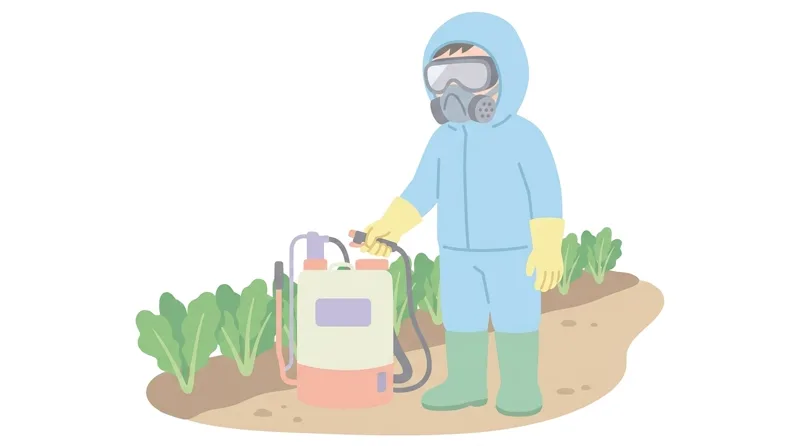
- A. 防除衣や保護メガネ、マスク、ゴム手袋を着用して散布する。
Wear pesticide protective clothing, safety goggles, a respirator mask, and rubber gloves. - B. 暑さを防ぐため、半袖シャツと半ズボンでマスクだけを着ける。
Wear a short-sleeved shirt and shorts with only a mask to prevent overheating. - C. 動きやすいよう、素手と運動靴のまま薬剤を散布する。
Spray the chemicals with bare hands and regular sneakers for easier movement.
Show answer
Correct answer: A
The illustration shows a worker preparing to spray pesticides in full protective gear. When mixing and spraying agricultural chemicals, workers must wear protective clothing, goggles, an appropriate respirator mask, rubber gloves, and rubber boots so chemicals do not touch the skin or enter the body. (Source: ASAT 耕種テキスト 第2章 17 / 第3章 1)
| Word | Meaning |
|---|---|
| 農薬 | pesticide, agricultural chemical |
| 散布 | spraying |
| 防除衣 | pesticide protective suit |
| 保護具 | protective equipment |
Question 3
植物が光を受けて、二酸化炭素と水からデンプンなどの養分と酸素を作る働きを光合成という。
The process by which plants receive light and produce nutrients such as starch along with oxygen from carbon dioxide and water is called photosynthesis.
- A. ○
○ True - B. ×
× False
Show answer
Correct answer: A
Photosynthesis is the physiological process in which plants use light energy to synthesize carbohydrates from carbon dioxide and water while releasing oxygen. (Source: ASAT 耕種テキスト 第2章 2)
| Word | Meaning |
|---|---|
| 植物 | plant |
| 二酸化炭素 | carbon dioxide |
| 養分 | nutrients |
| 光合成 | photosynthesis |
Question 4
耕した畑に一定の間隔で溝を掘り、その溝に沿って種をすじ状にまく方法はどれか。
Which seeding method involves digging shallow furrows at fixed intervals in a tilled field and sowing seeds in lines along those furrows?
- A. 畑の全体に種を散らす「ばらまき」
Broadcast seeding (baramaki), scattering seeds across the bed - B. 溝に沿って種をまく「条まき」
Row or drill seeding (sujimaki), sowing seeds along furrows - C. 等間隔に種をまく「点まき」
Spot or hill seeding (tenmaki), dropping seeds into spaced holes
Show answer
Correct answer: B
Row seeding (sujimaki) sows seeds in straight lines along shallow trenches. Broadcast seeding (baramaki) scatters seeds over the surface, while spot seeding (tenmaki) places several seeds at fixed intervals. (Source: ASAT 耕種テキスト 第2章 5)
| Word | Meaning |
|---|---|
| 間隔 | interval, spacing |
| 溝 | furrow, groove |
| 条まき | row seeding (drill seeding) |
| 点まき | spot seeding (hill seeding) |
Question 5
同じ畑で同じ種類(同じ科)の作物を続けて栽培すると、土壌中の特定の病害虫が増えて生育が良くなる。
When the same type (same family) of crop is grown repeatedly in the same field, specific soil-borne pests and diseases increase and make crop growth better.
- A. ○
○ True - B. ×
× False
Show answer
Correct answer: B
Growing crops of the same botanical family repeatedly in the same field causes continuous cropping injury (rensaku shōgai), where specific soil pathogens and pests build up and stunt plant growth rather than improving it. (Source: ASAT 耕種テキスト 第2章 9)
| Word | Meaning |
|---|---|
| 栽培 | cultivation |
| 土壌中 | in the soil |
| 病害虫 | pests and diseases |
| 生育 | growth |
Question 6
図のように、密生して発芽した苗のうち、生育の悪いものや混み合ったものを抜き取る作業を何というか。
As shown in the figure, what is the task of pulling out weak or overcrowded sprouts among densely germinated seedlings?
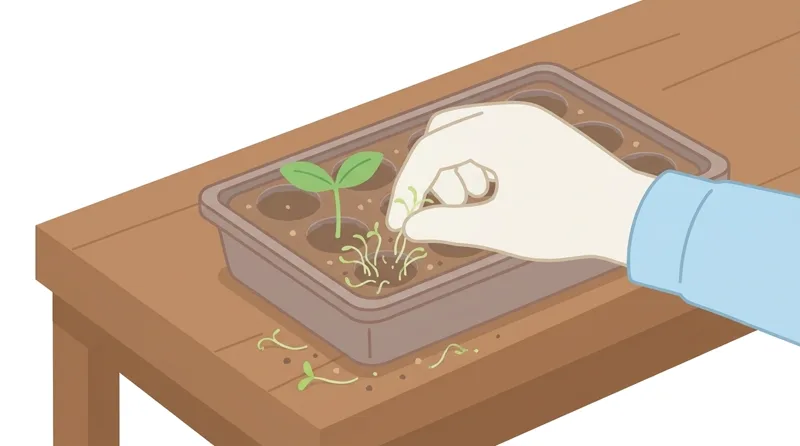
- A. 混んだ苗を抜く「間引き」
Thinning (mabiki) to pull extras and leave healthy seedlings - B. 株元に土を集めて寄せる「土寄せ」
Earthing up (tsuchiyose) to gather soil around plant bases - C. 本畑へ苗を移して植える「定植」
Transplanting (teishoku) to move seedlings to the main field
Show answer
Correct answer: A
The illustration shows hands pulling out crowded, weak sprouts from a seedling bed while leaving strong seedlings behind. This operation is called thinning (mabiki), which secures proper spacing, sunlight, and airflow. (Source: ASAT 耕種テキスト 第2章 6)
| Word | Meaning |
|---|---|
| 発芽 | germination |
| 間引き | thinning out |
| 土寄せ | earthing up (hilling) |
| 定植 | transplanting to main field |
Question 7
カレンダーの日付の読み方として、「8日」と同じように特別な読み方をする「20日」の正しいひらがな表記はどれか。
Regarding how to read calendar dates in Japanese, what is the correct hiragana spelling for the special reading of the 20th day of the month?
- A. 日付の「にじゅうにち」
nijūnichi - B. 日付の「ふたつか」
futatsuka - C. 日付の「はつか」
hatsuka
Show answer
Correct answer: C
In Japanese calendar dates, the 20th day of the month uses the special reading "hatsuka" rather than "nijūnichi". Workers must recognize this when receiving schedule instructions. (Source: ASAT 日本語テキスト 2 数字(カレンダー))
| Word | Meaning |
|---|---|
| 日付 | date |
| 読み方 | way of reading |
| 特別 | special |
| 表記 | notation, spelling |
Question 8
図の道具は、収穫物や肥料などを載せて手で押して運ぶときに使う。この道具の名称はどれか。
The tool in the figure is used to load harvested crops or fertilizer and push them by hand for transport. What is the name of this tool?
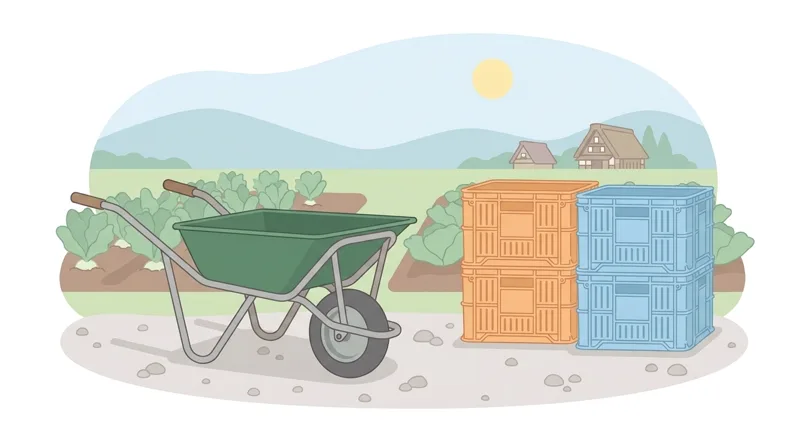
- A. 草を刈り取る「かま」
Sickle (kama) used for cutting grass - B. 土を耕す「くわ」
Hoe (kuwa) used for tilling soil - C. 荷物を運ぶ「一輪車」
Wheelbarrow (ichirinsha / nekoguruma) for hauling loads
Show answer
Correct answer: C
The illustration shows a single-wheel farm wheelbarrow. In Japanese agricultural workplaces, a wheelbarrow is called "ichirinsha" (or "nekoguruma"). "Kuwa" means hoe and "kama" means sickle. (Source: ASAT 日本語テキスト 3 名詞(道具))
| Word | Meaning |
|---|---|
| 道具 | tool |
| 収穫物 | harvested crops |
| 肥料 | fertilizer |
| 一輪車 | wheelbarrow |
Question 9
イネの栽培には水田で作る水稲と畑で作る陸稲があり、日本で生産される米の大部分は陸稲である。
Rice cultivation includes paddy rice (suitō) grown in flooded paddies and upland rice (rikutō) grown in dry fields, and the vast majority of rice produced in Japan is upland rice.
- A. ○
○ True - B. ×
× False
Show answer
Correct answer: B
While rice is classified into paddy rice (suitō) and upland rice (rikutō), almost all rice produced in Japan is paddy rice (suitō) cultivated in flooded paddy fields. (Source: ASAT 耕種テキスト 第4章 1)
| Word | Meaning |
|---|---|
| 水田 | paddy field |
| 水稲 | paddy rice (wetland rice) |
| 陸稲 | upland rice (dryland rice) |
| 大部分 | vast majority |
Question 10
図のように、水稲の生育の途中で水田の水を一時的に抜き、土を乾かして根に酸素を送る管理作業はどれか。
As shown in the figure, which management practice temporarily drains water from a paddy field in mid-growth to dry the soil and supply oxygen to the rice roots?
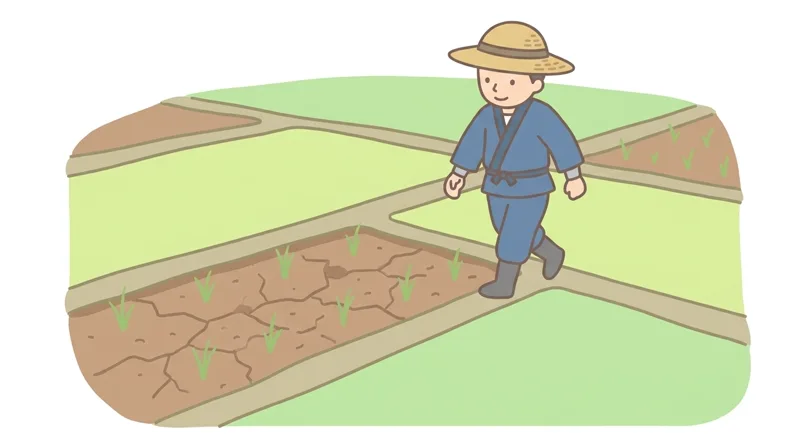
- A. 田植え前に行う「代かき」
Puddling the field before transplanting (shirokaki) - B. 種もみを選ぶ「塩水選」
Selecting seed rice with saltwater (ensuisen) - C. 夏場に行う「中干し」
Mid-season drainage done in summer (nakaboshi)
Show answer
Correct answer: C
The illustration shows a rice paddy drained in mid-summer with small surface cracks in the soil. This practice is mid-season drainage (nakaboshi), which supplies oxygen to the roots, removes harmful soil gases, and suppresses unproductive tillers. (Source: ASAT 耕種テキスト 第4章 2(6))
| Word | Meaning |
|---|---|
| 一時的 | temporarily |
| 代かき | puddling |
| 中干し | mid-season drainage |
| 塩水選 | saltwater seed selection |