
Home › Sample questions › Construction (SSW 2)
Construction (SSW 2) sample exam questions – 10 questions with answers
建設分野(2号)
10 sample questions in the real exam format, with furigana, English translation, answers and explanations. Tap "Show answer" under each question. For the full question bank and realistic mock exams, open the free app.
Question 1
建設現場の職長に求められるリーダーシップの「PM理論」において、P機能(目標達成機能)に該当する行動はどれか。
In the 'PM Theory' of leadership required of a foreman at a construction site, which action corresponds to the P function (Performance / goal achievement function)?
- A. 作業手順を明確に示し、品質や工程目標の達成に向けて指示を出す。
Clearly showing work procedures and giving instructions toward achieving quality and schedule goals. - B. 部下の悩みや意見を丁寧に聞き取り、職場内の人間関係を良好な状態に保つ。
Carefully listening to subordinates' concerns and opinions to maintain good interpersonal relationships in the workplace. - C. 声かけや励ましを通じて、チーム内の連帯感や和を高める。
Increasing solidarity and harmony within the team through communication and encouragement. - D. 技能者同士の対立を和らげ、相談しやすい職場の雰囲気を作る。
Easing conflicts between skilled workers and creating a workplace atmosphere where it is easy to consult.
Show answer
Correct answer: A
In the PM theory of leadership required of a foreman (職長), the P function (Performance / 目標達成機能) is the goal achievement function achieved by setting plans, giving clear instructions on work procedures, and managing quality and schedules. Actions that care for interpersonal relationships, encourage team members, and maintain a harmonious workplace atmosphere belong to the M function (Maintenance / 集団維持機能). (Textbook: JAC 職長テキスト 第1章)
| Word | Meaning |
|---|---|
| 職長 | Foreman, team leader |
| 目標達成機能 | Goal achievement function (P function) |
| 集団維持機能 | Group maintenance function (M function) |
Question 2
品質管理で用いられる「QC七つ道具」のうち、不良や不具合の項目別の件数を棒グラフで、累積比率を折れ線グラフで表し、重要な問題点を絞り込む図はどれか。
Among the 'Seven QC Tools' used in quality control, which diagram represents the number of defects or nonconformities by item as a bar graph and the cumulative ratio as a line graph to narrow down critical problems?
- A. 対になった二つのデータの相関関係を点の分布状態で調べる散布図
A scatter diagram that examines the correlation between two paired sets of data through the distribution of points - B. 結果に対して諸原因がどのように関係しているかを整理する特性要因図
A cause-and-effect diagram that organizes how various causes relate to a specific result - C. 不良項目を件数順に並べて重点対象を絞るパレート図
A Pareto chart that arranges defect items in order of frequency to narrow down priority targets - D. 測定値のばらつきや分布の形状を柱状のグラフで表すヒストグラム
A histogram that represents the variation and distribution shape of measured values using a column graph
Show answer
Correct answer: C
A Pareto chart (パレート図) combines a bar graph showing the number of defects by item in descending order with a line graph showing the cumulative ratio (累積比率), making it possible to identify which priority items need improvement first. A cause-and-effect diagram (特性要因図) organizes relationships between causes and effects, a scatter diagram (散布図) examines correlation between paired variables, and a histogram (ヒストグラム) displays data distribution. (Textbook: JAC 職長テキスト 第2章)
| Word | Meaning |
|---|---|
| パレート図 | Pareto chart |
| 特性要因図 | Cause-and-effect diagram (fishbone diagram) |
| 累積比率 | Cumulative ratio |
Question 3
労働安全衛生法第60条に基づき、新たに職務に就くこととなった職長に対して行うべき安全衛生教育の法定事項に含まれないものはどれか。
Under Article 60 of the Industrial Safety and Health Act, which of the following is NOT included among the statutory items of safety and health education to be provided to a newly appointed foreman?
- A. 作業方法の決定および労働者の適正な配置に関すること。
Matters concerning the determination of work methods and the proper placement of workers. - B. 現場の労働者に対する指導または監督の方法に関すること。
Matters concerning methods of guiding or supervising workers at the site. - C. 危険性または有害性等の調査およびその結果に基づく措置に関すること。
Matters concerning the investigation of hazards or harmfulness and measures based on the results. - D. 建設業の許可申請および経営事項審査の手続きに関すること。
Matters concerning procedures for construction business license applications and business evaluation reviews.
Show answer
Correct answer: D
Under Article 60 of the Industrial Safety and Health Act (労働安全衛生法), safety and health education for a newly appointed foreman (職長) covers determining work methods and proper placement (適正な配置) of workers, methods of guiding and supervising workers, investigating hazards (危険性) or harmfulness in risk assessment, and handling abnormalities. Procedures for construction business licenses and business management evaluations fall under the Construction Business Act for business operators, not foreman training. (Textbook: JAC 職長テキスト 第3章)
| Word | Meaning |
|---|---|
| 労働安全衛生法 | Industrial Safety and Health Act |
| 適正な配置 | Proper placement of personnel |
| 危険性 | Hazard, risk |
Question 4
建設業法に基づき、発注者から直接建設工事を請け負った特定建設業者が、下請契約の総額が4,500万円(建築一式工事では7,000万円)以上となる場合に現場へ配置しなければならない技術者はどれか。
Under the Construction Business Act, when a special construction contractor who contracted construction work directly from a client enters into subcontracts totaling 45 million yen or more (70 million yen or more for complete architectural work), which engineer must they assign to the site?
- A. 現場の労働災害を防止するために選任される安全衛生推進者
A safety and health promoter appointed to prevent industrial accidents at the site - B. 下請業者を含む工事全体の施工計画や指導監督を行う監理技術者
A managing engineer who handles overall construction planning, guidance, and supervision including subcontractors - C. 建築確認の審査および完了検査の業務を行う建築主事
A building official who performs building confirmation reviews and completion inspections - D. 足場や支保工などの危険作業を直接指揮する作業主任者
An operations chief who directly directs hazardous work such as scaffolding or shoring
Show answer
Correct answer: B
Under the Construction Business Act, when a special construction contractor (特定建設業者) awards subcontracts (下請契約) totaling 45 million yen or more (70 million yen or more for architectural work), they must assign a managing engineer (監理技術者) instead of a chief engineer (主任技術者) to manage technical matters and supervise subcontractors. Safety and health promoters and operations chiefs fall under the Industrial Safety and Health Act, while building officials fall under the Building Standards Act. (Textbook: JAC 学科テキスト 第1章)
| Word | Meaning |
|---|---|
| 特定建設業者 | Special construction contractor |
| 監理技術者 | Managing engineer (Kanri Gijutsusha) |
| 下請契約 | Subcontract |
Question 5
建築物を地震の揺れから守る構造のうち、建物の基礎部分にアイソレータやダンパーなどの装置を取り付け、地震のエネルギーを建物に伝わりにくくする工法はどれか。
Among the structures that protect buildings from earthquake shaking, which construction method installs devices such as isolators and dampers in the building's foundation to make it difficult for earthquake energy to be transmitted to the building?
- A. 柱や梁および耐力壁を太く堅固に造り、揺れに耐える耐震構造
Earthquake-resistant structure that builds columns, beams, and load-bearing walls thick and sturdy to withstand shaking - B. 建物の骨組みにエネルギー吸収機構を組み込む制振構造
Vibration-control structure that incorporates energy-absorbing mechanisms into the building's frame - C. 基礎と上部構造の間に積層ゴム等の装置を挟む免震構造
Base-isolated structure that sandwiches devices such as laminated rubber bearings between the foundation and superstructure - D. 壁の内部に筋交いや構造用合板を配置して変形を防止する剛構造
Rigid structure that places diagonal braces and structural plywood inside walls to prevent deformation
Show answer
Correct answer: C
A base-isolated structure (免震構造) installs isolators (such as laminated rubber bearings) and dampers between the foundation and superstructure to absorb and isolate seismic energy so shaking is hard to transmit into the building. An earthquake-resistant structure (耐震構造) strengthens columns and walls to endure shaking directly, while a vibration-control structure (制振構造) places dampers inside the structural frame to absorb vibration energy. (Textbook: JAC 学科テキスト 第3章)
| Word | Meaning |
|---|---|
| 免震構造 | Base-isolated structure |
| 制振構造 | Vibration-control structure |
| 耐震構造 | Earthquake-resistant structure |
Question 6
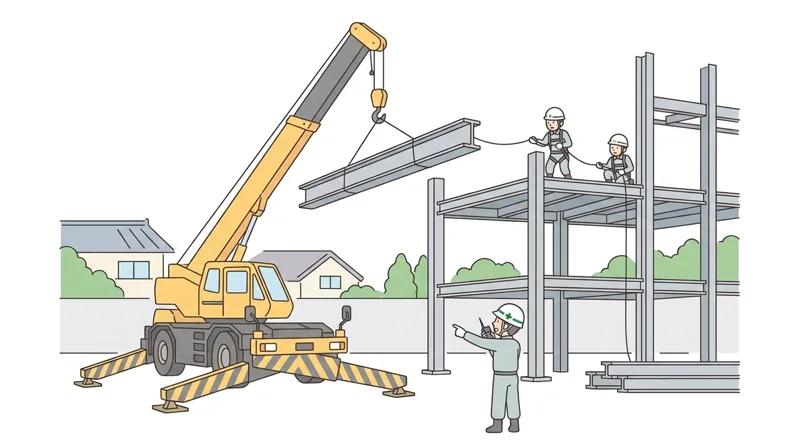
鉄骨工事の建て方方式のうち、移動式クレーンを使用して敷地の奥から手前に向かって順番に鉄骨を組み立てていく方法を何というか。
Among erection methods in structural steel work, what is the name of the method that uses a mobile crane to assemble the steel frame sequentially from the back of the site toward the front?
- A. 移動式クレーンで奥から手前へ組み進める建て逃げ方式
Retreating erection method that assembles progressively from the back toward the front using a mobile crane - B. タワークレーンを用いて下の階から1階ずつ順番に組み上げる水平積上げ方式
Horizontal tier erection method that uses a tower crane to assemble one floor at a time from the bottom up - C. 地上で屋根架構を組んでから油圧ジャッキで持ち上げるリフトアップ方式
Lift-up method that assembles the roof frame on the ground and raises it using hydraulic jacks - D. 工場で柱と梁の仕口部を溶接して現場へ搬入するブラケット方式
Bracket method that welds column-and-beam joints at a factory before transporting them to the site
Show answer
Correct answer: A
The retreating erection method (建て逃げ方式) uses a mobile crane (移動式クレーン) positioned on the ground to erect steel frames sequentially from the deepest part of the site while retreating toward the exit. By contrast, high-rise buildings typically use a tower crane to erect one floor at a time via the horizontal tier erection method (水平積上げ方式), while the lift-up method raises roof frames assembled on the ground. (Textbook: JAC 学科テキスト 第4章)
| Word | Meaning |
|---|---|
| 建て逃げ方式 | Retreating erection method (Tatenige) |
| 水平積上げ方式 | Horizontal tier erection method |
| 移動式クレーン | Mobile crane |
Question 7
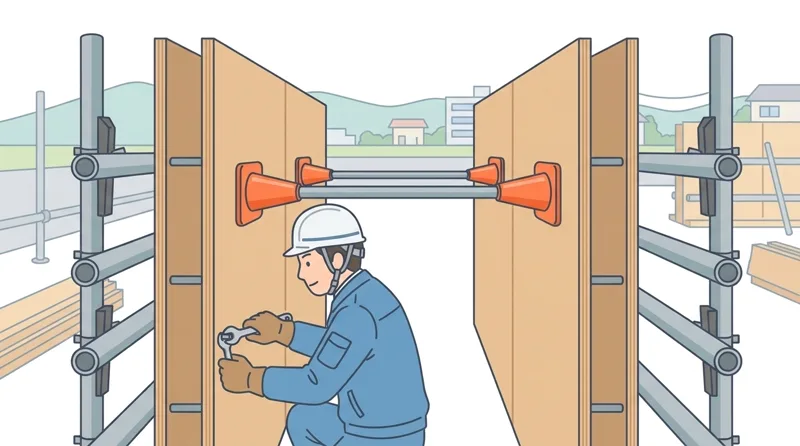
型枠工事で使用する部材のうち、向かい合うせき板の間隔(コンクリートの壁厚)を一定に保つために型枠の内部へ渡し、両端にPコンを取り付けて使う棒状の鋼製部材はどれか。
Among components used in formwork, which rod-shaped steel component is passed through the inside of the formwork with plastic cones (P-cones) attached to both ends to keep the distance between facing sheathing boards (the concrete wall thickness) constant?
- A. 型枠の外側で単管パイプを挟んで締めるフォームタイ
A form tie that clamps and tightens single pipes on the outside of the formwork - B. 対向する型枠の間隔を一定に保持する丸セパレーター
A round separator that maintains a constant distance between facing formwork panels - C. 梁底やスラブの型枠を下から垂直に支えるパイプサポート
A pipe support that vertically supports beam-bottom and slab formwork from below - D. コンクリートの出隅の角を欠き込んで面をとるために打ち付ける面木
A chamfer strip nailed to the formwork to bevel the external corners of the concrete
Show answer
Correct answer: B
A round separator (丸セパレーター) is placed between facing sheathing boards (せき板) with P-cones attached to both ends to keep the concrete wall thickness accurate and resist lateral pressure. A form tie (フォームタイ) fastens pipes on the exterior of the formwork, a pipe support props up slab and beam formwork from underneath, and a chamfer strip creates beveled corners. (Textbook: JAC 実技テキスト 第5章 5.1)
| Word | Meaning |
|---|---|
| 丸セパレーター | Round separator (formwork spacer rod) |
| フォームタイ | Form tie |
| せき板 | Sheathing board (formwork panel) |
Question 8
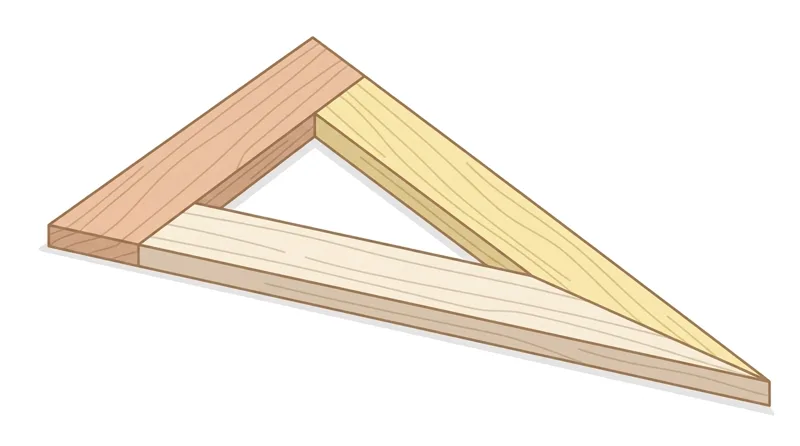
建築大工などの墨出し作業において、図の木製の道具を主に何のために使うか。
In layout marking work by construction carpenters, what is the wooden tool shown in the figure mainly used for?
- A. 柱や型枠に糸で円錐形のおもりを垂らして鉛直を確かめる下げ振り
A plumb bob that hangs a cone-shaped weight on a string along a column or formwork to check verticality - B. 気泡管の気泡の位置を見て部材の水平を調べる水平器
A spirit level that checks the horizontality of a member by observing the bubble position in a vial - C. スランプコーンを抜いた後のコンクリートの高さの差を測るスランプ検尺
A slump scale that measures the height difference of concrete after lifting the slump cone - D. 3対4対5の比率で木材を組んで現場で直角を出すおおがね
A large carpenter's square (Oogane) made by assembling timber in a 3:4:5 ratio to establish right angles on-site
Show answer
Correct answer: D
The illustration shows a large wooden carpenter's triangle square (ōgane) built with a 3:4:5 side ratio. A large carpenter's square (おおがね) is a large right-triangle gauge built on-site from timber using the 3:4:5 side ratio (サシゴ) based on the Pythagorean theorem to establish accurate right angles (直角) over wide areas. A plumb bob (下げ振り) checks verticality, a spirit level checks horizontality, and a slump scale measures concrete slump. (Textbook: JAC 実技テキスト 第5章 5.3)
| Word | Meaning |
|---|---|
| おおがね | Large square (Oogane) |
| 下げ振り | Plumb bob |
| 直角 | Right angle (90 degrees) |
Question 9
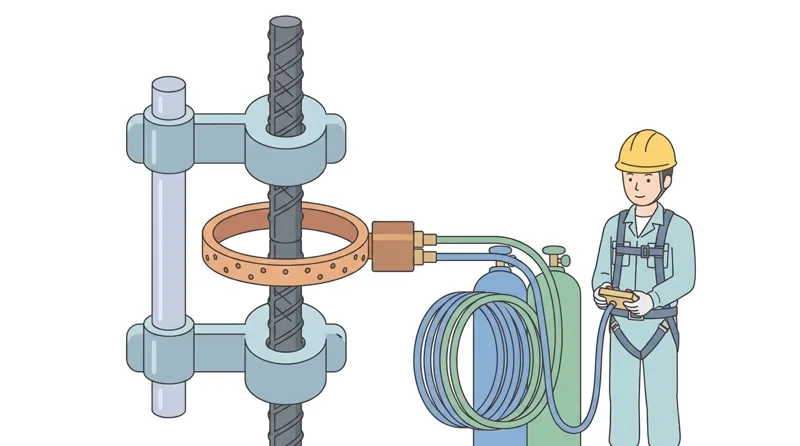
図の鉄筋の継手作業における品質管理として、正しいものはどれか。
Which of the following is correct quality control for the reinforcing bar splicing work shown in the figure?
- A. 鉄筋の端面は酸化を防ぐため、圧接当日に冷間直角切断機で平滑に切断する。
To prevent oxidation, the end faces of the rebars are cut flat with a cold right-angle cutting machine on the day of pressure welding. - B. 鉄筋の端面は接合の3日前までにガス溶断機で切断し、端面に防錆油を塗布して固定する。
The end faces of the rebars are cut with a gas torch at least 3 days before joining, coated with anti-rust oil, and fixed in place. - C. 加熱範囲は鉄筋径の半分の12ミリ程度とし、圧接部の膨らみを鉄筋径の1.1倍におさえる。
The heating range is set to half the rebar diameter at about 12 mm, and the joint bulge is kept to 1.1 times the rebar diameter. - D. 外観検査では、軸心の偏心量が鉄筋径の2分の1以下であることを合格基準とする。
In visual inspection, the acceptance standard is that the eccentricity of the axis is no more than half the rebar diameter.
Show answer
Correct answer: A
The illustration shows gas pressure welding of reinforcing bars, heating the butted bar ends with an oxy-acetylene ring burner under hydraulic pressure to form a symmetrical bulge. In a gas pressure welded joint (ガス圧接継手), rebar end faces (端面) oxidize easily and must be free of water or oil, so they must be cut flat and perpendicular using a cold right-angle cutting machine (冷間直角切断機) on the day of welding (or the day before if properly protected, never wetted). Furthermore, the heating width should be roughly twice the rebar diameter, the bulge diameter must be at least 1.4 times the rebar diameter, and axial eccentricity must not exceed 1/5 of the rebar diameter. (Textbook: JAC 実技テキスト 第6章 6.2)
| Word | Meaning |
|---|---|
| ガス圧接継手 | Gas pressure welded rebar joint |
| 冷間直角切断機 | Cold right-angle cutting machine |
| 端面 | End face (of a rebar) |
Question 10
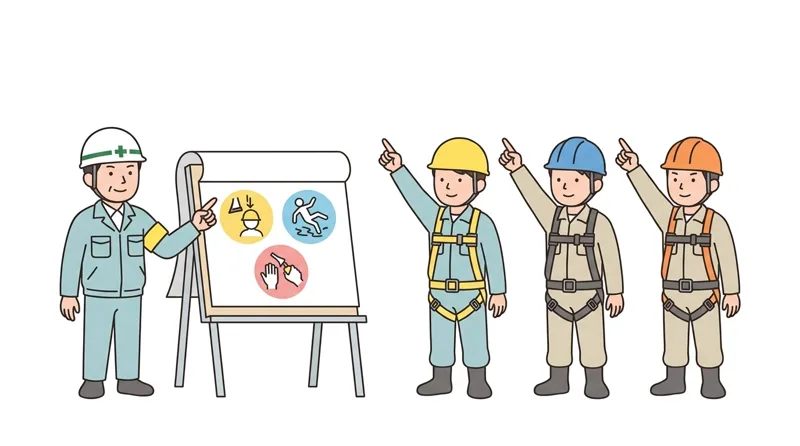
建設現場で毎日実施する「安全施工サイクル」の活動として、作業開始前に職長と作業員が作業場所の近くで当日の作業手順や危険箇所を確かめ合う活動はどれか。
As part of the 'Safety Construction Cycle' carried out daily at a construction site, which activity takes place before starting work, where the foreman and workers gather near the work location to confirm the day's work procedures and hazardous points together?
- A. 一日の作業が終了した後に現場内で行う片付けと清掃作業
Tidying up and cleaning inside the site carried out after the day's work has ended - B. 昼食休憩の前に元請と各職長が集まって行う安全工程打合せ
A safety and schedule coordination meeting held before the lunch break where the prime contractor and foremen gather - C. 全体安全朝礼の後に職種ごとの小集団で行う危険予知(KY)活動
Hazard prediction (KY) activities conducted in small groups by trade after the all-hands morning safety assembly - D. 退場時に元請担当者へ火気や戸締りを伝える終業時報告
An end-of-shift report at departure to inform the prime contractor's representative about fire safety and locking up
Show answer
Correct answer: C
In the daily Safety Construction Cycle (安全施工サイクル), immediately after the all-hands morning safety assembly (安全朝礼) and before starting work, each trade forms a small group with the foreman near the work area to hold a toolbox meeting and conduct hazard prediction activities (危険予知活動 / KY) to confirm procedures and safety measures. Cleaning, coordination meetings, and end-of-shift reports occur at different times of the day. (Textbook: JAC 実技テキスト 第7章 7.2)
| Word | Meaning |
|---|---|
| 安全施工サイクル | Safety construction cycle |
| 危険予知活動 | Hazard prediction activity (KY) |
| 安全朝礼 | Morning safety assembly |