Home › Sample questions › Construction
Construction sample exam questions – 10 questions with answers
建設分野
10 sample questions in the real exam format, with furigana, English translation, answers and explanations. Tap "Show answer" under each question. For the full question bank and realistic mock exams, open the free app.
Question 1
建設現場での高所作業における墜落防止対策として、正しいものはどれですか。
Which of the following is a correct fall prevention measure when working at heights on a construction site?
- A. 作業床の高さが5mを超える場所では、フルハーネス型墜落制止用器具を装着して使用する。
Wear and use a full-harness fall arrest device where the working platform is more than 5 m high. - B. 高所では作業床の高さにかかわらず、常に胴ベルト型墜落制止用器具のみを装着する。
When working at heights, always wear only a body-belt type fall arrest device regardless of the height of the working platform. - C. 建設現場では、作業床の高さが10mを超える場所でのみ墜落制止用器具を装着する。
On construction sites, wear a fall arrest device only where the working platform is over 10 m high. - D. 足場上で作業するときは、墜落制止用器具のフックを常に腰より低い足元に掛ける。
When working on a scaffold, always attach the hook of the fall arrest device to a foot-level position lower than your waist.
Show answer
Correct answer: A
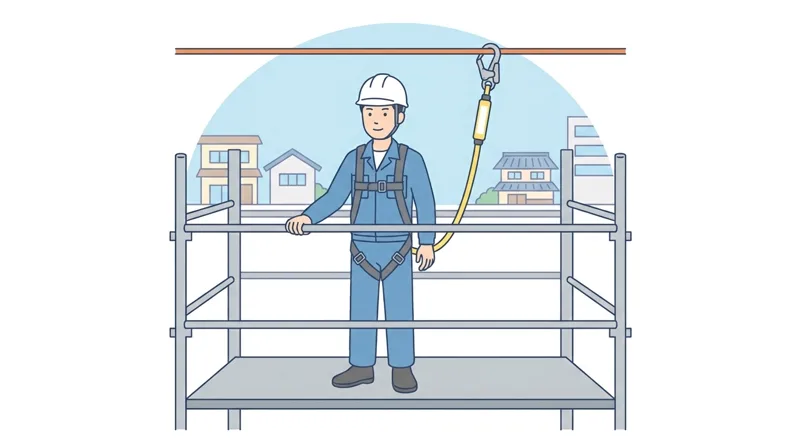
In the construction industry, where fall accidents are frequent, workers are required to wear a full-harness fall arrest device instead of a body belt when working at heights over 5 m (the general legal standard is over 6.75 m), and to attach the hook above waist level to minimize fall distance.
| Word | Meaning |
|---|---|
| 高所作業 | work at heights |
| 墜落制止用器具 | fall arrest device |
| 作業床 | working platform |
| 装着 | wearing, equipping |
Question 2
作業開始前にその日の作業にひそむ危険を予測し、対策を話し合って全員で共有する活動はどちらですか。
Which activity is conducted before starting work to predict hidden hazards in that day's work, discuss countermeasures, and share them with everyone?
- A. 危険予知活動(KY活動)
Hazard prediction activity (KY activity) - B. 新規入場者教育(雇入時教育)
Newcomer site induction training (hiring training)
Show answer
Correct answer: A
Hazard prediction activity (KY activity / kiken yochi) is performed before starting work to envision potential accidents during the day's tasks, discuss countermeasures, and share them among the whole team to prevent accidents beforehand.
| Word | Meaning |
|---|---|
| 危険予知活動 | hazard prediction activity (KY activity) |
| 予測 | prediction |
| 対策 | countermeasure |
| 共有 | sharing |
Question 3
大規模な建設工事の施工体制において、工事を依頼した発注者に代わり設計図面通りに施工されているかを確認する技術者はどちらですか。
In the construction system of a large-scale building project, which engineer checks on behalf of the client whether the construction is being carried out according to the design drawings?
- A. 現場で作業員を直接指揮する職長
The foreman (shokuchō) who directly leads workers on site - B. 設計図面通りの施工を確認する監理者
The design supervisor (kanrisha) who verifies compliance with design drawings
Show answer
Correct answer: B
The engineer responsible for checking and confirming whether the construction work follows the design drawings is the design and construction supervisor (kanrisha), whereas the foreman (shokuchō) directly leads workers in each specialized trade on site.
| Word | Meaning |
|---|---|
| 施工体制 | construction implementation system |
| 監理者 | design supervisor (kanrisha) |
| 発注者 | client / orderer (hatchūsha) |
| 職長 | foreman (shokuchō) |
Question 4
建設キャリアアップシステム(CCUS)において、技能者が最初に登録されたときに発行されるレベル1(見習いの技能者)のカードの色はどれですか。
In the Construction Career Up System (CCUS), what color is the Level 1 (apprentice skilled worker) card issued when a worker registers for the first time?
- A. 金色(ゴールド)
Gold - B. ぎん色(シルバー)
Silver - C. 青(ブルー)
Blue - D. 白(ホワイト)
White
Show answer
Correct answer: D
In the CCUS system, worker skill levels are divided into 4 levels represented by card colors: Level 1 is White (entry-level / apprentice worker), Level 2 is Blue (mid-level skilled worker), Level 3 is Silver (worker capable of serving as a site foreman), and Level 4 is Gold (highly skilled worker with advanced management ability).
| Word | Meaning |
|---|---|
| 技能者 | skilled worker (ginōsha) |
| 登録 | registration |
| 発行 | issuance |
| 見習い | apprentice (minarai) |
Question 5
墨出し作業において、壁や柱などの面に表示する「水平の基準高さ」を示す墨を何といいますか。
In layout marking work (sumidashi), what is the reference line marked on walls or columns to indicate the 'horizontal reference height' called?
- A. 床面に出す地墨
Floor marking line on the floor (jizumi) - B. 陸墨(水墨)
Level marking line (rokuzumi / mizuzumi) - C. 立て墨
Vertical marking line (tatezumi) - D. 逃げ墨
Offset reference line (nigezumi)
Show answer
Correct answer: B
The level marking line (rokuzumi, also called mizuzumi or koshizumi) indicates the horizontal reference height on walls or columns. The floor marking line (jizumi) is snapped directly on horizontal surfaces like floors, the vertical marking line (tatezumi) marks vertical lines, and the offset reference line (nigezumi) is placed at a set distance from the true line when obstacles exist.
| Word | Meaning |
|---|---|
| 墨出し | layout marking (sumidashi) |
| 陸墨 | level marking line (rokuzumi) |
| 立て墨 | vertical marking line (tatezumi) |
| 地墨 | floor marking line (jizumi) |
Question 6
建築図面や現場で使われる高さの記号のうち、「床の仕上がり面の高さ」を表すものはどれですか。
Among the height symbols used on architectural drawings and at construction sites, which symbol represents the 'finished floor height'?
- A. GL(地盤面)
GL (ground level) - B. CH(天井高)
CH (ceiling height) - C. FL(床面)
FL (floor level) - D. SL(スラブ面)
SL (slab surface level)
Show answer
Correct answer: C
FL (Floor Level / Floor Line) represents the height of the finished floor surface (for example, 1FL for the 1st floor and 2FL for the 2nd floor). GL (Ground Level) is the ground height, SL (Slab Level) is the top surface height of the concrete floor slab, and CH (Ceiling Height) is the height from the finished floor (FL) to the finished ceiling.
| Word | Meaning |
|---|---|
| 床 | floor |
| 仕上がり面 | finished surface |
| 記号 | symbol |
Question 7
鉄筋工事において、鉄筋と鉄筋が交差する部分を結束線で縛り、ねじって締め付けるために使う先端がフック状の道具はどれですか。
In rebar work, which hook-tipped tool is used to tie and twist binding wire tightly where reinforcing bars intersect?
- A. ハッカー
Rebar tying hook (hakkā) - B. ボルシン
Drift pin / bull pin (borushin) - C. たがね
Cold chisel (tagane) - D. ディバイダ
Divider
Show answer
Correct answer: A
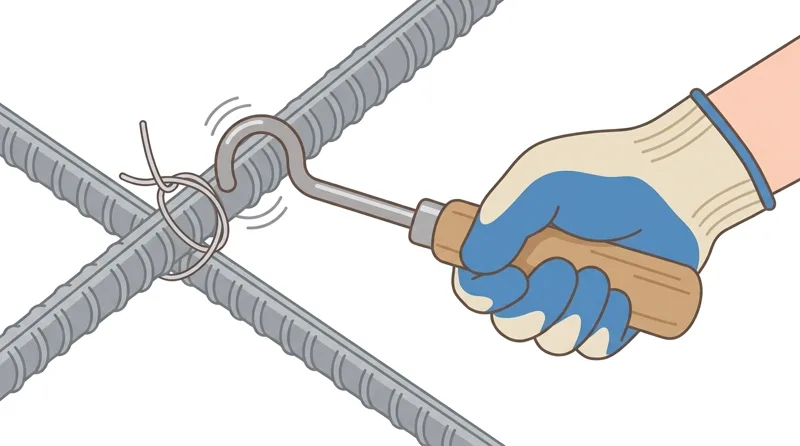
The rebar tying hook (hakkā) is the most essential tool for rebar workers, used to hook and twist binding wire (kessokusen) to secure intersecting rebars. A drift pin (borushin) aligns bolt holes in steel frame erection, a cold chisel (tagane) cuts thin metal or chips concrete, and a divider marks equal intervals in interior finishing.
| Word | Meaning |
|---|---|
| 鉄筋工事 | rebar work |
| 結束線 | binding wire (kessokusen) |
| 先端 | tip / point |
| 締め付ける | to tighten |
Question 8
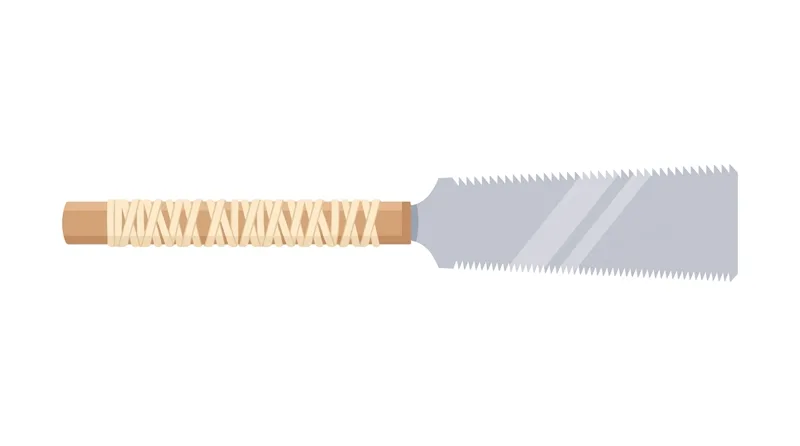
図の木工用工具(両刃のこぎり)の特徴として、正しいものはどれですか。
Which of the following is a correct characteristic of the woodworking tool (double-edged saw / ryōba nokogiri) shown in the figure?
- A. 薄い金属管や合成樹脂管、石膏ボードなどを切断するための専用のこぎりである。
It is a specialized saw used for cutting thin metal pipes, synthetic resin pipes, and gypsum boards. - B. 木材を精密に切るため、片刃の反対側に金属製の補強材(背金)がついたのこぎりである。
It is a single-edged saw with a metal stiffening rib (back) on the opposite side for making precise cuts in wood. - C. 硬い金属材料などを切るため、前に押したときにだけ刃が食い込んで切れるのこぎりである。
It is a saw for cutting hard metal materials, designed so the teeth bite and cut only when pushed forward. - D. 片側に繊維に沿って切る「縦引き刃」、反対側に繊維を横切る「横引き刃」があり、引いて切る。
It has a rip-cut blade (tatebiki) for cutting along the wood grain on one side and a crosscut blade (yokobiki) across the grain on the other, cutting when pulled.
Show answer
Correct answer: D
The illustration shows a traditional Japanese woodworking hand saw with a rattan-wrapped straight wooden handle. A Japanese double-edged saw (ryōba nokogiri) has teeth on both edges: a rip-cut blade (tatebiki) for cutting along the wood grain on one side, and a crosscut blade (yokobiki) for cutting across the grain on the other, both cutting on the pull stroke. A saw with a metal stiffening back is a backsaw (dōtsuki nokogiri), and a push-stroke saw for metal is a hacksaw (kananoko).
| Word | Meaning |
|---|---|
| 両刃のこぎり | double-edged saw (ryōba nokogiri) |
| 繊維 | fiber / wood grain |
| 縦引き | rip-cutting along the grain (tatebiki) |
| 横引き | crosscutting across the grain (yokobiki) |
Question 9
鉄筋コンクリート造(RC造)において、鉄筋の表面からこれを覆うコンクリートの表面までの最短距離を何といいますか。
In reinforced concrete (RC) structures, what is the shortest distance from the surface of the reinforcing bar to the outer surface of the concrete covering it called?
- A. あき
Clear spacing between rebars (aki) - B. 鉄筋のピッチ
Rebar spacing (pitch) - C. かぶり厚さ
Concrete cover thickness (kaburi atsusa) - D. 継手の重ね長さ
Lap splice length of rebar joints
Show answer
Correct answer: C
Concrete cover thickness (kaburi atsusa) is the shortest distance from the surface of the rebar to the outer concrete surface, protecting the rebar from rusting as concrete neutralizes over time. Clear spacing (aki) is the gap between adjacent rebar surfaces, while spacing or pitch is the center-to-center distance between rebars.
| Word | Meaning |
|---|---|
| 鉄筋コンクリート造 | reinforced concrete (RC) structure |
| かぶり厚さ | concrete cover thickness (kaburi atsusa) |
| 表面 | surface |
| 最短距離 | shortest distance |
Question 10
図の型枠工事において、生コンクリート打設時の側圧による型枠の「パンク(崩壊)」を防ぐ方法として、正しいものはどれですか。
In the formwork construction shown in the figure, which method is correct to prevent a 'formwork blowout (panku)' caused by lateral pressure during fresh concrete placement?
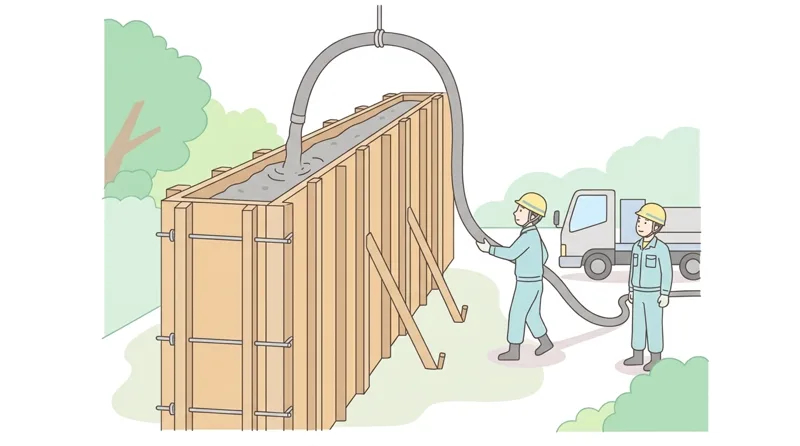
- A. セパレーターやフォームタイ、単管パイプ、支保工を用いて側圧に耐える補強を行う。
Reinforce the formwork to withstand lateral pressure using separators, form ties, single steel pipes, and shoring supports. - B. 型枠の下部よりも上部のほうが側圧が大きくなるため、上部のみセパレーターを密に配置する。
Because lateral pressure is greater at the top of the formwork than at the bottom, place separators densely only in the upper section. - C. 生コンクリートの打設速度を速くするほど側圧が減るため、一度に最上部まで連続で打設する。
Because lateral pressure decreases as the pouring speed of fresh concrete increases, pour continuously to the very top all at once. - D. 支保工のパイプサポートを2本継ぎ足して使うときは、差し込みピンだけで固定して立てる。
When joining two shoring pipe supports end-to-end, fasten them using only the insertion pin before standing them up.
Show answer
Correct answer: A
The illustration shows timber plywood wall formwork panels while fresh concrete is being poured in from above. When pouring fresh concrete, formwork bears heavy lateral pressure (especially near the bottom and when pouring speed is too fast), so insufficient reinforcement causes a blowout (panku). Separators, form ties, steel pipes, and shoring (shihokō) must be properly installed (pipe supports joined end-to-end require at least 4 bolts).
| Word | Meaning |
|---|---|
| 型枠工事 | formwork construction |
| 打設 | pouring / placing concrete (dasetsu) |
| 側圧 | lateral pressure (sokuatsu) |
| 支保工 | shoring / falsework (shihokō) |