
Printing and Bookbinding
印刷・製本
Industrial Manufacturing - Machinery and Electronics · 製造分野 · Written by Tokutei Pass based on the official study texts; not copied verbatim.
四大印刷方式の特徴とデジタル印刷・製本様式
Characteristics of the Four Major Printing Processes, Digital Printing, and Binding Styles
印刷方式は大きく「平版(オフセット)印刷」「凹版(グラビア)印刷」「凸版(フレキソ)印刷」「孔版(スクリーン)印刷」の4つに分かれます。刷版を使わないオンデマンド方式はデジタル印刷といいます。
Printing processes are classified into four major types: 'Planographic (Offset) printing', 'Intaglio (Gravure) printing', 'Relief (Flexographic) printing', and 'Stencil (Screen) printing'. Plateless on-demand printing is called digital printing.
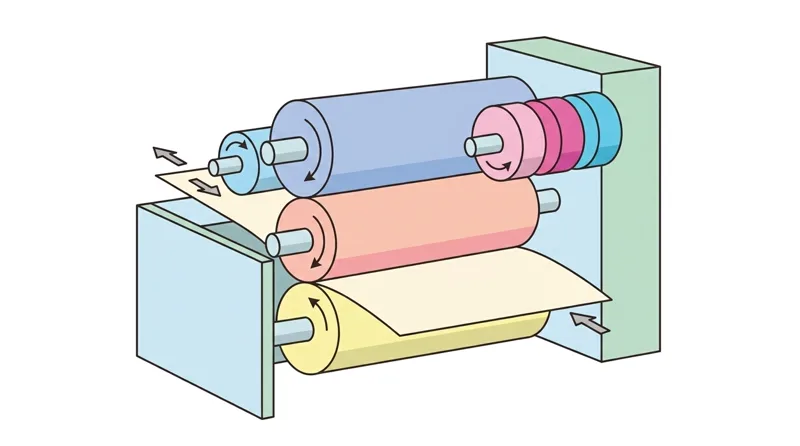
オフセット印刷は水と油の反発を利用し、版胴からゴムブランケット胴へインキをいったん転写(オフセット)してから紙に印刷する方式で、書籍や商業印刷に最も広く使われます。
Offset printing uses the repulsion between water and oil, transferring (offsetting) ink from the plate cylinder onto a rubber blanket cylinder before pressing it onto paper; it is the most widely used method for books and commercial printing.
グラビア印刷は版のくぼみ(セル)のインキをドクターブレードでかき取る方式で写真や軟包装に、フレキソ印刷は弾性樹脂版とアニロックスロールを使い段ボールに多用されます。
Gravure printing scrapes excess ink from recessed cells with a doctor blade and suits photographs and flexible packaging; flexographic printing uses elastic resin plates and an anilox roll and is widely used for corrugated cardboard.
製本様式には、折丁を重ねて背を糊で固める「無線とじ」、中央の折り目を針金で留める「中とじ」、ハードカバーの「上製本」があります。
Bookbinding styles include 'Perfect binding (wireless adhesive binding)' where gathered signatures are glued at the spine, 'Saddle stitching' where folded sheets are stapled through the center fold with wire, and hardcover 'Case binding'.
Key points
- 【○正しい】オフセット印刷は水と油の反発を利用し、版胴からブランケット胴を介して紙にインキを転写する平版印刷である。
(○ True) Offset printing is a planographic method using water-oil repulsion to transfer ink from the plate cylinder to paper via a rubber blanket cylinder. - 【○正しい】グラビア印刷は凹版のくぼみにインキを満たしてドクターブレードでかき取り、フレキソ印刷は弾性凸版とアニロックスロールを用いる。
(○ True) Gravure printing fills recessed cells with ink and wipes the surface with a doctor blade, while flexographic printing uses a flexible relief plate and an anilox roll. - 【×誤り】「オフセット印刷は版胴から紙へ直接インキを乗せる」「中とじは針金を使わず背を削って糊だけで固める」というのは誤り。
(× False) Claiming that 'offset printing transfers ink directly from the plate cylinder to paper' or 'saddle stitching mills the spine and uses glue without wire staples' is FALSE.
| Word | Meaning |
|---|---|
| 平版 | planographic plate (offset) |
| ブランケット胴 | blanket cylinder |
| ドクターブレード | doctor blade |
| 無線とじ | perfect binding (wireless adhesive) |
| 中とじ | saddle stitching |
プリプレス(DTP・色管理・網点・CTP・用紙と紙目)
Prepress (DTP, Color Management, Halftone Dots, CTP, Paper Sizes, and Paper Grain)
カラー印刷ではシアン(C)・マゼンタ(M)・イエロー(Y)にブラック(K)を加えたプロセス4色の「減法混色」で色を再現し、モニター画面は赤(R)・緑(G)・青(B)の「加法混色」で表示します。
Color printing reproduces colors by 'subtractive color mixing' using the four process inks Cyan (C), Magenta (M), Yellow (Y), and Black (K), whereas monitor screens display colors by 'additive color mixing' using Red (R), Green (G), and Blue (B) light.
写真などの濃淡は「網点(ハーフトーン)」の大きさで表現し、各色のスクリーン角度が不適切だと干渉縞の「モアレ」が発生します。
Continuous tones in photographs are represented by varying the size of tiny 'halftone dots'; if the screen angles of the four colors are set improperly, an unwanted interference pattern called 'moiré' appears.
デジタルデータからレーザーで直接刷版(PS版など)に出力する装置を「CTP(Computer To Plate)」といい、印刷物の周囲には見当合わせや断裁位置の基準となる「トンボ(トリムマーク)」を配置します。
A system that images printing plates directly from digital data using a laser without intermediate film is called 'CTP (Computer To Plate)', and 'registration/trim marks (Tombo)' are placed around the sheet as references for color registration and cutting.
印刷用紙の原紙寸法にはA判のもとになる「菊判(636×939mm)」とB判のもとになる「四六判(788×1091mm)」があり、冊子製本では本が開きやすく波打ちを防ぐため、紙の繊維方向(紙目)が背と平行になるように断裁・面付けします。
Standard Japanese base paper sizes include 'Kiku-ban (636×939 mm)' for A-series sizes and 'Shiroku-ban (788×1091 mm)' for B-series sizes; in bookbinding, paper must be cut and imposed so the 'paper grain (fiber direction)' runs parallel to the book spine so pages open smoothly without wavy warping.
Key points
- 【○正しい】プロセスカラー印刷はCMYKの減法混色(重ねるほど暗くなる)、モニター表示はRGBの加法混色(重ねるほど明るくなる)である。
(○ True) Process color printing uses CMYK subtractive mixing (darker as inks overlap), while monitors use RGB additive mixing (brighter as lights overlap). - 【○正しい】CTPはフィルムを介さずデータから直接刷版を出力する方式であり、製本では紙目(繊維方向)を本の背と平行にそろえる。
(○ True) CTP outputs plates directly from digital data without film, and bookbinding requires the paper grain direction to be parallel to the spine. - 【×誤り】「CMYKのインキをすべて重ねると純白になる」「本の背に対して紙目を直角にするほうがページが開きやすい」というのは誤り。
(× False) Claiming that 'overlapping all CMYK inks produces pure white' or 'setting paper grain perpendicular to the spine makes books easier to open' is FALSE.
| Word | Meaning |
|---|---|
| 減法混色 | subtractive color mixing |
| 加法混色 | additive color mixing |
| 網点 | halftone dot |
| 見当合わせ | color registration |
| 紙目 | paper grain (fiber direction) |
プレス工程(オフセット印刷機・湿し水管理・印刷不良対策)
Press Operations (Sheetfed Offset Press, Dampening Solution Control, and Print Defects)
枚葉オフセット印刷機の給紙部(フィーダー)では、エア吹きと吸盤(サッカー)で紙を1枚ずつ分離し、「2枚差し検知器」で重送を防ぎ、「前規矩(フロントレイ)」と「横規矩(サイドレイ)」で用紙位置を正確にそろえます。
At the feeder of a sheetfed offset press, air blasts and suction cups (suckers) separate sheets one by one, a 'double-sheet detector' prevents feeding two sheets together, and the 'front lay' and 'side lay' align each sheet accurately.
湿し水は一般に弱酸性(pH 4.5〜5.5程度)に管理し、供給量が少なすぎると非画線部にインキが付く「地汚れ」、多すぎるとインキに水が過剰に混ざる「過乳化」や濃度低下が起きます。
Dampening solution (fountain solution) is maintained at a weakly acidic pH of about 4.5–5.5; too little dampening water causes ink to adhere to non-image areas ('scumming'), while too much water causes 'over-emulsification' and low print density.
排紙部(デリバリー)で積み重ねた印刷物のインキが上の紙の裏面に付く「裏移り」や固着する「ブロッキング」を防ぐため、パウダー散布を行い棒積み高さを制限します。
To prevent wet ink on delivered sheets from transferring onto the back of the sheet above ('set-off') or sticking sheets together ('blocking'), anti-set-off spray powder is applied and pile height is limited.
紙粉やインキ皮が版やブランケットに付着するとドーナツ状の白抜け不良「ヒッキー」になり、インキの粘り気(タック)が高すぎると紙の表面がむける「紙むけ(ピッキング)」が発生します。
Paper dust or dried ink skin sticking to the plate or blanket causes donut-shaped white void spots called 'hickeys', while excessively high ink tack tearing fibers off the paper surface causes 'picking'.
Key points
- 【○正しい】湿し水は弱酸性(pH 4.5〜5.5)に管理し、少なすぎると「地汚れ」、多すぎると「過乳化」の原因になる。
(○ True) Dampening solution is kept weakly acidic (pH 4.5–5.5); insufficient water causes scumming, while excessive water causes over-emulsification. - 【○正しい】裏移り防止にはパウダー散布が有効であり、ドーナツ状の白抜け不良を「ヒッキー」、紙表面がむける不良を「ピッキング」という。
(○ True) Spray powder prevents ink set-off, donut-shaped white spots are called 'hickeys', and surface tearing caused by high ink tack is called 'picking'. - 【×誤り】「湿し水は強いアルカリ性(pH 11以上)にする」「冬場の静電気を防ぐには工場内をできるだけ乾燥させる」というのは誤り。
(× False) Claiming that 'dampening water must be strongly alkaline above pH 11' or 'keeping the pressroom bone-dry in winter prevents static electricity' is FALSE.
| Word | Meaning |
|---|---|
| 湿し水 | dampening solution (fountain solution) |
| 地汚れ | scumming (non-image tinting) |
| 過乳化 | over-emulsification |
| 裏移り | ink set-off |
| ピッキング | picking (paper surface tearing) |
ポストプレス工程(紙折り・丁合・とじ・三方断裁・表面加工)
Post-Press Operations (Folding, Collating, Binding, Three-Knife Trimming, and Surface Finishing)
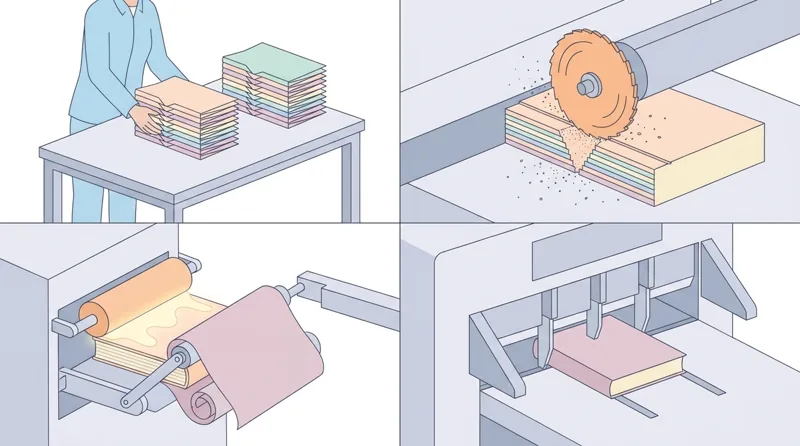
印刷後の大判用紙は「紙折り機」で折丁にし、「丁合機(コレーター)」でページ順に集めます。このときページの順序が狂う不良を「乱丁」、ページが抜け落ちる不良を「落丁」といいます。
Large printed sheets are folded into signatures by a 'folding machine' and gathered in page order by a 'collator'. Pages bound in the wrong sequence are called 'miscollation (Ranchou)', and missing pages are called 'missing signatures/pages (Rakuchou)'.
丁合の良否は折丁の背に印刷された階段状の黒い印「背標(ボーズ)」が規則正しく並んでいるかで確認し、カメラや厚みセンサーでも自動検知します。
Proper collation is verified visually by checking that the black 'collating marks (Sehyou)' printed on the fold spine of each signature form a neat stepped diagonal staircase pattern, supplemented by thickness sensors and cameras.
無線とじラインでは、丁合した本文の背をミーリングで削って溝(ラフニング)を入れ、加熱溶融したホットメルト接着剤や高強度のPUR接着剤を塗布して表紙をくるみ、「三方断裁機」で天・地・小口を仕上げ寸法に断裁します。
In a perfect binding line, the spine of the collated book block is roughened and notched by 'milling', coated with heated hot-melt adhesive or high-strength PUR adhesive, wrapped with a cover, and trimmed at the head, tail, and fore-edge by a 'three-knife trimmer'.
表紙やパッケージには耐摩耗性や光沢を出す「PP貼り(ラミネート加工)」や「ニス引き」を行い、箱の展開形状には切刃と折りすじ刃を組み込んだ木型(トムソン型)による打抜き加工を行います。
Book covers and packages undergo 'PP film lamination' or 'varnishing' for gloss and abrasion resistance, and folding cartons are die-cut and creased using a wooden flat die fitted with cutting rules and creasing rules ('Thomson die').
Key points
- 【○正しい】ページの順番が入れ替わる不良を「乱丁」、ページが抜け落ちる不良を「落丁」といい、折丁の背の「背標」が階段状に並んでいるかで点検する。
(○ True) Out-of-order pages are called 'Ranchou' and missing pages are called 'Rakuchou'; operators check that spine collating marks form a stepped staircase pattern. - 【○正しい】無線とじでは背をミーリング加工して接着剤を浸透させ、表紙をくるんだ後に天・地・小口を三方断裁する。
(○ True) Perfect binding mills the spine so glue penetrates, attaches the cover, and trims the head, tail, and fore-edge on a three-knife trimmer. - 【×誤り】「乱丁・落丁を防ぐため背標はすべて同じ高さ一列に印刷する」「三方断裁機では本の背の部分も切り落とす」というのは誤り。
(× False) Claiming that 'collating marks should all align in a single horizontal line' or 'a three-knife trimmer cuts off the glued spine itself' is FALSE.
| Word | Meaning |
|---|---|
| 丁合 | collating (gathering signatures) |
| 乱丁 | miscollation (wrong page order) |
| 落丁 | missing pages / signature omission |
| 背標 | collating mark (spine mark) |
| 三方断裁機 | three-knife trimmer |
印刷・製本現場の安全衛生・有機溶剤管理・環境対策
Occupational Safety, Organic Solvent Control, and Environmental Protection in Printing & Binding
版胴・ブランケット胴・インキローラーは高速回転するため「挟まれ・巻き込まれ」が最も危険です。運転前は合図と周囲確認を行い、清掃・紙詰まり除去は必ず機械を停止(または寸動)して行い、手袋の巻き込みにも注意します。
Plate cylinders, blanket cylinders and ink rollers rotate at high speed, so 'caught-in and entanglement accidents' are the primary hazard. Give signals and check the surroundings before starting; always stop the press (or use inching mode) before cleaning or clearing jams, and keep gloves from getting caught.
断裁機では刃物による重大災害を防ぐため、「両手操作式安全装置」と「光線式安全装置(エリアセンサー)」を無効化せず、作業前に正常作動を点検し、1台の断裁機は1人で操作します。
On paper guillotines (cutters), to prevent severe blade amputations, the 'two-hand control safety device' and 'photoelectric safety sensor (light curtain)' must never be bypassed, must be inspected before work, and each cutter must be operated by one person only.
洗浄剤やグラビアインキなどの有機溶剤を扱う職場では、「局所排気装置」を稼働させ、「有機ガス用防毒マスク」や不浸透性保護手袋を着用し、火気厳禁およびSDS(安全データシート)・GHSラベルの確認を徹底します。
When handling organic solvents such as roller washes or gravure inks, workers must run 'local exhaust ventilation', wear an 'organic gas respirator (with charcoal cartridges)' and chemical-resistant gloves, enforce no-open-flames rules, and check SDS and GHS labels.
環境保全のため、揮発性有機化合物(VOC)の排出を抑えた植物油インキやノンVOC洗浄剤の活用、および断裁くず・損紙(ヤレ紙)の分別回収(混入禁止品の混入防止)による古紙リサイクルを推進します。
For environmental protection, printing plants reduce volatile organic compound (VOC) emissions by using vegetable-oil inks and non-VOC washes, and sort trim waste and spoilage sheets ('Sonshi') free of prohibited contaminants for paper recycling.
Key points
- 【○正しい】印刷機のローラー清掃や紙詰まり処置は機械を停止して行い、断裁機の両手操作式安全装置や光線式安全装置は絶対に外さない。
(○ True) Always stop the press before clearing jams or wiping rollers, and never disable the two-hand buttons or light curtain on a paper cutter. - 【○正しい】有機溶剤作業では局所排気装置を動かし、防塵マスクではなく「有機ガス用防毒マスク(吸収缶付き)」を着用する。
(○ True) When handling organic solvents, operate local exhaust ventilation and wear an organic gas respirator rather than a simple dust mask. - 【×誤り】「高速回転中のローラーにウエスを手に巻いて押し当てて拭く」「作業効率を上げるため断裁機の片方のボタンをテープで固定する」というのは重大違反であり誤り。
(× False) 'Wiping high-speed rotating rollers by hand with a cloth wrapped around your fingers' or 'taping down one button of a two-hand paper cutter' is a critical safety violation.
| Word | Meaning |
|---|---|
| 巻き込まれ災害 | caught-in / entanglement accident |
| 両手操作式安全装置 | two-hand control safety device |
| 局所排気装置 | local exhaust ventilation |
| 有機ガス用防毒マスク | organic gas respirator |
| 損紙 | spoilage / waste paper (Sonshi) |
Printing and Bookbinding Technology
Practice this chapter in the appOfficial references
- 製造分野特定技能1号評価試験(経済産業省・JAIM) — https://www.jaim-skill.or.jp/exam/about-ssw1/
- 製造分野特定技能評価試験 試験基準(別紙) — https://www.jaim-skill.or.jp/assets/files/exam/top/exam_criteria.pdf