
Plating and Surface Treatment
めっき・表面処理
Industrial Manufacturing - Machinery and Electronics · 製造分野 · Written by Tokutei Pass based on the official study texts; not copied verbatim.
めっきの目的・pH(ピーエイチ)と前処理(脱脂・酸洗・水洗)
Purpose of Plating, pH, and Pretreatment (Degreasing, Acid Pickling, Rinsing)
めっきなどの表面処理は、防食性(耐食性)や装飾性、耐摩耗性などの機能を高めるために行います。
Surface treatments such as plating improve corrosion resistance, decorative appearance, wear resistance, and surface functionality.
水溶液のpHは7が中性、7未満が酸性、7より大きい値がアルカリ性(塩基性)を表します。
In aqueous solutions, pH 7 is neutral, less than 7 is acidic, and greater than 7 is alkaline (basic).
めっき前のバフ研磨で表面を滑らかにし、アルカリ脱脂で油分を除き(水濡れ性で確認)、酸洗でさびや酸化皮膜を除きます。
Before plating, buffing smooths the surface, alkaline degreasing removes oils (verified by the water-break test), and acid pickling removes rust and oxide scale.
酸洗液には素地の過溶解と水素ぜい性を防ぐ抑制剤(インヒビター)を入れ、各工程の間では前液の持ち込みを防ぐため十分に水洗します。
Pickling inhibitors prevent over-dissolution of the base metal and hydrogen absorption, and thorough water rinsing between steps prevents solution drag-in.
Key points
- 【○正しい】水溶液のpHは7が中性、7未満が酸性、7より大きい値がアルカリ性である。
(○ True) A solution pH of 7 is neutral, below 7 is acidic, and above 7 is alkaline. - 【○正しい】脱脂後に水が均一に広がれば脱脂良好(油分が残ると水をはじく)であり、酸洗では抑制剤を使う。
(○ True) Uniform water wetting without break indicates good degreasing (residual oil repels water), and inhibitors are used in acid pickling. - 【×誤り】前処理で「最初にめっきをしてから最後に脱脂・酸洗する」や「水洗を省略する」というのは誤り。
(× False) Saying you should 'plate first and degrease/pickle last' or 'skip water rinsing between steps' is FALSE.
| Word | Meaning |
|---|---|
| 表面処理 | surface treatment |
| 脱脂 | degreasing |
| 酸洗 | acid pickling |
| 抑制剤 | inhibitor |
| 水洗 | water rinsing |
電気めっきの原理・浴管理・不良対策と水素ぜい性
Electroplating Principles, Bath Control, Defects, and Hydrogen Embrittlement
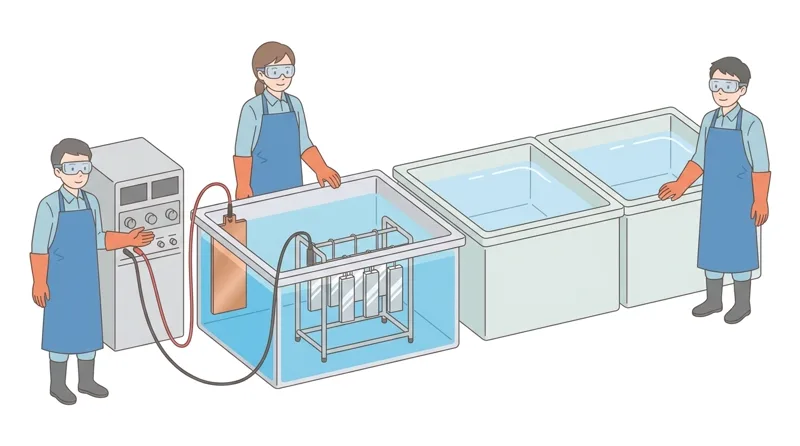
電気めっきでは、品物を直流電源のマイナス側(陰極)、金属板をプラス側(陽極)につなぎ、めっき厚さは電流と時間の積(電気量)に比例します。
In electroplating, the workpiece is connected to the DC negative terminal (cathode) and the metal plate to the positive terminal (anode); coating thickness is proportional to current multiplied by time.
極間距離が近すぎる部分や端・角部は電流が集まってめっきが厚くなり、電流密度が高すぎると表面が黒く粗くなる「ヤケ(焦げ)」が起きます。
Areas with short inter-electrode distance or sharp edges concentrate current and become thicker; excessively high current density causes dark, rough 'burning' (yake).
めっき液はろ過機で固形異物を除いて「ざらつき」を防ぎ、ハルセル試験で電流密度ごとの外観状態を調べ、水素の泡による小さな穴(ピット)を防ぎます。
Continuous filtration removes solid particles to prevent roughness, Hull cell tests check coating appearance across current densities, and gas bubble removal prevents pinholes (pits).
高強度の鋼が水素を吸って割れやすくなる「水素ぜい性」を防ぐため、めっき後すみやかに加熱処理(ベーキング)を行って水素を放出させます。
To prevent 'hydrogen embrittlement' in high-strength steel, baking (heat treatment) is performed promptly after plating to drive out absorbed hydrogen.
Key points
- 【○正しい】電気めっきでは品物をマイナス側(陰極)につなぎ、めっき厚さは電流×時間(電気量)に比例する。
(○ True) Connect the workpiece to the negative terminal (cathode); plating thickness is proportional to current × time. - 【○正しい】高電流密度部の黒い粗面不良を「ヤケ」、水素気泡による小穴を「ピット」といい、高強度鋼はめっき後にベーキングで水素ぜい性を防ぐ。
(○ True) Dark rough deposits at high current density are called 'burning' (yake), pinholes from hydrogen bubbles are 'pits', and baking prevents hydrogen embrittlement. - 【×誤り】品物をプラス側(陽極)につなぐ、またはハルセル試験を「破壊引張試験」というのは誤り。
(× False) Connecting the workpiece to the positive terminal (anode) or calling the Hull cell test a 'destructive tensile test' is FALSE.
| Word | Meaning |
|---|---|
| 陰極 | cathode (negative electrode) |
| 陽極 | anode (positive electrode) |
| 電流密度 | current density |
| ハルセル試験 | Hull cell test |
| 水素ぜい性 | hydrogen embrittlement |
ラックめっき・バレルめっき・無電解めっき・溶融亜鉛めっき
Rack Plating, Barrel Plating, Electroless Plating, and Hot-Dip Galvanizing
大きな部品は引っ掛け治具(ラック)に吊るしてめっきし(接点に付いためっきは剥離して通電性を保つ)、小さなねじ類は回転容器に入れる「バレルめっき」で処理します。
Large parts are hung on racks (rack contact buildup must be stripped regularly to maintain conductivity), while small screws and bolts are tumbled inside a rotating perforated barrel ('barrel plating').
「無電解めっき(化学めっき)」は外部電源を使わず薬品による化学反応で析出させるため、複雑な形状にも均一な厚さでめっきでき、プラスチックへのめっきにも使われます。
'Electroless plating' (chemical plating) deposits metal via chemical reduction without external power, producing uniform thickness even on complex shapes and enabling plating on plastics.
無電解ニッケル-りんめっきは約400℃で熱処理すると硬度が大きく上がり、装飾クロムめっきでは先に銅やニッケルの下地めっきをしてから薄くクロムをめっきします。
Electroless Ni-P coatings increase greatly in hardness when heat-treated at about 400°C, and decorative chromium plating applies a thin chrome layer over a nickel or copper-nickel undercoat.
「溶融亜鉛めっき」は約450℃に溶かした亜鉛浴に鋼材を浸して厚い皮膜を作る方法で、耐用年数は皮膜の厚さ(付着量)にほぼ比例します。
'Hot-dip galvanizing' immerses steel in molten zinc at about 450°C to form a thick coating whose corrosion service life is roughly proportional to coating thickness.
Key points
- 【○正しい】小さなねじやボルトを多数まとめるには「バレルめっき」、外部電源を使わず均一な膜厚を得るには「無電解めっき」を使う。
(○ True) Use 'barrel plating' for mass-producing small screws, and 'electroless plating' for uniform thickness without external power. - 【○正しい】無電解ニッケルめっきは約400℃の熱処理で硬くなり、溶融亜鉛めっきは約450℃の溶融亜鉛に浸し厚いほど長持ちする。
(○ True) Electroless nickel hardens with heat treatment at ~400°C; hot-dip galvanizing uses molten zinc at ~450°C and lasts longer with greater thickness. - 【×誤り】プラスチックを前処理なしで直接電気めっきできる、またはラック接点のめっきを剥離しなくてよいというのは誤り。
(× False) Saying non-conductive plastic can be electroplated directly without pretreatment, or rack contacts never need stripping, is FALSE.
| Word | Meaning |
|---|---|
| バレルめっき | barrel plating |
| 無電解めっき | electroless plating |
| 下地めっき | undercoat plating |
| 溶融亜鉛めっき | hot-dip galvanizing |
化成処理・陽極酸化処理(アルマイト)・ドライプレーティング
Conversion Coatings, Anodizing (Alumite), and Dry Plating
亜鉛めっき後の白さびを防ぐクロメート処理では、環境規制により有害な六価クロムから三価クロム化成処理への転換が進んでいます。
In chromate conversion treatment used to prevent white rust on zinc plating, industry has shifted from toxic hexavalent chromium to RoHS-compliant trivalent chromium.
鉄鋼表面の「りん酸塩化成処理(パーカー処理)」は、塗装の下地として塗料の密着性と防食性を高めるために行われます。
'Phosphate conversion coating' on steel forms a crystalline underlayer that improves paint adhesion and corrosion resistance.
アルミニウムの「陽極酸化処理(アルマイト)」では、品物を陽極にして多孔質酸化皮膜を作り、染色する場合は沸騰水などの封孔処理の前に行います。
In aluminum 'anodizing' (alumite), the aluminum part serves as the anode to grow a porous oxide film; dyeing must be done before hydrothermal sealing.
アルマイトの浴温が高すぎると皮膜が溶けて軟らかくなり、逆に0〜5℃の低温にすると厚くて硬い「硬質アルマイト」が得られます(真空中で成膜する方法はドライプレーティングといいます)。
High anodizing bath temperatures dissolve and soften the oxide film, whereas cooling the bath to 0–5°C produces thick, wear-resistant 'hard anodizing' (vacuum coating is called dry plating).
Key points
- 【○正しい】環境対策として三価クロム化成処理が使われ、りん酸塩処理は塗装の密着性向上に使われる。
(○ True) Trivalent chromate replaces hexavalent chromate for environmental safety, and phosphate coating improves paint adhesion. - 【○正しい】アルマイトの染色は封孔処理の前に行い、硬質アルマイトは0〜5℃の低温浴で処理する。
(○ True) Anodizing dye is applied before sealing the pores, and hard anodizing uses a low-temperature bath at 0–5°C. - 【×誤り】封孔処理で微細孔をふさいだ後に染料で染色する、または浴温が高いほど硬い皮膜になるというのは誤り。
(× False) Saying dyeing is performed after sealing the micropores, or that higher bath temperature makes the oxide film harder, is FALSE.
| Word | Meaning |
|---|---|
| 三価クロム化成処理 | trivalent chromate conversion |
| りん酸塩化成処理 | phosphate conversion coating |
| 陽極酸化処理(アルマイト) | anodizing (alumite) |
| 封孔処理 | sealing treatment |
| 硬質アルマイト | hard anodizing |
金属の性質・品質検査・滴定器具と安全・排水処理
Metal Properties, Quality Inspection, Titration Glassware, Safety, and Wastewater
イオン化傾向は「Al>Zn>Fe>Cu」の順で大きく(亜鉛は鉄よりさびやすい鉄の代わりに溶けて守る防食作用がある)、密度はアルミニウムが約2.7g/cm³、亜鉛が約7.1g/cm³です。
Ionization tendency follows the order 'Al > Zn > Fe > Cu' (zinc sacrificially protects steel), and density is about 2.7 g/cm³ for aluminum versus about 7.1 g/cm³ for zinc.
検査では、外観検査の照度を500ルクス(lx)以上とし、中性塩水噴霧試験は5%塩化ナトリウム水溶液・35℃で行い、膜厚は蛍光X線や電磁式膜厚計で非破壊測定します。
Visual inspection requires at least 500 lx illumination, neutral salt spray testing uses 5% NaCl solution at 35°C, and coating thickness is measured non-destructively by XRF or magnetic gauges.
めっき液の中和滴定では、ホールピペットで一定量をコニカルビーカーに取り、指示薬を加えてビュレットから試薬を滴下して濃度を求めます。
In titration analysis, a volumetric (whole) pipette transfers a fixed sample into a conical beaker, an indicator is added, and reagent is dispensed from a burette.
シアン化合物と酸が混ざると猛毒のシアン化水素ガスが出るため厳禁であり、シアン系・六価クロム系・酸アルカリ系の排水は必ず系統別に分けて処理します。
Never mix cyanide compounds with acid because lethal hydrogen cyanide (HCN) gas is generated; cyanide, hexavalent chromium, and acid/alkali wastewaters must be segregated and treated separately.
Key points
- 【○正しい】イオン化傾向はAl>Zn>Fe>Cuの順であり、中性塩水噴霧試験は5%塩化ナトリウム水溶液・35℃、外観検査は500lx以上で行う。
(○ True) Ionization tendency is Al > Zn > Fe > Cu; neutral salt spray testing uses 5% NaCl at 35°C; visual inspection requires >= 500 lx. - 【○正しい】滴定ではホールピペット・コニカルビーカー・ビュレット・指示薬を使い、膜厚は蛍光X線や電磁式膜厚計で非破壊測定する。
(○ True) Titration uses a whole pipette, conical beaker, burette, and indicator; coating thickness is measured non-destructively by XRF or magnetic gauges. - 【×誤り】シアン化合物と酸を同じ場所に保管したり、シアン系と酸系の排水を未処理のまま混ぜて流すのは猛毒ガスが発生するため厳禁。
(× False) Storing cyanides with acids or mixing untreated cyanide and acid wastewaters is strictly prohibited because it releases lethal gas.
| Word | Meaning |
|---|---|
| イオン化傾向 | ionization tendency |
| 塩水噴霧試験 | salt spray test |
| 電磁式膜厚計 | electromagnetic thickness gauge |
| ビュレット | burette |
| シアン化水素 | hydrogen cyanide |
Metal Surface Treatment
Practice this chapter in the appOfficial references
- 製造分野特定技能1号評価試験(経済産業省・JAIM) — https://www.jaim-skill.or.jp/exam/about-ssw1/
- 製造分野特定技能評価試験 試験基準(別紙) — https://www.jaim-skill.or.jp/assets/files/exam/top/exam_criteria.pdf