
Home › Sample questions › Automobile Transportation
Automobile Transportation sample exam questions – 10 questions with answers
自動車運送業
10 sample questions in the real exam format, with furigana, English translation, answers and explanations. Tap "Show answer" under each question. For the full question bank and realistic mock exams, open the free app.
Question 1
対面する信号機が黄色の灯火の点滅をしているときは、他の交通に注意して進むことができる。
When the facing traffic light is flashing yellow, you may proceed while paying attention to other traffic.
- A. ○
○ True - B. ×
× False
Show answer
Correct answer: A
A flashing yellow traffic light means vehicles and pedestrians may proceed while exercising caution toward other traffic, whereas a flashing red light requires a complete stop before the stop line. (Source: 全タク連 学習用テキスト 第1ステージ 2)
| Word | Meaning |
|---|---|
| 信号機 | traffic light |
| 黄色 | yellow |
| 点滅 | flashing |
| 交通 | traffic |
Question 2
道路標識などで最高速度が指定されていない一般道路における自動車の法定最高速度は、時速80キロメートルである。
On general roads where no maximum speed is specified by road signs, the statutory maximum speed for motor vehicles is 80 km/h.
- A. ○
○ True - B. ×
× False
Show answer
Correct answer: B
On general roads without speed limit signs or markings, the statutory maximum speed for motor vehicles is 60 km/h (30 km/h for mopeds), not 80 km/h. (Source: Road Traffic Act Art. 22)
| Word | Meaning |
|---|---|
| 道路標識 | road sign |
| 一般道路 | general road |
| 法定最高速度 | statutory maximum speed |
| 時速 | speed per hour |
Question 3
踏切を通過するときは、踏切の手前の停止線で一時停止し、窓を開けるなどして自分の目と耳で左右の安全を確かめなければならない。
When crossing a railroad crossing, you must come to a complete stop at the stop line before the crossing, open the window, and check for safety to the left and right with your own eyes and ears.
- A. ○
○ True - B. ×
× False
Show answer
Correct answer: A
Before crossing a railroad crossing, drivers must stop at the stop line, lower the window, and verify safety in both directions using both sight and hearing. (Source: Road Traffic Act Art. 33)
| Word | Meaning |
|---|---|
| 踏切 | railroad crossing |
| 停止線 | stop line |
| 一時停止 | temporary stop |
| 安全 | safety |
Question 4
車線変更のため進路を変えるときの合図は、進路を変えようとする約3秒前に行うが、右左折をするときの合図は交差点の10メートル手前で行う。
The signal for changing lanes is given about 3 seconds before changing course, whereas the signal for turning right or left is given 10 meters before the intersection.
- A. ○
○ True - B. ×
× False
Show answer
Correct answer: B
While the lane-change signal is given about 3 seconds in advance, the signal for turning right, turning left, or making a U-turn must be given 30 meters before the point of the turn, not 10 meters. (Source: Road Traffic Act Art. 53)
| Word | Meaning |
|---|---|
| 車線変更 | lane change |
| 進路 | course / path |
| 右左折 | turning right or left |
| 交差点 | intersection |
Question 5
交差点やその付近で緊急自動車が接近してきたときは、交差点を避け、かつ道路の左側に寄って一時停止しなければならない。
When an emergency vehicle approaches at or near an intersection, you must clear the intersection, pull over to the left side of the road, and come to a temporary stop.
- A. ○
○ True - B. ×
× False
Show answer
Correct answer: A
Under the Road Traffic Act, when an emergency vehicle approaches at or near an intersection, drivers must avoid the intersection, pull over to the left side of the road, and stop temporarily to yield. (Source: Road Traffic Act Art. 40)
| Word | Meaning |
|---|---|
| 緊急自動車 | emergency vehicle |
| 接近 | approaching |
| 左側 | left side |
| 一時停止 | temporary stop |
Question 6
横断歩道や自転車横断帯の手前30メートル以内の場所では、前を走る自動車だけでなく原動機付自転車も追い越すことができる。
Within 30 meters before a crosswalk or bicycle crossing zone, you are permitted to overtake both motor vehicles ahead of you and mopeds.
- A. ○
○ True - B. ×
× False
Show answer
Correct answer: B
On a crosswalk or bicycle crossing zone and within 30 meters before them, overtaking any motor vehicle or moped is strictly prohibited to protect crossing pedestrians and cyclists. (Source: Road Traffic Act Art. 30)
| Word | Meaning |
|---|---|
| 横断歩道 | pedestrian crosswalk |
| 自転車横断帯 | bicycle crossing zone |
| 原動機付自転車 | motorized bicycle (moped) |
| 手前 | before / in front of |
Question 7
図のように片側1車線の道路の交差点で左折するとき、道路交通法に基づく正しい通行方法はどれか。
When turning left at an intersection on a road with one lane in each direction as shown in the figure, which driving method is correct under the Road Traffic Act?
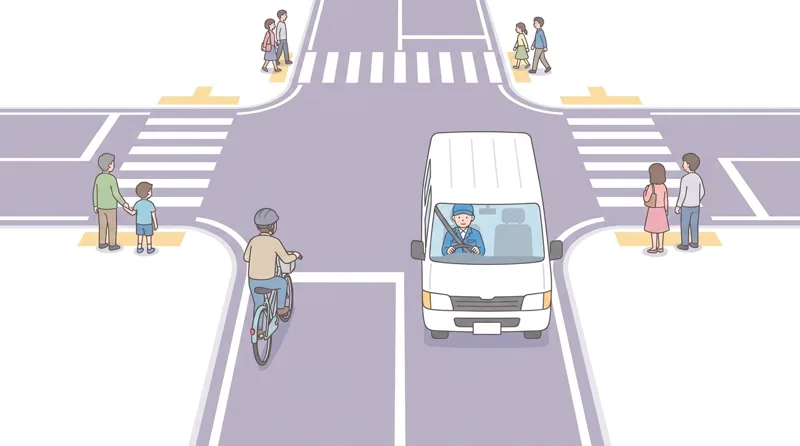
- A. あらかじめ道路の左端に寄り、左端に沿って徐行して曲がる。
Move close to the left edge of the road in advance, and turn slowly along the left edge. - B. 後続車の進行を妨げないよう道路の中央寄りから大回りして速やかに左折する。
Swing wide from near the center of the road and turn left quickly so as not to hinder following traffic. - C. 横断歩道に歩行者がいなければ減速せずそのままの速度で左端を通過する。
If no pedestrians are on the crosswalk, pass along the left edge at the same speed without slowing down.
Show answer
Correct answer: A
When turning left, drivers must move as close as possible to the left edge of the road beforehand to prevent two-wheeled vehicles from entering the left blind spot, and proceed at a slow speed (joko) along the left edge. (Source: Road Traffic Act Art. 34)
| Word | Meaning |
|---|---|
| 交差点 | intersection |
| 左折 | left turn |
| 左端 | left edge |
| 徐行 | driving slowly (joko) |
Question 8
道路交通法において、駐車と停車の両方が禁止されている「駐停車禁止場所」として正しいものはどれか。
Under the Road Traffic Act, which of the following is a "No Stopping or Parking Zone" where both parking and stopping are prohibited?
- A. 火災報知機から1メートル以内の道路の部分および消火栓から5メートル以内の道路の部分
Road sections within 1 meter of a fire alarm and road sections within 5 meters of a fire hydrant - B. 横断歩道や自転車横断帯と、その前後の側端からそれぞれ5メートル以内の道路の部分
Pedestrian crosswalks, bicycle crossing zones, and sections within 5 meters before and after their edges - C. 駐車場や車庫などの自動車用の出入口から3メートル以内の道路の部分
Road sections within 3 meters of a motor vehicle entrance or exit of a parking lot or garage
Show answer
Correct answer: B
Crosswalks, bicycle crossing zones, and areas within 5 meters before and after their edges are no-stopping-and-no-parking zones (Art. 44). Areas within 1 m of a fire alarm, 5 m of a fire hydrant, and 3 m of a garage entrance are parking-prohibited zones where brief stopping is not banned (Art. 45). (Source: Road Traffic Act Art. 44 & 45)
| Word | Meaning |
|---|---|
| 駐停車禁止場所 | no stopping or parking zone |
| 横断歩道 | pedestrian crosswalk |
| 側端 | side edge |
| 出入口 | entrance and exit |
Question 9
図のように交通整理の行われていない道幅が同じくらいの交差点に、同時に進入しようとするときの優先関係として正しいものはどれか。
When vehicles simultaneously approach an uncontrolled intersection of roads with similar widths as shown in the figure, which priority rule is correct?
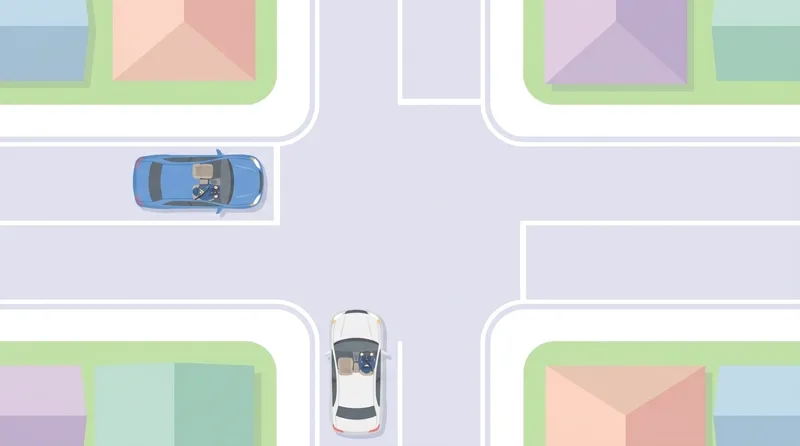
- A. 右方の道路から進入してくる車両に優先権があるため、左方の車両が減速して進路を譲る。
The vehicle approaching from the road on the right has the right-of-way, so the left vehicle yields. - B. 左方の道路から進入してくる車両に優先権があるため、右方の車両が減速して進路を譲る。
The vehicle approaching from the road on the left has the right-of-way, so the right vehicle yields. - C. 先に警音器を鳴らした車両に優先権があるため、鳴らされた側の車両が一時停止して譲る。
The vehicle that sounds its horn first has the right-of-way, so the other vehicle stops and yields.
Show answer
Correct answer: B
At an uncontrolled intersection where both roads are of similar width, Japan applies the left-side priority rule: the vehicle approaching from the left has the right-of-way, and the vehicle on the right must slow down and yield. (Source: Road Traffic Act Art. 36)
| Word | Meaning |
|---|---|
| 交通整理 | traffic control |
| 道幅 | road width |
| 優先関係 | priority relationship |
| 左方 | left side |
Question 10
運転中に業務連絡の電話がかかってきたりスマートフォンを操作したりする必要が生じたときの対応として正しいものはどれか。
What is the correct response when you receive a work phone call or need to operate a smartphone while driving?
- A. 速度を時速20キロメートル以下に落とせば、手に持って通話しながら運転を続けてもよい。
If you reduce speed to 20 km/h or less, you may continue driving while holding the phone to talk. - B. 赤信号で一時停止している間であれば、走行中ではないため画面を注視して返信してもよい。
While stopped briefly at a red light, you may look closely at the screen and reply since the vehicle is not moving. - C. 駐停車禁止でない安全な場所に車両を停止させてから使用する。
Stop the vehicle in a safe place where stopping or parking is not prohibited before using it.
Show answer
Correct answer: C
Holding a phone to talk or gazing at a smartphone or navigation screen while driving is strictly prohibited under the Road Traffic Act. You must first park or stop completely in a safe, legal location before using the device. (Source: Road Traffic Act Art. 71)
| Word | Meaning |
|---|---|
| 業務連絡 | work communication |
| 操作 | operation |
| 注視 | gazing / staring |
| 停止 | stopping |