
Home › Sample questions › Class 2 Electrician 第二種電気工事士 (written exam)
Class 2 Electrician 第二種電気工事士 practice test with answers – free sample questions
第二種電気工事士(学科試験)
10 sample questions in the real exam format, with furigana, English translation, answers and explanations. Tap "Show answer" under each question. For the full question bank and realistic mock exams, open the free app.
Question 1
抵抗 R₁ = 20Ω と R₂ = 30Ω を並列に接続し、その並列部分と抵抗 R₃ = 8Ω を直列に接続した直流回路がある。この回路全体の両端に 100V の直流電圧を加えたとき、電源から流れ出る電流 I[A]の値はいくらか。
In a DC circuit, resistors R₁ = 20 Ω and R₂ = 30 Ω are connected in parallel, and this parallel combination is connected in series with resistor R₃ = 8 Ω. When a DC voltage of 100 V is applied across the entire circuit, what is the current I (A) flowing from the power supply?
- A. 2.0 A
- B. 5.0 A
- C. 4.0 A
- D. 8.3 A
Show answer
Correct answer: B
The equivalent resistance of R₁ = 20 Ω and R₂ = 30 Ω in parallel is Rp = (20 × 30) ÷ (20 + 30) = 600 ÷ 50 = 12 Ω. Adding R₃ = 8 Ω in series gives a total circuit resistance of R = 12 + 8 = 20 Ω. By Ohm's law, the supply current is I = 100 V ÷ 20 Ω = 5.0 A.
| Word | Meaning |
|---|---|
| 並列接続 | parallel connection |
| 直列接続 | series connection |
| 合成抵抗 | equivalent resistance |
Question 2
4辺の抵抗からなるホイートストンブリッジ回路において、上辺左側が R₁ = 6Ω、上辺右側が R₂ = 12Ω、下辺左側が R₃ = 10Ω、下辺右側が R₄ である。中央の検流計 G に電流が流れずブリッジが平衡状態にあるとき、抵抗 R₄[Ω]の値はいくらか。
In a four-arm Wheatstone bridge circuit, the upper-left resistor is R₁ = 6 Ω, the upper-right resistor is R₂ = 12 Ω, the lower-left resistor is R₃ = 10 Ω, and the lower-right resistor is R₄. When no current flows through the center galvanometer G and the bridge is balanced, what is the resistance R₄ (Ω)?
- A. 5 Ω
- B. 16 Ω
- C. 20 Ω
- D. 18 Ω
Show answer
Correct answer: C
When a Wheatstone bridge is in a balanced state (zero current through galvanometer G), the products of opposite diagonal arms are equal: R₁ × R₄ = R₂ × R₃. Thus, 6 × R₄ = 12 × 10 = 120, which gives R₄ = 120 ÷ 6 = 20 Ω.
💡 Wheatstone bridge balance condition (zero current through galvanometer G): products of opposite arms are equal (R₁ × R₄ = R₂ × R₃).
| Word | Meaning |
|---|---|
| ホイートストンブリッジ | Wheatstone bridge |
| 検流計 | galvanometer |
| 平衡状態 | balanced state |
Question 3
単相2線式配電線路において、電線1線あたりの抵抗が 0.15Ω であり、線路末端に接続された抵抗負荷(力率 100%)に 20A の電流が流れている。負荷端子の電圧が 100V のとき、線路の電源側電圧 Vs[V]はいくらか。ただし、線路のリアクタンスは無視する。
In a single-phase 2-wire distribution line, the resistance per wire is 0.15 Ω, and a current of 20 A flows to a resistive load (100% power factor) at the receiving end. When the load terminal voltage is 100 V, what is the sending-end voltage Vs (V)? Neglect line reactance.
- A. 106 V
- B. 103 V
- C. 94 V
- D. 105 V
Show answer
Correct answer: A
The voltage drop in a single-phase 2-wire line (both outgoing and return wires) is ΔV = 2 × r × I = 2 × 0.15 × 20 = 6 V. Therefore, the sending-end voltage is Vs = 100 V + 6 V = 106 V.
💡 Line voltage drop formulas: single-phase 2-wire ΔV = 2rI; balanced single-phase 3-wire ΔV = rI; three-phase 3-wire ΔV = √3rI. Sending voltage Vs = Vr + ΔV.
| Word | Meaning |
|---|---|
| 単相2線式 | single-phase 2-wire system |
| 電圧降下 | voltage drop |
| 抵抗負荷 | resistive load |
Question 4
厚鋼電線管の中へ直径 1.6mm の IV 電線(軟銅単線、空気中での許容電流 27A)を 3本入れて配線したとき、電流減少係数 0.70 を乗じた 1本あたりの許容電流値[A]はどれか。
When three 600V vinyl-insulated wires (annealed copper solid wires) of 1.6 mm diameter are installed inside a metal conduit, what is the allowable current (A) per wire? Assume the base allowable current of a 1.6 mm solid wire is 27 A and the current reduction factor is 0.70.
- A. 17 A
- B. 24 A
- C. 27 A
- D. 19 A
Show answer
Correct answer: D
Multiplying the base allowable current of 27 A by the current reduction factor of 0.70 for 3 wires gives I = 27 × 0.70 = 18.9 A, which rounds to 19 A.
| Word | Meaning |
|---|---|
| 許容電流 | allowable current (ampacity) |
| 電流減少係数 | current reduction factor |
| 軟銅線 | annealed copper wire |
Question 5
低圧屋内配線に使用される絶縁電線の記号、名称および最高許容温度に関する記述として、正しいものはどれか。
Which of the following statements correctly describes the symbol, name, and maximum allowable temperature of insulated wires used in low-voltage indoor wiring?
- A. 記号 IV は 600V 二種ビニル絶縁電線であり、最高許容温度は 75℃ である。
Symbol IV stands for 600V Type-2 vinyl-insulated wire with a maximum allowable temperature of 75℃. - B. 記号 HIV は 600V 二種ビニル絶縁電線であり、最高許容温度は 75℃ である。
Symbol HIV stands for 600V Type-2 vinyl-insulated wire with a maximum allowable temperature of 75℃. - C. 記号 EM-IE は屋外用ビニル絶縁電線であり、最高許容温度は 60℃ である。
Symbol EM-IE stands for outdoor vinyl-insulated wire with a maximum allowable temperature of 60℃. - D. 記号 OW は 600V 耐燃性ポリエチレン絶縁電線であり、最高許容温度は 90℃ である。
Symbol OW stands for 600V flame-retardant polyethylene-insulated wire with a maximum allowable temperature of 90℃.
Show answer
Correct answer: B
HIV (heat-resistant vinyl-insulated wire, 600V Type-2) has a maximum allowable temperature of 75℃. Standard IV and outdoor OW wires are rated at 60℃, and EM-IE is rated at 75℃ (while CV cable is rated at 90℃).
| Word | Meaning |
|---|---|
| 二種ビニル絶縁電線(HIV) | Type-2 heat-resistant vinyl-insulated wire (HIV) |
| 最高許容温度 | maximum allowable temperature |
| 耐燃性ポリエチレン絶縁電線(EM-IE) | flame-retardant polyethylene-insulated wire (EM-IE) |
Question 6
低圧屋内電路の過電流保護に用いる定格電流 20A の配線用遮断器に、定格電流の 2倍にあたる 40A の電流が継続して流れた場合、自動的に動作(遮断)しなければならない限度時間はどれか。
When a current of 40 A (twice the rated current) flows continuously through a 20 A molded-case circuit breaker (MCCB) protecting a low-voltage indoor circuit, within what maximum time limit must the breaker automatically trip?
- A. 2分以内
Within 2 minutes - B. 10分以内
Within 10 minutes - C. 30分以内
Within 30 minutes - D. 60分以内
Within 60 minutes
Show answer
Correct answer: A
For a molded-case circuit breaker rated at 30 A or less, it must automatically trip within 60 minutes at 1.25 times the rated current and within 2 minutes at 2 times the rated current (40 A for a 20 A breaker).
💡 Mandatory trip time for MCCBs rated ≤ 30 A: within 60 minutes at 1.25× rated current, and within 2 minutes at 2× rated current.
| Word | Meaning |
|---|---|
| 配線用遮断器 | molded-case circuit breaker (MCCB) |
| 過電流保護 | overcurrent protection |
| 動作時間 | operating (trip) time |
Question 7
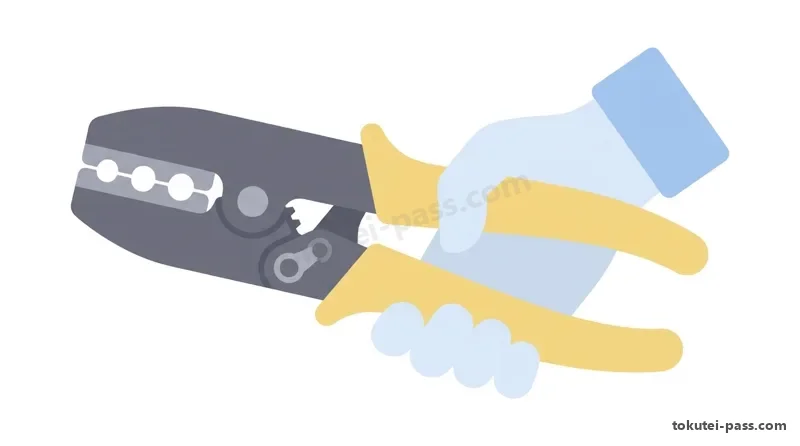
柄(グリップ)が黄色で、先端部に「○・小・中・大」の4つのダイス溝を備えた図の接続工具の名称および使用目的はどれか。
Which of the following combinations correctly gives the name and application of the yellow-handled tool shown in the figure?
- A. 裸圧着端子用圧着工具 ― 銅線用裸圧着端子(R形)を電線に圧着する。
Crimping tool for bare crimp terminals ― Used to crimp bare copper R-type terminals onto wires. - B. ケーブルカッタ ― 太い低圧ケーブルや硬銅線を切断する。
Cable cutter ― Used to cut thick low-voltage cables and hard-drawn copper wires. - C. リングスリーブ用圧着工具 ― リングスリーブ(E形)を用いて電線を圧着接続する。
Crimping tool for ring sleeves ― Used to crimp and splice wires using E-type ring sleeves. - D. ワイヤストリッパ ― 絶縁電線のビニル被覆を所定の長さだけむく。
Wire stripper ― Used to strip vinyl insulation from insulated wires to a specified length.
Show answer
Correct answer: C
A hand crimping tool with yellow handle grips (JIS C 9711) and four die grooves (○, 小, 中, 大) is specifically designed for crimping E-type ring sleeves. Crimping tools for bare R-type terminals have red handles.
| Word | Meaning |
|---|---|
| リングスリーブ用圧着工具 | crimping tool for ring sleeves |
| 圧着接続 | crimp connection |
| 裸圧着端子 | bare crimp terminal |
Question 8
直径 1.6mm の 600V ビニル絶縁電線(軟銅単線)2本だけをジョイントボックス内でリングスリーブ(E形)により圧着接続する際、選ぶべきスリーブの呼びと圧着工具のダイス刻印はどれか。
When splicing two 1.6 mm annealed copper solid wires inside an outlet box using an E-type ring sleeve, which combination of ring sleeve size and crimping die mark is correct?
- A. 小スリーブ ― 刻印「小」
Small (小) sleeve ― Die mark '小' - B. 中スリーブ ― 刻印「小」
Medium (中) sleeve ― Die mark '小' - C. 中スリーブ ― 刻印「中」
Medium (中) sleeve ― Die mark '中' - D. 小スリーブ ― 刻印「○」
Small (小) sleeve ― Die mark '○'
Show answer
Correct answer: D
When connecting exactly two 1.6 mm solid wires, a small (小) ring sleeve must be used and crimped with the extra-small '○' die mark. Using the '小' die mark is for three or four 1.6 mm wires.
| Word | Meaning |
|---|---|
| リングスリーブ(E形) | ring sleeve (E-type) |
| 終端圧着接続 | end crimp splice |
| 刻印 | embossed die mark (kokuin) |
Question 9
アナログ形回路計(テスタ)を用いて抵抗値を測定する際の操作手順および注意事項として、誤っているものはどれか。
Which of the following operating procedures or precautions for measuring resistance with an analog multimeter (tester) is INCORRECT?
- A. 測定前に赤と黒のテストリードの先端を接触させ、0Ω調整つまみで指針を 0Ω に合わせる。
Before measuring, touch the red and black test lead tips together and turn the 0 Ω adjustment knob to set the pointer to 0 Ω. - B. 通電中の回路にそのままテストリードを当てて、負荷の抵抗値を直接測定する。
Touch the test leads directly to an energized circuit to measure the load resistance while power is on. - C. 抵抗測定レンジを切り替えたときは、その都度 0Ω調整をやり直してから測定する。
Whenever the resistance range is changed, perform the 0 Ω adjustment again before taking measurements. - D. 抵抗測定では回路計内部の電池を使用するため、電池が消耗すると 0Ω調整ができなくなる。
Because resistance measurement uses the internal battery of the multimeter, 0 Ω adjustment cannot be performed if the battery is depleted.
Show answer
Correct answer: B
Resistance must never be measured on an energized (live) circuit, as external voltage will damage the multimeter and give false readings. Always de-energize the circuit first.
| Word | Meaning |
|---|---|
| アナログ形回路計(テスタ) | analog multimeter (tester) |
| 0Ω調整 | 0 Ω adjustment |
| テストリード | test leads |
Question 10
電気工事士法において、第二種電気工事士免状の交付を受けている者でなければ従事できない一般用電気工作物の電気工事作業はどれか。
Under the Electrician Act, which of the following electrical construction tasks on general electrical installations may ONLY be performed by a holder of a Second-Class (or First-Class) Electrician license?
- A. 接地極を地面に埋設する作業
Burying a grounding electrode in the ground - B. 電圧 600V 以下で使用する電力量計を取り付ける作業
Installing a watt-hour meter operating at 600 V or less - C. 小型変圧器(二次電圧 36V 以下)の二次側配線工事の作業
Wiring the secondary side of a small transformer (secondary voltage of 36 V or less) - D. 差込接続器にコードまたはキャブタイヤケーブルを接続する作業
Connecting a flexible cord or cabtyre cable to an attachment plug
Show answer
Correct answer: A
Burying a grounding electrode in the ground requires an Electrician license. Installing watt-hour meters, wiring the ≤ 36 V secondary side of bell transformers, and connecting flexible cords to plugs are designated as minor electrical works (keibi na kōji) that do not require a license.
| Word | Meaning |
|---|---|
| 電気工事士法 | Electrician Act (Denki Kōjishi-hō) |
| 接地極の埋設 | burying a grounding electrode |
| 軽微な工事 | minor electrical work (keibi na kōji) |