Home › Sample questions › Restaurant and Food Service
Restaurant and Food Service sample exam questions – 10 questions with answers
外食業
10 sample questions in the real exam format, with furigana, English translation, answers and explanations. Tap "Show answer" under each question. For the full question bank and realistic mock exams, open the free app.
Question 1
食中毒予防の三原則のうち、「やっつける」にあたる行動はどれですか。
Among the three principles of food poisoning prevention, which action corresponds to "kill (destroy) bacteria"?
- A. 食品の中心まで十分に加熱する。
Heat the food thoroughly all the way to the center. - B. 買った食品をすぐに冷蔵庫に入れて冷やす。
Put purchased food into the refrigerator right away to chill it. - C. 調理の前に手を洗う。
Wash your hands before cooking.
Show answer
Correct answer: A
The three principles of food poisoning prevention are "do not attach bacteria," "do not let bacteria multiply," and "kill bacteria." Heating food thoroughly to the center kills bacteria. Washing hands before cooking prevents attaching bacteria, while refrigerating food right away prevents bacteria from multiplying.
| Word | Meaning |
|---|---|
| 食中毒 | food poisoning |
| 三原則 | three principles |
| 加熱 | heating, cooking |
| 中心 | center, core |
Question 2
魚の刺身を切るときに使う、刃が細長い包丁はどれですか。
Which long, thin-bladed kitchen knife is used when slicing fish for sashimi?
- A. 両刃で刃が薄い菜切り包丁
A double-edged, thin-bladed Nakiri knife - B. 片刃で切れ味の良い柳刃包丁
A single-edged, sharp Yanagiba knife - C. 片刃で刃が厚い出刃包丁
A single-edged, thick-bladed Deba knife
Show answer
Correct answer: B
A Yanagiba knife is a single-edged knife with a long, narrow blade designed to slice fish for sashimi in one smooth pull. A double-edged Nakiri knife is used for cutting vegetables, while a thick-bladed, heavy Deba knife is used for filleting whole fish and cutting through bones.
| Word | Meaning |
|---|---|
| 刺身 | sashimi (sliced raw fish) |
| 包丁 | kitchen knife |
| 柳刃包丁 | Yanagiba knife (sashimi knife) |
| 出刃包丁 | Deba knife (thick fish knife) |
Question 3
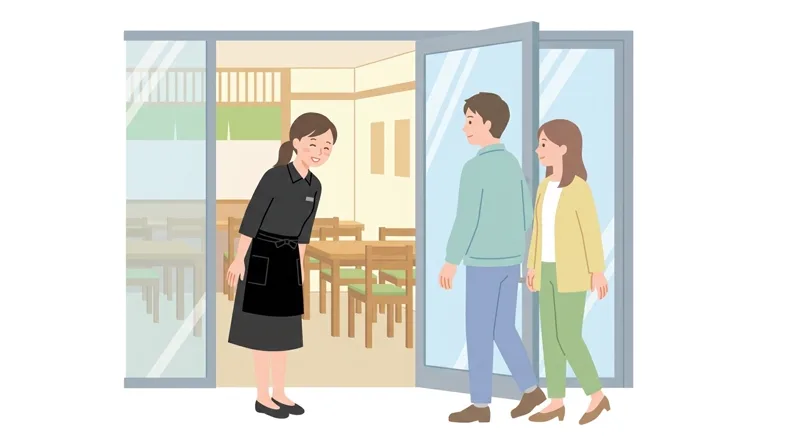
お客様が店に入ってきたとき、最初にかける言葉として適切なものはどれですか。
When a customer enters the restaurant, what is the appropriate first greeting?
- A. ありがとうございました。
Thank you very much. (Arigatou gozaimashita.) - B. お待たせいたしました。
Thank you for waiting. (Omatase itashimashita.) - C. いらっしゃいませ。
Welcome! (Irasshaimase.)
Show answer
Correct answer: C
When customers enter the restaurant, greet them brightly with "Irasshaimase" (Welcome). "Arigatou gozaimashita" is used when customers leave, and "Omatase itashimashita" is used when serving dishes or after keeping a customer waiting.
| Word | Meaning |
|---|---|
| お客様 | customer, guest |
| 最初 | first |
| 適切 | appropriate |
Question 4
業務用の冷蔵庫で食材を保存するときの温度の目安として、正しいものはどれですか。
What is the correct target temperature when storing ingredients in a commercial refrigerator?
- A. 庫内を15℃前後に保つ。
Keep the inside of the refrigerator around 15°C. - B. 庫内を20℃以下にして保つ。
Keep the temperature inside at 20°C or below. - C. 庫内の温度を10℃以下に保つ。
Keep the temperature inside at 10°C or below.
Show answer
Correct answer: C
Commercial refrigerators should be maintained at 10°C or below to suppress bacterial growth. Keeping the interior around 15°C or merely at 20°C or below is too warm and allows bacteria to multiply.
| Word | Meaning |
|---|---|
| 冷蔵庫 | refrigerator |
| 食材 | food ingredients |
| 保存 | storage |
| 目安 | guideline, standard |
Question 5
ダイコンやニンジンを、細く長く切る切り方はどれですか。
Which cutting method cuts daikon radish or carrots into thin, long strips?
- A. いちょう切り
Icho-giri (quarter-rounds / ginkgo-leaf cuts) - B. 千切り
Sen-giri (fine julienne strips) - C. 乱切り
Ran-giri (rolling wedges)
Show answer
Correct answer: B
Sen-giri (julienne) is cutting vegetables into thin, narrow strips. Icho-giri cuts rounds into quarters shaped like ginkgo leaves, and ran-giri cuts irregular wedges while turning the vegetable.
| Word | Meaning |
|---|---|
| 千切り | fine julienne (thin strips) |
| 切り方 | cutting method |
| 乱切り | rolling cuts (irregular wedges) |
Question 6
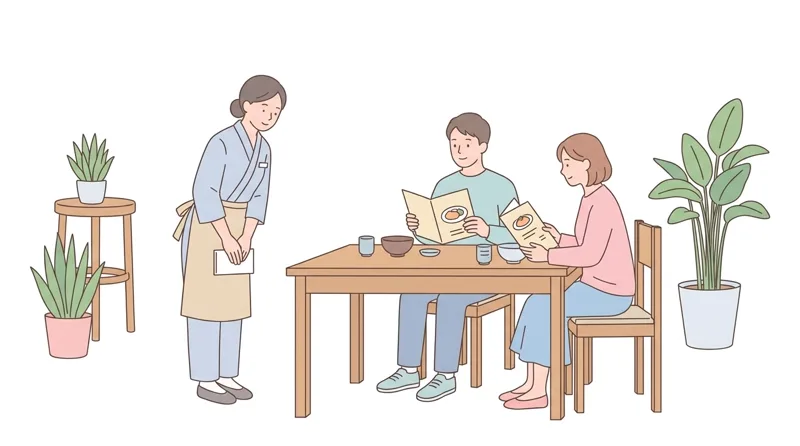
図の場面のように、お客様から注文を受けたあとにすることとして、正しいものはどれですか。
As shown in the scene in the figure, what is the correct action to take after taking an order from a customer?
- A. 注文の内容をくり返して、お客様に確認する。
Repeat the order details back to the customer to confirm. - B. お待たせしないよう確認は省き、すぐ厨房へ伝える。
Skip confirmation so the customer does not wait, and pass it straight to the kitchen. - C. 先に厨房へ伝えてから、あとで伝票に内容を書く。
Pass the order to the kitchen first, then write the details on the order slip afterward.
Show answer
Correct answer: A
The illustration shows a restaurant server standing beside a dining table holding an order pad or handheld terminal right after customers have placed their order. After taking an order, always repeat the dish names and quantities back to the customer to confirm there are no mistakes. Skipping confirmation to save time or telling the kitchen before writing the order slip easily causes wrong or missed orders.
| Word | Meaning |
|---|---|
| 注文 | order |
| 内容 | contents, details |
| 確認 | confirmation |
| 厨房 | kitchen |
Question 7
ノロウイルスについて、正しいものはどれですか。
Which statement about norovirus is correct?
- A. 食品の中で増えるため、冷蔵庫に入れて保存すれば安全である。
Because it multiplies inside food, storing food in the refrigerator makes it safe. - B. 調理器具はアルコール消毒だけで十分にやっつけることができる。
On cooking utensils, alcohol sanitization alone is sufficient to destroy the virus. - C. 感染した人の嘔吐物や便から、ほかの人にうつることがある。
It can spread to other people from the vomit or feces of an infected person.
Show answer
Correct answer: C
Norovirus is present in the vomit and feces of infected individuals and spreads easily via hands or contaminated food. It does not multiply in food and survives refrigeration, and alcohol sanitization alone is not sufficiently effective on utensils (boiling water or sodium hypochlorite is required).
| Word | Meaning |
|---|---|
| 感染 | infection |
| 嘔吐物 | vomit |
| 便 | feces, stool |
| 消毒 | disinfection, sanitization |
Question 8
計量スプーンの大さじ1杯は、何mLですか。
How many milliliters (mL) is 1 tablespoon (oosaji 1) of a measuring spoon?
- A. 5mL
5 mL - B. 10mL
10 mL - C. 15mL
15 mL
Show answer
Correct answer: C
In standard measuring spoons, 1 tablespoon (oosaji) is 15 mL and 1 teaspoon (kosaji) is 5 mL. The volume 10 mL is not the standard measure of 1 tablespoon.
| Word | Meaning |
|---|---|
| 計量 | measuring |
| 大さじ | tablespoon (15 mL) |
Question 9
お客様が食べることを尊敬語で言うとき、正しいものはどれですか。
Which is the correct honorific word (sonkeigo) to use when referring to a customer eating?
- A. いただく
Itadaku - B. 召し上がる
Meshiagaru - C. 拝見いたします
Haiken itashimasu
Show answer
Correct answer: B
Honorific language (sonkeigo) shows respect for the customer's actions, and "meshiagaru" is the honorific verb for eating or drinking. "Itadaku" (eat/receive) and "haiken itashimasu" (look at) are humble forms (kenjougo) used only for one's own actions.
| Word | Meaning |
|---|---|
| 尊敬語 | honorific language (sonkeigo) |
| 召し上がる | to eat/drink (honorific) |
| 拝見 | to look/see (humble) |
Question 10
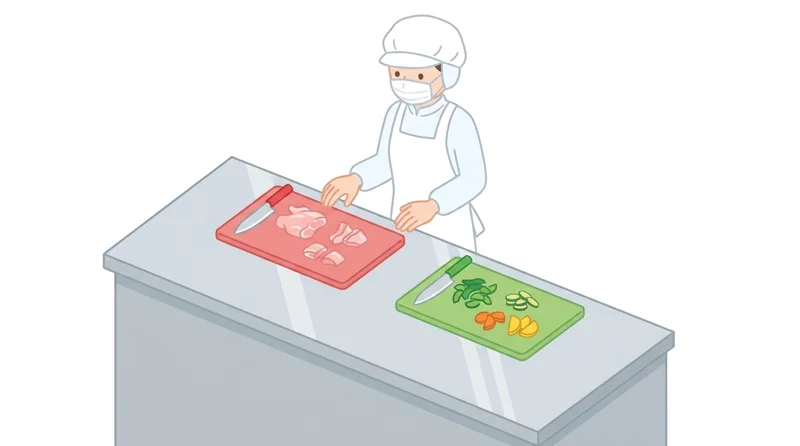
交差汚染を防ぐ方法として、正しいものはどれですか。
Which is the correct method to prevent cross-contamination?
- A. 生の肉を切ったまな板は、水で流してからすぐ野菜を切る。
Rinse the cutting board used for raw meat with water and immediately cut vegetables on it. - B. 生の肉と野菜で、使うまな板と包丁を別々に分ける。
Use separate cutting boards and knives for raw meat and for vegetables. - C. 生の肉と調理済みの食品を、同じ容器の別の端に入れる。
Place raw meat and cooked food at opposite ends inside the same container.
Show answer
Correct answer: B
To prevent cross-contamination, use separate cutting boards and knives for raw meat and for vegetables. Merely rinsing a board with water without washing with detergent and disinfecting, or placing raw meat and cooked food at opposite ends of the same container, still allows bacteria to transfer.
| Word | Meaning |
|---|---|
| 交差汚染 | cross-contamination |
| 調理済み | cooked, prepared |
| 容器 | container |
| 包丁 | kitchen knife |