
Home › Sample questions › Industrial Manufacturing (SSW 2)
Industrial Manufacturing (SSW 2) sample exam questions – 10 questions with answers
製造分野(2号)
10 sample questions in the real exam format, with furigana, English translation, answers and explanations. Tap "Show answer" under each question. For the full question bank and realistic mock exams, open the free app.
Question 1
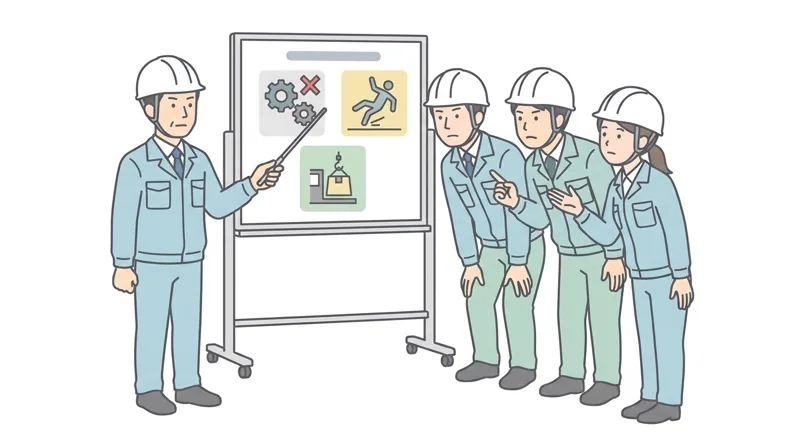
図のように職場の小集団で行う危険予知訓練(KYT)の「4ラウンド法」において、第2ラウンド(2R)で実施する内容として、正しいものはどれか。
In the "4-Round Method" of Hazard Prediction Training (KYT) conducted by a small workplace group as shown in the figure, which action is performed in Round 2 (2R)?
- A. 職場や作業状況のイラストを見ながら、潜んでいる危険要因を残らず挙げて現状把握を行う。
Looking at the workplace situation illustration and listing all latent hazard factors to grasp the current status. - B. 見つけ出した多くの危険要因の中から、重要な危険のポイントを絞り込んで本質追求を行う。
Narrowing down the critical hazard points from among the many identified hazard factors to pursue the root essence. - C. 絞り込んだ重要な危険のポイントに対して、具体的にどうするかという対策樹立を行う。
Proposing concrete and practical countermeasures for the narrowed-down critical hazard points to establish countermeasures. - D. 出された対策の中から全員で実践する重点実施項目を1つに絞り、指差唱和する目標設定を行う。
Selecting one priority action item from the proposed measures for everyone to practice and setting a goal with pointing and calling.
Show answer
Correct answer: B
The figure illustrates a small-group KYT meeting at the shop floor. The 4-round KYT method consists of 1R Grasping current status, 2R Pursuing the essence (narrowing down critical hazard points), 3R Establishing countermeasures, and 4R Setting action goals.
| Word | Meaning |
|---|---|
| 危険予知訓練 | hazard prediction training (KYT) |
| 現状把握 | grasping current status (1R) |
| 対策樹立 | establishing countermeasures (3R) |
| 目標設定 | setting goals (4R) |
Question 2
金属表面処理工場の排水処理工程において、六価クロムを含む排水を無害化して沈殿除去するための処理手順として、正しいものはどれか。
In the wastewater treatment process of a metal surface treatment plant, which procedure is correct for detoxifying and precipitating wastewater containing hexavalent chromium?
- A. 排水を強いアルカリ性に保ち、次亜塩素酸ナトリウムを加えて酸化分解してから中和する。
Keep the wastewater strongly alkaline, add sodium hypochlorite for oxidative decomposition, and then neutralize it. - B. 排水を高温に加熱して水分を蒸発させ、六価クロムを気体として大気中へ放出させる。
Heat the wastewater to a high temperature to evaporate the water and release hexavalent chromium into the atmosphere as a gas. - C. 薬剤を加えずにそのまま凝集槽へ送り、高分子凝集剤だけでフロックを作って沈殿させる。
Send it directly to the coagulation tank without chemicals and form flocs using only a polymer flocculant for sedimentation. - D. 排水を酸性(pH3以下)に調整して反応剤で三価クロムに変えた後、アルカリで中和沈殿させる。
Adjust the wastewater to acidic (pH 3 or lower) to reduce it to trivalent chromium with a reducing agent, then neutralize with alkali to precipitate.
Show answer
Correct answer: D
Hexavalent chromium cannot be precipitated directly by neutralization. It must first be adjusted to pH 3 or lower and reduced to trivalent chromium using a reducing agent such as sodium bisulfite, followed by alkaline neutralization to precipitate chromium hydroxide. Alkaline oxidation with sodium hypochlorite is used for cyanide wastewater.
| Word | Meaning |
|---|---|
| 排水処理 | wastewater treatment |
| 六価クロム | hexavalent chromium |
| 三価クロム | trivalent chromium |
| 中和沈殿 | neutralization precipitation |
Question 3
ある製造工程で1か月間の不良件数を集計したところ、総不良数が200件であり、件数の多い順に「寸法不良:90件」「傷不良:60件」「へこみ傷:30件」「その他:20件」であった。パレート図を作成したとき、上位2項目(寸法不良・傷不良)までの累積比率はいくらか。
When tallying defects over one month in a manufacturing process, the total number of defects was 200, ordered from most to least as: "Dimensional defect: 90", "Scratch defect: 60", "Dent: 30", and "Others: 20". When creating a Pareto chart, what is the cumulative ratio up to the top two items (Dimensional defect and Scratch defect)?
- A. 上位2項目の合計150件を総数で割った75%
75%, obtained by dividing the sum of the top two items (150) by the total - B. 傷不良とへこみ傷の件数を合算した60%
60%, obtained by combining scratch defects and dents - C. 寸法不良の比率のみを計算した45%
45%, calculated from the ratio of dimensional defects alone - D. 上位3項目の合計180件を総数で割った90%
90%, obtained by dividing the sum of the top three items (180) by the total
Show answer
Correct answer: A
The sum of the top two defect items is 90 + 60 = 150 cases. Dividing by the total of 200 cases gives a cumulative ratio of (150 ÷ 200) × 100% = 75%. 45% is for the first item alone, and 90% is up to the third item.
| Word | Meaning |
|---|---|
| 不良件数 | number of defects |
| 寸法不良 | dimensional defect |
| パレート図 | Pareto chart |
| 累積比率 | cumulative ratio |
Question 4
機械製図(JIS B 0001・JIS Z 3021)において、ねじの呼び「M10×1.25」および溶接記号の基本記号「▽(三角形)」が表す意味の組み合わせとして、正しいものはどれか。
In mechanical drawing (JIS B 0001 / JIS Z 3021), which combination correctly describes the meaning of the thread designation "M10×1.25" and the basic triangle welding symbol?
- A. M10×1.25は外径10mm・長さ1.25cmのメートル並目ねじを表し、記号▽はスポット溶接を表す。
M10×1.25 indicates a metric coarse thread with a 10 mm major diameter and 1.25 cm length, and the triangle symbol indicates a spot weld. - B. M10×1.25は内径10mm・深さ1.25mmの管用平行ねじを表し、記号▽はV形突合せ溶接を表す。
M10×1.25 indicates a parallel pipe thread with a 10 mm inner diameter and 1.25 mm depth, and the triangle symbol indicates a V-butt weld. - C. M10×1.25は外径10mm・ピッチ1.25mmのメートル細目ねじを表し、記号▽はすみ肉溶接を表す。
M10×1.25 indicates a metric fine thread with a 10 mm major diameter and 1.25 mm pitch, and the triangle symbol indicates a fillet weld. - D. M10×1.25は谷径10mm・条数1.25のユニファイねじを表し、記号▽はプラグ溶接を表す。
M10×1.25 indicates a Unified thread with a 10 mm root diameter, and the triangle symbol indicates a plug weld.
Show answer
Correct answer: C
In JIS mechanical drawings, "M10×1.25" denotes a metric fine screw thread with a nominal outer diameter of 10 mm and a pitch of 1.25 mm (coarse threads omit the pitch). In JIS Z 3021 welding symbols, a right-triangle symbol represents a fillet weld (suminiku-yousetsu).
| Word | Meaning |
|---|---|
| 機械製図 | mechanical drawing |
| 細目ねじ | fine pitch thread |
| 溶接記号 | welding symbol |
| すみ肉溶接 | fillet weld |
Question 5
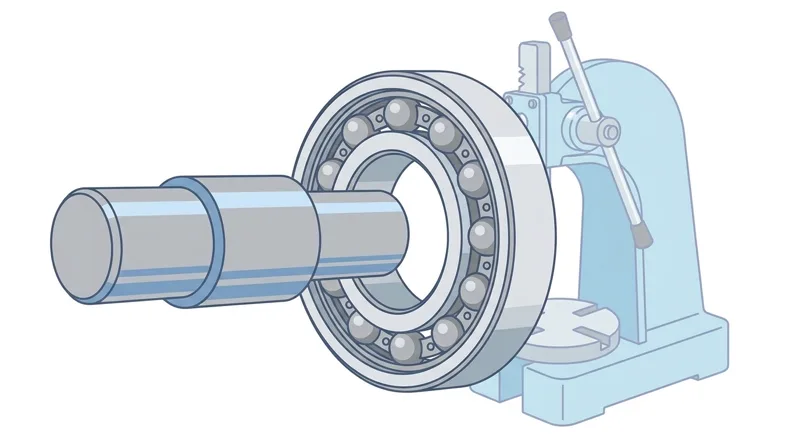
図のように玉軸受(ボールベアリング)を回転軸に「しまりばめ」で圧入して組み付ける作業において、軸受の損傷を防ぐための適切な方法はどれか。
When press-fitting a ball bearing onto a rotating shaft with an interference fit as shown in the figure, which method is appropriate to prevent damage to the bearing?
- A. 外輪の端面だけに当て金を当て、転動体(玉)を介して力を伝えながらハンマで叩き込む。
Place a drift against the outer ring face only and hammer it in so the force is transmitted through the balls. - B. 内輪の端面に専用の圧入治具(スリーブ)を垂直に当て、ハンドプレスで均一に押し込む。
Place a dedicated press-fitting sleeve squarely against the inner ring face and press it in evenly with a hand press. - C. 当て金を使わずに鉄製ハンマで内輪の片側だけを強く叩き、少しずつ傾けながら入れる。
Strike only one side of the inner ring directly with a steel hammer without a sleeve, tilting it slightly as it enters. - D. ガスバーナーの炎で軸受を300℃以上に赤熱するまで直接あぶり、膨張させてから軸へ差し込む。
Heat the bearing directly with a gas burner flame until red-hot above 300°C to expand it before sliding it onto the shaft.
Show answer
Correct answer: B
The figure shows a mounting sleeve pressing against the inner ring of a ball bearing on a shaft. When press-fitting a bearing onto a shaft (inner ring interference fit), pressing force must be applied evenly to the inner ring face. Pressing on the outer ring damages the raceways via the rolling elements, and heating above 120°C ruins the bearing temper.
| Word | Meaning |
|---|---|
| 玉軸受 | ball bearing |
| しまりばめ | interference fit |
| 圧入 | press-fitting |
| 内輪 | inner ring |
Question 6
炭素鋼に含まれる炭素量(質量%)が0.1%から0.8%程度まで増加したときの機械的性質および加工性の変化として、正しいものはどれか。
When the carbon content (mass %) in carbon steel increases from about 0.1% to 0.8%, which change in mechanical properties and workability is correct?
- A. 硬さと引張強さが大きくなり、伸びや絞りおよび溶接性は低下する。
Hardness and tensile strength increase, while elongation, reduction of area, and weldability decrease. - B. 硬さと引張強さが小さくなり、伸びや衝撃値および溶接性は向上する。
Hardness and tensile strength decrease, while elongation, impact value, and weldability improve. - C. 引張強さは一定のまま変わらず、熱伝導率と耐食性だけが急激に高まる。
Tensile strength remains constant, while only thermal conductivity and corrosion resistance rise sharply. - D. 融点が大幅に上昇して焼入れができなくなり、常温での曲げ加工が容易になる。
The melting point rises significantly so quenching becomes impossible, and cold bending becomes easier.
Show answer
Correct answer: A
As carbon content in carbon steel increases from 0.1% to about 0.8%, pearlite increases, raising hardness and tensile strength while reducing ductility (elongation and reduction of area), toughness, and weldability.
| Word | Meaning |
|---|---|
| 炭素鋼 | carbon steel |
| 機械的性質 | mechanical properties |
| 引張強さ | tensile strength |
| 溶接性 | weldability |
Question 7
図のように静電容量がそれぞれ4μFのコンデンサ2個を並列に接続し、その並列部分と8μFのコンデンサ1個を直列に接続した回路全体の合成静電容量はいくらか。
As shown in the circuit diagram, two capacitors of 4 μF each are connected in parallel, and this parallel group is connected in series with one 8 μF capacitor. What is the total equivalent capacitance of the entire circuit?

- A. すべての容量を逆数和で計算した1.6μF
1.6 μF calculated from the reciprocal sum of all capacitances - B. 3個のコンデンサの容量をすべて単純加算した16μF
16 μF obtained by simply adding the capacitances of all three capacitors - C. 並列部2μFと直列部8μFを足し合わせた10μF
10 μF obtained by adding a 2 μF parallel section to the 8 μF series capacitor - D. 並列部8μFと直列部8μFから求めた4μF
4 μF obtained from the 8 μF parallel section in series with the 8 μF capacitor
Show answer
Correct answer: D
The figure shows two capacitors connected in parallel, followed by a third capacitor connected in series. The combined capacitance of the two 4 μF capacitors in parallel is Cp = 4 + 4 = 8 μF. Connecting this 8 μF group in series with the 8 μF capacitor yields C = (8 × 8) ÷ (8 + 8) = 4 μF.
| Word | Meaning |
|---|---|
| 静電容量 | capacitance |
| 並列接続 | parallel connection |
| 直列接続 | series connection |
| 合成静電容量 | equivalent capacitance |
Question 8
抵抗R=8Ωと誘導性リアクタンスXL=6Ωが直列に接続された交流回路に、実効値100Vの交流電圧を加えたとき、回路に流れる電流の実効値Iはいくらか。
When an AC voltage with an effective (RMS) value of 100 V is applied to an AC series circuit having resistance R = 8 Ω and inductive reactance XL = 6 Ω, what is the effective current I flowing through the circuit?
- A. 抵抗とリアクタンスの差2Ωで電圧を割った50A
50 A obtained by dividing the voltage by the difference of 2 Ω between R and XL - B. 抵抗8Ωのみに電圧がかかるとして計算した12.5A
12.5 A calculated assuming the voltage is applied only across the 8 Ω resistor - C. インピーダンスZ=10Ωからオームの法則で求めた10A
10 A obtained by Ohm's law from the circuit impedance Z = 10 Ω - D. 抵抗とリアクタンスの単純和14Ωで電圧を割った約7.1A
Approximately 7.1 A obtained by dividing the voltage by the simple sum of 14 Ω
Show answer
Correct answer: C
In an R-L series AC circuit, the magnitude of the impedance Z is căn bậc hai của (R² + XL²) = căn(8² + 6²) = căn(64 + 36) = căn(100) = 10 Ω. Therefore, the effective current is I = V ÷ Z = 100 V ÷ 10 Ω = 10 A.
| Word | Meaning |
|---|---|
| 誘導性リアクタンス | inductive reactance |
| 交流回路 | AC circuit |
| 実効値 | effective value (RMS) |
| インピーダンス | impedance |
Question 9
表面積が2dm²(200cm²)の鋼板に銅めっきを行ったところ、析出した銅の質量は17.8gであった。銅の密度を8.9g/cm³とし、均一に析出したものとした場合、めっき膜厚は何μmか。
When copper plating was performed on a steel plate with a surface area of 2 dm² (200 cm²), the mass of deposited copper was 17.8 g. Assuming the density of copper is 8.9 g/cm³ and the deposit is uniform, what is the plating film thickness in μm?
- A. 析出質量を密度と面積で割り単位換算した10μm
10 μm, obtained by misconverting the unit after dividing mass by density and area - B. 体積2cm³を表面積200cm²で割って換算した100μm
100 μm, obtained by dividing the volume of 2 cm³ by the surface area of 200 cm² and converting to μm - C. 質量と密度の積を面積で割って計算した79μm
79 μm, calculated by dividing the product of mass and density by the surface area - D. 密度を質量で割った値に面積を掛けて求めた250μm
250 μm, obtained by dividing density by mass and multiplying by the surface area
Show answer
Correct answer: B
The volume of deposited copper is V = m ÷ d = 17.8 g ÷ 8.9 g/cm³ = 2 cm³. Dividing by the area A = 200 cm² gives a thickness of d = 2 ÷ 200 = 0.01 cm = 0.1 mm = 100 μm (since 1 cm = 10,000 μm).
| Word | Meaning |
|---|---|
| 表面積 | surface area |
| 析出 | deposition |
| 密度 | density |
| 膜厚 | film thickness |
Question 10
ニッケルめっきで広く用いられる「ワット浴」の主要3成分(主塩のニッケル塩・塩化ニッケル・ホウ酸)のうち、「塩化ニッケル」と「ホウ酸」が果たす主な役割の組み合わせとして、正しいものはどれか。
Among the three main components of the "Watts bath" widely used in nickel electroplating (nickel sulfate, nickel chloride, and boric acid), which combination correctly describes the primary roles of "nickel chloride" and "boric acid"?
- A. 塩化ニッケルは浴中の不純物を凝集沈殿させ、ホウ酸はめっき液を強いアルカリ性に保つ。
Nickel chloride coagulates and precipitates impurities in the bath, while boric acid keeps the solution strongly alkaline. - B. 塩化ニッケルはめっき皮膜を黒色に着色し、ホウ酸は表面の油脂分を乳化して脱脂する。
Nickel chloride colors the plating film black, while boric acid emulsifies surface oil for degreasing. - C. 塩化ニッケルは陽極の溶解を助けて導電性を高め、ホウ酸はpHの変動を抑える緩衝剤として働く。
Nickel chloride aids anode dissolution and increases bath conductivity, while boric acid acts as a buffer to suppress pH fluctuations. - D. 塩化ニッケルは陰極での水素発生を促進させ、ホウ酸は陽極の表面を不動態化させる。
Nickel chloride promotes hydrogen evolution at the cathode, while boric acid passivates the anode surface.
Show answer
Correct answer: C
In a Watts nickel plating bath, nickel sulfate is the main source of nickel ions, nickel chloride prevents anode passivation (assisting anode dissolution) and improves solution conductivity, and boric acid acts as a pH buffer to maintain stable acidity near the cathode.
| Word | Meaning |
|---|---|
| ワット浴 | Watts bath |
| 塩化ニッケル | nickel chloride |
| ホウ酸 | boric acid |
| 緩衝剤 | buffering agent |