Bus Operations, Preventing Onboard Passenger Falls, Barrier-Free Service, and Emergency Evacuation
バスの運行実務・車内事故防止・バリアフリー接遇と非常時避難誘導
Automobile Transportation · 自動車運送業 · Written by Tokutei Pass based on the official study texts; not copied verbatim.
バス事業の種類(乗合・貸切・特定)と安全最優先の原則
Types of Bus Services (Route, Chartered, Specific) and the Safety-First Principle
道路運送法上のバス事業には、決められた路線と時刻表にしたがって不特定多数の乗客を運ぶ「一般乗合旅客自動車運送事業(路線バス・高速乗合バス)」、1つの契約で団体客等を運ぶ「一般貸切旅客自動車運送事業(観光・貸切バス)」、および企業・学校等の特定の利用者のみを運ぶ「特定旅客自動車運送事業」があります。
Under the Road Transport Act, bus services include 'General Route Passenger Transport (Noriai Bus—local route buses and highway express buses)' operating on fixed routes and timetables, 'General Chartered Passenger Transport (Kashikiri Bus—sightseeing/tour buses)' chartered under a single contract, and 'Specific Passenger Transport (Tokutei Bus)' for designated users such as company commuters or school students.
乗車定員11人以上の営業用バスに乗客を乗せて運転するには、車両規模に応じた「大型第二種運転免許(または中型第二種免許)」が必須です。
Operating a commercial bus seating 11 or more passengers with customers aboard requires a 'Large Class 2 Driver's License (Ogata Dai-nishu Menkyo)' (or Medium Class 2 License matching the vehicle size).
バス運転者は一度に数十人もの尊い命を預かって走るため、いかなる場合も「定時運行(時刻表通りに走ること)よりも安全を最優先する」ことが絶対の鉄則です。
Because a bus driver is entrusted with dozens of precious lives at once, the absolute iron rule under all circumstances is to 'prioritize SAFETY over on-time schedule adherence.'
道路渋滞や雨雪・乗降対応等でダイヤに遅れが生じたとしても、遅れを取り戻そうとして速度を出しすぎたり、黄色信号で無理に交差点へ進入したり、乗降確認を省略したりしてはなりません。
Even if traffic congestion, rain or snow, or passenger assistance causes a delay behind schedule, never speed, force your way through a yellow light, or rush boarding/alighting checks to make up time.
また、乗務中はマイクを使った丁寧で聞き取りやすい車内放送(行先・次の停留所・発進や右左折・ブレーキの予告等)を心がけ、お客様が安心して乗車できる車内環境を作ります。
While on duty, make clear, polite onboard microphone announcements—announcing destinations, next stops, and advance warnings before starting, turning, or braking—so passengers can ride with peace of mind.
Key points
- バス事業には乗合(路線・高速)・貸切(観光)・特定の区分があり、営業運転には大型二種免許等が必須
Bus services comprise Route (Noriai), Chartered (Kashikiri), and Specific (Tokutei) buses, requiring a Large/Medium Class 2 license - ダイヤが遅延しても決して焦らず、「定時運行よりも安全確保を最優先」する
Never rush when behind schedule—always prioritize safety over on-time performance - 丁寧な車内放送(発進・右左折・減速の予告)により乗客の安全と安心を守る
Use polite onboard announcements (warning before starting, turning, or braking) to keep passengers safe and comfortable
| Word | Meaning |
|---|---|
| 一般乗合旅客自動車運送事業 | General Route Passenger Motor Vehicle Transport Business (route bus) |
| 一般貸切旅客自動車運送事業 | General Chartered Passenger Motor Vehicle Transport Business (chartered bus) |
| 大型第二種運転免許 | Large Class 2 driver's license |
| 定時運行 | on-time operation (running on schedule) |
路線バスにおける「車内人身事故(車内転倒事故)」の防止
Preventing 'Onboard Passenger Injury Accidents (Passenger Falls)' on Route Buses
路線バスの人身事故の中で全体の約3割〜4割を占め、最も多く発生しているのが、発進時やブレーキ時・右左折時に乗客(特に高齢のお客様)が車内でバランスを崩して転倒し骨折等の重傷を負う「車内事故(車内転倒事故)」です。
Accounting for 30% to 40% of all route-bus injury accidents—and the single most frequent category—are 'onboard passenger accidents (passenger falls),' in which passengers (especially elderly riders) lose their balance and suffer fractures or serious injuries when the bus starts, brakes, or turns.
乗車時の車内事故を防ぐため、停留所でお客様が乗られたときは、運賃精算やICカードタッチを終えて「お客様が座席に座るか、つり革・握り棒(手すり)にしっかりつかまったこと」を室内ミラーで確実に確認してから、「発進します」と放送して緩やかに発進します。
To prevent falls after boarding at a bus stop, always check the interior mirror to confirm that 'boarding passengers have either seated themselves or firmly gripped a hand strap (tsurikawa) or stanchion pole (handrail),' announce 'The bus is departing,' and pull out smoothly.
反対に降車時には、バスが停留所に着く前に席を立って歩き出したお客様が停車寸前のブレーキで転倒する事故が多いため、「バスが完全に止まってから席をお立ちください」と事前に繰り返しアナウンスします。
Conversely, when alighting, many falls happen when passengers stand up and walk toward the exit before the bus stops; repeatedly announce in advance: 'Please remain seated until the bus comes to a complete stop.'
走行中も、急ブレーキを踏まなくて済むように前車との車間距離を十分にとり、交差点や横断歩道・バス停前からの自転車や歩行者の飛び出しを予測した「防衛運転」に徹します。
While driving, maintain a generous following distance and practice defensive hazard-predicting driving so you never have to slam on the brakes for sudden pedestrians or cyclists.
また、停車するときは停止直前にブレーキペダルをわずかに緩めて「カックンブレーキ(停止時の揺り戻し衝撃)」を防ぐ滑らかな制動操作を行います。
When bringing the bus to a stop, ease off the brake pedal slightly just before stopping to eliminate the final lurch ('kakkun brake') and achieve a smooth stop.
Key points
- 路線バスの人身事故で最も多いのは発進・制動・右左折時の「車内転倒事故」である
The most frequent route-bus injury accident is 'onboard passenger falls' during starting, braking, or turning - 発進時は乗客が着席するか手すり・つり革につかまったことを確認してから予告放送して発進する
Before departing a stop, confirm via the interior mirror that passengers are seated or holding a handrail/strap, then announce departure - 降車時は「バスが完全に止まってから席をお立ちください」と事前放送して走行中の離席を防ぐ
Prevent passengers from standing while moving by announcing in advance: 'Please stay seated until the bus stops completely'
| Word | Meaning |
|---|---|
| 車内事故 | onboard passenger injury accident |
| つり革 | hanging hand strap |
| 握り棒 | stanchion pole / grab bar |
| 離席 | leaving one's seat / standing up from a seat |
バス停留所への正着・扉開閉時の安全確認と発進時の注意
Proper Bus Stop Docking (Seichaku), Door Operation Safety, and Pulling Out Safely
バス停留所に接近するときは、早めに左ウインカーを出して減速し、待っているお客様が車体に接触しないよう注意しながら、歩道(縁石)と乗降口のすき間が広くならないよう歩道に平行にピタリと寄せて止める「正着」を行います。
When approaching a bus stop, signal left early and slow down; watching carefully for waiting passengers near the curb, pull the bus parallel and close to the sidewalk ('proper docking / seichaku') so there is no wide gap between the curb and the boarding step.
バスが「完全に停止し、パーキングブレーキ(または停留所ブレーキ)をかけたあと」でなければ、決して乗降扉(前扉・中扉/後扉)を開けてはなりません。停止前に扉を開けると、お客様が転落したり歩道上の人に扉が当たったりします。
Never open the boarding or exit doors (front door, center/rear door) until 'the bus has come to a complete stop and the parking brake (or bus-stop brake) is set.' Opening doors before stopping causes passengers to fall out or strikes people on the sidewalk.
乗降終了後に扉を閉めるときは、駆け込み乗車をしてくるお客様や、降りた直後のお客様の衣類・カバン・傘・杖・ベビーカーなどが扉に挟まっていないかをミラーや目視・センサーで確実に確認します(ドア挟み引きずり事故の防止)。
Before closing the doors after boarding/alighting, carefully check mirrors, sensors, and direct sightlines for rush-boarding passengers or clothing, bags, umbrellas, canes, or strollers caught in the doors ('preventing door-trapping dragging accidents').
停留所から発進するときは、まず「すべての扉が完全に閉まり、ステップ灯・扉開閉表示灯が消灯したこと」および「乗客の着席・手すり保持」を確認します。
Before pulling out from a bus stop, first verify that 'all doors are completely closed and door-indicator lights are off' and that 'passengers are seated or holding onto handrails.'
そのうえで、右ウインカーを出し、バスの直前や直後(死角)を横断しようとする歩行者がいないかをアンダーミラーと目視で確かめ、さらに右後方から追い越してくる車やバイクがないかを右ミラーと直接目視で確認してから静かに発進します。
Next, turn on the right turn signal, check the front under-mirror and blind spots for pedestrians crossing immediately in front of or behind the bus, and check the right mirror and blind spot for overtaking cars or motorcycles before pulling out smoothly.
Key points
- バス停では歩道に平行に寄せて「正着」し、完全停止後に扉を開ける
Dock parallel and close to the curb ('seichaku') at bus stops, and open doors only after coming to a complete stop - 扉を閉めるときは駆け込み乗車や衣類・杖・カバン等のドア挟み(引きずり事故)を厳重に警戒する
When closing doors, watch carefully for rush-boarding passengers and items caught in the doors to prevent dragging accidents - 発進時は扉閉鎖・乗客着席・バス直前直後の横断者・右後方の追越車両をすべて確認する
Before pulling out, check door closure, passenger seating, pedestrians crossing right in front/behind, and overtaking traffic on the right
| Word | Meaning |
|---|---|
| 正着 | proper parallel docking at a bus stop curb |
| 駆け込み乗車 | rushing aboard just as the doors close |
| 引きずり事故 | door-trapping and dragging accident |
| アンダーミラー | front under-mirror (blind-spot mirror) |
ノンステップバスの機能(ニーリング・スロープ板)と車椅子・ベビーカー対応
Non-Step Bus Features (Kneeling & Ramp) and Assisting Wheelchairs and Strollers
現在の路線バスでは、乗降口の段差(ステップ)をなくして床面を低くした「ノンステップバス」が主流となっており、エアサスペンションの空気を抜いて車体左側(乗降口側)をさらに数センチメートル下げる「ニーリング機能」が備わっています。
Most modern route buses are 'non-step buses' with a low floor and no steps at the doorway, equipped with a 'kneeling function' that vents air from the air suspension to lower the left (boarding) side of the bus by several centimeters.
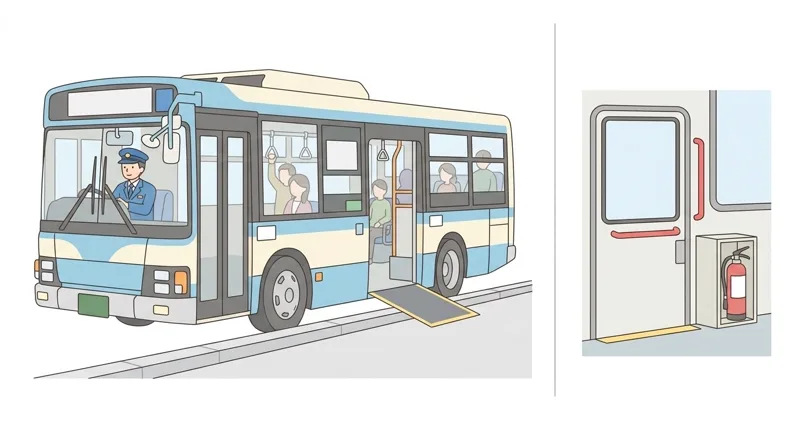
車椅子をご利用のお客様が乗車されるときは、バスを歩道に正着させてパーキングブレーキを引き、ニーリング機能で車高を下げたうえで、中扉(乗降口)に「乗降用スロープ板」を隙間やがたつきがないよう確実に設置します。
When a passenger using a wheelchair boards, dock parallel to the curb, set the parking brake, lower the bus with the kneeling function, and deploy the 'boarding ramp (slope board)' securely at the center door without gaps or wobble.
お客様に声をかけてスロープ上を慎重に車内の車椅子スペースへご案内したら、①車椅子自体のブレーキ(ストッパー)を左右ともかけ、②車内の「車椅子固定装置(タイダウンベルト・4点式固定ベルト等)」で車椅子のフレームをしっかり固定し、③シートベルトを装着します。
After speaking with the passenger and carefully guiding the wheelchair up the ramp into the designated wheelchair space, (1) lock both left and right brakes on the wheelchair itself, (2) secure the wheelchair frame firmly to the floor with the 'wheelchair tie-down belts,' and (3) fasten the passenger seatbelt.
作業中は他の乗客に対しても「ただいま車椅子のお客様をご案内しております。発車までしばらくお待ちください」と丁寧に車内放送を行い、車内全体の理解と協力を得るようにします。
While assisting, make a polite announcement to other passengers on board ('We are currently assisting a passenger with a wheelchair; thank you for your patience before departure') to foster understanding and cooperation.
また、ベビーカーをご利用のお客様がそのまま乗車される場合も、ベビーカーの車輪ストッパー(ロック)をかけてもらい、運転者側の固定用ベルトで座席手すりへ固定するとともに、保護者の方にベビーカーをしっかり支えていただくよう案内します。
When a passenger boards with a baby stroller unfolded, ask the parent/guardian to lock the stroller wheel stoppers, secure the stroller frame to a handrail with the onboard securing strap, and ask the guardian to hold the stroller firmly.
Key points
- ノンステップバスの「ニーリング機能」は車体左側の車高を下げて乗降しやすくする装置である
The 'kneeling function' on a non-step bus lowers the left side of the vehicle to make boarding and alighting easier - 車椅子乗車時はスロープ板を設置して案内後、車椅子のブレーキ・固定装置(ベルト)・シートベルトを確実に装着する
For wheelchair boarding, deploy the ramp, then engage the wheelchair brakes, floor tie-down belts, and seatbelt - ベビーカー乗車時も車輪ロックと固定ベルトを装着し、他の乗客へも丁寧な協力放送を行う
For strollers, lock the stroller wheels and attach the securing strap, while making polite announcements to other passengers
| Word | Meaning |
|---|---|
| ノンステップバス | non-step (low-floor) bus |
| ニーリング機能 | kneeling function (lowering bus boarding side) |
| スロープ板 | wheelchair boarding ramp (slope board) |
| 車椅子固定装置 | wheelchair tie-down / restraint system |
大型バスの車両特性(大きな内輪差・リアオーバーハングの振り出し・高さ制限)
Large Bus Vehicle Characteristics (Large Inner Wheel Difference, Tail Swing, and Height Limits)
大型バスは全長が10〜12メートル、車幅が約2.5メートル、車高が3.2〜3.8メートルにも及ぶ巨大な車両であり、ホイールベース(前輪軸と後輪軸の距離)が非常に長いため、右左折時の「内輪差」が乗用車よりはるかに大きくなります。
A large bus is a massive vehicle measuring 10 to 12 meters long, about 2.5 meters wide, and 3.2 to 3.8 meters tall; because its wheelbase (distance between front and rear axles) is very long, its 'inner wheel difference (nairinsa)' when turning is far larger than that of a passenger car.
そのため、交差点の左折時には後輪が歩道の縁石に乗り上げたり、左側の歩行者や自転車・標識柱を巻き込んだりしないよう、徐行して左バックミラーで後輪の軌跡を終始確認しながら回ります。
When turning left at an intersection, drive at a slow crawl (Joko) and continuously monitor the path of the rear wheels in the left mirror so the rear wheels do not mount the curb or catch pedestrians, cyclists, or signposts.
さらにバス特有の重大な特性として、後輪軸から車体後端までの距離(「リアオーバーハング」)が長いため、ハンドルを切って曲がり始めると、車体の最後部が「曲がる方向とは反対側(外側)」へ最大数十センチメートルから1メートル近くも大きく振り出します。
Furthermore, a critical characteristic of buses is their long 'rear overhang' behind the rear axle: when you turn the steering wheel, the rear end of the bus swings wide toward the 'opposite side of the turn (the outside)' by several dozen centimeters up to nearly 1 meter ('tail swing').
たとえばバス停から右へハンドルを切って発進するときや交差点を右折するときには、車体の左後部が左側(歩道側)へ振り出してバス停の屋根・電柱・待っている乗客に激突する危険があり、左折時には右後部が隣の車線や対向車線へはみ出します。
For example, when pulling out to the right from a bus stop or turning right at an intersection, the rear-left corner swings out toward the sidewalk and can strike bus-stop shelters, utility poles, or waiting passengers; when turning left, the rear-right corner swings into the adjacent right lane.
また、観光バス(ハイデッカー・スーパーハイデッカー)などは車高が高いため、高架下やトンネルの「高さ制限標識」、道路脇の街路樹の枝、ホテルや施設の車寄せ(キャノピー・軒先)の高さを事前に必ず確認し、横風にも十分警戒します。
Because touring coaches (high-deckers and super high-deckers) are very tall, always verify 'height limit signs' at underpasses and tunnels, overhanging tree branches, and hotel porte-cochere canopies in advance, and stay alert for crosswinds.
Key points
- バスはホイールベースが長く内輪差が大きいため、左折時は左ミラーで後輪位置を確認しながら徐行する
Because buses have a long wheelbase and large inner wheel difference, turn left at a slow crawl while watching the rear wheel in the left mirror - リアオーバーハングが長いため、右折・右発進時は「左後部の歩道側への振り出し」、左折時は「右後部の振り出し」に注意する
Due to the long rear overhang, watch for left-rear tail swing toward the sidewalk when turning right, and right-rear tail swing when turning left - 高架下の高さ制限・街路樹の枝・ホテルの軒先・バス停上屋との上部接触に厳重注意する
Always check overhead clearance under bridges, tree branches, hotel canopies, and bus-stop roofs
| Word | Meaning |
|---|---|
| リアオーバーハング | rear overhang (body section behind the rear axle) |
| 振り出し | tail swing (outward swing of the rear end) |
| 車高 | vehicle height |
| 街路樹 | roadside trees |
貸切バス・高速乗合バスの運行実務(運行指示書・シートベルト・EDSS)
Chartered and Highway Express Bus Operations (Operation Instruction Sheet, Seatbelts, and EDSS)
観光バスなどの「貸切バス」や都市間を結ぶ「高速乗合バス」では、高速道路や山岳道路(長い下り坂)を走行する機会が多く、一度事故が起きると多くの命が失われるため、より厳格な安全管理が義務づけられています。
Chartered sightseeing buses ('kashikiri buses') and intercity 'highway express buses' frequently travel on expressways and mountain roads (long downgrades), where any crash can claim many lives, so strict safety management is mandated.
貸切バスの乗務時には、運行管理者が作成した「運行指示書」を必ず携行し、記載された経路や休憩地点・交替運転者配置計画にしたがって運行します。乗客や旅行会社添乗員から予定外の経路変更や速度超過・駐停車禁止場所での乗降を求められても、勝手に応じてはならず必ず運行管理者の指示を仰ぎます。
When operating a chartered bus, always carry the 'Operation Instruction Sheet (Unko Shijisho)' prepared by the Operation Manager and follow the designated route, rest stops, and relief-driver schedule. Even if passengers or a tour conductor request an unscheduled route change, speeding, or stopping in a no-stopping zone, never comply on your own—always contact the Operation Manager for instructions.
発進前には、すべてのお客様に対して「シートベルトの着用」を車内放送や掲示・巡回確認等で徹底し、高速道路走行中にシートベルトを外して車内を歩き回らないよう案内します。
Before departure, thoroughly instruct all passengers via announcements, signs, and visual checks to 'fasten their seatbelts,' and ask them not to unbuckle or walk in the aisle while traveling on expressways.
また、床下の「トランクルーム(荷物室)」にお客様の手荷物やスーツケースを積み卸ししたあとは、走行中にトランク扉が開いて荷物が散乱しないよう、すべてのトランク扉がロックされているかを出発前に指差呼称で確認します。
After loading or unloading passenger luggage in the underfloor 'luggage compartments (trunk rooms),' point and call before departure to verify that all trunk doors are securely latched and locked so they cannot fly open while driving.
さらに近年のバスには、運転者が急病等で運転不能に陥った際に、運転席や客席前部の非常ボタンを押す(またはドライバーモニターが異常を検知する)ことで警報音とハザードランプで周囲に知らせながら自動的にバスを減速・停止させる「ドライバー異常時対応システム(EDSS)」が搭載されています。
Modern buses are also equipped with an 'Emergency Driving Stop System (EDSS)': if the driver becomes incapacitated due to sudden illness, pressing the emergency button (or automatic driver-monitor detection) sounds alarms, flashes hazard lights, and automatically slows and brings the bus to a stop.
Key points
- 貸切バスでは「運行指示書」を携行し、経路変更等は乗客に求められても必ず運行管理者の指示を仰ぐ
Carry the 'Operation Instruction Sheet' on chartered buses and always get Operation Manager approval before any route change - 発進前に全席シートベルト着用の案内と、床下トランクルーム扉のロック確認を徹底する
Ensure all passengers fasten seatbelts and verify that all underfloor luggage compartment (trunk) doors are locked before departure - 運転者の急病時にバスを自動的に減速・停止させる「ドライバー異常時対応システム(EDSS)」を理解しておく
Understand the 'Emergency Driving Stop System (EDSS)' that automatically slows and stops the bus if the driver becomes incapacitated
| Word | Meaning |
|---|---|
| 貸切バス | chartered bus / sightseeing tour coach |
| 高速乗合バス | highway express route bus |
| トランクルーム | underfloor luggage compartment (trunk room) |
| ドライバー異常時対応システム | Emergency Driving Stop System (EDSS) |
非常口・消火器の点検と火災・事故・不審物発見時の避難誘導
Inspecting Emergency Exits & Extinguishers and Evacuating Passengers in Fires, Crashes, or Bomb Threats
乗車定員30人以上のバス等には、事故や火災で通常の乗降扉から出られなくなったときに脱出するための「非常口」が車体後部または右側面後部に設けられています。
Buses with a seating capacity of 30 or more persons are equipped with an 'emergency exit door (hijoguchi)' at the rear or rear-right side so passengers can escape if an accident or fire blocks the normal doors.
日常点検および出庫前には、①非常口の扉がスムーズに開くか・警報ブザーが鳴るか、②非常口付近に荷物等が置かれて通路をふさいでいないか、③車載消火器・発炎筒・停止表示器材・緊急脱出用ハンマー(ガラス割りハンマー)が所定の位置に備えられているかを必ず確認します。
During daily pre-trip inspection, always check that: (1) the emergency exit opens smoothly and its alarm buzzer sounds, (2) no luggage or obstacles block the emergency exit passage, and (3) the fire extinguisher, emergency flare, warning triangle, and emergency glass-breaking hammer are in place.
万が一、トンネル内や高速道路上で車両火災や重大事故が発生したときは、ただちに安全な場所(トンネル内では非常駐車帯や消火栓付近、または可能ならトンネル外)に停車してエンジンを切り、乗客の「避難誘導」を最優先に行います。
If a vehicle fire or serious crash occurs inside a tunnel or on an expressway, immediately stop in a safe place (an emergency bay or outside the tunnel if possible), shut off the engine, and make 'passenger evacuation guidance' your highest priority.
乗客を避難させるときは、パニックにならないよう落ち着いた大きな声で指示し、乗降扉または非常口から後続車にはねられないよう注意して降車させ、火災時は煙が流れてこない「風上側」やガードレールの外側・非常口(避難坑)へ誘導し、全員が脱出したか車内の最後部まで確認します。
Speak calmly and loudly to prevent panic, guide passengers out through the regular doors or emergency exit while watching for oncoming traffic, lead them 'upwind' away from smoke and outside the guardrail (or into a tunnel evacuation passage), and check all the way to the back row to confirm nobody is left aboard.
また、車内点検時に持ち主不明の「不審物(異臭や異音がするもの、危険物の疑いがある袋や箱)」を発見したときは、爆発や有害物質のおそれがあるため「絶対に手を触れたり動かしたり開けたりせず」、直ちに運行停止して乗客を車外の遠くへ避難させ、110番および運行管理者へ通報します。
If you discover a 'suspicious object (fushinbutsu—an unclaimed bag or box emitting strange odors or sounds)' inside the bus, 'never touch, move, or open it'; immediately stop the bus, evacuate all passengers well away from the vehicle, and call 110 and the Operation Manager.
Key points
- 出庫前に非常口の開閉・ブザー作動と、非常口付近に荷物が置かれていないこと、消火器の位置を点検する
Before departure, check emergency exit operation and alarm buzzer, ensure the exit path is clear of luggage, and verify fire extinguisher placement - 火災・事故発生時は乗客の避難誘導(風上側・ガードレール外側)を最優先し、車内に取り残しがないか最後部まで確かめる
In a fire or crash, prioritize evacuating passengers upwind and outside the guardrail, and check the entire cabin to ensure nobody is left behind - 車内で不審物を見つけたときは絶対に触れず、乗客を車外の遠くへ避難させて110番通報する
If a suspicious object is found aboard, never touch or move it—evacuate passengers far from the bus and call 110
| Word | Meaning |
|---|---|
| 非常口 | emergency exit door |
| 避難誘導 | evacuation guidance |
| 不審物 | suspicious object / unattended package |
| 車載消火器 | onboard fire extinguisher |
Bus: Operations and Passenger Safety
Practice this chapter in the appOfficial references
- 日本バス協会(NBA)特定技能1号 バス運転者 学習用テキスト(安全・接遇・法令) — https://www.bus.or.jp/tokuteiginou/
- 国土交通省 路線バス・貸切バスの安全運行及び車内事故防止ガイドライン — https://www.mlit.go.jp/jidosha/anzen/03safety/bus.html