
Japanese Traffic Laws, Road Signs, and the Improvement Standards Notification
日本の交通法令・標識と改善基準告示
Automobile Transportation · 自動車運送業 · Written by Tokutei Pass based on the official study texts; not copied verbatim.
プロドライバーの社会的責任と左側通行の原則
Social Responsibility of Professional Drivers and the Keep-Left Principle
自動車運送事業(トラック・タクシー・バス)の運転者は、営業用自動車(緑ナンバー)を運転して大切な人命や荷物を運ぶプロドライバーであり、一般の運転者の模範となる高い安全意識と社会的責任が求められます。
Drivers in the motor transport business (trucks, taxis, and buses) who operate commercial vehicles (green license plates) carrying precious human lives and cargo are professional drivers required to maintain high safety awareness and social responsibility as role models for general drivers.
日本の道路交通法(第17条・第18条)では、すべての車両は道路の中央から左の部分を通行する「左側通行」が原則と定められており、車両通行帯のない道路では道路の左端に寄って通行しなければなりません。
Under Japan's Road Traffic Act (Articles 17 and 18), all vehicles must follow the principle of 'keep-left traffic' (driving on the left side of the center of the road), and on roads without marked traffic lanes, vehicles must keep toward the left edge of the road.
片側に2つ以上の車両通行帯がある道路では、原則として一番左側の通行帯を走行し、一番右側の通行帯は追い越しや右折などのために空けておく必要があります。
On roads with two or more traffic lanes in one direction, vehicles must in principle travel in the leftmost lane and leave the rightmost lane clear for overtaking or turning right.
また、歩道や路側帯を横切って道路外の施設や営業所・駐車場へ入るときは、その直前で必ず一時停止し、歩行者の通行を妨げないよう左右の安全を確かめなければなりません。
Furthermore, when crossing a sidewalk or roadside strip to enter an off-road facility, depot, or parking lot, you must come to a complete stop immediately before crossing and check left and right so as not to impede pedestrians.
さらに、安全運転の5原則である「安全速度を必ず守る」「カーブの手前ではスピードを落とす」「交差点では必ず安全を確かめる」「一時停止で横断歩行者を守る」「飲酒運転は絶対にしない」を日頃から徹底することが、プロドライバーとしての第一歩となります。
In addition, thoroughly practicing the Five Principles of Safe Driving—obeying safe speeds, slowing down before curves, checking safety at intersections, stopping to protect pedestrians at crosswalks, and never driving under the influence of alcohol—is the first step as a professional driver.
Key points
- 営業用自動車(緑ナンバー)の運転者は安全運転の模範となる責任を負う
Drivers of commercial vehicles (green plates) bear the responsibility of being role models for safe driving - 日本の道路は左側通行が原則であり、複数車線では原則一番左の通行帯を走る
Japanese roads follow the keep-left principle, and on multi-lane roads vehicles travel in the leftmost lane in principle - 歩道や路側帯を横切るときは直前で一時停止して歩行者を優先する
Always come to a complete stop immediately before crossing a sidewalk or roadside strip and yield to pedestrians
| Word | Meaning |
|---|---|
| 営業用自動車 | commercial motor vehicle (green plate) |
| 左側通行 | keep-left traffic |
| 車両通行帯 | vehicular traffic lane |
| 路側帯 | roadside strip |
信号機の意味と道路標識・道路標示の遵守
Meanings of Traffic Signals and Compliance with Road Signs and Markings
信号機の「黄色の灯火」は「加速して進め」という意味ではなく、原則として「停止線を越えて進んではならない(止まれ)」という意味であり、停止位置に近づきすぎて安全に止まれない場合に限り進行できます。
A solid yellow traffic light does NOT mean 'accelerate and proceed'; in principle it means 'do not proceed beyond the stop line (Stop),' and you may proceed only if you are already so close to the stop line that you cannot stop safely.
夜道などで見られる「黄色の点滅信号」は他の交通に注意して進むことができ、「赤色の点滅信号」は停止位置で必ず一時停止し、安全を確認したあとでなければ進むことができません。
At a 'flashing yellow light,' you may proceed while watching cautiously for other traffic; at a 'flashing red light,' you must come to a complete stop at the stop line and may proceed only after confirming safety.
道路標識には、本標識(案内標識・警戒標識・規制標識・指示標識の4種類)と、その下に付けられて対象車種や時間帯・区間を示す「補助標識」があります。
Road signs consist of four types of main signs (guide signs, yellow diamond warning signs, regulatory signs, and instruction signs) along with 'auxiliary signs' mounted below them to specify applicable vehicle types, hours, or zones.
特に赤い逆三角形の「一時停止(止まれ)」標識、車両進入禁止・通行止め、最高速度、最大幅や高さ制限・重量制限の規制標識は、大型車や営業車の運転において確実に守らなければなりません。
In particular, the red inverted-triangle 'Stop (Tomare)' sign, No Entry, Road Closed, Maximum Speed, and width, height, and weight limit signs must be strictly obeyed when operating commercial and large vehicles.
また、路面に描かれた「道路標示」には規制標示と指示標示があり、黄色の実線で示された中央線(はみ出し通行禁止)や車両通行帯境界線(進路変更禁止)の意味も正確に理解して走行しなければなりません。
Road markings painted on the pavement also include regulatory and instruction markings; drivers must accurately understand solid yellow center lines (no crossing the center line for overtaking) and solid yellow lane lines (no lane changing).
Key points
- 黄色の灯火信号は原則「停止線の手前で停止」、赤色の点滅信号は「一時停止」
A solid yellow light means 'stop before the stop line' in principle; a flashing red light means 'come to a complete stop' - 本標識は案内・警戒・規制・指示の4種類に分かれる
Main road signs are divided into four categories: guide, warning, regulatory, and instruction signs - 高さ制限・最大幅・重量制限および補助標識の条件を確実に見極める
Carefully check height, width, and weight limit signs as well as the conditions shown on auxiliary signs
| Word | Meaning |
|---|---|
| 点滅信号 | flashing traffic signal |
| 警戒標識 | warning sign |
| 規制標識 | regulatory sign |
| 補助標識 | auxiliary sign |
最高速度・車間距離・徐行と一時停止
Maximum Speeds, Following Distance, Slowing Down (Joko), and Stopping
道路標識等で最高速度が指定されていない一般道路では、自動車の法定最高速度は時速60キロメートルです。また、高速自動車国道の本線車道における法定最高速度は、大型貨物自動車(大型トラック)が時速80キロメートル、普通乗用車や大型乗用自動車(バス)が時速100キロメートルです。
On general roads where no maximum speed sign is posted, the statutory speed limit for motor vehicles is 60 km/h. On the main through lanes of national expressways, the statutory maximum speed is 80 km/h for large cargo trucks and 100 km/h for standard passenger cars and large buses.
追突事故を防ぐため、前の車が急停止してもこれに追突しないような十分な「車間距離」を保たなければなりません。特に大型トラックやバス、空車時より重い実車時は制動距離が長くなり、雨天や路面凍結時には乾燥路面の2倍以上の車間距離が必要です。
To prevent rear-end collisions, you must maintain a sufficient 'following distance' so that you will not hit the vehicle ahead even if it stops suddenly. Large trucks, buses, and loaded vehicles have longer braking distances, and on wet or icy roads you need at least twice the following distance required on dry pavement.
「徐行」とは、車が直ちに停止できるような速度(おおむね時速10キロメートル以下、ブレーキをかけてから約1メートル以内で止まれる速度)で進行することをいいます。
'Slowing down (Joko / driving at a crawl)' means proceeding at a speed at which the vehicle can stop immediately (generally 10 km/h or less, able to stop within about 1 meter of applying the brakes).
見通しのきかない交差点(優先道路や信号機のある場合を除く)、道路の曲がり角付近、上り坂の頂上付近、および勾配の急な下り坂では、必ず徐行しなければなりません。
Drivers are legally required to drive at a slow crawl (Joko) at blind intersections (except when on a priority road or controlled by traffic signals), near road corners/bends, near the crest of an uphill slope, and on steep downhill grades.
さらに、一時停止の道路標識がある交差点や踏切を通過するときは、徐行で通過するのではなく、停止線の直前で車輪の回転が完全に止まるまで確実に一時停止し、自分の目で左右の安全を確かめてから発進します。
Furthermore, at intersections with a Stop sign or at railway crossings, do not merely roll through slowly; bring the wheels to a complete stop immediately before the stop line and visually confirm safety left and right before pulling out.
Key points
- 法定最高速度は一般道路60km/h、高速道路本線は大型貨物80km/h・普通車や大型乗用(バス)100km/h
Statutory speed limits: 60 km/h on general roads; on national expressways, 80 km/h for large trucks and 100 km/h for passenger cars and large buses - 徐行とは直ちに停止できる速度(おおむね10km/h以下)で進むこと
Slowing down (Joko) means driving at a speed able to stop immediately (roughly 10 km/h or less) - 見通しのきかない交差点・曲がり角・上り坂の頂上付近・急な下り坂は徐行場所
Mandatory Joko locations: blind intersections, road bends, near the crest of an uphill slope, and steep downhill slopes
| Word | Meaning |
|---|---|
| 法定最高速度 | statutory maximum speed |
| 車間距離 | following distance |
| 制動距離 | braking distance |
| 徐行 | slowing down / driving at a crawl (joko) |
交差点の通行・横断歩道の歩行者保護・追い越しと駐停車禁止
Intersections, Pedestrian Protection at Crosswalks, Overtaking, and No Stopping/Parking
交差点を左折するときは、あらかじめできるだけ道路の左端に寄り、十分に速度を落として徐行しながら通行します。右折するときは、あらかじめ道路の中央に寄り、交差点の中心のすぐ内側を徐行しなければなりません。
When turning left at an intersection, move as close as possible to the left edge of the road in advance and turn at a slow crawl (Joko). When turning right, move toward the center of the road in advance and pass just inside the center of the intersection at a slow crawl.
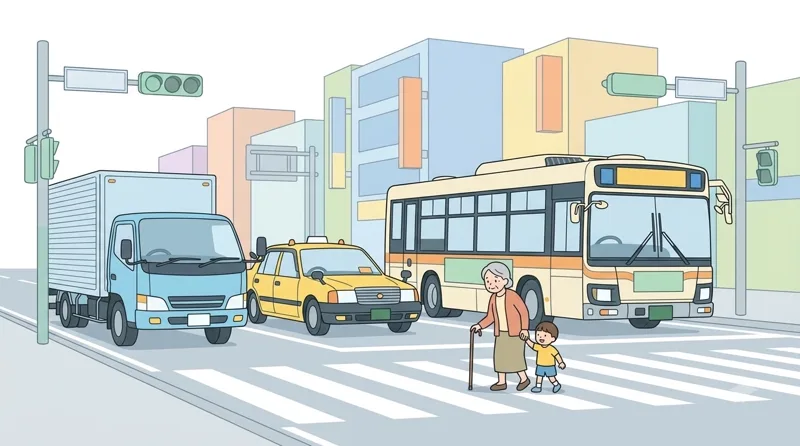
横断歩道や自転車横断帯に近づいたとき、横断しようとしている歩行者等がいる場合は、停止線(または横断歩道)の手前で必ず一時停止して通行を妨げてはなりません(道路交通法第38条)。
When approaching a pedestrian crosswalk or bicycle crossing zone, if any pedestrian or cyclist is crossing or about to cross, you must come to a complete stop before the stop line (or crosswalk) and yield the right of way (Road Traffic Act Article 38).
また、横断歩道や自転車横断帯と、その手前30メートル以内の部分では、他の自動車や原動機付自転車を追い越したり追い抜いたりすることが固く禁止されています。
In addition, on a crosswalk or bicycle crossing zone and within 30 meters before it, overtaking or passing any other motor vehicle or moped is strictly prohibited.
駐停車については、交差点・横断歩道・踏切・軌道敷内・坂の頂上付近・勾配の急な坂・トンネル、および交差点や横断歩道の端から5メートル以内、バス停留所の標示板から10メートル以内(運行時間中)などは「駐停車禁止場所」です。
Regarding stopping and parking: intersections, crosswalks, railway crossings, streetcar tracks, near hill crests, steep slopes, tunnels, within 5 meters of the edge of an intersection or crosswalk, and within 10 meters of a bus stop sign (during operating hours) are 'No Stopping and No Parking zones.'
また、駐車のみが禁止される「駐車禁止場所」として、火災報知器から1メートル以内、駐車場や車庫の出入口から3メートル以内、道路工事の区域の端から5メートル以内、および消火栓や消防用防火水槽の吸管投入孔から5メートル以内の部分も覚えておく必要があります。
You must also remember key 'No Parking zones': within 1 m of a fire alarm, within 3 m of a driveway or garage entrance, within 5 m of the edge of a road construction zone, and within 5 m of a fire hydrant or fire cistern intake.
Key points
- 横断歩道に横断しようとする歩行者がいるときは直前で必ず一時停止する
Always come to a complete stop before a crosswalk whenever a pedestrian is crossing or about to cross - 横断歩道とその手前30メートル以内は追い越し・追い抜きがともに禁止
Both overtaking (oikoshi) and passing (oinuki) are prohibited on a crosswalk and within 30 meters before it - 交差点や横断歩道の端から5m以内、バス停から10m以内・踏切から10m以内は駐停車禁止
Stopping and parking are prohibited within 5 m of an intersection or crosswalk, and within 10 m of a bus stop or railway crossing
| Word | Meaning |
|---|---|
| 横断歩道 | pedestrian crosswalk |
| 追い越し | overtaking (changing lanes) |
| 追い抜き | passing (without changing lanes) |
| 駐停車禁止 | no stopping and no parking |
緊急自動車・路線バスの優先と高速道路の走行ルール
Yielding to Emergency Vehicles and Route Buses, and Expressway Rules
サイレンを鳴らし赤色の警光灯をつけた緊急自動車(救急車・消防車・パトカーなど)が接近してきたときは、交差点およびその付近では交差道路を避けて道路の左側に寄り、必ず一時停止して進路を譲らなければなりません(単路では左側に寄って進路を譲ります)。
When an emergency vehicle sounding its siren and flashing its red warning lights (ambulance, fire engine, police car) approaches, if you are at or near an intersection you must clear the intersection, pull over to the left side of the road, and come to a complete stop to yield (on a regular road section, pull to the left to yield).
また、停留所に止まっていた路線バスが発進の合図(右ウインカー)を出したときは、急な減速や車線変更を強いられる場合を除き、その路線バスの発進を妨げてはなりません(道路交通法第31条の2)。
Furthermore, when a route bus stopped at a bus stop signals with its right turn indicator to pull out, following vehicles must not impede its departure unless doing so would require sudden braking or swerving (Road Traffic Act Article 31-2).
高速道路へ入る前には、燃料や冷却水、タイヤの空気圧(少ないとスタンディングウェーブ現象が起きてバーストする危険がある)および積荷の固縛状態を特に念入りに点検します。
Before entering an expressway, carefully inspect fuel, coolant, tire pressure (low tire pressure at high speed causes the standing-wave phenomenon and tire blowouts), and cargo securing.
高速道路上で故障等によりやむを得ず駐停車するときは、路肩や非常駐車帯に寄せてハザードランプを点灯し、車両の後方に停止表示器材(三角表示板)や発炎筒を置いたうえで、乗員・乗客は車内に残らずガードレールの外側へ避難します。
If forced to stop on an expressway due to a breakdown, pull onto the shoulder or emergency bay, turn on hazard lights, place a warning triangle and flare behind the vehicle, and evacuate all occupants outside the guardrail rather than staying inside the vehicle.
高速道路の本線車道へ入るときは「加速車線」で十分に加速してから本線へ合流し、高速道路から出るときは本線車道では減速せず、「減速車線」に入ってから確実に速度を落とすことが追突防止の基本です。
When entering an expressway, accelerate sufficiently in the 'acceleration lane' before merging into the main lanes; when exiting, avoid slowing down in the main lane and decelerate only after entering the 'deceleration lane' to prevent rear-end crashes.
Key points
- 交差点付近で緊急自動車が接近したときは交差道路を避けて左側に寄り一時停止する
Near an intersection, pull to the left clear of the cross street and come to a complete stop for approaching emergency vehicles - タイヤの空気圧不足で高速走行すると「スタンディングウェーブ現象」によるバーストが起きる
High-speed driving with underinflated tires causes the 'standing-wave phenomenon,' leading to a tire blowout - 高速道路での故障停車時は停止表示器材を設置しガードレールの外側へ避難する
During an expressway breakdown, set up a warning triangle behind the vehicle and evacuate outside the guardrail
| Word | Meaning |
|---|---|
| 緊急自動車 | emergency vehicle |
| 警光灯 | warning light / beacon |
| 停止表示器材 | warning triangle / stop signaling device |
| 発炎筒 | emergency flare |
改善基準告示(2024年改正):拘束時間と休息期間
Improvement Standards Notification (2024 Revision): Binding Hours and Rest Periods
自動車運転者の過労運転を防ぐため、厚生労働大臣が定めた「自動車運転者の労働時間等の改善のための基準(改善基準告示・2024年4月施行)」により、拘束時間・休息期間・運転時間のルールが厳格に定められています。
To prevent fatigued driving among motor vehicle drivers, the 'Standards for Improving Working Hours of Motor Vehicle Drivers (Improvement Standards Notification, effective April 2024)' issued by the Minister of Health, Labour and Welfare strictly regulates binding hours, rest periods, and driving hours.
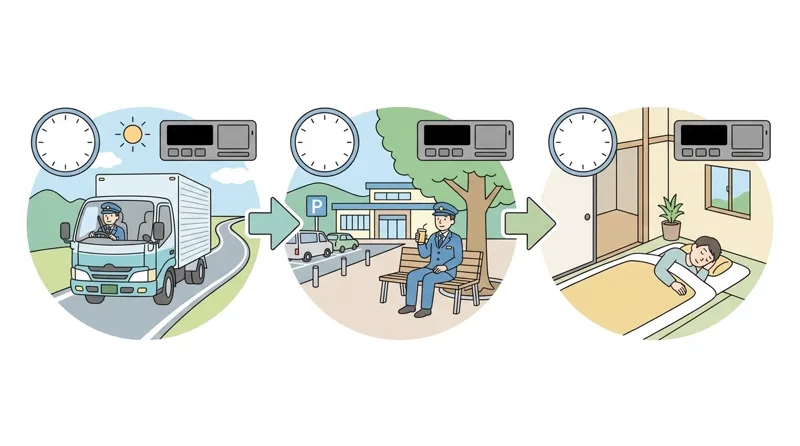
「拘束時間」とは、始業(出勤)から終業(退勤)までの全時間(運転時間+荷役・点検等の作業時間+休憩時間)を指し、トラック・タクシー・バスともに1日の拘束時間は「原則13時間以内」(上限でも最大15時間以内)です。
'Binding time (Kosoku jikan)' refers to the total time from clocking in to clocking out (driving time + cargo/inspection work time + break time). Across trucks, day-shift taxis, and buses, daily binding time is '13 hours or less in principle' (with a maximum cap of 15 hours).
「休息期間」とは、勤務と次の勤務の間にある自由に過ごせる睡眠・休養時間のことです。改正改善基準告示では、1日の休息期間は「継続11時間以上与えるよう努めることを基本とし、継続9時間を下回ってはならない」と定められています。
'Rest period (Kyusoku kikan)' refers to the off-duty free time for sleep and rest between one shift and the next. Under the revised notification, the daily rest period 'shall basically strive to be a continuous 11 hours or more, and must never be less than a continuous 9 hours.'
1年および1か月の拘束時間についても、トラックは原則年3,300時間以内(最大3,400時間)、バスは原則年3,300時間以内(最大3,400時間)、タクシー(日勤)は年2,880時間以内・月288時間以内などの上限が設けられています。
Annual and monthly binding-hour caps are also set: for trucks and buses, 3,300 hours per year in principle (3,400 hours maximum), and for day-shift taxis, 2,880 hours per year and 288 hours per month.
なお、トラックの休息期間については、業務の必要上やむを得ない場合に設けられている「分割休息(1回あたり継続3時間以上、2分割で合計10時間以上・3分割で合計12時間以上)」や、フェリー乗船時間を原則として休息期間として扱う特例も定められています。
In addition, for truck drivers, the rules provide exceptions when operationally unavoidable, such as 'split rest periods (each at least 3 continuous hours, totaling at least 10 hours for 2 splits or 12 hours for 3 splits)' and counting ferry boarding time toward the rest period in principle.
Key points
- 1日の拘束時間はトラック・タクシー(日勤)・バスともに「原則13時間以内・最大15時間以内」
Daily binding time for trucks, day-shift taxis, and buses is '13 hours or less in principle, 15 hours maximum' - 勤務終了後の休息期間は「継続11時間以上を基本とし、継続9時間を下回らない」
Off-duty rest period between shifts is 'basically a continuous 11 hours or more, and never less than a continuous 9 hours' - 拘束時間には運転時間だけでなく荷役・点検作業や休憩時間も含まれる
Binding time includes not only driving time but also cargo handling, vehicle inspection, and break time
| Word | Meaning |
|---|---|
| 改善基準告示 | Improvement Standards Notification |
| 拘束時間 | binding time (total shift time) |
| 休息期間 | off-duty rest period (between shifts) |
| 過労運転 | fatigued / overworked driving |
連続運転時間の制限(4時間以内)と1日の運転時間
Continuous Driving Time Limit (Max 4 Hours) and Daily Driving Hours
改善基準告示により、トラックおよびバスの「連続運転時間」は「4時間以内」と定められています。運転開始後4時間以内または4時間経過直後に、合計30分以上の休憩等を確保して運転を中断しなければなりません。
Under the Improvement Standards Notification, the 'continuous driving time' for both trucks and buses is limited to '4 hours or less.' Within 4 hours of starting to drive or immediately after 4 hours have elapsed, the driver must interrupt driving to take a total of at least 30 minutes of breaks or non-driving time.
この運転中断(合計30分以上)を分割してとる場合は、トラックでは「1回おおむね10分以上」、バスでは「1回10分以上」のまとまった時間でなければ運転中断時間としてカウントされません。
When splitting this driving interruption (totaling 30 minutes or more), each segment must be 'roughly 10 minutes or more' for trucks and 'at least 10 minutes' for buses to be counted as a valid driving break.
また、1日あたりの運転時間は、2日間(特定の日を起算日とする2日間)を平均して「1日あたり9時間以内」に収めなければなりません。
Furthermore, daily driving time must not exceed '9 hours per day' when averaged over any 2-day period.
さらに週単位の運転時間についても、トラックでは2週間を平均して1週間あたり44時間以内、バスでは4週間を平均して1週間あたり40時間以内という上限基準が定められています。
Weekly driving time is also capped: for trucks, an average of 44 hours or less per week over 2 weeks; for buses, an average of 40 hours or less per week over 4 weeks.
なお、高速道路のサービスエリア(SA)やパーキングエリア(PA)が満車で駐車できないなど、予期し得ない事象に遭遇した場合や、運行上やむを得ない場合の特例(連続運転時間を最大4時間30分まで延長可など)もありますが、通常時は4時間以内に早めの休憩をとることが鉄則です。
Although special provisions exist for unforeseen events (such as expressway SA/PA parking areas being full) or unavoidable operational cases allowing an extension up to 4 hours 30 minutes, the standard rule in normal operations is always to take an early break within 4 hours.
Key points
- 連続運転時間の上限は「4時間」であり、合計30分以上の休憩等(分割時は1回10分以上)をとる
Continuous driving is capped at '4 hours,' requiring a total break of at least 30 minutes (at least 10 minutes per split break) - 1日の運転時間は「2日平均で1日あたり9時間以内」
Daily driving time is limited to 'an average of 9 hours or less per day over 2 days' - 週間運転時間はトラックが2週平均44時間以内、バスが4週平均40時間以内
Weekly driving time is capped at a 2-week average of 44 hours/week for trucks and a 4-week average of 40 hours/week for buses
| Word | Meaning |
|---|---|
| 連続運転時間 | continuous driving time |
| 運転中断 | interruption of driving (break) |
| 分割 | splitting / dividing |
| 起算日 | starting date for calculation |
Traffic Laws and Road Signs
Practice this chapter in the appOfficial references
- JTA 特定技能1号 共通科目(トラック・タクシー・バス)学習用テキスト 第1章・第2章 — https://jta.or.jp/member/shien/tokuteiginou.html
- 厚生労働省 自動車運転者の労働時間等の改善のための基準(改善基準告示) — https://www.mhlw.go.jp/stf/seisakunitsuite/bunya/koyou_roudou/roudoukijun/gyosyu/roudoujouken05/index.html