
Fundamentals of Safe Driving, Hazard Prediction (KYT), and Adverse-Weather Driving
安全運転の基本・危険予知と悪天候時等の運転
Automobile Transportation · 自動車運送業 · Written by Tokutei Pass based on the official study texts; not copied verbatim.
「だろう運転」から「かもしれない運転」への転換とKYT
Shifting from 'Wishful Driving (Daro)' to 'Defensive Driving (Kamoshirenai)' and KYT
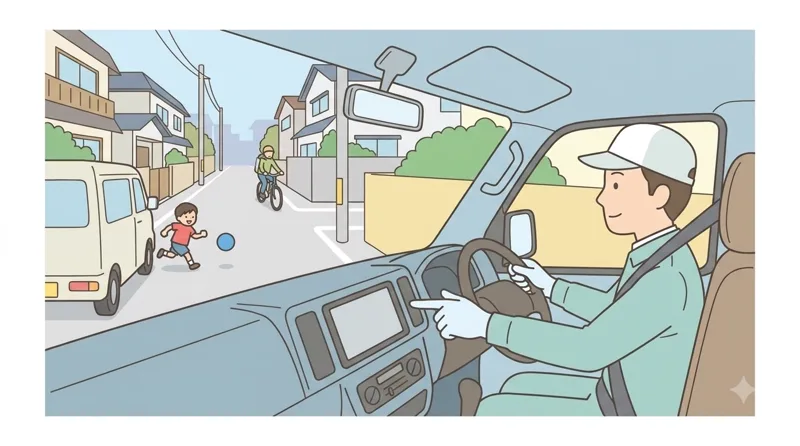
交通事故の多くは、「人や車は出てこないだろう」と自分の都合のよいように思い込んで運転する「だろう運転」が原因で発生します。
Many traffic accidents are caused by 'wishful driving (daro-unten)'—assuming whatever is convenient for oneself, such as 'no pedestrian or car will probably come out.'
プロドライバーは常に、「物陰から子どもが飛び出してくるかもしれない」「前の車が急停止するかもしれない」と危険を予測して備える「かもしれない運転(防衛運転)」を徹底しなければなりません。
Professional drivers must always practice 'defensive hazard-predicting driving (kamoshirenai-unten),' anticipating potential dangers such as 'a child might dart out from behind that obstacle' or 'the car ahead might stop suddenly.'
運転中は、「認知(危険を発見する)→判断(どう対処するか決める)→操作(ハンドルやブレーキを動かす)」の3段階を繰り返しており、いずれか1つでも遅れたり誤ったりすると事故につながります。
Driving continuously cycles through three stages: 'Recognition (spotting a hazard) -> Judgment (deciding how to respond) -> Operation (steering or braking)'; a delay or error in any single stage leads to an accident.
交通場面の写真やイラストを使って潜んでいる危険要因を見つけ出し、安全な対処法を考える「危険予知訓練(KYT)」を日頃から行うことで、危険を素早く見抜く力を養うことができます。
Regularly practicing 'Hazard Prediction Training (KYT)'—using photos or illustrations of traffic scenes to identify hidden hazards and plan safe responses—develops the ability to spot dangers early.
また、運転中にスマートフォンやカーナビの画面を注視したり通話したりする「ながら運転」は、前方への注意が全く欠落して重大な死亡事故を引き起こすため、道路交通法により厳しく罰せられます。
Furthermore, 'distracted driving (nagara-unten)'—such as looking at a smartphone or navigation screen or talking on a hand-held phone while driving—completely removes attention from the road ahead, causes fatal accidents, and is severely penalized under the Road Traffic Act.
Key points
- 思い込みによる「だろう運転」をやめ、危険を予測する「かもしれない運転」を徹底する
Abandon wishful 'daro-unten' and thoroughly practice hazard-anticipating 'kamoshirenai-unten' - 運転行動は「認知→判断→操作」の3段階で行われる
Driving behavior consists of three stages: 'Recognition -> Judgment -> Operation' - 危険予知訓練(KYT)により交通場面に潜む危険を早期に発見する力を高める
Use Hazard Prediction Training (KYT) to sharpen your ability to detect hidden traffic dangers early
| Word | Meaning |
|---|---|
| 危険予知訓練 | Hazard Prediction Training (KYT) |
| 防衛運転 | defensive driving |
| 認知 | recognition / perception |
| 危険要因 | hazard factor |
停止距離(空走距離+制動距離)と衝撃力の法則
Stopping Distance (Reaction Distance + Braking Distance) and Impact Force
運転者が前の危険に気づいてから車が完全に止まるまでに走る距離を「停止距離」といい、「空走距離」と「制動距離」を足し合わせたものになります。
The total distance a vehicle travels from the moment the driver perceives a hazard ahead until the vehicle comes to a complete stop is called the 'stopping distance (teishi kyori),' which equals the 'reaction distance (kuso kyori)' plus the 'braking distance (seido kyori).'
「空走距離」は危険を発見してからブレーキが効き始めるまでに走る距離であり、運転者の疲労や漫然運転・わき見によって長くなります。「制動距離」はブレーキが効き始めてから車が止まるまでの距離です。
'Reaction distance' is the distance traveled from spotting the hazard until the brakes actually begin to take effect, and it lengthens when the driver is fatigued or distracted. 'Braking distance' is the distance from when the brakes take effect until the vehicle stops.
制動距離や衝突時の衝撃力(運動エネルギー)は、「速度の2乗」に比例して大きくなります。つまり、速度が2倍になると制動距離は約4倍、速度が3倍になると約9倍に伸びます。
Braking distance and collision impact force (kinetic energy) increase in proportion to the 'square of the speed.' That means doubling your speed quadruples the braking distance, and tripling your speed multiplies it by about nine times.
さらに、車両の重量(重さ)が重いほど運動エネルギーは大きくなり、雨で濡れた路面やすり減ったタイヤでは摩擦係数が下がるため、制動距離はさらに大幅に長くなります。
Moreover, the heavier the vehicle weight, the greater its kinetic energy; and on rain-slicked roads or with worn tires, lower friction causes the braking distance to increase dramatically.
特にトラックに多くの荷物を積んでいる実車時や、バスに多くの乗客が乗っているときは、空車時と比べて車がすぐには止まれないことを常に意識し、早めのブレーキとゆとりある車間距離を心がけます。
Especially when a truck is loaded with cargo or a bus is carrying many passengers, always keep in mind that the vehicle cannot stop as quickly as when empty, and practice early braking and generous following distances.
Key points
- 停止距離=空走距離(判断・操作までの距離)+制動距離(ブレーキが効いてからの距離)
Stopping distance = Reaction distance (perception & pedal movement) + Braking distance (after brakes engage) - 制動距離と衝突時の衝撃力は「速度の2乗」に比例して大きくなる(速度2倍で約4倍)
Braking distance and impact force increase with the 'square of speed' (2x speed = ~4x braking distance) - 疲労やわき見は空走距離を伸ばし、雨天・凍結路面や重積載は制動距離を伸ばす
Fatigue and distraction lengthen reaction distance; wet/icy roads and heavy loads lengthen braking distance
| Word | Meaning |
|---|---|
| 停止距離 | stopping distance |
| 空走距離 | reaction / free-running distance |
| 衝撃力 | impact force |
| 比例 | proportion |
内輪差・外輪差・オーバーハングと死角への注意
Inner/Outer Wheel Difference, Rear Overhang, and Blind Spots
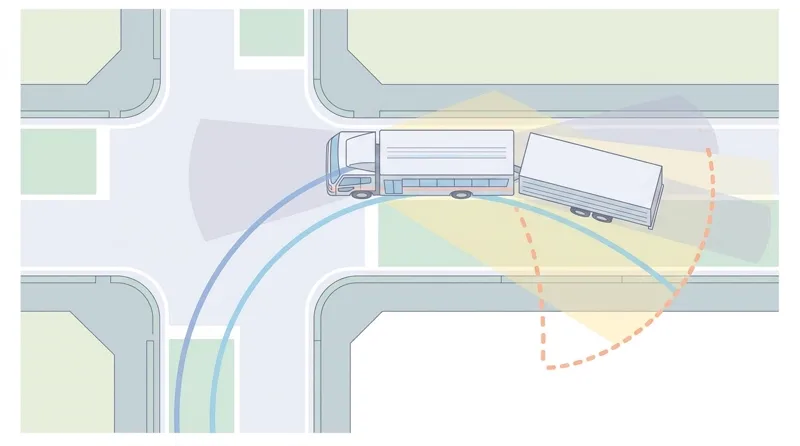
自動車が曲がるとき、後輪は前輪よりも内側を通ります。この前輪と後輪の通る軌跡の差を「内輪差」といい、ホイールベース(前輪と後輪の軸間距離)が長い大型トラックや大型バスほど内輪差が大きくなります。
When a motor vehicle turns, the rear wheels track closer to the inside of the turn than the front wheels. This difference in path between the front and rear wheels is called 'inner wheel difference (nairinsa),' and the longer the wheelbase—as on large trucks and buses—the larger the inner wheel difference.
交差点を左折するときは、この内輪差と車体左側の死角によって、左後方を直進してくる自転車や原付バイク、歩行者を巻き込む「左折巻き込み事故」が大変起きやすいため、左ミラーと目視で確実に確認します。
When turning left at an intersection, inner wheel difference combined with the left-side blind spot easily causes 'left-turn catching accidents (makikomi)' involving bicycles, mopeds, and pedestrians coming from the rear left, so you must check the left mirrors and blind spot directly.
このとき、内輪差を避けようとして一旦右へハンドルを切ってから左折する「あおりハンドル」は、右側の車線の車と衝突したり、左後方の二輪車に「右折する」と誤解させたりするため絶対に行ってはなりません。
Never swing the steering wheel to the right before turning left ('aori-handoru' / wide swing turn) to compensate for inner wheel difference, as doing so causes collisions with traffic in the right lane and misleads cyclists behind you into thinking you are turning right.
また、後輪より後ろの車体部分(リアオーバーハング)が長いバスやトラックでは、ハンドルを切った反対側(旋回外側)へ車体後部が大きく振り出すため、発進時や右左折時には反対側のミラーも必ず確かめます。
Additionally, on buses and trucks with a long rear overhang behind the rear axle, the rear of the vehicle swings wide toward the outside of the turn (opposite the steering direction), so always check the opposite-side mirror as well when pulling out or turning.
さらに、車両を後退(バック)させるときは、バックモニターやミラーだけに頼らず、必ず窓を開けるか一度車から降りて車両直後の死角に人や障害物がないかを直接自分の目で確かめてから動かします。
Furthermore, when reversing (backing up), never rely solely on the backup camera or mirrors; always roll down the window or step out of the vehicle first to check the blind spot directly behind the vehicle with your own eyes.
Key points
- ホイールベースが長い大型車ほど「内輪差」が大きく、左折時の巻き込み事故に注意する
Vehicles with a longer wheelbase have a larger 'inner wheel difference (nairinsa),' requiring extra care against left-turn catching accidents - 左折前に一旦右へ振る「あおりハンドル」は大変危険であり厳禁
Swinging wide to the right before turning left ('aori-handoru') is extremely dangerous and strictly prohibited - リアオーバーハングが長い車両は旋回時に反対側へ車体後部が振り出すことに注意する
On vehicles with a long rear overhang, watch out for the tail swinging out toward the opposite side when turning
| Word | Meaning |
|---|---|
| 内輪差 | inner wheel difference / off-tracking |
| 巻き込み事故 | turning-in / catching accident |
| 死角 | blind spot |
| 軸間距離 | wheelbase (axle distance) |
カーブ・坂道の走行とブレーキのフェード・ベーパーロック現象
Driving on Curves and Slopes, Brake Fade, and Vapor Lock
カーブを走行するとき、車には外側へ飛び出そうとする「遠心力」が働きます。遠心力は「速度の2乗」に比例して大きくなり、カーブの半径が小さい(急なカーブである)ほど大きくなります。
When a vehicle travels around a curve, 'centrifugal force (enshinryoku)' acts to push the vehicle outward. Centrifugal force increases in proportion to the 'square of the speed' and becomes stronger as the curve radius becomes smaller (sharper).
そのため、カーブの手前の直線部分で十分に速度を落とし、カーブの途中で急ブレーキや急ハンドルを使わずに回ることが横転事故や車線逸脱を防ぐ鉄則です。
Therefore, the iron rule for preventing rollover and lane-departure accidents is to slow down sufficiently on the straight section BEFORE entering the curve, avoiding hard braking or sharp steering inside the curve.
長い下り坂でフットブレーキばかりを使い続けると、摩擦熱でブレーキライニング(パッド)が過熱して摩擦力が低下する「フェード現象」や、ブレーキ液が沸騰して気泡が生じブレーキが効かなくなる「ベーパーロック現象」が起こります。
Using the foot brake continuously down a long downgrade causes friction heat to overheat the brake linings and reduce friction ('brake fade'), or boils the brake fluid to create vapor bubbles so the brakes fail ('vapor lock').
また、エアブレーキ車でブレーキを繰り返し踏みすぎると空気圧が不足してブレーキが効かなくなるため、下り坂では低速ギアによるエンジンブレーキや排気ブレーキ・リターダーを積極的に併用します。
In addition, repeatedly pumping the brakes on an air-brake vehicle depletes compressed air pressure; therefore, always shift to a low gear on downgrades and actively use engine braking together with the exhaust brake or retarder.
もし下り坂でブレーキの効きが悪くなったと感じたときは、ただちにギアをさらに低い段へ落として強力なエンジンブレーキを効かせ、道路脇の待避所(緊急待避所)などを利用して速やかに車両を停止させます。
If you feel brake effectiveness fading on a downgrade, immediately shift down to an even lower gear to apply strong engine braking and bring the vehicle to a safe stop using a roadside emergency escape ramp or pull-off area.
Key points
- カーブでの遠心力は「速度の2乗」に比例するため、カーブの手前で十分に減速する
Centrifugal force on a curve increases with the 'square of speed,' so slow down thoroughly before the curve - 長い下り坂でのフットブレーキの使いすぎは「フェード現象」や「ベーパーロック現象」を招く
Overusing the foot brake on a long downgrade causes 'brake fade' and 'vapor lock' - 下り坂では低速ギアのエンジンブレーキや排気ブレーキ・リターダーを併用する
On downgrades, use low-gear engine braking together with the exhaust brake or retarder
| Word | Meaning |
|---|---|
| 遠心力 | centrifugal force |
| 摩擦熱 | friction heat |
| 気泡 | vapor bubbles / air bubbles |
| 排気ブレーキ | exhaust brake |
夜間運転の視覚特性(蒸発現象)とライトの切り替え
Nighttime Visual Characteristics (Disappearance Phenomenon) and Headlight Switching
夜間は昼間に比べて視界が狭くなり、速度感が鈍って速度が出すぎたり、黒っぽい服装の歩行者や無灯火の自転車の発見が遅れたりしやすくなります。
At night, the field of view narrows compared to daytime, your sense of speed dulls so you easily drive too fast, and pedestrians in dark clothing or unlit bicycles are much harder to spot in time.
特に夜間、自車のヘッドライトと対向車のヘッドライトの光が交錯すると、道路中央付近(横断歩道上など)にいる歩行者が突然見えなくなる「蒸発現象(グレア現象)」が起こるため厳重な警戒が必要です。
In particular, when your headlights and an oncoming vehicle headlights cross at night, pedestrians near the center of the road (such as in a crosswalk) can suddenly seem to vanish—known as the 'disappearance phenomenon (johatsu / glare phenomenon)'—requiring extreme caution.
また、対向車の強いライトを直接見つめると目がくらむ「眩惑」が起きて数秒間何も見えなくなるため、対向車のライトを直視せず、視線をやや左前方の道路端へ向けて走行します。
Staring directly into bright oncoming headlights also causes temporary 'dazzling (genwaku)' blindness for several seconds, so avoid looking straight at oncoming lights and shift your gaze slightly toward the left-ahead road edge.
夜間走行時のヘッドライトは、道路交通法上「上向きライト(ハイビーム=走行用前照灯)」が基本であり、前の車の後ろを走るときや対向車とすれ違うとき、交通量の多い市街地ではこまめに「下向きライト(ロービーム=すれ違い用前照灯)」へ切り替えます。
For night driving, high beams (driving headlights) are the legal baseline for spotting pedestrians early, while you must promptly switch to low beams (passing headlights) when following another vehicle, passing oncoming traffic, or driving on busy urban streets.
また、夕暮れ時(薄暮時間帯)は周囲の明るさが急激に変化して人間の目が慣れにくく、歩行者や自転車を見落としやすいため、日没より前に「早めのヘッドライト点灯」を行って自車の存在を周囲に知らせます。
During twilight (dusk), ambient light changes rapidly and human eyes adjust slowly, making it easy to miss pedestrians and cyclists; therefore, practice 'early headlight illumination' before sunset to make your vehicle visible to others.
Key points
- 対向車のライトと自車のライトが重なると道路中央の歩行者が見えなくなる「蒸発現象」が起きる
Overlapping headlights from your vehicle and oncoming cars cause the 'disappearance phenomenon,' hiding pedestrians in the center of the road - 眩惑を防ぐため対向車のライトを直視せず、視線をやや左前方に移す
To prevent dazzling (genwaku), do not look directly at oncoming headlights; shift your gaze slightly to the left front - 夜間はハイビームとロービームを状況に応じてこまめに切り替えて歩行者を早期発見する
Switch diligently between high beams and low beams at night according to traffic conditions to spot pedestrians early
| Word | Meaning |
|---|---|
| 蒸発現象 | disappearance phenomenon (glare blind spot) |
| 眩惑 | dazzling / temporary blindness from glare |
| 走行用前照灯 | driving headlights (high beam) |
| すれ違い用前照灯 | passing headlights (low beam) |
雨天(ハイドロプレーニング現象)・強風・濃霧・雪道の運転
Driving in Rain (Hydroplaning), Strong Winds, Dense Fog, and Snowy/Icy Roads
雨の降り始めは路面の泥や油分が浮き上がって特に滑りやすく、また水がたまった道路を高速で走ると、タイヤと路面の間に水の膜ができてハンドルもブレーキも全く効かなくなる「ハイドロプレーニング現象」が発生します。
When rain first starts falling, oil and dirt on the road surface float up, making it especially slippery; and driving at high speed on water-covered roads creates a film of water between the tires and pavement so that neither steering nor braking works at all ('hydroplaning').
積雪や凍結のおそれがある道路では、冬用タイヤ(スタッドレスタイヤ)の装着やタイヤチェーンの携行・装着を行い、「急発進・急加速・急ハンドル・急ブレーキ」の「急」のつく操作を厳しく慎みます。
On roads where snow or ice is expected, equip winter tires (studless tires) or carry and mount tire chains, and strictly avoid any sudden operations: sudden starts, sudden acceleration, sharp steering, and hard braking.
特に「橋の上」「トンネルの出入口」「日陰の坂道やカーブ」「交差点付近」は路面が凍結しやすく、一見ただの濡れた路面に見えても薄い氷が張っている「ブラックアイスバーン」に十分注意します。
In particular, 'bridge decks,' 'tunnel entrances and exits,' 'shaded slopes and curves,' and 'intersections' freeze easily; watch out for 'black ice (black ice-bahn),' where a thin, transparent layer of ice looks merely like wet asphalt.
トンネルの出口や高い橋の上・海岸沿いでは強い横風で車体が流されやすいため、あらかじめ減速して両手でハンドルをしっかり握り、濃霧のときは昼間でもロービームやフォグランプを点灯して車間距離を広くとります。
At tunnel exits, high bridges, and coastal roads, strong crosswinds can push high-profile trucks and buses sideways, so slow down in advance and grip the wheel firmly with both hands; in dense fog, turn on low beams or fog lamps even during the day and increase your following distance.
さらに、豪雨(ゲリラ豪雨)や台風・大雪のときにアンダーパス(道路が立体交差で掘り下げられた場所)へ進入すると、冠水によってエンジンが停止し車内に閉じ込められる重大事故になるため、冠水箇所へは絶対に進入せず安全な場所へ迂回・待機します。
Furthermore, entering an underpass (a sunken road section beneath an overpass) during torrential rain, a typhoon, or heavy snow risks stalling the engine in deep water and trapping occupants inside; never enter flooded road sections—detour or wait in a safe place.
Key points
- 水たまりを高速走行するとタイヤが浮いてハンドルもブレーキも効かなくなる「ハイドロプレーニング現象」が起きる
High-speed driving on wet roads causes 'hydroplaning,' where tires ride on a water film and lose all steering and braking - 雪道・凍結路面では「急」のつく操作を避け、橋の上やトンネル出入口のブラックアイスバーンを警戒する
On snowy or icy roads, avoid all sudden inputs and watch for 'black ice' on bridges and at tunnel entrances/exits - トンネル出口や橋の上では横風に備えて減速し、濃霧時はロービーム・フォグランプを点灯する
Slow down for crosswinds at tunnel exits and bridges, and use low beams and fog lamps in dense fog
| Word | Meaning |
|---|---|
| 水の膜 | film of water |
| 路面凍結 | road surface freezing / icing |
| 横風 | crosswind / side wind |
| 濃霧 | dense fog |
エコドライブ(環境にやさしい運転)と先進安全自動車(ASV)の理解
Eco-Driving (Environmentally Friendly Driving) and Advanced Safety Vehicles (ASV)
地球温暖化防止と燃料消費の削減のため、穏やかにアクセルを踏んで発進する「ふんわりアクセル」、車間距離にゆとりをもたせた「加減速の少ない運転」、早めにアクセルから足を離す「エンジンブレーキの活用」、および駐停車時の「アイドリングストップ」などのエコドライブを実践します。
To help prevent global warming and reduce fuel consumption, practice eco-driving: gentle acceleration on departure, maintaining ample following distance to minimize unnecessary speed changes, releasing the accelerator early to use engine braking, and turning off the engine while parked (idling stop).
エコドライブは燃費を良くして排気ガスを減らすだけでなく、急発進や急ブレーキをなくすことで追突事故や車内事故・荷崩れを大幅に減らす安全運転そのものでもあります。
Eco-driving not only improves fuel economy and cuts exhaust emissions, but by eliminating sudden starts and hard braking it also directly reduces rear-end collisions, passenger falls inside buses/taxis, and cargo shifting in trucks.
近年の事業用自動車には、衝突被害軽減ブレーキ(AEBS)や車線逸脱警報装置(LDWS)、アンチロック・ブレーキ・システム(ABS)などの先進安全技術(ASV)が搭載されています。
Modern commercial vehicles are equipped with Advanced Safety Vehicle (ASV) technologies such as Autonomous Emergency Braking Systems (AEBS), Lane Departure Warning Systems (LDWS), and Anti-lock Braking Systems (ABS).
しかし、これらの装置はあくまで運転者を支援する補助装置であり、天候や路面状況によっては十分に作動しないこともあるため、装置の性能を過信せず運転者自身が責任をもって安全運転を行わなければなりません。
However, these systems are strictly driver-assistance aids that may not function fully under all weather or road conditions; drivers must never over-rely on them and must always take personal responsibility for safe driving.
Key points
- 穏やかな発進・加減速の少ない運転・エンジンブレーキ活用・アイドリングストップがエコドライブの基本
Gentle starts, steady speeds, using engine braking, and idling stop are the foundations of eco-driving - エコドライブは燃費向上だけでなく、追突事故や車内事故・荷崩れの防止にも直結する
Eco-driving not only saves fuel but also directly prevents rear-end crashes, passenger falls, and cargo collapse - 衝突被害軽減ブレーキ(AEBS)やABSなどの先進安全装置を過信してはならない
Never over-rely on advanced safety devices such as Autonomous Emergency Braking (AEBS) or ABS
| Word | Meaning |
|---|---|
| 加減速 | acceleration and deceleration |
| 燃費 | fuel economy / fuel efficiency |
| 衝突被害軽減ブレーキ | collision damage mitigation brake (AEBS) |
| 過信 | overconfidence / over-reliance |
Safe Driving and Hazard Prediction (KYT)
Practice this chapter in the appOfficial references
- JTA 特定技能1号 共通科目(トラック・タクシー・バス)学習用テキスト 第2章 安全運行 — https://jta.or.jp/member/shien/tokuteiginou.html
- 国土交通省 事業用自動車総合安全プラン・安全教育教材 — https://www.mlit.go.jp/jidosha/anzen/03safety/instruction.html