
Truck Cargo Handling Safety, Fall Prevention, Tailgate Lifters, and Occupational Safety
トラックの荷役作業安全・墜落防止・テールゲートリフターと労働災害対策
Automobile Transportation · 自動車運送業 · Written by Tokutei Pass based on the official study texts; not copied verbatim.
トラック荷役災害の特徴と荷台昇降時の「三点支持」・飛び降り禁止
Characteristics of Truck Cargo Accidents, 'Three-Point Contact' When Climbing, and No Jumping Down
トラック運送事業における労働災害(仕事中のケガや死亡事故)の約7割は、道路上での交通事故ではなく、集荷先や納品先・倉庫等での「荷役作業中」に発生しています。
Roughly 70% of occupational accidents (workplace injuries and fatalities) in the trucking industry occur NOT in road traffic crashes, but 'during cargo handling work (niyaku)' at pickup sites, delivery docks, and warehouses.
その中でも最も多いのが、トラックの荷台や積荷の上からの「墜落・転落」であり、死亡災害や重篤な後遺症につながりやすいため最重点の対策が求められます。
Among these, the single most frequent accident type is 'falls from height (tsuiraku / tenraku)' off the truck bed or top of the load, which easily cause fatalities or permanent disabilities.
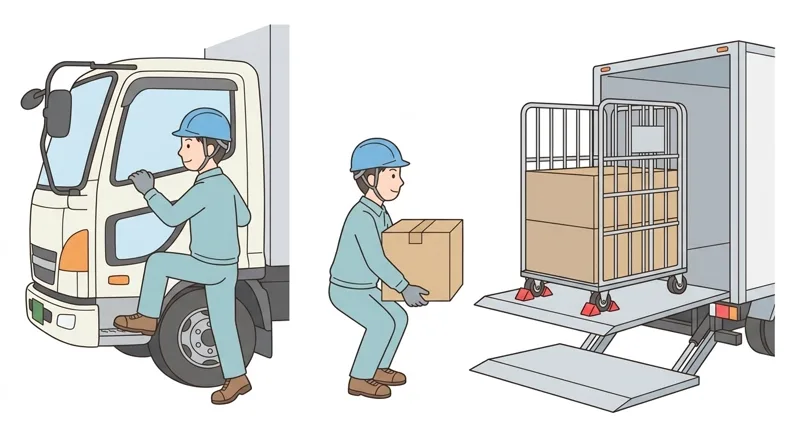
運転席(キャビン)や荷台へ昇り降りするときは、両手・両足の4点のうち常に3点以上を手すり(グリップ)やステップ(足掛け)に接しさせる「三点支持」を徹底し、荷物や伝票を手に持ったまま昇降してはなりません。
When climbing into or out of the cab or onto/off the cargo bed, strictly maintain 'three-point contact (santen shiji)'—keeping at least three of your four limbs on handholds and steps at all times—and never climb while holding packages or clipboards in your hands.
また、荷台の端(あおりの上など)から地面へ「飛び降りる行為」は、足首や膝の骨折・転倒による頭部強打を招くため絶対に禁止です。さらに最大積載量2トン以上のトラックで荷台昇降を行うときは、昇降設備(移動式ステップ等)の設置・使用が義務づけられています。
'Jumping down' from the edge of the truck bed or side gate to the ground is strictly prohibited because it causes ankle/knee fractures and severe head injuries; furthermore, on trucks with a maximum payload of 2 tons or more, using proper boarding steps/ladders is mandatory.
荷役作業時は、袖口やすそが機械に巻き込まれない清潔な作業服、つま先に先芯が入り靴底に滑り止めのある「安全靴」、および作業用手袋を正しく着用します(かかとを踏んだ靴やサンダルは厳禁です)。
During cargo work, wear neat work clothing, 'safety shoes (anzengutsu)' with protective toe caps and non-slip soles, and work gloves (stepping on shoe heels or wearing sandals is strictly forbidden).
Key points
- トラック業界の労働災害の約7割は荷役作業中に起きており、最多は荷台等からの墜落・転落
About 70% of trucking workplace accidents occur during cargo handling, with falls from the truck bed being the leading cause - キャビンや荷台の昇降時は荷物を持たずに「三点支持」を守り、荷台から絶対に飛び降りない
Keep hands free, maintain 'three-point contact,' and never jump down from the cab or truck bed - 最大積載量2トン以上のトラックでの荷台昇降時は昇降設備を使用し、安全靴を着用する
Use boarding steps/ladders on trucks with a maximum payload of 2 tons or more, and always wear safety shoes
| Word | Meaning |
|---|---|
| 荷役作業 | cargo handling work |
| 墜落・転落 | falling from height |
| 三点支持 | three-point contact |
| 昇降設備 | boarding steps / ladder equipment |
墜落時保護用ヘルメット(保護帽)の着用義務と正しいかぶり方
Mandatory Use of Fall-Protection Safety Helmets (Hogobo) and Proper Wearing
労働安全衛生規則により、トラックでの荷役作業時には「墜落時保護用の保護帽(ヘルメット)」を着用することが法律で義務づけられている場面が明確に定められています。
Under the Ordinance on Industrial Safety and Health, specific truck cargo-handling situations legally require wearing a 'fall-protection safety helmet (tsuiraku-ji hogoyo hogobo).'
具体的には、①最大積載量2トン以上のトラックで「あおりのある荷台の側面が開放できるもの(平ボディ車・ウイング車等)」の荷台や積荷の上で作業するとき、②すべてのトラックで「テールゲートリフターを使用して荷を積み卸す作業」を行うとき、③高さ2メートル以上の箇所で作業するときには、墜落時保護用ヘルメットの着用が法的義務です。
Specifically, wearing a fall-protection safety helmet is mandatory when: (1) working on the bed or load of a truck with a maximum payload of 2 tons or more whose side gates/panels open (flatbeds, wing-body trucks, etc.), (2) loading or unloading cargo using a tailgate lifter on any truck, or (3) working at a height of 2 meters or more.
保護帽には「飛来・落下物用」と「墜落時保護用(帽体内部に衝撃吸収ライナー=発泡スチロール等が入っているもの)」の2種類があり、荷台作業やテールゲートリフター作業では必ず「墜落時保護用」の検定合格標章がついたものを使用します。
Industrial safety helmets have two ratings: 'for flying/falling objects' and 'for fall protection (equipped inside with a shock-absorbing foam liner)'; for truck-bed and tailgate-lifter work, you must wear a helmet certified for 'fall protection.'
ヘルメットをかぶるときは、あみだかぶり(後ろに傾けてかぶること)や帽子・タオルの上からの着用を避けてまっすぐ深くかぶり、後頭部のヘッドバンドで頭のサイズに合わせて固定したうえで、「あごひも」を緩みなく確実に締めます。
Wear the helmet straight and level (never tilted back or over a cap), adjust the rear headband snugly to your head size, and securely fasten the 'chin strap (agohimo)' without slack.
あごひもを締めていないと、転落した瞬間にヘルメットが脱げ飛んで頭を守ることができません。また、一度でも大きな衝撃を受けたヘルメットや亀裂・劣化があるものは新品と交換します。
If the chin strap is unfastened or loose, the helmet will fly off during a fall and fail to protect your head; also replace any helmet that has suffered a hard impact even once or shows cracks or aging.
Key points
- 2トン以上の平ボディ・ウイング車の荷台作業時や、テールゲートリフター作業時は墜落時保護用保護帽の着用が義務
Wearing a fall-protection safety helmet is mandatory on >=2-ton flatbed/wing beds and during all tailgate lifter work - 内部に衝撃吸収ライナーが入った「墜落時保護用」の検定合格ヘルメットを使用する
Always use a certified 'fall-protection' helmet equipped with an internal shock-absorbing liner - ヘルメットはまっすぐ深くかぶり、あごひもを緩みなく確実に締める
Wear the helmet straight and level, and fasten the chin strap snugly without slack
| Word | Meaning |
|---|---|
| 保護帽 | safety helmet / hard hat |
| 墜落時保護用 | for fall protection |
| 衝撃吸収ライナー | shock-absorbing liner |
| あごひも | chin strap |
テールゲートリフター(パワーゲート)の安全作業と特別教育
Safe Operation of Tailgate Lifters (Power Gates) and Mandatory Special Safety Training
トラック後部に装着された昇降装置である「テールゲートリフター(パワーゲート)」を使用して荷物を積み卸す作業を行うには、労働安全衛生規則により所定の「特別教育(学科4時間+実技2時間)」を修了していなければならず、墜落時保護用ヘルメットの着用も義務づけられています。
To load or unload cargo using a 'tailgate lifter (power gate)' mounted on the rear of a truck, the Ordinance on Industrial Safety and Health requires completing 'Special Safety Training (4 hours classroom + 2 hours practical)' and wearing a fall-protection safety helmet.
テールゲートリフターを使用するときは、傾斜のない平坦な場所にトラックを止め、パーキングブレーキを引き、エンジンを止める(電動式の場合)とともに輪止めを確実に装着してから作業を開始します。
Before operating a tailgate lifter, park the truck on flat, level ground, set the parking brake, stop the engine (for electric-powered units), and place wheel chocks firmly against the tires.
昇降板(プラットホーム)にロールボックスパレット(カゴ車)を載せるときは、昇降板の端にある「車輪止め(ストッパー)」を必ず立てて固定し、カゴ車自体のキャスターブレーキもかけた状態で昇降させます。
When placing a roll box pallet (cage trolley) onto the lift platform, always raise and latch the platform's 'wheel stoppers (roll stops)' and lock the trolley's own caster brakes before raising or lowering the platform.
昇降板が動いている最中は、荷物と一緒に作業者が昇降板の上に乗ることは原則禁止されており、昇降板の横の地上または荷台上の安全な位置からスイッチを操作します。
While the lift platform is moving up or down, riding on the platform together with cargo is prohibited in principle; operate the control switch from a safe position on the ground beside the platform or on the truck bed.
また、昇降板の下に足や体を入れたり、荷台床面と昇降板のすき間につま先や手を置いたりすると、挟まれて切断・骨折する重大災害となるため厳重に注意し、作業終了後は必ず昇降板を格納してロックピンを掛けます。
Never put your feet or body underneath a raised platform or place your toes or hands near the gap between the truck bed floor and the platform; after finishing work, always stow the platform fully and engage the lock pin.
Key points
- テールゲートリフターによる荷役作業には「特別教育」の修了と「墜落時保護用ヘルメット」の着用が義務
Cargo work with a tailgate lifter requires completing 'Special Safety Training' and wearing a 'fall-protection helmet' - 平坦な場所に止めて輪止めをし、カゴ車積載時は昇降板のストッパーとキャスターブレーキを必ずかける
Park on level ground with wheel chocks, and engage both the platform wheel stoppers and cage caster brakes - 昇降中の昇降板には乗らず、昇降板の下や荷台とのすき間への手足の挟まれに厳重注意する
Do not ride on a moving platform, and keep hands and feet clear of the underside and the gap with the truck bed
| Word | Meaning |
|---|---|
| テールゲートリフター | tailgate lifter (power liftgate) |
| 特別教育 | special safety training |
| 昇降板 | lift platform |
| 車輪止め | wheel stopper / roll stop |
フォークリフト・クレーン・ハンドリフト作業時の危険防止
Hazard Prevention Around Forklifts, Cranes, and Hand Pallet Trucks (Hand Lifts)
倉庫や集配先で「フォークリフト」を運転して荷役作業を行うには、最大荷重1トン以上では「フォークリフト運転技能講習」、1トン未満では「特別教育」を修了した有資格者でなければならず、無資格者が運転することは法律違反です。
Operating a 'forklift' for cargo work at a warehouse or dock legally requires completing the 'Forklift Operation Skill Training Course' (for maximum loads of 1 ton or more) or 'Special Training' (under 1 ton); operating a forklift without certification is illegal.
フォークリフトによる荷役作業中は、作業範囲内に無関係な人を入れず、持ち上げられたフォーク(爪)やパレットの下には絶対に立ち入ってはなりません。
During forklift operations, keep unauthorized persons out of the work zone and never stand or walk underneath raised forks or elevated pallets.
また、高い所の荷物を取るためにフォークリフトのフォークやパレットの上に人を乗せて昇降させることや、荷崩れしそうな荷物を手で支えながらフォークリフトと並んで歩くことは、墜落や下敷きによる死亡災害を招くため厳禁です。
Furthermore, lifting a person standing on the forks or a pallet to reach high places, or walking alongside a moving forklift while holding an unstable load by hand, is strictly prohibited as it causes fatal falls and crushing accidents.
移動式クレーンやホイストで荷物を吊り上げる作業でも、所定の資格(小型移動式クレーン運転技能講習・玉掛け技能講習等)が必要であり、「吊り荷の下には絶対に入らない」ことが鉄則です。
Slinging and lifting loads with a mobile crane or hoist also requires proper certification (Small Mobile Crane Operation and Slinging/Tamagake Skill Training), and the iron rule is 'never enter beneath a suspended load.'
手動式の「ハンドリフト(ハンドパレットトラック)」を使用するときは、パレットの奥までフォークを確実に差し込み、坂道や段差では荷物の重みで暴走・転倒しないよう、決してハンドリフトの下側(前側)に立たずに慎重に操作します。
When using a manual 'hand lift (hand pallet truck),' insert the forks all the way into the pallet, and on slopes or steps never stand downhill in front of the load where a runaway trolley could crush you.
Key points
- フォークリフトや移動式クレーン・玉掛け作業は必ず法定の有資格者が行う
Forklift operation, mobile crane operation, and slinging (tamagake) must only be performed by legally certified workers - 持ち上げたフォークや吊り荷の下には絶対に入らず、フォークやパレットに人を乗せて昇降させない
Never go under raised forks or a suspended load, and never lift people on forks or pallets - 走行中のフォークリフトの積荷を手で支えて歩いたり、坂道でハンドリフトの下側に立ったりしない
Never walk beside a moving forklift holding the load by hand, and never stand downhill in front of a hand pallet truck
| Word | Meaning |
|---|---|
| 技能講習 | skill training course (national certification) |
| 玉掛け | slinging / rigging work (for cranes) |
| 吊り荷 | suspended load |
| ハンドパレットトラック | hand pallet truck (pallet jack) |
人力荷役作業における腰痛予防(正しい持ち上げ姿勢)
Preventing Lower Back Pain in Manual Cargo Handling (Proper Lifting Posture)
トラック運転者の職業性疾病として非常に多いのが、重い荷物の持ち上げや中腰姿勢の繰り返し、長時間運転によって起こる「腰痛(ぎっくり腰等)」です。
One of the most common occupational ailments among truck drivers is 'lower back pain (yotsu / acute back strain)' caused by repeatedly lifting heavy packages, bending at the waist, and sitting for long hours.
床や地面にある重い荷物を手で持ち上げるとき、膝を伸ばしたまま腰だけを曲げて(中腰で)持ち上げようとすると、腰椎(腰の骨や椎間板)に極めて大きな負担がかかり、急性腰痛を引き起こします。
When lifting a heavy box from the floor, keeping your knees straight and bending only at the waist puts enormous stress on the lumbar spine and intervertebral discs, causing acute back injury.
正しい持ち上げ方は、①まず片足を少し前に出して荷物にできるだけ体を近づけて重さを確かめ、②「膝を十分に曲げて腰を落とし」、③荷物を体(おへその近く)にしっかり引き寄せて抱え、④背筋を伸ばしたまま「腹圧を入れて脚(太もも)の力」で立ち上がることです。
The proper lifting technique is: (1) place one foot slightly forward and get as close as possible to the load, (2) 'bend your knees deeply and lower your hips,' (3) pull the load close to your body (near your navel), and (4) keep your back straight while 'standing up using your leg (thigh) muscles.'
また、荷物を持ったまま上体(腰)だけをひねって方向転換すると腰を痛めやすいため、方向を変えるときは腰をひねらずに足先(体全体の向き)を動かして回ります。
Twisting only your upper body (waist) while holding a heavy load also easily injures your back; to change direction, move your feet to turn your entire body rather than twisting your spine.
人力のみで抱えて持ち上げる重量は、男性労働者でおおむね体重の約40%以下(女性はさらにその60%程度)を目安とし、重い荷物は無理をせず台車・ハンドリフトを使うか「2人以上」で声をかけ合って運び、作業前には腰痛予防体操(ストレッチ)を行います。
As a guideline, loads lifted manually by a single male worker should not exceed about 40% of body weight (about 60% of that for female workers); for heavier items, use a hand truck/pallet jack or lift with 'two or more people' calling out together, and stretch before work.
Key points
- 荷物を持ち上げるときは膝を伸ばしたままの中腰を避け、「膝を曲げて腰を落とし、荷物を体に引き寄せて脚の力」で立つ
Avoid bending with straight knees; bend your knees, lower your hips, hug the load close, and lift with your leg muscles - 荷物を持ったまま腰(上体)だけをひねらず、足を動かして体全体の向きを変える
Never twist your waist while holding a load—move your feet to turn your entire body - 重い荷物は台車等を使うか2人以上で声をかけ合って運び、作業前にストレッチを行う
Use a cart/lift or team up with two or more people for heavy items, and perform back-stretching exercises before work
| Word | Meaning |
|---|---|
| 腰痛 | lower back pain (lumbago) |
| 中腰 | stooped / half-crouching posture |
| 腹圧 | intra-abdominal pressure |
| 台車 | platform hand truck / dolly |
荷役場所でのトラック逸走防止措置と後方誘導の安全ルール
Preventing Runaway Trucks at Loading Docks and Safe Reversing Guidance Rules
集荷先や納品先で運転者が運転席を離れて荷役作業を行っている間に、無人のトラックが勝手に動き出す「逸走事故」が起きると、運転者自身がプラットホームと車体の間に挟まれたり通行人をひいたりする死亡災害となります。
If an unattended truck rolls away while the driver is away from the cab handling cargo ('runaway vehicle accident / isso jiko'), the driver or bystanders can be fatally crushed between the truck and the loading dock.
運転席を離れるときは、たとえわずか数分であっても、①パーキングブレーキを確実に引く、②エンジンを停止してキーを抜く、③ギアを平地や上り坂では「1速(ロー)」・下り坂では「リバース(後退)」(AT車はPレンジ)に入れる、④ドアをロックする、⑤タイヤに「輪止め」を装着する、という逸走防止措置を徹底します。
Whenever leaving the driver's seat even for a few minutes, strictly follow all runaway-prevention steps: (1) firmly apply the parking brake, (2) shut off the engine and remove the key, (3) put the transmission in 1st gear on flat ground/upgrades or Reverse on downgrades ('P' for automatics), (4) lock the cab doors, and (5) place 'wheel chocks (wadome)' against the tires.
また、トラックを倉庫や荷役ホーム(バース)へ後退(バック)させて着車させるときは、車両後方の死角に入った作業者が車体後部とホームの壁の間に挟まれる死亡事故が多発しています。
Furthermore, when backing a truck up to a warehouse loading dock (berth), fatal accidents frequently occur when a worker in the rear blind spot is pinned between the rear of the truck and the dock wall.
バックで着車するときは、事前に一度降車して後方の障害物や高さ・幅を確認し、誘導者がいる場合は「車両真後ろ(車体と壁の間)には絶対に立たせず、運転者からミラーで姿がはっきり見える斜め後方の安全な位置」に立ってもらいます。
Before backing into a dock, step out first to inspect rear obstacles and clearance; if a spotter (guide) is assisting, 'never let the spotter stand directly behind the truck between the vehicle and the wall—have them stand diagonally behind the truck in plain view of your side mirror.'
もし誘導中にミラーから誘導者の姿が見えなくなったときは、「見えない=危険」と捉えて、その瞬間に直ちにトラックを停止させ、安全を確かめるまで絶対に動かしてはなりません。
If you ever lose sight of the spotter in your mirror while reversing, immediately stop the truck on the spot and do not move again until you have confirmed their safety.
Key points
- 降車時の逸走防止:パーキングブレーキ・エンジン停止・キー抜取り・ギア入れ(1速/R/P)・ドアロック・輪止め
Runaway prevention when leaving the cab: parking brake, engine off, key out, in gear (1st/R/P), doors locked, and wheel chocks - ホームへバック着車時は、誘導者を車体と壁の間に立たせずミラーで見える斜め後方に配置する
When backing into a loading dock, never let the spotter stand between the truck and wall—position them diagonally in mirror view - 誘導者の姿がミラーから見えなくなった瞬間に、直ちに車両を停止させる
Stop the truck immediately the instant you lose sight of the spotter in your mirror
| Word | Meaning |
|---|---|
| 逸走事故 | runaway vehicle accident |
| 着車 | docking a truck at a loading bay |
| 誘導者 | spotter / reversing guide |
| プラットホーム | loading dock platform |
5S活動・指差呼称の徹底と荷役災害発生時の緊急対応
5S Activities, Pointing and Calling (Shisa Kosho), and Cargo Accident Response
荷役作業現場やトラックの荷台・運転席の安全を保つため、「整理(不要なものを捨てる)」「整頓(必要なものをすぐ取り出せるよう並べる)」「清掃(ゴミや汚れを掃除する)」「清潔(きれいで衛生的な状態を保つ)」「しつけ(決められたルールを正しく守る習慣)」の「5S活動」を毎日実践します。
To keep loading docks, truck beds, and driver cabs safe, practice the '5S Activities' every day: 'Seiri (Sort—discard unneeded items),' 'Seiton (Set in order—arrange tools neatly for easy use),' 'Seiso (Shine—sweep away trash and dirt),' 'Seiketsu (Standardize—maintain cleanliness),' and 'Shitsuke (Sustain—make following rules a daily habit).'
荷台の床に木片や緩衝材・ロープが散乱していたり、運転席の足元にペットボトルや空き缶が転がっていたりすると、つまずき転落事故やブレーキペダル下への挟まりによる重大事故を引き起こします。
Scrap wood, dunnage, or ropes left scattered on the cargo bed cause tripping and falls from height, while plastic bottles or cans rolling on the cab floor can wedge beneath the brake pedal and cause a catastrophic crash.
また、作業の節目や発進前・検品時には、確認対象を指でしっかり指しながら「輪止めよし!」「ウイングロックよし!」「後方よし!」と声に出して確かめる「指差呼称」を行うことで、うっかりミス(ヒューマンエラー)を約6分の1に減らすことができます。
At key steps before departure or during cargo checks, practicing 'Pointing and Calling (Shisa Kosho)'—pointing directly at the target and calling out 'Wheel chocks OK!', 'Wing locks OK!', 'Rear clear OK!'—reduces human error to roughly one-sixth.
万が一、荷役作業中に作業者が転落したり機械に挟まれたりする労働災害が発生したときは、まず機械やフォークリフトを直ちに非常停止させて二次災害を防ぎ、周囲の人と協力して被災者の救護と119番通報を行います。
If a workplace accident occurs during cargo handling—such as a fall or machinery entanglement—first hit the emergency stop on the machine or forklift to prevent secondary injury, rescue and aid the victim with bystanders, and call 119.
そのうえで、現場の責任者および自社の運行管理者へ速やかに報告し、たとえ軽いケガや荷物の破損であっても決して隠さず正確に報告して再発防止につなげなければなりません。
Then promptly report to the site supervisor and your company's Operation Manager; never conceal even a minor injury or cargo damage—report it accurately so recurrence-prevention measures can be taken.
Key points
- 5S(整理・整頓・清掃・清潔・しつけ)を徹底し、荷台でのつまずきや運転席足元への異物挟まりを防ぐ
Practice 5S (Sort, Set in order, Shine, Standardize, Sustain) to prevent tripping on the bed and objects jamming under pedals - 指で差して声に出す「指差呼称」によりヒューマンエラーを大幅に減らす
Use 'Pointing and Calling (Shisa Kosho)' to drastically reduce human error - 荷役災害発生時は機械停止(二次災害防止)と救護・119番通報を優先し、運行管理者へ必ず報告する
In a cargo accident, stop machinery first, rescue the victim and call 119, and always report to the Operation Manager
| Word | Meaning |
|---|---|
| 指差呼称 | pointing and calling (shisa kosho) |
| 整理・整頓 | sorting and setting in order (first two of 5S) |
| 二次災害 | secondary accident / secondary disaster |
| 再発防止 | recurrence prevention |
Truck: Cargo Handling Safety
Practice this chapter in the appOfficial references
- JTA 特定技能1号 トラック運転者 学習用テキスト(荷役作業の安全・労働災害防止) — https://jta.or.jp/member/shien/tokuteiginou.html
- 厚生労働省・陸上貨物運送事業労働災害防止協会 荷役作業安全ガイドライン — https://www.mhlw.go.jp/stf/seisakunitsuite/bunya/0000123259.html