
Civil Engineering Construction (Earthwork, Concrete, Foundations, Paving, Rivers & Roads)
土木施工(土工・コンクリート・基礎・舗装・河川道路)
Construction · 建設分野 · Written by Tokutei Pass based on the official study texts; not copied verbatim.
土工(掘削・盛土・締固め・法面保護)
Earthwork (Excavation, Embankment, Compaction, and Slope Protection)
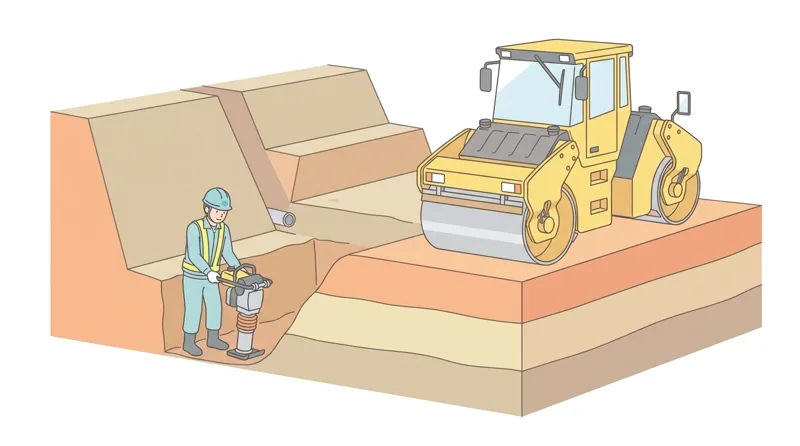
地山を削り取る作業を「切土(掘削)」、土を運んで積み上げる作業を「盛土」といい、切土や盛土で作られた人工的な斜面を「法面」といいます。
Cutting away natural ground is called 'cutting/excavation (kirido)', hauling and piling up soil is called 'embankment/filling (morido)', and an artificial slope created by cutting or filling is called a 'slope face (norimen)'.
盛土では地盤沈下を防ぐため、土を一気に高く盛らず、約20〜30cmの薄い層(まき出し厚さ)ごとにロードローラー等で転圧します。
In embankment work, to prevent ground settlement, soil is not piled high all at once; instead, it is spread in thin layers of about 20 to 30 cm and compacted after each layer using road rollers.
狭い溝や構造物の周りの埋戻しには「ランマ」や「振動コンパクタ」を使い、法面の浸食防止には「植生工」や「吹付工」を行います。
For backfilling narrow trenches or around structures, rammers or vibratory plate compactors are used, while slope erosion is prevented by vegetation work (hydroseeding) or mortar/concrete spraying.
Key points
- 地山を削る作業は「切土」、土を盛る作業は「盛土」、人工斜面は「法面」という。
Cutting natural ground is 'kirido', piling soil is 'morido', and the resulting artificial slope is 'norimen'. - 盛土は約20〜30cmの層状にまき出し、そのつどローラーやランマで転圧して締め固める。
Embankment soil is spread in layers of about 20-30 cm and compacted layer by layer with rollers or rammers. - 法面の風化・浸食を防ぐため、種子散布等の「植生工」やモルタル等の「吹付工」を行う。
To prevent slope weathering and erosion, vegetation work or shotcrete/mortar spraying is performed.
| Word | Meaning |
|---|---|
| 切土・盛土 | Cutting & Embankment (Kirido / Morido) |
| 法面 | Slope face (Norimen) |
| 転圧(締固め) | Rolling compaction (Ten-atsu / Shimekatame) |
| ランマ・振動コンパクタ | Rammer & Vibratory plate compactor |
コンクリート工・鉄筋工・型枠工
Concrete Work, Reinforcing Bar Work, and Formwork
生コンクリートのやわらかさ(流動性)は「スランプ試験」で測り、現場到着時にはスランプ・空気量・温度・塩化物含有量の受入検査を行います。
The consistency (fluidity) of fresh concrete is measured by a 'slump test', and upon delivery to the site, acceptance inspections are performed for slump, air content, temperature, and chloride content.
打設時は材料分離を防ぐため自由落下高さを1.5m以下とし、棒形振動機を鉛直に差し込んで締め固め、打設後は湿潤養生します。
During placement, the free-fall height is kept within 1.5 m to prevent segregation, internal vibrators are inserted vertically for compaction, and moist curing is carried out after placement.
鉄筋の腐食防止のため「スペーサー」で所定のかぶり厚さを確保し、型枠内面には打設前に「剥離剤」を薄く塗り、セパレーターで側圧に耐えさせます。
To prevent rebar corrosion, 'spacers' are installed to maintain the required concrete cover, form release agent is thinly applied inside forms before pouring, and separators resist lateral concrete pressure.
Key points
- 生コンの流動性は「スランプ試験」で測定し、現場荷卸し時にスランプ・空気量・温度・塩化物量を検査する。
Fresh concrete fluidity is measured by the 'slump test', and slump, air content, temperature, and chloride are checked at delivery. - 自由落下高さは1.5m以下とし、バイブレータを鉛直に挿入してジャンカやコールドジョイントを防ぐ。
Keep free-fall height at 1.5 m or less and insert vibrators vertically to prevent honeycombing (janka) and cold joints. - 鉄筋には「スペーサー」を配置してかぶり厚さを確保し、型枠は所定強度確認後に脱型する。
Place 'spacers' to secure proper concrete cover and strip formwork only after verifying the required concrete strength.
| Word | Meaning |
|---|---|
| スランプ試験 | Slump test |
| 材料分離 | Material segregation (Zairyou bunri) |
| スペーサー・かぶり厚さ | Spacer & Concrete cover thickness (Kaburi atsusa) |
| 湿潤養生 | Moist curing (Shitsujun youjou) |
基礎工・土留め支保工・軟弱地盤対策
Foundation Work, Earth Retaining Shoring, and Soft Ground Countermeasures
構造物の荷重を浅い支持層に直接伝える「直接基礎」に対し、軟弱地盤で深い支持層まで杭を打つ基礎を「杭基礎」といいます。
In contrast to a 'spread foundation (chokusetsu kiso)' that transfers structural loads directly to a shallow bearing layer, a 'pile foundation (kuigiso)' drives piles down to a deep bearing stratum in soft ground.
場所打ちコンクリート杭(オールケーシング工法やアースドリル工法)では、掘削孔の底に溜まったスライム(泥水沈殿物)を鉄筋挿入前後に除去します。
In cast-in-place concrete piles (all-casing or earth drill methods), 'slime' (settled mud sediment) accumulating at the bottom of the bored hole is removed before and after lowering the rebar cage.
深い掘削では土砂崩壊と湧水を防ぐため「鋼矢板(シートパイル)」等で土留め壁を築き、腹起しと切梁でしっかり支えます。
In deep excavations, 'steel sheet piles (kouyaita)' are driven to prevent soil collapse and groundwater inflow, and are supported firmly by wales (haraokoshi) and struts (kiribari).
Key points
- 浅い強固な地盤には「直接基礎」、深い支持層へ荷重を伝える場合は「杭基礎」を用いる。
Use 'spread foundations' on shallow firm ground and 'pile foundations' when transferring loads to deep bearing strata. - 場所打ち杭の孔底に溜まる「スライム」は、支持力低下を防ぐため確実に処理する。
Remove bottom sediment ('slime') in cast-in-place pile boreholes thoroughly to prevent loss of bearing capacity. - 土留め支保工では「鋼矢板」や「腹起し・切梁」を設け、変状があれば直ちに退避する。
Use steel sheet piles, wales, and struts in earth-retaining shoring, and evacuate immediately if deformation is observed.
| Word | Meaning |
|---|---|
| 直接基礎・杭基礎 | Spread foundation & Pile foundation (Chokusetsu kiso / Kuigiso) |
| 場所打ちコンクリート杭 | Cast-in-place concrete pile (Bashouchi concrete kui) |
| スライム処理 | Slime removal (Slime shori) |
| 鋼矢板・切梁 | Steel sheet pile & Strut (Kouyaita / Kiribari) |
道路舗装工・河川・トンネル・上下水道土木
Road Paving, River Works, Tunnels, and Water/Sewer Civil Works
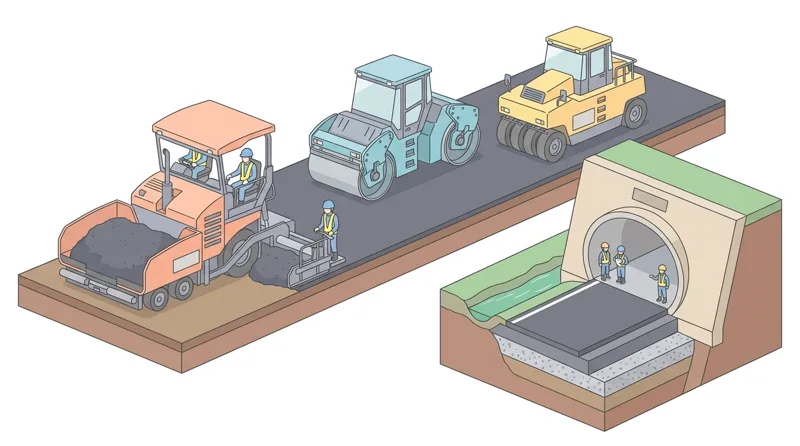
アスファルト舗装は下から「路床→下層路盤→上層路盤→基層→表層」の順に重ね、路盤上には「プライムコート」、層間には「タックコート」を散布します。
Asphalt pavement consists from bottom to top of 'subgrade -> lower subbase -> upper base course -> binder course -> surface course', with 'prime coat' sprayed on the base course and 'tack coat' between asphalt layers.
アスファルト合材はフィニッシャで敷きならしたあと、温度が高いうちに「初転圧(マカダムローラー)→二次転圧(タイヤローラー)→仕上げ転圧」を行います。
After hot-mix asphalt is spread by an asphalt finisher, rolling compaction is performed while hot in the sequence: 'initial rolling (macadam roller) -> secondary rolling (pneumatic tire roller) -> finish rolling (tandem roller)'.
河川では堤防を「護岸工」で守り、山岳トンネルのNATMでは「吹付けコンクリート・ロックボルト・鋼製支保工」で地山を支え、下水管は下流から上流へ据え付けます。
In river works, levees are protected by 'revetment work (gogankou)'; in mountain tunnels using NATM, 'shotcrete, rock bolts, and steel ribs' support the ground; and gravity sewer pipes are laid from downstream to upstream.
Key points
- アスファルト舗装は「路床・路盤・基層・表層」からなり、路盤上にプライムコート、層間にタックコートを散布する。
Asphalt pavement comprises subgrade, base course, binder course, and surface course, using prime coat on the base and tack coat between asphalt layers. - 合材敷きならし後は「マカダムローラー(初転圧)→タイヤローラー(二次転圧)→タンデムローラー(仕上げ)」で転圧する。
After spreading asphalt mix, compact in order: macadam roller (initial) -> tire roller (secondary) -> tandem roller (finish). - NATMは吹付けコンクリートとロックボルトを主支保材とし、自然流下の下水管は下流側から上流側へ布設する。
NATM uses shotcrete and rock bolts as primary support, and gravity sewer pipes are installed from downstream toward upstream.
| Word | Meaning |
|---|---|
| 路盤・基層・表層 | Base course, Binder course & Surface course (Roban / Kisou / Hyousou) |
| プライムコート・タックコート | Prime coat & Tack coat |
| マカダムローラー・タイヤローラー | Macadam roller & Pneumatic tire roller |
| NATM(ロックボルト・吹付けコンクリート) | NATM (Rock bolts & Shotcrete) |
Civil Engineering Work (Practical)
Practice this chapter in the appOfficial references
- 建設分野特定技能1号評価試験 学習用テキスト「土木」(一般社団法人建設技能人材機構 JAC) — https://jac-skill.or.jp/exam/textbook.html
- 建設分野特定技能評価試験 試験実施要領(国土交通省) — https://www.mlit.go.jp/tochi_fudousan_kensetsugyo/content/001519991.pdf