 Tokutei Pass
General Customer Service and Store Operations
接客全般と店舗管理
Restaurant and Food Service · 外食業 · Written by Tokutei Pass based on the official study texts; not copied verbatim.
おもてなしの心・顧客満足と身だしなみ・基本動作
Hospitality, Customer Satisfaction, Grooming, and Basic Movements
接客サービスの基礎は「おもてなしの心(ホスピタリティ)」で、それを表す基本動作を「型(フォーム)」と呼びます。お客様に満足していただく状態を「顧客満足(CS)」といい、繰り返し来店されるお客様を「リピーター」と呼びます。
The foundation of Japanese restaurant service is the 'spirit of hospitality (Omotenashi)', and the standardized basic movements used to convey it are called 'forms (Kata)'. Delighting customers is known as 'Customer Satisfaction (CS)', and valued customers who return repeatedly because they are satisfied are called 'repeaters'.
顧客満足は事前の「期待感」と実際の「経験」の差で決まります。経験が期待感を上回ると「満足(大きいと感動)」になり、同じなら「普通」、下回ると「不満(大きいとクレーム)」になります。
Customer satisfaction is determined by the gap between prior 'expectations' and actual 'experience'. When the experience exceeds expectations, 'satisfaction (or deep impression when large)' results; when equal, it feels 'ordinary'; and when below expectations, 'dissatisfaction (or a complaint when large)' occurs.
身だしなみはお客様に清潔感と安心感を与えるためのもので、清潔な制服を着て髪をまとめ、爪を短く切り、香水やネイル・腕時計はつけません。靴は滑りにくいものをかかとを踏まずに履きます。
Personal grooming gives customers a sense of cleanliness and reassurance: wear a clean uniform, tie back hair, keep nails trimmed short, and never wear perfume, nail polish, or wristwatches. Wear slip-resistant shoes properly without stepping on the heels.
立ち姿は背筋を伸ばして前で手を組み、方向を示すときは指をそろえて手のひら全体で案内します。お辞儀は場面に応じて、すれ違うときの「会釈(約15度)」、お迎えや案内時の「敬礼(約30度)」、感謝やお詫びの「最敬礼(約45度)」を使い分けます。
Maintain a straight posture with hands neatly crossed in front, and guide directions using your whole open palm with fingers together. Use three types of bows according to the situation: a 'light nod (Eshaku, about 15°)' when passing guests, a 'standard bow (Keirei, about 30°)' when welcoming or guiding, and a 'deepest bow (Saikeirei, about 45°)' for deep gratitude or apologies.
Key points
- 実際のサービス経験がお客様の期待感を上回ると「満足・感動」が生まれ、リピーターにつながる。
When actual service experience exceeds customer expectations, 'satisfaction and deep impression (Kandō)' are created, leading to repeat customers. - 身だしなみでは制服の清潔・まとめ髪・短い爪を守り、料理の邪魔になる香水や時計・指輪は外す。
For grooming, keep uniforms clean, hair tied, and nails short, and remove perfume, watches, and rings that interfere with food service. - お辞儀は「会釈(約15度)」「敬礼(約30度)」「最敬礼(約45度)」の3種類を正しく使い分ける。
Properly use the three types of bows: 'Eshaku (approx. 15°)', 'Keirei (approx. 30°)', and 'Saikeirei (approx. 45°)'.
| Word | Meaning |
|---|---|
| おもてなし(ホスピタリティ) | hospitality (Omotenashi) |
| 顧客満足(CS) | Customer Satisfaction (CS) |
| リピーター | repeat customer (Repeater) |
| 身だしなみ | personal grooming and appearance (Midashinami) |
| 会釈・敬礼・最敬礼 | 15° nod (Eshaku), 30° bow (Keirei), 45° deep bow (Saikeirei) |
接客基本用語と正しい敬語
Basic Service Phrases and Correct Honorific Language (Keigo)
「8大接客用語」は、「いらっしゃいませ」「かしこまりました(注文承知時)」「少々お待ちください」「お待たせいたしました」「恐れ入ります(クッション言葉)」「申し訳ございません」「ありがとうございます」「失礼いたします」です。
The '8 basic service phrases' in restaurants are: 'Irasshaimase (Welcome)', 'Kashikomarimashita (Certainly, when acknowledging an order or request)', 'Shōshō omachi kudasai (Please wait a moment)', 'Omatase itashimashita (Thank you for waiting)', 'Osoreirimasu (Pardon me / Excuse me)', 'Mōshiwake gozaimasen (I am very sorry)', 'Arigatō gozaimasu (Thank you)', and 'Shitsurei itashimasu (Excuse me)'.
敬語には、お客様の行動を高める「尊敬語」と、自分(店側)の行動をへりくだる「謙譲語」があります。「食べる・飲む」の尊敬語は「召し上がる」、謙譲語は「いただく」です。「言う」の尊敬語は「おっしゃる」、謙譲語は「申し上げる・申す」です。
Keigo includes 'respectful language (Sonkeigo)' to elevate the customer's actions and 'humble language (Kenjōgo)' to lower your own (the restaurant's) actions. For 'eat/drink', the respectful form is 'Meshiagaru' and the humble form is 'Itadaku'. For 'say', the respectful form is 'Ossharu' and the humble form is 'Mōshiageru / Mōsu'.
「行く・来る」の尊敬語は「いらっしゃる・お越しになる」、謙譲語は「参る・伺う」です。「いる」の尊敬語は「いらっしゃる」、謙譲語は「おる(おります)」を使い、「聞く・訪問する」の謙譲語は「伺う」を使います。
For 'go/come', the respectful form is 'Irassharu / Okoshi ni naru' and the humble form is 'Mairu / Ukagau'. For 'be', use respectful 'Irassharu' and humble 'Oru (Orimasu)', and for 'ask/hear/visit', use humble 'Ukagau'.
また、「見る」は尊敬語「ご覧になる」・謙譲語「拝見する」、「知っている」は尊敬語「ご存じ」・謙譲語「存じております」、「受け取る」の謙譲語は「頂戴する・いただく」と言い、名前を尋ねるときは「どなた様でしょうか」と聞きます。
Additionally, 'see/look' is respectful 'Goran ni naru' and humble 'Haiken suru'; 'know' is respectful 'Gozonji' and humble 'Zonjite orimasu'; the humble form of 'receive' is 'Chōdai suru / Itadaku', and when politely asking who a customer is, say 'Donata-sama deshōka'.
Key points
- 注文を受けたときは「かしこまりました」と答え、質問やお願いの前には「恐れ入りますが」を添える。
Reply 'Kashikomarimashita' when taking an order, and place the cushion phrase 'Osoreirimasu ga' before asking a question or making a request. - お客様には尊敬語(召し上がる・おっしゃる・いらっしゃる・ご覧になる・ご存じ)を使う。
Use respectful language (Meshiagaru, Ossharu, Irassharu, Goran ni naru, Gozonji) for the customer's actions. - 自分の行動には謙譲語(いただく・申し上げる・参る・伺う・おる・拝見する・存じております・頂戴する)を使う。
Use humble language (Itadaku, Mōshiageru, Mairu, Ukagau, Oru, Haiken suru, Zonjite orimasu, Chōdai suru) for your own actions.
| Word | Meaning |
|---|---|
| かしこまりました | Certainly / Understood (Kashikomarimashita) |
| 恐れ入りますが | Excuse me, but... (Osoreirimasu ga) |
| 尊敬語・謙譲語 | respectful language (Sonkeigo) and humble language (Kenjōgo) |
| 召し上がる・いただく | to eat/drink: Meshiagaru (respectful) and Itadaku (humble) |
| おっしゃる・申し上げる | to say: Ossharu (respectful) and Mōshiageru (humble) |
| 伺う・参る | to ask/visit: Ukagau and to go/come: Mairu (humble) |
予約・案内と配慮が必要なお客様への対応
Reservations, Seating Guidance, and Guests Requiring Special Consideration
電話に出るときは「お電話ありがとうございます。○○(店名)でございます」と名乗ります。予約や変更を受けるときは予約台帳で空席状況を確認し、「日時・人数・お名前・連絡先」の4つを必ず確認して復唱します。
When answering the phone, state the restaurant's name first: 'Odenwa arigatō gozaimasu. ○○ de gozaimasu'. When taking or changing a reservation, check seat availability in the reservation ledger (Yoyaku daichō) and always confirm and repeat back (Fukushō) the four items: 'date/time, number of guests, name, and contact number'.
来店時は人数を確認し(例:4人掛けテーブルに10名なら最低3卓必要)、お客様の歩調に合わせて1〜2歩前を歩いて案内します。部屋の奥で主賓が座る席を「上座」、出入口に近く幹事などが座る席を「下座」と呼びます。
When guests arrive, confirm the party size (e.g., a group of 10 at 4-person tables requires at least 3 tables) and walk 1–2 steps ahead at the guests' pace. The seat furthest from the entrance for the guest of honor is called the 'seat of honor (Kamiza)', while the seat closest to the entrance for the host is called the 'lower seat (Shimoza)'.
日本の飲食店は受動喫煙防止のため原則屋内禁煙であり、専用の喫煙室には20歳未満の人(客も従業員も)を入れてはいけません。また、補助犬(盲導犬など)を連れたお客様は法律に従いそのまま席へ案内します。
To prevent passive smoking, restaurants in Japan are indoor non-smoking in principle, and no one under 20 years old (neither customers nor employees) may enter designated smoking rooms. Also, welcome guests accompanied by assistance dogs (such as guide dogs) into regular seating as required by law.
車いすのお客様には通路を確保して席の椅子を外し、目の不自由なお客様には料理名と器の位置を声に出して説明します。小さな子ども連れには子ども用の椅子・食器を用意して熱い料理を離して置き、外国人には「やさしい日本語」や写真で丁寧に案内します。
For wheelchair users, secure aisle space and remove table chairs; for visually impaired guests, verbally explain dish names and positions. For families with young children, provide child chairs and tableware and place hot dishes out of reach; for foreign guests, guide them politely using 'Easy Japanese (Yasashii Nihongo)' and photos.
Key points
- 電話予約では空席を確認し、「日時・人数・お名前・連絡先」を確認・復唱して記録する。
For phone reservations, check availability and confirm and repeat back 'date/time, headcount, name, and contact information'. - 入口から遠い奥の席を「上座」、出入口に最も近い席を「下座」といい、喫煙室への20歳未満の立入りは禁止である。
The inner seat furthest from the entrance is 'Kamiza' and the seat nearest the entrance is 'Shimoza'; entry of anyone under 20 into smoking rooms is prohibited. - 補助犬(盲導犬など)の同伴入店を受け入れ、車いす・高齢・子ども連れ・外国人のお客様に配慮する。
Accept assistance dogs (guide dogs) accompanying guests, and show consideration for wheelchair users, elderly guests, children, and foreign visitors.
| Word | Meaning |
|---|---|
| 予約台帳・復唱 | reservation book (Yoyaku daichō) and repeating back (Fukushō) |
| 上座・下座 | seat of honor (Kamiza) and lower seat near entrance (Shimoza) |
| 受動喫煙防止 | prevention of passive smoking |
| 補助犬(盲導犬) | assistance dog / guide dog (Mōdōken) |
注文・配膳・テーブルマナーとバッシング
Ordering, Serving (Haizen), Table Manners, and Bussing
朝礼でその日のおすすめ料理や旬の食材を確認します。おしぼりはおしぼり受けにのせるか両手を添えて渡し、注文を受けたら必ず復唱します。トレイ(お盆)では重い物や背の高いグラスを手前や中央に置き、皿の内側やグラスの飲み口に指を触れずに運びます。
Confirm daily recommended dishes and seasonal ingredients at the pre-shift briefing (Chōrei). Present wet towels (oshibori) on a tray or with both hands, and always repeat back orders to confirm. Load heavy items and tall glasses toward the front or center of the tray, and carry plates and glasses without touching the inside of plates or the drinking rim.
生ビールは冷やした清潔なジョッキに「ビール7:泡3」で注ぎ、ボトルワインは抜栓前にラベル(銘柄)を提示して確認します。熱い料理は「熱いのでお気をつけください」と声をかけ、皿の縁の汚れは清潔なペーパーで拭いて出します。
Pour draft beer into a clean, chilled mug at a '7 parts beer : 3 parts foam' ratio, and show the bottle wine label to the customer for confirmation before uncorking. Warn guests when serving hot dishes ('Please be careful as it is hot'), and wipe any sauce splatters off the rim of a plate with a clean paper towel before serving.
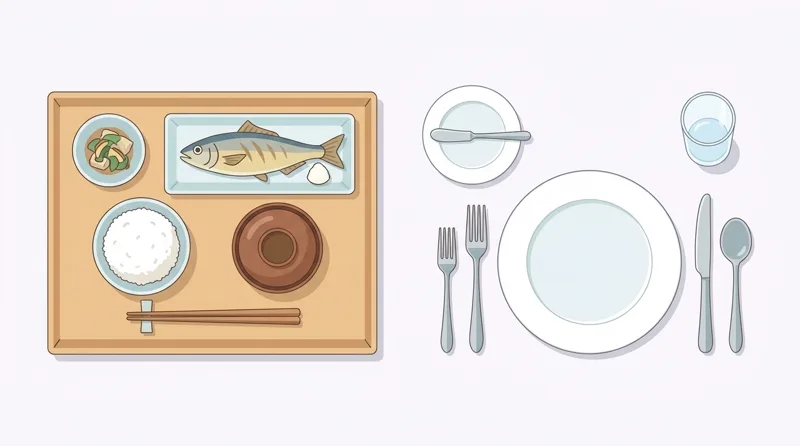
和食(一汁三菜)の配膳は、手前左に「ご飯」、手前右に「汁物」、奥右に「主菜」、奥左に「副菜」を置き、お箸は一番手前に箸先を左に向けて置きます。尾頭付きの焼き魚は「頭が左・お腹が手前」です。
In Japanese table setting (Ichijū-sansai: one soup, three dishes), place 'rice' at the front left, 'soup' at the front right, the 'main dish (Shusai)' at the back right, and the 'side dish (Fukusai)' at the back left, with chopsticks placed horizontally in front pointing left. Serve whole grilled fish with the 'head on the left and belly toward the diner'.
洋食は皿の左にフォーク、右にナイフやスプーンを外側から使う順に並べ、ナイフとフォークを皿の上でそろえて置くのが食事終了の合図です。箸などを落とされたらすぐ新しい物を持っていき、片付け後は清潔な台拭きとアルコールで拭きます。
In Western dining, arrange forks on the left and knives (blade facing in) and spoons on the right in outside-in order; placing the knife and fork parallel together on the right side of the plate signals that the guest has finished eating. If a guest drops chopsticks or a fork, bring a clean replacement first before picking up the dropped one, and reset tables with a clean counter cloth (duster) and alcohol.
Key points
- トレイでは重い物・背の高い物を手前や中央に置き、生ビールは冷えたジョッキに「液体7:泡3」で注ぐ。
Place heavy or tall items at the front or center of the tray, and pour draft beer into a chilled mug at a '7 liquid : 3 foam' ratio. - 和食は「左手前にご飯・右手前に汁物・右奥に主菜」、箸先は左、丸ごとの魚は「頭が左・腹が手前」に置く。
In Japanese dining, set 'rice front-left, soup front-right, main dish back-right', chopstick tips pointing left, and whole fish 'head left, belly front'. - 洋食は左にフォーク・右にナイフを並べ、皿の上でそろえて置くのが終了のサインである。
In Western dining, place forks on the left and knives on the right; aligning the knife and fork together on the plate signals the meal is finished.
| Word | Meaning |
|---|---|
| 配膳・一汁三菜 | table setting (Haizen) and one-soup three-dishes layout (Ichijū-sansai) |
| 尾頭付き | whole fish with head and tail (Okashiratsuki) |
| 抜栓・銘柄 | uncorking (Bassen) and wine brand/label (Meigara) |
| バッシング | clearing dishes from the table (Bussing) |
| 台拭き(ダスター) | clean table cloth / duster (Daifuki) |
食の知識・会計・クレームと緊急時対応
Food Knowledge, Payment, Complaints, and Emergency Response
五味は「甘味・塩味・酸味・苦味・うま味」、五大栄養素は「たんぱく質・脂質・炭水化物・ビタミン・無機質」です。アレルギーやハラール(豚肉・お酒禁止)を聞かれたら調理場に確認し、20歳未満や運転者にはお酒を出しません。
The five basic tastes (Gomi) are 'sweet, salty, sour, bitter, and umami', and the five major nutrients are 'proteins, lipids, carbohydrates, vitamins, and minerals'. When asked about allergies or religious restrictions (such as Halal prohibiting pork and alcohol), never guess on your own—check with the kitchen including broths and seasonings—and never serve alcohol to anyone under 20 or to drivers.
消費税(軽減税率)は、酒類以外の飲食物の「テイクアウト(持ち帰り)が8%」「店内飲食が10%」です(例:税抜き500円の弁当2個の持ち帰りは税込み1,080円、税抜き1,000円のランチ2つの店内飲食は税込み2,200円)。
Under Japan's consumption tax (reduced tax rate system), food and non-alcoholic drinks are taxed at '8% for takeout' and '10% for dine-in' (e.g., two 500-yen pre-tax takeout bentos cost 1,080 yen tax-included; two 1,000-yen pre-tax dine-in lunches cost 2,200 yen tax-included).
伝票は裏返して置き、領収書は「宛名・但し書き・金額」を確認して発行します。カード決済の暗証番号はお客様に入力していただき目線を外し、QRコード決済は画面に触れずに読み取って完了音を確認します。
Place the check slip (denpyō) face-down so the amount is hidden, and confirm the 'recipient name, description, and amount' before issuing a formal receipt (ryōshūsho). For credit cards, avert your gaze while the customer enters their PIN; for QR payments, scan without touching the customer's phone screen and verify the completion tone.
水がこぼれたらまずお客様の服やけがを気遣っておしぼりを渡し、異物混入や苦情はお詫びして責任者へ報告します。忘れ物はお帰り直後なら追いかけて渡し、不在なら責任者へ報告して保管します。地震発生時はエレベーターを使わず、階段で非常口へ誘導します。
If water spills, first check the customer's clothing and safety and hand them a towel; for foreign objects in food or complaints, apologize sincerely first and report to a supervisor. If a departed guest leaves an item behind, run after them immediately if nearby, or report to the manager to record and store it. During an earthquake, evacuate guests via stairs to emergency exits without using elevators.
Key points
- 消費税率は「テイクアウト(持ち帰り)8%・店内飲食10%」であり、20歳未満や運転者への酒類提供は法律で禁止されている。
Consumption tax is '8% for takeout and 10% for dine-in', and serving alcohol to persons under 20 or drivers is prohibited by law. - カード決済時は暗証番号入力中に目線を外し、QR決済は画面に触れずに読み取り、完了音と金額を確認する。
Avert your eyes when a customer enters a credit card PIN, and scan QR codes without touching the screen while confirming the completion sound and amount. - 苦情や異物混入時はまずお詫びして責任者へ報告し、地震避難時はエレベーターを使わず階段で誘導する。
When a complaint or foreign object occurs, apologize first and report to a supervisor; during earthquake evacuation, guide guests via stairs, never elevators.
| Word | Meaning |
|---|---|
| 五味・五大栄養素 | five basic tastes (Gomi) and five major nutrients |
| ハラール・ベジタリアン | Halal and vegetarian dietary rules |
| 軽減税率(8%・10%) | reduced tax rate system (8% takeout / 10% dine-in) |
| 伝票・領収書 | check slip (Denpyō) and formal receipt (Ryōshūsho) |
| 暗証番号 | PIN / personal identification number (Anshō bangō) |
Customer Service
Practice this chapter in the appOfficial references
- 一般社団法人日本フードサービス協会 外食業特定技能1号技能測定試験 学習用テキスト【接客全般】 — https://www.jfnet.or.jp/wp/wp-content/uploads/2025/09/230808jf_customer_service_text_ja_v1.1.pdf