 Tokutei Pass
Fundamentals of Food and Drink Preparation
飲食物調理の基本
Restaurant and Food Service · 外食業 · Written by Tokutei Pass based on the official study texts; not copied verbatim.
食材の知識と計量・仕込み計算
Ingredient Knowledge, Measuring, and Prep Calculations
牛肉や豚肉の「ヒレ」は脂肪が最も少なく柔らかい部位で、ステーキやとんかつに適します。「ロース・サーロイン」は適度な脂肪があり、「かた・すね」は煮込み料理に、「ばら」は角煮や炒め物に向きます。
Beef and pork cuts have distinct traits: 'Tenderloin (Hire)' is the leanest, finest-grained, and most tender cut, ideal for steak or tonkatsu. 'Loin / Sirloin' has balanced fat and umami; 'Shoulder (Kata) and Shank (Sune)' are rich in collagen and suited for long-simmered stews; 'Belly (Bara)' has alternating layers of lean meat and fat suited for braised pork or stir-fries.
計量では「1カップ=200mL(米1合は180mL)」「大さじ1=15mL」「小さじ1=5mL」を使います(大さじ2+小さじ1=35mL)。はかりは容器を乗せて「風袋引き(0表示)」を押し、中身の重さを測ります。
For measuring seasonings, use '1 measuring cup = 200 mL (1 gō of rice is 180 mL)', '1 tablespoon (Ōsaji) = 15 mL', and '1 teaspoon (Kosaji) = 5 mL (1 tbsp = 3 tsp)'. For example, 2 tablespoons plus 1 teaspoon equals 35 mL. On a digital scale, place the container first and press 'Tare (Fūtaibiki / zero)' to weigh only the ingredients inside.
原材料に対する下処理後の可食部の割合を「歩留まり」といいます(1,000gで歩留まり80%なら800g)。開店時刻から逆算して仕込みを始め、レシピの比率(だし10:しょうゆ1:みりん1など)や人数分で分量を計算します。
The ratio of usable weight after trimming to the original raw weight is called 'yield rate (Budomari)' (e.g., 1,000 g of vegetables at an 80% yield gives 800 g of edible portion). Also, calculate backward from opening time to schedule prep work and scale recipe ratios (e.g., 10 dashi : 1 soy sauce : 1 mirin) or serving counts accurately.
Key points
- ヒレは脂肪が少なく柔らかい部位で、かた・すねは長時間の煮込み料理に適している。
Tenderloin (Hire) is lean and tender, whereas shoulder (Kata) and shank (Sune) are suited for long-simmered dishes. - 計量の基本は「1カップ=200mL、大さじ1=15mL、小さじ1=5mL」であり、はかりは風袋引き機能で容器分を引く。
Standard measurements are '1 cup = 200 mL, 1 tablespoon = 15 mL, 1 teaspoon = 5 mL', and a digital scale's tare function subtracts container weight. - 下処理後に実際に使える食材の割合を「歩留まり」といい、人数や比率に合わせて分量を計算する。
The usable percentage of an ingredient after pre-processing is called 'yield (Budomari)'; calculate ingredient amounts accurately by headcount and ratio.
| Word | Meaning |
|---|---|
| ヒレ・ロース・ばら | tenderloin (Hire), loin (Rōsu), belly (Bara) |
| 大さじ・小さじ | tablespoon (Ōsaji) and teaspoon (Kosaji) |
| デジタルスケール | digital scale |
| 風袋引き | tare function (resetting container weight to zero) |
| 歩留まり | yield rate (Budomari) |
包丁の種類と野菜の切り方
Types of Knives and Vegetable Cutting Styles
和包丁のうち「柳刃包丁(刺身包丁)」は刃が細長く断面をきれいに引き切るのに使い、「出刃包丁」は刃が厚く重いため魚をさばいたり骨を切ったりするのに使い、「菜切り包丁」は刃が薄く野菜を切るのに使います。
Among Japanese knives, the 'Yanagiba knife (sashimi knife)' has a long, narrow blade for slicing raw fish cleanly in one pull; the 'Deba knife' has a thick, heavy blade for filleting fish and cutting through fish bones; and the 'Nakiri knife' has a thin rectangular blade for cutting vegetables.
包丁は定期的に研いで切れ味を保ち、食材を押さえる左手は指先を内側に丸めて「ねこの手」の形にします。けがを防ぐため、水を張ったシンクの中に包丁を放置してはいけません。
Sharpen knives regularly to maintain sharpness, and curl the fingertips of your left hand inward like a 'cat's paw' when holding ingredients. To prevent injuries, never leave knives submerged in a sink filled with water.
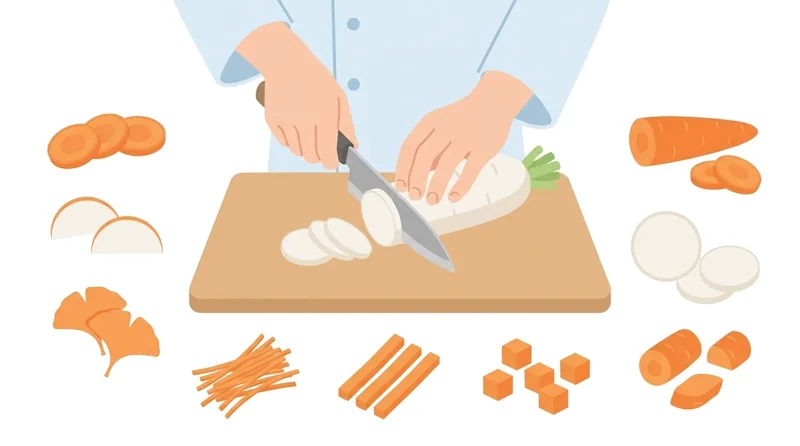
野菜の切り方には、丸い「輪切り」、縦半分に切る「半月切り」、縦4つ割りの「いちょう切り」、細長い「千切り」、薄い長方形の「短冊切り」、角柱状の「拍子木切り」、1cm角の「さいの目切り(角切り)」、薄い正方形の「色紙切り」があります。
Vegetable cuts include round slices (Wagiri), lengthwise halves sliced into half-moons (Hangetsugiri), quarters sliced into ginkgo fans (Ichōgiri), fine strips (Sengiri), thin rectangles (Tanzakugiri), thick rectangular sticks (Hyōshigigiri), 1 cm cubes (Sainomegiri / Kakugiri), and thin squares (Shikishigiri).
さらに、回しながら切る「乱切り」、端から薄く切る「小口切り」、トマトなどの「くし形切り」、細かい「みじん切り」、大根を薄くむく「桂むき」、ごぼうの「ささがき」のほか、煮崩れを防ぐ「面取り」や火通りを良くする「隠し包丁」を行います。
Other cuts include rolling diagonal chunks (Rangiri), thin end rounds (Koguchigiri), wedges for tomatoes or onions (Kushigatagiri), fine mince (Mijingiri), rotary sheet peeling (Katsuramuki), and shavings for burdock (Sasagaki), as well as 'chamfering edges (Mentori)' to prevent breaking when simmering and 'scoring (Kakushibōchō)' for even cooking.
Key points
- 刺身には柳刃包丁、魚をさばくには出刃包丁、野菜には菜切り包丁などを使い分ける。
Use a Yanagiba knife for sashimi, a Deba knife for filleting fish, and a Nakiri or chef's knife (Gyūtō) for vegetables. - 輪切り・半月切り・いちょう切り・千切り・短冊切り・乱切り・くし形切りなど、料理に合わせて切り方を選ぶ。
Select the appropriate cut—rounds, half-moons, ginkgo fans, fine strips, thin rectangles, rolling chunks, or wedges—according to the dish. - 煮崩れを防ぐために角を削る「面取り」や、味と熱を通しやすくする「隠し包丁」を行う。
Perform 'chamfering (Mentori)' to keep vegetables from crumbling while simmering, and 'scoring (Kakushibōchō)' to help heat and flavor penetrate.
| Word | Meaning |
|---|---|
| 柳刃包丁・出刃包丁 | Yanagiba (sashimi knife) and Deba (fish-filleting knife) |
| 千切り・みじん切り | fine julienne strips (Sengiri) and fine mince (Mijingiri) |
| 半月切り・いちょう切り | half-moon cut (Hangetsugiri) and ginkgo-leaf cut (Ichōgiri) |
| 短冊切り・さいの目切り | thin rectangular strips (Tanzakugiri) and diced cubes (Sainomegiri) |
| 乱切り・くし形切り | rolling diagonal cut (Rangiri) and wedge cut (Kushigatagiri) |
| 面取り・隠し包丁 | chamfering edges (Mentori) and hidden score cut (Kakushibōchō) |
野菜・魚介類・肉・米の下処理
Pre-processing Vegetables, Seafood, Meat, and Rice
ごぼうやなすなどは切った後すぐに水にさらして「あく」を抜き、変色を防ぎます。魚は「うろこ・えら・内臓」を除いて流水で洗い、水気を拭きます。魚に塩を振る「振り塩」は余分な水分と臭みを抜き、身を締めます。
Soak cut burdock root, eggplant, or lotus root immediately in water or vinegared water to remove 'harshness (aku)' and prevent discoloration. When prepping fish, remove scales, gills, and internal organs, wash under running water, and wipe dry. Sprinkling salt on fish (Furijio) draws out excess moisture and fishy odor while firming the flesh.
魚のさばき方で、中骨がついた身と骨のない身の2つに分けるのが「二枚おろし」、左右の身2枚と中骨1つに分けるのが「三枚おろし」です。エビは背ワタを取り、揚げたときに丸まらないよう腹側に切り目を入れて「筋切り」をします。
In fish filleting, separating the fish into 2 pieces (one bone-in side and one boneless side) is called 'two-piece filleting (Nimai-oroshi)', while separating it into 2 boneless left/right fillets and 1 center bone is called 'three-piece filleting (Sanmai-oroshi)'. Devein shrimp (remove back vein) and make shallow cuts on the belly (Sujikiri) so they do not curl when fried.
豚肉のロースなども、焼いたり揚げたりしたときに縮んで反り返るのを防ぐため、赤身と脂身の境目に包丁の先で「筋切り」をします。
For pork loin and similar cuts, use the tip of the knife to 'sever connective sinew (Sujikiri)' between the lean meat and fat so the meat does not shrink and curl when grilled or deep-fried.
米はぬかの臭いが移らないよう手早く水で洗い、分量の水(重量比で約1.2倍など)に浸水させてから炊きます。炊き上がり後は「蒸らし」てから、しゃもじで底から切るようにほぐして余分な水分を逃がします。
When cooking rice, wash it quickly with cold water at first so bran odor is not absorbed, then soak it in measured water (e.g., about 1.2 times the weight of rice) before cooking. After cooking and 'steaming (murasu)', fluff the rice from the bottom with a paddle (shamoji) in a cutting motion to release excess moisture.
Key points
- ごぼうやなすは水にさらして「あく抜き」と変色防止を行い、魚は「振り塩」で臭みと水分を除く。
Soak burdock and eggplant in water to remove harshness and prevent discoloration, and use 'salting (Furijio)' on fish to remove odor and moisture. - 魚を左右の身2枚と中骨に分ける方法を「三枚おろし」といい、肉やエビは縮みを防ぐため「筋切り」をする。
Dividing a fish into two left/right fillets and one center bone is called 'three-piece filleting (Sanmai-oroshi)'; score sinews (Sujikiri) on meat and shrimp to prevent curling. - 米は洗米・浸水の後に炊き、蒸らしてからしゃもじで底からほぐして余分な水気を飛ばす。
Wash and soak rice before cooking, let it steam after cooking, and fluff from the bottom with a rice paddle to release excess moisture.
| Word | Meaning |
|---|---|
| あく抜き | removing harshness/astringency (Akunuki) |
| 振り塩 | sprinkling salt on fish (Furijio) |
| 二枚おろし・三枚おろし | two-piece filleting (Nimai-oroshi) and three-piece filleting (Sanmai-oroshi) |
| 筋切り | scoring tendons/sinews (Sujikiri) |
| 蒸らす | steaming rice after cooking (Murasu) |
加熱調理と非加熱調理の基本
Fundamentals of Heated and Non-Heated Cooking Methods
「煮る」調理では、味が染み込みやすい順に「さ(砂糖)・し(塩)・す(酢)・せ(しょうゆ)・そ(みそ)」の順で調味します。和食の基本だしは昆布とかつお節でとり、煮物では「落とし蓋」で煮汁を対流させ、浮いた「灰汁(アク)」をすくい取ります。
In 'Simmering (Niru)', add seasonings in the order of penetrability: 'Sa (Sugar) → Shi (Salt) → Su (Vinegar) → Se (Soy sauce) → So (Miso)'. Basic Japanese dashi broth is made from kelp (kombu) and bonito flakes (katsuobushi); use a 'drop lid (Otoshibuta)' to circulate broth and skim off floating 'scum (Aku)'.
「ゆでる」調理では、ほうれん草などの青菜やブロッコリーは塩を少し入れた沸騰湯でふたをせずにゆで、冷水に取って緑色を保ちます。一方、大根やじゃがいもなどの根菜類は中心まで均一に熱を通すため「水から」ゆでます。
In 'Boiling (Yuderu)', boil leafy greens like spinach or broccoli uncovered in plenty of salted boiling water, then plunge into cold water to keep their bright green color. Conversely, boil root vegetables (Konsairui) like daikon and potatoes 'starting from cold water' so heat penetrates evenly to the center.
「焼く」では、焼き網の魚は「強火の遠火」で表面をパリッと焼き、オーブンはあらかじめ「予熱」しておきます。「揚げる」では、天ぷらは冷水で衣を軽く混ぜて170〜180℃の油で揚げ、フライは「小麦粉→溶き卵→パン粉」の順に衣をつけます。
In 'Grilling/Baking (Yaku)', grill fish over 'high heat from a distance (Tsuyobi no Tōbi)' for crisp skin, and always 'preheat (Yonetsu)' ovens. In 'Deep-frying (Ageru)', mix tempura batter lightly with cold water and fry at 170–180°C, and coat breaded cutlets (Furai) in the order of 'Flour → Beaten egg → Breadcrumbs (Panko)'.
揚げ油は揚げかすをこまめにすくい、使用後にろ過して酸化を防ぎます(泡が消えない・黒ずむ・粘り気や異臭・煙が出る油は劣化しているため交換します)。非加熱の「和える」調理は、水気が出ないよう提供直前に和えます。
Extend frying oil life by skimming crumbs frequently and filtering after use (replace degraded oil that has persistent bubbles, dark color, viscosity, bad odor, or smoke). Perform non-heated 'Tossing/Dressing (Aeru)' just before serving to prevent moisture from drawing out.
Key points
- 煮物の調味料は「さしすせそ(砂糖→塩→酢→しょうゆ→みそ)」の順に入れ、落とし蓋やアク取りを行う。
Add simmering seasonings in the 'Sa-Shi-Su-Se-So (Sugar → Salt → Vinegar → Soy sauce → Miso)' order, using a drop lid and skimming scum. - 青菜は沸騰したお湯でゆでて冷水にとり、根菜類は「水から」ゆでて中までやわらかくする。
Boil leafy greens in boiling water and chill in cold water, while boiling root vegetables 'starting from cold water' to cook evenly to the center. - フライの衣は「小麦粉→溶き卵→パン粉」の順につけ、劣化して泡や煙・異臭が出る油は交換する。
Coat breaded fried foods in the order 'Flour → Beaten egg → Breadcrumbs', and replace degraded oil that foams persistently, smokes, or smells bad.
| Word | Meaning |
|---|---|
| さしすせそ | Sa-Shi-Su-Se-So seasoning order |
| 落とし蓋 | drop lid placed directly on food (Otoshibuta) |
| 灰汁(アク) | scum (Aku) |
| 予熱 | preheating (Yonetsu) |
| 和える | tossing / dressing (Aeru) |
調理機器・器具の扱いと労働安全衛生
Handling Kitchen Equipment, Utensils, and Occupational Safety
お玉は「レードル」、泡立て器は「ホイッパー」、フライ返しは「ターナー」、円すい形のこし器は「シノワ」と呼びます。深い「寸胴鍋」は木べらで底から混ぜて焦げを防ぎ、フッ素樹脂加工のフライパンは空焚きや金属たわしを避けます。
Among kitchen tools, a soup dipper is called a 'ladle', a wire whisk is a 'whipper', a flat spatula is a 'turner', and a conical strainer is a 'chinois'. Stir deep stockpots (Zundōnabe) from the bottom with a wooden spatula to prevent scorching, and never dry-heat (karadaki) or scrub fluoropolymer-coated pans with metal scrubbers.
「スチームコンベクションオーブン」は蒸気と熱風で焼く・蒸す・煮るができ、やけどを防ぐため扉を少し開けて蒸気を逃がしてから開けます。「ブラストチラー」は加熱後の食品を急速冷却し、「真空包装機」は空気を抜いて酸化や乾燥を防ぎます。
A 'steam convection oven' uses steam and hot air to bake, steam, and simmer; open its door slightly first to let steam escape and avoid burns. A 'blast chiller' rapidly cools cooked foods, and a 'vacuum packaging machine' removes air to prevent oxidation and drying.
スライサーやミキサーの刃を洗ったり詰まりを取ったりするときは、必ず電源を切りコンセントを抜いてから行います。熱い鍋は「乾いたふきんやミトン」で持ち(濡れたふきんは蒸気でやけどするため不可)、周囲に声をかけて運びます。
Always turn off the power and unplug the cord before disassembling, washing blades, or clearing jams in slicers or mixers. Carry hot pots using 'dry cloths or dry oven mitts' (never wet cloths, as steam causes burns) while calling out to coworkers around you.
ガス臭いときは火や換気扇のスイッチに絶対に触れず、ガスの元栓を閉めて窓を開けます。フライヤーの油に火がついたときは、水をかけると油が飛び散り爆発的に燃え広がるため絶対に水をかけず、火を止めて消火器やふたで消火します。
If you smell gas, never use fire or touch ventilation fan switches; close the main gas valve immediately and open windows. If fryer oil catches fire, never pour water on it because the oil will splatter explosively—turn off the heat and extinguish it with a fire extinguisher or lid.
Key points
- スチームコンベクションオーブンの扉は蒸気によるやけどを防ぐためゆっくり開け、熱い鍋は乾いたミトンで持つ。
Open steam convection oven doors slowly to prevent steam burns, and always hold hot pots with dry mitts or dry cloths. - スライサーやミキサーを分解・洗浄するときは、必ず電源を切り電源プラグを抜いてから作業する。
Always turn off power and unplug the power cord before disassembling or cleaning slicers and mixers. - 揚げ油に引火したときに水をかけるのは厳禁であり、ガス漏れ時は換気扇スイッチに触れず元栓を閉めて窓を開ける。
Never pour water on burning frying oil, and if gas leaks, close the main gas valve and open windows without touching ventilation switches.
| Word | Meaning |
|---|---|
| レードル・ホイッパー・ターナー | ladle, whipper (whisk), and turner (spatula) |
| 寸胴鍋 | deep cylindrical stockpot (Zundōnabe) |
| スチームコンベクションオーブン | steam convection oven |
| ブラストチラー | blast chiller |
| 空焚き | dry-heating an empty pan/pot (Karadaki) |
Food Preparation
Practice this chapter in the appOfficial references
- 一般社団法人日本フードサービス協会 外食業特定技能1号技能測定試験 学習用テキスト【飲食物調理】 — https://www.jfnet.or.jp/wp/wp-content/uploads/2025/09/jf_preparation_of_food_and_drink_text_ja_v1.1.pdf