Occupational Safety and Health (Industrial Safety and Health Act, Fall Prevention, Rigging/Slinging, Machinery, Electrical & Gas Safety)
安全衛生(労働安全衛生法・墜落防止・玉掛け・機械・電気・ガス安全)
Rebar Worker Certificate 鉄筋技能士 (Grade 1/2 theory) · 技能検定「鉄筋施工」1級・2級 学科 · Written by Tokutei Pass based on the official study texts; not copied verbatim.
安全衛生管理体制と危険予知活動(KY・4S・リスクアセスメント)
Safety Management System and Hazard Prediction Activities (KY, 4S, Risk Assessment)
建設現場では元請事業者と多数の下請事業者が混在して作業するため、労働安全衛生法により、一定規模以上の現場では元請が「統括安全衛生責任者」および「元方安全衛生管理者」を選任し、関係請負人(専門工事業者)は「安全衛生責任者(職長等)」を選任して連絡調整を行います。
Because construction sites involve a prime contractor and multiple subcontractors working together, the Industrial Safety and Health Act requires the prime contractor on sites above a specified scale to appoint an 'Overall Safety and Health Controller,' while each subcontractor appoints a 'Safety and Health Person-in-Charge (foreman)' for coordination.
また政令で定める危険な作業(高さ5m以上のコンクリート造の工作物の解体や、足場の組立て・解体・変更、型枠支保工の組立て等)では、技能講習を修了した者から「作業主任者」を選任し、作業方法の決定や直接指揮を行わせなければなりません。
For hazardous operations designated by Cabinet Order (such as erecting, dismantling, or altering scaffolding or formwork shoring), an 'Operations Chief (sagyō shuninsha)' who has completed the required Skill Training Course must be appointed to determine work methods and directly supervise workers.
毎日の作業開始前には、全員でその日の作業に潜む危険要因と対策を話し合う「KY活動(危険予知活動)」やツールボックスミーティングを実施し、重要行動目標を指差呼称(「ヨシ!」)で確認します。
Before starting work each day, all crew members conduct 'KY (Hazard Prediction) activities' and toolbox meetings to identify hazards and countermeasures, confirming key safety targets through point-and-call checks ('Yoshi!').
さらに職場環境の基本である「4S活動(整理・整頓・清掃・清潔)」を徹底してつまずき・転倒災害を防ぎ、現場に初めて入る作業員には作業開始前に「新規入場者教育」を行います。
In addition, '4S activities (Sort, Set in order, Shine, Standardize)' are strictly maintained to prevent trip-and-fall accidents, and 'New-Entrant Safety Orientation' is provided to workers entering the site for the first time.
Key points
- 混在作業現場では元請が「統括安全衛生責任者」、下請が「安全衛生責任者」を選任し、危険作業には「作業主任者」を配置する
Prime contractors appoint an 'Overall Safety and Health Controller,' subcontractors appoint a 'Safety and Health Person-in-Charge,' and an 'Operations Chief' supervises designated hazardous tasks - 作業開始前に「KY活動(危険予知活動)」と指差呼称を行い、不安全行動による労働災害を防止する
Daily pre-work 'KY (Hazard Prediction) activities' and point-and-call checks prevent unsafe acts and accidents - 現場の「4S(整理・整頓・清掃・清潔)」を徹底し、新規入場者には入場時教育を実施する
Thorough '4S (Seiri, Seiton, Seisō, Seiketsu)' housekeeping and mandatory new-entrant safety orientation are enforced on site
| Word | Meaning |
|---|---|
| 統括安全衛生責任者と安全衛生責任者 | Overall Safety and Health Controller and Safety and Health Person-in-Charge |
| 作業主任者(技能講習修了者から選任) | Operations Chief (sagyō shuninsha, appointed from skill-training graduates) |
| KY活動(危険予知活動)と指差呼称 | KY (hazard prediction) activity and point-and-call |
| 4S活動(整理・整頓・清掃・清潔) | 4S activities (Sort, Set in order, Shine, Standardize) |
保護具の着用と熱中症予防対策
Personal Protective Equipment (PPE) and Heat Stroke Prevention
鉄筋作業では、飛来・落下物による頭部外傷および高所からの墜落時の頭部保護のため、衝撃吸収ライナー(発泡スチロール等の緩衝材)が内蔵された「飛来・落下物用兼墜落時保護用」の保護帽(ヘルメット)を正しくかぶり、あごひもを確実に締めます。
To protect the head from both falling/flying objects and falls from height during rebar work, workers must wear a dual-rated safety helmet ('for flying/falling objects and fall protection') equipped with an internal shock-absorbing liner, with the chinstrap securely fastened.
服装は長袖・長ズボンの作業服を着て袖口や裾のボタンを留め、足元はつま先に先芯が入り踏み抜き防止性能のある「安全靴」を着用します。また鉄筋切断時やワイヤーブラシ清掃時・ガス圧接時には飛散物や紫外線から目を守る「保護眼鏡(しゃ光保護眼鏡)」を着用します。
Workers must wear long-sleeved shirts and full-length trousers with cuffs fastened, steel-toe 'safety shoes (anzengutsu)' with puncture-resistant soles, and 'safety glasses (or shade goggles)' during cutting, wire-brushing, or gas pressure welding.
なお、ボール盤や鉄筋曲げ機・電動丸のこなどの「回転する刃物やローラー」を扱う作業では、繊維が巻き込まれて手指を切断する重大災害となるため、「軍手(綿手袋)」の使用は厳禁です。
When operating rotating machinery (such as drill presses, rebar benders, or circular saws), wearing 'knitted cotton gloves (gunte)' is strictly prohibited because loose fibers can catch and pull the hand into rotating parts.
夏場の屋外鉄筋作業では「熱中症」のリスクが極めて高いため、現場の「WBGT値(暑さ指数:気温・湿度・輻射熱を総合した指標)」を常時測定し、のどが渇く前に定期的に「水分と塩分(ナトリウム)」を両方補給するとともに、冷房や日陰のある涼しい休憩所で小休止をとります。
During outdoor summer rebar work, the 'WBGT (Wet Bulb Globe Temperature) heat stress index' (combining air temperature, humidity, and radiant heat) must be monitored continuously, and workers must regularly replenish both 'water and salt (sodium)' before feeling thirsty while taking breaks in shaded or air-conditioned rest areas.
Key points
- 保護帽は衝撃吸収ライナー入りの「飛来・落下物用兼墜落時保護用」を使用し、あごひもを確実に締める
Wear a dual-rated safety helmet with an internal shock-absorbing liner ('for flying/falling objects and fall protection') and fasten the chinstrap - 回転機械を扱う作業では、巻き込まれ防止のため「軍手」の着用は禁止されている
Never wear 'knitted cotton gloves (gunte)' around rotating machinery to prevent entanglement hazards - 熱中症予防では「WBGT値(暑さ指数)」を確認し、こまめに「水分と塩分」を同時に補給する
Monitor the 'WBGT heat index' and regularly replenish both 'water and salt' to prevent heat stroke
| Word | Meaning |
|---|---|
| 保護帽(飛来・落下物用兼墜落時保護用・衝撃吸収ライナー) | safety helmet (flying/falling object & fall protection, shock-absorbing liner) |
| 安全靴と保護眼鏡 | safety shoes and safety glasses |
| 回転機械作業における軍手使用禁止 | prohibition of cotton gloves (gunte) on rotating machines |
| 熱中症予防とWBGT値(暑さ指数) | heat stroke prevention and WBGT (heat stress index) |
高所作業と墜落・転落災害の防止
Work at Height and Prevention of Fall Accidents
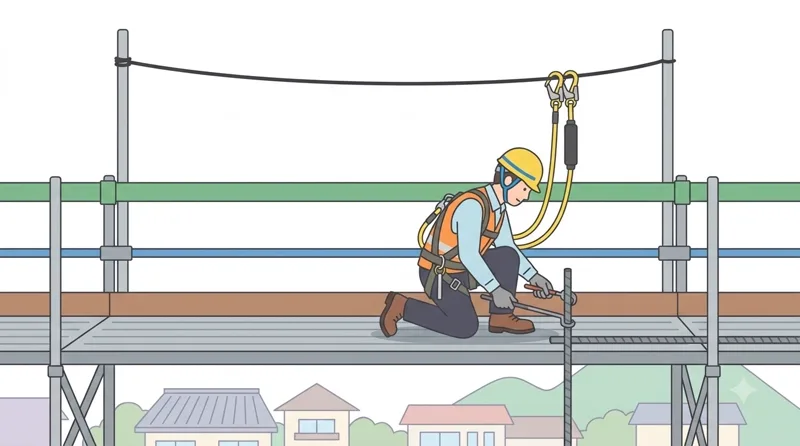
労働安全衛生規則第518条により、「高さが2m以上」の箇所(作業床の端・開口部等)で作業を行う場合には、足場を組み立てるなどの方法により「作業床」を設けることが原則として義務付けられています。
Under Article 518 of the Ordinance on Industrial Safety and Health, whenever work is performed at a 'height of 2 m or more' (including platform edges and floor openings), a safe 'working platform (sagyō yuka)' must in principle be provided by erecting scaffolding or equivalent means.
高さ2m以上の作業床の端や開口部には、墜落防止のため「高さ85cm以上の手すり」および「高さ35cm以上50cm以下の中さん(またはこれと同等以上の機能を有する設備)」を設け、物の落下防止のため高さ10cm以上の幅木やメッシュシートを取り付けます。
Along the edges of working platforms at heights of 2 m or more and around openings, fall-prevention guardrails consisting of a 'top rail at least 85 cm high' and a 'mid-rail (nakasan) at a height of 35 cm to 50 cm' (or equivalent protection), together with toeboards at least 10 cm high, must be installed.
作業床や囲いを設けることが困難な場合は、防網を張り「要求性能墜落制止用器具」を使用させます。墜落制止用器具は原則「フルハーネス型」(高さ6.75m超は義務)とし、フックは「腰より高い位置」に掛けます(第一種ショックアブソーバは足元掛け禁止)。
Where providing a working platform or guardrails is extremely difficult, safety nets must be rigged and workers must wear 'certified fall-arrest equipment.' In principle, a 'full-body harness' must be used (mandatory by law above 6.75 m), and the lanyard hook must be attached to a lifeline or anchor point 'above waist level' to minimize free-fall distance (Type 1 shock absorbers must not be anchored at foot level).
また悪天候時の作業中止基準として、「強風(10分間の平均風速が10m/s以上)」「大雨(1回の降雨量が50mm以上)」「大雪(1回の降雪量が25cm以上)」または「中震(震度4)以上の地震」の場合には、高所作業や足場組立作業を中止しなければなりません。
High-elevation work and scaffold erection must be suspended during adverse weather meeting statutory thresholds: 'strong wind (10-minute mean wind speed of 10 m/s or more),' 'heavy rain (50 mm or more per rainfall event),' 'heavy snow (25 cm or more per snowfall),' or an 'earthquake of moderate intensity (seismic intensity 4) or greater.'
Key points
- 「高さ2m以上」の箇所での作業には原則として作業床を設け、「高さ85cm以上の手すり」と「35〜50cmの中さん」を設置する
Work at a 'height of 2 m or more' requires a working platform in principle, equipped with a 'top rail ≥ 85 cm high' and a 'mid-rail at 35–50 cm' - 墜落制止用器具は原則「フルハーネス型」(6.75m超は義務)とし、フックは「腰より高い位置」に掛ける
Fall-arrest equipment should be a 'full-body harness' (mandatory above 6.75 m), with the hook anchored 'above waist height' - 強風(10分間平均風速10m/s以上)・大雨(50mm以上)・大雪(25cm以上)・中震以上の地震時は高所作業を中止する
Suspend work at height during strong wind (10-min mean ≥ 10 m/s), heavy rain (≥ 50 mm), heavy snow (≥ 25 cm), or seismic intensity ≥ 4
| Word | Meaning |
|---|---|
| 高さ2m以上の作業床と手すり(85cm以上)・中さん(35〜50cm) | working platform at height ≥ 2 m; top rail (≥ 85 cm) and mid-rail (35–50 cm) |
| 要求性能墜落制止用器具(フルハーネス型) | certified fall-arrest equipment (full-body harness type) |
| ショックアブソーバとフックの腰高以上への取付け | shock absorber and anchoring hook above waist level |
| 強風基準(10分間平均風速10m/s以上で作業中止) | strong-wind threshold (suspend work at 10-min mean wind speed ≥ 10 m/s) |
足場・作業床・通路・脚立・支保工の安全基準
Safety Standards for Scaffolds, Working Platforms, Access Ramps, Stepladders, and Shoring
足場における「作業床」は、幅を「40cm以上」とし、床材間のすき間は「3cm以下」、建地(支柱)と床材とのすき間は「12cm未満」とし、転位や脱落を防止するため2以上の支持物に確実に固定します。
A scaffold 'working platform (sagyō yuka)' must have a width of '40 cm or more,' a gap between floor planks of '3 cm or less,' and a gap between standards (uprights) and planks of 'less than 12 cm,' and must be securely fastened to two or more supports to prevent displacement.
鋼管足場(単管足場)では、建地の間隔を「けた行方向1.85m以下、はり間方向1.5m以下」とし、地上第一の布(水平材)は「高さ2m以下」の位置に設けます。また単管足場の建地1スパンあたりの積載荷重は原則「400kg以下」とし、足場材の緊結や手すりの有無は毎日の作業開始前および悪天候後・組立変更後に必ず点検します。
In single-pipe steel scaffolding (tankan ashiba), upright spacing must be '1.85 m or less longitudinally and 1.5 m or less transversely,' with the first ledger above ground (dai-ichi no nuno) placed at a 'height of 2 m or less.' The maximum load per span is '400 kg or less' in principle, and scaffolds must be inspected before starting work each day and after severe weather or alterations.
現場内の「架設通路・登り桟橋」は勾配「30°以下」とし、勾配「15°を超える」ものには踏みさん等の滑り止めを設けます。高さ8m以上の登り桟橋には「7m以内ごと」におどり場を設けます。「移動はしご」は幅30cm以上、角度約75°、上端を床から「60cm以上」突き出して固定します。
Temporary 'access ramps and inclined walkways (nobori sanbashi)' must have a slope of '30° or less,' and cleats or non-slip treads (fumisan) must be installed whenever the slope 'exceeds 15°.' Ramps 8 m or more in height require landings at intervals of 'every 7 m or less.' Portable ladders must be at least 30 cm wide, pitched at about 75°, and extend 'at least 60 cm' above the upper landing.
「脚立(うま)」を使用するときは、開き止め金具を確実にロックし、天板の上に乗ったりまたがったりして作業することは禁止です。また型枠支保工に用いる「パイプサポート」は、3本以上継いで使用してはならず、2本を継ぐときは4個以上のボルトで締結します。
When using a 'stepladder (kyatatsu),' the spreader bars must be locked securely, and working while standing on or straddling the top cap is prohibited. Furthermore, tubular steel 'pipe supports' used in formwork shoring must never be spliced three or more high (when joining two pipe supports, at least 4 bolts must be used).
Key points
- 足場の作業床は「幅40cm以上・床材間のすき間3cm以下」とし、単管足場の地上第一の布は「高さ2m以下」、スパン荷重は400kg以下とする
Scaffold working platforms must be '≥ 40 cm wide with plank gaps ≤ 3 cm'; single-pipe scaffolds require the first ledger at '≤ 2 m height' and span load ≤ 400 kg - 架設通路の勾配は「30°以下」とし、「15°を超える」ときは踏みさんを設け、高さ8m以上の登り桟橋には「7m以内ごと」におどり場を設ける
Temporary ramps must have a slope '≤ 30°' (with cleats if '> 15°'), and ramps ≥ 8 m high require landings 'every 7 m or less' - 移動はしごは上端を「60cm以上」突き出し、脚立の天板作業やパイプサポートの「3本以上の継ぎ足し」は禁止されている
Portable ladders must extend '≥ 60 cm' above the upper floor; standing on a stepladder top cap and splicing '3 or more pipe supports' are prohibited
| Word | Meaning |
|---|---|
| 作業床(幅40cm以上・床材間のすき間3cm以下) | working platform (width ≥ 40 cm; gap between planks ≤ 3 cm) |
| 単管足場(地上第一の布2m以下・スパン荷重400kg以下) | single-pipe scaffold (first ledger ≤ 2 m; span load ≤ 400 kg) |
| 架設通路(勾配30°以下・15°超は踏みさん設置) | temporary ramp (slope ≤ 30°; cleats required over 15°) |
| 移動はしご(上端突出60cm以上)と脚立の開き止め | portable ladder (top extension ≥ 60 cm) and stepladder spreader lock |
クレーン・玉掛け作業の安全とワイヤロープの廃棄基準
Crane & Slinging (Tamagake) Safety and Wire Rope Discard Criteria
つり上げ荷重が「1t以上」のクレーンまたは移動式クレーンの玉掛け業務には、「玉掛け技能講習」を修了した有資格者でなければ就くことができません(1t未満は特別教育)。また移動式クレーンの運転は、つり上げ荷重1t以上5t未満が「小型移動式クレーン運転技能講習」、5t以上が「移動式クレーン運転士免許」を必要とします。
Slinging (tamagake) operations for a crane or mobile crane with a lifting capacity of '1 ton or more' may only be performed by workers who have completed the 'Slinging Skill Training Course (Tamagake Ginō Kōshū)' (special education applies under 1 ton). Operating a mobile crane of 1 to under 5 tons requires the 'Small Mobile Crane Operation Skill Training Course,' and 5 tons or more requires a 'Mobile Crane Operator License.'
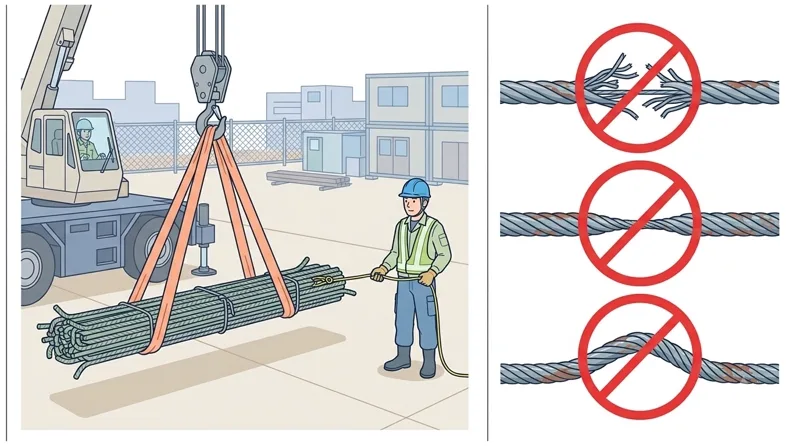
玉掛け用ワイヤロープの「安全係数」は「6以上」と定められています。使用禁止(廃棄基準)となるワイヤロープは、①「1よりの間で素線(しん線を除く)の数の10%以上が切断したもの」、②「直径の減少が公称径の7%を超えるもの」、③「キンク(よじれ)したもの」、④「著しい形崩れまたは腐食があるもの」です。
The 'safety factor' of slinging wire ropes must be '6 or more' under the Ordinance on Safety of Cranes and Similar Equipment. Wire ropes must be discarded (prohibited from use) if: (1) '10% or more of the individual wires (excluding filler wires) are broken within one lay,' (2) 'diameter reduction exceeds 7% of nominal diameter,' (3) 'the rope is kinked,' or (4) 'severe deformation or corrosion is present.'
2本つり以上の玉掛けでは、つり角度が大きくなるほどワイヤロープ1本にかかる張力が増大するため、標準の「つり角度は60°以内」とします。長尺の鉄筋束は重心を挟んで左右対称の「2点つり(あだ巻き掛けやハッカー・シャックル併用)」とし、フックには必ず「外れ止め装置」が付いたものを使用します。
Because sling tension increases sharply as the sling angle widens, the standard 'slinging angle must be kept within 60°.' Long rebar bundles must be lifted using a balanced 'two-point choke hitch' around the center of gravity, and crane hooks must be equipped with a working 'safety latch (hazure-dome).'
つり上げ開始時には、荷を地面から10〜20cm程度浮かして一旦停止する「地切り確認」を行い、水平バランスや玉掛け状態を確かめます。旋回・誘導時は「介錯ロープ(誘導ロープ)」で荷振れを抑え、いかなる場合も「つり荷の下」に作業員が入ることは絶対に禁止です。
At the start of every lift, perform a 'lift-off check (chigiri kakunin)' by raising the load 10–20 cm off the ground and pausing to verify balance and rigging security. Use 'tag lines (kaishaku rōpu)' to control load swing, and never allow anyone to enter 'under a suspended load.'
Key points
- つり上げ荷重「1t以上」の玉掛け業務には「玉掛け技能講習」が必要であり、ワイヤロープの安全係数は「6以上」とする
Slinging for cranes with a lifting capacity of '1 t or more' requires the 'Slinging Skill Training Course,' and wire ropes must have a safety factor of '6 or more' - ワイヤロープの廃棄基準は「1よりの間の素線切断10%以上」「公称径の7%を超える摩耗減少」「キンク・著しい形崩れ・腐食」である
Discard wire ropes with '≥ 10% broken wires in one lay,' 'diameter wear > 7% of nominal diameter,' or 'kinking, severe distortion, or corrosion' - 玉掛けの標準つり角度は「60°以内」とし、長尺鉄筋は2点吊りで「地切り確認」を行い、「つり荷の下への立入り」を厳禁とする
Keep the slinging angle 'within 60°,' use two-point rigging for long rebar bundles with a 'lift-off check (chigiri),' and strictly prohibit entering 'under suspended loads'
| Word | Meaning |
|---|---|
| 玉掛け技能講習(つり上げ荷重1t以上) | Slinging Skill Training Course (lifting capacity ≥ 1 ton) |
| 玉掛け用ワイヤロープ(安全係数6以上) | slinging wire rope (safety factor ≥ 6) |
| ワイヤロープ廃棄基準(素線切断10%以上・径減少7%超・キンク) | wire rope discard criteria (≥ 10% broken wires, > 7% wear, kinking) |
| つり角度60°以内・地切り確認・介錯ロープ | slinging angle ≤ 60°, lift-off check (chigiri), and tag line (kaishaku rōpu) |
加工機械・電気・アーク溶接の安全対策
Safety Measures for Rebar Machinery, Electricity, and Arc Welding
鉄筋切断機(バーカッター)や鉄筋曲げ機(バーベンダー)などの電動機械および移動電線を使用するときは、感電災害を防止するため定格感度電流30mA以下・動作時間0.1秒以内の「感電防止用漏電遮断装置(漏電遮断器)」を接続し、機械本体の金属製外箱には確実に「接地(アース)」を施します。
When operating electric rebar cutters, rebar benders, and portable power cables, an 'earth-leakage circuit breaker for electric-shock prevention' (rated sensitivity current ≤ 30 mA, operating time ≤ 0.1 s) must be connected, and the metal machine enclosure must be securely 'grounded (earthed).'
機械の始業前にはブレーキ・クラッチ・非常停止装置を点検します。切断時に端材が飛ぶのを防ぐ保護カバーを設け、ローラーから手を離してからスイッチを踏みます。また機械の清掃・給油・刃やローラーの交換・調整時には、必ず「機械を停止し電源を切る」ことが鉄則です。
Inspect brakes, clutches, foot switches, and emergency stops before starting work. Keep protective guards in place to stop flying bar ends during cutting, and remove hands from rollers before stepping on the foot pedal. Whenever cleaning, lubricating, changing blades/rollers, or adjusting a machine, it is an absolute rule to 'shut down the machine and turn off the main power.'
現場でフレア溶接や仮付け溶接を行うには「アーク溶接等特別教育」が必要であり、交流アーク溶接機には「自動電撃防止装置」の取付けが義務付けられています。紫外線による眼炎を防ぐため「しゃ光保護面」と革製手袋を着用し、発汗や雨天で濡れた状態での溶接は感電防止のため避けます。
Performing flare welding or tack arc welding requires 'Special Education for Arc Welding,' and AC arc welding machines must be equipped with an 'automatic electric-shock prevention device (low-voltage reducer).' Welders must wear a filter faceplate and leather gloves to prevent arc eye from UV radiation and avoid welding when clothes or skin are wet from rain or heavy sweat.
さらに「架空電線(高圧電線)」の近くで移動式クレーンや長尺鉄筋を取り扱う場合は、電線との安全離隔距離を確保し、電線に絶縁用防護管を装着するとともに、専任の「監視人」を配置して接触感電事故を防止します。
When operating mobile cranes or handling long rebars near 'overhead power lines (kakū densen),' maintain the required safe clearance distance, install insulating protective sleeves on the lines, and assign a dedicated 'watcher (kanshinin)' to prevent electrocution.
Key points
- 電動機械には「感電防止用漏電遮断装置」と「アース(接地)」を取り付け、清掃・注油・調整時は必ず電源を切る
Equip electric machines with an 'earth-leakage circuit breaker' and 'grounding (earth),' and always turn off the power before cleaning, oiling, or adjusting - 交流アーク溶接機には「自動電撃防止装置」の使用が義務付けられ、業務には「アーク溶接等特別教育」が必要である
AC arc welding machines must be fitted with an 'automatic electric-shock prevention device,' and operators must complete 'Special Education for Arc Welding' - 架空電線付近での長尺鉄筋やクレーン作業では、離隔距離の確保・絶縁用防護管の設置・監視人の配置を行う
Near overhead power lines, maintain safe clearance, install insulating protective tubes, and station a dedicated watcher
| Word | Meaning |
|---|---|
| 感電防止用漏電遮断装置(漏電遮断器)とアース | earth-leakage circuit breaker (ELCB) and grounding (earth) |
| 機械調整・清掃時の運転停止(電源遮断) | stopping machine and cutting power during adjustment/cleaning |
| 交流アーク溶接機の自動電撃防止装置 | automatic electric-shock prevention device on AC arc welders |
| 架空電線の絶縁用防護管と監視人配置 | insulating protective tubes on overhead lines and dedicated watcher |
ガス圧接作業と高圧ガス容器の安全管理
Gas Pressure Welding Operations and High-Pressure Gas Cylinder Safety
ガス圧接作業では高圧の「酸素」と可燃性の「溶解アセチレンガス」を使用します。高圧ガス保安法により、ガス容器(ボンベ)の表面塗色は、酸素容器が「黒色」、溶解アセチレン容器が「褐色(茶色)」と定められています。
Gas pressure welding uses high-pressure 'oxygen' and flammable 'dissolved acetylene gas.' Under the High Pressure Gas Safety Act, cylinder paint colors are standardized as 'black (kokushoku)' for oxygen cylinders and 'brown (kasshoku)' for dissolved acetylene cylinders.
ガス容器の取扱いでは、容器温度を常に「40℃以下」に保ち、直射日光を避けて風通しの良い場所に置きます。特に溶解アセチレン容器は、横倒しにすると内部の溶剤(アセトン)が流出して爆発・逆火の危険があるため、保管時も使用時も必ず鎖やロープで転倒防止措置を講じて「直立(立てた状態)」にしなければなりません。
Gas cylinders must always be kept at a temperature of '40°C or below' in a well-ventilated area out of direct sunlight. In particular, if a dissolved acetylene cylinder is laid horizontally, the internal acetone solvent will leak out and create a severe flashback/explosion hazard; therefore, cylinders must always be kept 'upright (vertical)' and secured against tipping with chains or ropes during both storage and use.
ホース接続部には専用の圧力調整器と逆火を遮断する「乾式安全器(逆火防止器)」を確実に取り付け、作業前に石けん水などでガス漏れがないか点検します。また酸素の圧力調整器やバルブに油脂類が付着すると急激な酸化発熱で爆発的に発火するため、油の付いた手や手袋で絶対に触れてはなりません。
Fit dedicated pressure regulators and a 'dry-type flashback arrestor (kanshiki anzenki)' securely to the hoses, and check connections for leaks using soapy water before work. Because oil or grease in contact with high-pressure oxygen can ignite explosively, never touch oxygen valves or regulators with oily hands or gloves.
圧接バーナー(吹管)への「点火順序」は、まず「酸素バルブを少し開けてからアセチレンバルブを開けて点火」します。逆に「消火順序(および逆火発生時)」は、先に可燃性の「アセチレンバルブを閉めてから酸素バルブを閉める」のが鉄則です。作業場所の周囲には可燃物を置かず、必ず消火器を常備します。
When 'lighting' the blowpipe (torch), 'slightly open the oxygen valve first, then open the acetylene valve and ignite.' Conversely, when 'extinguishing' the flame (or if a flashback occurs), always 'close the acetylene valve first, and then close the oxygen valve.' Remove combustibles from the work area and keep a fire extinguisher on hand.
Key points
- ボンベの塗色は「酸素=黒色」「溶解アセチレン=褐色(茶色)」であり、容器温度は「40℃以下」に保ち転倒防止して「直立」させる
Cylinder colors are 'Oxygen = black' and 'Dissolved acetylene = brown'; keep cylinder temperature at '40°C or below' and secure cylinders 'upright' - 溶解アセチレン容器には逆火防止の「乾式安全器」を取り付け、酸素器具には絶対に油脂類を付着させない
Install a 'dry-type flashback arrestor' on the acetylene line, and keep all oxygen fittings strictly free of oil and grease - バーナーの点火は「酸素→アセチレン」の順、消火は「アセチレン→酸素」の順にバルブを操作する
Operate torch valves in the order 'Oxygen → Acetylene' when lighting, and 'Acetylene → Oxygen' when extinguishing
| Word | Meaning |
|---|---|
| 高圧ガス容器塗色(酸素=黒色・アセチレン=褐色) | gas cylinder paint colors (oxygen = black; acetylene = brown) |
| 容器温度40℃以下と直立転倒防止保管 | cylinder temperature ≤ 40°C and upright anti-tipping storage |
| 乾式安全器(逆火防止器)と油脂厳禁 | dry-type flashback arrestor (kanshiki anzenki) and no oil/grease |
| バーナー点火順序(酸素先)と消火順序(アセチレン先) | torch lighting order (oxygen first) and extinguishing order (acetylene first) |
鉄筋現場特有の労働災害防止(差し筋保護・よじ登り禁止・転倒防止)
Preventing Rebar-Specific Site Accidents (Impalement Caps, No Climbing on Rebar, Bracing Against Collapse)
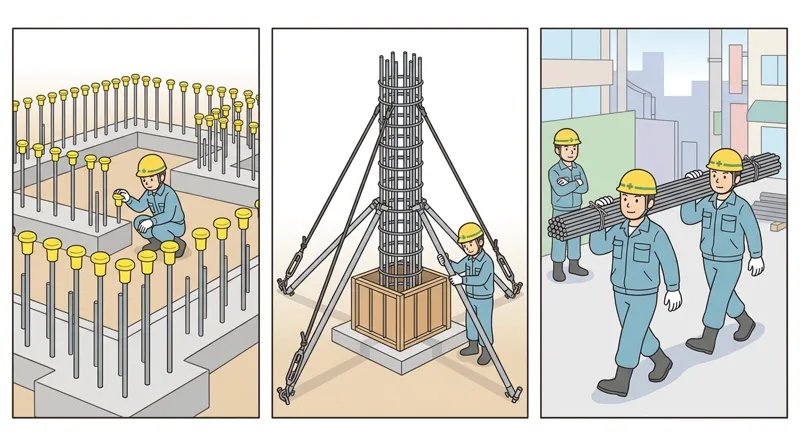
鉄筋現場で重大な災害の1つが、基礎やスラブから上向きに突出した柱・壁の「差し筋」やアンカーボルトの上に作業員が転倒・墜落して刺さる「突き刺し災害」です。これを防ぐため、露出した鉄筋先端には必ず「鉄筋保護キャップ(安全キャップ)」や連続保護カバーを取り付けます。
One of the most severe hazards unique to rebar sites is 'impalement (tsukisashi saigai)' when a worker trips or falls onto upward-protruding column/wall 'starter bars (sashikin)' or anchor bolts projecting from foundations or slabs. To prevent impalement, bright yellow 'rebar protective caps (safety caps)' or continuous trough covers must always be fitted over exposed bar ends.
第2に、組み立てた柱の帯筋や壁の横筋・配力筋を「はしごや足場代わりにして昇降する(よじ登る)こと」は絶対に禁止です。結束線が切れて作業員が墜落するだけでなく、鉄筋間隔が乱れたり鉄筋かご全体が崩壊したりする原因となります。
Second, 'climbing up or down assembled column hoops or horizontal wall bars' as a makeshift ladder is strictly prohibited. Stepping on tied bars can snap tie wires and cause a fall, as well as distort bar spacing or collapse the entire rebar cage.
第3に、立て込んだばかりの柱主筋・高い壁鉄筋・先組み鉄筋は自立安定性が低く、強風や他部材の接触で一気に連鎖倒壊する「鉄筋倒壊災害」のおそれがあります。したがって組立中および組立後には、単管パイプやワイヤロープ・トラロープによる「転倒防止用の控え材(控え綱・サポート)」を四方に確実に取り付けます。
Third, newly erected freestanding column bars, tall wall rebar mats, and preassembled cages have low lateral stability and can topple in high winds or upon impact ('rebar collapse accidents'). Therefore, temporary 'guy wires, stay ropes, or pipe-support braces (hikae-zai)' must be securely installed in multiple directions during and after assembly.
第4に、長尺の鉄筋を2人以上で肩に担いで人力運搬するときは、前後の作業員が「同じ側の肩」に担いで足並みをそろえ、先端に注意標識(赤布等)を付けて、曲がり角や荷下ろし時には必ず声を掛け合って周囲の人や電線への接触を防ぎます。
Fourth, when two or more workers manually carry long reinforcing bars on their shoulders, the front and rear workers must carry the bars on the 'same shoulder,' walk in step, attach a warning flag to the tip, and call out clearly to each other when turning corners or setting the load down.
Key points
- 突き刺し災害防止のため、基礎やスラブから突出した「差し筋」の先端には必ず「保護キャップ(安全キャップ)」を取り付ける
Always fit 'protective caps (safety caps)' over protruding 'starter bars (sashikin)' to prevent impalement accidents - 組み立てた柱の帯筋や壁の横筋に足をかけて昇降(よじ登り)することは、墜落および配筋崩壊を防ぐため厳禁である
Never climb on assembled column hoops or horizontal wall bars, which can snap tie wires, cause falls, and deform the rebar cage - 自立する柱・壁鉄筋には「転倒防止用の控え材(ワイヤー・単管サポート)」を取り付け、長尺鉄筋の2人担ぎ運搬では「同じ側の肩」に担ぐ
Install 'temporary guy wires or pipe braces (hikae-zai)' to prevent freestanding column/wall cages from toppling, and use the 'same shoulder' when team-carrying long bars
| Word | Meaning |
|---|---|
| 差し筋の突き刺し防止(保護キャップ・安全キャップ) | starter-bar impalement prevention (protective cap / safety cap) |
| 帯筋・壁横筋での昇降禁止(よじ登り禁止) | prohibition of climbing on column hoops and horizontal wall bars |
| 鉄筋倒壊防止の控え材(控えワイヤー・単管サポート) | temporary bracing/guy wires against rebar cage collapse (hikae-zai) |
| 長尺鉄筋の人力運搬(同じ側の肩と声掛け) | manual carrying of long rebars (same shoulder and vocal signaling) |
Occupational Safety & Health
Practice this chapter in the appOfficial references
- 労働安全衛生法・労働安全衛生規則・クレーン等安全規則(e-Gov法令検索) — https://laws.e-gov.go.jp/law/347M50002000032
- 鉄筋施工技能検定 試験科目及びその範囲並びにその細目(厚生労働省) — https://www.mhlw.go.jp/stf/seisakunitsuite/bunya/koyou_roudou/jinzaikaihatsu/ability_skill/ginoukentei/index.html