
Home › Sample questions › Food Manufacturing (SSW 2)
Food Manufacturing (SSW 2) sample exam questions – 10 questions with answers
飲食料品製造業(2号)
10 sample questions in the real exam format, with furigana, English translation, answers and explanations. Tap "Show answer" under each question. For the full question bank and realistic mock exams, open the free app.
Question 1
職長が現場を監督・指示するための「5つの能力」の説明として、正しいものはどれか。
Which is a correct description of the "five abilities" a foreman (職長) needs to supervise and give instructions at the work site?
- A. 問題解決能力とは、目標に向けてチームを先導し、作業員の士気を高める能力である。
Problem-solving ability is the ability to lead the team toward a goal and raise the workers' morale. - B. コーチング能力とは、部下や後輩の力を引き出し、自発的な行動や成長を促す能力である。
Coaching ability is the ability to bring out the strengths of subordinates and juniors and encourage them to act on their own and grow. - C. リーダーシップ能力とは、現場の機械操作や製造技術を自ら正確に実演してみせる能力である。
Leadership ability is the ability to personally and accurately demonstrate machine operation and manufacturing techniques at the site. - D. 技能・技術的能力とは、発生したトラブルの真の原因を分析して再発防止策を立てる能力である。
Skill and technical ability is the ability to analyze the true cause of a trouble and make measures to prevent it from happening again.
Show answer
Correct answer: B
A foreman (職長) needs five abilities: skill and technical ability, leadership, coaching, communication, and problem solving. Coaching ability is bringing out the strengths of subordinates and encouraging them to act and grow on their own, so this description is correct. Leading the team toward a goal is leadership, showing accurate operation is skill and technical ability, and analyzing the cause of trouble is problem-solving ability. The other descriptions mix up these abilities. (Textbook: OTAFF2号テキスト 第1章 3-1 p.9)
| Word | Meaning |
|---|---|
| 職長 | foreman |
| 監督 | supervision |
| 自発的 | voluntary, on one's own initiative |
Question 2
HACCPの7原則を含む「12の手順」において、準備段階の手順1〜5に続く「手順6(原則1)」はどれか。
In the "12 steps" that include the 7 principles of HACCP, which is "Step 6 (Principle 1)", coming after the preparation steps 1 to 5?
- A. 製造工程一覧図を作成し、現場の実際の設備配置や作業手順と合致しているかを確認する。
Create a flow diagram of the manufacturing process and check that it matches the actual equipment layout and work procedures at the site. - B. 重要管理点(CCP)の管理基準(CL)から逸脱が生じた際にとるべき改善措置を設定する。
Set the corrective actions to take when a critical limit (CL) at a critical control point (CCP) is not met. - C. 各工程における危害要因(ハザード)をリストアップして分析し、その管理手段を検討する。
List and analyze the hazards in each process, and consider how to control them. - D. 策定したHACCPプランが有効に機能しているかを定期的に確かめる検証方法を設定する。
Set verification methods to regularly check that the HACCP plan is working effectively.
Show answer
Correct answer: C
In the 12 steps of HACCP, steps 1 to 5 are the preparation stage. Step 6 is Principle 1, hazard analysis (危害要因分析): listing and analyzing the hazards in each process and considering how to control them. Making and checking the flow diagram belongs to the preparation steps (steps 4 and 5). Setting corrective actions is step 10 (Principle 5), and setting verification methods is step 11 (Principle 6). (Textbook: OTAFF2号テキスト 第2章 4-2 p.36)
| Word | Meaning |
|---|---|
| 危害要因 | hazard |
| 重要管理点 | critical control point (CCP) |
| 改善措置 | corrective action |
Question 3
品質管理におけるSDCAサイクルとPDCAサイクルの違いおよび職長の役割として、正しいものはどれか。
Which is correct about the difference between the SDCA cycle and the PDCA cycle in quality control, and the role of the foreman?
- A. SDCAの「S」は安全基準(Safety)を意味し、労働災害防止に特化した管理サイクルである。
The "S" in SDCA means safety standards (Safety), and it is a management cycle specialized in preventing workplace accidents. - B. PDCAの「C」では作業結果の確認だけでなく、目標未達の要因調査や計画の見直しまで実施する。
In the "C" of PDCA, you do not only check the work results, but also investigate the causes of unmet targets and review the plan. - C. SDCAサイクルは新製品立上時の初期管理に回すものであり、日常の定常作業ではPDCAを回す。
The SDCA cycle is run for initial control when launching a new product, while PDCA is run in daily routine work. - D. 職長は既存の作業標準を維持するSDCAを主に担当し、課題発見や計画立案は工場長が行う。
The foreman mainly handles SDCA to maintain existing work standards, while finding problems and making plans is done by the factory manager.
Show answer
Correct answer: B
In SDCA, the "S" means Standard, and it is used to keep daily work stable. In the "C" (Check) of PDCA, you do more than check the results: you also investigate why a target was not met and review the plan. SDCA is not about safety standards and is not only for new product development, because it is used in routine work too. The foreman does not leave problem finding and planning to the factory manager. The foreman actively finds problems and runs PDCA to improve the process as well. (Textbook: OTAFF2号テキスト 第3章 1-1 p.50)
| Word | Meaning |
|---|---|
| 作業標準 | work standard |
| 要因調査 | cause investigation |
| 計画立案 | planning, drawing up a plan |
Question 4
食品工場におけるトレーサビリティの「トレースバック(遡及)」と「トレースフォワード(追跡)」の説明として、正しいものはどれか。
Which is a correct explanation of "trace back" and "trace forward" in traceability at a food factory?
- A. トレースフォワードとは、問題のある原料ロットから使用先の製品ロットや出荷先を特定することである。
Trace forward means identifying, from a problem raw material lot, the product lots where it was used and where they were shipped. - B. トレースバックとは、問題のある原料ロットからどのラインや製品に使われたかを追うことである。
Trace back means following a problem raw material lot to find which lines and products it was used in. - C. トレースフォワードとは、苦情品の製品ロットから製造記録や使用原料の入荷元を遡って調べることである。
Trace forward means going back from a complaint product lot to check the manufacturing records and the suppliers of the raw materials used. - D. 両者とも原料入荷時と製品出荷時の伝票を保管する仕組みであり、工程内の加工記録は対象に含まれない。
Both are systems for keeping slips at raw material receiving and product shipping, and in-process manufacturing records are not included in their scope.
Show answer
Correct answer: A
Trace forward (トレースフォワード) means following a problem raw material lot forward to find the product lots made with it and the places they were shipped to. Trace back (トレースバック) is the opposite: going back from a product, such as a complaint product, to its manufacturing records and the raw material lots and suppliers. Two of the other descriptions swap the two directions. The last one is wrong because traceability must also link the processing records inside the factory. (Textbook: OTAFF2号テキスト 第3章 3-3 p.65)
| Word | Meaning |
|---|---|
| 遡及 | tracing back |
| 追跡 | tracking, tracing |
| 出荷先 | shipping destination |
Question 5
生産管理の指標である「生産性」と「原単位」の関係および計算式として、正しいものはどれか。
Which is correct about the relationship and formulas of "productivity" and "unit consumption" (原単位), which are indicators of production management?
- A. 生産性は「投入量(INPUT)÷産出量(OUTPUT)」で求められ、その数値が小さいほど効率が良い。
Productivity is calculated as input (INPUT) ÷ output (OUTPUT), and the smaller the value, the better the efficiency. - B. 原単位は「産出量(OUTPUT)÷投入量(INPUT)」で求められ、単位時間あたりの生産量を表す。
Unit consumption is calculated as output (OUTPUT) ÷ input (INPUT), and shows the amount produced per unit of time. - C. 原単位は「投入量(INPUT)÷産出量(OUTPUT)」で求められ、生産性とは逆数の関係にある。
Unit consumption is calculated as input (INPUT) ÷ output (OUTPUT), and it is the reciprocal of productivity. - D. 生産性が向上すると、製品1単位をつくるのに要する労働時間や原料の原単位の数値は大きくなる。
When productivity improves, the unit consumption value, such as labor time or raw material needed to make one unit of product, becomes larger.
Show answer
Correct answer: C
Productivity is output (OUTPUT) ÷ input (INPUT), and the larger it is, the better the efficiency. Unit consumption (原単位) is input (INPUT) ÷ output (OUTPUT), so it is the reciprocal of productivity. That is why, when productivity improves, the labor time and raw material needed for one unit of product (the unit consumption) become smaller, not larger. The other descriptions have the formulas reversed. (Textbook: OTAFF2号テキスト 第4章 1-5 p.95)
| Word | Meaning |
|---|---|
| 生産性 | productivity |
| 原単位 | unit consumption |
| 産出量 | output amount |
| 投入量 | input amount |
Question 6
労働災害を防ぐための危険予知(KY)活動における「4ラウンド法」の進め方として、正しい順序はどれか。
In hazard prediction (KY) activities to prevent workplace accidents, which is the correct order of the "4-round method"?
- A. 1R:本質追究→2R:現状把握→3R:対策樹立→4R:目標設定
Round 1: Get to the essence → Round 2: Grasp the current situation → Round 3: Make countermeasures → Round 4: Set the target - B. 1R:現状把握 → 2R:本質追究 → 3R:対策樹立 → 4R:目標設定
Round 1: Grasp the current situation → Round 2: Get to the essence → Round 3: Make countermeasures → Round 4: Set the target - C. 1R:現状把握 → 2R:対策樹立 → 3R:本質追究 → 4R:目標設定
Round 1: Grasp the current situation → Round 2: Make countermeasures → Round 3: Get to the essence → Round 4: Set the target - D. 第1R:目標設定 → 第2R:現状把握 → 第3R:本質追究 → 第4R:対策樹立
Round 1: Set the target → Round 2: Grasp the current situation → Round 3: Get to the essence → Round 4: Make countermeasures
Show answer
Correct answer: B
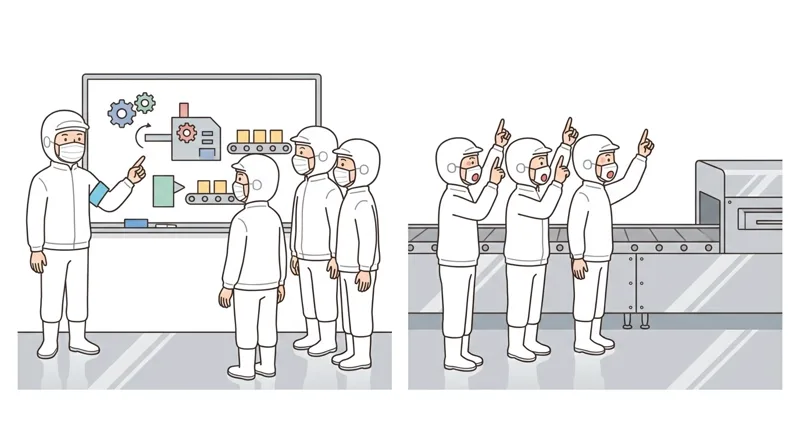
The 4-round method (4ラウンド法) in KY activities must be done in this order: Round 1, grasp the current situation (find the hidden hazards); Round 2, get to the essence (decide the key hazard points); Round 3, make countermeasures (think of ways to solve them); Round 4, set the target (decide the team's action goal). The other orders mix up the steps of grasping the situation, finding the key points, making countermeasures, and setting the target. (Textbook: OTAFF2号テキスト 第5章 3-1 p.119)
| Word | Meaning |
|---|---|
| 危険予知 | hazard prediction |
| 現状把握 | grasping the current situation |
| 本質追究 | getting to the essence |
| 対策樹立 | making countermeasures |
Question 7
意図的な異物混入を防ぐ「フードディフェンス(食品防御)」に関する説明として、誤っているものはどれか。
Which is NOT correct about "food defense" (フードディフェンス), which prevents intentional contamination with foreign matter?
- A. 私物の持ち込みを防ぐため、ポケットのない作業服の着用や入退室管理の強化を行う。
To prevent personal belongings from being brought in, wear work clothes without pockets and strengthen control of entering and leaving rooms. - B. 製造ラインへのカメラ設置は、混入抑止だけでなく万一の際に作業員の潔白を守る役割もある。
Installing cameras on the production line not only discourages contamination, but also protects workers' innocence in an emergency. - C. 日頃から職長と作業員が良好な関係を築き、混入をしたいと思わせない職場環境をつくる。
Build good relationships between the foreman and workers every day to create a workplace where no one feels like contaminating products. - D. HACCPによる重要管理点のモニタリングを行っていれば、悪意による意図的な混入も完全に防止できる。
If you monitor critical control points with HACCP, you can completely prevent intentional contamination caused by malice.
Show answer
Correct answer: D
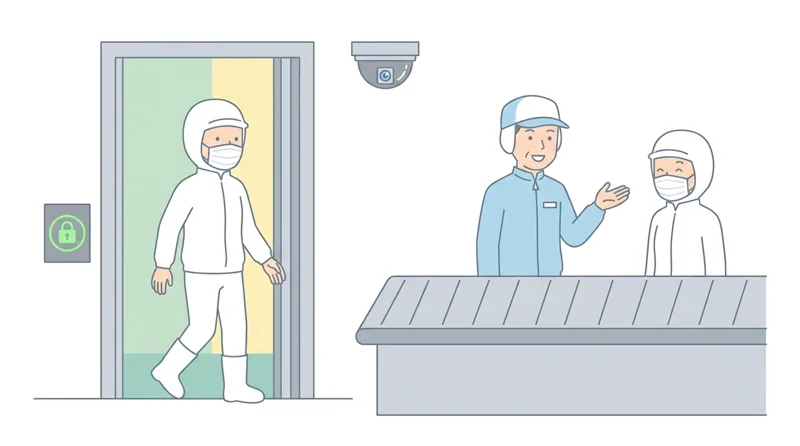
HACCP is a system for managing hazards that happen unintentionally during manufacturing, so monitoring critical control points alone cannot completely prevent malicious, intentional contamination. This is why the last statement is wrong. A factory must also take food defense (食品防御) measures: pocketless work clothes, control of entering and leaving rooms, cameras, and above all a good workplace where people communicate well. (Textbook: OTAFF2号テキスト 第6章 3 p.148)
| Word | Meaning |
|---|---|
| 意図的 | intentional, deliberate |
| 異物混入 | foreign matter contamination |
| 食品防御 | food defense |
Question 8
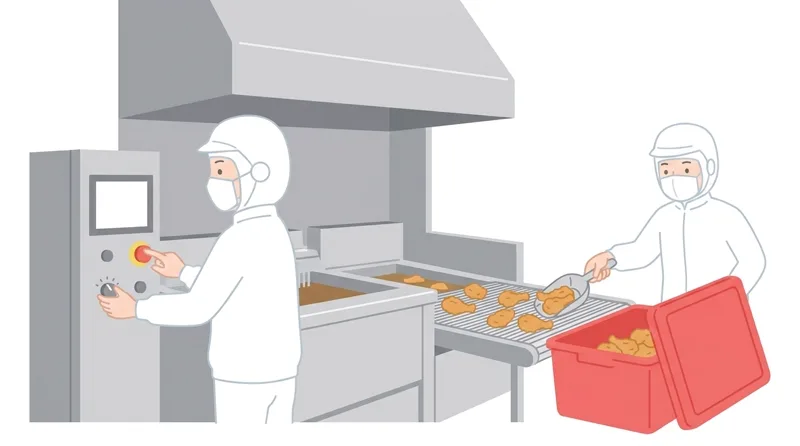
鶏唐揚げのフライ工程(CCP)の管理基準が「油温180℃・揚げ時間5分以上」のラインで、油温が165℃に低下していた際の改善措置として正しいものはどれか。
On a line where the control standard (CCP) of the frying process for fried chicken is "oil temperature 180°C, frying time at least 5 minutes", the oil temperature dropped to 165°C. Which is the correct corrective action?
- A. ラインを止めて油温を180℃に復帰させ、温度低下中の製品を特定・隔離して再加熱等を行う。
Stop the line and bring the oil temperature back to 180°C, then identify and isolate the products made while the temperature was low, and reheat them. - B. 油温を180℃に再設定したうえで、温度低下中の製品は抜取検査で外観を確認して次工程へ流す。
Reset the oil temperature to 180°C, and send the products made while the temperature was low to the next process after checking their appearance by sampling inspection. - C. ラインを止めずに油温設定を195℃へ引き上げ、温度低下中の製品と混ぜて平均温度を保つ。
Without stopping the line, raise the oil temperature setting to 195°C and mix the products made while the temperature was low with the others to keep the average temperature. - D. コンベア速度を遅くして揚げ時間を6分に延ばし、すでに通過した製品は保温庫で余熱を加えて次工程へ送る。
Slow down the conveyor to extend the frying time to 6 minutes, and keep the products that already passed in a warming cabinet to apply residual heat before sending them to the next process.
Show answer
Correct answer: A
When a critical limit (CL) at a CCP is not met, the corrective action must do two things: restore the process condition (bring the oil back to 180°C) and deal with all products made during the deviation (identify and isolate them, then reheat them or check their core temperature). Checking only the appearance, mixing products together, or relying on residual heat in a warming cabinet for products that passed through cold oil does not ensure bacteria at the center of the food are killed. (Textbook: OTAFF2号テキスト 第2章 4-3 p.42)
| Word | Meaning |
|---|---|
| 管理基準 | control standard |
| 油温 | oil temperature |
| 隔離 | isolation |
Question 9
ある包装製品の内容量が正規分布に従っており、平均値が200g、標準偏差(σ)が2gであるとき、全製品の約95.4%が含まれる重量範囲(平均値±2σ)はどれか。
The content weight of a packaged product follows a normal distribution, with a mean of 200 g and a standard deviation (σ) of 2 g. Which is the weight range (mean ± 2σ) that includes about 95.4% of all products?
- A. 198g〜202g(平均値±1σの範囲)
198 g to 202 g (the range of mean ± 1σ) - B. 194g 〜 206g(平均値 ± 3σ の範囲)
194 g to 206 g (the range of mean ± 3σ) - C. 196g 〜 204g(平均値 ± 2σ の範囲)
196 g to 204 g (the range of mean ± 2σ) - D. 192g 〜 208g(平均値 ± 4σ の重量範囲)
192 g to 208 g (the range of mean ± 4σ)
Show answer
Correct answer: C
In a normal distribution, mean ± 1σ (198 g to 202 g) includes about 68.3% of the data, mean ± 2σ includes about 95.4%, and mean ± 3σ (194 g to 206 g) includes about 99.7%. With a mean of 200 g and σ = 2 g, mean ± 2σ is 200 ± (2 × 2) = 196 g to 204 g. The other ranges correspond to ± 1σ, ± 3σ, and ± 4σ. (Textbook: OTAFF2号テキスト 第3章 4-2 p.72)
| Word | Meaning |
|---|---|
| 正規分布 | normal distribution |
| 平均値 | mean value |
| 標準偏差 | standard deviation |
Question 10
100kgの原料から1袋の規格重量50gの製品を製造し、良品1,800袋(実総重量95kg)を得た。販売単位が「袋数」のときの歩留まりはどれか。
From 100 kg of raw material, 50 g standard-weight bags of product were made, and 1,800 good bags (actual total weight 95 kg) were obtained. What is the yield when the sales unit is "number of bags"?
- A. 95.0%(実総重量95kg ÷ 投入原料100kg)
95.0% (actual total weight 95 kg ÷ raw material input 100 kg) - B. 94.7%(規格総重量90kg ÷ 実総重量95kg)
94.7% (standard total weight 90 kg ÷ actual total weight 95 kg) - C. 92.5%(実総重量と規格総重量の平均比率)
92.5% (the average ratio of actual total weight and standard total weight) - D. 90.0%(良品1,800袋 ÷ 理論袋数2,000袋)
90.0% (1,800 good bags ÷ theoretical number of bags 2,000)
Show answer
Correct answer: D
When the sales unit is the number of bags (50 g per bag), the extra weight packed into each bag, which brings the actual total to 95 kg, does not increase the number of bags sold. In theory, 100 kg (100,000 g) of raw material should make 2,000 bags (100,000 g ÷ 50 g), but only 1,800 good bags were obtained (90 kg at standard weight). So the yield (歩留まり) is 1,800 ÷ 2,000 = 90.0%, not 95.0%. The other values use the wrong quantities or ratios. (Textbook: OTAFF2号テキスト 第4章 2-2 p.102)
| Word | Meaning |
|---|---|
| 規格重量 | standard weight |
| 良品 | good product |
| 歩留まり | yield |