
Home › Sample questions › National Exam for Certified Care Workers 介護福祉士
National Exam for Certified Care Workers 介護福祉士 sample exam questions – 10 questions with answers
介護福祉士国家試験(筆記)
10 sample questions in the real exam format, with furigana, English translation, answers and explanations. Tap "Show answer" under each question. For the full question bank and realistic mock exams, open the free app.
Question 1
人間の尊厳と基本的人権、および生活の質(QOL:Quality of Life)に関する次の記述のうち、最も適切なものを1つ選びなさい。
Which of the following statements regarding human dignity, fundamental human rights, and Quality of Life (QOL) is most appropriate?
- A. 生活の質(QOL)には、身体的な健康状態だけでなく、本人の主観的な満足感や生きがいも含まれる。
Quality of Life (QOL) encompasses not only physical health status but also the individual's subjective sense of satisfaction and purpose in life. - B. 日本国憲法第13条が定める幸福追求権は、公共の福祉に反する場合であっても制限されることはない。
The right to pursue happiness under Article 13 of the Constitution of Japan is never restricted even when it conflicts with the public welfare. - C. 日本国憲法第25条の生存権は、国民が自力で最低限度の生活を維持する法的義務を定めたものである。
The right to life under Article 25 of the Constitution of Japan establishes a citizen's legal duty to maintain a minimum standard of living through self-reliance. - D. 要介護高齢者の生活支援では、医学的な機能回復の達成度が本人の主観的な満足感より上位の評価基準となる。
In daily life support for older adults requiring care, the degree of medical functional recovery serves as a higher evaluation criterion than the person's subjective satisfaction. - E. 生活の質(QOL)の評価は、本人の主観的な感情を除外し、専門職による客観的な機能評価尺度で決定する。
Evaluation of Quality of Life (QOL) excludes the person's subjective feelings and is determined by objective functional assessment scales administered by professionals.
Show answer
Correct answer: A
Quality of Life (QOL) includes both physical/functional well-being and the person's subjective satisfaction, values, and sense of meaning in life. Article 13 guarantees the right to pursue happiness to the extent that it does not interfere with the public welfare; Article 25 guarantees the right to maintain minimum standards of wholesome and cultured living and the state's duty to promote social welfare; and QOL centers on the individual's own subjective evaluation rather than purely objective medical recovery metrics.
| Word | Meaning |
|---|---|
| 人間の尊厳 | human dignity |
| 生活の質(QOL) | Quality of Life (QOL) |
| 生存権 | right to life / right to wholesome living |
Question 2
日本の家族法制および近年の世帯構造の動向に関する次の記述のうち、正しいものを1つ選びなさい。
Which of the following statements regarding Japanese family law and recent trends in household structure is correct?
- A. 民法上の親族の範囲は、4親等内の血族、配偶者、および2親等内の姻族と定められている。
Under the Civil Code, the scope of relatives is defined as blood relatives within the 4th degree, spouses, and relatives by affinity within the 2nd degree. - B. 民法における親族は、6親等内の血族、配偶者、3親等内の姻族と規定されている。
Relatives under the Civil Code are defined as blood relatives within the 6th degree, spouses, and relatives by affinity within the 3rd degree. - C. 国民生活基礎調査によると、65歳以上の者がいる世帯では三世代世帯が過半数を占めている。
According to the Comprehensive Survey of Living Conditions, three-generation households account for the majority of households with members aged 65 or older. - D. 夫婦と未婚の子で構成される世帯は、国勢調査等の世帯分類において拡大家族世帯に区分される。
A household composed of a married couple and their unmarried children is classified as an extended family household in national census categories. - E. 高齢者世帯のうち単独世帯の割合は、過去20年間にわたって減少傾向が続いている。
The proportion of single-person households among older adult households has continued on a downward trend over the past 20 years.
Show answer
Correct answer: B
Under Article 725 of the Civil Code of Japan, relatives (shinzoku) are defined as blood relatives within 6 degrees, spouses, and relatives by marriage (affinity) within 3 degrees. Three-generation households have declined sharply, a couple with unmarried children is a nuclear family (kakukazoku), and single-person elderly households have been increasing.
| Word | Meaning |
|---|---|
| 親族の範囲 | scope of relatives |
| 血族と姻族 | blood relatives and relatives by affinity |
| 単独世帯 | single-person household |
Question 3
マズロー(Maslow, A.)の欲求階層説に関する次の記述のうち、正しいものを1つ選びなさい。
Which of the following statements regarding Maslow's (Maslow, A.) hierarchy of needs is correct?
- A. 階層の最も低次に位置する基本的欲求は、心身の危険から身を守りたいという安全の欲求である。
The most basic need at the lowest level of the hierarchy is the safety need to protect oneself from physical and psychological danger. - B. 安全の欲求や所属と愛の欲求は、それが満たされた後もさらに強まる成長欲求に分類される。
Safety needs and belongingness and love needs are classified as growth needs that intensify even after being satisfied. - C. 生理的欲求から承認欲求までの4階層は、不足を補おうとする欠乏欲求に分類される。
The four levels from physiological needs up to esteem needs are classified as deficiency needs aimed at fulfilling a lack. - D. 自己実現の欲求は他の4つの階層とは独立しており、生理的欲求が未充足でも最初に現れる。
The need for self-actualization is independent of the other four levels and emerges first even when physiological needs are unmet. - E. 他者と関わり集団に帰属したいという所属と愛の欲求は、承認欲求よりも上位にある。
The need for belongingness and love—to connect with others and belong to a group—is positioned higher than esteem needs.
Show answer
Correct answer: C
Maslow's hierarchy of needs progresses from (1) physiological needs, (2) safety needs, (3) belongingness and love needs, and (4) esteem needs—which together form the four deficiency needs (ketsubō yokkyū)—to (5) self-actualization needs, which is a growth need (seichō yokkyū).
| Word | Meaning |
|---|---|
| 欲求階層説 | hierarchy of needs theory |
| 欠乏欲求と成長欲求 | deficiency needs and growth needs |
| 自己実現の欲求 | need for self-actualization |
Question 4
立位姿勢の保持に働く抗重力筋および長期臥床による廃用症候群(disuse syndrome)に関する次の記述のうち、正しいものを1つ選びなさい。
Which of the following statements regarding antigravity muscles that maintain standing posture and disuse syndrome caused by prolonged bed rest is correct?
- A. 抗重力筋は、主に上腕二頭筋や手根屈筋群などの上肢の屈筋群を中心として構成されている。
Antigravity muscles are composed primarily of upper-limb flexor groups such as the biceps brachii and wrist flexors. - B. 安静臥床を長期間続けた場合、下肢の抗重力筋よりも上肢の筋肉のほうが先に著しく萎縮する。
When bed rest continues for a long period, muscles of the upper limbs atrophy markedly earlier than antigravity muscles of the lower limbs. - C. 廃用症候群(disuse syndrome)では、起立時の血管収縮反応が亢進して起立性高血圧が生じる。
In disuse syndrome, vasoconstrictor responses upon standing become hyperactive, resulting in orthostatic hypertension. - D. 大腿四頭筋や大殿筋、下腿三頭筋、脊柱起立筋などは、立位を保つ代表的な抗重力筋である。
The quadriceps femoris, gluteus maximus, triceps surae, and erector spinae are representative antigravity muscles that maintain standing posture. - E. 長期臥床に伴う廃用症候群(disuse syndrome)では、骨吸収が抑制されて骨密度が次第に増加する。
In disuse syndrome associated with prolonged bed rest, bone resorption is suppressed and bone mineral density gradually increases.
Show answer
Correct answer: D
Antigravity muscles (kōjūryokukin) work against gravity to maintain upright posture and include the erector spinae, gluteus maximus, quadriceps femoris, and triceps surae. Prolonged bed rest causes rapid atrophy of lower-limb and trunk antigravity muscles, orthostatic hypotension (not hypertension), and increased bone resorption leading to decreased bone density (osteoporosis).
| Word | Meaning |
|---|---|
| 抗重力筋 | antigravity muscles |
| 廃用症候群 | disuse syndrome |
| 大腿四頭筋 | quadriceps femoris muscle |
Question 5
乳幼児期における身体発育と運動機能の発達に関する次の記述のうち、正しいものを1つ選びなさい。
Which of the following statements regarding physical growth and motor development in infancy and early childhood is correct?
- A. 乳児の運動発達は、体幹から遠位へと向かう方向よりも、末梢の手指から中枢へ向かう方向へ先に進行する。
Infant motor development progresses from the distal fingers toward the center earlier than from the trunk toward the distal extremities. - B. 体重が出生時の約2倍に達する時期の標準的な目安は、生後6か月頃から1歳0か月頃とされている。
The standard milestone at which body weight reaches approximately double the birth weight is between 6 months and 1 year of age. - C. 身長が出生時の約2倍(約100cm)に達する標準的な目安は、生後1歳6か月頃とされている。
The standard milestone at which body height reaches approximately double the birth length (about 100 cm) is around 1 year and 6 months of age. - D. スキャモン(Scammon, R.)の発達曲線において、乳幼児期に最も急激に発育するのはリンパ系型である。
In Scammon's (Scammon, R.) growth curves, the organ system that grows most rapidly during infancy and early childhood is the lymphoid type. - E. 体重は生後3か月頃に出生時の約2倍、生後1年頃に出生時の約3倍になる。
Body weight reaches approximately double the birth weight at around 3 months of age and triple the birth weight at around 1 year of age.
Show answer
Correct answer: E
An infant's weight doubles by around 3 months of age and triples by around 1 year of age, while height reaches 1.5 times birth length at 1 year and doubles (to ~100 cm) at around 4 years of age. Motor development proceeds cephalocaudally and proximodistally (from trunk to fingers), and in Scammon's curve the neural type grows most rapidly in infancy/early childhood while the lymphoid type peaks around age 12.
| Word | Meaning |
|---|---|
| 身体発育の目安 | milestones of physical growth |
| 頸定(首すわり) | head control (keitei) |
| スキャモンの発達曲線 | Scammon's growth curves |
Question 6
地域における認知症(dementia)の人と家族への支援体制(認知症初期集中支援チーム・チームオレンジ・認知症ケアパス等)に関する次の記述のうち、最も適切なものを1つ選びなさい。
Which of the following statements regarding community support systems for people with dementia and their families (Initial-Phase Intensive Support Team for Dementia, Team Orange, Dementia Care Path, etc.) is most appropriate?
- A. 認知症初期集中支援チームは、複数の専門職が家族等の訴えにより訪問し、おおむね6か月以内を目安に初期の支援を集中的に行う。
An Initial-Phase Intensive Support Team for Dementia consists of multiple professionals who visit homes upon family consultation and provide intensive early support for roughly up to 6 months. - B. 認知症サポーターは、都道府県が指定する専門研修を修了し、介護保険サービスのケアプランを作成する専門職である。
A Dementia Supporter is a certified professional who has completed specialized prefectural training and formulates long-term care insurance care plans. - C. 認知症ケアパスとは、主治医が認知症の人の服薬履歴や画像検査の結果を専門医療機関へ引き継ぐための診療情報提供書である。
A Dementia Care Path is a medical referral letter prepared by a primary care physician to hand over medication history and imaging results to a specialized hospital. - D. チームオレンジは、地域包括支援センターの3職種で構成され、要介護認定の一次判定業務を担う行政組織である。
Team Orange is an administrative body composed of the three professions of a Community General Support Center that conducts primary determination for care-need certification. - E. 本人ミーティングは、家族介護者や医療福祉専門職が主体となり、認知症の人の施設入所先を決定するサービス担当者会議である。
A 'Honnin Meeting' (Peers Meeting) is a service provider meeting led by family caregivers and health/welfare professionals to decide institutional placement for a person with dementia.
Show answer
Correct answer: A
The Initial-Phase Intensive Support Team for Dementia (ninchishō shoki shūchū shien team) is a multidisciplinary team that visits individuals with suspected or untreated dementia at home and provides intensive assessment and coordination for approximately 6 months until stable services are established. Dementia Supporters are community volunteers who attend an awareness session; a Dementia Care Path maps out local support services according to the stage of dementia; Team Orange links Dementia Supporters and people with dementia in the community; and a Honnin Meeting is led by people with dementia themselves.
| Word | Meaning |
|---|---|
| 認知症初期集中支援チーム | Initial-Phase Intensive Support Team for Dementia |
| 認知症サポーターとチームオレンジ | Dementia Supporter and Team Orange |
| 認知症ケアパス | Dementia Care Path |
Question 7
現代の日本における家族介護の課題と社会背景に関する次の記述のうち、最も適切なものを1つ選びなさい。
Which of the following statements regarding challenges in family caregiving and social backgrounds in contemporary Japan is most appropriate?
- A. ヤングケアラーとは、児童福祉施設に勤務して障害児の日常生活支援を専門に行う若年の福祉専門職を指す。
The term 'young carer' refers to young welfare professionals working at child welfare facilities who specialize in daily life support for children with disabilities. - B. 8050問題とは、80歳代の親が50歳代のひきこもり状態の子を支えて孤立する問題である。
The '8050 problem' refers to the issue where parents in their eighties financially and socially support their socially withdrawn children in their fifties in isolation. - C. ダブルケアとは、同一世帯のなかに要介護高齢者が2人以上おり、1人の介護者が双方の介護を担うことをいう。
'Double care' refers to a household with two or more older adults requiring long-term care where a single caregiver cares for both of them. - D. 介護の社会化とは、在宅での家族介護を廃止して、要介護高齢者の支援を公的施設での入所介護へ一本化することをいう。
'Socialization of care' means abolishing family caregiving at home and unifying all support for older adults requiring care into public institutional admission. - E. 老老介護とは、85歳以上の後期高齢者同士の世帯に限定して用いられる行政上の統計用語である。
'Elder-to-elder caregiving' (rōrō kaigo) is an administrative statistical term used exclusively for households where both members are late-stage older adults aged 85 or older.
Show answer
Correct answer: B
The 8050 problem refers to households where aging parents in their 80s support adult children in their 50s experiencing social withdrawal (hikikomori) or unemployment, risking isolation and financial hardship. Young carers are children/youth bearing family care responsibilities, double care means simultaneously raising children and caring for aging parents, socialization of care means society as a whole sharing care responsibilities across home and facility settings, and elder-to-elder caregiving generally refers to caregivers and care recipients both aged 65 or older.
| Word | Meaning |
|---|---|
| 8050問題 | 8050 problem |
| ヤングケアラーとダブルケア | young carer and double care |
| 介護の社会化 | socialization of care |
Question 8
図に示すベッド上の全身清拭において、涙嚢炎や結膜炎を予防しながら目の周囲を拭く手順や湯温・拭き方の基本として、最も適切なものを1つ選びなさい。
In the full-body bed bath (zenshin seishiki) shown in the illustration, which of the following is most appropriate regarding the procedure for wiping around the eyes to prevent dacryocystitis and conjunctivitis, as well as the basic water temperature and wiping direction?
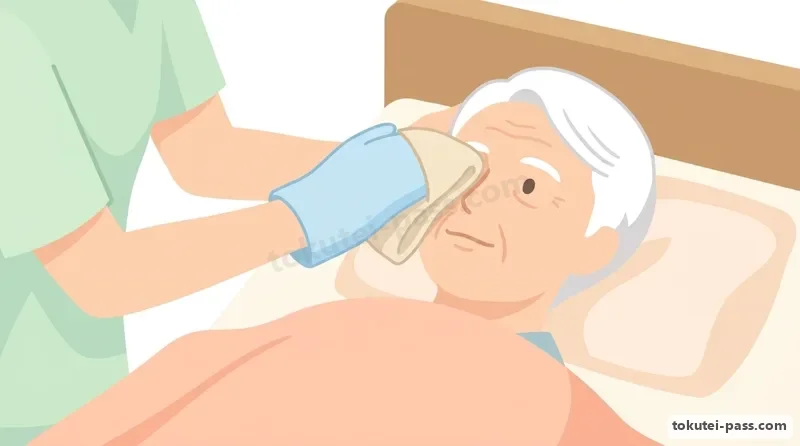
- A. 目の周囲を拭くときは、涙嚢への感染を防ぐため目尻から目頭に向かって一方向に拭く。
When wiping around the eyes, wipe in one direction from the outer corner toward the inner corner to prevent infection of the lacrimal sac. - B. 左右の目を拭くときは、皮膚への刺激を均一にするためタオルの同じ面を使って両目を順番に拭く。
When wiping the left and right eyes, use the same surface of the towel to wipe both eyes in turn so that skin stimulation stays uniform. - C. 目の周囲を拭くときは、タオルの清潔な面を使い目頭から目尻に向かって優しく拭く。
When wiping around the eyes, use a clean surface of the towel and wipe gently from the inner corner toward the outer corner. - D. 清拭用のタオルを浸すバケツの湯温は、皮膚の乾燥を防ぐため体温より低い35℃前後のぬるま湯を用意する。
Prepare lukewarm water at around 35°C—lower than body temperature—in the basin for soaking the washcloth to prevent dry skin. - E. 手足を清拭するときは、動脈血の循環を促すため身体の中心から手足の先へ向かって力を入れて拭く。
When wiping the arms and legs, wipe firmly from the center of the body toward the extremities to promote arterial blood circulation.
Show answer
Correct answer: C
When wiping around the eyes during a bed bath, always wipe gently from the inner canthus (megashira) toward the outer canthus (mejiri), using a different clean section of the towel for each eye to prevent contamination of the lacrimal sac. Basin water should be prepared at about 50–55°C so the wrung towel stays warm (around 40°C), and limbs are wiped from distal extremities toward the body center to promote venous return to the heart.
| Word | Meaning |
|---|---|
| 全身清拭 | full-body bed bath (zenshin seishiki) |
| 目頭から目尻 | from inner corner to outer corner of the eye |
| 末梢から中心 | from distal periphery to center |
Question 9
高齢者施設における集団レクリエーションの支援とアイスブレーキング(ice breaking)の目的に関する次の記述のうち、最も適切なものを1つ選びなさい。
Which of the following statements regarding support for group recreation in an elderly care facility and the purpose of ice breaking is most appropriate?
- A. アイスブレーキングは、プログラムの最後に実施して活動の振り返りと次回の目標設定を行う手法である。
Ice breaking is a technique conducted at the end of a program to review the activity and set goals for the next session. - B. レクリエーションへの参加をためらう利用者には、集団への適応を促すため最初から進行役のリーダーを任せる。
Users who hesitate to join recreation should be assigned the leader role from the very beginning to accelerate their adaptation to the group. - C. 活動内容は参加者の機能訓練を最優先とし、個人の生活歴や趣味嗜好よりも運動強度の高さを基準に選定する。
Activity content prioritizes functional training above all else and is selected based on high exercise intensity rather than personal life history or hobbies. - D. アイスブレーキングは、開始時の緊張をほぐして参加者同士が交流しやすい雰囲気をつくるために行う。
Ice breaking is conducted to ease initial tension at the start of a session and create an atmosphere conducive to interaction among participants. - E. 片麻痺のある利用者が参加する場合は、他の参加者と同じ条件を保つため道具やルールの変更は行わない。
When a user with hemiplegia participates, tools and rules are kept unchanged in order to maintain identical conditions with other participants.
Show answer
Correct answer: D
Ice breaking is used at the beginning of group activities to relieve initial nervousness and foster a relaxed, welcoming atmosphere that encourages communication and participation. Hesitant users should be supported at their own pace, activities should reflect users' interests and life histories, and tools or rules should be flexibly adapted so users with hemiplegia can participate comfortably.
| Word | Meaning |
|---|---|
| アイスブレーキング | ice breaking |
| レクリエーション支援 | recreation support |
| 自己決定と社会参加 | self-determination and social participation |
Question 10
Bさん(81歳、女性、要介護3)は、脳梗塞(cerebral infarction)の後遺症で左片麻痺があり、訪問介護(ホームヘルプサービス)を利用している。介護用電動ベッド(ギャッチベッド)で仰臥位にあるBさんの背上げを行い、端座位へ誘導するときの介護福祉職の対応として、最も適切なものを1つ選びなさい。
Ms. B (81 years old, female, Care Level 3) has left hemiplegia as a sequela of cerebral infarction and uses home-visit care (home help service). When raising the backrest of an electric care bed (Gatch bed) for Ms. B while she is lying supine and guiding her to a sitting position on the edge of the bed, which response by the care worker is most appropriate?
- A. 背上げを開始するときは、骨盤の傾きを防ぐため膝上げを行わずに頭側を先に60度まで上げてから膝側を上げる。
When starting backrest elevation, raise the head section to 60 degrees first without raising the knee section, and then raise the knee section to prevent pelvic tilt. - B. 背上げを行った後は、姿勢が崩れるのを防ぐため身体をマットに密着させたまま背部の圧抜きは行わない。
After raising the backrest, keep her body pressed against the mattress and omit back pressure relief so that her posture does not collapse. - C. 仰臥位から端座位へ起き上がるときは、残存機能を鍛えるため麻痺側である左側の肘をついて上体を起こしてもらう。
When sitting up from supine to the edge of the bed, have her prop herself up on her left elbow on the paralyzed side to train her remaining function. - D. 端座位になった直後は、筋力の低下を防ぐため座位での安静時間を設けずにそのまま連続して立位へ移行させる。
Immediately after she sits on the edge of the bed, transition her continuously into a standing position without a sitting rest period to prevent muscle weakness. - E. 膝上げをしてから背上げを行い、背上げ後は背中を一度マットから離して背部の圧抜きを行う。
Raise the knee section first before raising the backrest, and after raising the backrest, briefly lift her back off the mattress to relieve shear pressure.
Show answer
Correct answer: E
When raising the backrest of a Gatch bed, the knee section should be raised first (hiza-age) to prevent the pelvis from sliding down, followed by raising the backrest (se-age), and then briefly lifting the user's back away from the mattress (atsunuki) to release shear forces and clothing tension. Rising to sit on the edge of the bed utilizes the unaffected side (right elbow), and the caregiver must pause to check for orthostatic dizziness before standing.
| Word | Meaning |
|---|---|
| ギャッチベッドの背上げ | raising the backrest of a Gatch bed |
| 背部の圧抜き | back pressure/shear relief (atsunuki) |
| 端座位 | sitting on the edge of the bed (tanzai) |