
General Crop Farming, Plant Physiology, Soil, and Pests & Diseases
耕種農業一般・植物生理・土壌・病害虫
Agriculture (SSW 2) · 農業(2号) · Written by Tokutei Pass based on the official study texts; not copied verbatim.
光合成・呼吸・蒸散とC/N比(炭素率)
Photosynthesis, Respiration, Transpiration, and the C/N Ratio
植物は光エネルギーを使い、二酸化炭素と水からデンプン(糖)と酸素を作る「光合成」を行います。光の強さが光飽和点に達すると光合成速度は頭打ちになりますが、CO2濃度を高めるとさらに促進されます。
Plants use light energy to synthesize carbohydrates (sugars) and oxygen from carbon dioxide and water through photosynthesis. Once light intensity reaches the light saturation point, photosynthesis plateaus unless CO2 concentration is increased.
葉裏に多い気孔から水蒸気を出す「蒸散」は、葉温の上昇を抑え、根からの吸水と養分吸収を助けます。植物体内の炭水化物(C)が多く窒素(N)が適度な状態(C/N比が適正)で花芽分化が進みます。
Transpiration of water vapor through stomata (abundant on the undersides of leaves) cools leaf temperature and drives water and nutrient uptake from the roots. Flower bud differentiation is promoted when carbohydrates (C) are abundant relative to moderate nitrogen (N).
一方、窒素過多でC/N比が極端に低くなると茎や葉ばかりが茂る「つるぼけ(過繁茂)」となり、花や実がつきにくくなります。
Conversely, excessive nitrogen lowers the C/N ratio, causing overly vigorous stem and leaf growth ('vine overgrowth / tsuruboke') and poor flowering and fruit set.
Key points
- 光合成は二酸化炭素と水から糖と酸素を作る反応であり、光飽和点ではCO2施用が有効である。
Photosynthesis produces sugars and oxygen from CO2 and water; CO2 enrichment boosts photosynthesis beyond the light saturation point. - 気孔からの蒸散は葉の温度を下げ、根からの水分・養分の吸収を引き上げる働きをする。
Transpiration through stomata cools leaves and pulls water and mineral nutrients up from the roots. - 窒素肥料のやりすぎでC/N比が低下すると茎葉ばかり茂る「つるぼけ」になり、着果不良を招く。
Excess nitrogen lowers the C/N ratio, causing vegetative overgrowth (tsuruboke) and poor fruit set.
| Word | Meaning |
|---|---|
| 光合成・光飽和点 | photosynthesis and light saturation point |
| 蒸散・気孔 | transpiration and stomata |
| 花芽分化 | flower bud differentiation |
| 過繁茂 | excessive vegetative growth (vine overgrowth) |
発芽条件・光周性と必須要素の欠乏症
Germination Conditions, Photoperiodism, and Nutrient Deficiencies
種子の発芽に不可欠な三条件は「水分・温度・酸素」です。また、レタスやニンジン・ゴマなどは光で発芽が促される「好光性種子」なので覆土を薄くし、ダイコン・ネギ・スイカなどは「嫌光性種子」です。
The three essential conditions for seed germination are water, temperature, and oxygen. Lettuce, carrot, and sesame have light-favored seeds requiring shallow soil cover, whereas radish, green onion, and watermelon have dark-favored seeds.
日長が短くなると花芽がつく「短日植物」にはイネ・ダイズ・イチゴ・キクがあり、日長が長くなると花芽がつく「長日植物」にはホウレンソウ・ダイコン・コムギがあります(トマト・キュウリは中性植物)。
Short-day plants (flowering as nights lengthen) include rice, soybean, strawberry, and chrysanthemum; long-day plants include spinach, radish, and wheat (tomato and cucumber are day-neutral).
移動しにくいカルシウム(Ca)が不足すると新芽の先端や果実にトマトの尻腐果やハクサイの芯腐れ症が出ます。マグネシウム(Mg)欠乏では古い下葉の葉脈間が黄化し、ホウ素(B)欠乏では成長点の萎縮が起きます。
Because calcium (Ca) is immobile in plants, Ca deficiency appears at new shoot tips and fruit ends as blossom-end rot in tomatoes or tipburn in Chinese cabbage. Magnesium (Mg) deficiency causes interveinal chlorosis in older lower leaves, and boron (B) deficiency stunts growing points.
Key points
- 発芽の三条件は「水・温度・酸素」であり、レタスやニンジンなどの好光性種子は浅く種をまく。
Seed germination requires water, temperature, and oxygen; light-favored seeds like lettuce and carrot need thin soil cover. - イネ・ダイズ・イチゴ・キクは短日植物、ホウレンソウ・ダイコン・コムギは長日植物である。
Rice, soybean, strawberry, and chrysanthemum are short-day plants; spinach, radish, and wheat are long-day plants. - カルシウム欠乏は新葉や果実先端(尻腐果・芯腐れ)、マグネシウム欠乏は下葉の葉脈間黄化として現れる。
Calcium deficiency causes blossom-end rot and tipburn in young tissues; magnesium deficiency causes interveinal yellowing in older leaves.
| Word | Meaning |
|---|---|
| 好光性種子 | light-favored (photoblastic) seed |
| 短日植物 | short-day plant |
| 長日植物 | long-day plant |
| 尻腐果 | blossom-end rot |
土壌の団粒構造・pH・ECと太陽熱消毒
Crumb Soil Structure, pH, EC, and Soil Solarization
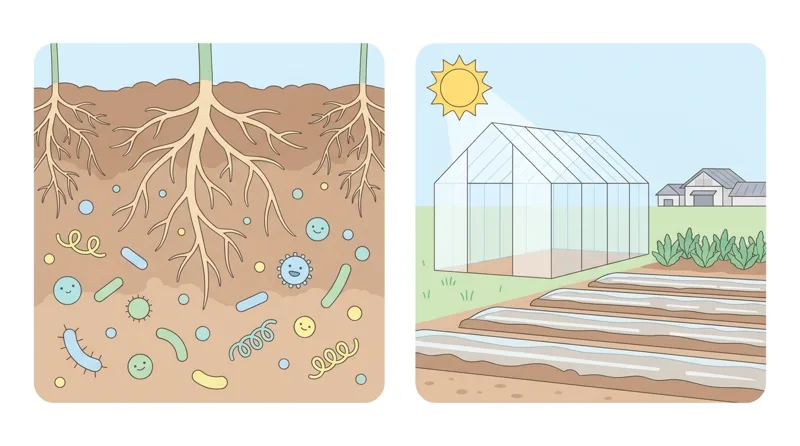
土壌は固相・液相・気相の三相からなり、完熟堆肥を施して「団粒構造」を発達させると、大孔隙で排水性・通気性が良くなり、小孔隙で保水性・保肥力(CEC)も高まります。
Soil consists of solid, liquid, and gas phases; applying mature compost develops a crumb (aggregate) structure whose macropores improve drainage and aeration while micropores retain water and nutrients (CEC).
日本の土壌は雨が多く酸性化しやすいため、苦土石灰などを施用して多くの作物に適した弱酸性(pH 6.0〜6.5)に矯正します(ジャガイモはそうか病予防のためpH 5.0〜5.5、ブルーベリーやチャも好酸性)。
Because heavy rainfall acidifies Japanese soils, dolomitic lime is applied to adjust soil to a slightly acidic pH of 6.0–6.5 for most crops (potatoes are kept at pH 5.0–5.5 to prevent common scab; blueberries and tea also prefer acidic soil).
肥料塩類がたまりすぎると電気伝導度(EC)が上がり、根から水分が奪われる濃度障害が起きます。夏期に湛水して透明マルチで密閉する「太陽熱消毒」は地温を高めて土壌病害虫を防除します。
Excessive fertilizer salt accumulation raises electrical conductivity (EC), drawing water out of roots and causing salt burn. In summer, soil solarization—flooding the field and sealing it with clear plastic mulch—raises soil temperature to kill soilborne pests and pathogens.
Key points
- 団粒構造の土壌は、排水性(通気性)と保水性(保肥力)の両方が優れている。
Crumb-structured soil excels in both drainage/aeration and water/nutrient retention. - 一般作物の好適土壌pHは6.0〜6.5の弱酸性であるが、ジャガイモはそうか病防止のためpH 5.0〜5.5に管理する。
Most crops thrive at pH 6.0–6.5, whereas potatoes are grown at pH 5.0–5.5 to suppress common scab. - 電気伝導度(EC)が高すぎると塩類集積による濃度障害(根傷み)が起こる。
Excessively high electrical conductivity (EC) indicates salt accumulation that causes root injury (concentration damage).
| Word | Meaning |
|---|---|
| 団粒構造 | crumb / aggregate soil structure |
| 電気伝導度 | electrical conductivity (EC) |
| 濃度障害 | salt injury / fertilizer burn |
| 太陽熱消毒 | soil solarization |
代表的な病害虫と総合的病害虫・雑草管理(IPM)
Major Pests & Diseases and Integrated Pest Management (IPM)
植物の病気は主に糸状菌(カビ:うどんこ病・べと病・灰色かび病・いもち病)、細菌(青枯病・軟腐病)、ウイルス(モザイク病・黄化葉巻病)によって起こります。
Plant diseases are mainly caused by filamentous fungi (powdery mildew, downy mildew, gray mold, rice blast), bacteria (bacterial wilt, soft rot), and viruses (mosaic disease, yellow leaf curl).
アブラムシ・コナジラミ・アザミウマなどの吸汁害虫はウイルス病を媒介し、排泄物で「すす病」も引き起こします。ウイルス病は薬で治せないため、媒介虫の防除と発病株の抜き取り処分が基本です。
Sap-sucking insects such as aphids, whiteflies, and thrips transmit viral diseases and excrete honeydew that causes sooty mold. Because viral diseases cannot be cured chemically, control relies on excluding vectors and roguing infected plants.
化学農薬だけに頼らず、輪作・抵抗性品種や接ぎ木(耕種的防除)、防虫ネット・粘着板・銀色マルチ(物理的防除)、天敵昆虫やフェロモントラップ(生物的防除)を組み合わせる手法を「IPM」といいます。
Integrated Pest Management (IPM) combines cultural controls (crop rotation, resistant varieties, grafting), physical controls (insect nets, sticky traps, reflective silver mulch), biological controls (natural enemies, pheromone traps), and judicious chemical use.
Key points
- 青枯病や軟腐病は細菌、うどんこ病や灰色かび病は糸状菌(カビ)が原因である。
Bacterial wilt and soft rot are caused by bacteria, while powdery mildew and gray mold are caused by fungi. - アブラムシ・コナジラミ・アザミウマはウイルス病を媒介し、銀色(シルバー)マルチはアブラムシの飛来防止に有効である。
Aphids, whiteflies, and thrips are vectors of viral diseases; silver mulch reflects UV light to repel winged aphids. - IPM(総合的病害虫・雑草管理)は、耕種的・物理的・生物的・化学的防除を組み合わせて被害を抑える。
IPM integrates cultural, physical, biological, and chemical control methods to keep pest damage below economic thresholds.
| Word | Meaning |
|---|---|
| 糸状菌 | filamentous fungi (molds) |
| 媒介 | vector transmission |
| 天敵 | natural enemy |
| 総合的病害虫・雑草管理 | Integrated Pest Management (IPM) |
Plant Physiology, Soil and Crop Protection
Practice this chapter in the appOfficial references
- 一般社団法人全国農業会議所 農業特定技能2号評価試験 テキスト(耕種農業全般) — https://asat-nca.jp/