
Civil Engineering Construction Methods, Schedule & Quality Control (Type 2 Practical)
土木の施工方法・工程管理・品質管理(2号実技)
Construction (SSW 2) · 建設分野(2号) · Written by Tokutei Pass based on the official study texts; not copied verbatim.
土工・法面・軟弱地盤対策と土留め支保工の施工手順
Procedures for Earthwork, Slopes, Soft Ground Treatment & Earth Retaining Shoring
切土は上部から下部へ段階的に掘削して法面保護工を施工し、盛土は水はけを良くするため横断排水勾配をつけながら一層ごとに敷きならして転圧します。
Cut slopes are excavated in stages from top to bottom with slope protection applied, while embankments are spread and compacted layer by layer with a cross-drainage gradient.
軟弱地盤では、サンドドレーンやペーパードレーンを打設した上に載荷盛土(プレロード)を行って間隙水を抜き、事前に圧密沈下を促進させます。
On soft ground, vertical sand drains or paper drains are installed with a surcharge embankment (preload) to expel pore water and accelerate consolidation settlement in advance.
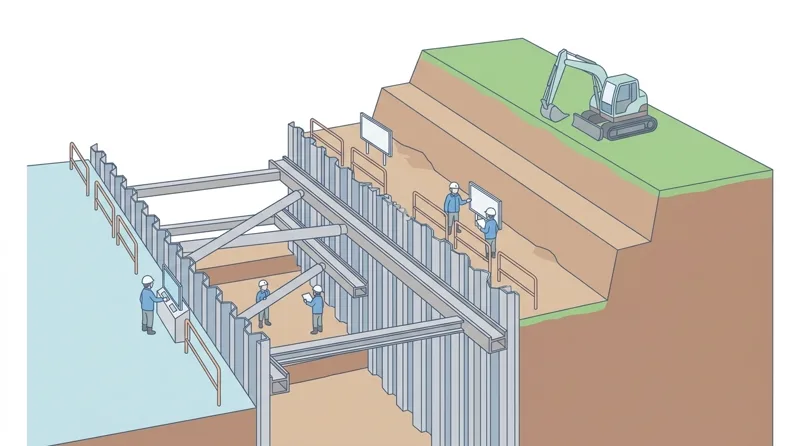
深い掘削では鋼矢板や親杭横矢板を建て込み、掘削の進行に合わせて上段から順次「腹起し」と「切梁」を取り付け、埋戻し時は下段から解体します。
In deep excavations, steel sheet piles or soldier piles with lagging are installed; wales and struts are mounted sequentially from top to bottom as digging progresses, and removed from bottom to top during backfilling.
Key points
- 段切り:傾斜地盤や既設盛土に腹付け盛土をする際、境界面での滑動を防ぐため階段状にカットする。
Benching (Dangiri): When widening an existing embankment or building on a slope, cut steps into the slope to prevent sliding along the interface. - ボイリング・ヒービング対策:矢板の根入れ長を確保し、ウェルポイント工法やディープウェル工法で地下水位を低下させる。
Boiling & Heaving countermeasures: Ensure adequate sheet pile embedment depth and lower the groundwater table using wellpoint or deep well dewatering systems. - 構造物の裏込めは透水性の良い砕石等を用い、偏土圧を防ぐため左右均等に薄く敷きならして転圧する。
Structure backfilling uses free-draining crushed stone, spread thinly and compacted evenly on both sides to prevent eccentric earth pressure.
| Word | Meaning |
|---|---|
| 段切り・腹付け盛土 | Benching (stepping) & Slope widening embankment |
| バーチカルドレーン・載荷盛土 | Vertical drain & Preloading surcharge embankment |
| ウェルポイント工法・ディープウェル工法 | Wellpoint dewatering & Deep well dewatering |
| ボイリング・ヒービング現象 | Boiling (sand piping) & Heaving (clay bottom heave) |
鉄筋・型枠・コンクリート打設・養生と特殊コンクリート
Rebar, Formwork, Concrete Placing & Curing, and Special Concrete
鉄筋の継手位置は応力の集中を避けるため同一断面に集めず「千鳥配置」とし、所定の重ね継手長さとスペーサーによる「かぶり厚さ」を確保します。
Rebar splices must be staggered rather than concentrated in the same cross-section to avoid stress concentration, ensuring proper lap splice length and cover thickness via spacers.
コンクリートは練り混ぜ開始から外気温25℃以下で120分以内(25℃超は90分以内)に打ち終え、高さ1.5m以下から投入してバイブレータを鉛直に下層へ約10cm挿入し締固めます。
Concrete must be placed within 120 minutes of mixing when ambient temperature is <= 25°C (or 90 minutes when > 25°C), dropped from <= 1.5 m, and vibrated vertically penetrating ~10 cm into the lower layer.
暑中コンクリートは打込み温度35℃以下とし急激な乾燥を防ぎ、寒中コンクリートは打込み温度5〜20℃を保ち初期凍害を防ぐ保温養生を行います。
Hot-weather concrete requires a placing temperature <= 35°C with moisture retention, whereas cold-weather concrete requires 5-20°C placing temperature and insulated curing against early freezing.
Key points
- コールドジョイント防止:下層コンクリートが固まる前に上層を打ち重ね、バイブレータを下層に10cm程度挿入して一体化させる。
Preventing cold joints: Place the upper concrete layer before the lower layer sets, inserting the vibrator ~10 cm into the lower layer to bond them together. - 型枠・支保工の取外し:柱・壁など鉛直面は早く外せるが、スラブ・梁の底型枠は設計基準強度に達するまで解体できない。
Formwork & shoring stripping: Vertical side forms (columns/walls) can be removed earlier, whereas slab and beam soffit forms cannot be removed until specified compressive strength is reached. - 場所打ち杭の水中コンクリート打設では、トレミー管の先端を常にコンクリート中に2m以上埋め込んで連続打設する。
When placing underwater concrete for cast-in-place piles, keep the tip of the tremie pipe submerged at least 2 m inside the fresh concrete at all times.
| Word | Meaning |
|---|---|
| 重ね継手・ガス圧接継手 | Lap splice & Gas pressure welded splice |
| コールドジョイント・ジャンカ(豆板) | Cold joint & Honeycomb defect (rock pocket) |
| 暑中コンクリート・寒中コンクリート | Hot-weather concrete & Cold-weather concrete |
| トレミー管・スライム処理 | Tremie pipe & Slime removal treatment |
道路舗装・橋梁・トンネル(NATM・シールド)の専門施工
Specialized Construction of Road Pavements, Bridges & Tunnels (NATM & Shield)
アスファルト舗装では、粒状路盤の上に乳剤を散布する「プライムコート」で防水・なじみを良くし、アスファルト層間には「タックコート」を散布して接着させます。
In asphalt paving, a 'prime coat' of asphalt emulsion is sprayed on the granular base course for waterproofing and bonding, while a 'tack coat' bonds successive asphalt layers together.
山岳トンネルのNATM(ナトム)では、発破や機械掘削後に切羽の浮石を落とし(こそく)、吹付けコンクリート・ロックボルト・鋼製支保工で地山を支えます。
In mountain tunneling via NATM, loose rock is scaled from the face after blasting/excavation, and the surrounding ground is supported by shotcrete, rock bolts, and steel ribs.
都市部のシールド工法では、泥水式や土圧式シールド掘進機で切羽を安定させながら掘り進み、後方でセグメントをリング状に組み立てて裏込め注入を行います。
In urban shield tunneling, slurry or earth-pressure balance shield machines stabilize the face while advancing, assembling segment rings behind the shield and injecting backfill grout.
Key points
- プライムコートは路盤と表層・基層の間、タックコートは基層と表層(または既設舗装面)の間に散布する。
Prime coat is applied between the granular base and asphalt binder/surface course, whereas tack coat is applied between the binder course and surface course (or existing pavement). - プレストレストコンクリート(PC)橋では、PC鋼材を緊張してあらかじめ圧縮力を与え、シース管内にPCグラウトを充てんして防錆する。
In prestressed concrete (PC) bridges, PC tendons are tensioned to pre-compress the concrete, and PC grout is injected into the sheaths for corrosion protection. - トンネル内では可燃性ガスや酸欠・粉じんを防ぐため、送風機と風管による換気とガス濃度測定を徹底する。
Inside tunnels, continuous ventilation using blowers and ducts along with strict gas concentration monitoring are essential to prevent flammable gas, oxygen deficiency, and dust hazards.
| Word | Meaning |
|---|---|
| プライムコート・タックコート | Prime coat & Tack coat |
| NATM(吹付けコンクリート・ロックボルト) | NATM tunneling (Shotcrete & Rock bolts) |
| シールド工法・セグメント | Shield tunneling method & Tunnel segments |
| PC鋼材緊張・PCグラウト | PC tendon tensioning & PC grouting |
工程管理(ネットワーク工程表)と品質・出来形管理図表
Schedule Control (Network Diagrams) and Quality & As-Built Control Charts
工程表には、縦軸に作業項目・横軸に日数をとる「バーチャート」や、作業の前後関係と余裕時間(フロート)が明確な「ネットワーク工程表」があります。
Schedule charts include 'bar charts' plotting tasks on the vertical axis against days on the horizontal axis, and 'network diagrams' clearly showing task dependencies and float time.
ネットワーク工程表において、余裕時間がゼロで、その経路の遅れが工事全体の工期遅延に直結する最長経路を「クリティカルパス」といいます。
In a network schedule diagram, the longest path with zero float—where any delay directly delays the overall project completion date—is called the 'critical path'.
品質管理では、測定値のばらつきと分布を見る「ヒストグラム(度数分布図)」や、時間経過に伴う異常を管理限界線で判定する「管理図(X̄-R管理図)」を用います。
Quality control utilizes 'histograms' to examine data dispersion and distribution shape, and 'control charts (X-bar R charts)' with control limit lines to detect process abnormalities over time.
Key points
- 斜線式工程表(グラフ式)は各作業の進捗速度(勾配)が分かり、トンネルや道路など線状工事に適する。
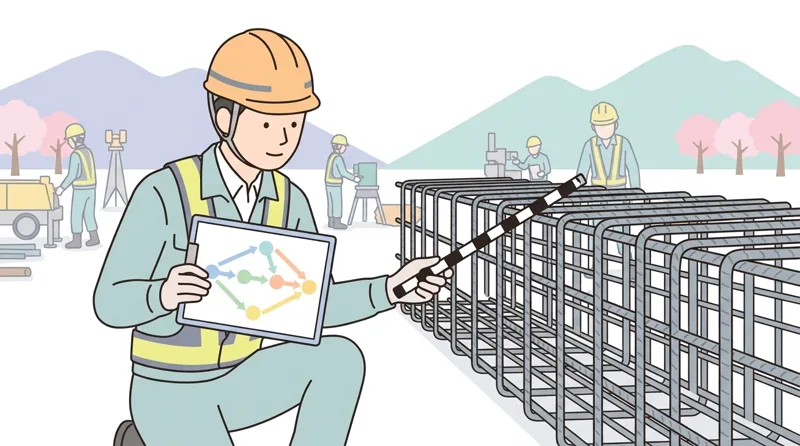
Time-distance (sloped line) schedule charts show progress speed via line slope and are ideal for linear projects like roads and tunnels. - 施工サイクル(PDCA):計画(Plan)→実施(Do)→確認・点検(Check)→処置・改善(Act)を回して継続的に改善する。
The PDCA management cycle—Plan -> Do -> Check -> Act—is continuously rotated to maintain and improve construction quality and safety. - 出来形管理と工事写真:不可視となる鉄筋の配筋状況やかぶり厚さ・砕石厚さは、黒板と検尺ロッドを添えて埋設前に撮影する。
As-built control and construction photos: Concealed work such as rebar arrangement, cover depth, and base thickness must be photographed with a chalkboard and measuring rod before burial or concreting.
| Word | Meaning |
|---|---|
| ネットワーク工程表・クリティカルパス | Network schedule diagram & Critical path |
| ヒストグラム・管理図 | Histogram & Quality control chart |
| 出来形管理・不可視部分の写真 | As-built dimension control & Photos of concealed work |
| PDCAサイクル(計画・実施・確認・処置) | PDCA cycle (Plan - Do - Check - Act) |
Civil Engineering Methods
Practice this chapter in the appOfficial references
- 建設分野特定技能2号評価試験 学科・実技試験テキスト【土木区分】(JAC 建設技能人材機構) — https://jac-skill.or.jp/exam/files/text6d.pdf
- 建設分野特定技能2号評価試験 サンプル問題【土木区分】(JAC 建設技能人材機構) — https://jac-skill.or.jp/exam/files/st2_sample2_d.pdf