Civil Engineering Machinery, Tools, Materials & Surveying Instruments (Type 2 Practical)
土木の機械・工具・材料・測量機器(2号実技)
Construction (SSW 2) · 建設分野(2号) · Written by Tokutei Pass based on the official study texts; not copied verbatim.
測量機器(レベル・トータルステーション・GNSS)と図面記号
Surveying Instruments (Level, Total Station, GNSS) and Drawing Symbols
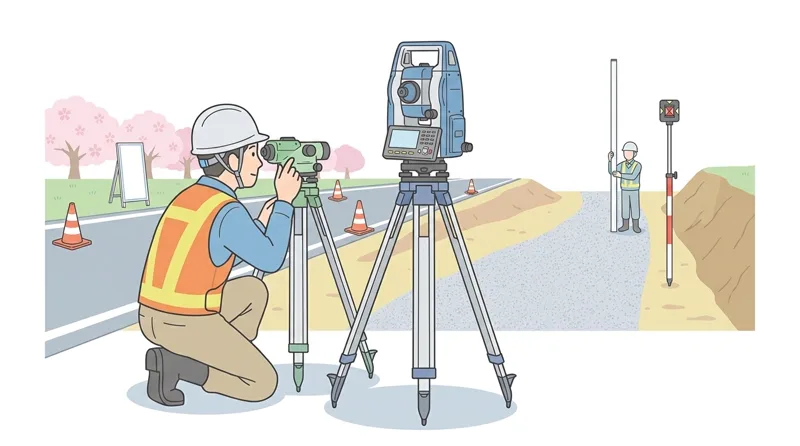
高低差(比高)や地盤高を求める水準測量では、自動補正機構を持つオートレベルを三脚に据え付け、円形気泡管の気泡を中央に入れて整準します。
In leveling surveys to find height differences and ground elevations, an auto level with an automatic compensator is mounted on a tripod and leveled by centering the circular bubble.
水平角・鉛直角と光波による斜距離を同時に測定するトータルステーション(TS)や、人工衛星の電波で三次元座標を求めるGNSS測量機が座標管理に使われます。
A Total Station (TS), which simultaneously measures horizontal/vertical angles and slope distances via light waves, and GNSS receivers using satellite signals are used for 3D coordinate control.
土木図面では、BM(ベンチマーク:水準点)、IP(路線の交点)、BC(曲線始点)、EC(曲線終点)や勾配表記(1:1.5や2.0%)を正確に読み取ります。
On civil engineering drawings, accurately read symbols such as BM (Benchmark), IP (Intersection Point), BC (Beginning of Curve), EC (End of Curve), and slope notations (1:1.5 or 2.0%).
Key points
- 水準測量の公式は「器械高 IH = 既知点地盤高 + 後視(BS)」、「新測点地盤高 = IH - 前視(FS)」。
Leveling formula: 'Instrument Height IH = Known Elevation + Backsight (BS)', and 'New Point Elevation = IH - Foresight (FS)'. - トータルステーションは角度と距離を同時測定し、GNSS測量は上空視界が開けた場所で三次元座標を観測する。
A Total Station measures angles and distances simultaneously, while GNSS surveying observes 3D coordinates in locations with an open sky view. - 法面勾配「1:1.5(1割5分)」は鉛直高さ1mに対し水平距離1.5mを表す。
A slope gradient of '1:1.5 (1 wari 5 bu)' represents 1.5 m of horizontal distance per 1 m of vertical height.
| Word | Meaning |
|---|---|
| オートレベル・標尺 | Auto level & Leveling staff |
| トータルステーション(TS) | Total Station (TS) |
| 後視(BS)・前視(FS) | Backsight (BS) & Foresight (FS) |
| 水準点(ベンチマーク:BM) | Benchmark (BM) |
土工・基礎・舗装・コンクリート用建設機械の選定
Selection of Earthwork, Foundation, Paving & Concrete Construction Machinery
掘削・積込みには油圧ショベル(バックホウ)を用い、軟弱湿地の押土・整地には接地圧が低い湿地ブルドーザを選定します。
Hydraulic excavators (backhoes) are used for digging and loading, while low-ground-pressure swamp bulldozers are selected for dozing and grading on soft marshy ground.
盛土や路盤の締固めには振動ローラやタイヤローラ、構造物裏込めや狭い掘削部にはランマや振動コンパクタを使い分けます。
Vibratory rollers and tire rollers are used for embankment and base course compaction, whereas rammers and vibratory plate compactors are used for structure backfilling and narrow trenches.
舗装工事ではアスファルトフィニッシャで合材を敷きならし、マカダムローラで初期転圧、タイヤローラで二次転圧を行います。
In paving work, an asphalt finisher spreads the mix, a macadam roller performs initial breakdown rolling, and a pneumatic tire roller performs secondary compaction.
Key points
- 縦穴の垂直掘削にはクラムシェル、硬岩や既設コンクリートの破砕には油圧ブレーカを使用する。
Use a clamshell bucket for vertical shaft excavation and a hydraulic breaker for crushing hard rock or existing concrete. - アスファルト舗装は「敷きならし→初期転圧(マカダム)→二次転圧(タイヤ)→仕上げ転圧(タンデム)」の順に施工する。
Asphalt paving follows the sequence: 'Spreading -> Breakdown rolling (Macadam) -> Secondary rolling (Tire) -> Finish rolling (Tandem)'. - クレーン機能付きドラグ・ショベル(移動式クレーン仕様機)での荷吊りはクレーンモードに切り替えて定格荷重内で行う。
When lifting loads with a crane-equipped excavator, switch to crane mode and operate strictly within the rated load capacity.
| Word | Meaning |
|---|---|
| 湿地ブルドーザ | Swamp bulldozer (low ground pressure) |
| アスファルトフィニッシャ | Asphalt finisher (paver) |
| マカダムローラ・タイヤローラ | Macadam roller & Pneumatic tire roller |
| クラムシェル・油圧ブレーカ | Clamshell bucket & Hydraulic breaker |
土質・骨材・セメント・混和材・鋼材の特性と管理
Properties & Management of Soil, Aggregates, Cement, Admixtures & Steel
盛土の締固めでは、乾燥密度が最大となる「最適含水比」付近で施工し、砂置換法やRI計器で現場締固め度を確認します。
Embankment compaction is performed near the 'optimum moisture content' where dry density is maximized, and field compaction degree is verified via the sand replacement method or RI gauge.
コンクリートの骨材は5mmふるいを通過する細骨材(砂)と5mmにとどまる粗骨材(砂利・砕石)に分かれ、表面水率に応じて現場配合の単位水量を補正します。
Concrete aggregates are divided into fine aggregate passing a 5 mm sieve (sand) and coarse aggregate retained on a 5 mm sieve (gravel/crushed stone); mix water is adjusted for surface moisture.
鉄筋にはコンクリートとの付着力が高い異形棒鋼(SD295やSD345、D16は直径約16mm)を用い、水セメント比(W/C)を小さくして強度と耐久性を高めます。
Deformed steel bars (SD295, SD345; D16 indicates ~16 mm diameter) with high bond strength are used for rebar, and a lower water-cement ratio (W/C) increases strength and durability.
Key points
- 土の乾燥密度が最大になる含水比を「最適含水比」といい、路盤の支持力指標にはCBR試験や平板載荷試験を用いる。
The moisture content yielding maximum dry density is the 'optimum moisture content'; subgrade bearing capacity is evaluated using the CBR test or plate bearing test. - AE減水剤は微細な空気泡(エントレインドエア)を連行し、ワーカビリティーと耐凍害性を向上させる。
AE water-reducing admixtures entrain microscopic air bubbles (entrained air) to improve workability and freeze-thaw resistance. - 早強ポルトランドセメントは初期強度が高く緊急工事や寒中に向き、高炉セメントは化学的抵抗性に優れる。
High-early-strength Portland cement develops high early strength for urgent or cold-weather work, while blast-furnace slag cement offers superior chemical resistance.
| Word | Meaning |
|---|---|
| 最適含水比・最大乾燥密度 | Optimum moisture content & Maximum dry density |
| 細骨材・粗骨材 | Fine aggregate & Coarse aggregate |
| 水セメント比(W/C)・AE減水剤 | Water-cement ratio (W/C) & AE water-reducing agent |
| 異形棒鋼(SD345・D16) | Deformed steel bar (Grade SD345, nominal diameter D16) |
受入れ検査・品質試験器具と維持補修材料
Acceptance Inspection & Quality Testing Apparatus and Maintenance Materials
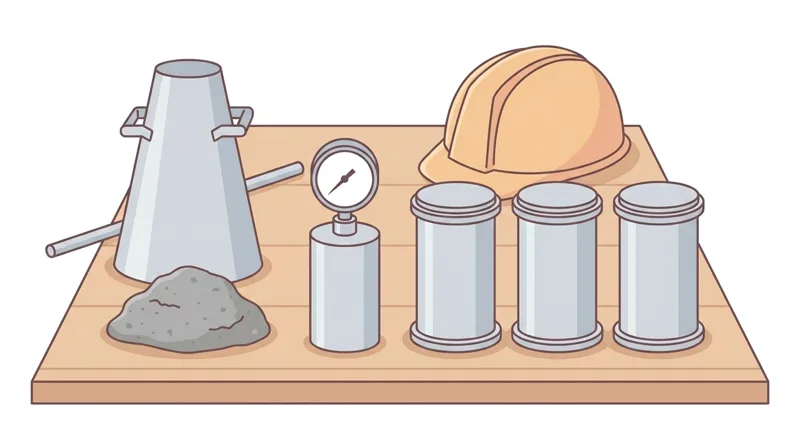
生コンクリートの受入れ検査では、スランプコーンで流動性(スランプ)、エアメータで空気量、塩分濃度計で塩化物イオン量(0.30kg/m³以下)を測定します。
In fresh concrete acceptance tests, a slump cone measures workability (slump), an air meter measures air content, and a salinity meter checks chloride ion content (<= 0.30 kg/m³).
硬化コンクリートの強度管理には円柱供試体の圧縮強度試験を用い、既設構造物の非破壊検査にはテストハンマー(反発度)や電磁誘導法(かぶり・鉄筋径)を用います。
Compressive strength tests on cylindrical specimens manage hardened concrete strength, while rebound hammers and electromagnetic induction devices perform non-destructive testing.
アスファルト舗装の品質管理では、温度計で到着・転圧温度を確認し、施工後はコアカッタで円柱コアを採取して舗装厚さと締固め度を検査します。
In asphalt pavement quality control, thermometers check arrival and rolling temperatures, and core cutters extract cylindrical cores after paving to inspect thickness and compaction.
Key points
- 生コンクリートの塩化物イオン量は原則0.30kg/m³以下とし、荷卸し時の温度・スランプ・空気量とともに記録する。
Chloride ion content in fresh concrete must not exceed 0.30 kg/m³ in principle, and is recorded along with unloading temperature, slump, and air content. - 既設コンクリートのひび割れ補修には低圧エポキシ樹脂注入、断面欠損にはポリマーセメントモルタル充てんを用いる。
Low-pressure epoxy resin injection is used for repairing cracks in existing concrete, while polymer cement mortar is used for patching cross-sectional spalling. - 3mプロフィルメータや直定規を用いて、仕上がり舗装面の平坦性(凹凸)を測定する。
A 3 m profilometer or straightedge is used to measure the surface regularity (evenness) of the finished pavement.
| Word | Meaning |
|---|---|
| スランプコーン・エアメータ | Slump cone & Concrete air meter |
| テストハンマー(リバウンドハンマー) | Rebound hammer (Test hammer) |
| コアカッタ・プロフィルメータ | Core cutter & Profilometer |
| エポキシ樹脂注入材・無収縮モルタル | Epoxy resin injection material & Non-shrink mortar |
Tools, Machines, Materials and Instruments (Civil)
Practice this chapter in the appOfficial references
- 建設分野特定技能2号評価試験 学科・実技試験テキスト【土木区分】(JAC 建設技能人材機構) — https://jac-skill.or.jp/exam/files/text6d.pdf
- 建設分野特定技能2号評価試験 サンプル問題【土木区分】(JAC 建設技能人材機構) — https://jac-skill.or.jp/exam/files/st2_sample2_d.pdf