 Tokutei Pass
Types of Construction Work, Specialized Trades & Qualifications
建設工事の種類・専門工事・資格
Construction – Building (SSW 2) · 建設分野(2号・建築区分) · Written by Tokutei Pass based on the official study texts; not copied verbatim.
土木・インフラ工事(土工・トンネル・ダム・橋梁・舗装・造園)
Civil Engineering & Infrastructure (Earthwork, Tunnels, Dams, Bridges, Paving, Landscaping)
地山の土はほぐすと体積が増え締固めると減ります。「ウェルポイント工法」は揚水管と真空ポンプで地下水をくみ上げ、「バーチカルドレーン工法」は鉛直排水材で軟弱粘性土の圧密沈下を早め、「鋼矢板」は継手の止水性に優れます。
Excavated bank soil swells in volume as air enters and shrinks when compacted. For dewatering, the 'Wellpoint method' pumps groundwater with vacuum pumps and wellpoints, while the 'Vertical drain (sand drain) method' drives vertical drains into soft clay to accelerate consolidation settlement. Interlocking 'steel sheet piles (Sheet piles)' provide high water tightness.
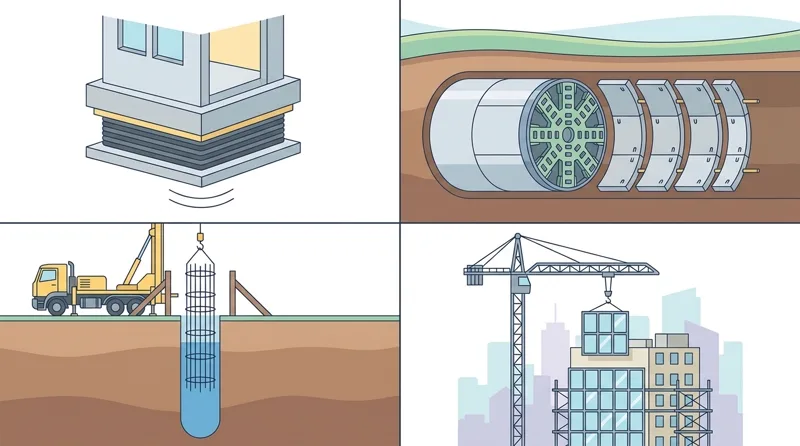
トンネルでは、掘進機後部でセグメントを組み立てる「シールドトンネル工法」、吹付けコンクリートとロックボルトで地山の支保力を活かす山岳の「NATM(ナトム)」、発進立坑内の「油圧ジャッキ装置」で非開削で管を押し込む「推進工事」があります。
Tunnel methods include the 'Shield tunnel method' assembling segments behind a boring machine, mountain 'NATM' utilizing rock mass strength with shotcrete and rock bolts, and non-open-cut 'pipe jacking (Suishin kouji)' pushing pipes underground from a starting shaft using 'hydraulic jacks'.
水圧を両岸岩盤へ伝える「アーチ式コンクリートダム」、土石流被害を防ぐ「砂防えん堤」、河岸浸食を防ぐ「護岸工・根固め工」、防波堤本体となる大型箱「ケーソン」、カッターで海底土砂を切り崩し泥水で送る「ポンプ浚渫船」も重要です。
Key civil works include the 'arch concrete dam' transferring water pressure to canyon walls, 'Sabo check dams' stopping debris flows, 'revetments and foot protection (Gogankou / Negatamekou)' preventing river erosion, large RC boxes called 'caissons' forming breakwaters, and 'cutter suction pump dredgers' cutting seabed soil and pumping it as slurry.
橋の下部構造は「橋台・橋脚」、PC鋼材で圧縮力を与えるのは「PC」です。舗装は下から「路床→路盤→基層→表層」で、「インターロッキング舗装」、鉄道の「まくらぎ」、法面の「種子吹付工」、植穴に水を注ぎ根に土を密着させる「水極め」があります。
Bridge substructures transferring loads to the ground are 'abutments and piers (Kyoudai / Kyoukyaku)', and 'Prestressed Concrete (PC)' applies pre-compression via PC tendons to prevent tensile cracks. Asphalt pavement layers from bottom up are 'subgrade (Roshou) → base course (Roban) → binder course (Kisou) → surface course (Hyousou)'; other works include 'interlocking block paving' on bedding sand, railway 'sleepers (Makuragi)', slope 'hydroseeding (Shushi fukitsukekou)', and tree planting 'water-puddling (Mizugime)'.
Key points
- 真空ポンプで地下水を抜くのは「ウェルポイント工法」、粘性土に鉛直排水材を打ち圧密を早めるのは「バーチカルドレーン工法」である。
Vacuum dewatering is the 'Wellpoint method', and vertical drains accelerating clay settlement are the 'Vertical drain method'. - セグメントを組むのは「シールド工法」、吹付けコンとロックボルトは「NATM」、非開削で管を油圧ジャッキで圧入するのは「推進工事」である。
Assembling segments is the 'Shield tunnel method', shotcrete + rock bolts is 'NATM', and pushing pipes with hydraulic jacks is 'pipe jacking'. - アスファルト舗装は下から「路床→路盤→基層→表層」、橋梁下部構造は「橋台・橋脚」、植栽で水と土を根に密着させる作業は「水極め」である。
Asphalt layers from bottom up are Subgrade → Base course → Binder course → Surface course; bridge substructures are 'abutments & piers'; puddling soil around tree roots is 'Mizugime'.
| Word | Meaning |
|---|---|
| ウェルポイント工法・バーチカルドレーン工法 | Wellpoint method & Vertical drain method |
| シールドトンネル工法・NATM | Shield tunnel method & NATM (New Austrian Tunnelling Method) |
| ケーソン・ポンプ浚渫船 | Port caisson & Cutter suction pump dredger |
建築構造・基礎杭・躯体専門工事(鉄骨・鉄筋・圧送・溶接)
Building Structures, Piles & Structural Trades (Steel, Rebar, Pumping, Welding)
基礎と上部の間に積層ゴムやダンパーを挟み揺れを減らす構造を「免震構造」、支持層に届く杭を「支持杭」といいます。場所打ち杭の「アースドリル工法」は「ベントナイト安定液と表層ケーシング」で孔壁崩壊を防ぎ鉄筋かごを入れて打設します。
A 'seismic base isolation structure (Menshin kouzou)' places laminated rubber isolators and dampers between the foundation and superstructure to reduce earthquake shaking. Piles reaching a deep bearing stratum are 'end-bearing piles (Shijigui)', and in the cast-in-place 'Earth drill method', 'bentonite stabilizing liquid and a surface casing' prevent borehole collapse before lowering the rebar cage and pouring concrete.
鉄骨工事で移動式クレーンを使い敷地の奥から手前へ順に組み進める方法を「建て逃げ方式」といい、火災熱による鋼材の強度低下・倒壊を防ぐためロックウールなどで「耐火被覆」を施工します。
Erecting steel frames sequentially from the back of the site toward the front with a mobile crane is the 'retreating erection method (Tatenige)', and 'fireproofing coating (Taika hifuku)' such as rock wool prevents steel strength loss and collapse in a fire.
RC造の「かぶり厚さ」は中性化による鉄筋の錆び・膨張を防ぎます。鉄筋端面を加圧しながら酸素・アセチレン炎で加熱接合する工法を「ガス圧接」、母材を溶かさず融点の低い溶加材を溶かしてつなぐ方法を「ろう接」といいます。
Adequate 'concrete cover thickness (Kaburi atsusa)' prevents carbonation from rusting and expanding internal rebar. Heating butted rebar ends with an oxy-acetylene flame under axial pressure to form a bulge is 'gas pressure welding', while joining metals by melting a lower-melting-point filler metal without melting the base metal is 'brazing/soldering (Rousetsu)'.
コンクリート圧送では「ポンプ操作オペレータ・筒先作業員・バイブレータ締固め作業員」の3者連携が重要です。補強コンクリートブロック造はブロックを湿らせ目地厚10mm程度で積み、縦筋空洞部にモルタル等を充填します。
Concrete pumping requires close teamwork among the 'pump operator, hose nozzle worker (Tsutsusaki), and concrete vibrator worker'. In reinforced concrete block masonry, dampen blocks, lay them with ~10 mm mortar joints, and fill hollow cores containing vertical rebar.
Key points
- 基礎に積層ゴム等を挟むのは「免震構造」、アースドリル工法の孔壁保護には「ベントナイト安定液と表層ケーシング」を使う。
Laminated rubber bearings under a building form 'base isolation (Menshin)', and Earth drill boreholes are stabilized with 'bentonite liquid and surface casing'. - 移動式クレーンで奥から手前へ鉄骨を組むのは「建て逃げ方式」、母材を溶かさず低融点金属でつなぐのは「ろう接」である。
Erecting steel from back to front is the 'retreating method (Tatenige)', and joining without melting base metal is 'brazing (Rousetsu)'. - 圧送工事の3者連携は「操作オペレータ・筒先作業員・土工作業員」であり、かぶり厚さは中性化による鉄筋腐食を防ぐ。
Pumping teamwork links the 'pump operator, nozzleman, and vibrator worker'; concrete cover prevents carbonation-induced rebar corrosion.
| Word | Meaning |
|---|---|
| 免震構造 | Seismic base isolation structure (Menshin kouzou) |
| 建て逃げ方式 | Retreating steel erection method (Tatenige houshiki) |
| ろう接 | Brazing / Soldering (Rousetsu) |
外装・屋根・防水・左官・タイル・石・ガラス・サッシ・断熱
Exterior Walls, Roofing, Waterproofing, Plastering, Tile, Stone, Glass & Insulation
高層ビルで荷重を支えず工場製パネルを柱・梁に付ける非耐力外壁を「カーテンウォール」といいます。屋根にはタイトフレームに固定する「折板屋根」、燻して銀色炭素膜を作る「いぶし瓦」、二次防水の「アスファルトルーフィング」があります。
Non-load-bearing factory-made exterior panels attached to columns and beams on high-rises are 'curtain walls'. Roof systems include 'folded-plate metal roofs (Seppan yane)' fixed to tight frames, unglazed 'smoked clay tiles (Ibushi-gawara)' finished with a silver carbon film by smoking at the end of firing, and 'asphalt roofing' underlayment providing secondary waterproofing.
液状のウレタンゴムやFRPを塗り広げて継ぎ目のない防水層をつくる工法を「塗膜防水工法」といい、現場発泡の硬質ウレタンフォーム断熱材原液は「ポリオール成分とポリイソシアネート成分」の2成分を混合します。
Spreading liquid urethane rubber or FRP to cure into a seamless membrane is 'liquid-applied membrane waterproofing (Tomaku bousui)', and sprayed rigid urethane foam insulation mixes two liquid components on site: 'polyol and polyisocyanate'.
左官モルタルは収縮ひび割れ防止のため数回に分けて塗り、表面を洗い種石を出す工法を「洗い出し」といいます。外壁には低吸水の「磁器質・せっ器質タイル」を張り打診ハンマーで浮きを調べ、外部床・壁石材には硬い「花崗岩(御影石)」を用います。
Plaster mortar is applied in multiple coats (undercoat, brown coat, finish coat) to prevent drying shrinkage cracks, and washing away surface mortar before hardening to expose decorative pebbles is 'washed-out finish (Araishidashi)'. Exterior walls use low-absorption, frost-resistant 'porcelain or stoneware tiles' inspected for delamination with a test hammer, and hard, abrasion-resistant 'granite (Kakougan / Mikage-ishi)' is ideal for exterior walls and floors.
2枚のガラスの間に中空層を設け断熱性・結露防止性を高めたガラスを「複層ガラス」、既存サッシ枠上に新設枠をかぶせる改修法を「カバー工法」といい、塗装工事は「美装」と「被塗物の保護(劣化防止)」が主目的です。
Two glass panes separated by a dry air/gas space for thermal insulation and condensation prevention form 'double-glazed glass (Fukusou glass)', fitting a new sash frame over an existing frame is the 'cover method', and architectural painting serves both 'beautification (Bisou)' and 'substrate protection'.
Key points
- 建物荷重を支えない工場製外壁は「カーテンウォール」、炭素膜を作る瓦は「いぶし瓦」、液状防水材を塗るのは「塗膜防水」である。
Non-load-bearing exterior wall panels are 'curtain walls', silver carbon-filmed tiles are 'Ibushi-gawara', and seamless liquid waterproofing is 'Tomaku bousui'. - 吹付け硬質ウレタン原液は「ポリオールとポリイソシアネート」の2成分、表面を洗い小石を出す左官は「洗い出し仕上げ」、外壁石材には「花崗岩(御影石)」が適する。
Sprayed urethane foam mixes 'polyol and polyisocyanate', washing mortar to expose pebbles is 'Araishidashi', and durable exterior stone is 'granite'. - 中空層で断熱・結露を防ぐのは「複層ガラス」、既存枠上に新枠をかぶせるのは「カバー工法」である。
Insulating glass with an air space is 'double-glazed glass (Fukusou glass)', and capping old window frames is the 'cover method'.
| Word | Meaning |
|---|---|
| カーテンウォール・複層ガラス | Curtain wall & Double-glazed insulating glass (Fukusou glass) |
| 洗い出し仕上げ・花崗岩 | Washed-out pebble finish (Araishidashi) & Granite (Kakougan) |
| 塗膜防水・硬質ウレタンフォーム | Liquid membrane waterproofing & Rigid urethane foam insulation |
内装・建具・建築設備工事(電気・空調・衛生・消防)と資格
Interior Finishing, Fire Doors, MEP Equipment (Electrical, HVAC, Plumbing, Fire) & Licenses
床下配線空間をつくる床を「フリーアクセスフロア(OAフロア)」といいます。ビニル床は接着剤塗布後「オープンタイム」をとって圧着し、クロス下地はパテとシーラーで処理します。防火戸周囲に物を置かず、石綿事前調査結果は「3年間保存」します。
A raised floor creating underfloor space for power and communication cables is a 'free access floor (OA floor)'. Apply vinyl floor tiles/sheets after drying and cleaning the mortar substrate, spreading adhesive evenly, and observing 'open time'; before wallpapering, smooth gypsum board joints and screw heads with putty and apply sealer. Keep areas around 'fire doors (Boukado)' clear of obstacles, and conduct pre-work asbestos surveys regardless of project size, keeping records for '3 years'.
電気設備の接地(アース)は漏電時の感電・火災を防ぎ、「第二種電気工事士」は一般住宅等の「600V以下」で受電する設備工事に従事できます。また「つり上げ荷重1トン以上の玉掛け業務」には技能講習修了が必要です。
Electrical 'grounding (Earth)' limits current through the body during leakage to prevent shock and fire, and a 'Class 2 Electrician' license covers facilities receiving power at '600 V or less'. Slinging work ('Tamagake') for cranes with a lifting capacity of '1 ton or more' requires completion of a Skill Training Course.
冷媒配管には熱伝導・耐食性に優れた「銅管」を使い、給排気ともファンで行う「第一種換気」、煙を出す「排煙ダクト」を設けます。熱絶縁工事は熱損失と結露を防ぎ、金属板で覆う「ラッキング」で外傷や紫外線から守ります。
HVAC refrigerant piping uses 'copper pipe (Doukan)' for superior heat transfer and corrosion resistance; mechanical ventilation using fans for both supply and exhaust is 'Type 1 ventilation'; and ducts exhausting smoke outdoors during fires are 'smoke exhaust ducts'. 'Thermal insulation work' prevents heat loss and condensation, while covering insulation with sheet metal ('jacketing / Racking') protects it from rain, impact, and UV rays.
上水道の浄水場処理は「沈殿池→ろ過池→塩素消毒」の順で行います。消防設備の「閉鎖型スプリンクラーヘッド」は熱で感熱部が溶けてそのヘッドだけから散水し、熱や煙を感知器で検知し受信機を通じて警報する設備を「自動火災報知設備」といいます。
Water purification plants process river water in order: 'sedimentation basin → filtration basin → chlorine disinfection'. In fire protection, a 'closed-type sprinkler head' melts its thermal element in fire heat to spray water only from that head, and a 'fire alarm system (Jidou kasai houchi setsubi)' detects heat or smoke with ceiling detectors and sounds alarms via a receiver.
Key points
- 配線用二重床は「フリーアクセスフロア」、石綿事前調査記録は規模不問で「3年間保存」、第二種電気工事士は「600V以下」の受電設備を扱う。
Raised wiring floors are 'free access floors', asbestos survey records are kept for '3 years', and Class 2 Electricians handle facilities at '600 V or less'. - 冷媒配管は「銅管」、給排気機械換気は「第一種換気」、保温材外装保護は「ラッキング」、浄水処理は「沈殿池→ろ過池→塩素消毒」である。
Refrigerant pipes use 'copper pipe', fan supply + fan exhaust is 'Type 1 ventilation', sheet-metal insulation cover is 'Racking', and water treatment follows Sedimentation → Filtration → Chlorination. - つり上げ荷重「1t以上の玉掛け」は技能講習が必要であり、熱・煙を検知して建物内へ知らせる設備は「自動火災報知設備」である。
Slinging for cranes '≥ 1 ton' requires Skill Training, and detectors + receiver + alarm bells form an 'automatic fire alarm system'.
| Word | Meaning |
|---|---|
| フリーアクセスフロア(OAフロア) | Free access floor (OA floor) |
| ラッキング・第一種換気方式 | Sheet-metal insulation jacketing (Racking) & Type 1 mechanical ventilation |
| 第二種電気工事士・玉掛け技能講習 | Class 2 Electrician (≤ 600 V) & Slinging Skill Training (≥ 1 t) |
Types of Construction Work and Terms
Practice this chapter in the appOfficial references
- 建設分野特定技能2号評価試験(一般社団法人建設技能人材機構 JAC) — https://jac-skill.or.jp/exam.html
- 建設分野特定技能2号評価試験 試験実施要領(国土交通省) — https://www.mlit.go.jp/tochi_fudousan_kensetsugyo/content/001708857.pdf