 Tokutei Pass
Tools, Machinery, Materials & Measuring Instruments (Architecture)
工具・機械・材料・計測器(建築)
Construction – Building (SSW 2) · 建設分野(2号・建築区分) · Written by Tokutei Pass based on the official study texts; not copied verbatim.
型枠・鉄筋・鉄骨・足場・土工の工具と資材
Formwork, Rebar, Steel Frame, Scaffolding & Earthwork Tools and Materials
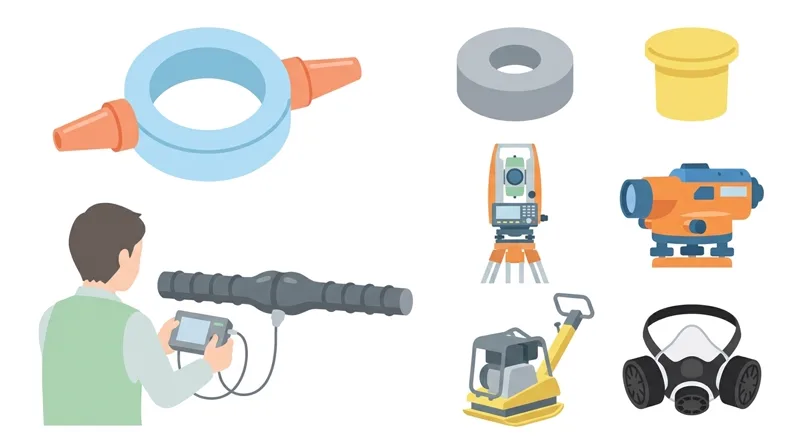
型枠工事で対向するせき板の間隔(壁厚)を一定に保ち両端にPコンを付ける鋼製部材を「丸セパレーター」といい、パイプサポートは高さ「3.5m」を超えるとき「2m以内ごとに水平つなぎを2方向」に設けます。
In formwork, the steel rod fitted with plastic P-cones at both ends to maintain uniform wall thickness between facing panels is a 'round separator (Maru-separator)'; when pipe supports exceed '3.5 m' in height, install 'horizontal ties in two directions at intervals of 2 m or less'.
側面スペーサーを「ドーナツ」、先端保護材を「プラキャップ」、結束具を「ハッカー」、切断機を「バーカッタ」、曲げ機を「バーベンダ」といいます。「SD345」は「降伏点下限値345N/mm²」で、圧接部は「超音波探傷器」で検査します。
Circular spacers maintaining side concrete cover on rebar are 'donuts', protective caps placed on protruding rebar ends are 'plastic caps (Pura-cap)', the hook tool for twisting tie wire is a 'Hakka', the rebar cutting machine is a 'bar cutter', and the bending machine is a 'bar bender'. In deformed rebar code 'SD345', 345 means a 'minimum yield point or proof stress of 345 N/mm²', and internal defects in gas pressure welds are inspected non-destructively using an 'ultrasonic flaw detector'.
トルシア形高力ボルトは「ピンテール破断」で締付完了を確認します。筋かい張力調節は「ターンバックル」、単管直角緊結は「直交クランプ」、親綱張りは「親綱緊張器」を使い、「シャックル」はピンを奥まで締め本体頂部とピン中央に荷をかけます。
Verify completion of Torshear high-strength bolt tightening by confirming the 'pintail has sheared off'; use a 'turnbuckle' to adjust diagonal brace tension, an 'orthogonal clamp (Chokkou clamp)' to join two scaffold pipes at 90 degrees, and a 'main rope tensioner (Oyazuna kinchouki)' to pull safety lifelines taut; with a slinging 'shackle', screw the pin all the way in so load bears on the bow crown and pin center.
土工のショベルやつるはしは柄が折れるため「てこ」に使わず、底面鉄板の振動で砕石や合材を平らに締め固める小型機械を「プレートコンパクター」といい、「油圧ジャッキ」は堅固な平らな面に垂直に据えて荷の下に安全ブロックを入れます。
Never use shovels or pickaxes as 'levers (Teko)' because handles can snap; use a 'plate compactor' (vibrating bottom steel plate) to compact crushed stone or asphalt flat; and set a 'hydraulic jack' vertically on a firm, flat surface while placing safety blocks under the raised load.
Key points
- せき板間隔保持は「丸セパレーター」、高さ3.5m超のパイプサポートは「2m以内ごとに2方向の水平つなぎ」を設ける。
Keep formwork spacing with a 'round separator', and brace pipe supports over 3.5 m high in 'two horizontal directions every 2 m or less'. - 側面スペーサーは「ドーナツ」、先端保護は「プラキャップ」、SD345は「降伏点下限値345N/mm²」、圧接内部検査は「超音波探傷器」である。
Side spacers are 'donuts', tip guards are 'plastic caps', SD345 denotes 'yield strength ≥ 345 N/mm²', and weld interiors are checked with an 'ultrasonic flaw detector'. - トルシア形高力ボルトは「ピンテール破断」で確認し、張力調節は「ターンバックル」、単管直角緊結は「直交クランプ」、親綱張りは「親綱緊張器」である。
Check Torshear bolts by 'pintail shear-off', adjust brace tension with a 'turnbuckle', join pipes at 90° with an 'orthogonal clamp', and tension lifelines with a 'main rope tensioner'.
| Word | Meaning |
|---|---|
| 丸セパレーター・ドーナツ・プラキャップ | Round separator, Donut spacer & Plastic rebar cap (Pura-cap) |
| 超音波探傷器 | Ultrasonic flaw detector (Chouonpa tanshouki) |
| ターンバックル・親綱緊張器 | Turnbuckle & Main rope lifeline tensioner (Oyazuna kinchouki) |
木工・左官・塗装・内装・管工事の工具と材料
Carpentry, Plastering, Painting, Interior & Piping Tools and Materials
木工の「両刃のこぎり」は繊維に沿って切るとき「縦挽き刃」、直角に切るとき「横挽き刃」を使います。木材は含水率が繊維飽和点(約30%)以下になると収縮が始まり、繊維方向より年輪の接線方向が大きく収縮して強度は高まります。
On a Japanese double-edged carpenter's saw (Ryouba nokogiri), use the 'rip blade (Tatebiki)' when cutting along the wood grain and the 'crosscut blade (Yokobiki)' when cutting perpendicular to the grain. When wood moisture content drops below the fiber saturation point (approx. 30%), shrinkage begins—shrinking much more in the 'tangential direction of annual rings' than along the fibers—while strength increases.
左官で壁や柱の「出隅(外側に出た角)」を仕上げるときは「面引きごて」を使い、シーリング工事で深い目地の充填深さ調整と三面接着防止のために入れる材料を「バックアップ材」といいます。
In plastering, use a 'corner bevel trowel (Menbiki-gote)' to finish projecting 'outside corners (Dezumi)' of walls or columns; in sealant work, insert 'backup material (Backup-zai)' into deep joints to adjust sealant depth and prevent three-sided adhesion.
内装下地の「石膏ボード」は結晶水を含む石膏を芯材とし防火性・遮音性・施工性に優れ、鋼製天井下地で吊りボルトの先に付けて野縁受けを保持する金具を「ハンガー」といいます。
'Gypsum board' has a gypsum core containing crystal water, giving it excellent fire resistance, sound insulation, and workability; in light-gauge steel (LGS) ceilings, the hardware attached to the bottom of a suspension bolt to hold the main carrying channel (Nobuchi-uke) is a 'hanger'.
鉄骨等の塗装ではケレン(素地調整)を終えた鋼材に最初に「さび止め塗料」を塗り、有機溶剤作業の防毒マスクには「黒色(有機ガス用)」の吸収缶を使います。また鋼管端の切断・面取り・管用テーパおねじ加工を同時に行う機械を「パイプマシン」といいます。
In steel painting, apply 'rust-inhibiting paint (Sabidome toryou)' first after surface preparation (Keren); fit organic gas respirators with a 'black canister (for organic gases)'; and use a 'pipe threading machine (Pipe machine)' to cut, ream/chamfer, and cut tapered external threads on steel pipes.
Key points
- 両刃のこぎりは繊維方向に「縦挽き刃」・直角に「横挽き刃」を使い、木材は含水率30%以下で接線方向に大きく収縮し強度が増す。
Cut along wood grain with the 'rip blade (Tatebiki)' and across grain with the 'crosscut blade (Yokobiki)'; below 30% moisture, wood shrinks most tangentially and gains strength. - 出隅仕上げには「面引きごて」、三面接着防止には「バックアップ材」、吊りボルト先で野縁受けを吊る金具には「ハンガー」を使う。
Finish outside corners with a 'Menbiki-gote', prevent 3-sided sealant adhesion with 'backup material', and hang ceiling main channels with a 'hanger'. - ケレン後の鋼材には最初に「さび止め塗料」を塗り、有機ガス用吸収缶は「黒色」、鋼管ねじ切り機は「パイプマシン」である。
Coat cleaned steel first with 'rust-inhibiting paint', use a 'black canister' for organic solvent vapors, and thread steel pipes with a 'pipe machine'.
| Word | Meaning |
|---|---|
| 面引きごて・バックアップ材 | Corner trowel (Menbiki-gote) & Sealant backup material (Backup-zai) |
| ハンガー・パイプマシン | Ceiling suspension hanger & Pipe threading machine (Pipe machine) |
| 繊維飽和点(含水率約30%) | Fiber saturation point of timber (~30% moisture content) |
セメント・コンクリートの種類・混和剤・試験と振動機
Cement & Concrete Types, Admixtures, Slump Testing, and Vibrators
冬期などに普通ポルトランドセメントより早く強度が出るものを「早強ポルトランドセメント」といい、ダム等のマスコンクリートで水和熱による温度ひび割れを抑えるには「中庸熱・低熱ポルトランドセメント」を使います。
For winter construction requiring faster strength gain than ordinary Portland cement, use 'high-early-strength Portland cement (Soukyou)'; to suppress thermal cracking from hydration heat in mass concrete (dams, large foundations), use 'moderate-heat or low-heat Portland cement'.
コンクリートの混和剤のうち「AE剤・AE減水剤」は、微細な独立気泡を均一に入れて作業性(ワーカビリティー)と耐凍害性を高めるために用います。
Among concrete admixtures, an 'AE agent / AE water-reducing agent' entrains uniform microscopic air bubbles into concrete to improve 'workability' and 'freeze-thaw resistance (frost resistance)'.
生コンクリートの軟らかさ(コンシステンシー)を調べる「スランプ試験」では、スランプコーンを引き上げた直後の「コンクリート頂部の下がり量(cm)」を測定します。
In the 'slump test' measuring fresh concrete consistency (softness), measure the 'vertical subsidence (drop in cm) of the top of the concrete' immediately after lifting the slump cone.
締固めに使う「棒形振動機(内部振動機)」は、打ち込んだ各層に鉛直(垂直)に差し込み、下の層に「10cm程度」入れて上下層を一体化させながら締め固めます。
When consolidating concrete with an 'internal rod vibrator (Bougata shindouki)', insert it vertically into each freshly placed layer and penetrate about '10 cm' into the underlying layer.
Key points
- 早期強度発現には「早強ポルトランドセメント」、マスコンクリートの温度ひび割れ抑制には「中庸熱・低熱ポルトランドセメント」を使う。
Use 'high-early-strength Portland cement' for rapid winter strength, and 'moderate-heat or low-heat Portland cement' to prevent thermal cracks in mass concrete. - 「AE剤・AE減水剤」は微細気泡により作業性(ワーカビリティー)と耐凍害性を高める。
'AE agents / AE water-reducing agents' entrain fine air bubbles to improve workability and freeze-thaw resistance. - スランプ試験はコーン引上げ直後の「頂部の下がり量(cm)」を測り、棒形振動機は鉛直に差して下層へ「約10cm」入れる。
The slump test measures 'top subsidence (cm)' right after lifting the cone; insert rod vibrators vertically about '10 cm' into the lower layer.
| Word | Meaning |
|---|---|
| 早強・中庸熱・低熱ポルトランドセメント | High-early-strength, Moderate-heat & Low-heat Portland cement |
| AE剤・AE減水剤 | Air-Entraining (AE) agent / AE water-reducing agent |
| スランプ試験・棒形振動機 | Concrete slump test & Internal rod vibrator |
測量・墨出し機器と電動・ガス・高所作業機械の安全
Surveying/Layout Instruments & Safety for Power, Gas, and Aerial Equipment
現場で3対4対5の比率で直角を出す木製道具は「おおがね」、垂直を調べるのは「下げ振り」、基準線を引くのは「墨つぼ」、自動補正機構で水平・垂直線を同時照射するのは「レーザー墨出し器」です。
The wooden triangle using the 3 : 4 : 5 ratio to lay out right angles on site is an 'Oogane', the conical weight checking verticality is a 'plumb bob (Sagefuri)', the line marker is an 'ink pot (Sumitsubo)', and the self-leveling device projecting horizontal and vertical lines simultaneously is a 'laser line level'.
角度の経緯儀と距離の光波測距儀を一体にした機器は「トータルステーション」です。レベル測量でA点高10.000m・後視1.520m(器械高11.520m)、B点前視0.980mなら、B点高は11.520-0.980=「10.540m」です。
A 'total station' integrates a theodolite (angle meter) and an electro-optical distance meter to measure angles and distances simultaneously. In leveling, if backsight (BS) on Point A (elevation 10.000 m) is 1.520 m (instrument height = 11.520 m) and foresight (FS) on Point B is 0.980 m, the elevation of Point B is 11.520 − 0.980 = '10.540 m'.
「携帯用丸のこ」はキックバック防止のため切断線真後ろに立たず点検時は電源を切り、「グラインダー」砥石交換は特別教育修了者が行い試運転します。ガス溶接・圧接には逆火防止の「乾式安全器」を付けます。
With a 'portable circular saw', never stand directly behind the cutting line to avoid kickback and disconnect power before blade checks; 'disc grinder' wheel replacement must be done by a Special Training graduate followed by a trial run and PPE use. In gas welding and rebar gas pressure welding, install a 'dry flashback arrestor (Kanshiki anzenki)' to prevent flashback explosions.
玉掛けの「吊り角度は原則60度以内」とし、キンクや素線切れのあるワイヤロープは使いません。また「高所作業車」の運転は、作業床高さ「10m以上なら技能講習、10m未満なら特別教育」が必要です。
In crane slinging, keep the 'sling angle within 60 degrees in principle' and never use kinked or broken-strand wire ropes. Operating an 'aerial work platform (Kousho sagyousha)' requires a 'Skill Training Course if the working floor height is 10 m or more, and Special Training if under 10 m'.
Key points
- A点(高さ10.000m)の後視1.520m・B点の前視0.980mのとき、B点の高さは「10.540m」である。
With Point A at 10.000 m, backsight 1.520 m, and Point B foresight 0.980 m, Point B's elevation is '10.540 m'. - 丸のこはキックバック防止のため切断線真後ろに立たず、グラインダー砥石交換は「特別教育修了者」、ガス逆火防止には「乾式安全器」を使う。
Stand clear of the line behind a circular saw to avoid kickback, require 'Special Training' for grinder wheel changes, and fit a 'dry flashback arrestor' on gas torches. - 玉掛け吊り角度は「60度以内」とし、高所作業車は作業床「10m以上が技能講習、10m未満が特別教育」である。
Keep slinging angles 'within 60 degrees', and require 'Skill Training for aerial platforms ≥ 10 m and Special Training for < 10 m'.
| Word | Meaning |
|---|---|
| 乾式安全器(逆火防止器) | Dry flashback arrestor (Kanshiki anzenki) |
| 高所作業車の資格区分 | Aerial work platform qualification threshold (10 m working floor height) |
| トータルステーション・レーザー墨出し器 | Total station & Self-leveling laser line level |
Tools, Machines, Materials and Instruments
Practice this chapter in the appOfficial references
- 建設分野特定技能2号評価試験(一般社団法人建設技能人材機構 JAC) — https://jac-skill.or.jp/exam.html
- 建設分野特定技能2号評価試験 試験実施要領(国土交通省) — https://www.mlit.go.jp/tochi_fudousan_kensetsugyo/content/001708857.pdf