
Lifeline & Equipment Tools, Materials, Measuring Instruments & Drawings (Type 2 Practical)
ライフライン・設備の工具・材料・測定器・図面(2号実技)
Construction (SSW 2) · 建設分野(2号) · Written by Tokutei Pass based on the official study texts; not copied verbatim.
配管・ダクト・電気・通信工事の専門工具と加工機械
Specialized Tools & Processing Machines for Piping, Ducts, Electrical & Telecom Work
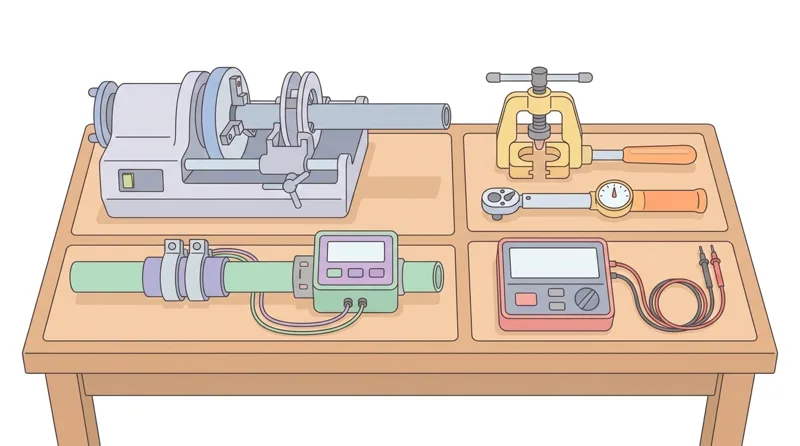
鋼管のねじ切り加工には電動ねじ切り機(パイプマシン)を用い、切削油を十分にかけながら管の切断・内面のバリ取り(リーマがけ)・テーパおねじ切りを行います。
Powered pipe threading machines cut steel pipes, ream internal burrs, and cut tapered external threads while applying generous cutting oil.
冷媒用銅管の切断にはチューブカッタ、端面のラッパ状拡管にはフレアツール、曲げ加工にはチューブベンダを用い、フレアナットはトルクレンチで規定トルクに締め付けます。
For refrigerant copper tubing, tube cutters make clean cuts, flaring tools form bell-shaped ends, tube benders prevent kinking, and torque wrenches tighten flare nuts to specified torque.
電気工事ではケーブルストリッパや電工ナイフで被覆をむき、リングスリーブ用(黄色柄)や裸圧着端子用(赤色柄)の圧着ペンチをダイスサイズに合わせて使い分けます。
In electrical work, cable strippers remove insulation, and crimping pliers for ring sleeves (yellow handles) or bare crimp terminals (red handles) are matched to the proper die size.
Key points
- パイプレンチやチェーントングは鋼管用であり、傷がつきやすい塩ビ管・銅管・メッキ化粧管にはベルトレンチ(ストラップレンチ)等を用いる。
Pipe wrenches and chain tongs are for steel pipes; use belt (strap) wrenches on PVC, copper, or chrome-plated pipes to prevent surface damage. - ポリエチレン管のEF(電気融着)接合では、専用スクレーパで管表面の酸化被膜を削り取り、固定クランプで保持して通電融着する。
In electrofusion (EF) joining of polyethylene pipes, peel the oxidized surface layer with a dedicated scraper and hold the joint in alignment clamps during fusion and cooling. - 光ファイバの融着接続では、光ファイバホルダ・高精度ファイバカッタ・融着接続機を用いて心線を鏡面切断し接続する。
In optical fiber fusion splicing, fiber holders, precision cleavers, and fusion splicers cleave the glass fiber to a mirror finish and fuse the cores together.
| Word | Meaning |
|---|---|
| パイプマシン(電動ねじ切り機)・リーマ | Powered pipe threading machine & Pipe reamer |
| フレアツール・トルクレンチ | Flaring tool & Torque wrench |
| 圧着ペンチ・油圧式圧着工具 | Hand crimping pliers & Hydraulic crimping tool |
| EFコントローラ・スクレーパ | Electrofusion (EF) controller & Pipe scraper |
管材・継手・弁類(バルブ)・ケーブル・保温材の選定
Selection of Pipe Materials, Fittings, Valves, Cables & Thermal Insulation
給水・排水・ガス・消火などの用途に応じて、硬質ポリ塩化ビニル管(VP/VU)、耐熱性硬質塩ビ管(HT)、ポリエチレン管(PE)、ダクタイル鋳鉄管(DCIP)、ステンレス鋼管を選定します。
Depending on water supply, drainage, gas, or fire protection needs, select rigid PVC pipes (VP/VU), heat-resistant PVC (HT), polyethylene (PE), ductile cast iron (DCIP), or stainless steel pipes.
バルブ(弁)は、全開・全閉用の「仕切弁(ゲートバルブ)」、流量調整に向く「玉形弁(グローブバルブ)」、逆流を防ぐ「逆止弁(チャッキバルブ)」を使い分けます。
Valves are selected by function: 'gate valves' for full open/close isolation, 'globe valves' for flow throttling/regulation, and 'check valves' to prevent backflow.
電力ケーブルには屋内配線用のVVFケーブルや、架橋ポリエチレン絶縁のCVケーブル(許容温度90℃)があり、結露・熱損失防止にはグラスウールや発泡ポリエチレン保温材を巻きます。
Power cables include flat VVF cables for indoor wiring and cross-linked polyethylene CV cables (90°C rating); glass wool or foamed polyethylene insulation prevents condensation and heat loss.
Key points
- 肉厚のVP管は圧力がかかる給水や屋外排水、薄肉のVU管は無圧の排水・通気に用い、90℃までの給湯にはHT管(茶褐色)を用いる。
Thick-walled VP pipes are used for pressurized water supply or outdoor drainage, thin-walled VU pipes for non-pressure drainage/venting, and brown HT pipes for hot water up to 90°C. - 水道本管のダクタイル鋳鉄管(GX形・NS形)は、継手の伸縮・屈曲機能と離脱防止リングにより高い耐震性を持つ。
Earthquake-resistant ductile iron water mains (GX/NS types) prevent joint pull-out during earthquakes through flexible expansion/deflection joints and locking rings. - 異種金属管(鋼管と銅管・ステンレス管)を直接つなぐと電食(異種金属接触腐食)が起きるため、絶縁継手を介在させる。
Directly connecting dissimilar metal pipes (e.g., steel to copper or stainless steel) causes galvanic corrosion, so dielectric (insulating) fittings must be installed between them.
| Word | Meaning |
|---|---|
| 硬質ポリ塩化ビニル管(VP・VU)・HT管 | Rigid PVC pipe (VP/VU) & Heat-resistant PVC pipe (HT) |
| 耐震型ダクタイル鋳鉄管(GX形・NS形) | Earthquake-resistant ductile iron pipe (GX/NS joint) |
| 仕切弁・玉形弁・逆止弁 | Gate valve, Globe valve & Check valve |
| 絶縁継手・異種金属接触腐食(電食) | Dielectric fitting & Galvanic corrosion |
試験・測定機器(水圧・気密・絶縁・接地・風量・光)
Testing & Measuring Instruments (Hydrostatic, Airtightness, Insulation, Grounding, Airflow, Optical)
給水配管の水圧試験にはテストポンプと圧力計、ガス管の気密試験には自記圧力計やマノメータ、排水管には満水試験・通水試験を用います。
Water supply hydrostatic tests use a test pump and pressure gauge; gas pipe airtightness tests use a recording pressure gauge or manometer; drainage pipes undergo water-filling and flow tests.
電気設備では、電線と大地間の漏電の有無を調べる「絶縁抵抗計(メガー)」、アース抵抗を測る「接地抵抗計」、回路を切らずに電流を測る「クランプメータ」を使います。
Electrical testing uses an 'insulation resistance tester (Megger)' to check leakage to ground, an 'earth resistance tester' for grounding resistance, and a 'clamp meter' to measure current without breaking the circuit.
空調・換気設備の風速・風量測定には熱線風速計や風量フード、光通信の損失・破断位置測定には光パワーメータやOTDR(光パルス試験器)を用います。
HVAC airflow testing uses hot-wire anemometers and airflow capture hoods, while optical fiber loss and fault location use optical power meters and OTDRs.
Key points
- 冷媒配管の気密試験には乾燥窒素ガスを用い、真空引き(真空乾燥)には真空ポンプとマニホールドゲージを使用する(酸素や可燃性ガスの加圧は爆発するため厳禁)。
Refrigerant piping airtightness tests must use dry nitrogen gas, and vacuum drying uses a vacuum pump and manifold gauge (pressurizing with oxygen or flammable gas is strictly prohibited due to explosion risk). - 絶縁抵抗計(メガー)は高電圧を印加するため、測定前にブレーカを切り、電子機器やコンデンサを保護してから測定する。
Because an insulation resistance tester (Megger) applies high DC voltage, turn off the breaker and isolate sensitive electronics before testing. - 三相誘導電動機(モータ)の逆回転を防ぐため、電源投入前に「検相器」でR・S・T相の相順(正相)を確認する。
To prevent reverse rotation of three-phase induction motors, verify correct R-S-T phase sequence using a 'phase rotation tester' before energizing.
| Word | Meaning |
|---|---|
| テストポンプ・マニホールドゲージ・真空ポンプ | Hydrostatic test pump, Manifold gauge & Vacuum pump |
| 絶縁抵抗計(メガー)・接地抵抗計 | Insulation resistance tester (Megger) & Earth resistance tester |
| クランプメータ・検相器・検電器 | Clamp meter, Phase rotation tester & Voltage detector |
| 光パワーメータ・OTDR(光パルス試験器) | Optical power meter & OTDR (Optical Time-Domain Reflectometer) |
設備施工図・アイソメ図・単線結線図と図面記号(JIS)
Equipment Shop Drawings, Isometric Drawings, Single-Line Diagrams & JIS Symbols
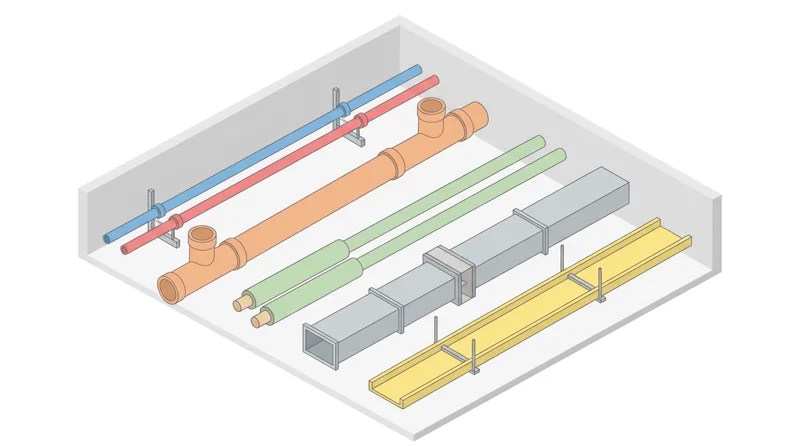
設備工事では、配管・ダクト・電気ケーブルトレイが天井裏やシャフトで干渉(衝突)しないよう、各設備のルートの高さ・位置を重ね合わせた「総合施工図」で事前調整します。
In MEP installation, a 'combined coordination shop drawing' overlays piping, ducts, and cable trays in ceiling spaces and shafts to resolve clashes and adjust elevations beforehand.
配管の高低や折れ曲がり・継手の数を立体的に把握する図面を「アイソメ図(等角投影図)」といい、管の土被り深さや交差状況を確認する図面を「縦断図」といいます。
An 'isometric drawing' depicts piping runs, bends, and fittings in 3D perspective, whereas a 'longitudinal profile drawing' shows burial depth (earth cover), slope, and utility crossings along a pipeline route.
図面表記では、BOP(管底高)、COP(管芯高)、TOP(管頂高)、スリーブ記号、勾配(1/100など)およびJISバルブ・電気記号を正確に読み取ります。
Accurately read drawing notations such as BOP (Bottom of Pipe), COP (Center of Pipe), TOP (Top of Pipe), sleeve symbols, drainage slopes (e.g., 1/100), and JIS valve and electrical symbols.
Key points
- 排水横枝管などは管底(BOP)で勾配を管理し、ダクトの防火区画貫通部にはFD(防火ダンパ)を設ける。
Horizontal drainage branches are grade-controlled by Bottom of Pipe (BOP), and Fire Dampers (FD) must be installed where ducts penetrate fire compartment walls. - 屋内配線の図面記号では、黒丸(●)はスイッチ、接地極・接地端子付きコンセントには「E・ET」などが添えられる。
In indoor wiring symbols, a solid black circle (●) denotes a switch, and grounded outlets include letters such as 'E' (earth pole) or 'ET' (earth terminal). - 梁や壁を貫通する配管・ダクト用の孔(スリーブ)は、コンクリート打設前に鉄筋の補強とともに所定位置へ正確に固定する。
Pipe and duct sleeves penetrating structural beams or walls must be accurately positioned and secured with reinforcing bars before concrete placement.
| Word | Meaning |
|---|---|
| 総合施工図・アイソメ図(等角投影図) | Combined coordination shop drawing & Isometric 3D drawing |
| BOP(管底高)・COP(管芯高)・TOP(管頂高) | Bottom of Pipe (BOP), Center of Pipe (COP) & Top of Pipe (TOP) |
| 防火ダンパ(FD)・貫通スリーブ | Fire damper (FD) & Penetration sleeve |
| 単線結線図・複線図 | Single-line diagram & Multi-line wiring diagram |
Tools, Machines, Materials and Instruments (Lifeline)
Practice this chapter in the appOfficial references
- 建設分野特定技能2号評価試験 学科・実技試験テキスト【ライフライン・設備区分】(JAC 建設技能人材機構) — https://jac-skill.or.jp/exam/files/text6l.pdf
- 建設分野特定技能2号評価試験 サンプル問題【ライフライン・設備区分】(JAC 建設技能人材機構) — https://jac-skill.or.jp/exam/files/st2_sample2_l.pdf