 Tokutei Pass
Construction Machinery, Tools & Materials
建設機械・工具・材料
Construction (Building) · 建設分野(建築区分) · Written by Tokutei Pass based on the official study texts; not copied verbatim.
手工具・専門道具の名称と正しい使い方
Names and Proper Use of Hand Tools and Trade Tools
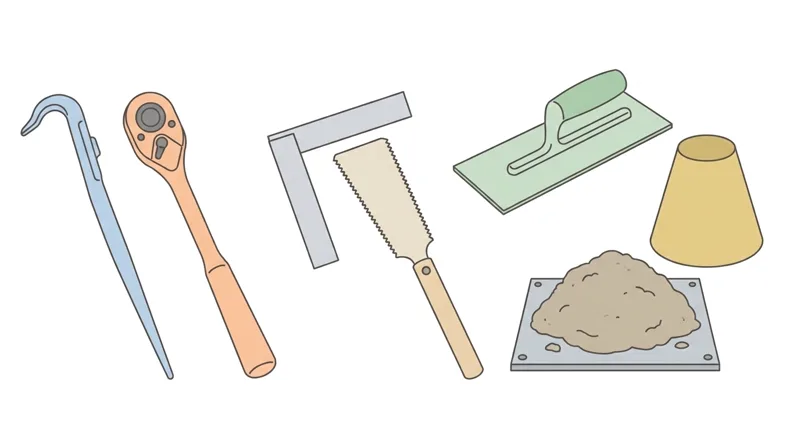
鉄筋の結束線を縛るフック状の道具を「ハッカー」、足場の番線結束やボルト締めに使う先端が尖った工具を「シノ(シノ付きラチェット)」、単管パイプどうしを固定する金具を「クランプ」といいます。
The hooked tool used to twist tie wires around rebar intersections is a 'rebar tier (Hakka)', the tapered-tail wrench used for twisting wire and tightening scaffold bolts is a 'Shino ratchet wrench', and the fitting used to fasten single steel pipes together is a 'clamp'.
木工の「両刃のこぎり」は縦引き刃と横引き刃があり手前に引いて切り、「かんな」は木材表面を薄く削り、「のみ」と「玄能」でほぞ穴を掘るときは刃先の前方に手を置かず木材を固定して叩きます。
A Japanese 'double-edged saw (Ryouba nokogiri)' has rip teeth on one side and crosscut teeth on the other and cuts on the pull stroke; a 'hand plane (Kanna)' shaves wood smooth; when mortising with a 'chisel (Nomi)' and 'hammer (Gennou)', secure the wood and never place hands in front of the blade.
左官・土間仕上げの最終押さえには「金ごて」、コテ波を消してなじませるには「左官ブラシ・スポンジ(水刷毛)」、外壁タイルの浮きを音で調べるには「打診棒(テストハンマー)」を使います。
For final smooth troweling of mortar or concrete floors, use a 'metal trowel (Kanagote)'; to erase trowel marks with water, use a 'plasterer's brush/sponge (Mizubake)'; to detect loose exterior tiles by sound, roll a 'sounding rod (Dashinbou / test hammer)' over the wall.
墨つぼは糸を強く張り真上につまみ上げて弾き、コンベックスは爪の変形を確認して正面から読み、モンキーレンチは下あご側に力がかかる向きで回し、カッターは刃を出しすぎず進行方向に手を置かず、解体した板の釘はバールで抜くか折り曲げます。
Snap an ink line (Sumitsubo) by pulling the string taut and plucking it straight up; check a tape measure's hook for bending and read straight on; pull an adjustable wrench toward the fixed lower jaw; keep utility knife blades short; and immediately pull or bend protruding nails in stripped formwork with a crowbar.
Key points
- 結束線を縛るのは「ハッカー」、番線やボルトを締めるのは「シノ付きラチェット」、単管を固定するのは「クランプ」である。
Use a 'Hakka' to tie rebar wire, a 'Shino ratchet' to twist heavy wire and tighten bolts, and a 'clamp' to join scaffold pipes. - 左官の最終平滑仕上げには「金ごて」、外壁タイルの浮き調査には「打診棒」を使い、両刃のこぎりは引いて切る。
Use a 'metal trowel (Kanagote)' for final floor finishing, a 'sounding rod (Dashinbou)' to check tile delamination, and pull a Japanese hand saw to cut. - モンキーレンチは下あご側に力をかけて回し、型枠解体後の板から出た釘は踏み抜き防止のためすぐ抜くか折り曲げる。
Apply force toward the lower jaw of an adjustable wrench, and pull out or bend nails immediately after stripping formwork to prevent puncture injuries.
| Word | Meaning |
|---|---|
| ハッカー | Rebar tying hook (Hakka) |
| シノ付きラチェット | Ratchet wrench with tapered drift pin (Shino ratchet) |
| 打診棒 | Tile sounding rod / Test hammer (Dashinbou) |
| 金ごて | Metal finishing trowel (Kanagote) |
電動工具・空圧工具・仮設電気設備
Power Tools, Pneumatic Tools, and Temporary Electrical Equipment
金属やコンクリートの切断・研磨には「ディスクグラインダー」、硬化したコンクリートへの穴あけには回転に打撃を加える「ハンマードリル(振動ドリル)」、防水シートや断熱材をコの字型の針で留めるには「タッカー」を使います。
Use a 'disc grinder' for cutting/grinding metal or concrete, a 'hammer drill' (combining rotation and percussion) for drilling anchor holes in hardened concrete, and a 'tacker (staple gun)' to fasten waterproof sheets or insulation with U-shaped staples.
鉄骨のトルシア形高力ボルトを本締めしてピンテールを破断させる専用工具は「シャーレンチ」であり、インパクトドライバーでは溝が潰れるカムアウトを防ぐため十字溝に合ったビットを垂直に押し付けて回します。
A 'shear wrench' is the specialized electric tool that tightens Torshear-type high-strength bolts and shears off the splined pintail at the specified torque; with an impact driver, choose a bit matching the cross slot and press perpendicularly to prevent cam-out.
圧縮空気で釘を打つ「釘打機(ネイラ)」は、補充・点検時に必ずエアホースを外して銃口を人に向けません。また「電動鉄筋曲げ機(鉄筋ベンダー)」は常温で加工し、ローラーの可動範囲に手を近づけません。
Always disconnect the air hose before reloading or inspecting a pneumatic 'nailer' and never point the nose at anyone; bend rebar at room temperature with an 'electric rebar bender' while keeping hands clear of the moving rollers.
コードリール(電工ドラム)は発熱・火災を防ぐため電線をすべて引き出して使い、仮設分電盤の「漏電遮断器」が作動して電気が止まったときは直ちに使用をやめて職長に報告し点検を受けます。
Fully unwind the cable from a 'cord reel (cable drum)' when using high-power tools to prevent overheating and fire; if an 'earth leakage circuit breaker (ELCB)' trips on a temporary distribution board, stop work immediately and report to the foreman for inspection.
Key points
- コンクリートの穴あけには「ハンマードリル」、トルシア形高力ボルトの本締めには「シャーレンチ」、シート留めには「タッカー」を使う。
Use a 'hammer drill' for concrete holes, a 'shear wrench' for Torshear high-strength bolts, and a 'tacker' for stapling sheets. - 釘打機の点検時はエアホースを外し、鉄筋ベンダーは加熱せず常温で加工してローラーに手を近づけない。
Disconnect the air hose before inspecting a nail gun, and bend rebar at room temperature without putting hands near the bender rollers. - コードリールは電線をすべて引き出して使い、漏電遮断器が作動したら使用を中止して職長へ報告する。
Fully unwind cord reels before use, and stop work and report to the foreman if an earth leakage breaker trips.
| Word | Meaning |
|---|---|
| ハンマードリル | Hammer drill (rotary percussion drill) |
| シャーレンチ | Shear wrench (for Torshear high-strength bolts) |
| タッカー(ガンタッカー) | Tacker / Staple gun |
| 漏電遮断器 | Earth leakage circuit breaker (Rouden shadanki) |
建設機械・生コンクリート・鉄筋・型枠資材
Construction Machinery, Ready-Mixed Concrete, Rebar, and Formwork Materials
前面の排土板(ブレード)で土砂を押し運ぶ機械を「ブルドーザ」、掘削底や埋め戻し土を強い打撃力で締め固める機械を「ランマ」、生コンに振動を与えて気泡を抜き密実にする機械を「バイブレータ」といいます。
A 'bulldozer' Excavates and pushes soil with its front blade, a 'rammer' compacts trench bottoms and backfill soil with strong vertical impacts, and a 'vibrator' consolidates fresh concrete by removing air bubbles.
「セメント」は水との水和反応で硬化するため防湿保管し、「5mmのふるい」を基準に細骨材(砂)と粗骨材(砂利)に分けます。セメント・水・砂を練り混ぜたものが「モルタル」です。
'Cement' hardens through hydration with water and must be stored in a moisture-proof place; aggregates are divided into fine aggregate (sand) and coarse aggregate (gravel) by a '5 mm sieve'. Mixing cement, water, and sand produces 'mortar'.
生コンはトラックアジテータのドラムを回転させて分離を防ぎ、受入時は「スランプ試験」で流動性を確認します。呼び方「24-18-20-N」の「24」は呼び強度(24N/mm²)、「18」はスランプ値(18cm)を表します。
A truck agitator (concrete mixer truck) rotates its drum during transport to prevent segregation, and a 'slump test' checks fluidity upon delivery. In the designation '24 - 18 - 20 - N', '24' is nominal strength (24 N/mm²) and '18' is slump (18 cm).
異形鉄筋の節(突起)はコンクリートとの付着強度を高め、かぶり厚さを保つ「スペーサー」、せき板間隔を保つ「セパレーター」を使います。剥離剤(フォームオイル)は鉄筋に付けないよう組立前のせき板に薄く塗ります。
Ribs/lugs on 'deformed rebar (Ikei tekkin)' increase bond strength with concrete; 'spacers' maintain concrete cover thickness, and 'separators' keep sheathing panels at a uniform wall thickness. Apply 'form release agent (form oil)' thinly to panels before assembly without getting it on rebar.
Key points
- 土を押し運ぶのは「ブルドーザ」、土を打撃で締め固めるのは「ランマ」、生コンを振動締固めするのは「バイブレータ」である。
A 'bulldozer' pushes soil, a 'rammer' compacts soil by impact, and a 'vibrator' consolidates freshly poured concrete. - 細骨材(砂)と粗骨材(砂利)は「5mmのふるい」で分け、セメント+水+砂を「モルタル」という。
Fine aggregate (sand) and coarse aggregate (gravel) are separated by a '5 mm sieve', and cement + water + sand makes 'mortar'. - 生コン表記「24-18-20-N」の24は呼び強度、18はスランプ値であり、型枠間隔はセパレーター、かぶり厚さはスペーサーで保つ。
In concrete code '24-18-20-N', 24 is nominal strength and 18 is slump (cm); separators maintain wall thickness and spacers maintain concrete cover.
| Word | Meaning |
|---|---|
| スランプ試験 | Slump test (fluidity test for fresh concrete) |
| バイブレータ | Concrete vibrator |
| スペーサー | Spacer (maintains concrete cover thickness) |
| セパレーター | Separator (maintains formwork wall thickness) |
建築資材・内外装材・塗装・シーリング材料
Building Materials, Interior/Exterior Boards, Paint, and Sealants
「木材」は乾燥収縮による反りや割れを防ぐため十分乾燥させたものを使い、単板の木目を直交させて奇数枚接着した板を「合板(コンパネ等)」といいます。鋼材には酸化(腐食)を防ぐため亜鉛めっきやさび止め塗装を施します。
Use well-dried 'timber' to prevent warping or cracking from drying shrinkage; 'plywood (Gouhan)' is made by gluing an odd number of thin wood veneers with alternating perpendicular grain directions. Steel members receive galvanizing or rust-inhibiting paint to prevent oxidation.
「ALCパネル(軽量気泡コンクリートパネル)」は内部に気泡があり軽くて断熱性・耐火性に優れ、「石こうボード」は防火性・遮音性に優れた内装下地材です。
'ALC panels (Autoclaved Lightweight aerated Concrete)' contain fine air pores making them lightweight with excellent thermal insulation and fire resistance; 'gypsum board (plasterboard)' is a fire-resistant, sound-insulating interior substrate.
鋼製下地(LGS)では天井のボード下地を「野縁」、壁の垂直柱材を「スタッド」といいます。断熱材にはグラスウールや押出法ポリスチレンフォーム、壁紙には水拭きしやすい「ビニルクロス」が多く使われます。
In light-gauge steel (LGS) framing, ceiling board furring bars are 'Nobuchi' and vertical wall studs are 'Studs'. Common thermal insulators include glass wool and extruded polystyrene foam, while durable, wipeable 'vinyl cloth' is the most common wallpaper.
境目に「マスキングテープ」を貼り、密着性向上にまず「プライマー」を塗ります。2液型は主剤と硬化剤を正確に混ぜ、塗装する目地には「変成シリコーン系(またはポリウレタン系)」、広い壁にはローラー塗りを用います。
Apply 'masking tape' along borders and coat substrates first with 'primer (sealer)' to improve adhesion. Accurately weigh and mix base and hardener for two-component sealants without trapping air; use 'modified silicone (or polyurethane) sealant' when painting over joints, and use roller coating on wide walls to minimize paint spatter.
Key points
- 単板の繊維を直交させて貼り合わせた板は「合板」、気泡を含み軽くて耐火性に優れるのは「ALCパネル」である。
Cross-laminated veneer sheets form 'plywood (Gouhan)', and lightweight cellular concrete with high fire/thermal resistance is an 'ALC panel'. - LGSの天井下地材は「野縁」、壁の垂直柱材は「スタッド」といい、下地の密着性を高める下塗材を「プライマー(シーラー)」という。
In LGS framing, ceiling furring is 'Nobuchi' and wall uprights are 'Studs'; 'primer (sealer)' is applied first to strengthen substrate adhesion. - 上から塗装する外壁目地には「変成シリコーン系(またはポリウレタン系)シーリング材」を用いる。
Use 'modified silicone (or polyurethane) sealant' for exterior joints that will be painted over.
| Word | Meaning |
|---|---|
| ALCパネル | ALC panel (Autoclaved Lightweight Concrete) |
| 石こうボード | Gypsum board / Plasterboard (Sekkou board) |
| 野縁・スタッド | Ceiling furring & wall upright in LGS (Nobuchi / Stud) |
| プライマー(シーラー) | Primer / Sealer (adhesion promoter) |
Construction Machinery, Tools, and Materials
Practice this chapter in the appOfficial references
- 建設分野特定技能1号評価試験(一般社団法人建設技能人材機構 JAC) — https://jac-skill.or.jp/exam.html
- 建設分野特定技能評価試験 試験実施要領(国土交通省) — https://www.mlit.go.jp/tochi_fudousan_kensetsugyo/content/001519991.pdf