Occupational Safety & Health and Electrical/Environmental Laws (Industrial Safety & Health Act, Electrical Facility Standards, Grounding, PSE, PRTR Act)
安全衛生および電気・環境関係法規(労働安全衛生法・電気設備技術基準・接地工事・PSE・PRTR法)
Electrical Equipment Assembly – Control Panels 電気機器組立て (Grade 2 theory) · 技能検定「電気機器組立て」2級 学科(配電盤・制御盤組立て) · Written by Tokutei Pass based on the official study texts; not copied verbatim.
労働安全衛生規則の照度基準(精密300lx・普通150lx・粗な作業70lx)と作業環境・5S・KY活動
Illuminance Standards in the Ordinance on Industrial Safety and Health (Precision 300lx, Ordinary 150lx, Rough 70lx), Work Environment, 5S, and KY
労働者を常時就業させる作業場の作業面の「照度(明るさ:単位はルクス lx)」について、労働安全衛生規則では作業の区分に応じて次の3段階の最低基準が定められています。
Regarding the "illuminance (brightness: unit is lux - lx)" on work surfaces in workplaces where workers are regularly employed, the Ordinance on Industrial Safety and Health stipulates the following 3 minimum threshold levels according to the category of work:
①「精密な作業」は「300 ルクス(lx)以上」、②「普通の作業」は「150 ルクス(lx)以上」、③「粗な作業」は「70 ルクス(lx)以上」としなければなりません(近年の法改正後も学科試験ではこの伝統的な3区分の数値が継続して出題されています)。
① "Precision work": "300 lux (lx) or more", ② "Ordinary work": "150 lux (lx) or more", ③ "Rough work": "70 lux (lx) or more" (even after recent regulatory amendments, written exams continue to test the numerical values of these traditional 3 categories).
学科試験では「普通の作業で 300 ルクス以上(誤り:正しくは精密な作業が 300 lx以上・普通の作業は 150 lx以上)」や「精密な作業は 500 ルクス以上(誤り)」といった数値の入れ替えが頻出するため正確に記憶します。
Written exams frequently feature number-swapping traps such as "300 lux or more for ordinary work (false: precision work is ≥ 300 lx, while ordinary work is ≥ 150 lx)" or "500 lux or more for precision work (false)", so memorize these exact numbers carefully.
また採光および照明は、「明暗の対照が著しくなく、かつ、まぶしさを生じさせない方法」によらなければならず、屋内作業場の気積は労働者 1人につき 10 m³以上、通路は幅 80 cm以上を確保し障害物を置かないこととされています。
Furthermore, natural and artificial lighting must follow "a method that avoids extreme contrast between light and dark and does not cause glare", indoor workspace air volume must be at least 10 m³ per worker, and indoor passageways must be at least 80 cm wide and kept free of obstacles.
さらに職場の基本である「5S(整理・整頓・清掃・清潔・しつけ)」を徹底し、作業開始前には作業手順書の確認と、潜む危険要因を抽出して対策を指差呼称する「KY(危険予知)活動」や「ヒヤリ・ハット活動」を実践します。
In addition, workplaces must thoroughly implement the foundational "5S (Sort - Seiri, Set in Order - Seiton, Shine - Seisou, Standardize - Seiketsu, Sustain - Shitsuke)", check work procedure manuals before starting work, and practice "KY (Kiken Yochi / Hazard Prediction) activities" with Pointing and Calling (Shisa Koshou) as well as "Hiyari-Hatto (near-miss) reporting".
Key points
- 作業面の照度基準は「精密な作業:300 lx以上」「普通の作業:150 lx以上」「粗な作業:70 lx以上」である
Work surface illuminance standards are "Precision work: 300 lx or more", "Ordinary work: 150 lx or more", and "Rough work: 70 lx or more" - 照明は明暗の差が著しくなく、まぶしさを生じさせない方法とし、屋内通路は幅 80 cm以上を確保する
Lighting must avoid extreme light-dark contrast and prevent glare, and indoor passageways must maintain a width of 80 cm or more - 5S(整理・整頓・清掃・清潔・しつけ)と作業前の「KY(危険予知)活動」により労働災害を未然に防ぐ
Prevent industrial accidents proactively through 5S (Sort, Set in Order, Shine, Standardize, Sustain) and pre-work "KY (Hazard Prediction) activities"
| Word | Meaning |
|---|---|
| 作業面の照度基準(300lx・150lx・70lx) | Work surface illuminance standards (300lx, 150lx, 70lx) |
| 明暗の対照とまぶしさの防止 | Prevention of extreme contrast and glare |
| 5S(整理・整頓・清掃・清潔・しつけ) | 5S (Sort, Set in Order, Shine, Standardize, Sustain) |
| KY(危険予知)活動と指差呼称 | KY (Hazard Prediction) activities and Pointing-and-Calling (Shisa Koshou) |
ボール盤作業(回転する錐への手袋着用禁止・バイスの使用)とグラインダ(試運転・保護具)の安全
Drilling Machine Safety (Prohibition of Gloves with Rotating Drills, Use of Vise) and Grinder Safety (Trial Run, Protective Gear)
電気機器組立ての制御盤の外箱や取付板の穴あけに使う「ボール盤」や「旋盤・フライス盤」など、刃物や工作物が回転する機械を扱う際、「労働者に手袋(軍手等)を使用させることは法令で固く禁止」されています。
When operating machinery with rotating cutting tools or workpieces such as a "drilling machine (drill press)" or "lathe / milling machine" used to drill holes in control panel enclosures or mounting plates in electrical equipment assembly, the law "strictly prohibits allowing workers to wear gloves (such as cotton work gloves)".
これは、回転する錐(ドリル)や主軸に手袋の繊維が絡みつくと、手指ごと瞬時に巻き込まれる重大災害になるためです(学科試験で「ボール盤作業では安全のため軍手を着用する」と出たら必ず誤りです)。
This is because if glove fibers catch on a rotating drill bit or spindle, the worker's fingers and hand will be entangled and pulled in instantaneously, causing a severe injury (if a written exam statement says "wear cotton gloves for safety during drilling machine work", it is always false).
またボール盤で小形の加工物に穴をあける際は、ドリルが貫通する瞬間に加工物が一緒に振り回されて手を負傷するのを防ぐため、加工物を手で直接持たず、必ず「マシンバイス(万力)やクランプ」でテーブルにしっかり固定します。
Furthermore, when drilling holes in a small workpiece on a drilling machine, to prevent the workpiece from spinning violently with the drill at the moment of breakthrough and injuring the hand, never hold the workpiece directly by hand; always clamp it securely to the table using a "machine vise or clamp".
切りくず(キリコ)を取り除く際も素手で払ったり口で吹いたりせず、必ず機械を止めて「ブラシや専用のフック」を使用し、切粉の飛散から目を守るため「保護めがね」を着用します。
When removing cutting chips (swarf), never brush them away with bare hands or blow them with your mouth; always stop the machine first, use a "brush or dedicated hook", and wear "safety glasses" to protect your eyes from flying chips.
一方、「グラインダ(研削盤)」を使用する際は、作業開始前に「1分間以上」、砥石を取り替えた際には「3分間以上」の試運転を行い、砥石に覆い(カバー)を設け、砥石とワークレスト(受け台)のすき間を「3 mm以下」に調整して保護めがねを着用します。
Meanwhile, when using a "grinder (grinding wheel)", perform a trial run for "1 minute or more" before starting work each day and for "3 minutes or more" when a grinding wheel has been replaced, install a protective wheel guard, adjust the gap between the wheel and the work rest to "3 mm or less", and wear safety glasses.
Key points
- ボール盤・旋盤など回転する刃物(錐・ドリル)を扱う作業では、巻き込まれ防止のため「手袋(軍手)の着用は禁止」である
When working with rotating cutting tools (drill bits) such as on a drilling machine or lathe, "wearing gloves (cotton work gloves) is prohibited" to prevent entanglement - 穴あけ加工物は手で保持せず必ず「バイスやクランプ」で固定し、切りくずは機械停止後にブラシで除去する
Never hold a workpiece by hand when drilling; always secure it with a "vise or clamp", and remove chips with a brush after stopping the machine - 研削といし(グラインダ)は作業開始前に「1分間以上」、交換時は「3分間以上」の試運転を行い、保護めがねを着用する
Grinding wheels (grinders) require a trial run of "1 minute or more" before daily work and "3 minutes or more" upon wheel replacement, along with wearing safety glasses
| Word | Meaning |
|---|---|
| 手袋着用禁止(ボール盤・回転機械) | Prohibition of wearing gloves (drilling machines, rotating machinery) |
| マシンバイスによる工作物固定 | Securing workpieces with a machine vise |
| 研削といしの試運転(作業前1分・交換時3分) | Grinding wheel trial run (1 min before work, 3 min upon replacement) |
| 保護めがね・防じんマスク | Safety glasses and dust respirator |
クレーン・玉掛け作業の安全(1t以上の技能講習・指名合図者1名・安全係数6以上・吊り角度60°以内)
Crane & Slinging (Tamagake) Safety (Skill Training Course for ≥ 1t, Single Designated Signaler, Safety Factor ≥ 6, Sling Angle ≤ 60°)
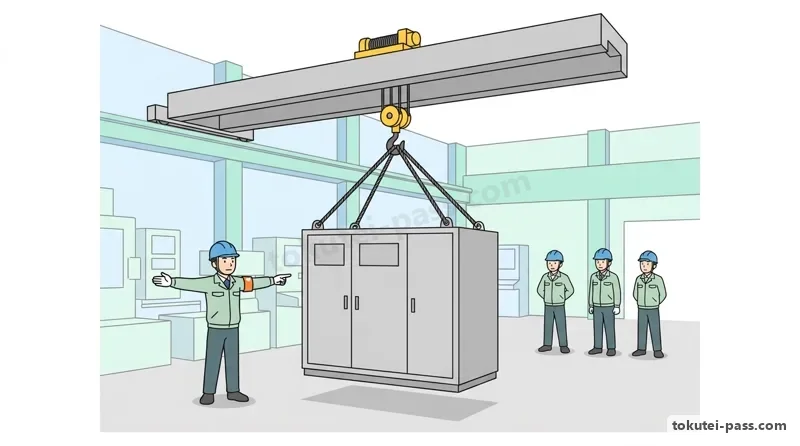
大型の配電盤・変圧器・電動機などをクレーン等で吊り上げる際、ワイヤロープや吊りチェーンを荷に掛け外しする「玉掛け業務」は、吊り上げ荷重「1 トン(t)以上」の場合、「玉掛け技能講習」の修了者等でなければ就かせてはなりません(1t未満は特別教育)。
When lifting large switchboards, transformers, or motors with a crane, "slinging work (Tamagake)" — attaching and detaching wire ropes or lifting chains to/from the load — for a crane with a lifting capacity of "1 ton (t) or more" may only be performed by someone who has completed the "Slinging Skill Training Course (Tamagake Ginou Koushuu)" (under 1t requires special education).
またクレーンの運転について、吊り上げ荷重 5t以上はクレーン・デリック運転士免許、5t未満は特別教育(床で運転し荷と共に移動する方式の 5t以上は床上操作式クレーン運転技能講習)が必要です。
Regarding crane operation, a lifting capacity of 5t or more requires a Crane/Derrick Operator License, and under 5t requires special education (for floor-operated cranes that move with the load and have a capacity of 5t or more, completion of the Floor-Operated Crane Operation Skill Training Course is required).
クレーンと玉掛け作業者が連携して作業するときは、事業者は「作業指揮者(または合図を行う者)を1名指名」し、その指名された者だけが一貫して明確な合図を行わせます(「作業者全員がそれぞれ自由に合図を行う」は重大な誤りです)。
When a crane operator and slinging workers work together, the employer must "designate 1 work leader (or 1 person to give signals)", and only that designated person may give consistent, clear signals (the statement "all workers freely give signals on their own" is a critical error).
玉掛け用ワイヤロープの「安全係数(切断荷重 ÷ かかる最大荷重)」は「6 以上」(吊りチェーンやフックは 5 以上)でなければならず、素線の切断(1よりの間で10%以上)、直径の減少(公称径の7%超)、キンク(ねじれ)、著しい形崩れや腐食があるものは使用禁止です。
The "safety factor (breaking load ÷ maximum applied load)" of wire ropes used for slinging must be "6 or more" (5 or more for lifting chains and hooks); wire ropes with broken elemental wires (10% or more in one lay), diameter reduction (exceeding 7% of nominal diameter), kinks (twisting loops), or severe deformation/corrosion are prohibited from use.
さらに2本以上のワイヤロープで荷を吊る場合、吊り角度が大きくなるほどロープにかかる張力が急増するため、原則として「吊り角度は 60°以内」とし、まず床から数十cmだけ浮かせる「地切り」で荷の重心と玉掛け状態を確認し、吊り荷の下には絶対に立ち入らせません。
Furthermore, when slinging a load with 2 or more wire ropes, because rope tension increases sharply as the sling angle widens, in principle keep the "sling angle within 60°", first lift the load just a few dozen centimeters off the floor ("lift-off check / Chigiri") to verify the center of gravity and slinging condition, and never allow anyone to enter beneath a suspended load.
Key points
- 吊り上げ荷重「1t以上」のクレーン等の玉掛け業務には「玉掛け技能講習」の修了資格が必要である
Slinging (Tamagake) work for cranes with a lifting capacity of "1t or more" requires qualification from completing the "Slinging Skill Training Course" - クレーン運転の合図は、あらかじめ「指名された一定の合図者 1名」のみに行わせる(複数人の勝手な合図は厳禁)
Crane operation signals must be given solely by "1 fixed signaler designated in advance" (arbitrary signaling by multiple people is strictly prohibited) - 玉掛け用ワイヤロープの安全係数は「6以上」、基本の吊り角度は「60°以内」とし、キンクや素線切断があるものは使用しない
Slinging wire ropes must have a safety factor of "6 or more", a basic sling angle "within 60°", and ropes with kinks or broken wires must not be used
| Word | Meaning |
|---|---|
| 玉掛け技能講習(吊り上げ荷重1t以上) | Slinging Skill Training Course / Tamagake (lifting capacity ≥ 1t) |
| 指名された合図者による単一合図 | Unified signaling by a single designated signaler |
| ワイヤロープの安全係数(6以上)とキンク | Wire rope safety factor (≥ 6) and kink defects |
| 吊り角度(60°以内)と地切り確認 | Sling angle (within 60°) and lift-off check (Chigiri) |
感電防止(人の通過電流と危険度)と電気取扱特別教育・停電作業手順
Electric Shock Prevention (Current Through Body & Hazard Levels), Special Education for Electrical Work, and De-energized Work Procedure
人体が感電した際の危険度は、身体を通過する「電流の大きさ」と「通電時間」および経路(心臓を通るか)で決まります。商用周波交流では約1mAでビリッと感じ(感知電流)、約10〜15mAを超えると筋肉がけいれんして自力で電線から離れられなくなります(不随意的把握電流・離脱電流)。
The danger level of an electric shock to the human body is determined by the "magnitude of current" passing through the body, the "duration of current flow", and the path (whether it passes through the heart). At commercial AC frequency, about 1mA causes a tingling sensation (perception current), and exceeding about 10–15mA causes muscle spasms that prevent letting go of the wire voluntarily (let-go current).
さらに「約50mA(50〜100mA)以上」の電流が心臓付近に流れると、「心室細動(心臓のポンプ機能停止)」を起こして短時間で死に至ります。汗や水で皮膚が濡れていると人体の電気抵抗が数千Ωから数百Ωへ激減するため、100Vの低圧でも致命傷になります。
Furthermore, if a current of "approximately 50mA (50–100mA) or more" flows near the heart, it causes "ventricular fibrillation (loss of the heart's pumping function)", leading to death within a short time. When skin is wet with sweat or water, human body resistance drops drastically from several thousand Ω to a few hundred Ω, making even 100V low voltage fatal.
低圧または高圧の充電電路の敷設・点検・修理・操作(制御盤内の開閉器操作や耐電圧試験等を含む)の業務に労働者を就かせるときは、事業者は「電気取扱業務に係る特別教育」を行わなければなりません。
When assigning workers to install, inspect, repair, or operate live low-voltage or high-voltage circuits (including operating switches inside control panels and conducting dielectric withstand voltage tests), the employer must provide "Special Education for Electrical Handling Work".
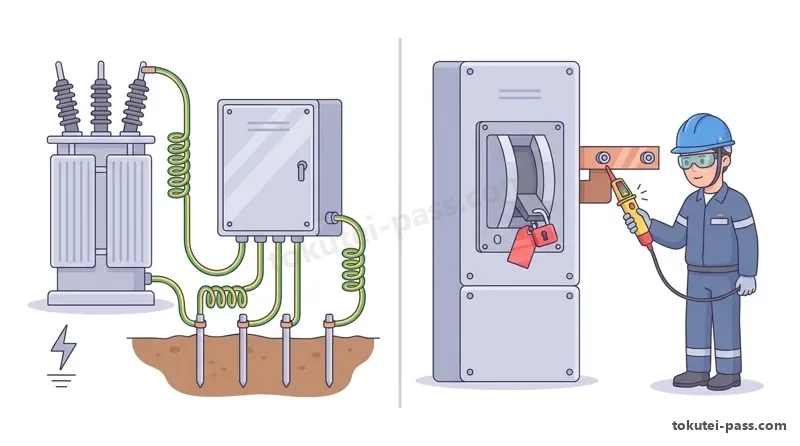
電気機器の点検・修理は「停電作業(非充電状態)」を原則とし、次の厳格な手順で行います。①開閉器(ブレーカ・断路器)を開放して電源を遮断する、②第三者による誤投入を防ぐため開閉器に「施錠(ロックアウト)」し「作業中・投入禁止の表示札(タグアウト)」を掲げる。
Inspection and repair of electrical equipment must in principle be performed as "de-energized work (power-off state)" following this strict sequence: ① Open switches (breakers, disconnectors) to cut off power, ② "Lock (Lockout)" the switches and post "Work in Progress - Do Not Energize warning tags (Tagout)" to prevent accidental re-closing by third parties.
③使用前に機能確認した「検電器」を用いて作業箇所の「無電圧確認」を行い、電力用コンデンサ等の残留電荷を放電させる、④高圧電路等では「短絡接地器具」を取り付ける(取り付けは「接地側が先・線路側が後」、取り外しは逆に「線路側が先・接地側が後」)。
③ Use a "voltage detector (checked for proper function before use)" to "verify zero voltage" at the work point and discharge residual charge in power capacitors, ④ On high-voltage circuits, attach "short-circuit grounding gear" (when attaching, connect the "ground side first, line side second"; when removing, reverse the order: "line side first, ground side second").
Key points
- 人体に約10〜15mA以上流れると自力離脱不能となり、約50mA以上で致死的な「心室細動」を引き起こす
Current of about 10–15mA or more through the body prevents voluntary release, and about 50mA or more causes fatal "ventricular fibrillation" - 充電電路の点検・操作業務には「低圧・高圧の電気取扱業務特別教育」が必要である
Inspecting or operating live electrical circuits requires "Special Education for Low/High-Voltage Electrical Handling Work" - 停電作業では「電源遮断 → 開閉器の施錠と表示札 → 検電器による無電圧確認・残留電荷放電 → 短絡接地」を順守する
For de-energized work, strictly follow: "Cut power → Lock switch & post warning tag → Verify zero voltage with detector & discharge residual charge → Attach short-circuit grounding"
| Word | Meaning |
|---|---|
| 離脱電流と心室細動(約50mA) | Let-go current and ventricular fibrillation (approx. 50mA) |
| 電気取扱業務特別教育 | Special Education for Electrical Handling Work |
| ロックアウト・タグアウト(施錠と表示札) | Lockout / Tagout (locking switches and posting warning tags) |
| 検電と短絡接地器具(接地側から先に接続) | Voltage detection and short-circuit grounding gear (ground side connected first) |
電気設備技術基準の電圧区分(低圧:直流750V・交流600V以下)と絶縁抵抗基準
Voltage Classifications in Technical Standards for Electrical Facilities (Low Voltage: DC ≤ 750V, AC ≤ 600V) and Insulation Resistance Standards
「電気設備に関する技術基準を定める省令」において、電圧は「低圧・高圧・特別高圧」の3種類に区分されています。①「低圧」は「直流にあっては 750 V以下、交流にあっては 600 V以下」のものです。
In the "Ministerial Ordinance Establishing Technical Standards for Electrical Facilities", voltage is classified into 3 categories: "Low Voltage, High Voltage, and Extra-High Voltage (Special High Voltage)". ① "Low Voltage" is "750 V or less for direct current (DC), and 600 V or less for alternating current (AC)".
②「高圧」は低圧を超え(直流 750 V超、交流 600 V超)、「7000 V以下」のもの、③「特別高圧」は「7000 Vを超えるもの」です。直流(750V)と交流(600V)で低圧の上限値が異なる点が重要です。
② "High Voltage" exceeds low voltage (over 750 V DC, over 600 V AC) up to "7000 V or less", and ③ "Extra-High Voltage" is "over 7000 V". It is important to note that the upper limit of low voltage differs between direct current (750V) and alternating current (600V).
また低圧屋内電路の「絶縁抵抗値(電線相互間および電線と大地間)」は、電路の使用電圧区分に応じて次の値以上でなければなりません。
Furthermore, the "insulation resistance value (between conductors and between conductors and ground)" of low-voltage indoor circuits must be at or above the following values according to the operating voltage category of the circuit:
①対地電圧 150 V以下(単相100V回路や接地式単相100/200V回路など)は「0.1 MΩ以上」、②対地電圧 150 V超〜使用電圧 300 V以下(非接地側200V回路など)は「0.2 MΩ以上」、③使用電圧 300 Vを超える低圧(三相400V動力回路など)は「0.4 MΩ以上」です。
① Voltage to ground of 150 V or less (such as single-phase 100V circuits or grounded single-phase 100/200V circuits): "0.1 MΩ or more", ② Voltage to ground over 150 V up to operating voltage of 300 V or less (such as ungrounded 200V circuits): "0.2 MΩ or more", ③ Operating voltage over 300 V low voltage (such as three-phase 400V power circuits): "0.4 MΩ or more".
なお、感電災害防止のため、金属箱や定格電圧対地 150Vを超える移動用・可搬形電気機械器具、または湿気の多い場所の低圧電路には、地絡時に自動的に電路を遮断する「漏電遮断器(ELCB)」の施設が義務付けられています。
Additionally, to prevent electric shock accidents, low-voltage electrical machinery/apparatus with metal enclosures or portable/moveable equipment exceeding 150V to ground, or low-voltage circuits in damp/wet locations, are legally required to be equipped with an "earth leakage circuit breaker (ELCB)" that automatically cuts off the circuit upon a ground fault.
Key points
- 電圧区分は「低圧:直流750V以下・交流600V以下」「高圧:7000V以下」「特別高圧:7000V超」である
Voltage classifications are "Low Voltage: DC ≤ 750V, AC ≤ 600V", "High Voltage: ≤ 7000V", and "Extra-High Voltage: over 7000V" - 低圧電路の絶縁抵抗基準は、対地150V以下で「0.1 MΩ以上」、300V以下で「0.2 MΩ以上」、300V超で「0.4 MΩ以上」である
Low-voltage circuit insulation resistance standards are: "0.1 MΩ or more" for ≤ 150V to ground, "0.2 MΩ or more" for ≤ 300V, and "0.4 MΩ or more" for over 300V - 湿潤場所や対地電圧150V超の金属製外箱を持つ低圧機械器具には「漏電遮断器」の施設が義務付けられている
Installing an "earth leakage circuit breaker (ELCB)" is mandatory for metal-enclosed low-voltage apparatus (over 150V to ground) or circuits in wet locations
| Word | Meaning |
|---|---|
| 電圧の3区分(低圧・高圧・特別高圧) | 3 voltage classifications (Low Voltage, High Voltage, Extra-High Voltage) |
| 低圧電路の絶縁抵抗基準(0.1・0.2・0.4 MΩ) | Low-voltage insulation resistance standards (0.1, 0.2, 0.4 MΩ) |
| 対地電圧(接地式電路) | Voltage to ground (in grounded circuits) |
| 漏電遮断器の施設義務 | Mandatory installation of earth leakage circuit breakers (ELCB) |
接地工事の4種類(A・B・C・D種)と接地線の最小太さ(1.6mm)・計器用変成器2次側接地
4 Types of Grounding Work (Class A, B, C, D), Minimum Ground Wire Diameter (1.6mm), and Instrument Transformer Secondary Grounding
電気設備技術基準の解釈において、感電や火災・高圧混触事故を防ぐ「接地工事」は「A種・B種・C種・D種」の4種類に区分されています。使用電圧「300 V以下」の低圧機械器具の金属製外箱・鉄台には「D種接地工事(接地抵抗 100 Ω以下)」を施します。
In the Interpretation of Technical Standards for Electrical Facilities, "grounding work (earthing)" to prevent electric shock, fire, and high-voltage contact faults is divided into 4 classes: "Class A, Class B, Class C, and Class D". Metal enclosures and iron frames of low-voltage apparatus with an operating voltage of "300 V or less" require "Class D grounding work (ground resistance ≤ 100 Ω)".
使用電圧「300 Vを超える」低圧機械器具(三相400Vモータや制御盤など)の外箱には「C種接地工事(接地抵抗 10 Ω以下)」を施します(ただし 0.5秒以内に動作する漏電遮断器を設けた場合は C種・D種とも 500 Ω以下に緩和されます)。
Enclosures of low-voltage apparatus with an operating voltage "exceeding 300 V" (such as three-phase 400V motors or control panels) require "Class C grounding work (ground resistance ≤ 10 Ω)" (however, if an earth leakage breaker operating within 0.5 seconds is installed, both Class C and Class D are relaxed to ≤ 500 Ω).
また高圧または特別高圧の機械器具の外箱・鉄台には「A種接地工事(接地抵抗 10 Ω以下)」を、高圧・特別高圧と低圧を結合する変圧器の低圧側中性点(または1端子)には混触時の低圧側電位上昇を防ぐ「B種接地工事」を施します。
Furthermore, enclosures and frames of high-voltage or extra-high-voltage apparatus require "Class A grounding work (ground resistance ≤ 10 Ω)", while the low-voltage neutral point (or 1 terminal) of a transformer coupling high/extra-high voltage with low voltage requires "Class B grounding work" to prevent low-voltage potential rise during inter-winding contact.
学科試験で極めて頻出するのが「接地線(単線)の最小太さ(直径)」と「計器用変成器2次側の接地種別」です。①「C種およびD種接地工事」の接地線には、故障時に流れる電流を安全に通すことができ、かつ、「直径 1.6 mm 以上の軟銅線」を使用します(A種は直径 2.6 mm以上、B種は原則 4.0 mm以上)。
Two topics tested extremely often on the written exam are the "minimum diameter of a solid ground wire" and the "grounding class of the secondary side of instrument transformers (VT, CT)". ① Ground wires for "Class C and Class D grounding work" must safely carry fault currents and use an "annealed copper wire with a diameter of 1.6 mm or more" (Class A requires ≥ 2.6 mm diameter, Class B in principle ≥ 4.0 mm).
②さらに、絶縁破壊時に高圧が計器や保護継電器に侵入するのを防ぐため、「高圧の計器用変成器(VT・CT)の2次側電路には『D種接地工事』」を施し、「特別高圧の計器用変成器の2次側電路には『A種接地工事』」を施さなければなりません。
② Moreover, to prevent high voltage from entering meters or protective relays upon insulation breakdown, "the secondary circuit of a High-Voltage instrument transformer (VT, CT) requires 'Class D grounding work'", whereas "the secondary circuit of an Extra-High-Voltage instrument transformer requires 'Class A grounding work'".
Key points
- 低圧300V以下の外箱は「D種接地(100Ω以下)」、300V超は「C種接地(10Ω以下)」、高圧機器外箱は「A種接地(10Ω以下)」である
Enclosures of low-voltage apparatus ≤ 300V use "Class D grounding (≤ 100Ω)", > 300V use "Class C grounding (≤ 10Ω)", and high-voltage enclosures use "Class A grounding (≤ 10Ω)" - C種およびD種接地工事の接地線には「直径 1.6 mm 以上の軟銅線」を使用する(A種は直径 2.6 mm以上)
Ground wires for Class C and Class D grounding work must use "annealed copper wire of 1.6 mm diameter or more" (Class A uses 2.6 mm diameter or more) - 「高圧の計器用変成器の2次側電路にはD種接地工事」を、「特別高圧の計器用変成器の2次側電路にはA種接地工事」を施す
Apply "Class D grounding work to the secondary circuit of High-Voltage instrument transformers (VT/CT)", and "Class A grounding work to the secondary of Extra-High-Voltage instrument transformers"
| Word | Meaning |
|---|---|
| A種・B種・C種・D種接地工事 | Class A, Class B, Class C, and Class D grounding work |
| C種・D種接地線の最小太さ(直径1.6mm軟銅線) | Minimum diameter of Class C & D ground wire (1.6mm annealed copper wire) |
| 高圧計器用変成器2次側の接地(D種) | High-voltage instrument transformer secondary grounding (Class D) |
| 漏電遮断器併用時の緩和(500Ω以下) | Relaxation when combined with an earth leakage breaker (≤ 500Ω) |
電気用品安全法(特定電気用品のひし形PSE・丸形PSE)と消防法・電気火災消火
Electrical Appliance and Material Safety Act (Diamond PSE for Specified Appliances, Round PSE), Fire Service Act, and Electrical Fire Extinguishing
一般用電気工作物などで使用される電気製品・部品の安全性を規制する「電気用品安全法」では、対象品目を「特定電気用品」と「特定電気用品以外の電気用品」の2つに分類し、国が定めた基準に適合した製品に「PSEマーク」の表示を義務付けています。
Under the "Electrical Appliance and Material Safety Act (PSE Law)", which regulates the safety of electrical products and components used in general electrical installations, regulated items are classified into "Specified Electrical Appliances and Materials" and "Electrical Appliances and Materials other than Specified ones", and compliant products must display the "PSE mark".
構造や使用方法からみて特に危険や障害の発生するおそれが多い「特定電気用品(600Vビニル絶縁電線 IV、配線用遮断器、漏電遮断器、温度ヒューズなど)」には、登録検査機関の適合性検査が必要であり、「ひし形(ダイヤモンド形)の枠内に PSE」と書かれた記号を表示します。
"Specified Electrical Appliances and Materials (such as 600V vinyl insulated wire IV, molded case circuit breakers, earth leakage circuit breakers, thermal fuses, etc.)", which pose a particularly high risk of hazard or fault due to their structure or usage, require conformity inspection by a registered inspection body and display "PSE inside a diamond-shaped frame".
一方、「特定電気用品以外の電気用品(換気扇、蛍光ランプ・LEDランプ、小形単相変圧器など)」には、「丸形(円形)の枠内に PSE」と書かれた記号を表示します(ひし形と丸形の区別が学科試験で出題されます)。
Conversely, "Electrical Appliances and Materials other than Specified ones (such as ventilating fans, fluorescent/LED lamps, small single-phase transformers, etc.)" display "PSE inside a round (circular) frame" (distinguishing between the diamond PSE mark and round PSE mark is tested on the written exam).
また工場で洗浄剤・塗装溶剤・絶縁油として使う有機溶剤や鉱油類の多くは、「消防法」上の「危険物 第4類(引火性液体)」に該当し、指定数量以上を貯蔵・取扱うには危険物取扱者の配置と許可施設が必要であり、火気厳禁と静電気対策を徹底します。
Furthermore, most organic solvents and mineral oils used as cleaning agents, paint thinners, or insulating oils in factories fall under "Hazardous Materials Category 4 (Flammable Liquids)" under the "Fire Service Act"; storing or handling the designated quantity or more requires assigning a licensed Hazardous Materials Engineer in an approved facility, strictly prohibiting open flames, and preventing static electricity.
なお、通電中の配電盤や変圧器などによる「電気火災(C火災)」に対しては、水や泡・強化液(棒状放射)をかけると消火薬剤を伝って「感電」するため絶対に使用せず、まず電源を遮断し、「粉末(ABC)消火器」や「二酸化炭素消火器」を使用します。
In addition, for an "electrical fire (Class C fire)" involving energized switchboards or transformers, spraying water, foam, or loaded stream (solid stream) extinguishers will conduct electricity through the extinguishing agent and cause "electric shock", so never use them; first cut off the power supply, then use a "dry chemical powder (ABC) extinguisher" or "carbon dioxide (CO2) extinguisher".
Key points
- 電気用品安全法において、「特定電気用品」には「ひし形のPSEマーク」、それ以外の電気用品には「丸形のPSEマーク」を表示する
Under the Electrical Appliance and Material Safety Act, "Specified Electrical Appliances" display the "diamond-shaped PSE mark", while other regulated appliances display the "round PSE mark" - 洗浄用有機溶剤や絶縁油は消防法の「危険物 第4類(引火性液体)」に該当し、火気厳禁・換気を徹底する
Cleaning organic solvents and insulating oils fall under "Category 4 Hazardous Materials (Flammable Liquids)" of the Fire Service Act, requiring strict fire prohibition and ventilation - 通電中の「電気火災(C火災)」に水や泡消火器を使うと感電するため、電源遮断後に「粉末(ABC)消火器」や「二酸化炭素消火器」を使う
Using water or foam extinguishers on an energized "electrical fire (Class C fire)" causes electric shock; cut power first and use a "dry powder (ABC) extinguisher" or "CO2 extinguisher"
| Word | Meaning |
|---|---|
| 特定電気用品とひし形PSEマーク | Specified Electrical Appliances and the diamond PSE mark |
| 特定電気用品以外と丸形PSEマーク | Non-Specified Electrical Appliances and the round PSE mark |
| 消防法 第4類危険物(引火性液体) | Fire Service Act Category 4 Hazardous Materials (flammable liquids) |
| 電気火災(C火災)の消火方法 | Extinguishing methods for electrical fires (Class C fires: powder, CO2) |
化学物質排出把握管理促進法(PRTR法:対象物質と固形製品の届出対象外)とRoHS・有機溶剤
PRTR Act (Chemical Release Management: Designated Substances and Exemption of Solid Products), RoHS Directive, and Organic Solvents
「特定化学物質の環境への排出量の把握等及び管理の改善の促進に関する法律(化管法・PRTR法)」は、環境や人体に有害なおそれのある「第一種指定化学物質」の環境への排出量・移動量の届出(PRTR制度)と、「SDS(安全データシート)」の提供を義務付けた法律です。
The "Act on Confirmation, etc. of Release Amounts of Specific Chemical Substances in the Environment and Promotion of Improvements to the Management Thereof (PRTR Act)" mandates reporting environmental release and transfer amounts (PRTR system) and providing a "Safety Data Sheet (SDS)" for "Class I Designated Chemical Substances" that may be harmful to the environment or human health.
学科試験で毎年出題される最重要ポイントが2つあります。①対象物質として、はんだ等に含まれる「鉛及びその化合物」や、めっき・防錆処理に関係する「六価クロム化合物」「カドミウム化合物」などは、「特定第一種指定化学物質(第一種指定化学物質)」に指定されています。
There are 2 top-priority points tested almost every year on the written exam: ① Regarding regulated substances, "lead and its compounds" (contained in leaded solder, etc.), "hexavalent chromium compounds" (related to plating and rustproofing), and "cadmium compounds" are designated as "Specific Class I Designated Chemical Substances (Class I Designated Chemical Substances)".
(したがって「鉛化合物は指定化学物質から除外されている」「六価クロムは対象外である」という選択肢はすべて誤りです)。
(Therefore, any exam choice claiming that "lead compounds are excluded from designated chemical substances" or "hexavalent chromium is exempt" is false).
②一方、化学物質の含有率が一定以上であっても、すでに形状が定まった「固形物(製品)」であり、かつ取扱い時に溶融・蒸発・溶解や研磨・切断による粉じん発生を伴わない「電気機器組立て用のクロムめっきねじ・金属板・管・完成部品」などは、PRTRの取扱量把握・届出対象製品の要件から「除外(対象外)」されています。
② Conversely, even if the chemical content ratio exceeds the threshold, "solid articles (products)" whose shape is already fixed and which do not involve melting, evaporation, dissolution, or dust generation from grinding/cutting during handling — such as "chrome-plated screws, metal plates, pipes, or finished parts used for electrical equipment assembly" — are "excluded (exempt)" from PRTR handling volume calculation and reporting requirements.
また国際的な電気・電子機器の有害物質制限である「RoHS指令」でも「鉛・水銀・カドミウム・六価クロム・PBB・PBDE・フタル酸エステル類」の使用が制限されており、工場内で洗浄用「有機溶剤」を使う際は局所排気装置を稼働させ有機ガス用防毒マスクを使用します。
Additionally, the international "RoHS Directive" restricting hazardous substances in electrical and electronic equipment restricts the use of "lead, mercury, cadmium, hexavalent chromium, PBB, PBDE, and phthalates"; and when using cleaning "organic solvents" inside a factory, operate local exhaust ventilation and wear an organic gas respirator.
Key points
- 化管法(PRTR法)において、「鉛化合物」や「六価クロム化合物」は第一種指定化学物質の対象である
Under the PRTR Act, "lead compounds" and "hexavalent chromium compounds" are regulated as Class I Designated Chemical Substances - 電気機器組立てにそのまま使う「クロムめっきねじ」などの固形完成部品(溶融・粉じん発生を伴わない固形物)は、PRTR法の届出対象外である
Solid finished parts used as-is in electrical equipment assembly, such as "chrome-plated screws" (solid articles not involving melting or dust generation), are exempt from PRTR reporting - 化学物質を譲渡・提供する際は危険有害性情報を記した「SDS(安全データシート)」を交付し、RoHS指令の規制物質も管理する
When transferring or supplying regulated chemical substances, provide an "SDS (Safety Data Sheet)" detailing hazard information, and manage substances restricted under the RoHS Directive
| Word | Meaning |
|---|---|
| 化管法(PRTR法)と第一種指定化学物質 | PRTR Act and Class I Designated Chemical Substances |
| 固形製品(クロムめっきねじ等)の対象外規定 | Exemption rule for solid products (such as chrome-plated screws) |
| SDS(安全データシート) | SDS (Safety Data Sheet) |
| RoHS指令と有機溶剤中毒予防規則 | RoHS Directive and Ordinance on Prevention of Organic Solvent Poisoning |
Safety, Regulations & Electrical Standards
Practice this chapter in the appOfficial references
- 中央職業能力開発協会(JAVADA)「技能検定 電気機器組立て 2級 学科試験基準(安全衛生・関係法規)」 — https://www.javada.or.jp/jigyou/gino/giken.html
- 厚生労働省「労働安全衛生規則・クレーン等安全規則」および経済産業省「電気設備に関する技術基準を定める省令・電気用品安全法・化管法(PRTR法)」 — https://www.meti.go.jp/policy/safety_security/industrial_safety/sangyo/electric/index.html