 Tokutei Pass
Basics of Working as a Foreman (Process Manager)
職長として働くための基本
Food Manufacturing (SSW 2) · 飲食料品製造業(2号) · Written by Tokutei Pass based on the official study texts; not copied verbatim.
日本での生活習慣と永住許可の要件
Living Habits in Japan and Requirements for Permanent Residence
特定技能2号は在留期間の更新回数に制限がなく、素行善良・独立生計・国益適合(原則10年以上在留や納税義務履行など)の要件を満たせば永住許可を申請できます。
Specified Skilled Worker (ii) has no limit on the number of period-of-stay renewals, and holders can apply for permanent residence if they meet the requirements of good conduct, independent livelihood, and conformity with national interests (in principle, 10+ years of residence, fulfilling tax and insurance obligations, etc.).
日本で生活し続けるには継続的な日本語学習と生活習慣の習得が不可欠であり、職長は後輩の外国人作業員にも生活マナーを指導します。
Continuous Japanese language learning and acquiring Japanese living habits are essential to continue living in Japan, and foremen also guide junior foreign workers in daily manners.
家庭ごみの分別区分や収集日は住んでいる自治体ごとに異なるため確認が必要です。また、集合住宅では夜間の入浴や洗濯機の騒音で近隣住民に迷惑をかけないよう配慮します。
Household garbage sorting categories and collection days differ by municipality, so you must check local rules. In apartment buildings, be considerate not to disturb neighbors with late-night bathing or washing machine noise.
水洗トイレでは配管の詰まりや故障を防ぐため、備え付けのトイレットペーパー以外の紙類や異物を流してはいけません。外出時は手洗い後にふけるよう自分用の清潔なハンカチを持参します。
In flush toilets, never flush paper other than the provided toilet paper or foreign objects to prevent pipe clogging and breakdowns. When going out, carry your own clean handkerchief to dry your hands after washing.
Key points
- 永住許可申請には、素行善良・独立生計・国益適合(原則10年以上在留や納税など)の3要件を満たす必要がある。
Applying for permanent residence requires meeting three conditions: good conduct, independent livelihood, and conformity with national interests (10+ years of stay, paying taxes, etc.). - ごみの分別区分は自治体のルールに従い、水洗トイレにはトイレットペーパー以外を流さない。
Follow municipal rules for garbage sorting, and never flush anything other than toilet paper down flush toilets. - 夜間の生活音への配慮や清潔なハンカチの持参など、日本の生活習慣を自ら守り後輩にも指導する。
Observe Japanese living habits yourself—such as avoiding nighttime noise and carrying a clean handkerchief—and teach them to junior workers.
| Word | Meaning |
|---|---|
| 永住許可 | permanent residence permission |
| 素行善良・独立生計 | good conduct, independent livelihood |
| 国益適合 | conformity with the national interest |
| 自治体・分別区分 | municipality, garbage sorting category |
| 近隣住民 | neighboring residents |
職長への期待と現場管理の柱
Expectations for Foremen and Pillars of On-Site Management
製造現場を預かる工程管理者(職長)には、「品質管理」「生産管理」「安全衛生管理」「人材育成」という4つの主要な管理業務があります。
A process manager (foreman) entrusted with the manufacturing floor has four major management duties: Quality Management, Production Management, Safety and Health Management, and Human Resource Development.
現場管理では、安全衛生と食品安全を最優先の土台としたうえで、Q(品質)・C(コスト)・D(納期)をバランスよく達成します。
In on-site management, occupational safety and health and food safety are placed as the top-priority foundation, upon which Q (Quality), C (Cost), and D (Delivery) are achieved in good balance.
職長は「職場のモデル」として手洗いや保護具着用・作業手順を率先して守り、作業員には手順だけでなくルールの目的や意味を説明して納得して守らせます。
As a 'workplace role model,' the foreman takes the lead in handwashing, wearing protective gear, and following procedures, while explaining not just the steps but also the purpose and meaning of rules so workers follow them with conviction.
中間のリーダーとして上司へ「報告・連絡・相談(報連相)」を行う際、トラブル時は直ちに第一報を報告し、相談時は「自分はこう判断したいがよいか」と考えを持って相談します。
As a middle leader practicing 'Reporting, Communicating, and Consulting (Hou-Ren-Sou)' with superiors, make an immediate initial report when trouble occurs, and bring your own proposed judgment ('I would like to judge it this way; is that alright?') when consulting.
Key points
- 職長の4大管理業務は「品質管理・生産管理・安全衛生管理・人材育成」であり、安全衛生と食品安全を最優先の土台としてQCDを達成する。
The foreman's four major duties are Quality Management, Production Management, Safety and Health Management, and HR Development, achieving QCD on the top-priority foundation of safety and food hygiene. - 職長自身が率先して手本を示し、ルールの目的や意味を説明して作業員に納得して守らせる。
Lead by example and explain the purpose and meaning of rules so workers understand and comply. - 異常時は隠蔽せず直ちに第一報を報告し、上司への相談は自分なりの判断案を持って行う。
Never cover up abnormalities—report the first update immediately, and consult superiors with your own proposed idea.
| Word | Meaning |
|---|---|
| 工程管理者(職長) | process manager (foreman) |
| 品質管理・生産管理 | quality management, production management |
| 安全衛生管理・人材育成 | safety and health management, human resource development |
| 納期(QCD) | delivery deadline (Quality, Cost, Delivery) |
| 率先・模範的行動 | taking the lead, exemplary behavior |
日常業務の監督・改善と人材育成(OJT)
Daily Supervision, Improvement, and On-the-Job Training (OJT)
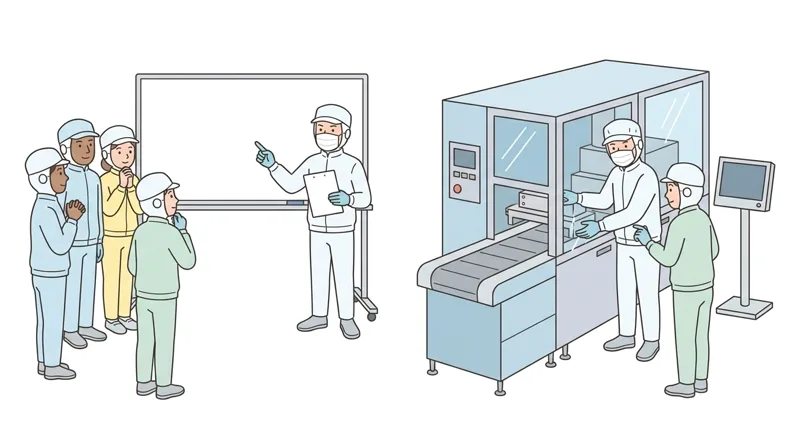
職長には、現場を監督・指示するための「5つの能力」(技能・技術的能力、リーダーシップ能力、コーチング能力、コミュニケーション能力、問題解決能力)が求められます。
Foremen need 'five abilities' to supervise and instruct on-site: technical/skill ability, leadership ability, coaching ability, communication ability, and problem-solving ability.
日常監督では、「作業前」に作業指示書確認・健康点検・KYT、「作業中」に現場パトロール(巡視)と進捗調整、「作業後」に結果確認と整理整頓・対面と書面での引継ぎを行います。
In daily supervision: 'Before work,' check work instructions, health, and conduct KYT; 'During work,' patrol the floor and adjust progress; 'After work,' check results, perform 5S, and conduct shift handovers both in writing and face-to-face.
改善では「三現主義(現場・現物・現実)」で事実を確かめ、「3M(ムリ:過度な負荷、ムダ:付加価値を生まない動作、ムラ:時間帯や人によるばらつき)」をなくしてPDCAサイクルのA(処置・標準化)へつなげます。
For improvement, verify facts through the 'Three Actuals Principle (actual site, actual item, actual situation),' eliminate the '3Ms (Muri: overload, Muda: non-value-adding waste, Mura: unevenness by time or worker),' and connect findings to 'A (Act: corrective action and standardization)' in the PDCA cycle.
OJTでは「指導計画を立てる→やってみせて説明する→やらせてみる→改善点を伝えて習熟度を確認する」手順で進め、新人にはティーチング、慣れてきたら自発的行動を促すコーチングを使い分けます。
Conduct OJT by 'making a plan → demonstrating and explaining → letting them try → giving feedback and checking proficiency,' using teaching for newcomers and coaching to encourage initiative as they gain proficiency.
Key points
- 作業前(指示書確認・KYT)、作業中(現場巡視・進捗管理)、作業後(結果確認・整理整頓・書面と口頭での引継ぎ)を確実に行う。
Reliably execute pre-work checks (instructions, KYT), during-work patrols and progress adjustments, and post-work result checks, 5S, and written/oral handovers. - 三現主義(現場・現物・現実)と3M(ムリ・ムダ・ムラ)の視点でPDCAサイクルを回し、A(Act)で再発防止と標準化を行う。
Run the PDCA cycle using the Three Actuals Principle and the 3Ms (Muri, Muda, Mura), implementing recurrence prevention and standardization in 'Act.' - OJTは「計画→実演説明→実施→評価・フォロー」で進め、習熟度に応じてティーチングとコーチングを使い分ける。
Proceed with OJT through Plan → Demonstrate/Explain → Practice → Evaluate/Follow up, switching between teaching and coaching according to proficiency.
| Word | Meaning |
|---|---|
| コーチング・ティーチング | coaching, teaching |
| 三現主義(現場・現物・現実) | Three Actuals Principle (actual site, actual item, actual situation) |
| ムリ・ムダ・ムラ(3M) | overburden (Muri), waste (Muda), unevenness (Mura) |
| 進捗管理・応援配置 | progress management, assigning extra help |
| 実演・習熟度 | demonstration, skill proficiency |
ていねいな情報伝達とハラスメント防止
Careful Information Communication and Harassment Prevention
外国人を含む多様な作業員には、文化や宗教の違いを尊重しつつ安全衛生ルールを全員公平に守らせます。曖昧な代名詞や略語を避け、「やさしい日本語」や写真・イラストを用いて復唱や質問で理解度を確認します。
With diverse workers including foreign nationals, respect cultural and religious differences while ensuring everyone fairly follows safety and hygiene rules. Avoid vague pronouns or abbreviations; use 'Easy Japanese,' photos, and illustrations, and confirm understanding through repeating back (fukushou) or questions.
作業員が標準作業手順書(SOP)どおりに作業できていないときは、「手順がやりにくいのか・理由を知らないのか」を聴き取り、理由説明と作業環境改善を両面から行います。
When workers are not following Standard Operating Procedures (SOP), ask whether 'the procedure is hard to perform or they do not know the reason,' and address both explaining the reason and improving the work environment.
作業上の指示は普段の雑談と口調を区別して伝え、ルール違反はその場で具体行動を指摘し、良い行動や改善提案は皆の前で正当に評価・承認してほめることで意欲(モチベーション)を高めます。
Distinguish work instructions from casual chat in your tone of voice; point out specific unsafe actions on the spot with reasons, and praise good actions or improvement proposals in front of everyone to boost motivation.
職場のハラスメント(パワハラ・セクハラ・マタハラ・ケアハラ)は、加害者に「指導のため」という意識があって自覚がなかったり、被害者が人間関係を気にして相談しにくかったりするため表面化しにくく、職長の日常的な配慮が重要です。
Workplace harassment (power, sexual, maternity, and care harassment) rarely surfaces because perpetrators often lack awareness thinking it is 'for guidance,' while victims hesitate to consult out of concern for workplace relationships—making daily consideration by the foreman vital.
Key points
- 「やさしい日本語」や視覚資料・実演を使い、復唱や質問によって相手の理解度を確認する。
Use Easy Japanese, visual aids, and demonstrations, and verify understanding by having workers repeat back instructions or ask questions. - 手順不遵守には理由説明と環境改善の両面で対応し、指示は雑談と区別し、良い行動は皆の前でほめて承認する。
Address SOP non-compliance through both explaining reasons and improving the work environment; separate instructions from chat and praise good actions in public. - ハラスメントは加害者の無自覚や被害者の相談しにくさから表面化しにくいため、職長が感情的な叱責を慎み相談しやすい職場をつくる。
Because harassment is hidden by perpetrators' lack of awareness and victims' hesitation to speak up, foremen must avoid emotional scolding and build an open workplace.
| Word | Meaning |
|---|---|
| 情報伝達・復唱 | information communication, repeating back |
| 文化的背景・雇用形態 | cultural background, employment type |
| 不遵守・自己流 | non-compliance, self-styled way |
| 意欲・承認 | motivation, recognition/approval |
| 表面化・加害者・被害者 | surfacing, perpetrator, victim |
Basics of Process Management
Practice this chapter in the appOfficial references
- 厚生労働省・OTAFF 飲食料品製造業特定技能2号技能測定試験 学習用テキスト — https://otaff.or.jp/tokutei/insyoku-2/materials/