 Tokutei Pass
Basic Knowledge of Occupational Safety and Health
労働安全衛生の基礎知識
Food and Beverage Manufacturing · 飲食料品製造業 · Written by Tokutei Pass based on the official study texts; not copied verbatim.
労働災害の防止と安全活動の基本
Preventing Industrial Accidents and Basic Safety Activities
仕事中のケガや病気を「労働災害」といいます。「ハインリッヒの法則」では、1件の重大災害の裏に29件の軽微な災害と300件の「ヒヤリ・ハット」があるとされ、ヒヤリ・ハットを報告・共有して対策することが大切です。
Injuries and illnesses occurring during work are called industrial accidents. According to Heinrich's Law, behind 1 serious accident lie 29 minor accidents and 300 near-misses (Hiyari-Hatto—incidents that nearly caused an injury), making it vital to report and share near-misses to take preventive measures.
作業前に危険と対策を話し合う「KY活動(危険予知活動)」や、対象を指さして声に出す「指差呼称」、そして職場の「4S(整理・整頓・清掃・清潔)」でミスや事故を防ぎます。
Prevent human errors and accidents through pre-work KY (Hazard Prediction) activities, Pointing and Calling (pointing at an object and calling out its status aloud), and workplace 4S (Sort, Set in Order, Shine, Standardize).
仕事は必ず「作業手順書」どおりに行い、使い方がわからない機械は勝手に操作せず責任者に確認します。また、「ホウレンソウ(報告・連絡・相談)」と交代時の確実な「引き継ぎ」を徹底します。
Always follow the Standard Operating Procedure (SOP) manual, and never operate unfamiliar machinery on your own without asking a supervisor. Practice thorough Horenso (Report, Communicate, Consult) and conduct reliable shift handovers.
Key points
- ハインリッヒの法則(1:29:300)に基づき、ヒヤリ・ハットを放置せず報告・共有して重大事故を防ぐ。
Based on Heinrich's Law (1:29:300), report and share near-misses (Hiyari-Hatto) rather than ignoring them to prevent severe accidents. - 作業前のKY活動(危険予知活動)と指差呼称により、うっかりミスによる災害を予防する。
Prevent careless mistakes by conducting pre-work Hazard Prediction (KY) activities and Pointing and Calling. - 作業手順書を厳守し、わからないことは勝手に判断せず「報告・連絡・相談(ホウレンソウ)」を行う。
Strictly follow Standard Operating Procedures (SOPs) and practice Horenso (Report, Communicate, Consult) whenever unsure.
| Word | Meaning |
|---|---|
| 労働災害 | industrial accident (occupational injury) |
| ハインリッヒの法則 | Heinrich's Law (1:29:300 ratio) |
| ヒヤリ・ハット | near-miss incident (Hiyari-Hatto) |
| 危険予知活動 | hazard prediction activity (KY activity) |
| 指差呼称 | pointing and calling (Shisa Kosho) |
| 作業手順書 | standard operating procedure manual (SOP) |
安全な作業服と保護具の着用
Safe Work Attire and Personal Protective Equipment (PPE)
機械に巻き込まれないよう、袖口やズボンのすそが締まった体に合う作業着を着て、髪は帽子の中に入れ、タオルを首や腰にぶら下げません。回転する機械やドリルを扱うときは、繊維が巻き込まれやすいため「軍手」を着けてはいけません。
To avoid getting caught in machinery, wear properly fitting work clothes with snug cuffs and hems, tuck all hair inside your cap, and never hang towels from your neck or waist. Never wear woven cotton work gloves (Gunte) when operating rotating machinery or drills, because the fibers easily get entangled.
スライサーの刃やカッターを洗うときは手を切らないよう「耐切創手袋」を着け、熱い釜やオーブンを扱うときは「耐熱手袋」を使います。また、大きな音がする場所では騒音性難聴を防ぐため耳栓やイヤーマフを着けます。
Wear cut-resistant gloves when washing slicer blades or cutters, and use heat-resistant gloves when handling hot kettles or ovens. In noisy work areas, wear earplugs or earmuffs to prevent noise-induced hearing loss.
薬品を扱うときや、圧縮空気のエアガンで水滴やゴミを吹き飛ばすときは「保護メガネ」を着けます(エアガンを人や体に向けるのは厳禁です)。足元は滑りにくい安全靴・作業靴を履き、靴底が減ったら交換します。
Wear safety glasses when handling chemicals or using a compressed air gun to blow away water droplets or dust (pointing an air gun at anyone is strictly prohibited). Wear slip-resistant safety shoes or work boots and replace them when the soles wear down.
Key points
- 回転する機械を扱うときは、巻き込まれ事故を防ぐため軍手の着用を禁止する。
Never wear cotton work gloves (Gunte) when operating rotating machines to prevent entanglement accidents. - 刃物の洗浄時は耐切創手袋、高温作業時は耐熱手袋、薬品やエアガン使用時は保護メガネを着ける。
Wear cut-resistant gloves when washing blades, heat-resistant gloves for hot work, and safety glasses for chemicals or air guns. - 騒音が大きい職場では耳栓やイヤーマフを着用し、エアガンは絶対に人に向けてはならない。
Wear earplugs or earmuffs in noisy areas, and never point a compressed air gun at a person.
| Word | Meaning |
|---|---|
| 保護具 | personal protective equipment (PPE) |
| 耐切創手袋 | cut-resistant gloves |
| 耐熱手袋 | heat-resistant gloves |
| 保護メガネ | safety glasses (goggles) |
| 騒音性難聴 | noise-induced hearing loss |
機械の安全作業(挟まれ・巻き込まれ・切れ対策)
Machine Safety (Preventing Caught-In, Entanglement, and Cut Hazards)
ミキサーの羽根やローラー、コンベヤに挟まれたり巻き込まれたりする事故を防ぐため、始業点検で安全カバーやインターロック(扉を開けると止まる装置)、両手操作式・光線式安全装置を点検し、絶対に外したり無効化したりしません。
Accidents where workers get caught or entangled in mixer blades, rollers, or conveyors occur frequently in food plants. Perform pre-work inspections on safety guards, interlocks (devices that stop the machine when a cover opens), two-hand controls, and optical safety sensors, and never remove or disable them.
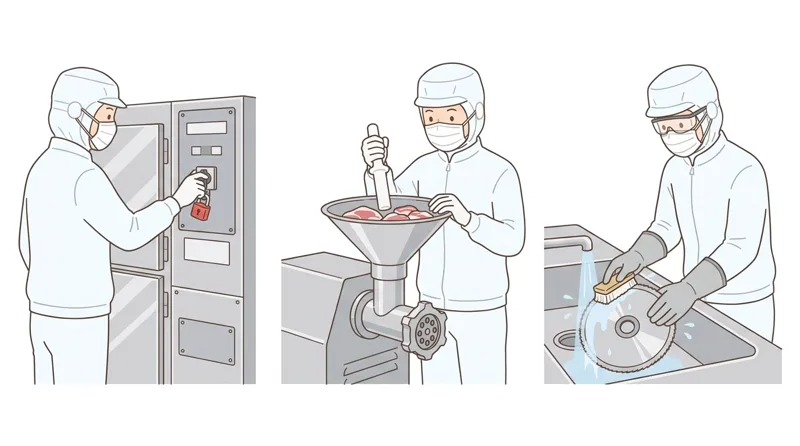
清掃・詰まり除去・点検・修理をするときは、必ず機械を止めて電源を切り、スイッチに鍵と「操作禁止」札をつける「ロックアウト・タグアウト」を行います。回転が完全に止まり、残圧や余熱がないことも確認します。
Before cleaning, clearing jams, inspecting, or repairing a machine, always stop the machine, turn off the power, and perform Lockout/Tagout (locking the switch and attaching a Do Not Operate tag). Also verify there is no residual rotation, pressure, or heat.
機械から異常な音・振動・においがしたときは、すぐに機械を止めて責任者へ報告します。チョッパー(挽肉機)などに原料を入れるときは手で押し込まず、必ず専用の「押し棒」を使います。
If a machine makes an abnormal noise, vibration, or smell, stop it immediately and report to your supervisor. When feeding ingredients into a meat grinder (chopper), never push them in by hand—always use the dedicated pusher stick.
動いているコンベヤの上をまたいだり下をくぐったりせず、横断歩道橋や回り道を通ります。また、包丁やスライサーの刃は作業前後に数と欠けがないかを必ず点検します。
Never step over or crawl under a moving conveyor; use a crossover bridge or walk around. In addition, inspect knives and slicer blades before and after work to confirm their count and check for any chipped edges.
Key points
- 機械の清掃・詰まり除去・点検時は必ず停止・電源遮断し、ロックアウト・タグアウトを行う。
Always stop the machine, cut off power, and perform Lockout/Tagout before cleaning, clearing jams, or inspecting. - 安全カバーやインターロックを外して運転してはならず、異音や異臭がしたら直ちに停止して報告する。
Never remove safety covers or disable interlocks, and stop the machine and report immediately if abnormal noise or odor occurs. - 投入口へは手を入れずに専用の押し棒を使い、コンベヤをまたいだりくぐったりしない。
Use a dedicated pusher stick instead of your hands to feed hoppers, and never step over or crawl under conveyors.
| Word | Meaning |
|---|---|
| 挟まれ・巻き込まれ | caught-in and entanglement hazards |
| インターロック | interlock safety device |
| ロックアウト・タグアウト | Lockout / Tagout (LOTO) |
| 押し棒 | pusher stick |
| 始業点検 | pre-work inspection |
転倒・墜落・腰痛の防止と運搬作業
Preventing Slips, Falls, and Lower Back Pain, and Safe Transport
床が水や油で濡れていると滑って転倒するため、すぐに拭き取るか注意表示を出します。通路や非常口には荷物を置かず、階段では手すりを持ちます。脚立は開き止め金具をロックし、一番上の天板には乗らずに昇降します。
Wet or oily floors cause slip-and-fall accidents, so wipe spills up immediately or put up warning signs. Keep aisles and emergency exits free of obstacles, and hold the handrail on stairs. When using a stepladder, lock the spreader bars and never stand or work on the top plate.
重い荷物を持つときは腰痛を防ぐため、荷物に体を近づけて膝を曲げて腰を下ろし、背筋を伸ばして膝の力で持ち上げます。無理をせず台車を使うか、2人以上で声をかけ合って運びます。
To prevent lower back pain when lifting heavy loads, stand close to the load, bend your knees and lower your hips, keep your back straight, and lift using your leg muscles. Do not overexert yourself—use a hand cart or lift with two or more people using vocal signals.
台車やハンドリフトは、前が見える高さ以下に崩れないよう積み、押してゆっくり歩きます(下り坂で台車の前に立つと下敷きになるため危険です)。フォークリフトが通る場所では歩行者用通路を歩きます。
Load hand carts and hand lifts stably below eye level so your view is clear, and push them slowly (standing in front of a cart on a downhill slope is dangerous). Walk strictly within designated pedestrian lanes in areas where forklifts operate.
Key points
- 床の水や油はすぐに拭き取り、通路や非常口の周りには物を置かない。
Wipe up water or oil on floors immediately, and never place objects in aisles or around emergency exits. - 脚立は開き止めをロックして使い、最上部の天板の上に乗って作業してはならない。
Lock the spreader bar when using a stepladder, and never stand on the top plate to work. - 重量物は膝を曲げて腰を落とし、体に近づけて持ち上げることで腰痛を防ぐ。
Prevent lower back pain by bending your knees, lowering your hips, and keeping heavy loads close to your body when lifting.
| Word | Meaning |
|---|---|
| 転倒 | slip and fall (same-level fall) |
| 脚立 | stepladder |
| 天板 | top plate of a stepladder |
| 腰痛 | lower back pain |
| 台車 | hand cart (dolly) |
火傷・感電・薬品・酸欠と緊急時の対応
Burns, Electric Shock, Chemicals, Oxygen Deficiency, and Emergencies
蒸気釜のふたは蒸気を逃がしながらゆっくり開け、フライヤーの油は冷めてから清掃します。火傷をしたときはすぐに清潔な流水で15〜20分以上冷やします(服の上からなら脱がさず冷やし、水ぶくれは潰しません)。
Open steam kettle lids slowly while releasing steam away from your body, keep water out of hot fryer oil, and clean fryers only after the oil cools. If burned, cool the area immediately under clean running water for at least 15–20 minutes (cool over clothing without removing it first, and do not pop blisters).
感電を防ぐため濡れた手でスイッチに触れず、配電盤に水をかけません。薬品はGHS絵表示とSDSを確認し、飲料ボトルへの移し替えや「塩素系」と「酸性」を混ぜることは厳禁です。目に入ったら15分以上流水で洗って眼科へ行きます。
To prevent electric shock and short circuits, never touch switches or plugs with wet hands or splash water on distribution boards. Check GHS pictograms and Safety Data Sheets (SDS) before handling chemicals, and never transfer chemicals into beverage PET bottles. Never mix chlorine-based and acidic cleaners because toxic chlorine gas is released; if chemicals enter the eye, flush with running water for 15+ minutes and see an eye doctor.
冷凍庫内では防寒着を着て非常開錠装置を確認し、ガス機器は換気して一酸化炭素中毒を防ぎます。ドライアイスや窒素を使う場所は換気して酸素濃度18%以上を確認し、酸素欠乏症を防ぎます(防毒マスクは無効)。
Wear cold-weather gear inside walk-in freezers and check the internal emergency release to prevent entrapment. Ventilate gas equipment to prevent carbon monoxide poisoning; in rooms using dry ice (CO2) or nitrogen, ventilate and verify oxygen concentration is 18% or higher to prevent oxygen deficiency (gas masks cannot prevent oxygen deficiency).
仲間が機械に巻き込まれたときは、二次災害を防ぐためまず機械を止めてから救助します。安全標識の色は「緑=安全・避難(非常口)」「黄=注意」「赤=禁止・停止・消火」「青=指示(保護具着用)」を表します。
If a coworker is caught in a machine, stop the machine first to prevent secondary accidents before rescuing them. JIS safety sign colors mean: Green = Safety/Evacuation (emergency exit), Yellow = Caution/Warning, Red = Prohibition/Stop/Firefighting, and Blue = Mandatory instruction (wear PPE).
Key points
- 火傷は直ちに流水で15〜20分以上冷やし、薬品が目に入ったときも15分以上流水で洗って医師の診察を受ける。
Cool burns immediately with running water for 15–20+ minutes; if chemicals enter the eye, flush with running water for 15+ minutes and seek medical care. - 塩素系と酸性の洗剤・殺菌剤を混ぜると有毒ガスが発生するため、絶対に混ぜてはならない。
Never mix chlorine-based and acidic cleaners/sanitizers because doing so generates poisonous gas. - ドライアイスや窒素を使う庫内は酸素欠乏症の危険があるため、十分に換気し酸素濃度18%以上を確認する。
Storage rooms using dry ice or nitrogen pose an oxygen deficiency hazard; ventilate thoroughly and confirm oxygen is at least 18%. - 労働災害が発生したときは、二次災害を防ぐため最優先で機械を停止させてから救助と報告を行う。
When a machine accident occurs, stop the machine first to prevent secondary accidents before rescuing the victim and reporting.
| Word | Meaning |
|---|---|
| 感電・漏電 | electric shock and current leakage |
| 安全データシート | Safety Data Sheet (SDS) |
| 一酸化炭素中毒 | carbon monoxide poisoning |
| 酸素欠乏症 | oxygen deficiency (below 18% oxygen) |
| 二次災害 | secondary accident (secondary disaster) |
| 安全標識 | safety sign |
Workplace Safety and Health
Practice this chapter in the appOfficial references
- 厚生労働省・OTAFF 飲食料品製造業特定技能1号技能測定試験 学習用テキスト — https://otaff.or.jp/tokutei/insyoku-1/materials/