 Tokutei Pass
Hygiene Management and Process Control with HACCP
HACCPによる衛生管理と工程管理
Food and Beverage Manufacturing · 飲食料品製造業 · Written by Tokutei Pass based on the official study texts; not copied verbatim.
HACCPの基本と3つの危害要因
HACCP Basics and the Three Types of Hazards
HACCP(ハサップ)は「危害要因分析(HA)・重要管理点(CCP)」の頭文字をとった衛生管理のしくみです。原材料の受入れから出荷までの全工程で危害を予測し、重要な工程を連続的に管理して事故を未然に防ぎます。
HACCP stands for Hazard Analysis (HA) and Critical Control Point (CCP). It is a preventive hygiene management system that analyzes hazards across all processes from raw material receiving to shipping and continuously monitors critical steps to prevent accidents before they happen.
HACCPは「一般衛生管理(施設・設備の清掃や手洗いなど)」という土台の上で初めて効果を発揮します。また、小規模な事業者は業界団体の手引書を参考にした「HACCPの考え方を取り入れた衛生管理」を行います。
HACCP is effective only when built on a solid foundation of General Hygiene Management (such as facility cleaning and handwashing). Small-scale businesses implement Hygiene Management Incorporating the HACCP Concept using industry association guidebooks.
管理すべき3つの危害要因(ハザード)は、①生物的危害要因(細菌・ウイルス・寄生虫)、②化学的危害要因(洗剤・殺菌剤・残留農薬・ヒスタミン・アレルゲン)、③物理的危害要因(金属片・ガラス・石・硬い骨など)です。
The three types of hazards to control are: (1) Biological hazards (bacteria, viruses, parasites), (2) Chemical hazards (detergents, sanitizers, pesticide residues, histamine, allergens), and (3) Physical hazards (metal fragments, glass, stones, hard bones, etc.).
Key points
- HACCPは「危害要因分析(HA)」と「重要管理点(CCP)」から成り、一般衛生管理を土台として行う。
HACCP consists of Hazard Analysis (HA) and Critical Control Points (CCP), built upon General Hygiene Management. - 3つの危害要因は「生物的(菌等)・化学的(薬品・アレルゲン等)・物理的(金属・ガラス・石等)」である。
The three hazard categories are Biological (bacteria, etc.), Chemical (chemicals, allergens, etc.), and Physical (metal, glass, stones, etc.). - 最終製品の抜き取り検査だけでなく、製造工程全体で危険を予防することが目的である。
Rather than relying only on final product sampling, HACCP aims to prevent hazards throughout the entire production process.
| Word | Meaning |
|---|---|
| 危害要因分析 | Hazard Analysis (HA) |
| 重要管理点 | Critical Control Point (CCP) |
| 生物的危害要因 | biological hazard |
| 化学的危害要因 | chemical hazard |
| 物理的危害要因 | physical hazard |
HACCPの12手順(準備5手順と原則1・2)
The 12 Steps of HACCP (5 Preliminary Steps and Principles 1 & 2)
HACCPは5つの準備手順と7原則を合わせた「12手順」で進めます。手順1は「HACCPチームの編成」、手順2は原材料や保存方法などをまとめた「製品説明書の作成」です。
HACCP is implemented through 12 steps consisting of 5 preliminary steps and 7 principles. Step 1 is Assemble the HACCP Team, and Step 2 is Describe the Product (summarizing ingredients, storage conditions, etc.).
手順3は加熱の有無や乳幼児・高齢者向けかといった「用途と対象消費者の確認」、手順4は「製造工程一覧図の作成」、手順5は実際の現場と合っているかを確かめる「現場確認」です。
Step 3 is Identify Intended Use and Consumers (such as whether heating is required and whether infants or the elderly are targeted); Step 4 is Construct the Flow Diagram; and Step 5 is On-site Confirmation of the Flow Diagram.
手順6(原則1)は各工程の危険と対策をリストアップする「危害要因分析(HA)」です。続く手順7(原則2)は、決定図(ディシジョンツリー)などを使い、加熱殺菌や金属探知など特に厳重に管理すべき「重要管理点(CCP)の決定」です。
Step 6 (Principle 1) is Conduct a Hazard Analysis (HA) to list hazards and control measures for each process. Step 7 (Principle 2) is Determine Critical Control Points (CCPs) using tools like a Decision Tree for critical steps such as heat sterilization or metal detection.
Key points
- 準備5手順は「①チーム編成→②製品説明書→③用途・対象者確認→④製造工程一覧図→⑤現場確認」の順に行う。
The 5 preliminary steps are: (1) Assemble team -> (2) Product description -> (3) Intended use/consumers -> (4) Flow diagram -> (5) On-site confirmation. - 手順6(原則1)は危害要因分析(HA)、手順7(原則2)は重要管理点(CCP)の決定である。
Step 6 (Principle 1) is Hazard Analysis (HA), and Step 7 (Principle 2) is Determine Critical Control Points (CCPs). - 加熱殺菌工程や金属探知機による検査工程は、代表的な重要管理点(CCP)である。
Heat sterilization processes and metal detector inspection steps are representative Critical Control Points (CCPs).
| Word | Meaning |
|---|---|
| 製品説明書 | product description sheet |
| 製造工程一覧図 | manufacturing process flow diagram |
| 決定図 | decision tree |
| 加熱殺菌 | heat sterilization |
HACCPの原則3〜7と基準逸脱時の対応
HACCP Principles 3 to 7 and Responding to Deviations
手順8(原則3)は「管理基準(CL)の設定」です。「中心温度75℃で1分間以上」や「殺菌液の濃度・時間」のように客観的な数値で決めます。手順9(原則4)はCLを継続監視する「モニタリング方法の設定」です。
Step 8 (Principle 3) is Establish Critical Limits (CL). Critical limits must be set using objective numbers—such as a core temperature of 75°C for at least 1 minute or specific sanitizer concentration and soaking time—rather than vague human senses. Step 9 (Principle 4) is Establish a Monitoring System to track compliance with the CL.
手順10(原則5)はCLから外れたときの「改善措置の設定」です。加熱温度や冷却温度が基準を満たさないときは、ラインを止めて責任者へ報告し、該当ロットの製品を隔離・保留して原因を直します。
Step 10 (Principle 5) is Establish Corrective Actions when a CL deviation occurs. If heating or cooling temperatures fail to meet standards, stop the line, report to the supervisor, isolate and hold the affected product lot, and correct the root cause.
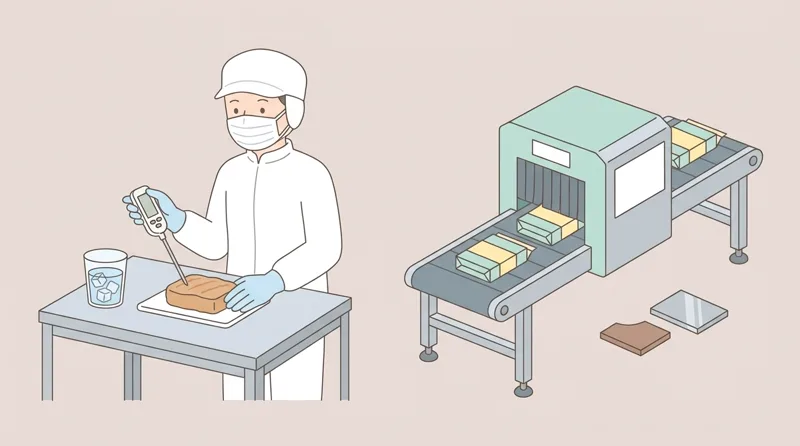
手順11(原則6)は有効性を確認する「検証方法の設定」で、氷水(0℃)や標準分銅による温度計・はかりの校正も含みます。手順12(原則7)は「記録の作成と保管」で、訂正は修正液を使わず二重線と訂正印で行います。
Step 11 (Principle 6) is Establish Verification Procedures to confirm the HACCP plan works effectively, including calibrating thermometers with ice water (0°C) and scales with standard weights. Step 12 (Principle 7) is Establish Record-Keeping; never use correction fluid for mistakes—cross out with a double line and stamp/sign.
Key points
- 管理基準(CL)は感覚的な表現ではなく、温度・時間・濃度などの具体的な数値で設定する。
Set Critical Limits (CL) using specific measurable values (temperature, time, concentration) rather than subjective expressions. - モニタリングで基準逸脱を見つけたときは、製造を止めて報告し、対象ロットを隔離・保留する。
When monitoring detects a deviation from a CL, stop production, report immediately, and isolate/hold the affected lot. - 温度計やはかりは定期的に校正し、記録の訂正は修正液を使わず二重線で行う。
Regularly calibrate thermometers and scales, and correct record errors using a double line rather than correction fluid.
| Word | Meaning |
|---|---|
| 管理基準 | Critical Limit (CL) |
| モニタリング | monitoring |
| 改善措置 | corrective action |
| 検証 | verification |
| 校正 | calibration |
| 二重線 | double-line correction |
検査機器の管理とトレーサビリティ
Inspection Equipment Control and Traceability
金属探知機は、作業開始前・作業中・終了後に鉄(Fe)とステンレス(SUS)のテストピースを製品と一緒にトンネル中央へ通し、検出感度と排除装置の動作を点検します。反応しないときは製造を始めず報告します。
Check metal detectors before, during, and after production by passing iron (Fe) and stainless steel (SUS) test pieces together with a product through the center of the tunnel to verify sensitivity and the rejecter mechanism. If a test piece is not detected, do not start production—report immediately.
X線異物検出機は、石・ガラス・硬い骨・金属などを検出でき、アルミ蒸着袋に入った製品の検査にも有効です。ウェイトチェッカー(重量選別機)は内容量の過不足(例:300g±10gなら290〜310gが合格)を検査します。
X-ray foreign object detectors can detect stones, glass, hard bones, and metal, and are effective even for products in aluminum-laminated packaging. Checkweighers inspect for over- or under-weight packages (for example, 300g ± 10g means 290–310g passes).
加熱殺菌後の冷却水はピンホールからの汚染を防ぐため殺菌された清潔な水を使い、ロットごとに保存検体(サンプル)を保管してコールドチェーン(低温物流)で出荷します。
Use sanitized potable water for cooling after heat sterilization to prevent contamination through microscopic pinholes, keep retention samples for each lot, and ship products under a temperature-controlled Cold Chain.
仕入先・製造ロット・出荷先を追跡できるしくみをトレーサビリティといい、万一問題が起きたときに素早い自主回収(リコール)や原因究明を行うために欠かせません。
Traceability is the system for tracking ingredient suppliers, production lots, and shipping destinations; it is essential for rapid voluntary recalls and root-cause investigation if a safety issue arises.
Key points
- 金属探知機は鉄(Fe)とステンレス(SUS)のテストピースを通し、排除装置まで正常に動くか確認する。
Test metal detectors with iron (Fe) and stainless steel (SUS) test pieces and verify that the rejecter operates properly. - X線異物検出機は金属だけでなく石・ガラス・硬い骨も検出でき、アルミ包装品にも使える。
X-ray detectors can spot stones, glass, hard bones, and metal, and work even on aluminum-packaged products. - トレーサビリティにより、問題発生時に対象ロットの追跡と迅速な自主回収(リコール)ができる。
Traceability enables tracking affected lots and executing swift voluntary recalls when problems occur.
| Word | Meaning |
|---|---|
| 金属探知機 | metal detector |
| テストピース | test piece |
| X線異物検出機 | X-ray foreign object detector |
| ウェイトチェッカー | checkweigher (weight sorter) |
| トレーサビリティ | traceability |
| コールドチェーン | cold chain |
製造現場の計算(希釈・歩留まり・不良率・生産計画)
Workplace Calculations (Dilution, Yield, Defect Rate, Production Planning)
1%は10,000ppmです。濃度5%(50,000ppm)の次亜塩素酸ナトリウム原液から200ppmの消毒液を10L(10,000mL)作る場合は、10,000×200÷50,000=40mLの原液に水を加えて全量10Lにします。
Perform sanitizer and seasoning calculations accurately. Because 1% equals 10,000 ppm, making 10 L (10,000 mL) of 200 ppm sanitizer from 5% (50,000 ppm) sodium hypochlorite requires 10,000 x 200 / 50,000 = 40 mL of stock solution plus water up to a total volume of 10 L.
濃度3%の食塩水を10,000g作るときは、食塩300g(10,000×0.03)と水9,700gを混ぜます。また、歩留まり(可食部の割合)が90%の野菜で90kgの具材を得るには、90÷0.9=100kgの原料が必要です。
To make 10,000 g of 3% salt water, mix 300 g of salt (10,000 x 0.03) with 9,700 g of water. Also, if vegetables have a 90% yield rate (edible portion), obtaining 90 kg of usable ingredient requires 90 / 0.9 = 100 kg of raw vegetables.
500個製造して10個の不良品が出たときの不良率は、10÷500×100=2%です。生産時間では、1分間に40個包装できる機械で2,400個作るなら2,400÷40=60分かかります。
If 10 defective units occur out of 500 units produced, the defect rate is 10 / 500 x 100 = 2%. For production time, packing 2,400 units on a machine that packs 40 units per minute takes 2,400 / 40 = 60 minutes.
1人1分間に10箱詰められる作業者3人(合計30箱/分)で1,200箱作業するなら1,200÷30=40分であり、480個の製品を1箱24個入りで箱詰めするなら480÷24=20箱になります。
If 3 workers who each pack 10 boxes per minute (30 boxes/min total) pack 1,200 boxes, it takes 1,200 / 30 = 40 minutes; packing 480 products into cartons holding 24 units each yields 480 / 24 = 20 cartons.
Key points
- 5%(50,000ppm)原液から200ppmの消毒液を10L作るには、原液40mLに水を加えて10Lにする。
To prepare 10 L of 200 ppm sanitizer from a 5% (50,000 ppm) stock solution, add water to 40 mL of stock solution to make 10 L. - 3%食塩水10,000gには食塩300gと水9,700gが必要であり、歩留まり90%で90kg得るには原料100kgが要る。
Making 10,000 g of 3% brine requires 300 g salt and 9,700 g water; getting 90 kg at a 90% yield requires 100 kg of raw material. - 不良率(%)=不良品数÷総生産数×100で求める(500個中10個なら2%)。
Defect rate (%) = Defective units / Total units produced x 100 (10 defects out of 500 units is 2%).
| Word | Meaning |
|---|---|
| 希釈 | dilution |
| 原液 | undiluted stock solution |
| 歩留まり | yield rate (edible ratio) |
| 不良率 | defect rate |
食品表示・アレルゲン管理・包装の点検
Food Labeling, Allergen Control, and Packaging Inspection
食品表示基準により、原材料名は使用重量の多い順に記載し、食品添加物も基準どおり正確に計量して表示します。栄養成分表示では「熱量・たんぱく質・脂質・炭水化物・食塩相当量」の5項目と製造所の表示が義務です。
Under the Food Labeling Standards, ingredients must be listed in descending order by weight, and food additives must be weighed accurately and labeled. Mandatory nutrition labeling covers five items: Energy (calories), Protein, Fat, Carbohydrates, and Salt Equivalent, along with the manufacturer's name and address.
傷みやすい弁当や惣菜には安全に食べられる「消費期限」、スナック菓子や缶詰にはおいしく食べられる「賞味期限」を表示します。どちらも「未開封で表示された保存方法を守った場合」の期限です。
Perishable foods like bento boxes and delicatessen items display a Use-by Date (Shohikigen), while shelf-stable foods like snacks and canned goods display a Best-before Date (Shomikigen). Both apply only when the package remains unopened and is stored according to labeled instructions.
食物アレルギーで重篤な症状が出やすい「特定原材料8品目(えび・かに・くるみ・小麦・そば・卵・乳・落花生)」は表示が義務づけられています(大豆・ごま・豚肉・さば等は推奨品目)。
Eight specific raw materials (mandatory allergens) that cause severe allergic reactions must be labeled by law: Shrimp, Crab, Walnut, Wheat, Buckwheat (Soba), Egg, Milk, and Peanut (while soybean, sesame, pork, mackerel, etc. are recommended items).
アレルゲンの交差汚染を防ぐため、アレルゲンを含まない製品を先に製造し、使用後の器具は徹底的に洗浄します。包装工程では製品規格書と表示を照合し、シール部への具材の噛み込み(密封不良)を厳重に点検します。
To prevent allergen cross-contamination, schedule non-allergen products before allergen-containing products and thoroughly wash equipment afterward. In packaging, verify labels against the product specification sheet and inspect seals carefully for trapped food (seal defects).
Key points
- 原材料は重量の多い順に記載し、傷みやすい食品には消費期限、日持ちする食品には賞味期限を表示する。
List ingredients in descending order by weight; use Use-by Dates (Shohikigen) for perishable foods and Best-before Dates (Shomikigen) for shelf-stable foods. - 義務表示の特定原材料8品目は「えび・かに・くるみ・小麦・そば・卵・乳・落花生」である。
The 8 mandatory allergens are Shrimp, Crab, Walnut, Wheat, Buckwheat, Egg, Milk, and Peanut. - アレルゲンを含まない製品を先に生産し、包装時は表示の誤りやシール部の噛み込みを点検する。
Produce non-allergen items first, and inspect packages for labeling errors and food caught in heat seals.
| Word | Meaning |
|---|---|
| 消費期限 | use-by date (Shohikigen, for perishable foods) |
| 賞味期限 | best-before date (Shomikigen, for shelf-stable foods) |
| 特定原材料 | specific raw materials (8 mandatory allergens) |
| 栄養成分表示 | nutrition facts labeling |
| 噛み込み | product caught in package seal (seal defect) |
HACCP and Production Process
Practice this chapter in the appOfficial references
- 厚生労働省・OTAFF 飲食料品製造業特定技能1号技能測定試験 学習用テキスト — https://otaff.or.jp/tokutei/insyoku-1/materials/