
Machining and Metalworking (Practical Level 2)
機械加工・金属加工(実務)
Industrial Manufacturing (SSW 2) · 製造分野(2号) · Written by Tokutei Pass based on the official study texts; not copied verbatim.
切削速度・回転速度の計算と旋盤・フライス盤加工
Cutting Speed and Spindle Speed Calculations, Lathe and Milling Operations
切削速度 $V$(m/min)、直径 $D$(mm)、主軸回転速度 $N$(min$^{-1}$)の関係は $V = \frac{\pi D N}{1000}$ であり、$N = \frac{1000 V}{\pi D}$ で求めます。
Cutting speed $V\text{ (m/min)}$, diameter $D\text{ (mm)}$, and spindle speed $N\text{ (min}^{-1}\text{)}$ are related by $V = \frac{\pi D N}{1000}$, or $N = \frac{1000 V}{\pi D}$.
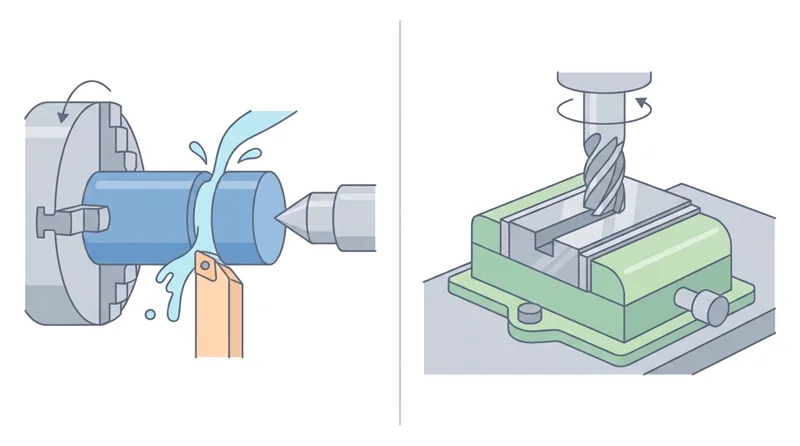
旋盤では、円筒工作物に3つ爪スクロールチャック、偏心や角材に4つ爪単動チャック、細長い軸のたわみ防止に心押台のセンタを使い、チャックハンドルは手を離す前に必ず抜きます。
On a lathe, use a 3-jaw scroll chuck for round stock, a 4-jaw independent chuck for square/eccentric work, and a tailstock center for long slender shafts; always remove the chuck wrench immediately.
バイトの刃先高さは工作物の回転中心(心高さ)に一致させ、びびり振動を防ぐためバイトの突き出し長さはできるだけ短くします。
Set the cutting tool tip exactly at the workpiece centerline height, and keep tool overhang as short as possible to prevent chatter vibration.
フライス盤の「上向き削り(アップカット)」は刃の回転とテーブル送りが逆向きでバックラッシュの影響を受けにくく、NC機械の優位な「下向き削り(ダウンカット)」は工具寿命と仕上げ面に優れます。
In milling, 'up-milling' (conventional milling) feeds against cutter rotation to avoid backlash, whereas 'down-milling' (climb milling) on CNC machines improves tool life and surface finish.
Key points
- 【○正しい】直径50mmの丸棒を毎分1000回転で旋削するとき($\pi = 3.14$)、切削速度は $V = 3.14 \times 50 \times 1000 \div 1000 = 157\text{ m/min}$ である。
(○ True) Turning a 50 mm diameter bar at 1000 rpm ($\pi = 3.14$) gives a cutting speed of $V = 3.14 \times 50 \times 1000 \div 1000 = 157\text{ m/min}$. - 【○正しい】バイトの刃先は中心高さに合わせて突き出しを短くし、チャックハンドルは挿したまま手を離さない。
(○ True) Align the lathe tool tip with the centerline, minimize tool overhang, and never leave the chuck key in the chuck. - 【×誤り】びびり振動を抑えるためにバイトの突き出しをできるだけ長くするというのは誤り(剛性が下がり激しく振動する)。
(× False) Saying you should extend tool overhang as long as possible to suppress chatter vibration is FALSE (long overhang reduces rigidity and worsens chatter).
| Word | Meaning |
|---|---|
| 切削速度 | cutting speed |
| 心押台 | tailstock |
| 構成刃先 | built-up edge |
| 上向き削り | up-milling (conventional milling) |
| 下向き削り | down-milling (climb milling) |
NCプログラム(Gコード・Mコード・座標系)・穴加工と研削盤作業
NC Programming (G-Codes, M-Codes, Coordinates), Hole Machining, and Grinding
NCプログラムのGコードでは、G00が位置決め(早送り)、G01が直線補間(切削送り)、G02が時計回り円の補間、G03が反時計回り円の補間です。
In NC G-codes: G00 is rapid positioning, G01 is linear interpolation (cutting feed), G02 is clockwise circular interpolation, and G03 is counterclockwise circular interpolation.
MコードではM03が主軸正転、M05が主軸停止、M06が工具交換、M08が切削油吐出であり、絶対座標指令(G90)と増分指令(G91)や工具補正を管理します。
In M-codes: M03 starts spindle forward, M05 stops the spindle, M06 changes tools, and M08 turns coolant on; programs also manage absolute (G90) vs. incremental (G91) coordinates and tool offsets.
高精度な穴は「センタ穴→ドリル下穴→リーマ仕上げ」の順で加工し、M10×1.5のタップ下穴径は「呼び径-ピッチ=10-1.5=8.5mm」とします(深い穴はステップフィードで切りくずを出す)。
High-precision holes are machined in the order 'center drill -> twist drill -> reamer'; the tap drill diameter for M10×1.5 is '10 - 1.5 = 8.5 mm' (deep holes use peck drilling to clear chips).
研削砥石は取付前に木づち等で打音検査を行い、交換後は「3分間以上」、毎日の作業開始前は「1分間以上」試運転し、目詰まりにはドレッシング(目立て)を行います。
Perform a sound (ring) test before mounting a grinding wheel, run a trial operation for '3 minutes or more' after wheel replacement and '1 minute or more' before daily work, and dress glazed/loaded wheels.
Key points
- 【○正しい】NCコードでG00は早送り位置決め、G01は直線補間(切削送り)であり、M10×1.5のタップ下穴径は約8.5mmである。
(○ True) In NC codes, G00 is rapid positioning, G01 is linear cutting feed, and the tap drill diameter for M10×1.5 is about 8.5 mm. - 【○正しい】研削砥石交換後は「3分間以上」、毎日の作業開始前は「1分間以上」の試運転を行い、砥石の目立て・形直しにはドレッシング(ツルーイング)を行う。
(○ True) Run a grinding wheel trial for '3 minutes or more' after replacement and '1 minute or more' before daily work, and restore wheel sharpness/form by dressing and truing. - 【×誤り】G00(早送り)で工作物をそのまま切削加工したり、リーマを通した後にドリルで穴を仕上げるのは誤り。
(× False) Cutting into the workpiece using rapid traverse G00, or reaming a hole before drilling it, is FALSE.
| Word | Meaning |
|---|---|
| 直線補間(G01) | linear interpolation (G01) |
| リーマ加工 | reaming |
| タップ下穴径 | tap drill diameter |
| 打音検査 | ring (sound) test |
| ドレッシング | wheel dressing |
プレス加工・板金成形(クリアランス・スプリングバック・深絞り)と溶接・鋳造
Press Working and Sheet Metal Forming (Clearance, Springback, Deep Drawing), Welding, and Casting
プレスせん断加工(打抜き)では、パンチとダイの隙間(クリアランス)が狭すぎると二次せん断や工具摩耗が増え、広すぎるとだれや大きなバリが出ます(順送型は複数工程を順次加工します)。
In press blanking/piercing, excessive die clearance causes large rollover and burrs, while insufficient clearance causes secondary shear and rapid tool wear (progressive dies perform multiple stations sequentially).
曲げ加工後に除荷すると弾性回復で角度が戻る「スプリングバック」が起き、深絞り加工ではしわ押さえ力が不足するとフランジしわ、強すぎると底抜け(破断)が起きます。
After sheet metal bending, elastic recovery causes angle return called 'springback'; in deep drawing, insufficient blank-holder force causes flange wrinkling, while excessive force tears the cup wall.
ガスシールドアーク溶接では、風でシールドガスが飛ぶとブローホール(気孔)が出やすく、電流過大ではアンダーカット、電流不足ではオーバーラップや融合不良が生じます。
In gas-shielded arc welding, wind blowing away shielding gas causes blowholes (porosity), excessive current causes undercut, and insufficient current causes overlap or lack of fusion.
鋳造では凝固収縮による「引け巣」を防ぐため押湯を設け(模型には収縮分を見込んだ「伸び尺」と「抜き勾配」を付ける)、ダイカストは溶湯を金型へ高速・高圧射出して量産します。
In casting, risers feed molten metal to prevent shrinkage cavities (patterns include shrinkage allowance and draft angle), while die casting injects molten metal into steel dies at high speed and pressure.
Key points
- 【○正しい】曲げ加工後の角度戻りを「スプリングバック」といい、深絞りでしわ押さえ力が弱すぎるとフランジしわ、強すぎると破断が起きる。
(○ True) Elastic angle recovery after bending is called 'springback', and improper blank-holder force in deep drawing causes wrinkling (too low) or tearing (too high). - 【○正しい】溶接部のシールドガス不足は「ブローホール」、鋳造の凝固収縮による空洞は「引け巣」(押湯で防止)の原因になる。
(○ True) Loss of shielding gas in welding causes 'blowholes', and solidification shrinkage in casting causes 'shrinkage cavities' (prevented by risers). - 【×誤り】ガスシールドアーク溶接でブローホールを防ぐために大型扇風機でアーク部に強風を当てるというのは誤り(シールドガスが飛んで欠陥が増える)。
(× False) Blowing strong fan wind directly at the weld arc during gas-shielded welding to prevent blowholes is FALSE (wind disperses shielding gas and causes porosity).
| Word | Meaning |
|---|---|
| クリアランス | die clearance |
| スプリングバック | springback |
| ブローホール | blowhole (porosity) |
| アンダーカット | undercut |
| 引け巣 | shrinkage cavity |
熱処理(焼入れ・焼戻し・焼きなまし・浸炭)・材料記号と材料試験
Heat Treatment (Quenching, Tempering, Annealing, Carburizing), JIS Materials, and Mechanical Testing
鋼を高温加熱して急冷する「焼入れ」で硬くした後は、もろさを減らして粘り強さ(じん性)を与えるため必ず「焼戻し」をセットで行います。
After hardening steel by 'quenching' (heating and rapid cooling), always perform 'tempering' (reheating to a moderate temperature) to reduce brittleness and impart toughness.
内部応力を除いて軟らかく削りやすくする「焼きなまし」、結晶組織を均一化する「焼きならし」、表面だけ炭素をしみ込ませて硬くする「浸炭焼入れ」や「高周波焼入れ」を使い分けます。
'Annealing' furnace-cools steel to soften it for machining, 'normalizing' refines grain structure, and 'carburizing' or 'induction hardening' hardens only the outer surface while keeping a tough core.
JIS材料記号では、S45Cが炭素量約0.45%の機械構造用炭素鋼、SUS304がオーステナイト系ステンレス鋼(非磁性)、FC200がねずみ鋳鉄、FCDが球状黒鉛鋳鉄です。
In JIS material codes: S45C is machine structural carbon steel with ~0.45% C, SUS304 is austenitic stainless steel (non-magnetic), FC200 is gray cast iron, and FCD is ductile cast iron.
機械的性質の検査では、引張強さや伸びを測る「引張試験」、圧子を押し込む「硬さ試験(ビッカースHV・ロックウェルHRC・ブリネルHBW)」、粘り強さを測る「シャルピー衝撃試験」、繰返し応力による「疲労破壊」を把握します。
Mechanical testing includes 'tensile testing' (strength and elongation), 'hardness testing' (Vickers HV, Rockwell HRC, Brinell HBW), 'Charpy impact testing' (toughness), and evaluating 'fatigue fracture' under cyclic stress.
Key points
- 【○正しい】焼入れで硬くした鋼はもろいため、粘り強さを与える「焼戻し」と組み合わせて行う。
(○ True) Quenched steel is hard but brittle, so it is always paired with 'tempering' to restore toughness. - 【○正しい】S45Cは炭素量約0.45%の機械構造用炭素鋼であり、ビッカース(HV)・ロックウェル(HRC)は「硬さ試験」、シャルピーは「衝撃試験」である。
(○ True) S45C is machine structural carbon steel (~0.45% C); Vickers (HV) and Rockwell (HRC) are hardness tests, and the Charpy test is an impact test. - 【×誤り】「焼きなまし」を鋼を水中急冷して最も硬くする処理というのは誤り(炉冷で軟らかくする処理)。
(× False) Defining 'annealing' as rapid water quenching to achieve maximum hardness is FALSE (annealing cools slowly in a furnace to soften steel).
| Word | Meaning |
|---|---|
| 焼入れ・焼戻し | quenching and tempering |
| 焼きなまし | annealing |
| 浸炭焼入れ | carburizing and quenching |
| 機械構造用炭素鋼(S45C) | machine structural carbon steel (S45C) |
| シャルピー衝撃試験 | Charpy impact test |
Machining and Machine Maintenance (Advanced)
Practice this chapter in the appOfficial references
- 製造分野特定技能2号評価試験(経済産業省・JAIM) — https://www.jaim-skill.or.jp/exam/about-ssw2/
- 製造分野特定技能評価試験 試験基準(別紙) — https://www.jaim-skill.or.jp/assets/files/exam/top/exam_criteria.pdf