
Plastic Molding (Injection Molding, Compression Molding, Blow Molding, Molds, and Defect Countermeasures)
プラスチック成形(射出成形・圧縮成形・ブロー成形・金型・成形不良対策)
Industrial Manufacturing - Machinery and Electronics · 製造分野 · Written by Tokutei Pass based on the official study texts; not copied verbatim.
1. プラスチック材料の分類(熱可塑性・熱硬化性・結晶性・非結晶性)と予備乾燥
1. Classification of Plastic Materials (Thermoplastic, Thermosetting, Crystalline, Amorphous) and Pre-drying
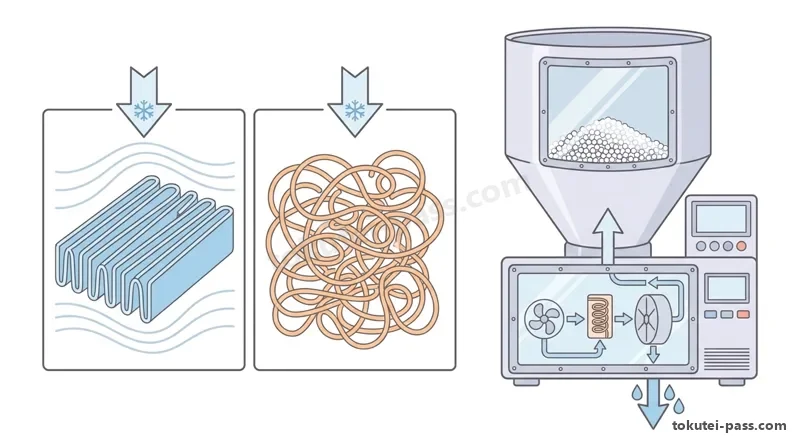
プラスチックは熱に対する性質によって、加熱すると軟らかくなって溶け、冷やすと固まる変化を繰り返せる「熱可塑性樹脂」と、一度加熱して硬化反応(架橋反応)が進むと再加熱しても溶けない「熱硬化性樹脂」に大別されます。
Based on their thermal behavior, plastics are classified into 'Thermoplastic resins', which can be repeatedly softened/melted by heating and solidified by cooling, and 'Thermosetting resins', which undergo an irreversible chemical curing (cross-linking) reaction upon heating and cannot be remelted.
熱可塑性樹脂はさらに、冷えて固まるときに分子鎖が規則正しく並ぶ「結晶性樹脂」と、分子鎖が不規則に絡み合ったまま固まる「非結晶性樹脂(非晶性樹脂)」に分かれます。
Thermoplastic resins are further divided into 'Crystalline resins', whose molecular chains align regularly upon cooling, and 'Amorphous (non-crystalline) resins', whose molecular chains solidify in a randomly entangled state.
結晶性樹脂の代表例はポリエチレン(PE)・ポリプロピレン(PP)・ポリアセタール(POM)・ポリアミド(PA:ナイロン)・PBTであり、耐薬品性や耐摩耗性に優れる一方、成形収縮率が大きく(約1.0〜2.5%)、ヒケやソリが出やすい特徴があります。
Typical crystalline resins include Polyethylene (PE), Polypropylene (PP), Polyacetal (POM), Polyamide (PA: Nylon), and PBT; they offer excellent chemical and wear resistance but have high molding shrinkage (approx. 1.0–2.5%), making them prone to sink marks and warpage.
非結晶性樹脂の代表例はポリスチレン(PS)・ABS樹脂・ポリカーボネート(PC)・アクリル樹脂(PMMA)・硬質ポリ塩化ビニル(PVC)であり、透明性に優れるものが多く、成形収縮率が小さいため(約0.4〜0.7%)寸法精度が出しやすい特徴があります。
Typical amorphous resins include Polystyrene (PS), ABS resin, Polycarbonate (PC), Acrylic (PMMA), and rigid Polyvinyl Chloride (PVC); many offer high transparency and low molding shrinkage (approx. 0.4–0.7%), making it easy to achieve tight dimensional accuracy.
また、PA・PC・PET・PBT・ABS・PMMAなどの「吸水性樹脂」は、水分を含んだまま成形すると加水分解による強度低下やシルバーストリーク(銀条)が生じるため、成形前にホッパドライヤや除湿乾燥機で所定温度・時間の「予備乾燥」を行います。
Furthermore, 'hygroscopic (water-absorbing) resins' such as PA, PC, PET, PBT, ABS, and PMMA suffer from strength reduction due to hydrolysis or silver streaks if molded while containing moisture; therefore, they must undergo 'pre-drying' in a hopper dryer or dehumidifying dryer at a specified temperature and time before molding.
Key points
- 加熱で溶けて冷却で固まる樹脂を「熱可塑性樹脂」、加熱で化学反応により硬化し再溶融しない樹脂を「熱硬化性樹脂(PF・EP・UP・MF)」という
Resins that melt on heating and solidify on cooling are 'Thermoplastics'; resins that cure chemically on heating and do not remelt are 'Thermosets (PF, EP, UP, MF)' - 「結晶性樹脂(PE・PP・POM・PA)」は耐薬品性が高いが成形収縮率が大きく、「非結晶性樹脂(PS・ABS・PC・PMMA)」は成形収縮率が小さい
'Crystalline resins (PE, PP, POM, PA)' have high chemical resistance but large molding shrinkage; 'Amorphous resins (PS, ABS, PC, PMMA)' have small molding shrinkage - PC・PA・PET・ABSなどの吸水性樹脂は、加水分解やシルバーストリークを防ぐため成形前に必ず「予備乾燥」を行う
Hygroscopic resins such as PC, PA, PET, and ABS must always undergo 'pre-drying' before molding to prevent hydrolysis and silver streaks
| Word | Meaning |
|---|---|
| 熱可塑性樹脂・熱硬化性樹脂 | Thermoplastic resin and Thermosetting resin |
| 結晶性樹脂・非結晶性樹脂 | Crystalline resin and Amorphous resin |
| 成形収縮率 | Molding shrinkage rate |
| 予備乾燥・加水分解 | Pre-drying and Hydrolysis |
2. 射出成形機(インラインスクリュ式)の構造と可塑化・計量機構
2. Structure of Injection Molding Machines (In-line Screw Type) and Plasticizing/Metering Mechanism
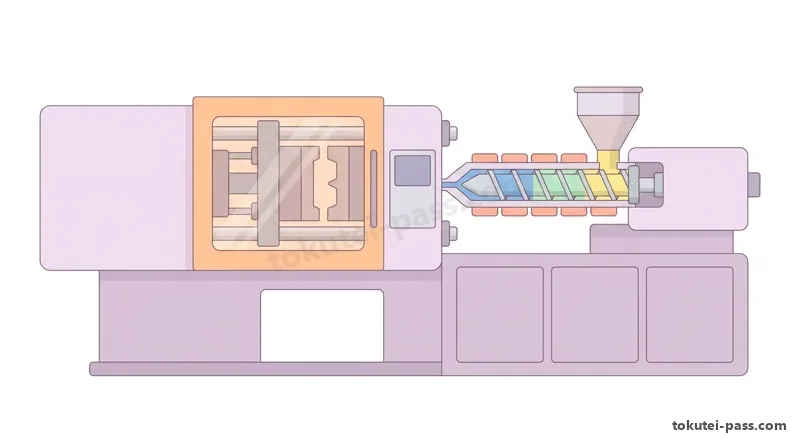
射出成形機は、樹脂ペレットを溶かして金型内へ送り込む「射出装置」と、金型を開閉して高圧に耐える力で締め付ける「型締装置(直圧式またはトグル式)」の2つの主装置で構成されています。
An injection molding machine consists of two main units: the 'Injection unit', which melts resin pellets and injects them into the mold, and the 'Clamping unit (direct hydraulic or toggle type)', which opens/closes the mold and clamps it tightly against high injection pressure.
現在主流の「インラインスクリュ式射出装置」では、加熱シリンダ(バレル)の中で1本のスクリュが「回転」して樹脂を溶かしながら先端へ送る「可塑化・計量」と、スクリュが「前進」して溶融樹脂を金型へ押し出す「射出」の両方を行います。
In the mainstream 'In-line screw injection unit', a single screw inside the heating cylinder (barrel) both 'rotates' to melt and convey resin toward the tip ('plasticizing and metering') and 'moves forward' to push the molten resin into the mold ('injection').
スクリュの溝の深さは、ホッパ下からペレットを受け取る「供給部(フィードゾーン)」が最も深く、圧縮しながら溶かす「圧縮部」でしだいに浅くなり、先端側の「計量部(メータリングゾーン)」で最も浅くなります。
The screw groove depth is deepest in the 'Feed zone' beneath the hopper where solid pellets enter, gradually becomes shallower in the 'Compression zone' where pellets are compressed and melted, and is shallowest in the front 'Metering zone'.
計量中にスクリュが樹脂圧力で後退するとき、油圧やサーボモータで後方から適度な抵抗圧力「背圧(バックプレッシャ)」をかけることで、混練効果が高まり、空気や揮発ガスが後方へ抜けて計量密度が安定します。
During metering, as the screw retreats under the pressure of molten resin accumulating at the tip, applying a controlled hydraulic or servo resistance pressure from behind called 'Back pressure' enhances mixing, expels entrapped air and volatile gases rearward, and stabilizes metering density.
計量完了後には、ノズル先端からの樹脂垂れ(ドルーリング・鼻垂れ)を防ぐためスクリュをわずかに後退させる「サックバック」を行い、射出前進時にはスクリュ先端の「逆流防止リング(チェックリング)」が閉じて後方への逆流を防ぎます。
After metering finishes, the screw is slightly retracted without rotation in an action called 'Suck-back (decompression)' to prevent molten resin from drooling out of the nozzle tip; during forward injection, the 'Check ring (non-return valve)' at the screw tip closes to prevent backward resin leakage.
Key points
- インラインスクリュ式は、スクリュの「回転」で可塑化・計量を行い、スクリュの「前進」で射出・保圧を行う
An in-line screw machine uses screw 'rotation' for plasticizing/metering and screw 'forward movement' for injection and holding pressure - 計量時にスクリュ後退へ与える抵抗圧力を「背圧」といい、ガス巻き込み防止と計量安定化の役割がある
The resistance pressure applied against screw retreat during metering is called 'Back pressure', preventing gas entrapment and stabilizing shot weight - ノズル先端の樹脂垂れを防ぐ微小後退動作を「サックバック」、射出時の逆流を防ぐ部品を「逆流防止リング」という
Slight screw retraction to prevent nozzle drooling is called 'Suck-back', and the part preventing backflow during injection is the 'Check ring'
| Word | Meaning |
|---|---|
| インラインスクリュ式 | In-line screw system |
| 可塑化・計量 | Plasticizing and Metering |
| 背圧(バックプレッシャ) | Back pressure |
| サックバック・逆流防止リング | Suck-back and Check ring (Non-return valve) |
3. 射出成形サイクルの工程と保圧・V-P切替・クッション量
3. Injection Molding Cycle Stages, Holding Pressure, V-P Switchover, and Cushion
射出成形の1サイクルは、「①型閉じ・型締め → ②射出(充填) → ③保圧 → ④冷却(および次サイクルの可塑化・計量) → ⑤型開き → ⑥成形品の突出し(エジェクト)」の順に進みます。
One injection molding cycle proceeds in the order: '1. Mold closing & clamping → 2. Injection (filling) → 3. Holding pressure (packing) → 4. Cooling (concurrent with plasticizing/metering for the next shot) → 5. Mold opening → 6. Part ejection'.
1サイクルの時間のうち最も大きな割合(約50〜70%)を占めるのは、金型内の溶融樹脂を取出し可能な温度まで冷やし固める「冷却工程」であり、この冷却中に並行して次のショットの計量を行います。
Accounting for the largest portion of the total cycle time (approx. 50–70%) is the 'Cooling stage', which solidifies the molten resin inside the mold down to an ejectable temperature; metering for the next cycle takes place in parallel during this cooling period.
射出工程でキャビティの約95〜98%まで樹脂を高速充填した位置で、速度制御(V)から圧力制御(P)の「保圧工程」へ切り替えます。この切替位置を「V-P切替位置(保圧切替位置)」と呼びます。
Near the end of the injection stage, when the cavity is approx. 95–98% filled at high speed, the machine switches from velocity control (V) to pressure control (P) for the 'Holding pressure stage'. This transition point is called the 'V-P switchover position'.
「保圧」とは、ゲート部の樹脂が冷えて固まる(ゲートシールする)までの間、スクリュ前進方向に圧力をかけ続け、冷却に伴う体積収縮分の樹脂をキャビティへ補給してヒケや寸法不足を防ぐ工程です。
'Holding pressure' is the stage where forward pressure is continuously applied to the screw until the resin at the gate solidifies ('gate seal'), supplying additional resin into the cavity to compensate for volumetric shrinkage during cooling and preventing sink marks and undersized dimensions.
保圧完了時には、スクリュが最前進端に底付きしないよう、先端に数mm(約3〜7mm)の溶融樹脂「クッション量(最小残量)」を残す必要があります。クッション量が0mmになると保圧がキャビティに伝わりません。
At the end of holding pressure, a few millimeters (approx. 3–7 mm) of molten resin called the 'Cushion (minimum residual resin)' must remain ahead of the screw tip so the screw does not bottom out; if the cushion reaches 0 mm, holding pressure cannot be transmitted to the cavity.
Key points
- 成形サイクルは「型閉じ・型締め → 射出 → 保圧 → 冷却(計量) → 型開き → 突出し」の順で、冷却時間が最も長い
The molding cycle runs 'Mold closing/clamping → Injection → Holding pressure → Cooling (Metering) → Mold opening → Ejection', with cooling taking the longest time - 充填終盤の「V-P切替位置」で速度制御から「保圧」へ切り替え、ゲートシールまで冷却収縮分の樹脂を補給する
At the 'V-P switchover position' near the end of filling, control switches from speed to 'Holding pressure' to compensate for shrinkage until gate seal - 保圧圧力を有効に伝えるため、保圧完了時のスクリュ先端には必ず数mmの「クッション量」を残す
To transmit holding pressure effectively, a few millimeters of 'Cushion' must always remain ahead of the screw tip when holding finishes
| Word | Meaning |
|---|---|
| 成形サイクル・冷却時間 | Molding cycle and Cooling time |
| 保圧・ゲートシール | Holding pressure and Gate seal |
| V-P切替位置 | V-P switchover position |
| クッション量 | Cushion amount |
4. 射出成形金型の構造(2プレート・3プレート・ランナー・ゲート・突出し機構)
4. Structure of Injection Molds (2-Plate, 3-Plate, Runners, Gates, and Ejection Mechanism)
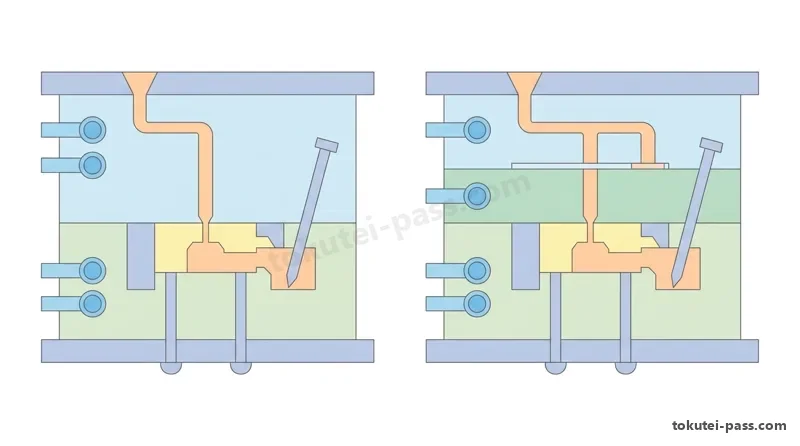
射出成形金型は、成形機のノズルが当たる「固定側金型(キャビティ側)」と、型開きで移動して突出し機構を備える「可動側金型(コア側)」からなり、両者の合わせ面を「パーティングライン(PL面)」といいます。
An injection mold consists of the 'Stationary mold half (Cavity side)', which contacts the machine nozzle, and the 'Moving mold half (Core side)', which moves during mold opening and houses the ejector mechanism; the mating surface between them is the 'Parting line (PL surface)'.
ノズルから出た溶融樹脂は、「スプル → ランナー → ゲート」という流路を通って製品部である「キャビティ」へ入ります。金型内の空気やガスを逃がすため、PL面などには深さ0.01〜0.03mm程度の浅い溝「ガスベント」を設けます。
Molten resin from the nozzle flows through the channel path 'Sprue → Runner → Gate' into the product-forming 'Cavity'. To allow trapped air and volatile gases to escape, shallow grooves approx. 0.01–0.03 mm deep called 'Gas vents' are machined on the PL surface.
金型構造には、パーティング面が1つで製品とランナーが一緒に取出される「2プレート金型(サイドゲートなど)」と、ストリッパプレートを備え型開き時にピンポイントゲートが自動切断される「3プレート金型」があります。
Mold structures include the '2-plate mold', which has a single parting plane and ejects the molded parts and runner together (e.g., side gate), and the '3-plate mold', which incorporates a stripper plate to automatically cut pin-point gates upon mold opening.
さらに、金型内の流路をヒータで加熱してランナーを常に溶融状態に保つ「ホットランナー金型」を使えば、スプル・ランナーの廃棄ロスが出ず、冷却時間短縮によるハイサイクル成形が可能になります。
Additionally, using a 'Hot runner mold' that keeps the runner channels constantly molten via internal heaters eliminates sprue and runner scrap and shortens cooling time for high-cycle molding.
また、成形品の側面に穴や凹部があってそのままでは型抜きできない形状を「アンダーカット」といい、金型開閉時に「アンギュラピン」の傾きによって横方向へスライドする「スライドコア機構」などを用いて抜き取ります。
Features such as side holes or recesses that prevent straight ejection along the mold opening direction are called 'Undercuts'; they are released prior to ejection using a 'Slide core mechanism' driven sideways by an inclined 'Angular pin' as the mold opens.
Key points
- 樹脂流路は「スプル → ランナー → ゲート → キャビティ」の順であり、合わせ面(PL面)には空気抜きの「ガスベント」を設ける
The resin flow path is 'Sprue → Runner → Gate → Cavity', and shallow 'Gas vents' are provided on the parting line (PL) to vent air - 「3プレート金型」はピンポイントゲートを自動切断でき、「ホットランナー金型」はランナー廃材を出さずに成形できる
A '3-plate mold' automatically cuts pin-point gates on opening, while a 'Hot runner mold' molds parts without generating runner scrap - 側面のくぼみ(アンダーカット)は、アンギュラピンと「スライドコア」によって横方向へ逃がしてから突き出す
Side recesses ('Undercuts') are cleared sideways by an angular pin and 'Slide core' before part ejection
| Word | Meaning |
|---|---|
| スプル・ランナー・ゲート | Sprue, Runner, and Gate |
| パーティングライン(PL)・ガスベント | Parting line (PL) and Gas vent |
| 2プレート金型・3プレート金型 | 2-plate mold and 3-plate mold |
| アンダーカット・スライドコア | Undercut and Slide core |
5. 射出成形の代表的不良現象と原因・対策
5. Typical Injection Molding Defects, Causes, and Countermeasures
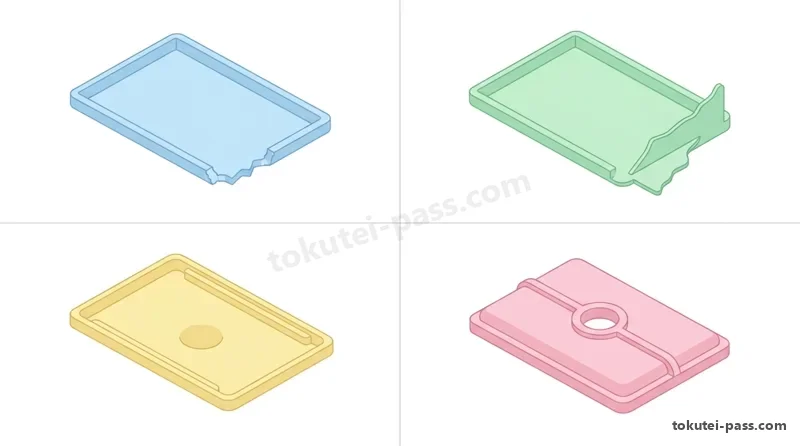
樹脂が末端まで満たされず欠ける「ショートショット(充填不足)」は、射出圧力・速度不足、樹脂温度・金型温度の低すぎ、計量不足が原因です。逆に、射出圧力や保圧が高すぎて型締力が負け、PL面からはみ出す不良が「バリ」です。
An incomplete part where resin fails to fill the end of the cavity is a 'Short shot', caused by insufficient injection pressure/speed, low resin/mold temperature, or short metering. Conversely, when excessive injection or holding pressure overcomes clamping force and resin leaks onto the PL surface, it causes 'Flash (burr)'.
肉厚部やリブ・ボスの裏側表面がくぼむ「ヒケ」や内部に空洞ができる「ボイド」は、冷却時の体積収縮に対して樹脂補給が足りないことが原因であり、保圧圧力を高くする、保圧時間を長くする、クッション量を確保する対策をとります。
Surface depressions on thick sections or opposite ribs/bosses called 'Sink marks' and internal vacuum bubbles called 'Voids' are caused by insufficient resin compensation for cooling shrinkage; they are corrected by increasing holding pressure, extending holding time, and ensuring an adequate cushion.
穴の周りや多点ゲートで二方向から流れてきた樹脂先端が合流する位置にスジが入る「ウェルドライン」は、合流部の融着不良が原因であり、金型温度・樹脂温度・射出速度を高くし、ガスベントを清掃して改善します。
A hairline seam formed where two flow fronts meet around a hole or in multi-gate molding is a 'Weld line', caused by incomplete fusion of cooled flow fronts; it is improved by raising mold temperature, resin temperature, and injection speed, and cleaning gas vents.
表面に銀白色のスジが出る「シルバーストリーク(銀条)」はペレットの乾燥不足(水分)やガス巻き込みが主因で、予備乾燥の徹底と背圧の適正化で防ぎます。流動末端が黒茶色に焦げる「ヤケ」は断熱圧縮が原因で、射出速度を下げガスベントを清掃します。
Silvery white streaks on the part surface called 'Silver streaks' are mainly caused by insufficient pellet drying (moisture) or air entrapment, prevented by thorough pre-drying and proper back pressure. Dark brown charring at the end of fill called a 'Burn mark' is caused by diesel-effect adiabatic compression, corrected by lowering injection speed and cleaning gas vents.
このほか、ゲートから蛇行状の模様が出る「ジェッティング」は射出初速を下げて防止し、ノズル先端の「糸引き(ストリンギング)」はノズル温度低下とサックバックで防ぎ、製品が曲がる「ソリ(変形)」は金型冷却の均一化で対策します。
In addition, snake-like patterns emerging from the gate called 'Jetting' are prevented by slowing initial injection speed; nozzle 'Stringing' is prevented by lowering nozzle temperature and applying suck-back; and part 'Warpage' is countered by uniform mold cooling.
Key points
- 「ショートショット」は圧力・温度不足、「バリ」は型締力不足や圧力過大、「ヒケ・ボイド」は保圧不足が主原因である
'Short shots' stem from insufficient pressure/temperature, 'Flash' from insufficient clamping force or excessive pressure, and 'Sink marks / Voids' from insufficient holding pressure - 「ウェルドライン」は金型温度・樹脂温度・射出速度を上げて改善し、「ヤケ」は射出速度を下げてガスベントを清掃する
'Weld lines' are improved by raising mold/resin temperature and injection speed, while 'Burn marks' are fixed by lowering injection speed and cleaning gas vents - 「シルバーストリーク」は予備乾燥の徹底、「ジェッティング」は射出初速の低減、「糸引き」はノズル温度低減とサックバックで防ぐ
'Silver streaks' are prevented by thorough pre-drying, 'Jetting' by reducing initial injection speed, and 'Stringing' by lowering nozzle temperature and using suck-back
| Word | Meaning |
|---|---|
| ショートショット・バリ | Short shot and Flash |
| ヒケ(シンクマーク)・ボイド | Sink mark and Void |
| ウェルドライン・ジェッティング | Weld line and Jetting |
| シルバーストリーク(銀条)・ヤケ | Silver streak and Burn mark |
6. 圧縮成形・トランスファ成形(熱硬化性樹脂の成形法)
6. Compression Molding and Transfer Molding (Thermosetting Resin Molding Methods)
フェノール樹脂(PF)・メラミン樹脂(MF)・ユリア樹脂(UF)・不飽和ポリエステル樹脂(UP)・エポキシ樹脂(EP)などの「熱硬化性樹脂」には、主に「圧縮成形(コンプレッション成形)」や「トランスファ成形」が用いられます。
For 'Thermosetting resins' such as Phenolic (PF), Melamine (MF), Urea (UF), Unsaturated Polyester (UP), and Epoxy (EP), the primary processing methods are 'Compression molding' and 'Transfer molding'.
「圧縮成形」は、150〜180℃程度に加熱した金型のキャビティ(下型)に粉状またはタブレット状の成形材料を直接入れ、加熱・加圧して溶融賦形すると同時に化学反応(架橋反応)で硬化させる方法です。
In 'Compression molding', powdered or tablet-form molding compound is placed directly into the lower cavity of a heated mold (approx. 150–180°C), and the mold is closed under heat and pressure so the material flows to fill the cavity while curing via a chemical cross-linking reaction.
成形前にタブレット材料を高周波予熱機などで「予備加熱(予熱)」しておくと、金型内での流動性が良くなり、硬化時間(キュアタイム)を大幅に短縮できるとともに水分や揮発分を減らせます。
'Pre-heating' the material tablets with a high-frequency pre-heater before loading improves flowability inside the mold, substantially shortens the 'Cure time (hardening time)', and reduces moisture and volatile gases.
また、硬化反応中には縮合水やガスが発生するため、加圧初期に一度わずかに金型を開いてガスを逃がす「ガス抜き(息抜き・ブリージング)」を行い、成形品表面の「フクレ(ブリスタ)」や内部気泡を防ぎます。
Because condensation water and reaction gases are generated during the curing reaction, the mold is momentarily cracked open slightly at the early stage of pressing in an operation called 'Breathing (degassing)' to vent gases and prevent surface 'Blisters' and internal pores.
一方、「トランスファ成形」は、加熱室(ポット)で軟化させた熱硬化性樹脂をプランジャでランナー・ゲート経由で閉じたキャビティへ圧入する方法であり、金属端子などのインサート部品を傷つけずに精密成形できます。
Meanwhile, in 'Transfer molding', thermosetting resin softened in a heating chamber ('Pot') is forced by a plunger through runners and gates into a pre-closed cavity; this method excels at precision insert molding without damaging delicate metal terminals.
Key points
- 圧縮成形は加熱した金型に熱硬化性樹脂を入れ、加圧・加熱による化学反応(キュア)で硬化させる成形法である
Compression molding places thermosetting resin into a heated mold and cures it via a chemical reaction under heat and pressure - 加圧初期に金型をわずかに開く「ガス抜き(息抜き・ブリージング)」によって、ガスによる「フクレ(ブリスタ)」を防ぐ
Momentarily opening the mold slightly early in pressing is called 'Breathing (degassing)' and prevents gas-induced 'Blisters' - ポットから閉じた金型へ樹脂を圧入する「トランスファ成形」は、インサート成形や肉厚複雑形状に適している
'Transfer molding' forces resin from a pot into a closed mold, making it ideal for insert molding and thick, complex parts
| Word | Meaning |
|---|---|
| 圧縮成形・トランスファ成形 | Compression molding and Transfer molding |
| 硬化時間(キュアタイム) | Cure time (Hardening time) |
| ガス抜き(息抜き・ブリージング) | Breathing (Degassing) |
| フクレ(ブリスタ)・予備加熱 | Blister and Pre-heating |
7. ブロー成形(中空成形)・押出成形・真空成形
7. Blow Molding (Hollow Molding), Extrusion Molding, and Vacuum Forming
ボトルやタンクなどの中空容器を作る「ブロー成形(中空成形)」では、まずダイヘッドから溶融樹脂を円筒状(パイプ状)に垂れ下げた「パリソン」を押し出し、左右の割型金型で挟んで内部に圧縮空気を吹き込み膨らませます。
In 'Blow molding (hollow molding)' used to manufacture hollow containers such as bottles and tanks, molten resin is first extruded downward from a die head as a hot tubular pipe called a 'Parison', clamped between split mold halves, and inflated with compressed air to take the mold shape.
金型が閉じるときにパリソンの下部を挟み切って融着させる部分を「ピンチオフ部」といい、パリソンが自重で垂れ下がって上部が薄くなる「ドローダウン」に対しては、ダイギャップを変化させる「パリソンコントローラ」で肉厚制御を行います。
The bottom section where the closing mold halves pinch and weld the parison shut is called the 'Pinch-off'; to counteract 'Draw-down' (where the hot parison sags under its own weight and thins at the top), a 'Parison controller' dynamically adjusts the die gap to control wall thickness.
また、PETボトルなどに用いられる「2軸延伸ブロー成形」では、射出成形で作った試験管状の「プリフォーム」をストレッチロッドで縦方向に伸ばしながら高圧空気で横方向に膨らませ、透明性・強度・ガスバリア性を高めます。
In 'Biaxial stretch blow molding' used for PET bottles, a test-tube-shaped 'Preform' made by injection molding is stretched lengthwise by a stretch rod while being inflated radially with high-pressure air, boosting transparency, strength, and gas-barrier performance.
一方、押出機の先端の口金(ダイ)から溶融樹脂を連続的に押し出して冷却賦形する「押出成形」は、パイプ・フィルム・シート・電線被覆など断面形状が一定の長尺製品を連続生産するのに適しています。
Meanwhile, 'Extrusion molding' continuously pushes molten resin through a shaping die and cools it, making it ideal for continuous production of long products with a constant cross-section such as pipes, films, sheets, and wire insulation.
さらに、押出成形で作ったプラスチックシートを加熱軟化させ、金型とシートの間の空気を真空吸引して大気圧で密着賦形する「真空成形(サーモフォーミング)」は、食品容器トレーやブリスタパックの量産に広く使われます。
Furthermore, 'Vacuum forming (thermoforming)' heats and softens a plastic sheet (made by extrusion) and evacuates the air between the sheet and mold so atmospheric pressure presses the sheet tightly against the mold contour; it is widely used for mass-producing food trays and blister packs.
Key points
- ブロー成形は円筒状の「パリソン」を金型で挟み(ピンチオフ)、圧縮空気を吹き込んで中空容器を成形する
Blow molding clamps a tubular 'Parison' inside a split mold ('Pinch-off') and blows compressed air inside to form hollow containers - パリソンの自重垂れ「ドローダウン」に対しては、「パリソンコントローラ」でパリソン肉厚を制御して均一化する
Gravitational sagging of the parison ('Draw-down') is compensated by controlling wall thickness with a 'Parison controller' - 断面が一定のパイプやフィルムの連続生産には「押出成形」、加熱シートを吸引してトレーを作るには「真空成形」を使う
Continuous production of constant-cross-section pipes/films uses 'Extrusion molding', while forming heated sheets into trays uses 'Vacuum forming'
| Word | Meaning |
|---|---|
| ブロー成形(中空成形) | Blow molding (Hollow molding) |
| パリソン・ピンチオフ部 | Parison and Pinch-off section |
| ドローダウン・パリソンコントローラ | Draw-down and Parison controller |
| 押出成形・真空成形 | Extrusion molding and Vacuum forming |
8. プラスチックの材料試験(機械的性質・MFR・熱的性質)と精密測定
8. Plastic Material Testing (Mechanical Properties, MFR, Thermal Properties) and Precision Measurement
プラスチックの機械的強度を調べる試験として、ダンベル形試験片を引っ張って引張強さ・破断伸び・弾性率を測る「引張試験」や、切欠き(ノッチ)付き試験片を振り子式ハンマーで打撃して耐衝撃性(粘り強さ)を測る「シャルピー衝撃試験」があります。
Mechanical strength tests for plastics include the 'Tensile test' (pulling a dumbbell-shaped specimen to measure tensile strength, elongation at break, and elastic modulus) and the 'Charpy impact test' (striking a notched specimen with a pendulum hammer to measure impact toughness).
また、一定の荷重と高温環境下で長時間経過したときに変形(ひずみ)が少ない性質を「耐クリープ性」といい、繰り返し応力に対する強さを「耐疲労性」、有機溶剤が付着した引張応力部に亀裂が入る現象を「ソルベントクラック」といいます。
Resistance to gradual deformation over long periods under constant load and elevated temperature is called 'Creep resistance'; resistance to repeated cyclic stress is 'Fatigue resistance'; and cracking that occurs when an organic solvent or oil contacts an area under tensile stress is called 'Solvent cracking (environmental stress cracking)'.
熱可塑性樹脂の溶融時の流れやすさ(流動性)を示す指標には、所定温度・荷重下で規定ダイから10分間に押し出されるグラム数(g/10min)で表す「MFR(メルトマスフローレイト)」があり、数値が大きいほど流動性が高くなります。
An index of melt flowability for thermoplastic resins is the 'MFR (Melt Mass-Flow Rate)', expressed as the mass in grams extruded through a standard die over 10 minutes (g/10min) under specified temperature and load; a higher MFR value indicates lower viscosity and higher flowability.
耐熱性の指標としては、規定の曲げ応力下で温度を上げていき一定量たわむ温度を測る「荷重たわみ温度(熱変形温度:HDT)」があり、結晶性樹脂にガラス繊維(GF)を充填強化するとHDTが大幅に向上します。
An index of heat resistance is the 'Heat Deflection Temperature (Temperature of Deflection Under Load: HDT)', which measures the temperature at which a specimen deflects by a specified amount under a standard bending stress; reinforcing crystalline resins with glass fiber (GF) dramatically increases HDT.
成形品の寸法検査では、ノギスやマイクロメータを用いますが、プラスチックは金属より弾性係数が小さく軟らかいため、強く挟みすぎると変形して測定誤差が出ます。また、離型直後は熱収縮中のため室温まで十分冷却後に測定します。
When measuring molded part dimensions with calipers or micrometers, because plastics have a much lower elastic modulus and are softer than metals, excessive measuring force causes deformation and error. Also, parts must be cooled completely to room temperature before measurement because thermal shrinkage continues right after ejection.
Key points
- 耐衝撃性は「シャルピー衝撃試験」、一定荷重下での長時間変形への強さは「クリープ試験」で評価する
Impact toughness is evaluated by the 'Charpy impact test', and resistance to long-term deformation under constant load by the 'Creep test' - 溶融樹脂の流れやすさを示す「MFR(g/10min)」は、数値が大きいほど粘度が低く流動性が高い
A higher 'MFR (g/10min)' value means lower melt viscosity and easier resin flow - プラスチック成形品の寸法測定は、成形後に室温まで十分冷えて収縮が落ち着いてから適度な測定力で行う
Dimensional measurement of plastic parts must be performed with moderate measuring force after the part has fully cooled to room temperature
| Word | Meaning |
|---|---|
| シャルピー衝撃試験・耐クリープ性 | Charpy impact test and Creep resistance |
| MFR(メルトマスフローレイト) | MFR (Melt Mass-Flow Rate) |
| 荷重たわみ温度(HDT) | Heat Deflection Temperature (HDT) |
| ソルベントクラック(環境応力亀裂) | Solvent cracking (Environmental stress cracking) |
9. 成形作業現場の労働安全衛生(安全装置・パージ・金型交換・5S)
9. Occupational Health and Safety in Molding Shops (Safety Devices, Purging, Mold Change, 5S)
射出成形機の型締部には数十〜数千kNの強大な力がかかるため、安全ドアを開けると電気的・機械的・油圧的に型閉じ動作が停止する「インターロック(安全装置)」が設けられています。インターロックを無効化しての作業は厳禁です。
Because the clamping unit of an injection molding machine exerts immense force ranging from tens to thousands of kN, it is equipped with an 'Interlock (safety device)' that electrically, mechanically, and hydraulically stops mold closing whenever the safety door is opened. Disabling the interlock is strictly prohibited.
材料替えや色替えの「パージ作業(シリンダ内洗浄)」では、200〜300℃の高温溶融樹脂や分解ガスがノズルから勢いよく噴出する危険があるため、ノズル周辺の安全カバーを閉じ、保護眼鏡(フェイスシールド)と耐熱手袋を必ず着用します。
During 'Purging (cylinder cleaning)' for material or color changes, 200–300°C molten resin and decomposition gases can violently spurt from the nozzle; operators must close the nozzle safety cover and wear safety glasses (face shield) and heat-resistant gloves.
ポリアセタール(POM)と塩化ビニル(PVC)のように異なる樹脂が加熱シリンダ内で混ざると、急激な化学反応で有毒なガスが発生して噴出するため、直接切り替えずPEやアクリル系などのパージ材で中間洗浄を行います。
If incompatible resins such as Polyacetal (POM) and Polyvinyl Chloride (PVC) mix inside a heated cylinder, a violent chemical reaction generates toxic gas and causes resin eruption; never switch directly between POM and PVC—always perform intermediate purging with PE or acrylic purging compound.
クレーンや玉掛けで重い金型を交換する際は、有資格者が吊り角度60°以内で行い、吊り荷の下には絶対に入りません。また、金型内の詰まり除去や清掃時には、機械を停止し、キャビティ面を傷つけないよう真鍮棒や銅棒を使います。
When replacing heavy molds using a crane and slings, qualified personnel must keep the sling angle within 60° and never enter beneath a suspended load. When clearing stuck resin or cleaning inside the mold, stop the machine completely and use brass or copper rods to avoid scratching the cavity surface.
さらに、床にこぼれた樹脂ペレットや作動油は転倒事故の原因になるため直ちに清掃する「5S(整理・整頓・清掃・清潔・しつけ)」と、作業前に危険要因を予測する「KY(危険予知)活動」を徹底します。
Furthermore, resin pellets or hydraulic oil spilled on the floor create severe slipping hazards and must be swept up immediately through '5S activities (Sort, Set in order, Shine, Standardize, Sustain)' combined with pre-shift 'KY (Hazard Prediction) activities'.
Key points
- 安全ドアの「インターロック」は絶対に無効化せず、金型内作業時は機械を停止し、樹脂除去には真鍮・銅工具を使う
Never disable the safety door 'Interlock'; stop the machine before working inside the mold and use brass/copper tools to remove stuck resin - 「パージ作業」ではノズル安全カバーを閉じ、保護眼鏡・耐熱手袋を着用し、POMとPVCは絶対に混ぜない
During 'Purging', close the nozzle safety cover, wear eye protection and heat-resistant gloves, and never mix POM and PVC inside the cylinder - 床にこぼれたペレットは滑りやすく転倒災害の原因となるため、5Sを徹底して直ちに掃き掃除する
Pellets spilled on the floor cause slip-and-fall accidents; practice thorough 5S and sweep them up immediately
| Word | Meaning |
|---|---|
| 安全ドア・インターロック | Safety door and Interlock |
| パージ作業(シリンダ内洗浄) | Purging operation (Cylinder cleaning) |
| 耐熱手袋・保護眼鏡 | Heat-resistant gloves and Safety glasses |
| 5S活動・KY(危険予知) | 5S activities and KY (Hazard prediction) |
Plastic Molding (Materials, Injection Machines, Molds, Defects)
Practice this chapter in the appOfficial references
- 製造分野特定技能1号評価試験(経済産業省・JAIM) — https://www.jaim-skill.or.jp/exam/about-ssw1/
- 技能検定 プラスチック成形 試験問題(JAVADA) — https://www.javada.or.jp/jigyou/gino/giken/