
Materials (Steel Materials, JIS Standards & Mechanical Properties of Rebar, Concrete Materials)
材料(鉄鋼材料・JIS規格と機械的性質・コンクリート材料)
Rebar Worker Certificate 鉄筋技能士 (Grade 1/2 theory) · 技能検定「鉄筋施工」1級・2級 学科 · Written by Tokutei Pass based on the official study texts; not copied verbatim.
鉄鋼材料の分類・炭素含有量と鉄筋の製造方法
Classification of Ferrous Metals, Carbon Content, and Rebar Manufacturing
鉄鋼材料は、鉄(Fe)にふくまれる「炭素(C)」の含有量によって「純鉄(Cが約0.02%以下)」「鋼(スチール:Cが約0.02〜2.0%)」「せん鉄・鋳鉄(Cが約2.0〜6.7%)」に分類されます。建築用の鉄筋や形鋼はすべて粘り強い「鋼」です。
Ferrous metals are classified by carbon (C) content into pure iron (C up to about 0.02%), steel (C about 0.02% to 2.0%), and pig/cast iron (C about 2.0% to 6.7%). All reinforcing bars and structural shapes used in buildings are tough 'steel (kō).'
鋼にふくまれる炭素量が多くなるほど、「硬さ」や「引張強さ」は大きくなりますが、逆に「伸び(延性)」「衝撃値(じん性)」「溶接性(ガス圧接性)」は低下してもろくなります。またリン(P)は低温ぜい性、硫黄(S)は赤熱ぜい性の原因となる有害元素です。
As carbon content in steel increases, hardness and tensile strength increase, whereas elongation (ductility), impact toughness, and weldability (including gas pressure weldability) decrease. Phosphorus (P) and sulfur (S) are harmful impurities that cause embrittlement.
鉄筋コンクリート用棒鋼の主な製造方法には、鉄スクラップ(古鉄)を主原料としてアーク熱で溶解・精製する「電気炉法(電炉鋼)」と、鉄鉱石から高炉と転炉を経てつくる「高炉・転炉法」があり、一般の異形棒鋼の多くは電気炉で製造されています。
Reinforcing steel bars are produced either by the 'electric arc furnace (EAF) process,' which melts and refines steel scrap, or the 'blast furnace–basic oxygen furnace process' from iron ore. Most ordinary deformed bars are manufactured in electric furnaces from scrap steel.
連続鋳造された鋼片(ビレット)を加熱炉で約1000〜1200℃の高温に加熱し、複数の圧延ロールの間を通して所定の径とリブ・節を成形する加工法を「熱間圧延」といいます。
Continuously cast steel billets are reheated to about 1000–1200°C and passed through grooved rolling mills to form the bar diameter, longitudinal ribs, and transverse lugs in a process called 'hot rolling (nekkan atsuen).'
Key points
- 鉄鋼は炭素量約0.02〜2.0%が「鋼」、約2.0%以上が「せん鉄・鋳鉄」であり、鉄筋には「鋼」を用いる
Ferrous alloys with ~0.02–2.0% carbon are 'steel' and over ~2.0% are 'cast/pig iron'; rebars are made of steel - 炭素含有量が増えるほど「硬さ・引張強さ」は大きくなるが、「伸び・じん性・溶接性」は低下する
Higher carbon content increases hardness and tensile strength but reduces elongation, toughness, and weldability - 一般の異形鉄筋は主に鉄スクラップを原料とする「電気炉」で溶解・精製し、高温の「熱間圧延」で製造される
Most deformed rebars are refined from steel scrap in electric arc furnaces and formed by hot rolling
| Word | Meaning |
|---|---|
| 純鉄・鋼・せん鉄(炭素含有量) | pure iron, steel, and pig/cast iron (by carbon content) |
| 引張強さと伸び・溶接性 | tensile strength, elongation, and weldability |
| 電気炉法(鉄スクラップ原料) | electric arc furnace process (steel scrap feedstock) |
| 熱間圧延と鋼片(ビレット) | hot rolling and steel billet |
鉄筋の引張試験と応力―ひずみ曲線・機械的性質
Tensile Testing of Rebar, Stress-Strain Curve, and Mechanical Properties
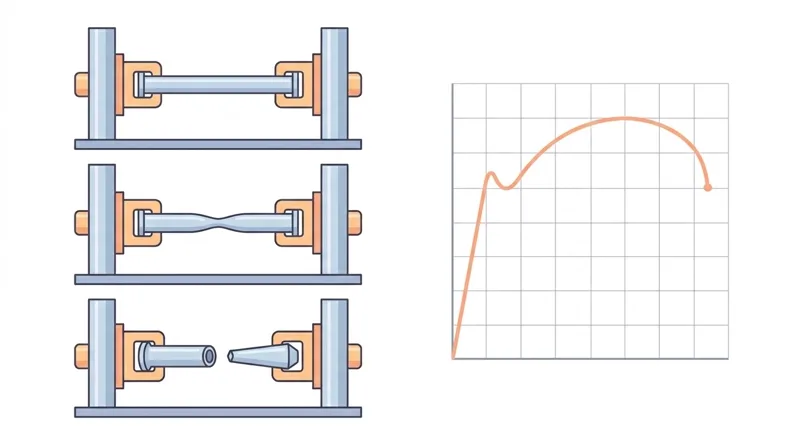
鉄筋の機械的性質を調べる「引張試験」では、試験片に引張力を加えて破断するまでの「応力(単位断面積あたりの力:N/mm²)」と「ひずみ(元の長さに対する伸びの割合)」の関係を記録します。
In a tensile test to determine the mechanical properties of rebar, a specimen is pulled to fracture while recording the relationship between stress (force per unit cross-sectional area, N/mm²) and strain (elongation divided by original gauge length).
応力が小さいうちは応力とひずみが正比例(フックの法則)し、力を除けば元の長さに戻る最大応力を「弾性限度」といいます。この比例区間の傾きである「ヤング係数(縦弾性係数)」は、鋼種(SD295〜SD490)にかかわらず約「2.05×10の5乗 N/mm²(205kN/mm²)」で一定です。
At low stress, stress is directly proportional to strain (Hooke's law), and the maximum stress from which the bar returns to its original length upon unloading is the 'elastic limit.' The slope of this linear region, Young's modulus (modulus of elasticity), is constant at about '205 kN/mm² (205,000 N/mm²)' regardless of steel grade.
弾性限度を超えると、応力が増えなくても急激にひずみ(伸び)だけが進む「降伏現象」が起きます。このとき最初の極大点を「上降伏点」、その直後の水平部を「下降伏点」といい、その後再び応力が上昇して達する最大応力を「引張強さ(引張強度)」といいます。
Beyond the elastic limit, yielding occurs where strain increases rapidly without an increase in stress: the initial peak is the 'upper yield point,' followed by the 'lower yield point' plateau, after which stress rises to the maximum value called 'tensile strength' before necking and fracture.
高強度鋼などで降伏点が明確に現れない場合は、永久伸び(残留ひずみ)が「0.2%」になるときの応力を「0.2%耐力」として降伏点の代わりに用います。また引張強さに対する降伏点の比を「降伏比」といい、降伏比が低いほど降伏後の余力(じん性)が大きくなります。
For high-strength steels that lack a distinct yield plateau, the stress that leaves a permanent plastic strain of '0.2%' is defined as the '0.2% proof stress (offset yield strength).' The ratio of yield point to tensile strength is the 'yield ratio'; a lower yield ratio provides a larger safety margin after yielding.
Key points
- 引張試験の応力―ひずみ曲線は「弾性限度→上降伏点・下降伏点→引張強さ(最大応力)→破断」の順に変化する
The stress-strain curve progresses through: elastic limit → upper/lower yield point → tensile strength (maximum stress) → fracture - 鉄筋のヤング係数(縦弾性係数)は鋼種(強度)によらず約「205kN/mm²(2.05×10の5乗 N/mm²)」で一定である
Young's modulus of reinforcing steel is constant at about 205 kN/mm² (205,000 N/mm²) regardless of steel grade - 明確な降伏点が現れない鋼材では、永久伸び「0.2%」を生じる応力を「0.2%耐力」として降伏点とみなす
When no distinct yield plateau exists, the stress producing 0.2% permanent elongation is used as the 0.2% proof stress
| Word | Meaning |
|---|---|
| 弾性限度とヤング係数(縦弾性係数) | elastic limit and Young's modulus (modulus of elasticity) |
| 上降伏点・下降伏点と0.2%耐力 | upper yield point, lower yield point, and 0.2% proof stress |
| 引張強さ(最大応力)と破断伸び | tensile strength (maximum stress) and elongation at fracture |
| 降伏比(降伏点÷引張強さ) | yield ratio (yield strength ÷ tensile strength) |
鉄筋コンクリート用棒鋼のJIS規格(JIS G 3112)と鋼種識別
JIS G 3112 Standard for Reinforcing Steel Bars and Grade Identification
日本産業規格「JIS G 3112(鉄筋コンクリート用棒鋼)」では、表面が滑らかな「丸鋼(SR235・SR295)」と、表面に軸方向の「リブ」と交差方向の「節」を設けて付着力を高めた「異形棒鋼(SD295A・SD295B・SD345・SD390・SD490)」が規定されています。
Japanese Industrial Standard JIS G 3112 specifies smooth 'round bars (SR235, SR295)' and 'deformed bars (SD295A, SD295B, SD345, SD390, SD490)' that feature longitudinal ribs and transverse lugs to enhance concrete bond.
鋼種記号の末尾の数字(235・295・345・390・490)は、引張強さではなく「降伏点または0.2%耐力の下限値(N/mm²)」を表しています。例えばSD345は降伏点が345〜440N/mm²、引張強さが490N/mm²以上と定められています。
The number in the grade designation (235, 295, 345, 390, 490) indicates the 'specified minimum yield point or 0.2% proof stress (N/mm²),' not the tensile strength. For instance, SD345 has a yield point of 345–440 N/mm² and a tensile strength of at least 490 N/mm².
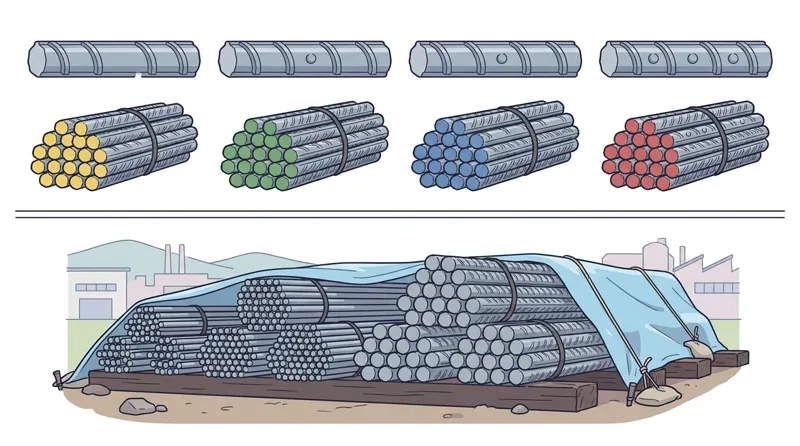
現場で異形棒鋼の鋼種を誤って混用しないよう、鉄筋表面の「圧延マーク(突起の数)」とバンドル端面の「識別色(塗色)」が定められています。SD295Aは突起なし(塗色なし)、SD295Bは突起なしまたは|(白色)です。
To prevent mixing steel grades on site, JIS G 3112 defines 'rolled identification marks (dots)' on the bar surface and 'end color coding' painted on bar ends. SD295A has no dot and no end color; SD295B has no round dot (or a vertical bar) and a white end color.
そして「SD345」は突起1個「・」で端面塗色は「黄色」、「SD390」は突起2個「・・」で端面塗色は「緑色」、「SD490」は突起3個「・・・」で端面塗色は「青色」と規定されており、技能検定で毎年のように出題されます。
'SD345' is marked with 1 dot (・) and painted yellow on the end; 'SD390' has 2 dots (・・) and is painted green; 'SD490' has 3 dots (・・・) and is painted blue. This identification table is tested almost every year.
Key points
- JIS G 3112の記号「SR」は丸鋼、「SD」は異形棒鋼であり、数字は「降伏点(耐力)の下限値(N/mm²)」を示す
In JIS G 3112, 'SR' denotes round bars, 'SD' denotes deformed bars, and the number is the minimum yield strength in N/mm² - 圧延マークの突起数は、SD295A・B=なし、SD345=1個(・)、SD390=2個(・・)、SD490=3個(・・・)である
Rolled identification dots: SD295A/B = none, SD345 = 1 dot (・), SD390 = 2 dots (・・), SD490 = 3 dots (・・・) - 端面の識別塗色は、SD295B=白、SD345=黄、SD390=緑、SD490=青である
End paint colors: SD295B = white, SD345 = yellow, SD390 = green, SD490 = blue
| Word | Meaning |
|---|---|
| 丸鋼(SR235・SR295)と異形棒鋼(SD) | round bars (SR235, SR295) and deformed bars (SD) |
| 降伏点または0.2%耐力の下限値 | minimum yield point or 0.2% proof stress |
| 圧延マーク(突起1個・2個・3個) | rolled identification marks (1, 2, or 3 dots) |
| 端面識別色(白・黄・緑・青) | bar end identification colors (white, yellow, green, blue) |
異形棒鋼の公称直径・単位質量とミルシート
Nominal Diameter, Unit Mass of Deformed Bars, and Mill Test Certificates
異形棒鋼には表面にリブと節があるため断面形状が真円ではありません。そこで鉄筋1mあたりの質量と鋼の密度(7.85g/cm³)から、同じ断面積をもつ丸鋼に換算した直径を「公称直径(d)」、その断面積を「公称断面積」といいます。
Because deformed bars have longitudinal ribs and transverse lugs, their cross-section is not a true circle. The diameter of an equivalent round bar having the same cross-sectional area—calculated from the mass per meter and steel density (7.85 g/cm³)—is called the 'nominal diameter (d),' and its area is the 'nominal cross-sectional area.'
異形棒鋼の呼び名と公称直径は、D10が「9.53mm」、D13が「12.7mm」、D16が「15.9mm」、D19が「19.1mm」、D22が「22.2mm」、D25が「25.4mm」、D29が「28.6mm」、D32が「31.8mm」です。定着長さやフック計算では一般に呼び名の数値(mm)を用います。
Nominal diameters for standard bar designations are: D10 = 9.53 mm, D13 = 12.7 mm, D16 = 15.9 mm, D19 = 19.1 mm, D22 = 22.2 mm, D25 = 25.4 mm, D29 = 28.6 mm, and D32 = 31.8 mm. Anchorage and hook formulas generally use the nominal designation number in millimeters.
JIS G 3112による異形棒鋼1mあたりの「単位質量(kg/m)」は積算で必須であり、D10=0.560、D13=0.995、D16=1.56、D19=2.25、D22=3.04、D25=3.98、D29=5.04(kg/m)です。
Standard 'unit masses per meter (kg/m)' under JIS G 3112 essential for quantity takeoffs are: D10 = 0.560 kg/m, D13 = 0.995 kg/m, D16 = 1.56 kg/m, D19 = 2.25 kg/m, D22 = 3.04 kg/m, D25 = 3.98 kg/m, and D29 = 5.04 kg/m.
現場への鉄筋搬入時には、メーカーが発行する「鋼材検査証明書(ミルシート)」を受け取り、記載された規格・鋼種・寸法・化学成分(C・Si・Mn・P・S)・機械的性質(降伏点・引張強さ・伸び・曲げ性)を現品のタグや圧延マークと照合します。
When rebar is delivered to the site, the manufacturer's 'mill test certificate (mill sheet)' is checked to verify that the steel grade, dimensions, chemical composition (C, Si, Mn, P, S), and mechanical properties (yield point, tensile strength, elongation, bendability) match the bundle tags and rolled marks.
Key points
- 異形棒鋼の「公称直径」は等断面積の丸鋼に換算した直径であり、D10=9.53mm、D13=12.7mm、D16=15.9mm、D19=19.1mm、D25=25.4mmである
Nominal diameters of deformed bars: D10 = 9.53 mm, D13 = 12.7 mm, D16 = 15.9 mm, D19 = 19.1 mm, D25 = 25.4 mm - 主な単位質量(kg/m)は、D10=0.560、D13=0.995、D16=1.56、D19=2.25、D22=3.04、D25=3.98、D29=5.04である
Key unit masses (kg/m): D10 = 0.560, D13 = 0.995, D16 = 1.56, D19 = 2.25, D22 = 3.04, D25 = 3.98, D29 = 5.04 - 搬入時には「ミルシート(鋼材検査証明書)」で化学成分と機械的性質がJIS規格に適合しているか確認する
Verify chemical composition and mechanical properties on the mill test certificate (mill sheet) upon delivery
| Word | Meaning |
|---|---|
| 公称直径と公称断面積 | nominal diameter and nominal cross-sectional area |
| 単位質量(D10=0.560・D13=0.995・D16=1.56kg/m) | unit mass (D10 = 0.560, D13 = 0.995, D16 = 1.56 kg/m) |
| 単位質量(D19=2.25・D22=3.04・D25=3.98kg/m) | unit mass (D19 = 2.25, D22 = 3.04, D25 = 3.98 kg/m) |
| ミルシート(鋼材検査証明書) | mill test certificate (mill sheet) |
溶接金網・PC鋼材・高強度せん断補強筋と結束線
Welded Wire Mesh, Prestressed Concrete (PC) Steel, High-Strength Shear Bars, and Tie Wire
「溶接金網(ワイヤーメッシュ・JIS G 3551)」は、冷間引抜きした鉄線または異形鉄線を縦横に直角に配列し、交点を電気抵抗溶接(スポット溶接)した網目状の補強材です。土間床やデッキプレート上のスラブのひび割れ防止に広く使われます。
Welded wire mesh (JIS G 3551) is fabricated by arranging cold-drawn steel wires at right angles and joining their intersections by electric resistance spot welding. It is widely used for crack control in slabs-on-grade and composite deck slabs.
「プレストレストコンクリート(PC)」は、あらかじめ高強度の「PC鋼材(PC鋼線・PC鋼より線・PC鋼棒)」を緊張してコンクリートに圧縮力(プレストレス)を与え、ひび割れを防いで大スパンの梁や床を実現する構造です。PC鋼材は普通鉄筋の約3〜5倍の極めて高い引張強さをもちます。
Prestressed concrete (PC) applies pre-compression to concrete using tensioned high-strength 'prestressing steel (PC wires, PC strands, PC bars)' to prevent flexural cracking across long spans. Prestressing steel has a tensile strength roughly 3 to 5 times that of ordinary rebar.
PC鋼材は高い応力で緊張されているため、現場での溶接や加熱によって急激に強度が失われて破断する危険があり、PC鋼材への溶接やバーナー加熱は絶対に行ってはなりません。
Because prestressing steel is under high tension and heat-treated, heating or welding it on site causes severe embrittlement and sudden rupture; therefore welding or torch-heating PC steel is strictly prohibited.
また柱の帯筋や梁のあばら筋には、降伏点が685N/mm²や785N/mm²級の「高強度せん断補強筋(ウルボン・リバーボン等)」も使われます。鉄筋の結束には直径「0.8mm(#21)」の「なまし鉄線」を2本または3本より合わせて使用します。
High-strength shear reinforcement with yield strengths of 685 N/mm² or 785 N/mm² is also used for column hoops and beam stirrups. Rebar tying uses annealed iron tie wire (namashi tessen) with a standard diameter of '0.8 mm (#21)' in 2-ply or 3-ply strands.
Key points
- 「溶接金網(JIS G 3551)」は鉄線の交点を電気抵抗溶接したもので、土間スラブ等のひび割れ防止に用いる
Welded wire mesh (JIS G 3551) is spot-welded by electric resistance and used for slab crack control - 「PC鋼材」は普通鉄筋の数倍の引張強さをもち、現場での溶接や加熱加工は厳禁である
Prestressing (PC) steel has several times the tensile strength of ordinary rebar; welding or heating PC steel is strictly forbidden - 鉄筋結束用の「なまし鉄線」は一般に線径「0.8mm(#21)」のものを用いる
Annealed iron tie wire (namashi tessen) for binding rebar has a standard wire diameter of 0.8 mm (#21)
| Word | Meaning |
|---|---|
| 溶接金網(JIS G 3551・電気抵抗溶接) | welded wire mesh (JIS G 3551, electric resistance welding) |
| プレストレストコンクリート(PC)とPC鋼材 | prestressed concrete (PC) and prestressing steel |
| 高強度せん断補強筋 | high-strength shear reinforcement |
| なまし鉄線(線径0.8mm) | annealed iron tie wire (0.8 mm diameter) |
コンクリートの構成材料(セメント・骨材・水・混和材料)
Constituent Materials of Concrete (Cement, Aggregates, Water, and Admixtures)
コンクリートは「セメント」「水」「細骨材(砂)」「粗骨材(砂利・砕石)」および必要に応じて加える「混和材料」を練り混ぜて作られます。セメントと水が反応して固まる化学反応を「水和反応」といい、その際に「水和熱」が発生します。
Concrete is produced by mixing cement, water, fine aggregate (sand), coarse aggregate (gravel or crushed stone), and admixtures. The chemical reaction between cement and water that causes hardening is called 'hydration,' which generates 'heat of hydration.'
骨材は5mmふるいを通過する「細骨材」と5mmふるいに留まる「粗骨材」に分かれ、一般の鉄筋コンクリートに用いる粗骨材の最大寸法は「20mmまたは25mm」が標準です。また軽量骨材を用いた軽量コンクリート1種・2種の気乾単位容積質量は「1.7〜2.0t/m³程度」(普通コンクリートは約2.3t/m³)です。
Aggregates are separated by a 5 mm sieve into fine aggregate and coarse aggregate; the standard maximum size of coarse aggregate for ordinary reinforced concrete is '20 mm or 25 mm.' Air-dry unit mass is about 1.7–2.0 t/m³ for lightweight concrete, compared to about 2.3 t/m³ for normal concrete (2.4 t/m³ for RC).
混和材料は2種類に大別されます。使用量が少なく練上がり容積に算入しない「混和剤(薬品)」には、微細な気泡を連行してワーカビリティーと耐凍害性を高める「AE剤」「AE減水剤」「高性能AE減水剤」があります。
Admixtures are divided into two groups: 'Chemical admixtures (konwazai - 剤),' used in small dosages and excluded from mix volume, include AE (air-entraining) agents, AE water-reducing agents, and high-range AE water-reducing agents that entrain microscopic air bubbles to improve workability and freeze-thaw resistance.
一方、使用量が比較的多くコンクリートの練上がり容積に算入する「混和材」には、「フライアッシュ(石炭灰)」「高炉スラグ微粉末」「シリカフューム」「膨張材」などがあります。
Conversely, 'mineral admixtures (konwazai - 材),' used in larger quantities and included in the concrete mix volume, include fly ash, ground granulated blast-furnace slag, silica fume, and expansive additives.
Key points
- セメントと水が化学反応して硬化する現象を「水和反応」といい、粗骨材最大寸法は一般に「20mmまたは25mm」とする
Cement hardens by hydration with water; the standard maximum size of coarse aggregate in RC is 20 mm or 25 mm - 単位容積質量は普通コンクリートが約2.3t/m³(RCは約2.4t/m³)、軽量コンクリートが約1.7〜2.0t/m³である
Unit mass is about 2.3 t/m³ for normal concrete (2.4 t/m³ for RC) and about 1.7–2.0 t/m³ for lightweight concrete - 微細気泡を入れる「AE剤・AE減水剤」は『混和剤』、フライアッシュや高炉スラグ微粉末は容積に算入する『混和材』である
AE agents and AE water-reducing agents are chemical admixtures (混和剤); fly ash and blast-furnace slag are mineral admixtures (混和材)
| Word | Meaning |
|---|---|
| 水和反応と水和熱 | hydration reaction and heat of hydration |
| 細骨材と粗骨材(最大寸法20mm・25mm) | fine aggregate and coarse aggregate (20 mm or 25 mm max size) |
| 混和剤(AE剤・AE減水剤) | chemical admixtures (AE agent, AE water-reducing agent) |
| 混和材(フライアッシュ・高炉スラグ微粉末) | mineral admixtures (fly ash, blast-furnace slag powder) |
フレッシュコンクリートの性質・スランプ試験と打込み時間制限
Properties of Fresh Concrete, Slump Test, and Placing Time Limits
練り混ぜ直後から硬化し始めるまでの柔らかいコンクリートを「フレッシュコンクリート(生コンクリート)」といい、型枠内や鉄筋の隅々への打ち込みやすさ(作業のしやすさ)の程度を「ワーカビリティー」といいます。
Freshly mixed concrete before setting is called 'fresh concrete,' and its ease of placing and consolidating into formwork and around rebar without segregation is termed 'workability.'
コンシステンシー(軟らかさ・流動性)を測る「スランプ試験」では、高さ「30cm(300mm)」のスランプコーンにコンクリートを3層に分けて詰め、コーンを鉛直に引き抜いた後に頂部中央が「下がった高さ(cm)」をスランプ値として測定します。
In a 'slump test' measuring consistency, concrete is rodded in three layers into a 30 cm (300 mm) tall slump cone, the cone is lifted vertically, and the 'vertical subsidence (cm) at the center of the top surface' is measured as the slump value.
打ち込んだ後、重力によって骨材やセメント粒子が沈下して上面に水が浮き上がる現象を「ブリーディング」といい、その水とともに表面に浮き出た微粒子が乾燥してできるぜい弱な薄層を「レイタンス」といいます。レイタンスは打継ぎ前に必ず除去します。
After placement, the upward migration of mix water as solid particles settle is called 'bleeding,' and the weak, porous film of fine particles left on the top surface is called 'laitance.' Laitance must be removed before placing the next lift at a construction joint.
レディーミクストコンクリート(生コン)の練り混ぜ開始から打ち込み終了までの時間は、外気温が「25℃未満のときは120分以内」、「25℃以上のときは90分以内」と定められています。また鉄筋の塩害腐食を防ぐため、塩化物イオン量は原則「0.30kg/m³以下」とします。
For ready-mixed concrete, the maximum allowable time from the start of mixing to completion of placing is 'within 120 minutes when ambient temperature is below 25°C' and 'within 90 minutes when ambient temperature is 25°C or higher.' Chloride ion content is limited to '0.30 kg/m³ or less' to prevent rebar corrosion.
Key points
- スランプ試験は高さ30cmのコーンを引き抜いた後の「頂部中央の下がり量(cm)」を測り、作業のしやすさを「ワーカビリティー」という
The slump test measures vertical drop (cm) at the center of the top surface from a 30 cm cone; ease of placement is workability - ブリーディングに伴って表面に生じるぜい弱な薄層を「レイタンス」といい、次層を打ち継ぐ前に除去して付着を保つ
The weak surface layer formed by bleeding is called 'laitance' and must be removed before pouring a construction joint - 練混ぜ開始から打込み終了までの限度時間は「外気温25℃未満で120分以内・25℃以上で90分以内」、塩化物イオン量は「0.30kg/m³以下」とする
Time from mixing to completion of placing: ≤ 120 min below 25°C, ≤ 90 min at 25°C or above; chloride ion content ≤ 0.30 kg/m³
| Word | Meaning |
|---|---|
| ワーカビリティーとスランプ試験(30cmコーン) | workability and slump test (30 cm cone) |
| ブリーディングとレイタンス | bleeding and laitance |
| 打込み時間制限(25℃未満120分・25℃以上90分) | placing time limit (< 25°C: 120 min; ≥ 25°C: 90 min) |
| 塩化物イオン量規制(0.30kg/m³以下) | chloride ion limit (≤ 0.30 kg/m³) |
硬化コンクリートの強度・水セメント比・初期養生と中性化
Hardened Concrete Strength, Water-Cement Ratio, Initial Curing, and Carbonation
構造計算の基準とする材齢28日(4週)の圧縮強度を「設計基準強度(Fc:単位N/mm²)」といい、寒中や暑中などの温度補正やばらつきを見込んで現場発注時に指定する強度を「呼び強度」といいます。
The 28-day compressive strength used as the basis for structural design is the 'specified design strength (Fc, in N/mm²),' while the strength ordered from the ready-mix plant after adding temperature and statistical margins is the 'nominal ordered strength (yobi kyōdo).'
セメントに対する水の質量割合を「水セメント比(W/C)」といい、水セメント比を「小さく」するほど硬化後のコンクリートは密実になり、圧縮強度・水密性・耐久性が高くなります。JASS 5等では普通コンクリートの最大水セメント比は原則「65%以下」とされています。
The mass ratio of water to cement is the 'water-cement ratio (W/C).' A lower water-cement ratio produces denser hardened concrete with higher compressive strength, watertightness, and durability. In JASS 5, the maximum water-cement ratio is generally '65% or less.'
打ち込み後の「養生」では、十分な水和反応を進め乾燥収縮ひび割れや初期凍害を防ぐため、打ち込み後少なくとも「5日間」は湿潤状態に保ち、コンクリートの温度を「2℃以上」に維持します。
During initial curing after placement, concrete must be kept moist for at least '5 days' and maintained at a temperature of '2°C or higher' to ensure proper hydration and prevent drying shrinkage cracking and early freezing.
また空気中の二酸化炭素(炭酸ガス)がコンクリート表面から浸入してアルカリ性が失われる現象を「中性化」といいます。中性化が鉄筋位置まで達すると不動態被膜が壊れて鉄筋が錆びて膨張し、かぶりコンクリートのひび割れ・剥落を招くため、所定のかぶり厚さ確保が不可欠です。
The loss of alkalinity from the concrete surface inward due to atmospheric carbon dioxide (CO2) is called 'carbonation (neutralization, chūseika).' Once carbonation reaches the rebar, the passive film breaks down and the bar rusts and expands, spalling the cover concrete.
Key points
- 構造設計の基準となる材齢28日圧縮強度を「設計基準強度(Fc)」といい、「水セメント比」が小さいほど強度と耐久性が高まる
The 28-day compressive strength for structural design is 'Fc'; a lower water-cement ratio yields higher strength and durability - 初期養生では、打ち込み後「5日間以上」は湿潤状態を保ち、コンクリート温度を「2℃以上」に保って初期凍害を防ぐ
Initial curing requires keeping the concrete moist for at least 5 days and maintaining concrete temperature at 2°C or higher - 空気中の二酸化炭素でアルカリ性が失われる「中性化」による鉄筋腐食を防ぐため、十分なかぶり厚さと密実な打込みが必要である
Carbonation (chūseika) from CO2 destroys alkalinity and causes rebar corrosion, making adequate concrete cover essential
| Word | Meaning |
|---|---|
| 設計基準強度(Fc)と呼び強度 | specified design strength (Fc) and nominal ordered strength |
| 水セメント比(W/C・65%以下) | water-cement ratio (W/C ≤ 65%) |
| 初期養生(湿潤養生5日間以上・温度2℃以上) | initial curing (moist curing ≥ 5 days, temperature ≥ 2°C) |
| コンクリートの中性化と鉄筋腐食 | concrete carbonation (neutralization) and rebar corrosion |
Materials (Steel & Concrete)
Practice this chapter in the appOfficial references
- 日本産業規格 JIS G 3112 鉄筋コンクリート用棒鋼(日本産業標準調査会 JISC) — https://www.jisc.go.jp/
- 公共建築工事標準仕様書(建築工事編)令和7年版 第5章 鉄筋工事・第6章 コンクリート工事(国土交通省) — https://www.mlit.go.jp/gobuild/gobuild_tk2_000017.html