Occupational Safety, Health & Environmental Management Fundamentals
安全衛生・環境管理基礎
Production Management Operations Grade 3 生産管理オペレーション (BC検定) · ビジネス・キャリア検定 生産管理オペレーション3級 · Written by Tokutei Pass based on the official study texts; not copied verbatim.
1. 労働安全衛生法の目的と安全衛生管理体制(管理者・産業医・委員会)
1. Purpose of the Industrial Safety and Health Act and Safety & Health Management Organization
「労働安全衛生法」は、労働基準法と相まって、労働災害の防止のための危害防止基準の確立、責任体制の明確化及び自主的活動の促進により、職場における労働者の安全と健康を確保するとともに「快適な職場環境の形成」を促進することを目的としています。
The "Industrial Safety and Health Act," in conjunction with the Labor Standards Act, aims to secure the safety and health of workers in the workplace and promote the "formation of a comfortable working environment" by establishing hazard-prevention standards, clarifying responsibility structures, and encouraging voluntary activities to prevent industrial accidents.
製造業などの事業場では規模に応じた安全衛生管理体制が義務づけられています。常時「50人以上」の労働者を使用する製造業の事業場では、「安全管理者」「衛生管理者」「産業医」を選任し、「安全衛生委員会」を設置して毎月1回以上開催しなければなりません。
Manufacturing workplaces are legally required to establish a safety and health management organization scaled to their workforce size. A manufacturing workplace regularly employing "50 or more workers" must appoint a "Safety Officer," a "Health Officer," and an "Industrial Physician," and must establish a "Safety and Health Committee" that meets at least once a month.
なお、常時「10人以上50人未満」の事業場では「安全衛生推進者」を選任し、製造業で常時「300人以上」の大規模事業場ではトップである工場長などを「総括安全衛生管理者」に選任します。
Workplaces regularly employing "10 to 49 workers" must appoint a "Safety and Health Promoter," while large manufacturing workplaces regularly employing "300 or more workers" must appoint the top site manager (such as the Plant Manager) as the "General Safety and Health Manager."
職場巡視の頻度は試験の超頻出ポイントです。「安全管理者」は随時巡視、「衛生管理者」は「少なくとも毎週1回」、「産業医」は「少なくとも毎月1回(一定の条件を満たし事業者の同意がある場合は2か月に1回)」作業場等を巡視する義務があります。
Workplace patrol frequency is a top exam favorite: the "Safety Officer" patrols as needed; the "Health Officer" must inspect the workplace "at least once every week"; and the "Industrial Physician" must inspect the workplace "at least once every month (or once every two months if specified conditions are met and the employer consents)."
Key points
- 製造業で常時50人以上の事業場=「安全管理者・衛生管理者・産業医」の選任と「安全衛生委員会(月1回以上)」の設置が義務(10〜49人は安全衛生推進者)。
Manufacturing workplaces with 50 or more regular workers = mandatory appointment of "Safety Officer, Health Officer, and Industrial Physician" and establishment of a "Safety and Health Committee (meets ≥ once/month)" (10–49 workers require a Safety and Health Promoter). - 職場巡視の義務頻度:衛生管理者=「少なくとも毎週1回」/産業医=「少なくとも毎月1回」。
Mandatory workplace patrol frequency: Health Officer = "at least once a week" / Industrial Physician = "at least once a month." - 安全衛生委員会の委員の半数は、労働者の過半数で組織する労働組合(または過半数代表者)の推薦に基づき指名しなければならない。
Half of the members of the Safety and Health Committee must be nominated based on the recommendation of the majority labor union (or majority worker representative).
| Word | Meaning |
|---|---|
| 労働安全衛生法 | Industrial Safety and Health Act |
| 総括安全衛生管理者・安全管理者・衛生管理者 | General Safety and Health Manager, Safety Officer, and Health Officer |
| 産業医と安全衛生委員会(50人以上) | Industrial Physician and Safety and Health Committee (50 or more workers) |
| 職場巡視(衛生管理者=週1回、産業医=月1回) | workplace patrol (Health Officer = weekly; Industrial Physician = monthly) |
2. 労働災害統計指標の計算(度数率・強度率・年千人率)
2. Calculating Occupational Accident Statistics (Frequency Rate, Severity Rate, Annual Rate per 1,000 Workers)
労働災害の発生状況を客観的に評価するため、3つの統計指標が用いられます。1つ目の「度数率」は、100万延べ実労働時間あたりの労働災害による死傷者数で、災害発生の「頻度」を表します。
Three statistical indicators are used to objectively evaluate occupational accident occurrence. First, the "Frequency Rate (Dosuuritsu)" represents the number of casualties (deaths and injuries) from industrial accidents per 1,000,000 total actual working hours, expressing accident "frequency."
度数率の公式は「度数率=(労働災害による死傷者数÷延べ実労働時間数)×1,000,000」です(不休災害は含めず、休業1日以上の死傷者を対象とします)。
The formula for Frequency Rate is "Frequency Rate = (Number of Casualties from Industrial Accidents ÷ Total Actual Working Hours) × 1,000,000" (counted for casualties requiring 1 or more days of absence, excluding no-lost-time injuries).
2つ目の「強度率」は、1,000延べ実労働時間あたりの労働損失日数で、災害の「重篤度(重さ)」を表します。公式は「強度率=(延べ労働損失日数÷延べ実労働時間数)×1,000」です(死亡や永久全労働不能の損失日数は「7,500日」、休業災害は「休業日数×(300÷365)」で換算します)。
Second, the "Severity Rate (Kyoudoritsu)" represents the number of lost workdays per 1,000 total actual working hours, expressing accident "severity (seriousness)." Its formula is "Severity Rate = (Total Lost Workdays ÷ Total Actual Working Hours) × 1,000" (a fatality or permanent total disability is counted as "7,500 lost days," while temporary disability days are converted by "Days of Absence × (300 ÷ 365)").
3つ目の「年千人率」は、労働者1,000人あたり1年間に発生する死傷者数を示し、「年千人率=(1年間の死傷者数÷1年間の平均労働者数)×1,000」で計算します。
Third, the "Annual Incidence Rate per 1,000 Workers (Nen-sennin-ritsu)" indicates the number of casualties occurring in 1 year per 1,000 workers, calculated as "Annual Rate per 1,000 = (Annual Casualties ÷ Average Number of Workers during the Year) × 1,000."
Key points
- 度数率(災害の頻度)=(死傷者数÷延べ実労働時間数)×1,000,000(100万時間あたり)。
Frequency Rate (accident frequency) = (Number of Casualties ÷ Total Actual Working Hours) × 1,000,000 (per 1 million hours). - 強度率(災害の重さ)=(延べ労働損失日数÷延べ実労働時間数)×1,000(1,000時間あたり、死亡=7,500日)。
Severity Rate (accident seriousness) = (Total Lost Workdays ÷ Total Actual Working Hours) × 1,000 (per 1,000 hours; death = 7,500 days). - 年千人率=(年間死傷者数÷年間平均労働者数)×1,000(労働者1,000人あたり)。
Annual Rate per 1,000 Workers = (Annual Casualties ÷ Average Annual Workers) × 1,000 (per 1,000 workers). - 【例】平均労働者数400人・年間延べ実労働時間800,000時間で死傷者2人 → 度数率=2÷800,000×1,000,000=2.5、年千人率=2÷400×1,000=5.0
Example: Average 400 workers, 800,000 total actual working hours/year, 2 casualties → Frequency rate = 2 ÷ 800,000 × 1,000,000 = 2.5; Annual rate per 1,000 workers = 2 ÷ 400 × 1,000 = 5.0 - 【例】延べ実労働時間800,000時間で延べ労働損失日数400日(うち休業365日の換算損失日数=365×300÷365=300日) → 強度率=400÷800,000×1,000=0.5
Example: 800,000 total actual working hours and 400 total lost workdays (including 365 absence days converted as 365 × 300 ÷ 365 = 300 lost days) → Severity rate = 400 ÷ 800,000 × 1,000 = 0.5
| Word | Meaning |
|---|---|
| 度数率(100万時間あたりの死傷者数:頻度) | Frequency Rate (casualties per 1,000,000 working hours: frequency) |
| 強度率(1,000時間あたりの労働損失日数:重さ) | Severity Rate (lost workdays per 1,000 working hours: severity) |
| 年千人率(労働者1,000人あたりの年間死傷者数) | Annual Rate per 1,000 Workers (annual casualties per 1,000 workers) |
3. 機械の本質安全化(フェールセーフ・フールプルーフ)と特定機械等・特定自主検査
3. Inherent Machine Safety (Fail-Safe / Fool-Proof), Specified Machinery, and Specified Autonomous Inspection
機械設備による労働災害を防ぐ「本質安全化(安全設計)」の2大原則が「フェールセーフ」と「フールプルーフ」です。「フェールセーフ」とは、機械や部品が故障・停電しても、必ず安全側(機械停止や遮断機降下など)に働くようにする設計です。
The two major principles of "Inherent Machine Safety (safety design)" preventing equipment accidents are "Fail-Safe" and "Fool-Proof." "Fail-Safe" is a design principle ensuring that even if a machine or component fails or loses power, it always defaults to the safe side (such as stopping the machine or lowering a crossing gate).
一方、「フールプルーフ」とは、人間がうっかりミスや誤操作をしても危険が生じないようにする仕組みで、安全カバーを閉めないと起動しない「インターロック(安全確認型)」や、両手で同時にボタンを押さないと動かないプレスの「両手操作式安全装置」が代表例です。
In contrast, "Fool-Proof" is a mechanism ensuring that even if a human makes a careless mistake or misoperates a control, no hazard arises; classic examples include an "Interlock" that prevents a machine from starting unless the safety guard is closed, and a "Two-Hand Control Safety Device" on a press that operates only when both hands press buttons simultaneously.
また労働安全衛生法では、特に危険度が高い「ボイラー、第一種圧力容器、つり上げ荷重3t以上のクレーン・移動式クレーン、デリック、エレベーター、ゴンドラ」を「特定機械等」と定め、都道府県労働局長の「製造許可」や「検査証」の交付を義務づけています。
Under the Industrial Safety and Health Act, particularly hazardous equipment—"Boilers, Class-1 Pressure Vessels, Cranes and Mobile Cranes with a lifting capacity of 3 tons or more, Derricks, Elevators, and Gondolas"—are designated as "Specified Machinery, etc.," requiring a "Manufacturing Permit" from the Prefectural Labor Bureau Director and issuance of an "Inspection Certificate."
さらに、動力プレス機械やフォークリフトなど一定の機械については、定期自主検査のなかでも特に「1年以内ごとに1回」、一定の資格を持つ検査者(または登録検査業者)による「特定自主検査」を実施し、「検査標章(ステッカー)」を貼り付けなければなりません(検査記録は3年間保存)。
Furthermore, for designated machines such as power presses and forklifts, among periodic self-inspections, employers must conduct a "Specified Autonomous Inspection" "at least once every year" performed by a qualified inspector (or registered inspection agency) and affix an "Inspection Sticker (decal)" to the machine (retaining inspection records for 3 years).
Key points
- フェールセーフ=機械が故障しても安全側(停止側)に制御する設計/フールプルーフ=人間が誤操作しても危険にならない設計(インターロック・両手操作スイッチ等)。
Fail-Safe = design that shifts to the safe side (stops) when equipment fails / Fool-Proof = design that prevents danger even when humans misoperate (interlocks, two-hand press switches, etc.). - 特定機械等(製造許可が必要)=ボイラー、第一種圧力容器、クレーン(3t以上)、移動式クレーン、デリック、エレベーター、ゴンドラ。
Specified Machinery (requires manufacturing permit) = Boilers, Class-1 Pressure Vessels, Cranes (≥ 3t), Mobile Cranes, Derricks, Elevators, Gondolas. - 特定自主検査=フォークリフトや動力プレス等に対し、1年以内ごとに1回有資格者が検査し、検査標章を貼付する義務。
Specified Autonomous Inspection = mandatory annual inspection by a qualified inspector with an inspection sticker affixed for forklifts, power presses, etc.
| Word | Meaning |
|---|---|
| フェールセーフとフールプルーフ(インターロック) | Fail-Safe and Fool-Proof (Interlock) |
| 特定機械等(ボイラー・クレーン等の製造許可) | Specified Machinery (manufacturing permit for boilers, cranes, etc.) |
| 定期自主検査と特定自主検査(検査標章) | Periodic Autonomous Inspection and Specified Autonomous Inspection (inspection sticker) |
4. リスクアセスメントの優先順位と安全衛生教育・就業制限業務
4. Risk Assessment Priority Hierarchy, Safety Education, and Restricted Work
職場の潜在的な危険性や有害性を特定し、リスク(災害の重篤度×発生可能性)を見積もって優先度に応じ低減措置をとる手法が「リスクアセスメント」です。
"Risk Assessment" is the systematic process of identifying potential workplace hazards or harmful factors, estimating their risk (Severity of Harm × Probability of Occurrence), and implementing risk-reduction measures in order of priority.
リスク低減措置の優先順位は、①法令事項の実施を大前提として、まず「危険な作業の廃止・代替などの本質安全設計」、次に②「安全ガード・インターロック・局所排気装置などの工学的対策」、③「マニュアル整備や立入禁止などの管理的対策」、そして最後の補完手段が④「個人用保護具の着用」です。
With legal compliance as an absolute prerequisite, the priority order for risk reduction is: ① "Inherent Safety Design (eliminating or substituting hazardous work/substances)," ② "Engineering Controls (safety guards, interlocks, local exhaust ventilation)," ③ "Administrative Controls (manuals, warning signs, restricted entry)," and finally, as a last-resort supplement, ④ "Using Personal Protective Equipment (PPE)."
また事業者は、労働者を雇い入れたときや作業内容を変更したときに「安全衛生教育」を行うほか、アーク溶接や低圧電気取扱・産業用ロボット教示などの危険有害業務に就かせる際には「特別教育」を行わなければなりません。
Employers must provide "Safety and Health Education" upon hiring workers or changing their job duties, and must conduct "Special Education" before assigning workers to designated hazardous tasks such as arc welding, low-voltage electrical work, or industrial robot teaching.
さらに危険度が高い「就業制限業務」では、都道府県労働局長の「免許」や登録教習機関の「技能講習」を修了した有資格者でなければ業務に就かせてはなりません。
For even higher-hazard "Restricted Work," only qualified personnel who hold a "License" from the Prefectural Labor Bureau Director or have completed a "Skill Training Course" at a registered training institution may be assigned to the job.
就業制限業務の代表例は、「最大荷重1t以上のフォークリフト運転」「つり上げ荷重5t以上のクレーン運転(免許)」「つり上げ荷重1t以上の玉掛け業務」「ガス溶接」などであり、また危険有害作業では「作業主任者」の選任も義務づけられています。
Representative examples of Restricted Work include "operating a forklift with a maximum load of 1 ton or more," "operating a crane with a lifting capacity of 5 tons or more (License)," "slinging work (Tamagake) for cranes with a lifting capacity of 1 ton or more," and "gas welding"; hazardous workplaces must also appoint an "Operations Chief (Sagyou Shuninsha)."
Key points
- リスクアセスメントの低減優先順位:①本質安全化(危険源の排除・代替)→②工学的対策(防護柵・安全装置)→③管理的対策(手順・教育)→④保護具の使用(最後の手段)。
Risk Assessment reduction priority: ① Inherent safety (elimination/substitution) → ② Engineering controls (guards, safety devices) → ③ Administrative controls (procedures, training) → ④ Personal Protective Equipment (last resort). - 安全衛生教育=雇入れ時・作業内容変更時の教育、および一定の危険有害業務に就く際の「特別教育」。
Safety & Health Education = education upon hiring or job change, plus "Special Education" when assigning specific hazardous tasks. - 就業制限業務(免許・技能講習が必須)=最大荷重1t以上のフォークリフト、つり上げ荷重1t以上の玉掛け、5t以上のクレーン運転、ガス溶接など。
Restricted Work (requires License or Skill Training Course) = Forklifts ≥ 1 ton, Slinging (Tamagake) ≥ 1 ton, Crane operation ≥ 5 tons, Gas welding, etc.
| Word | Meaning |
|---|---|
| リスクアセスメントとリスク低減措置の優先順位 | Risk Assessment and priority hierarchy of risk-reduction measures |
| 雇入れ時教育と特別教育 | education upon hiring and Special Education |
| 就業制限業務(免許・技能講習) | Restricted Work (License and Skill Training Course) |
| 作業主任者の選任 | appointment of an Operations Chief (Sagyou Shuninsha) |
5. 労働衛生の3管理・作業環境測定(第1〜第3管理区分)と健康診断
5. The Three Managements of Occupational Health, Working Environment Measurement (Control Classes 1–3), and Health Exams
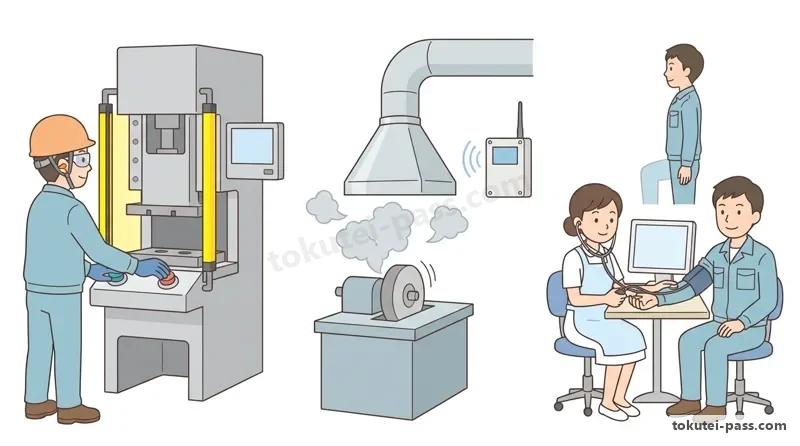
職業性疾病を防ぎ健康を守る「労働衛生の3管理」とは、①「作業環境管理(有害物発散源の密閉化・局所排気装置の設置・照明や温湿度の適正化など環境そのものの改善)」、②「作業管理(有害作業時間の短縮・無理のない作業姿勢・保護具の適正着用など作業方法の管理)」、③「健康管理(健康診断や事後措置)」です。
The "Three Managements of Occupational Health" to prevent occupational diseases and protect worker health are: ① "Working Environment Management (improving the environment itself—enclosing hazard sources, installing local exhaust ventilation, optimizing lighting, temperature, and humidity)," ② "Work Management (managing work methods—shortening hazardous exposure time, ergonomic posture, proper PPE use)," and ③ "Health Management (medical examinations and follow-up care)."
粉じん・有機溶剤・特定化学物質・騒音などの有害な作業場では、定期的(多くは6か月以内ごとに1回)に「作業環境測定」を行い、測定結果を3つの「管理区分」で評価します。
In hazardous workplaces handling dust, organic solvents, specified chemical substances, or noise, employers must periodically (typically at least once every 6 months) conduct "Working Environment Measurement" and evaluate the results into three "Control Classes."
「第1管理区分」は環境が適切な状態(維持継続)、「第2管理区分」は改善の余地がある中間状態(改善努力)、そして「第3管理区分」は管理濃度を超える不適切な状態であり、直ちに設備点検・改善措置を講じるとともに有効な呼吸用保護具を使用させる義務があります。
"Control Class 1" means the working environment is well-controlled and appropriate (maintain status); "Control Class 2" is an intermediate state with room for improvement (strive to improve); and "Control Class 3" is an inappropriate state exceeding administrative concentration levels—requiring immediate equipment inspection/improvement and mandatory use of effective respiratory protective equipment.
また「健康診断」には、雇入れ時および1年以内ごとに1回(深夜業や有害業務従事者は「6か月以内ごとに1回」)行う「一般健康診断」と、有機溶剤・鉛・じん肺などの有害業務に特化した「特殊健康診断(原則6か月以内ごとに1回)」があります。
Regarding "Medical Examinations," employers must conduct "General Health Examinations" upon hiring and periodically once a year (or "once every 6 months" for night-shift and designated hazardous work), as well as "Special Health Examinations" tailored to specific hazards like organic solvents, lead, or pneumoconiosis (generally "once every 6 months").
Key points
- 労働衛生の3管理:①作業環境管理(局所排気装置の設置・有害源密閉)+②作業管理(作業時間・姿勢・保護具着用)+③健康管理(健康診断)。
Three Managements of Occupational Health: ① Working Environment Management (local exhaust ventilation, enclosing sources) + ② Work Management (exposure time, posture, PPE) + ③ Health Management (health exams). - 作業環境測定の評価:第1管理区分(良好・維持)、第2管理区分(改善努力)、第3管理区分(不適切→直ちに設備改善と保護具着用が義務)。
Working Environment Measurement evaluation: Control Class 1 (good, maintain), Control Class 2 (strive to improve), Control Class 3 (inappropriate → immediate equipment improvement and PPE mandatory). - 定期健康診断は「1年以内ごとに1回」、深夜業等の特定業務従事者健診および有機溶剤等の特殊健康診断は「6か月以内ごとに1回」。
Periodic general health exams are "once a year"; exams for night-shift/specified workers and Special Health Examinations (organic solvents, etc.) are "once every 6 months."
| Word | Meaning |
|---|---|
| 労働衛生の3管理(作業環境管理・作業管理・健康管理) | Three Managements of Occupational Health (Working Environment, Work, Health) |
| 局所排気装置 | Local Exhaust Ventilation system |
| 作業環境測定(第1・第2・第3管理区分) | Working Environment Measurement (Control Classes 1, 2, and 3) |
| 一般健康診断と特殊健康診断 | General Health Examination and Special Health Examination |
6. 四大公害病と環境基本法の「典型7公害」
6. The Four Big Pollution Diseases and the "Typical 7 Pollutions" of the Basic Environment Act
日本の高度経済成長期(1950〜60年代)には、工場排水やばい煙による深刻な産業公害が発生し、「四大公害病」を引き起こしました。その反省が現在の厳しい環境法規の原点となっています。
During Japan's rapid economic growth era (1950s–1960s), factory effluent and smoke caused severe industrial pollution, resulting in the "Four Big Pollution Diseases." Reflection on these tragedies formed the starting point of Japan's strict modern environmental laws.
四大公害病の「発生地域と原因物質」は必ず暗記しましょう。①「水俣病(熊本県水俣湾)」と②「新潟水俣病(新潟県阿賀野川流域)」は工場排水中の「メチル水銀(有機水銀)化合物」が原因です。
Memorize the "region and causative substance" of each of the Four Big Pollution Diseases: ① "Minamata Disease (Minamata Bay, Kumamoto Prefecture)" and ② "Niigata Minamata Disease (Agano River basin, Niigata Prefecture)" were both caused by "Methylmercury (organic mercury) compounds" in factory wastewater.
③「イタイイタイ病(富山県神通川流域)」は鉱山排水中の「カドミウム」による慢性中毒(骨軟化症)であり、④「四日市ぜんそく(三重県四日市市)」は石油コンビナートから排出された「硫黄酸化物(SOx:亜硫酸ガス等)」による大気汚染が原因です。
③ "Itai-itai Disease (Jinzu River basin, Toyama Prefecture)" was chronic poisoning (osteomalacia) caused by "Cadmium" in mine effluent, and ④ "Yokkaichi Asthma (Yokkaichi City, Mie Prefecture)" was caused by air pollution from "Sulfur Oxides (SOx, such as sulfur dioxide)" emitted by petrochemical complexes.
現在の環境政策の根幹である「環境基本法」では、事業活動等によって人の健康や生活環境に被害が生じる「典型7公害」として、①大気汚染、②水質汚濁、③土壌汚染、④騒音、⑤振動、⑥地盤沈下(地下水の過剰くみ上げ等)、⑦悪臭の7つを定義しています。
The "Basic Environment Act," the cornerstone of current environmental policy, defines the "Typical 7 Pollutions" that harm human health or the living environment through business activities: ① Air Pollution, ② Water Pollution, ③ Soil Contamination, ④ Noise, ⑤ Vibration, ⑥ Ground Subsidence (from excessive groundwater pumping, etc.), and ⑦ Offensive Odors.
Key points
- 四大公害病:水俣病(熊本)と新潟水俣病(阿賀野川)=メチル水銀/イタイイタイ病(富山県神通川)=カドミウム/四日市ぜんそく(三重県)=硫黄酸化物(SOx)。
Four Big Pollution Diseases: Minamata (Kumamoto) & Niigata Minamata (Agano River) = Methylmercury / Itai-itai Disease (Jinzu River, Toyama) = Cadmium / Yokkaichi Asthma (Mie) = Sulfur Oxides (SOx). - 環境基本法の「典型7公害」=①大気汚染、②水質汚濁、③土壌汚染、④騒音、⑤振動、⑥地盤沈下、⑦悪臭。
"Typical 7 Pollutions" of the Basic Environment Act = ① Air pollution, ② Water pollution, ③ Soil contamination, ④ Noise, ⑤ Vibration, ⑥ Ground subsidence, ⑦ Offensive odors. - 産業廃棄物の不法投棄や日照阻害・電波障害などは環境問題であるが、「典型7公害」の7項目そのものには含まれない点に注意。
Note: Illegal dumping of industrial waste, sunlight obstruction, and radio wave interference are environmental issues, but they are NOT included among the "Typical 7 Pollutions."
| Word | Meaning |
|---|---|
| 四大公害病(水俣病・新潟水俣病・イタイイタイ病・四日市ぜんそく) | Four Big Pollution Diseases (Minamata, Niigata Minamata, Itai-itai, Yokkaichi Asthma) |
| メチル水銀・カドミウム・硫黄酸化物(SOx) | Methylmercury, Cadmium, and Sulfur Oxides (SOx) |
| 環境基本法と典型7公害 | Basic Environment Act and the Typical 7 Pollutions |
7. 公害防止法規(大気・水質BOD/COD・廃棄物マニフェスト)と緊急時対応
7. Pollution Control Laws (Air, Water BOD/COD, Waste Manifest System) and Emergency Response
「大気汚染防止法」は、ボイラーや焼却炉等のばい煙発生施設から出る「ばい煙(硫黄酸化物SOx・ばいじん・窒素酸化物NOx等の有害物質)」、塗装・洗浄工程から出る光化学オキシダントの原因「揮発性有機化合物(VOC)」、建物解体時等の「特定粉じん(石綿=アスベスト)」などを規制します。
The "Air Pollution Control Act" regulates "Soot and Smoke (harmful substances such as sulfur oxides SOx, soot/dust, and nitrogen oxides NOx)" emitted from boilers and incinerators, "Volatile Organic Compounds (VOCs)" from painting/cleaning processes that cause photochemical oxidants, and "Specified Particulates (Asbestos)" during building demolition.
「水質汚濁防止法」は、特定施設からの工場排水等について、カドミウム・シアン・水銀・六価クロムなどの「有害物質(人の健康項目)」と、pH・SS(浮遊物質量)・油分などの「生活環境項目」の排水基準を定めています。
The "Water Pollution Prevention Act" sets effluent standards for factory wastewater from specified facilities across two categories: "Harmful Substances (human health items)" such as cadmium, cyanide, mercury, and hexavalent chromium, and "Living Environment Items" such as pH, SS (suspended solids), and oil content.
特に有機物による水質汚濁の指標として、流れのある「河川」には微生物が有機物を分解するときに消費する酸素量である「BOD(生物化学的酸素要求量)」を用い、水が滞留する「湖沼・海域(海)」には酸化剤で化学的に測定する「COD(化学的酸素要求量)」を用います。
Specifically, as indicators of organic water pollution: flowing "Rivers (Kasen)" use "BOD (Biochemical Oxygen Demand)," the amount of oxygen consumed by microorganisms decomposing organic matter; stagnant "Lakes/Marshes and Sea Areas (Koshou / Kaiiki)" use "COD (Chemical Oxygen Demand)," measured chemically with an oxidizing agent.
「廃棄物処理法」では、汚泥・廃油・廃プラスチック・金属くずなどの「産業廃棄物」は「排出事業者に処理責任」があり、処理業者へ委託する際は「産業廃棄物管理票(マニフェスト)」を交付して最終処分終了まで確認・5年間保存する義務があります(3Rも推進します)。
Under the "Waste Management and Public Cleansing Act," "Industrial Waste" from factories—such as sludge, waste oil, waste plastics, and metal scrap—is the "processing responsibility of the waste-generating business"; when outsourcing disposal, the generator must issue an "Industrial Waste Management Ticket (Manifest)," verify completion through final disposal, and retain copies for 5 years (while promoting the 3Rs).
なお万一、有害物質や油の漏洩・流出事故が起きた際は、①発生源の緊急停止(バルブ閉止等)と構外流出の防止(土のう・オイルフェンス・中和等の応急措置)を直ちに行い、②社内責任者および都道府県知事・市区町村・消防等の行政機関へ速やかに通報・届出します。
If an accidental leak or spill of hazardous substances or oil occurs: ① Immediately shut down the source (close valves, etc.) and prevent off-site outflow using sandbags, oil fences, or neutralization, and ② Promptly report to internal managers and notify administrative authorities such as the prefectural governor, municipality, and fire department.
Key points
- 大気汚染防止法=ばい煙(SOx・NOx・ばいじん)、VOC(揮発性有機化合物)、特定粉じん(石綿=アスベスト)の排出規制。
Air Pollution Control Act = regulates emissions of soot/smoke (SOx, NOx, dust), VOCs (volatile organic compounds), and specified particulates (Asbestos). - 水質汚濁の指標:「河川(川)」の汚濁指標は「BOD(生物化学的酸素要求量)」/「湖沼・海域(海)」の汚濁指標は「COD(化学的酸素要求量)」。
Water pollution indicators: Organic pollution indicator for "Rivers" is "BOD (Biochemical Oxygen Demand)" / Indicator for "Lakes and Sea Areas" is "COD (Chemical Oxygen Demand)." - 産業廃棄物は「排出事業者」が責任を持ち、外部委託時は「マニフェスト(産業廃棄物管理票)」で最終処分まで確認する。
Industrial waste is the responsibility of the "waste-generating business"; when outsourcing, the "Manifest (Industrial Waste Management Ticket)" tracks waste until final disposal.
| Word | Meaning |
|---|---|
| 大気汚染防止法(ばい煙・VOC・特定粉じん=石綿) | Air Pollution Control Act (soot/smoke, VOCs, specified particulates = Asbestos) |
| 水質汚濁防止法(河川=BOD、湖沼・海域=COD) | Water Pollution Prevention Act (Rivers = BOD; Lakes & Sea Areas = COD) |
| 産業廃棄物とマニフェスト制度(産業廃棄物管理票) | Industrial Waste and the Manifest System (Industrial Waste Management Ticket) |
| 3R(リデュース・リユース・リサイクル) | 3Rs (Reduce, Reuse, Recycle) |
8. ISO 14001(環境マネジメントシステム)とSDGs(持続可能な開発目標)
8. ISO 14001 (Environmental Management System) and the SDGs (Sustainable Development Goals)
組織が自主的・継続的に環境負荷の低減や汚染の予防に取り組むための「環境マネジメントシステム(EMS)」の国際規格(認証基準)が「ISO 14001」です。
The international standard (certification standard) for an "Environmental Management System (EMS)" enabling organizations to voluntarily and continually reduce environmental impact and prevent pollution is "ISO 14001."
ISO 14001では、経営トップが定めた「環境方針」のもと、①計画(Plan:環境側面の抽出・順守義務の確認・環境目標の策定)→②実施及び運用(Do:運用管理と緊急事態への準備)→③パフォーマンス評価(Check:監視測定・内部監査・マネジメントレビュー)→④改善(Act:是正処置と継続的改善)のPDCAを回します。
Under an "Environmental Policy" established by top management, ISO 14001 rotates the PDCA cycle: ① Plan (identifying environmental aspects, compliance obligations, and environmental objectives) → ② Do (operational control and emergency preparedness) → ③ Check (monitoring/measurement, internal audit, management review) → ④ Act (corrective action and continual improvement).
また2015年の国連サミットで採択された、2030年までに達成すべき世界共通の目標が「SDGs(Sustainable Development Goals:持続可能な開発目標)」です。「地球上の誰一人取り残さない」を理念とし、「17のゴール(目標)」と「169のターゲット」で構成されています。
Adopted at the 2015 UN Summit, the universal global goals to be achieved by 2030 are the "SDGs (Sustainable Development Goals)." Guided by the pledge to "leave no one behind," the SDGs consist of "17 Goals" and "169 Targets."
SDGsが重視する「5つのP」とは、①人間(People:貧困や飢餓をなくす)、②地球(Planet:気候変動対策や環境保護)、③豊かさ(Prosperity:経済成長)、④平和(Peace)、⑤パートナーシップ(Partnership)です。
The "5 Ps" emphasized by the SDGs are: ① People (ending poverty and hunger), ② Planet (climate action and environmental protection), ③ Prosperity (economic growth), ④ Peace, and ⑤ Partnership.
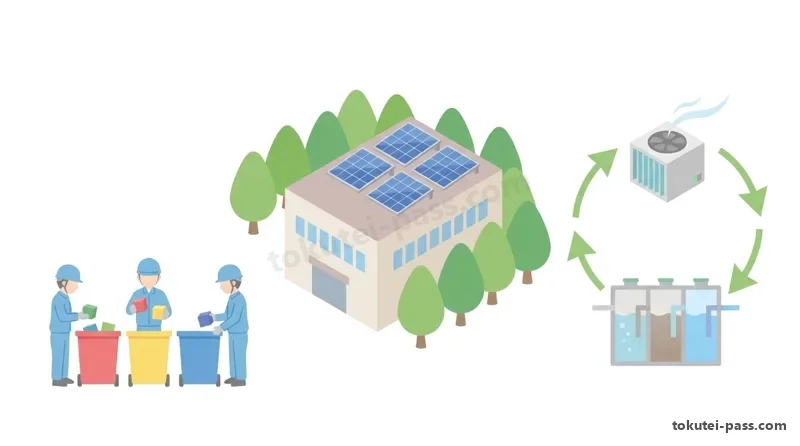
製造業においては、特に目標12「つくる責任 つかう責任(持続可能な生産と消費)」や、温室効果ガス排出実質ゼロを目指す「カーボンニュートラル(脱炭素)」への積極的な貢献が求められています。
In the manufacturing sector, active contributions are especially expected toward Goal 12 "Responsible Consumption and Production" and "Carbon Neutrality (decarbonization)," aiming for net-zero greenhouse gas emissions.
Key points
- ISO 14001=環境マネジメントシステム(EMS)の要求事項を定めた国際規格で、環境方針のもとPDCAサイクルで環境パフォーマンスを継続的に改善する。
ISO 14001 = international standard specifying requirements for an Environmental Management System (EMS), continually improving environmental performance via the PDCA cycle under an Environmental Policy. - SDGs(持続可能な開発目標)=2030年を達成期限とする「17のゴール(目標)と169のターゲット」。
SDGs (Sustainable Development Goals) = "17 Goals and 169 Targets" with a target deadline of 2030. - SDGsの「5つのP」=人間(People)・地球(Planet)・豊かさ(Prosperity)・平和(Peace)・パートナーシップ(Partnership)。
The "5 Ps" of the SDGs = People, Planet, Prosperity, Peace, and Partnership.
| Word | Meaning |
|---|---|
| ISO 14001(環境マネジメントシステム:EMS) | ISO 14001 (Environmental Management System: EMS) |
| 内部監査とマネジメントレビュー | Internal Audit and Management Review |
| SDGs(持続可能な開発目標:17のゴール) | SDGs (Sustainable Development Goals: 17 Goals) |
| SDGsの5つのPとカーボンニュートラル | 5 Ps of the SDGs and Carbon Neutrality |
試験によく出るポイントと覚え方
High-Frequency Exam Points and Memory Aids
安全衛生の計算では、「度数率=死傷者数÷延べ実労働時間×100万(頻度)」と「強度率=労働損失日数÷延べ実労働時間×1,000(重さ)」の掛ける桁数(100万と1,000)を絶対に取り違えないようにしましょう。
In safety statistics calculations, never mix up the multipliers (1,000,000 vs. 1,000) between "Frequency Rate = Casualties ÷ Total Working Hours × 1,000,000 (frequency)" and "Severity Rate = Lost Workdays ÷ Total Working Hours × 1,000 (seriousness)."
法規の数字では、「50人以上=安全管理者・衛生管理者・産業医・安全衛生委員会」「職場巡視=衛生管理者は毎週1回、産業医は毎月1回」「フォークリフト・玉掛けの就業制限=1t以上、クレーン免許=5t以上」が頻出です。
For statutory numbers, top exam questions test: "50 or more workers = Safety Officer, Health Officer, Industrial Physician, Safety & Health Committee," "Workplace patrol = Health Officer weekly, Industrial Physician monthly," and "Restricted Work for Forklifts & Slinging (Tamagake) = ≥ 1 ton; Crane license = ≥ 5 tons."
また「フェールセーフ(故障時に安全側へ停止)とフールプルーフ(人間の誤操作防止)」、「作業環境測定の第3管理区分(直ちに改善と保護具着用が必要)」もよく狙われます。
Also watch for "Fail-Safe (stopping on the safe side when a machine fails) vs. Fool-Proof (preventing human misoperation)" and "Control Class 3 in Working Environment Measurement (requires immediate improvement and respiratory PPE)."
環境分野では、「四大公害病の地域と原因物質(水俣・新潟=メチル水銀、富山イタイイタイ病=カドミウム、四日市=SOx)」「典型7公害」「川(河川)=BOD、海・湖=COD」「産廃マニフェスト=排出事業者が交付」「ISO 14001とSDGs(17ゴール・5つのP)」を確実に暗記してください。
In the environmental section, memorize: "Regions and causes of the Four Big Pollution Diseases (Minamata & Niigata = Methylmercury, Toyama Itai-itai = Cadmium, Yokkaichi = SOx)," "Typical 7 Pollutions," "Rivers = BOD vs. Lakes & Sea = COD," "Industrial Waste Manifest = issued by the waste-generating business," and "ISO 14001 & SDGs (17 Goals, 5 Ps)."
Key points
- 度数率=死傷者数÷延べ労働時間×100万/強度率=損失日数÷延べ労働時間×1,000/衛生管理者巡視=週1回、産業医巡視=月1回。
Frequency Rate = Casualties ÷ Working Hours × 1,000,000 / Severity Rate = Lost Days ÷ Working Hours × 1,000 / Patrols: Health Officer = weekly, Industrial Physician = monthly. - 四大公害病:水俣・新潟=メチル水銀、イタイイタイ病=カドミウム、四日市=硫黄酸化物(SOx)/水質指標:河川=BOD、湖沼・海域=COD。
Four Big Pollution Diseases: Minamata & Niigata = Methylmercury, Itai-itai = Cadmium, Yokkaichi = SOx / Water indicators: Rivers = BOD, Lakes & Sea = COD. - ISO 9001=品質、ISO 14001=環境マネジメント/SDGs=17のゴール・169のターゲット・5つのP(People, Planet, Prosperity, Peace, Partnership)。
ISO 9001 = Quality, ISO 14001 = Environmental Management / SDGs = 17 Goals, 169 Targets, 5 Ps (People, Planet, Prosperity, Peace, Partnership).
| Word | Meaning |
|---|---|
| 度数率(×100万)と強度率(×1,000) | Frequency Rate (× 1,000,000) and Severity Rate (× 1,000) |
| 衛生管理者(週1回)と産業医(月1回)の職場巡視 | workplace patrols by Health Officer (weekly) and Industrial Physician (monthly) |
| 四大公害病と河川BOD・海域COD | Four Big Pollution Diseases and River BOD vs. Sea/Lake COD |
| ISO 14001とSDGs(17のゴール・5つのP) | ISO 14001 and SDGs (17 Goals and 5 Ps) |
Safety, Health & Environment
Practice this chapter in the appOfficial references
- 中央職業能力開発協会(JAVADA) ビジネス・キャリア検定試験 3級 生産管理オペレーション 試験範囲 — https://www.javada.or.jp/jigyou/gino/business/subject.html
- 中央職業能力開発協会 編『ビジネス・キャリア検定試験 標準テキスト【専門知識】生産管理オペレーション 3級〔第4版〕』 — https://www.javada.or.jp/jigyou/gino/business/text.html