
Home › Sample questions › Accommodation (Hotel)
Tokutei Ginou Accommodation (Hotel) practice test with answers – free sample questions
宿泊分野
10 sample questions in the real exam format, with furigana, English translation, answers and explanations. Tap "Show answer" under each question. For the full question bank and realistic mock exams, open the free app.
Question 1
宿泊施設が季節や地域の行事に合わせて新しい宿泊プランを企画する主な目的として、最も適切なものはどれですか。
What is the most appropriate main purpose for an accommodation facility to plan new stay packages aligned with seasons and local events?
- A. 通年で同一の宿泊料金に固定し、時期による料金変動をなくすため。
To fix a single uniform room rate year-round and eliminate price fluctuations by season. - B. 季節ごとの魅力を伝えて集客を高め、閑散期を含めた客室の稼働を安定させるため。
To convey seasonal appeal to attract guests and stabilize room occupancy including during off-peak periods. - C. 既存の定番プランを廃止し、提供する料理や客室タイプを1種類に絞り込むため。
To abolish existing standard plans and narrow down the meals and room types offered to just one kind.
Show answer
Correct answer: B
Creating stay packages tailored to seasonal themes and local events highlights unique seasonal attractions, boosting guest numbers and stabilizing room occupancy even during slower off-peak periods. Fixing a single flat rate year-round or eliminating standard plans to offer only one room type is not the purpose of seasonal package planning.
| Word | Meaning |
|---|---|
| 宿泊プラン | stay package, accommodation plan |
| 企画 | planning |
| 集客 | attracting customers |
| 閑散期 | off-peak season, low season |
Question 2
地域の観光資源を活かした宿泊プランの造成に関する記述として、最も適切なものはどれですか。
Which statement is most appropriate regarding the creation of stay packages that utilize local tourism resources?
- A. その土地ならではの温泉や旬の郷土料理を組み込み、地域の魅力を体験できる内容にする。
Incorporate unique local hot springs and seasonal regional cuisine so guests can experience the appeal of the area. - B. 地域の観光施設との提携は行わず、館内のサービスだけで完結するプラン内容にする。
Do not partner with local tourist facilities, and design package contents that are completed solely through in-house services. - C. 地元の食材は仕入れが変動するため控え、通年で同じ定番メニューに統一する。
Refrain from using local ingredients because supply fluctuates, and standardize on the same regular menu year-round.
Show answer
Correct answer: A
Effective package creation leverages local tourism resources such as hot springs, seasonal local ingredients, regional dishes, and partnerships with nearby attractions so guests can enjoy an authentic local experience. Avoiding collaboration with local facilities or serving only a fixed year-round menu diminishes regional appeal.
| Word | Meaning |
|---|---|
| 観光資源 | tourism resources |
| 造成 | creation, development (of a package) |
| 郷土料理 | regional cuisine, local dishes |
| 連携 | cooperation, partnership |
Question 3
宿泊施設で火災が発生した際の初期対応の3原則として、正しい組み合わせはどれですか。
Which combination is correct as the three principles of initial response when a fire breaks out at an accommodation facility?
- A. 原因調査・貴重品回収・被害記録
Cause investigation – Valuables recovery – Damage recording - B. 防火点検・設備補修・避難訓練
Fire safety inspection – Equipment repair – Evacuation drill - C. 通報(連絡)・初期消火・避難誘導
Notification (reporting) – Initial firefighting – Evacuation guidance
Show answer
Correct answer: C
When a fire occurs at an accommodation facility, the three principles of initial response are Notification (alerting staff and calling 119), Initial firefighting (extinguishing the fire while it is still small), and Evacuation guidance (prioritizing guest lives above all). Fire inspections and drills are routine preventive measures, while cause investigation and damage recording take place after the emergency.
💡 Three principles of initial fire response: Notification (call 119 and alert staff) – Initial firefighting (use fire extinguishers early) – Evacuation guidance (guest safety first).
| Word | Meaning |
|---|---|
| 初期対応 | initial response |
| 通報 | notification, emergency reporting |
| 初期消火 | initial firefighting |
| 避難誘導 | evacuation guidance |
Question 4
宿泊施設で大きな地震が発生した際の対応として、正しいものはどれですか。
Which is the correct response when a major earthquake occurs at an accommodation facility?
- A. お客様に頭部を保護してもらうよう案内し、ドアを開けて避難経路を確保する。
Guide guests to protect their heads and open doors to secure an evacuation route. - B. 揺れが続いている間に、お客様をエレベーターに乗せて1階のロビーへ移動させる。
Put guests into the elevator while the shaking continues to move them to the first-floor lobby. - C. 揺れが収まるのを待たず、すぐに非常階段から屋外へ走って避難するよう促す。
Without waiting for the shaking to subside, urge guests to immediately run outside via the emergency stairs.
Show answer
Correct answer: A
During a strong earthquake, staff must instruct guests to protect their heads and open doors so a warped door frame does not trap them inside. Elevators must never be used during an earthquake, and rushing down stairs while strong shaking continues is dangerous due to the risk of falling or being struck by falling objects.
| Word | Meaning |
|---|---|
| 地震 | earthquake |
| 頭部 | head (body part) |
| 保護 | protection |
| 避難経路 | evacuation route |
Question 5
レストランの開店前に行うブリーフィング(打ち合わせ)の内容として、最も適切なものはどれですか。
Which content is most appropriate for the pre-opening briefing (staff meeting) at a restaurant?
- A. 前月の部門別の売上実績を集計し、来月のスタッフのシフト表を作成する。
Tally the previous month's departmental sales results and create next month's staff shift schedule. - B. 使用した調理器具の棚卸しと、閉店後のテーブルリセットの手順を確認する。
Take inventory of used cooking utensils and confirm the post-closing table reset procedures. - C. 当日の予約状況やおすすめ料理、お客様の食物アレルギー情報などを共有する。
Sharing the day's reservation status, recommended dishes, and guests' food allergy information.
Show answer
Correct answer: C
A pre-opening briefing brings service staff together before opening to share the day's reservation details, recommended menu items, and critical guest requests such as food allergies. Monthly sales tallies, shift scheduling, or post-closing inventory checks are not the primary purpose of the pre-opening briefing.
| Word | Meaning |
|---|---|
| 開店前 | before opening |
| 予約状況 | reservation status |
| 食物アレルギー | food allergy |
| 共有 | sharing (information) |
Question 6
日本料理の「会席料理」において、最初に提供される小鉢などの料理から、お造り(刺身)までの基本的な献立の順番として、正しいものはどれですか。
In Japanese "Kaiseki" cuisine, which is the correct basic menu order from the small starter dish served first up to the sliced raw fish (Otsukuri / Sashimi)?
- A. お造り → 吸物 → 先付け
Otsukuri → Suimono → Sakizuke - B. 先付け → 吸物 → お造り
Sakizuke → Suimono → Otsukuri - C. 吸物 → 先付け → お造り
Suimono → Sakizuke → Otsukuri
Show answer
Correct answer: B
In a traditional Kaiseki course, the meal begins with Sakizuke (a small appetizer served first), followed by Suimono (a clear soup to cleanse the palate), and then Otsukuri (fresh sashimi). Serving Otsukuri or Suimono before the opening Sakizuke appetizer reverses the standard course progression.
| Word | Meaning |
|---|---|
| 会席料理 | Kaiseki cuisine (traditional multi-course meal) |
| 献立 | menu, course sequence |
| 先付け | Sakizuke (opening appetizer) |
| 吸物 | Suimono (clear soup) |
Question 7
宿泊施設の4つの種類のうち、主に駅の周辺や都市部に立地し、出張などのビジネス客に向けたシングルルームを中心とする施設はどれですか。
Among the four types of accommodation facilities, which one is mainly located near train stations or in urban areas and focuses on single rooms for business travelers?
- A. ビジネスホテル
Business hotel - B. リゾートホテル
Resort hotel - C. 旅館
Ryokan (traditional Japanese inn)
Show answer
Correct answer: A
Business hotels are typically located near train stations or business districts and feature mainly functional single rooms tailored to business travelers. Resort hotels are built in scenic mountain, beach, or highland areas for leisure stays, while Ryokan are traditional Japanese-style inns featuring tatami rooms and hot springs.
| Word | Meaning |
|---|---|
| 宿泊施設 | accommodation facility |
| 都市部 | urban area |
| 立地 | location, site |
| 出張 | business trip |
Question 8
ホテルや旅館のスタッフに求められる「身だしなみの3原則」として、正しい組み合わせはどれですか。
Which combination is correct as the "Three Principles of Grooming (Midashinami)" required of hotel and ryokan staff?
- A. 流行・個性・華やかさ
Trendiness – Individuality – Glamorousness - B. 清潔・端正・機能的
Cleanliness – Neatness – Functionality (Harmony) - C. 迅速・正確・効率的
Speed – Accuracy – Efficiency
Show answer
Correct answer: B
The three principles of professional grooming in the accommodation industry are Cleanliness (hygienic and pleasant for guests), Neatness (properly worn uniform and tidy appearance), and Functionality/Harmony (easy to work in and matching the facility's atmosphere). Trendiness and individuality describe personal fashion (oshare), while speed and accuracy refer to operational work performance.
💡 Three principles of grooming (Midashinami): Cleanliness (Seiketsu) – Neatness (Tansei) – Functionality and Harmony (Kinoteki/Chowa), prioritizing guest comfort over personal fashion.
| Word | Meaning |
|---|---|
| 身だしなみ | personal grooming and attire |
| 清潔 | cleanliness |
| 端正 | neatness, tidiness |
| 機能的 | functional, practical |
Question 9
予約受付の際、お客様から「1泊朝食付きのプランを予約したいのですが、ホテルで夕食はとれますか」と質問されました。フロントスタッフの対応として、最も適切なものはどれですか。
While taking a reservation, a guest asks, "I would like to book the 1-night bed-and-breakfast plan, but can I have dinner at the hotel?" Which response by the front desk staff is most appropriate?
- A. 予約後のプラン変更はできないため、夕食はホテルの外の飲食店を利用するよう案内する。
Guide the guest to use restaurants outside the hotel for dinner because the plan cannot be changed after booking. - B. 1泊朝食付きプランにも夕食が含まれていると説明し、そのまま予約手続きを進める。
Explain that dinner is already included in the bed-and-breakfast plan and proceed with the booking as is. - C. 夕食は別料金になる旨を説明し、1泊2食付きプランや館内レストランを案内する。
Explain that dinner is charged separately, and introduce the half-board (1-night 2-meals) plan or on-site restaurants.
Show answer
Correct answer: C
A 1-night bed-and-breakfast plan (1-paku choshoku-tsuki) includes only the room and breakfast, not dinner. The staff member should politely clarify this and offer the 1-night 2-meals plan (1-paku 2-shoku-tsuki) or guide the guest on how to dine at the hotel's restaurant. Claiming dinner is included or forcing the guest to dine outside is inappropriate.
| Word | Meaning |
|---|---|
| 予約受付 | reservation reception |
| 1泊朝食付き | 1 night with breakfast included |
| 1泊2食付き | 1 night with 2 meals (dinner and breakfast) |
| 料金 | rate, charge |
Question 10
図のように、フロントやロビーでお客様をお出迎えして「いらっしゃいませ」と挨拶するときのお辞儀の種類と角度として、正しいものはどれですか。
As shown in the figure, when welcoming guests at the front desk or lobby with the greeting "Irasshaimase," which type of bow and angle is correct?
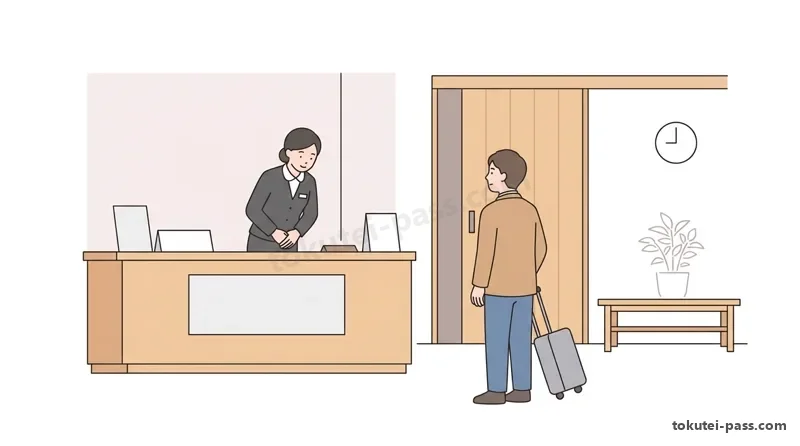
- A. 背筋を伸ばして腰から約15度曲げる「会釈」
Eshaku – Light bow (keeping the back straight and bending about 15 degrees from the hips) - B. 背筋を伸ばして腰から約30度曲げる「敬礼」
Keirei – Respectful bow (keeping the back straight and bending about 30 degrees from the hips) - C. 背筋を伸ばして腰から約45度曲げる「最敬礼」
Saikeirei – Deepest bow (keeping the back straight and bending about 45 degrees from the hips)
Show answer
Correct answer: B
The illustration shows a hotel staff member performing a 30-degree bow while welcoming a guest at the lobby. When welcoming guests with "Irasshaimase" or expressing standard gratitude, staff use Keirei (about 30 degrees). Eshaku (15 degrees) is used when passing guests in hallways, while Saikeirei (45 degrees) is reserved for deep gratitude or apologies.
💡 Three standard bowing angles: Eshaku = 15 degrees (passing in hallways); Keirei = 30 degrees (welcoming guests with Irasshaimase); Saikeirei = 45 degrees (deep gratitude or apologies).
| Word | Meaning |
|---|---|
| お出迎え | welcoming guests |
| お辞儀 | bow, bowing |
| 敬礼 | Keirei (30-degree respectful bow) |
| 角度 | angle |