
Home › Sample questions › Automobile Maintenance (SSW 2)
Tokutei Ginou 2 Automobile Maintenance practice test with answers – free sample questions
自動車整備分野(2号)
10 sample questions in the real exam format, with furigana, English translation, answers and explanations. Tap "Show answer" under each question. For the full question bank and realistic mock exams, open the free app.
Question 1
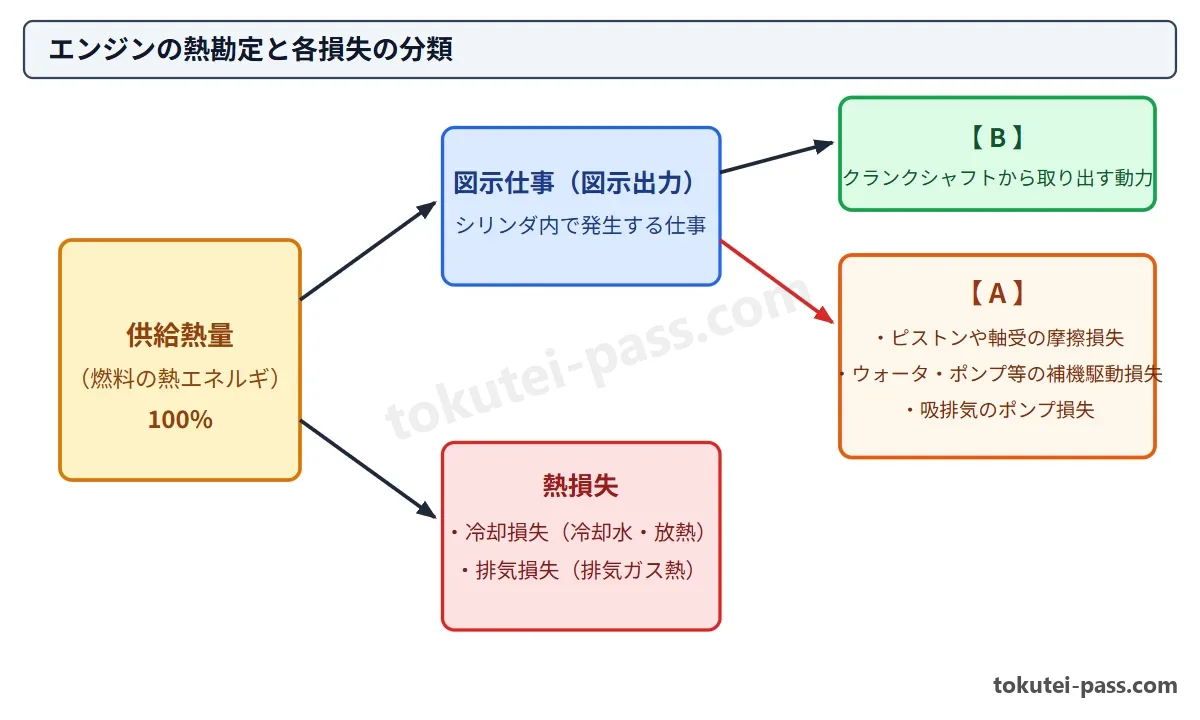
図に示すエンジンの熱勘定と各損失の分類において、図示仕事から差し引かれる【 A 】と、クランクシャフトから取り出される【 B 】の組み合わせとして、適切なものは次のうちどれか。
In the engine heat balance and loss classification diagram shown, which combination correctly identifies loss A subtracted from indicated work and output B taken from the crankshaft?
- A. 【 A 】排気損失 【 B 】図示出力
A: Exhaust loss — B: Indicated output - B. 【 A 】機械損失 【 B 】軸出力
A: Mechanical loss — B: Brake shaft output - C. 【 A 】冷却損失 【 B 】摩擦出力
A: Cooling loss — B: Friction output - D. 【 A 】ふく射損失 【 B 】理論出力
A: Radiation loss — B: Theoretical output
Show answer
Correct answer: B
The work generated inside the cylinder is indicated work (indicated output). Subtracting mechanical loss A (friction of pistons and bearings, accessory drive loss for water/oil pumps and alternator, plus pumping loss) yields the net power taken from the crankshaft, which is brake shaft output B.
💡 Engine loss rule: Thermal loss includes cooling and exhaust losses; Mechanical loss includes friction, accessory drive, and pumping losses. Brake shaft output equals Indicated output minus Mechanical loss.
| Word | Meaning |
|---|---|
| 熱勘定 | heat balance |
| 図示仕事 | indicated work |
| 機械損失 | mechanical loss |
| 軸出力 | brake shaft output |
Question 2
ピストンおよびピストン・リングに関する記述として、不適切なものは次のうちどれか。
Which of the following statements concerning pistons and piston rings is INCORRECT?
- A. コンプレッション・リングは、燃焼室の気密保持とピストンの放熱を行い、シリンダ壁面へ熱を逃がしている。
The compression ring maintains combustion chamber gas tightness and transfers heat from the piston to the cylinder wall. - B. テーパ・フェース型のコンプレッション・リングは、外周面にわずかな傾斜があり、主にセカンド・リングに用いられる。
A taper-face compression ring has a slight inclination on its outer periphery and is mainly used as the second ring. - C. スカッフ現象とは、高速回転時にリングが溝内で上下に振動して気密不良を起こすことをいう。
Scuffing refers to the phenomenon in which the ring vibrates violently up and down in the ring groove at high engine speeds, causing poor sealing. - D. オフセット・ピストンは、ピストン・ピン穴の中心をピストン中心線からスラスト側へわずかにずらして打音を軽減している。
An offset piston has the center of its piston pin hole slightly shifted toward the thrust side from the piston centerline to reduce piston slap noise.
Show answer
Correct answer: C
Violent up-and-down vibration of the piston ring inside its groove at high rotational speeds is called ring fluttering. Scuffing occurs when the lubricating oil film on the cylinder wall breaks down, causing direct metal-to-metal contact and scratch marks on the ring and cylinder wall.
| Word | Meaning |
|---|---|
| コンプレッション・リング | compression ring |
| テーパ・フェース型 | taper-face type |
| スカッフ現象 | scuffing phenomenon |
| フラッタ現象 | fluttering phenomenon |
Question 3
鉛バッテリの特性に関する記述として、不適切なものは次のうちどれか。
Which of the following statements concerning the characteristics of a lead-acid battery is INCORRECT?
- A. 5時間率放電で連続放電した場合の放電終止電圧は、一般に1セル当たり1.75Vである。
The final discharge voltage when discharged at the 5-hour rate is generally 1.75V per cell. - B. 電解液の温度が一定である場合、電解液の比重が1.200のときより1.280のときの方が起電力は大きい。
When the electrolyte temperature is constant, the electromotive force is greater at a specific gravity of 1.280 than at 1.200. - C. 電解液の比重は温度によって変化し、液温が1℃上昇するごとに約0.0007ずつ小さくなる。
The specific gravity of the electrolyte varies with temperature, decreasing by about 0.0007 for every 1℃ rise in temperature. - D. 液温50℃未満では、バッテリ容量は電解液温度が高くなるほど減少する。
At electrolyte temperatures below 50℃, the battery capacity decreases as the electrolyte temperature becomes higher.
Show answer
Correct answer: D
At electrolyte temperatures below 50℃, higher temperature lowers electrolyte viscosity and speeds up diffusion into the plate pores, so battery capacity increases as temperature rises (conversely, capacity drops sharply in cold weather).
💡 Lead-acid battery rule (below 50℃): Higher temperature or higher specific gravity INCREASES both electromotive force and battery capacity; final discharge voltage is 1.75V per cell.
| Word | Meaning |
|---|---|
| 鉛バッテリ | lead-acid battery |
| 放電終止電圧 | final discharge voltage |
| 電解液 | electrolyte |
| 起電力 | electromotive force |
Question 4
ガソリン・エンジンの電子制御式燃料噴射装置に用いられるセンサに関する記述として、適切なものは次のうちどれか。
Which of the following statements concerning sensors used in an electronically controlled gasoline fuel injection system is CORRECT?
- A. バキューム・センサ(吸気管圧力センサ)は、インテーク・マニホールド圧力が高くなるほど出力電圧が高くなる特性がある。
The vacuum sensor (manifold absolute pressure sensor) has the characteristic that its output voltage increases as intake manifold absolute pressure increases. - B. ジルコニア式O2センサは、理論空燃比付近で内外の酸素濃度差が小さくなると約1Vの起電力を発生する。
A zirconia O2 sensor generates an electromotive force of about 1V when the oxygen concentration difference between its inner and outer surfaces becomes small. - C. ホット・ワイヤ式エア・フロー・メータは、吸入空気の体積流量を検出するため、吸気温度による密度補正が不可欠である。
A hot-wire air flow meter detects intake air volume flow rate and therefore requires density correction based on intake air temperature. - D. 圧電素子式ノック・センサは、シリンダ・ブロックの振動が大きくなるほど内部の電気抵抗が減少する特性を利用している。
A piezoelectric knock sensor utilizes the characteristic that its internal electrical resistance decreases as cylinder block vibration increases.
Show answer
Correct answer: A
A vacuum sensor (MAP sensor) measures absolute pressure in the intake manifold; as throttle opening increases and manifold absolute pressure rises, its output voltage increases proportionally. A zirconia O2 sensor generates about 1V when the oxygen difference is large (rich mixture); a hot-wire air flow meter directly measures intake air mass; a piezoelectric knock sensor generates voltage directly via the piezoelectric effect.
| Word | Meaning |
|---|---|
| バキューム・センサ | vacuum sensor |
| インテーク・マニホールド圧力 | intake manifold pressure |
| ジルコニア式O2センサ | zirconia O2 sensor |
| エア・フロー・メータ | air flow meter |
Question 5
電子制御式ATのロックアップ機構および構成部品に関する記述として、不適切なものは次のうちどれか。
Which of the following statements concerning the lock-up mechanism and components of an electronically controlled automatic transmission (AT) is INCORRECT?
- A. ロックアップ・ピストンには、直結時にエンジンからのトルク変動を吸収・緩和するダンパ・スプリングが組み込まれている。
The lock-up piston incorporates damper springs to absorb and cushion engine torque fluctuations during direct engagement. - B. ロックアップ・ピストンは、タービン・ランナのハブにスプライン嵌合されており、軸方向へ摺動できるようになっている。
The lock-up piston is splined to the hub of the turbine runner so that it can slide in the axial direction. - C. 湿式多板クラッチには、クラッチ接続時の衝撃を和らげるためのディッシュ・プレートが組み込まれている。
A wet multi-plate clutch incorporates a dish plate to cushion engagement shock when the clutch is applied. - D. ロックアップ・ピストンがフロント・カバーから離れると、ポンプ・インペラとタービン・ランナが機械的に直結される。
When the lock-up piston moves away from the front cover, the pump impeller and turbine runner are mechanically coupled.
Show answer
Correct answer: D
The lock-up clutch mechanically couples the front cover (pump impeller) and turbine runner only when hydraulic pressure presses the lock-up piston tightly AGAINST the front cover. When the piston moves away from the front cover, lock-up is disengaged and power is transmitted hydrokinetically through the fluid.
| Word | Meaning |
|---|---|
| ロックアップ機構 | lock-up mechanism |
| ダンパ・スプリング | damper spring |
| タービン・ランナ | turbine runner |
| ディッシュ・プレート | dish plate |
Question 6
タイヤの特性および用語に関する記述として、適切なものは次のうちどれか。
Which of the following statements concerning tire characteristics and terminology is CORRECT?
- A. 静荷重半径とは、規定空気圧のタイヤを平板に垂直に置いて規定荷重を加えたときの軸中心から接地面までの最短距離をいう。
Static loaded radius is the shortest distance from the axle center to the ground contact surface when a tire inflated to specified pressure is placed vertically on a flat plate under specified load. - B. タイヤの転がり抵抗は、タイヤの空気圧が規定値より低くなるほど変形量が小さくなるため減少する。
Tire rolling resistance decreases as tire air pressure drops below the specified value because tire deformation becomes smaller. - C. 静的縦ばね定数とは、静止したタイヤに10mmの縦たわみを与えるために必要な垂直荷重のことをいう。
Static vertical spring constant refers to the vertical load required to produce a vertical deflection of 10mm in a stationary tire. - D. 静的縦ばね定数が大きいタイヤほど、路面からの衝撃をやわらかく吸収するため乗り心地が良くなる。
A tire with a larger static vertical spring constant absorbs road shocks more softly and provides better ride comfort.
Show answer
Correct answer: A
Static loaded radius is the shortest vertical distance from the wheel center to the contact patch under specified inflation pressure and load. Lower air pressure increases tire deformation and rolling resistance. The static vertical spring constant is the load per 1mm of vertical deflection (unit: N/mm, not 10mm), and a higher value means a stiffer tire with harsher ride comfort.
| Word | Meaning |
|---|---|
| 静荷重半径 | static loaded radius |
| 転がり抵抗 | rolling resistance |
| 静的縦ばね定数 | static vertical spring constant |
| 接地面 | ground contact surface |
Question 7
1シリンダ当たりの行程容積が450cm³、燃焼室容積が50cm³であるエンジンの圧縮比として、適切なものは次のうちどれか。
What is the compression ratio of an engine with a stroke volume (displacement) per cylinder of 450cm³ and a combustion chamber volume of 50cm³?
- A. 8.0
- B. 9.0
- C. 10.0
- D. 11.0
Show answer
Correct answer: C
Compression ratio formula: Compression ratio = (Stroke volume + Combustion chamber volume) / Combustion chamber volume. Substituting the values: (450 + 50) / 50 = 500 / 50 = 10.0. A common mistake is dividing 450 by 50 to get 9.0 without adding the combustion chamber volume to the numerator.
💡 Compression ratio formula: (Stroke volume + Combustion chamber volume) / Combustion chamber volume = (Vh / Vc) + 1. Always remember to add the combustion chamber volume in the numerator.
| Word | Meaning |
|---|---|
| 行程容積 | stroke volume |
| 燃焼室容積 | combustion chamber volume |
| 圧縮比 | compression ratio |
| 上死点 | top dead center |
Question 8
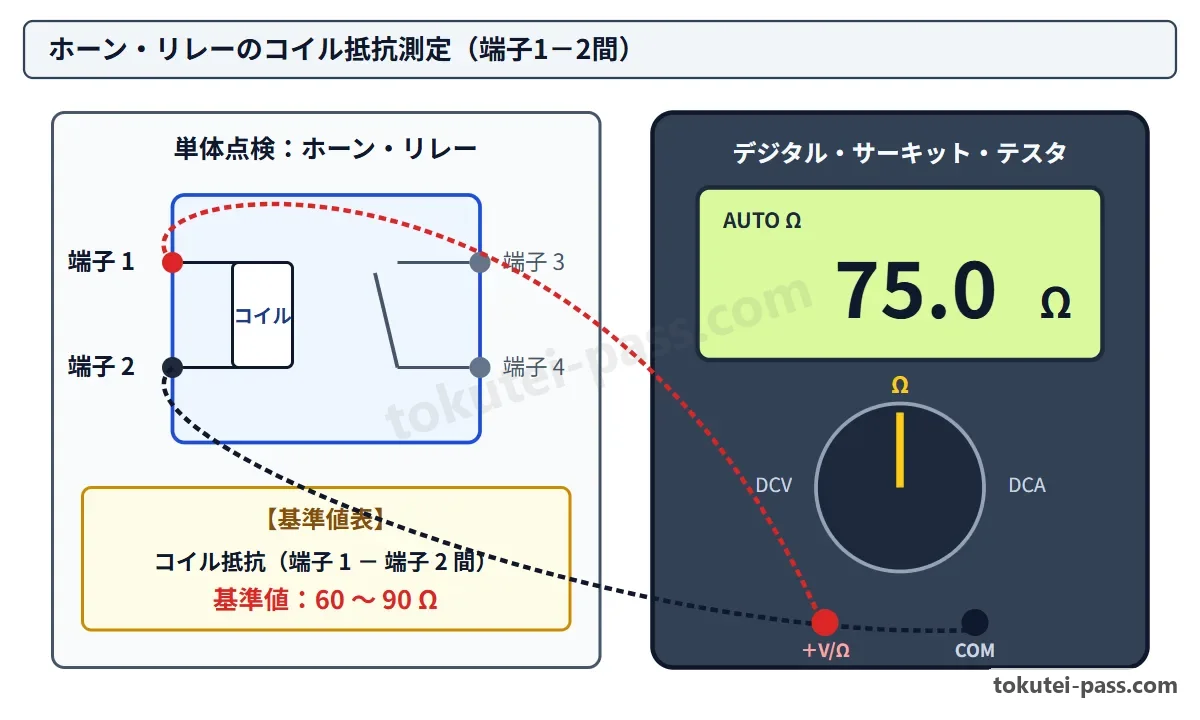
サーキット・テスタを用いた電気部品の単体抵抗測定作業について、図のようにホーン・リレーのコイル抵抗を測定する際の事前準備として、適切なものは次のうちどれか。
Regarding standalone component resistance measurement using a circuit tester, which preparation is appropriate when measuring the horn relay coil resistance as shown in the figure?
- A. 車両の回路からリレーを取り外し、電圧が掛かっていない単体状態にしてから測定する。
Remove the relay from the vehicle circuit and measure it as an isolated component with no voltage applied. - B. 車両のコネクタを接続してコイルにバッテリ電圧を掛けた状態のまま抵抗を測定する。
Leave the vehicle connector attached and measure the resistance while battery voltage is applied to the coil.
Show answer
Correct answer: A
When measuring resistance (Ω) with a circuit tester, the component must always be disconnected from any power source. Measuring resistance on a live circuit with battery voltage applied causes inaccurate readings and can damage the tester.
| Word | Meaning |
|---|---|
| サーキット・テスタ | circuit tester |
| 単体抵抗測定 | standalone resistance measurement |
| ホーン・リレー | horn relay |
| コイル抵抗 | coil resistance |
Question 9
図に示すホーン・リレーの端子1と端子2間のコイル抵抗(基準値:60~90Ω)を測定したデジタル・サーキット・テスタの表示から、抵抗値と良否判定の組み合わせとして、適切なものは次のうちどれか。
From the digital circuit tester display measuring the coil resistance between terminals 1 and 2 of the horn relay shown in the figure (standard value: 60 to 90Ω), which combination of resistance value and pass/fail judgment is appropriate?
- A. 75.0Ω・否
75.0Ω · Fail (否) - B. 75.0Ω・良
75.0Ω · Pass (良) - C. 7.5Ω・否
7.5Ω · Fail (否) - D. 750Ω・否
750Ω · Fail (否)
Show answer
Correct answer: B
The digital multimeter screen displays 75.0 with the unit Ω (75.0Ω). Since 75.0Ω falls within the specified standard range of 60 to 90Ω, the component is judged as Pass (良).
| Word | Meaning |
|---|---|
| 端子 | terminal |
| 基準値 | standard value |
| 抵抗値 | resistance value |
| 良否判定 | pass/fail judgment |
Question 10
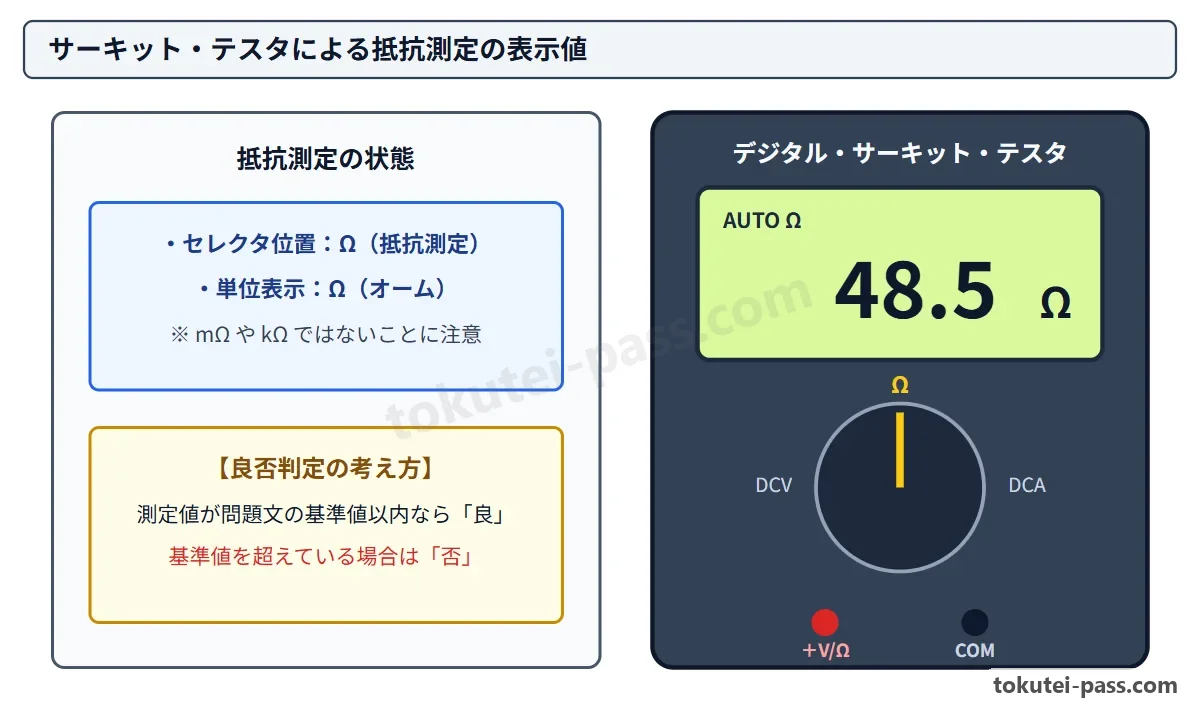
ストップ・ランプ・スイッチの単体点検において、スイッチを押し込んだON状態での端子間抵抗(基準値:1.0Ω以下)を測定したところ、図のテスタ表示となった。測定値と良否判定として、適切なものは次のうちどれか。
During standalone inspection of a stop lamp switch, measuring the terminal resistance with the switch pushed ON (standard value: 1.0Ω or less) produced the tester display shown in the figure. Which combination of measured value and pass/fail judgment is appropriate?
- A. 48.5Ω・良
48.5Ω · Pass (良) - B. 0.48Ω・良
0.48Ω · Pass (良) - C. 48.5Ω・否
48.5Ω · Fail (否) - D. 4.85Ω・否
4.85Ω · Fail (否)
Show answer
Correct answer: C
The multimeter displays 48.5Ω. Because the standard resistance when the switch is ON is 1.0Ω or less, a reading of 48.5Ω indicates excessive contact resistance inside the switch and is judged as Fail (否).
| Word | Meaning |
|---|---|
| ストップ・ランプ・スイッチ | stop lamp switch |
| 単体点検 | standalone inspection |
| 接触抵抗 | contact resistance |
| 測定値 | measured value |