
Home › Sample questions › Automobile Maintenance
Tokutei Ginou Automobile Maintenance practice test with answers – free sample questions
自動車整備分野
10 sample questions in the real exam format, with furigana, English translation, answers and explanations. Tap "Show answer" under each question. For the full question bank and realistic mock exams, open the free app.
Question 1
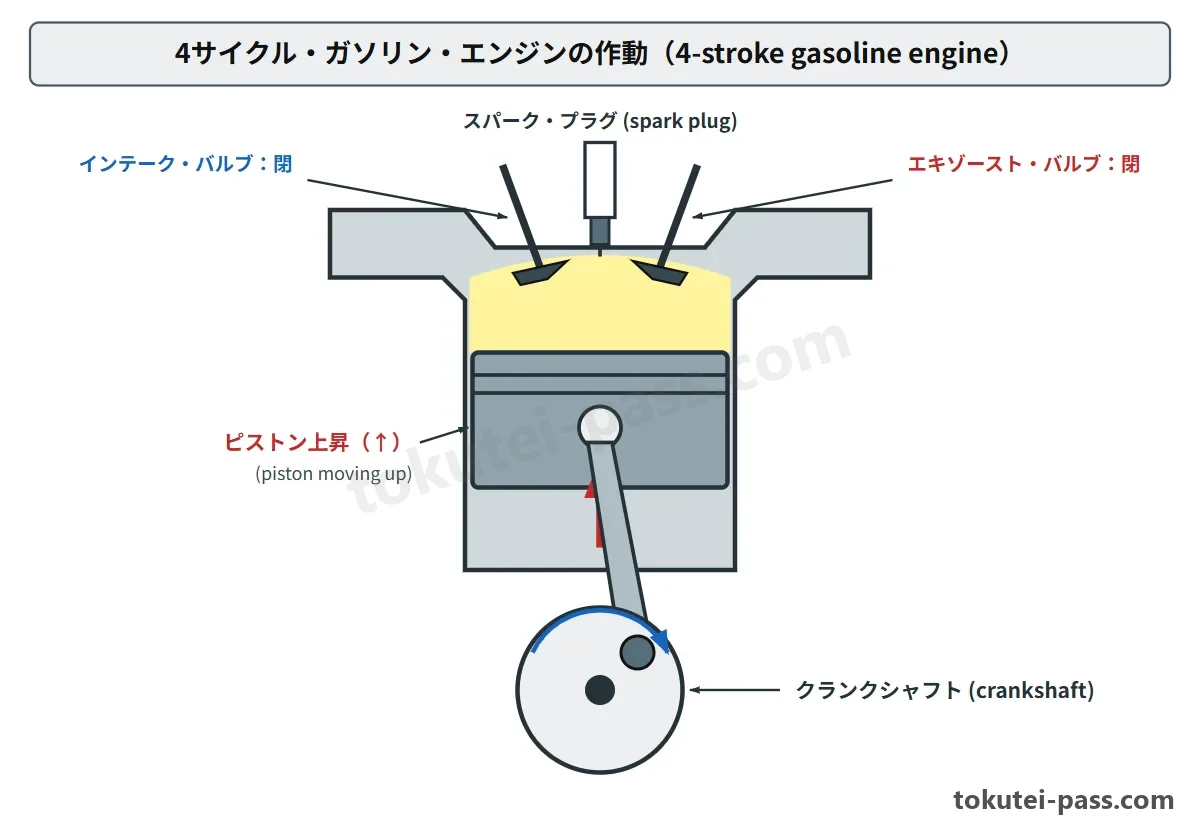
図の4サイクル・ガソリン・エンジン(4-stroke gasoline engine)の作動は、インテーク・バルブ(intake valve)とエキゾースト・バルブ(exhaust valve)がともに閉じてピストン(piston)が上昇する圧縮行程(compression stroke)である。
The operation of the 4-stroke gasoline engine shown in the figure is the compression stroke, in which both the intake valve and the exhaust valve are closed and the piston moves upward.
- A. ○
- B. ×
Show answer
Correct answer: A
True. During the compression stroke of a 4-stroke gasoline engine, both the intake valve and exhaust valve are closed while the piston moves upward from BDC to TDC to compress the air-fuel mixture.
💡 In a 4-stroke gasoline engine, the compression stroke is the only stroke where both intake and exhaust valves are closed while the piston moves upward.
| Word | Meaning |
|---|---|
| 圧縮行程 | compression stroke |
| インテーク・バルブ | intake valve |
| 上昇 | upward movement |
Question 2
ガソリン・エンジン(gasoline engine)の点火時期(ignition timing)を過度に遅らせると、燃焼室内でカリカリという異音を伴うノッキング(knocking)が発生しやすくなる。
In a gasoline engine, excessively retarding the ignition timing makes knocking accompanied by a pinging metallic noise more likely to occur in the combustion chamber.
- A. ○
- B. ×
Show answer
Correct answer: B
False. Knocking in a gasoline engine becomes more likely when the ignition timing is overly advanced (too early), not retarded, because excessive pressure and temperature cause the end-gas mixture to auto-ignite.
| Word | Meaning |
|---|---|
| 点火時期 | ignition timing |
| ノッキング | knocking |
| 燃焼室 | combustion chamber |
Question 3
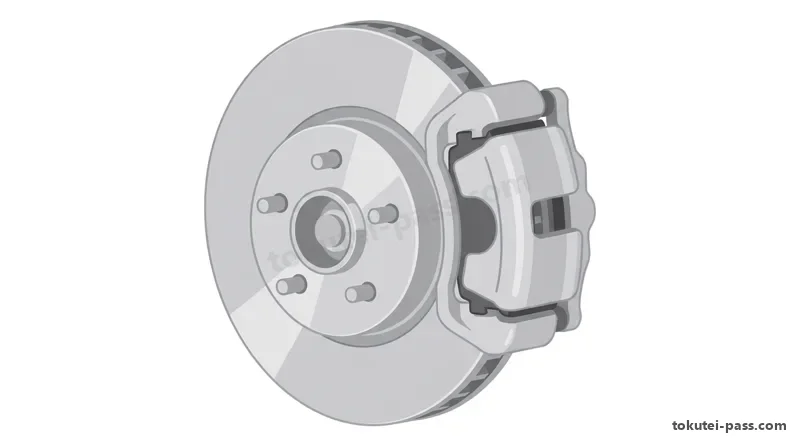
図のディスク・ブレーキ(disc brake)は、ブレーキ・キャリパ(brake caliper)内のピストン(piston)が油圧によってブレーキ・パッド(brake pad)をディスク・ロータ(disc rotor)に押し付けて制動力を発生させる。
The disc brake shown in the figure generates braking force when the piston inside the brake caliper uses hydraulic pressure to press the brake pads against the disc rotor.
- A. ○
- B. ×
Show answer
Correct answer: A
True. In a hydraulic disc brake, hydraulic pressure pushes the caliper piston so that the brake pads clamp both sides of the rotating disc rotor to generate braking force.
| Word | Meaning |
|---|---|
| ディスク・ブレーキ | disc brake |
| ブレーキ・パッド | brake pad |
| 制動力 | braking force |
Question 4
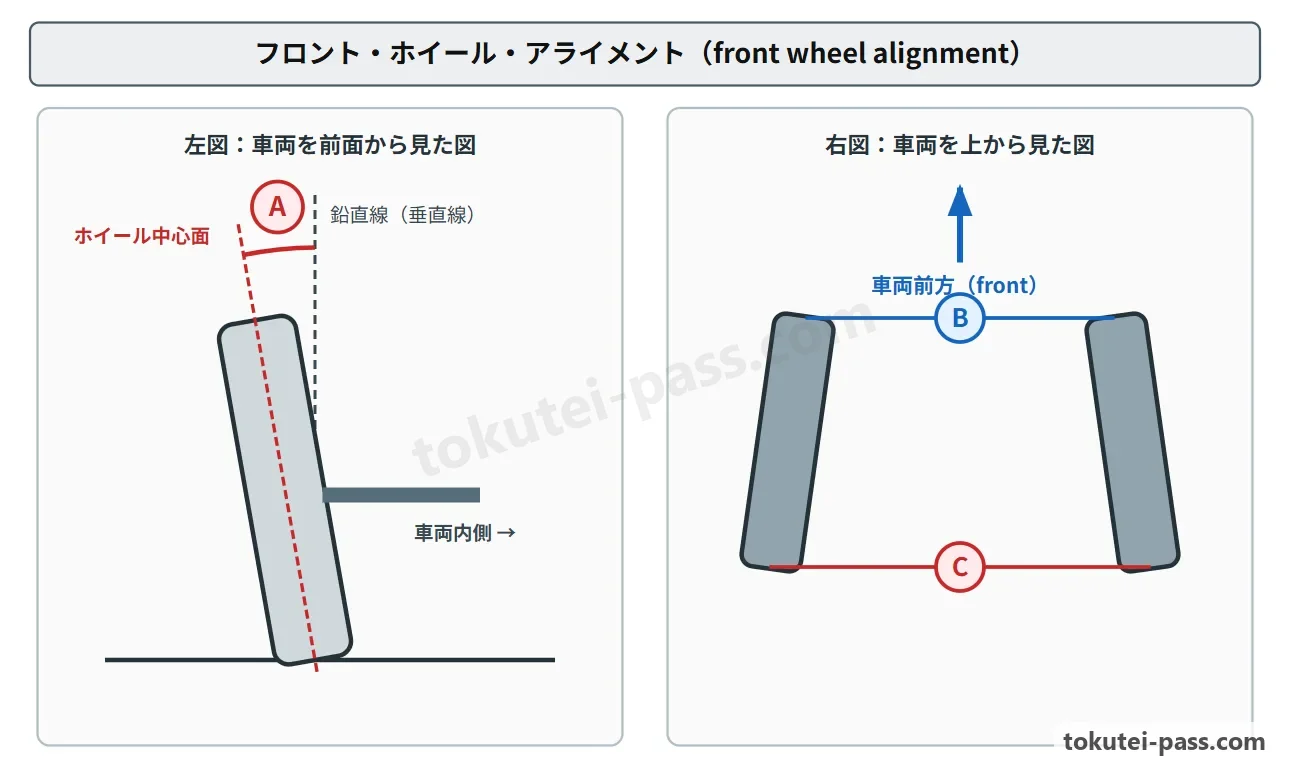
図の左側のように、自動車を前面から見たときのホイール中心面と鉛直線とのなす角Aは、キャンバ(camber)である。
As shown on the left side of the figure, angle A between the wheel center plane and the vertical line when viewing the vehicle from the front is the camber.
- A. ○
- B. ×
Show answer
Correct answer: A
True. Camber is the angle formed between the wheel center plane and the vertical line when the front wheel is viewed from the front of the vehicle.
| Word | Meaning |
|---|---|
| ホイール中心面 | wheel center plane |
| 鉛直線 | vertical line |
| キャンバ | camber |
Question 5
アウトサイド・マイクロメータ(outside micrometer)は、シンブル(thimble)を1回転させるとスピンドル(spindle)が0.5mm移動し、シンブル(thimble)の1目盛りは0.01mmを表す。
On an outside micrometer, one turn of the thimble moves the spindle 0.5 mm, and one graduation on the thimble represents 0.01 mm.
- A. ○
- B. ×
Show answer
Correct answer: A
True. The spindle thread pitch is 0.5 mm, so one turn of the thimble moves the spindle 0.5 mm. The thimble has 50 graduations, so one graduation = 0.5 ÷ 50 = 0.01 mm.
| Word | Meaning |
|---|---|
| シンブル | thimble |
| スピンドル | spindle |
| 目盛り | graduation (scale mark) |
Question 6
ガソリン(gasoline)のアンチノック性(anti-knock property)の高さを示す指標にはセタン価(cetane number)が用いられ、数値が大きいほどノッキング(knocking)が起きにくい。
The cetane number is used as the index indicating the anti-knock property of gasoline, and the higher the value, the less likely knocking is to occur.
- A. ○
- B. ×
Show answer
Correct answer: B
False. The anti-knock property of gasoline is indicated by the octane number, whereas the cetane number indicates the ignitability of diesel fuel (light oil).
💡 Remember fuel indices: Gasoline anti-knock property uses the octane number, whereas diesel fuel ignitability uses the cetane number.
| Word | Meaning |
|---|---|
| アンチノック性 | anti-knock property |
| オクタン価 | octane number |
| セタン価 | cetane number |
Question 7
タイヤ(tire)の空気圧(inflation pressure)は、走行直後のタイヤ(tire)が温まっているときに点検し、規定値より高ければ空気を抜いて調整する。
Tire inflation pressure should be checked right after driving while the tires are warm, and if it is above the specified value, air should be let out to adjust it.
- A. ○
- B. ×
Show answer
Correct answer: B
False. Right after driving, the air inside the tire is hot, so the pressure reads higher than normal. Letting air out then leaves the tire underinflated once it cools. Check and adjust the pressure when the tires are cold.
| Word | Meaning |
|---|---|
| 空気圧 | inflation pressure |
| 走行直後 | right after driving |
| 規定値 | specified value |
Question 8
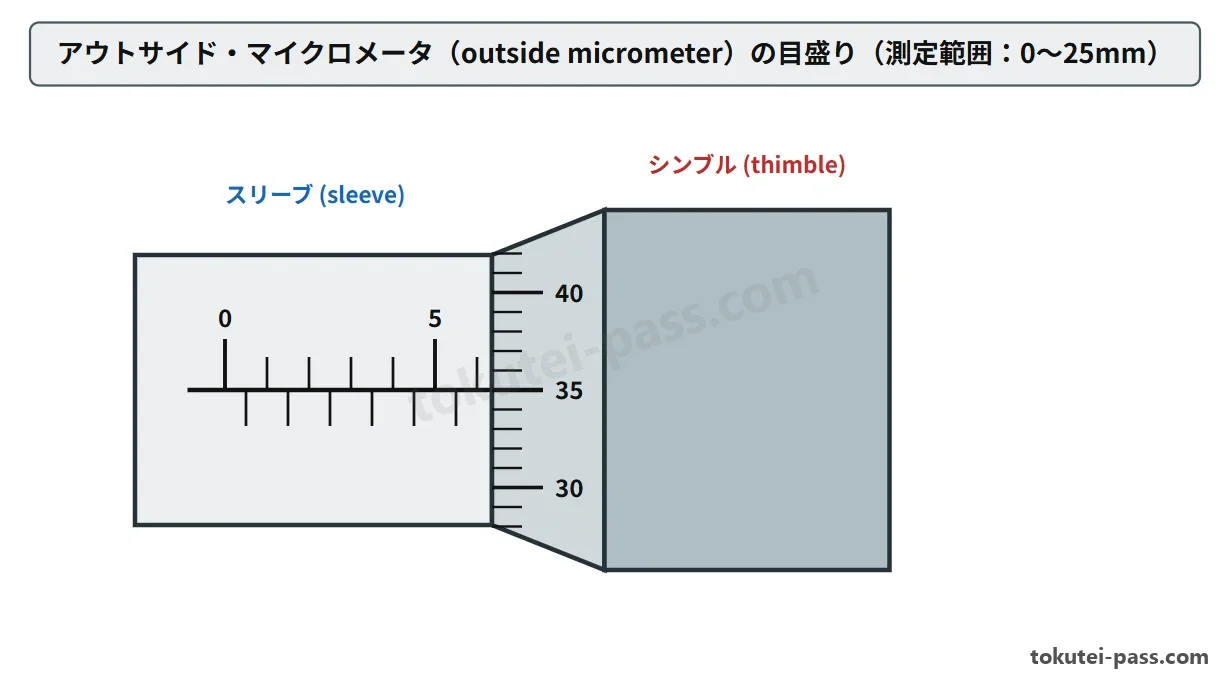
インテーク・バルブ(intake valve)のステム外径をアウトサイド・マイクロメータ(outside micrometer)で測定したときの目盛りについて、答えなさい。図が示している測定値はどれか。
Answer the following regarding measuring the outer diameter of a valve stem with a micrometer. Which of the following is the correct measurement reading of the micrometer shown in the figure?
- A. 6.35mm
- B. 6.85mm
Show answer
Correct answer: A
On the sleeve, the upper graduation shows 6mm and the lower 0.5mm graduation past 6 is not visible (6.00mm). On the thimble, the 35 mark aligns with the datum line (0.35mm), giving 6.00 + 0.35 = 6.35mm.
| Word | Meaning |
|---|---|
| バルブ・ステム | valve stem |
| 外径 | outer diameter |
| 測定値 | measured value |
Question 9
図のアウトサイド・マイクロメータ(outside micrometer)を用いた精密測定作業について、答えなさい。測定する前の準備および取扱いとして、正しいものはどれか。
Answer the following regarding precision measurement using the outside micrometer shown in the figure. Which preparation and handling procedure before measurement is correct?
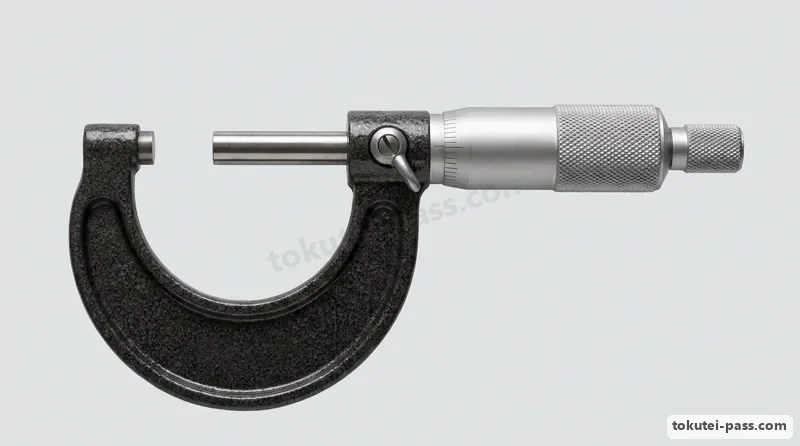
- A. フレーム(frame)を素手でしっかり握り、手の温かさになじませてから測定する。
Grip the frame firmly with bare hands so it warms up to hand temperature before measuring. - B. 測定前にアンビル(anvil)とスピンドル(spindle)の測定面を清掃し、0点(基準点)が合っているか点検する。
Clean the measuring faces of the anvil and spindle before measurement and check that the zero point (reference point) is properly aligned.
Show answer
Correct answer: B
Before measuring with a micrometer, clean the measuring surfaces of the anvil and spindle and verify zero-point alignment. Do not grip the frame with bare hands for long: body heat expands it and causes errors; hold it by the heat-insulating pad.
| Word | Meaning |
|---|---|
| アンビル | anvil |
| スピンドル | spindle |
| 0点点検 | zero-point inspection |
Question 10
シリンダ・ヘッド(cylinder head)の取り付け作業について、答えなさい。図のシリンダ・ヘッド・ボルト(cylinder head bolt)を締め付ける正しい順番はどれか。
Answer the following regarding cylinder head installation. Which is the correct sequence for tightening the cylinder head bolts shown in the figure?
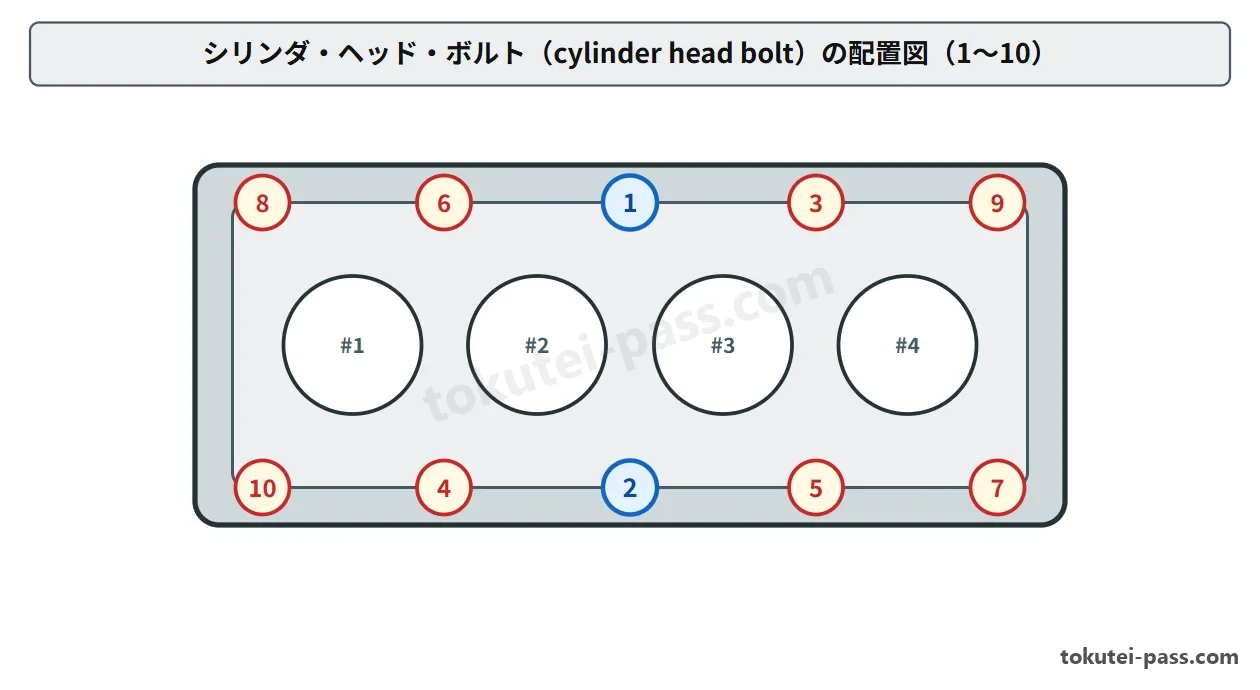
- A. 中央の1・2から始め、3→4→5→6→7→8→9→10と外側へ向かって数回に分けて締め付ける。
Start from center bolts 1 and 2, and tighten outward in the order 3→4→5→6→7→8→9→10 in several steps. - B. 外側の10・9・8・7から始め、6→5→4→3→2→1と中央へ向かって一度に規定トルクまで締め付ける。
Start from outer bolts 10, 9, 8, and 7, and tighten inward 6→5→4→3→2→1 to the specified torque in a single pass.
Show answer
Correct answer: A
When installing a cylinder head, bolts must be tightened from the center (1, 2) progressively outward toward the ends (3 through 10) in two or three stages to ensure uniform gasket seating and prevent warpage.
💡 Cylinder head bolt rule: when tightening, work from the center bolts (1, 2) outward; when loosening for removal, work from the outer bolts inward.
| Word | Meaning |
|---|---|
| シリンダ・ヘッド | cylinder head |
| 規定トルク | specified torque |
| 対角線 | diagonal order |