
Home › Sample questions › Production Management Planning Grade 3 生産管理プランニング (BC検定)
BC Kentei Production Management Planning Grade 3 practice test with answers – free sample questions
ビジネス・キャリア検定 生産管理プランニング3級
10 sample questions in the real exam format, with furigana, English translation, answers and explanations. Tap "Show answer" under each question. For the full question bank and realistic mock exams, open the free app.
Question 1
製造企業における製品開発から量産までの基本ステップおよび領域別の物流システムに関する次の文章において、空欄A〜Cに入る語句の組合せとして最も適切なものは、次のうちどれか。 「新製品を市場へ供給するまでの過程は、市場調査に基づく製品企画から始まり、A 、B を経て量産へと進む。また、工場内での原材料の受入れから加工・組立工程間の移動、完成品倉庫への入庫に至るまでの物流活動は C と呼ばれる。」
In the following passage regarding the basic steps from product development to mass production and domain-specific logistics systems in a manufacturing enterprise, which combination of terms filling blanks A to C is MOST APPROPRIATE? "The process up to supplying a new product to the market begins with product planning based on market research, proceeds through A and B, and advances to mass production. Furthermore, logistics activities from receiving raw materials inside the factory through moving items between machining and assembly processes up to storing finished goods in the warehouse are called C."
- A. A:製品設計 B:生産準備 C:生産物流
A: Product design B: Production preparation C: Production logistics - B. A:生産準備 B:製品設計 C:調達物流
A: Production preparation B: Product design C: Procurement logistics - C. A:製品設計 B:生産準備 C:販売物流
A: Product design B: Production preparation C: Sales logistics - D. A:生産準備 B:製品設計 C:回収物流
A: Production preparation B: Product design C: Recovery logistics
Show answer
Correct answer: A
The standard sequence from concept to mass production in manufacturing is: Product planning (製品企画) → Product design (製品設計: A) → Production preparation (生産準備: B) → Mass production (量産). By logistics domain: transporting materials from suppliers is procurement logistics (調達物流); internal movement and handling across factory processes and warehouses is production logistics (生産物流: C); delivering finished products to customers is sales logistics (販売物流); collecting empty containers or recyclables is recovery logistics (回収物流).
💡 Upstream sequence: Product planning → Product design → Production preparation → Mass production. Material flow inside the factory between processes is Production logistics.
| Word | Meaning |
|---|---|
| 製品企画と製品設計 | product planning and product design |
| 生産準備 | production preparation (seisan junbi) |
| 生産物流 | production logistics (seisan butsuryū) |
Question 2
製品企画におけるマーケティングの4P、消費財と生産財の特性、および原価企画の考え方に関する記述として最も不適切なものは、次のうちどれか。
Which of the following statements is MOST INAPPROPRIATE regarding the 4Ps of marketing, the characteristics of consumer goods and industrial goods, and the concept of target costing in product planning?
- A. マーケティング・ミックスを構成する4Pとは、製品(Product)、価格(Price)、流通・チャネル(Place)、販売促進(Promotion)の4つの要素を指す。
The 4Ps that make up the marketing mix refer to the four elements of Product, Price, Place (distribution channels), and Promotion. - B. 工作機械や工業用部品などの生産財は、一般個人が購入する消費財と比べて、専門知識を持つ購買担当者が経済性や品質・技術仕様を合理的に評価して購買を決定する傾向が強い。
Compared with consumer goods purchased by individuals, industrial goods such as machine tools and industrial parts tend to be purchased based on rational evaluations of economic efficiency, quality, and technical specifications by specialized buyers. - C. 原価企画は、製品の設計図面が確定して工場での量産が始まった後に出発点を置き、製造現場での作業改善や歩留まり向上を中心に原価低減を図る活動である。
Target costing takes its starting point after product design drawings have been finalized and mass production has begun at the factory, focusing on cost reduction through shop-floor work improvement and yield enhancement. - D. 新製品企画の段階では、企画・設計・生産技術・製造・購買などの関係部門が初期から参画し、市場が求める品質と目標原価を同時に造り込むことが重要である。
At the new product planning stage, it is important for related departments such as planning, design, production engineering, manufacturing, and purchasing to participate from the outset to build in both market-required quality and target cost.
Show answer
Correct answer: C
Target costing (原価企画) originates at the product planning and conceptual design stages—where roughly 80% of product cost is determined—through cross-functional participation (planning, design, production engineering, manufacturing, and purchasing). Cost reduction carried out on the shop floor via work improvements and yield enhancement after mass production begins is cost kaizen (原価改善), not target costing.
| Word | Meaning |
|---|---|
| マーケティングの4P | 4Ps of marketing (Product, Price, Place, Promotion) |
| 消費財と生産財 | consumer goods and industrial goods |
| 原価企画 | target costing (genka kikaku) |
Question 3
生産計画の立案から現場での生産統制へと連動する工程管理サイクル(P-D-C-A)の各業務に関する記述として最も不適切なものは、次のうちどれか。
Which of the following statements is MOST INAPPROPRIATE regarding the functions of 'production planning' and 'production control' that make up the process management system?
- A. 生産計画は、製品の作り方や加工順序を定める「手順計画」、負荷と能力を調整する「工数計画」、着手・完了時期を定める「日程計画」から構成される。
Production planning consists of 'routing planning' to set manufacturing methods and operation sequences, 'man-hour (load) planning' to balance load and capacity, and 'scheduling' to set start and completion times. - B. 生産統制における「余力管理」とは、倉庫内の原材料や仕掛品の所在と数量を現品票などで追跡し、盗難や紛失を防ぐ活動のことである。
'Capacity slack management (Yoryoku Kanri)' in production control refers to the activity of tracking the location and quantity of raw materials and work-in-process using identification tags to prevent theft or loss. - C. 生産統制における「作業手配(差立)」とは、日程計画に基づいて製造指図書や作業指導票を発行し、各職場へ具体的な作業開始を指示する活動である。
'Dispatching (work assignment)' in production control is the activity of issuing manufacturing orders and operation instruction sheets based on the schedule to instruct each workshop to start specific jobs. - D. 生産統制における「進捗管理(進度管理)」とは、計画された日程通りに生産が進んでいるかを把握し、遅れがあれば督促や日程調整を行う活動である。
'Progress control (expediting)' in production control is the activity of monitoring whether production is proceeding according to the planned schedule and expediting or adjusting schedules if delays occur.
Show answer
Correct answer: B
Tracking the physical location and quantity of materials, work-in-process, and finished goods using identification tags (現品票) or move tickets (移動票) is 'physical item control' (現品管理). In contrast, 'capacity slack management' (余力管理) monitors and adjusts the balance between workload (負荷工数) and available capacity (保有工数) at each process or workstation.
| Word | Meaning |
|---|---|
| 手順計画・工数計画・日程計画 | routing planning, load planning, and scheduling |
| 作業手配(差立)と進捗管理 | dispatching (sashitate) and progress control |
| 余力管理と現品管理 | capacity slack management and physical item control |
Question 4
サプライチェーンにおける「デカップリングポイント(DP)」の位置づけと生産形態の関係に関する記述として最も不適切なものは、次のうちどれか。
Which of the following statements is MOST INAPPROPRIATE regarding the positioning of the 'Decoupling Point (DP)' in a supply chain and its relationship with production types?
- A. デカップリングポイントとは、需要予測に基づいて生産・在庫を行う領域と、顧客の確定注文に基づいて生産・出荷を行う領域との分岐点であり、戦略的に在庫を配置する箇所である。
The decoupling point is the boundary between forecast-driven production/inventory activities and customer-order-driven production/shipment activities, serving as the location where strategic inventory is held. - B. 共通のモジュール部品やサブ組立品を見込生産して在庫として持ち、顧客からの注文確定後に最終組立を行うBTO(Build To Order)方式では、デカップリングポイントは部品・ユニット在庫の段階に置かれる。
In a Build-To-Order (BTO) system where common modules and subassemblies are produced to forecast and final assembly is performed after receiving a confirmed order, the decoupling point is placed at the parts/module inventory stage. - C. 完全見込生産で最終製品を倉庫や販売店に在庫として保有し、注文を受け次第すぐに出荷する方式では、デカップリングポイントはサプライチェーンの下流側(製品在庫の位置)にある。
In a pure make-to-stock system where finished products are held in warehouses or retail stores and shipped immediately upon order receipt, the decoupling point lies downstream in the supply chain at the finished goods inventory. - D. デカップリングポイントをサプライチェーンの上流側(原材料や設計段階)へ移動させるほど、完成品の在庫リスクは増大するが、顧客への納入リードタイムは大幅に短縮される。
Moving the decoupling point further upstream in the supply chain (toward raw materials or engineering design) increases the risk of unsold finished goods inventory while significantly shortening customer delivery lead time.
Show answer
Correct answer: D
Moving the decoupling point (デカップリングポイント) upstream (toward raw materials or design-to-order) reduces the risk of unsold finished goods inventory because products are not built ahead of orders; however, because manufacturing starts only after an order arrives, the delivery lead time to the customer becomes LONGER, not shorter. Placing the decoupling point downstream (finished goods stock) shortens delivery lead time but increases inventory risk.
💡 Decoupling Point rule: Moving DOWNSTREAM (finished goods stock) shortens delivery lead time but raises inventory risk; moving UPSTREAM (raw materials/design) lowers inventory risk but lengthens delivery lead time.
| Word | Meaning |
|---|---|
| デカップリングポイント | Decoupling Point (DP) |
| BTO(受注組立生産) | BTO (Build To Order) |
| サプライチェーンの上流と下流 | upstream and downstream in the supply chain |
Question 5
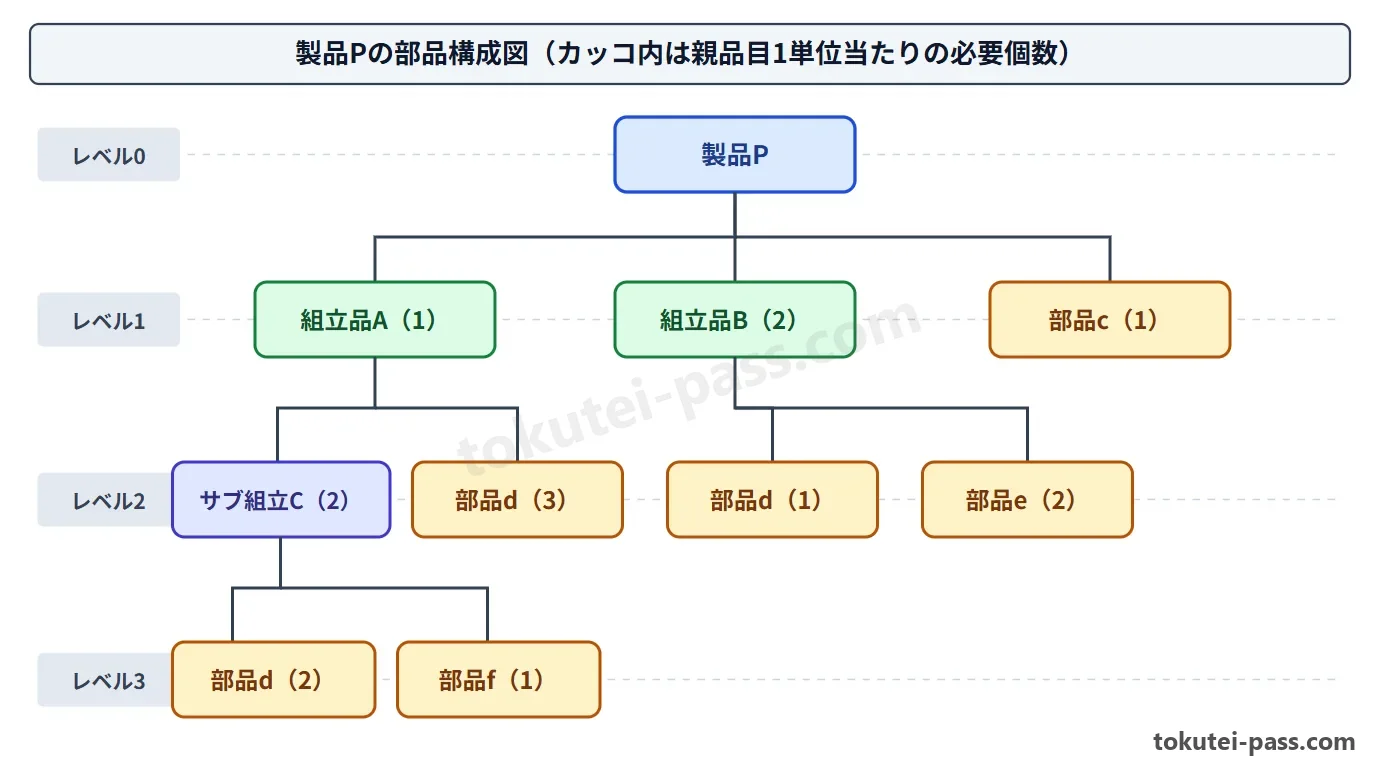
図に示す製品Pの部品構成図(カッコ内は親品目1単位当たりの必要個数)に基づき、製品Pを10個生産する場合の部品dの「正味所要量」を計算した値として最も適切なものは、次のうちどれか。ただし、製品P・組立品A・組立品B・サブ組立Cの在庫はすべて0個とし、部品dの現在の在庫状況は下表のとおりとする。 【部品dの在庫状況】 ・手持在庫量:25個 ・在庫引当量(他用途確定分):10個 ・発注残(入荷予定分):15個
Based on the Bill of Materials (BOM) tree for Product P shown in the diagram (numbers in parentheses indicate the quantity required per unit of parent item), which of the following is the MOST APPROPRIATE value for the 'net requirement' of Part d when producing 10 units of Product P? Assume that inventories of Product P, Assembly A, Assembly B, and Subassembly C are all 0, and the current inventory status of Part d is as shown in the table below. (Inventory Status of Part d) ・On-hand inventory: 25 units ・Allocated inventory (reserved for other uses): 10 units ・Scheduled receipts (on-order balance): 15 units
- A. 40個
40 units - B. 60個
60 units - C. 75個
75 units - D. 90個
90 units
Show answer
Correct answer: B
Step 1: Calculate the gross requirement (総所要量) of Part d for 10 units of Product P: ・Assembly A (Level 1) needed: 10 × 1 = 10 units; Assembly B (Level 1) needed: 10 × 2 = 20 units. ・Subassembly C (Level 2, child of A) needed: 10 × 2 = 20 units. ・Part d appears in three branches: (1) under Assembly A: 10 × 3 = 30 units; (2) under Assembly B: 20 × 1 = 20 units; (3) under Subassembly C: 20 × 2 = 40 units. → Gross requirement of Part d = 30 + 20 + 40 = 90 units. Step 2: Calculate available inventory (有効在庫量) of Part d: ・Available inventory = On-hand inventory − Allocated inventory + Scheduled receipts = 25 − 10 + 15 = 30 units. Step 3: Net requirement (正味所要量) = Gross requirement − Available inventory = 90 − 30 = 60 units. (40 units adds allocated stock by mistake; 75 units forgets to add the 15 scheduled receipts; 90 units is the gross requirement before deducting available inventory).
💡 MRP formulas: Available inventory = On-hand inventory − Allocated inventory + Scheduled receipts. Net requirement = Gross requirement − Available inventory.
| Word | Meaning |
|---|---|
| 総所要量と正味所要量 | gross requirement and net requirement |
| 有効在庫量 | available inventory (yūkō zaikoryō) |
| 在庫引当量と発注残 | allocated inventory and scheduled receipts (on-order balance) |
Question 6
ギルブレスが体系化した「サーブリッグ分析(18基本動作)」の3分類および「動作経済の4基本原則」に関する記述として最も不適切なものは、次のうちどれか。
Which of the following statements is MOST INAPPROPRIATE regarding the three categories of 'Therblig analysis (18 basic motion elements)' systematized by Gilbreth and the 'four basic principles of motion economy'?
- A. サーブリッグの第3類は作業を直接進行させる「有効動作」であり、「つかむ」「位置を決める」「組み立てる」「使う」などの動素がこれに分類される。
Category 3 of Therbligs consists of 'effective motions' that directly advance the work, including motion elements such as 'grasp', 'position', 'assemble', and 'use'. - B. サーブリッグの第2類は作業の進行を遅らせる「遅れを生ずる動作」であり、「探す」「選ぶ」「考える」「前おきする(用意する)」などの動素がこれに分類される。
Category 2 of Therbligs consists of 'motions that cause delay' and hinder work progress, including motion elements such as 'search', 'select', 'plan (think)', and 'pre-position'. - C. サーブリッグの第3類に含まれる「保持する」「休む」「避けられない遅れ」などは何も仕事をしていない動素であり、治具の活用などによって極力排除すべき対象である。
Motion elements included in Category 3 of Therbligs, such as 'hold', 'rest', and 'unavoidable delay', accomplish no actual work and should be eliminated as much as possible by using jigs. - D. 動作経済の4基本原則とは、「両手を同時に使う」「動作の距離を短くする(動作の数を減らす)」「動作を楽にする」「設備・治工具を工夫する」の4つである。
The four basic principles of motion economy are: 'use both hands simultaneously', 'shorten motion distance (reduce number of motions)', 'make motions easier and less fatiguing', and 'devise equipment and jigs/fixtures'.
Show answer
Correct answer: A
In Gilbreth's 18 basic motion elements (Therblig analysis): Category 1 (第1類) represents 'effective motions' (有効動作: reach, grasp, move, position, assemble, use, disassemble, release load); Category 2 (第2類) represents 'motions causing delay' due to mental or visual hesitation (遅れを生ずる動作: search, select, plan/think, pre-position, inspect); and Category 3 (第3類) represents 'non-effective (ineffective) motions' where no work is done (無効動作: hold, rest, unavoidable delay, avoidable delay). Calling Category 3 effective motions is incorrect.
💡 3 Categories of 18 Therbligs: Category 1 = Effective (grasp, assemble, use); Category 2 = Delaying (search, select, think, inspect); Category 3 = Ineffective (hold, delay, rest).
| Word | Meaning |
|---|---|
| サーブリッグ分析(動素分析) | Therblig analysis (therblig motion study) |
| 第1類〜第3類の基本動作 | Category 1 to Category 3 basic motions |
| 動作経済の4基本原則 | four basic principles of motion economy |
Question 7
品質管理で用いられる統計的グラフ(円グラフ・帯グラフ・折れ線グラフ・レーダーチャート)の特質と使い分けに関する記述として最も不適切なものは、次のうちどれか。
Which of the following statements is MOST INAPPROPRIATE regarding the characteristics and proper use of statistical graphs (pie chart, band chart, line graph, and radar chart) used in quality control?
- A. 円グラフは、円全体の面積を100%として各項目の構成比率を扇形の中心角の大きさで表すグラフであり、原則として時計の12時の位置から割合の大きい順に右回りで記入する。
A pie chart represents the whole circle as 100% and shows the proportion of each category by the central angle of its sector, plotted clockwise starting from the 12 o'clock position in descending order of share. - B. 帯グラフは、一定の長さの棒(帯)の全体を100%として内訳の比率に分割したグラフであり、複数の帯を並べることで年度別や工場別の構成比の変化を比較しやすい。
A band chart divides a bar of fixed length representing 100% into component ratios, making it easy to compare changes in composition across different years or factories when multiple bands are aligned. - C. 折れ線グラフは、横軸に時間(日・月・年など)をとり、縦軸に生産量や不適合率などの数量をとってデータ点を線で結ぶことで、時間的な推移や増減傾向を把握するのに適している。
A line graph plots time (days, months, years, etc.) on the horizontal axis and quantities such as output or defect rate on the vertical axis, connecting data points to grasp trends over time. - D. レーダーチャート(クモの巣グラフ)は、中心から放射状に引いた複数の軸上に評価値をプロットして結ぶグラフであり、2つの連続変数の間の相関係数や回帰直線を算出するために用いられる。
A radar chart (spiderweb chart) plots evaluation scores on multiple axes radiating from the center and is used to calculate the correlation coefficient and regression line between two continuous variables.
Show answer
Correct answer: D
A radar chart (レーダーチャート) is used to visualize the overall balance across multiple evaluation items (such as product performance attributes or QCD metrics). The tool used to examine the correlation between paired continuous variables (cause and effect) is a scatter diagram (散布図).
| Word | Meaning |
|---|---|
| 円グラフと帯グラフ(構成比) | pie chart and band chart (composition ratio) |
| 折れ線グラフ(時間的推移) | line graph (time-series trend) |
| レーダーチャートと散布図 | radar chart and scatter diagram (sanpuzu) |
Question 8
ある製造工場の月次原価集計表が次のとおりであるとき、「素原価」「製造原価」「総原価」を計算した記述として最も不適切なものは、次のうちどれか。 【当月の原価データ(期首・期末仕掛品なし)】 ・直接材料費:400万円 ・直接労務費:250万円 ・直接経費:50万円 ・製造間接費:200万円 ・販売費および一般管理費:150万円
Given the monthly cost data for a factory below, which of the following statements calculating Prime Cost (素原価), Manufacturing Cost (製造原価), and Total Cost (総原価) is **most inappropriate**? 【Monthly Cost Data (no beginning or ending work-in-process)】 ・Direct material cost: 4,000,000 yen ・Direct labor cost: 2,500,000 yen ・Direct expenses: 500,000 yen ・Manufacturing overhead: 2,000,000 yen ・Selling, general and administrative (SG&A) expenses: 1,500,000 yen
- A. 直接材料費・直接労務費・直接経費を合計した「素原価(製造直接費)」は、700万円である。
The Prime Cost (direct manufacturing cost), summing direct material, direct labor, and direct expenses, is 7,000,000 yen. - B. 直接労務費・直接経費・製造間接費を合計した「加工費」は、500万円である。
The Conversion Cost (加工費), summing direct labor, direct expenses, and manufacturing overhead, is 5,000,000 yen. - C. 素原価に製造間接費を加えた当月の「製造原価」は、1,050万円である。
The monthly Manufacturing Cost (製造原価), adding manufacturing overhead to prime cost, is 10,500,000 yen. - D. 製造原価に販売費および一般管理費を加えた「総原価」は、1,050万円である。
The Total Cost (総原価), adding SG&A expenses to manufacturing cost, is 10,500,000 yen.
Show answer
Correct answer: C
In the structure of manufacturing cost (製造原価 = Direct manufacturing cost + Indirect manufacturing cost): 1. Total direct manufacturing cost (製造直接費) = Direct materials (600) + Direct labor (350) + Direct expenses / subcontract processing (80) = 1,030 man-yen. 2. Total indirect manufacturing cost / overhead (製造間接費) = Indirect materials (40) + Indirect labor (110) + Indirect factory expenses (90) = 240 man-yen (2,400,000 yen). 3. Head office SG&A expenses (160) are added to manufacturing cost (1,270) to form total cost (総原価 = 1,430) and are NOT part of manufacturing overhead. (150 omits indirect expenses of 90; 200 omits indirect materials of 40; 400 mistakenly includes SG&A expenses of 160).
| Word | Meaning |
|---|---|
| 製造直接費と製造間接費 | direct manufacturing cost and indirect manufacturing cost (overhead) |
| 直接経費(外注加工費・特許権使用料) | direct expenses (subcontract processing fees, patent royalties) |
| 製造原価と総原価 | manufacturing cost (seizō genka) and total cost (sō-genka) |
Question 9
設計変更の頻発や出図遅れといった製品設計段階のトラブルが生産納期に及ぼす影響と対策に関する記述として最も不適切なものは、次のうちどれか。
In delivery management, which of the following statements is MOST INAPPROPRIATE regarding causes of delivery delays originating in the design department and their preventive countermeasures?
- A. 設計日程の遅れを防ぐためには、各設計段階の節目でのデザインレビュー(DR)やチェックポイントの設定を省略し、試作完了後に一括して図面修正を行うのが効果的である。
To prevent delays in the design schedule, it is effective to omit Design Reviews (DR) and checkpoints at each design milestone and instead revise all drawings in a single batch after prototyping is completed. - B. 顧客との仕様打ち合わせ不足や設計ミスによる後工程での大幅な手戻りは、出図遅れを引き起こして購買手配や製造期間を圧迫する大きな要因となる。
Insufficient specification consultation with customers or design errors that cause major rework in downstream processes are major causes of delayed drawing release, squeezing purchasing and manufacturing lead times. - C. 設計工程の日程計画を立てる際には、技術的な不確実性や不測のトラブルに対処できるよう、あらかじめ日程上に適切な緩衝時間(余裕時間)を見込んでおくことが有効である。
When establishing a schedule for the design process, building in an appropriate buffer time (allowance time) in advance to cope with technical uncertainties or unforeseen trouble is effective. - D. 既存部品の標準化・共通化や過去の設計データの流用、3次元CADの活用を進めることは、新規設計工数を削減し設計期間を短縮する対策となる。
Promoting standardization and commonality of existing parts, reusing past design data, and utilizing 3D CAD systems are effective measures to reduce new design man-hours and shorten design lead time.
Show answer
Correct answer: A
Omitting Design Reviews (DR) and milestone checkpoints during the design process allows design defects to pass unnoticed into prototyping or production, causing massive rework (手戻り) and severe delivery delays. Proper countermeasures in the design department include setting regular checkpoints, conducting DRs at each stage, and allocating buffer time (緩衝時間) in the design schedule.
| Word | Meaning |
|---|---|
| 設計部門の納期遅延対策 | delivery delay countermeasures in the design department |
| デザインレビュー(DR)とチェックポイント | Design Review (DR) and checkpoints |
| 緩衝時間(バッファ)の設定 | setting buffer time (kansho jikan) |
Question 10
労働安全衛生法における「労働者の定義」および機械等の設置・製造に関する法手続きの記述として最も不適切なものは、次のうちどれか。
Which of the following statements is MOST INAPPROPRIATE regarding the 'definition of a worker' and legal procedures for installing and manufacturing machinery under the Industrial Safety and Health Act?
- A. 労働安全衛生法の対象となる「労働者」には、正社員だけでなく、契約社員やパートタイマー、短期のアルバイトなども含まれる。
'Workers' covered by the Industrial Safety and Health Act include not only regular full-time employees but also contract employees, part-timers, and short-term temporary workers. - B. 事業場に動力プレス機械を新たに設置または移転しようとする事業者は、その工事開始の日の14日前までに計画を都道府県知事に届け出なければならない。
An employer who intends to newly install or relocate a power press machine at a workplace must submit the plan to the prefectural governor at least 14 days prior to the start of the installation work. - C. 特に危険な作業を必要とする特定機械等(ボイラーや第一種圧力容器など)を製造しようとする者は、あらかじめ都道府県労働局長の許可を受けなければならない。
Anyone who intends to manufacture Specified Machinery requiring particularly hazardous work (such as boilers or Class-1 pressure vessels) must obtain permission in advance from the Director of the Prefectural Labor Bureau. - D. 特定機械等であるボイラーを設置した者は、所轄労働基準監督署長が行う落成検査を受け、これに合格した後でなければ当該ボイラーを使用してはならない。
Anyone who has installed a boiler (Specified Machinery) must undergo a completion inspection conducted by the Chief of the competent Labor Standards Inspection Office and must not use it until it passes.
Show answer
Correct answer: B
Under Article 88 of the Industrial Safety and Health Act (労働安全衛生法第88条), an employer who intends to install, relocate, or alter a power press machine (動力プレス) must submit the plan notification to the Chief of the Labor Standards Inspection Office (労働基準監督署長) at least **30 days** prior to the start of the work (not 14 days and not to the prefectural governor).
💡 Safety and Health Act: report a power press installation to the Labor Standards Inspection Office 30+ days ahead; boiler manufacturing permit: Prefectural Labor Bureau; boiler completion inspection: the Inspection Office.
| Word | Meaning |
|---|---|
| 動力プレスの設置計画届(30日前) | installation plan notification for power press (30 days prior) |
| 特定機械等の製造許可(都道府県労働局長) | manufacturing permission for Specified Machinery (Prefectural Labor Bureau Director) |
| 落成検査(労働基準監督署長) | completion inspection (Chief of Labor Standards Inspection Office) |