
Home › Sample questions › Production Management Operations Grade 3 生産管理オペレーション (BC検定)
BC Kentei Production Management Operations Grade 3 practice test with answers – free sample questions
ビジネス・キャリア検定 生産管理オペレーション3級
10 sample questions in the real exam format, with furigana, English translation, answers and explanations. Tap "Show answer" under each question. For the full question bank and realistic mock exams, open the free app.
Question 1
生産システムと生産管理の目的(QCD)に関する記述として最も不適切なものは、次のうちどれか。
Which of the following statements is MOST INAPPROPRIATE regarding production systems and the objectives of production management (QCD)?
- A. 工場現場の生産管理では、製造原価(C)の低減を最優先とし、原価目標を達成するためであれば、設計品質(Q)や指定納期(D)は現場判断で緩和してよい。
In shop-floor production management, reducing manufacturing Cost (C) takes top priority, so design Quality (Q) or specified Delivery dates (D) may be relaxed at the shop floor's discretion to meet cost targets. - B. 生産管理の3つの基本目的であるQCDとは、品質(Quality)、原価(Cost)、納期(Delivery)および数量を顧客の要求水準に合わせて達成することである。
The three basic objectives of production management, QCD, are to achieve Quality, Cost, and Delivery as well as quantity in accordance with the customer's required standards. - C. 品質(Q)を高めようとすれば検査や高価な材料が必要となって原価(C)が上昇しやすいなど、QCDの要素間にはトレードオフ(二律背反)の関係が生じることがある。
A trade-off relationship may arise among QCD elements; for example, trying to improve Quality (Q) often requires extra inspection or expensive materials, which tends to increase Cost (C). - D. 生産システムとは、人(Man)・機械設備(Machine)・原材料(Material)などの経営資源を投入し、変換過程を経て製品を産出する仕組みである。
A production system is a mechanism that takes in management resources such as Man, Machine, and Material, and outputs products through a transformation process.
Show answer
Correct answer: A
The purpose of production management is to maintain an optimal balance among Quality (Q), Cost (C), and Delivery (D) to satisfy customer requirements; the shop floor must never arbitrarily lower design quality standards or delay delivery dates merely to reduce manufacturing cost. The statements regarding the 3M input-to-output transformation process, the meaning of QCD, and the trade-off relationships among Q, C, and D are all correct. (Textbook: Basics of Work Management - Production Systems)
| Word | Meaning |
|---|---|
| 生産システム | production system (seisan shisutemu) |
| 経営資源(3M) | management resources (3M: Man, Machine, Material) |
| 二律背反(トレードオフ) | trade-off relationship (niritsu haihan) |
Question 2
ある組立作業の1個当たりの正味時間を測定したところ、要素作業の合計が120秒であった。下表の余裕率のデータに基づき、外掛け法によってこの作業の1個当たりの標準時間を計算した値として最も適切なものは、次のうちどれか。 【余裕率の内訳】 ・用達余裕率:3% ・疲労余裕率:5% ・職場余裕率:7%
When the net time per unit for an assembly operation was measured, the sum of the elemental operations was 120 seconds. Based on the allowance rate data in the table below, which of the following is the MOST APPROPRIATE value for the standard time per unit calculated using the external ratio method (outside multiplication method)? Breakdown of allowance rates: ・Personal allowance rate: 3% ・Fatigue allowance rate: 5% ・Workshop allowance rate: 7%
- A. 132秒
132 seconds - B. 138秒
138 seconds - C. 141秒
141 seconds - D. 145秒
145 seconds
Show answer
Correct answer: B
Total allowance rate = 3% + 5% + 7% = 15% (0.15). Under the external ratio method (外掛け法), the standard time per unit is calculated as: Standard time = Net time × (1 + Total allowance rate) = 120 × (1 + 0.15) = 120 × 1.15 = 138 seconds. The value 132 seconds omits the 5% fatigue allowance rate; 141 seconds wrongly divides by (1 − 0.15) using the internal ratio method (120 ÷ 0.85 ≈ 141.2 seconds); 145 seconds miscalculates the allowance rate. (Textbook: Basics of Work Management - Setting Standard Time)
💡 Standard time formula under the external ratio method: Standard time = Net time × (1 + Total allowance rate). Here, 120 seconds × (1 + 0.03 + 0.05 + 0.07) = 138 seconds.
| Word | Meaning |
|---|---|
| 標準時間 | standard time (hyōjun jikan) |
| 正味時間と余裕時間 | net time and allowance time |
| 外掛け法 | external ratio method (sotogake-hō) |
Question 3
工程管理の目的と機能に関する記述として最も不適切なものは、次のうちどれか。
Which of the following statements is MOST INAPPROPRIATE regarding the objectives and functions of process management?
- A. 工程管理の主な目的には、納期の確保、生産期間(製造リードタイム)の短縮、仕掛品の減少、および設備や作業者の稼働率向上がある。
The main objectives of process management include ensuring delivery dates, shortening manufacturing lead time, reducing work-in-process inventory, and improving the utilization of equipment and workers. - B. 欠品や納期遅れを防ぐために各工程間の仕掛品在庫を常に大量に保有することは、製造リードタイムの短縮と運転資金の削減に直結する。
Constantly holding a large amount of work-in-process inventory between processes to prevent stockouts and delivery delays directly shortens manufacturing lead time and reduces working capital. - C. 設備や作業者の稼働率を高めることばかりを重視して大きなロットで先行生産を行うと、工程間の仕掛品が増加しやすくなる。
If large-lot advance production is carried out with an excessive focus on raising the utilization rate of equipment and workers, work-in-process inventory between processes tends to increase. - D. 工程管理は、生産活動の目標や手順を定める「生産計画」と、計画通りに進んでいるかを監視し調整する「生産統制」の2つの機能から成り立つ。
Process management consists of two functions: production planning, which sets targets and procedures for production activities, and production control, which monitors and adjusts progress to match the plan.
Show answer
Correct answer: B
Holding a large amount of work-in-process (WIP / 仕掛品) inventory between processes increases waiting and retention time, which lengthens manufacturing lead time, ties up working capital, and consumes factory floor space. A core objective of process management is to reduce work-in-process inventory while still meeting delivery dates. All other statements are correct. (Textbook: Basics of Process Management - Concept of Process Management)
| Word | Meaning |
|---|---|
| 工程管理 | process management (kōtei kanri) |
| 製造リードタイム | manufacturing lead time (seizō rīdotaimu) |
| 仕掛品 | work-in-process inventory (shikakarihin) |
Question 4
日程計画における大日程計画、中日程計画、小日程計画に関する記述として最も不適切なものは、次のうちどれか。
Which of the following statements is MOST INAPPROPRIATE regarding master scheduling (long-term), medium-term scheduling, and short-term scheduling in production scheduling?
- A. 大日程計画は、年間または半年程度の期間を対象とし、販売計画や受注予測に基づいて月別の生産枠や長期手配品の計画を立てる。
Master scheduling (large schedule) covers a period of about six months to a year, establishing monthly production frameworks and plans for long-lead-time items based on sales plans and order forecasts. - B. 中日程計画は、1か月〜数か月程度の期間を対象とし、製品別の生産数量と着手・完了時期を定めて工程別の負荷と能力のバランスを調整する。
Medium-term scheduling covers a period of about one to several months, determining production quantities and start/completion dates by product to balance load and capacity across processes. - C. 小日程計画は、1週間〜1日単位の短期を対象とし、職場の個々の機械設備や作業者に対して具体的な作業順序と日程を割り当てる。
Short-term scheduling (small schedule) covers a short period of one day to one week, assigning specific work sequences and schedules to individual machines and workers in the workshop. - D. 小日程計画は経営層が工場新設や設備投資の可否を決定するための長期戦略計画であり、現場の日々の進捗状況によって変更されることはない。
Short-term scheduling is a long-range strategic plan used by top management to decide on building new factories or making capital investments, and is never changed by daily shop-floor progress.
Show answer
Correct answer: D
Short-term scheduling (小日程計画) is an operational schedule covering one day to one week that assigns daily work sequences to individual machines and workers on the shop floor, and it is adjusted flexibly in response to daily production progress. Decisions on new factories or capital investment belong to long-range corporate planning by top management. (Textbook: Basics of Process Management - Production Scheduling)
| Word | Meaning |
|---|---|
| 大日程計画 | master / long-term schedule (dainittei keikaku) |
| 中日程計画 | medium-term schedule (chūnittei keikaku) |
| 小日程計画 | short-term / operational schedule (shōnittei keikaku) |
Question 5
設備の管理特性(経済性・信頼性・保全性)に関する記述として最も不適切なものは、次のうちどれか。
Which of the following statements is MOST INAPPROPRIATE regarding equipment management characteristics (economic efficiency, reliability, and maintainability)?
- A. 設備の信頼性とは、規定の条件で意図する期間中に故障せず機能を果たす性質であり、平均故障間隔(MTBF)の値が小さいほど信頼性が高いと評価される。
Equipment reliability is the property of performing its intended function without failure for a specified period under stated conditions; a smaller Mean Time Between Failures (MTBF) indicates higher reliability. - B. 設備の保全性とは、故障が発生した際の点検や修理のしやすさを表す性質であり、平均修復時間(MTTR)の値が小さいほど保全性が良いと評価される。
Equipment maintainability is the property representing how easily inspection and repairs can be performed when a failure occurs; a smaller Mean Time To Repair (MTTR) indicates better maintainability. - C. 設備の経済性を評価する際は、購入時の初期費用だけでなく、運転費や保全費などを含めたライフサイクルコスト(LCC)全体で判断する必要がある。
When evaluating the economic efficiency of equipment, judgment must be based on the total Life Cycle Cost (LCC), including not only initial acquisition cost but also operating and maintenance costs. - D. 設備が必要なときにいつでも稼働できる状態にある割合(可動率・アベイラビリティ)は、「MTBF ÷ (MTBF + MTTR)」の式で求められる。
The proportion of time that equipment is in an operable state whenever needed (availability) is calculated using the formula 'MTBF ÷ (MTBF + MTTR)'.
Show answer
Correct answer: A
Mean Time Between Failures (MTBF) represents the average operating time between one failure and the next; therefore, a LARGER MTBF value means fewer failures and higher equipment reliability. Conversely, a smaller Mean Time To Repair (MTTR) means faster repairs and better maintainability. (Textbook: Basics of Equipment Management - Concept of Equipment Management)
💡 Equipment reliability and maintainability: a LARGER MTBF (Mean Time Between Failures) means higher reliability; a SMALLER MTTR (Mean Time To Repair) means better maintainability. Availability = MTBF ÷ (MTBF + MTTR).
| Word | Meaning |
|---|---|
| 平均故障間隔(MTBF) | Mean Time Between Failures (MTBF) |
| 平均修復時間(MTTR) | Mean Time To Repair (MTTR) |
| 可動率(アベイラビリティ) | availability (kadōritsu) |
Question 6
図のように、工場の保管場所において製品入りの段ボール箱が木製パレットの上に整然と積み上げられて置かれている状態の「運搬活性示数」と、その理由の組み合わせとして最も適切なものは、次のうちどれか。
As shown in the illustration, cardboard boxes containing products are neatly stacked on a wooden pallet in a factory storage area. Which of the following combinations of the 'Material Handling Liveliness Index' for this state and its reason is MOST APPROPRIATE?
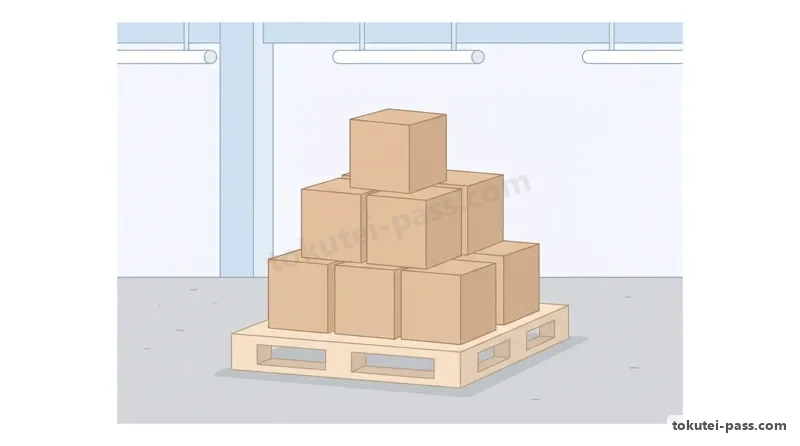
- A. 運搬活性示数は「0」である。床にバラ置きされている状態と同じであり、「起こす・かける・持ち上げる・引っ張る」の4つの手間がすべて必要なため。
The Material Handling Liveliness Index is '0', because it is the same as items scattered loose on the floor and requires all 4 handling actions: piling up, placing onto a support, lifting up, and pulling away. - B. 運搬活性示数は「1」である。箱に詰められているため「起こす」手間のみが不要となり、残り3つの手間が必要なため。
The Material Handling Liveliness Index is '1', because being packed in boxes eliminates only the 'piling up' action while still requiring the remaining 3 handling actions. - C. 運搬活性示数は「2」である。パレットの上にまとまっており、「起こす」と「かける」の2つの手間が不要で、「持ち上げる・引っ張る」の2つの手間ですむため。
The Material Handling Liveliness Index is '2', because being unitized on a pallet eliminates the 2 actions of 'piling up' and 'placing onto a support', requiring only the 2 actions of 'lifting up and pulling away'. - D. 運搬活性示数は「3」である。車輪付きの台車の上に乗っている状態と同等であり、「引っ張る」だけの1つの手間で移動できるため。
The Material Handling Liveliness Index is '3', because it is equivalent to being placed on a wheeled handcart and can be moved with just the 1 action of 'pulling away'.
Show answer
Correct answer: C
In the illustration, cardboard boxes are stacked neatly on a wooden pallet resting on the floor (パレット置き). Under the Material Handling Liveliness Index (運搬活性示数 = 4 − number of manual actions needed among piling up, placing onto a support, lifting up, and pulling away): loose on the floor is 0 (needs all 4 actions); boxed or bundled on the floor is 1; stacked on a pallet (as shown) eliminates 'piling up' and 'placing onto a support', leaving only 'lifting up' and 'pulling away' (4 − 2 = 2); on a wheeled cart is 3; moving on a conveyor is 4. (Textbook: Basics of Material Handling and Logistics - Liveliness Index)
💡 Material Handling Liveliness Index (0 to 4): Loose on floor = 0; Boxed on floor = 1; Stacked on a wooden pallet = 2 (only lifting up and pulling away needed); Wheeled handcart = 3; Moving conveyor = 4.
| Word | Meaning |
|---|---|
| 運搬活性示数 | Material Handling Liveliness Index (unpan kassei shisū) |
| パレット置き | palletized storage (paretto-oki) |
| マテリアルハンドリング(MH) | Material Handling (MH) |
Question 7
品質管理における「ねらいの品質・できばえの品質」および「真の特性・代用特性」に関する記述として最も不適切なものは、次のうちどれか。
Which of the following statements is MOST INAPPROPRIATE regarding 'quality of design vs. quality of conformance' and 'true quality characteristics vs. substitute quality characteristics' in quality control?
- A. ねらいの品質(設計品質)とは、市場調査や顧客のニーズを踏まえて、企業が目標として企画・設計した品質水準のことである。
Quality of design (targeted quality) is the quality level planned and designed as a target by the company based on market research and customer needs. - B. できばえの品質(製造品質)とは、設計図面や仕様書のねらい通りに実際に製造された製品がどの程度合致しているかを表す品質である。
Quality of conformance (manufactured quality) represents how closely the actually manufactured product conforms to the targeted design drawings and specifications. - C. 真の特性とは、「書きやすいボールペン」「長持ちする電池」のように、消費者が製品の使用にあたって本当に求めている品質特性のことである。
True quality characteristics are the quality properties that consumers genuinely seek when using a product, such as 'a ballpoint pen that writes smoothly' or 'a long-lasting battery'. - D. 代用特性とは、工場の測定器では数値化できないため、消費者へのアンケート調査だけで感覚的に評価する主観的な特性のことである。
Substitute quality characteristics are subjective properties that cannot be quantified with factory measuring instruments and are evaluated purely by intuition through consumer questionnaires.
Show answer
Correct answer: D
Because 'true quality characteristics' (真の特性 — customer desires like 'writes smoothly' or 'durable') are often qualitative and difficult to measure directly on a factory line, manufacturers translate them into quantifiable physical or chemical parameters measurable with factory instruments (such as ink viscosity, ball diameter, tensile strength, or mAh capacity), which are called 'substitute quality characteristics' (代用特性). Claiming that substitute quality characteristics cannot be quantified with factory measuring instruments is incorrect. (Textbook: Quality Control - Concept of Quality Control)
💡 Quality pairs: Quality of design = targeted quality; Quality of conformance = manufactured quality. True quality characteristics = what consumers seek; Substitute quality characteristics = quantifiable factory metrics.
| Word | Meaning |
|---|---|
| ねらいの品質とできばえの品質 | quality of design and quality of conformance |
| 真の特性 | true quality characteristic (shin no tokusei) |
| 代用特性 | substitute quality characteristic (daiyō tokusei) |
Question 8
ある工場の当月の原価データが下表のとおりであるとき、当月の「製造原価」と「総原価」の組み合わせとして最も適切なものは、次のうちどれか。 【当月の原価データ】 ・直接材料費:400万円 ・直接労務費:250万円 ・直接経費(外注加工費):50万円 ・製造間接費:180万円 ・販売費及び一般管理費:120万円
Given the monthly cost data for a factory in the table below, which of the following combinations of 'Manufacturing Cost' and 'Total Cost' for the month is MOST APPROPRIATE? Monthly cost data: ・Direct material cost: 4,000,000 yen ・Direct labor cost: 2,500,000 yen ・Direct expenses (subcontract processing cost): 500,000 yen ・Manufacturing overhead (indirect cost): 1,800,000 yen ・Selling, general and administrative (SG&A) expenses: 1,200,000 yen
- A. 製造原価:880万円 / 総原価:1,000万円
Manufacturing Cost: 8,800,000 yen / Total Cost: 10,000,000 yen - B. 製造原価:700万円 / 総原価:880万円
Manufacturing Cost: 7,000,000 yen / Total Cost: 8,800,000 yen - C. 製造原価:830万円 / 総原価:950万円
Manufacturing Cost: 8,300,000 yen / Total Cost: 9,500,000 yen - D. 製造原価:1,000万円 / 総原価:1,120万円
Manufacturing Cost: 10,000,000 yen / Total Cost: 11,200,000 yen
Show answer
Correct answer: A
Direct manufacturing cost = Direct material cost (4,000,000) + Direct labor cost (2,500,000) + Direct expenses (500,000) = 7,000,000 yen. Manufacturing Cost (製造原価) = Direct manufacturing cost (7,000,000) + Manufacturing overhead (1,800,000) = 8,800,000 yen. Total Cost (総原価) = Manufacturing Cost (8,800,000) + Selling, general and administrative expenses (1,200,000) = 10,000,000 yen. The combination of 7,000,000 and 8,800,000 yen confuses direct cost with manufacturing cost; 8,300,000 and 9,500,000 yen omits direct expenses of 500,000 yen. (Textbook: Cost Management - Cost Structure)
💡 Cost structure formulas: Direct cost = Direct material + Direct labor + Direct expenses. Manufacturing Cost = Direct cost + Manufacturing overhead. Total Cost = Manufacturing Cost + SG&A expenses.
| Word | Meaning |
|---|---|
| 製造直接費と製造間接費 | direct manufacturing cost and manufacturing overhead |
| 製造原価と総原価 | manufacturing cost and total cost |
| 販売費及び一般管理費 | selling, general and administrative (SG&A) expenses |
Question 9
納期管理における「納期遅れ」および「早期納入(指定納期より早すぎる納入)」に関する記述として最も不適切なものは、次のうちどれか。
Which of the following statements is MOST INAPPROPRIATE regarding 'delivery delay' and 'early delivery (delivering much earlier than the specified delivery date)' in delivery management?
- A. 早期納入は顧客に対して常に歓迎されるサービスであるため、製品が完成し次第、顧客の承諾を得ずに何日前であっても直ちに出荷すべきである。
Early delivery is always welcomed by customers as a good service, so as soon as products are completed, they should be shipped immediately without customer consent regardless of how many days early it is. - B. 指定納期より大幅に早く製品を納入する早期納入は、顧客側の保管場所を圧迫し在庫管理費を増加させるため避けなければならない。
Early delivery—shipping products much earlier than the specified delivery date—must be avoided because it crowds the customer's storage space and increases inventory management costs. - C. 自社工場において納期に余裕がある注文品を不必要に前倒しして生産すると、本当に急ぐべき他の注文品の生産が遅れる原因となる。
In one's own factory, unnecessarily advancing the production of orders that still have ample time before their delivery date can delay the production of other orders that are truly urgent. - D. 納期遅れが発生すると、顧客の生産ラインを停止させるなどの損害を与え、企業の信用低下や取引停止につながるおそれがある。
When a delivery delay occurs, it can cause damage such as stopping the customer's production line, leading to a loss of corporate credibility or termination of business.
Show answer
Correct answer: A
In delivery management (納期管理), the fundamental rule is delivering the exact required quantity on the exact specified delivery date (Just-In-Time). Shipping products early without the customer's consent crowds the customer's warehouse space, increases inventory holding costs, and disrupts receiving schedules, while unnecessary advance production in the factory delays urgent orders. (Textbook: Delivery Management - Concept of Delivery Management)
💡 In delivery management, both delivery delay and unauthorized early delivery must be avoided: early delivery crowds the customer's storage space, increases inventory costs, and delays urgent orders.
| Word | Meaning |
|---|---|
| 納期管理 | delivery management (nōki kanri) |
| 早期納入の弊害 | adverse effects of early delivery (sōki nōnyū no heigai) |
| 前倒し生産 | advance production ahead of schedule (maedaoshi seisan) |
Question 10
労働安全衛生法に基づく事業場の安全衛生管理体制に関する記述として最も不適切なものは、次のうちどれか。
Which of the following statements is MOST INAPPROPRIATE regarding the occupational safety and health management system at a workplace under the Industrial Safety and Health Act?
- A. 安全管理者は、建設物・設備・作業場所または作業方法に危険がある場合の応急措置や防止措置など、安全に関する技術的事項を管理する。
A Safety Officer manages technical matters related to safety, such as emergency measures and preventive measures when hazards exist in buildings, equipment, work areas, or work methods. - B. 衛生管理者は、労働者の健康障害を防止するため、少なくとも毎週1回は作業場等を巡視し、設備や衛生状態の点検を行わなければならない。
A Health Officer must patrol the workplace at least once every week to inspect equipment and sanitary conditions in order to prevent health impairments among workers. - C. 産業医は、労働者の健康管理等を行う医師であるが、診察室での健康相談のみを行えばよく、工場の作業場を巡視する義務はない。
An Industrial Physician is a medical doctor who manages workers' health, but only needs to conduct health consultations in the clinic room and has no obligation to patrol the factory work areas. - D. 製造業において常時50人以上の労働者を使用する事業場では、事業主は衛生管理者および産業医を選任しなければならない。
In the manufacturing industry, at workplaces regularly employing 50 or more workers, the employer must appoint both a Health Officer and an Industrial Physician.
Show answer
Correct answer: C
Under the Industrial Safety and Health Act (労働安全衛生法), an Industrial Physician (産業医) is legally required to patrol the factory workplace in person at least once every month (or at least once every two months if the employer consents and weekly patrol results from the Health Officer are reported monthly) to inspect working conditions and take immediate health protection measures when needed. A Health Officer (衛生管理者) must patrol at least once a week. (Textbook: Safety and Health Management - Safety and Health Management System)
| Word | Meaning |
|---|---|
| 安全管理者 | Safety Officer (anzen kanrisha) |
| 衛生管理者 | Health Officer (eisei kanrisha) |
| 産業医 | Industrial Physician (sangyōi) |