
Engine Structure and Function (Gasoline and Diesel)
エンジン(ガソリン・ジーゼル)の構造・機能
Automobile Maintenance · 自動車整備分野 · Written by Tokutei Pass based on the official study texts; not copied verbatim.
4サイクル・エンジンの基本行程とガソリン・ジーゼルの違い
Basic Four-Stroke Cycle and Differences Between Gasoline and Diesel Engines
自動車用エンジンの主流である4サイクル・エンジンは、「吸入」「圧縮」「燃焼(膨張)」「排気」の4つの行程で1サイクルを完了します。ピストンが上死点と下死点の間を2往復(4行程)する間に、クランクシャフト(crankshaft)は2回転(720°)し、カムシャフト(camshaft)は1回転(360°)します。
A four-stroke engine, the mainstream automotive engine, completes one operating cycle in four strokes: Intake, Compression, Combustion (Power/Expansion), and Exhaust. While the piston makes two reciprocating trips (four strokes) between Top Dead Center (TDC) and Bottom Dead Center (BDC), the crankshaft rotates twice (720°) and the camshaft rotates once (360°).
吸入行程ではインテーク・バルブ(吸気弁)が開きピストンが下降します。圧縮行程では両バルブが閉じてピストンが上昇し、燃焼(膨張)行程で高圧の燃焼ガスがピストンを押し下げて動力を発生します。排気行程ではエキゾースト・バルブ(排気弁)が開き、ピストンが上昇して燃焼ガスを押し出します。
During the intake stroke, the intake valve opens and the piston descends. During the compression stroke, both valves close and the piston rises; in the combustion (expansion) stroke, high-pressure combustion gas pushes the piston down to generate power. In the exhaust stroke, the exhaust valve opens and the rising piston pushes out the burned gas.
一方、2サイクル・エンジンはピストンが1往復(2行程)、クランクシャフトが1回転(360°)するごとに1サイクルを行います。また、ピストンが上死点から下死点まで移動する容積を「排気量(行程容積)」といい、上死点上部に残る空間を「燃焼室容積」といいます。
In contrast, a two-stroke engine completes one cycle every two strokes of the piston and every single revolution (360°) of the crankshaft. The volume swept by the piston from TDC to BDC is called displacement (stroke volume), and the space remaining above the piston at TDC is called combustion chamber volume.
ガソリン・エンジンは空気とガソリンの混合気を吸入(または筒内噴射)して圧縮し、スパーク・プラグ(点火プラグ)の電気火花で点火します。これに対し、ジーゼル・エンジンは空気のみを吸入して高圧に圧縮し、高温になった空気中に軽油(ジーゼル燃料)を高圧噴射して自己着火させます。
A gasoline engine draws in an air-fuel mixture (or injects fuel directly into the cylinder), compresses it, and ignites it with an electric spark from a spark plug. In contrast, a diesel engine draws in air only, compresses it to high pressure and temperature, and injects diesel fuel (light oil) at high pressure so that it self-ignites.
そのため、ジーゼル・エンジンにはスパーク・プラグがなく、圧縮比はガソリン・エンジン(約9〜11)よりもジーゼル・エンジン(約15〜22)の方がはるかに高くなっています。また、ガソリン・エンジンはスロットル・バルブで吸入空気量を加減しますが、ジーゼル・エンジンは主に燃料噴射量で出力を調整します。
Therefore, a diesel engine has no spark plugs, and its compression ratio (about 15 to 22) is much higher than that of a gasoline engine (about 9 to 11). Furthermore, a gasoline engine controls output mainly by regulating intake air volume with a throttle valve, whereas a diesel engine adjusts output primarily via fuel injection quantity.
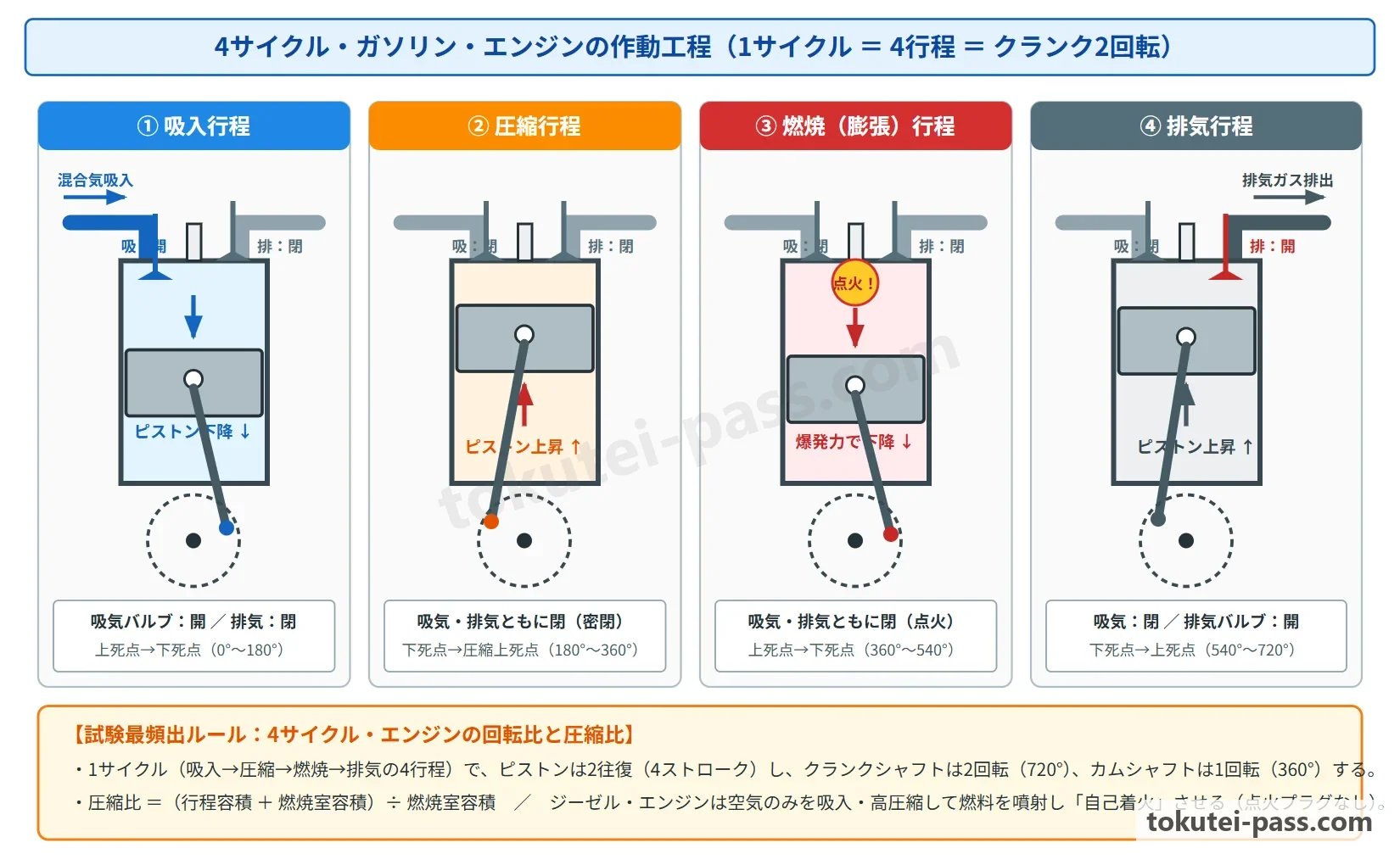
Key points
- 4サイクル・エンジンは「吸入→圧縮→燃焼(膨張)→排気」の4行程で1サイクルとなり、クランクシャフト2回転(720°)につきカムシャフトは1回転(360°)する
A 4-stroke engine completes 1 cycle in 4 strokes (Intake → Compression → Combustion → Exhaust), with 2 crankshaft revolutions (720°) and 1 camshaft revolution (360°) - ガソリン・エンジンは混合気をスパーク・プラグの電気火花で点火し、ジーゼル・エンジンは空気のみを吸入・高圧縮して軽油を噴射し自己着火させる
Gasoline engines ignite an air-fuel mixture with a spark plug, whereas diesel engines compress air only and inject diesel fuel for self-ignition - 圧縮比=(燃焼室容積+1気筒の排気量)÷燃焼室容積であり、総排気量=1気筒の排気量×気筒数で求める
Compression ratio = (Combustion chamber volume + Single-cylinder displacement) ÷ Combustion chamber volume; Total displacement = Single-cylinder displacement × Number of cylinders - 【例】4サイクル・エンジンでクランクシャフトが10回転(または2,000 rpm)するとき、カムシャフトは半分の5回転(1,000 rpm)し、1気筒あたり5回燃焼する
Example: In a 4-stroke engine, when the crankshaft makes 10 revolutions (or 2,000 rpm), the camshaft makes half that at 5 revolutions (1,000 rpm), with 5 combustion strokes per cylinder - 【例】1気筒の排気量が 450 cm³、燃焼室容積が 50 cm³ の4気筒エンジンの場合、総排気量=450×4=1,800 cm³(1.8 L)、圧縮比=(50+450)÷50=10 となる
Example: For a 4-cylinder engine with 450 cm³ single-cylinder displacement and 50 cm³ combustion chamber volume, total displacement = 450 × 4 = 1,800 cm³ (1.8 L), and compression ratio = (50 + 450) ÷ 50 = 10
| Word | Meaning |
|---|---|
| 上死点・下死点 | Top Dead Center (TDC) and Bottom Dead Center (BDC) |
| クランクシャフト(crankshaft) | Crankshaft |
| カムシャフト(camshaft) | Camshaft |
| 自己着火 | Self-ignition (compression ignition) |
| 圧縮比 | Compression ratio |
エンジン本体の主要部品(シリンダ・ピストン・クランク機構)
Main Engine Body Components (Cylinder, Piston, and Crank Mechanism)
エンジン本体は、上部のシリンダ・ヘッド(cylinder head)、中央のシリンダ・ブロック(cylinder block)、下部のオイル・パン(oil pan)で構成されます。
The engine body consists of the cylinder head at the top, the cylinder block in the middle, and the oil pan at the bottom.
シリンダ・ヘッドとシリンダ・ブロックの接合面にはシリンダ・ヘッド・ガスケットが挟まれ、燃焼ガスや冷却水・エンジン・オイルの漏れを防いでいます。
A cylinder head gasket is clamped between the mating surfaces of the cylinder head and cylinder block to prevent leakage of combustion gas, coolant, and engine oil.
ピストン(piston)は燃焼ガスの圧力を直接受けてシリンダ内を往復運動する部品で、熱膨張を見込んでヘッド部よりスカート部の直径をわずかに大きく作り、ピストン・ピン方向を短くした楕円形に加工されています。ピストンとコンロッドはピストン・ピンによって連結されます。
The piston directly receives combustion gas pressure and reciprocates inside the cylinder; to account for thermal expansion, its skirt diameter is made slightly larger than the head, and its cross-section is machined into an oval shape shorter along the piston-pin axis. The piston and connecting rod are linked by the piston pin.
ピストンの外周溝にはピストン・リング(piston ring)が装着されます。上側のコンプレッション・リング(圧縮リング)は燃焼室の気密を保ちピストンの熱をシリンダ壁へ逃がす役割を持ち、下側のオイル・リングはシリンダ壁の余分なオイルをかき落として適切な油膜を作ります。
Piston rings are fitted into the outer grooves of the piston. The upper compression rings seal the combustion chamber and transfer heat from the piston to the cylinder wall, while the lower oil ring scrapes excess oil off the cylinder wall to maintain a proper oil film.
コンロッド(コネクティング・ロッド)とクランクシャフトは、ピストンの往復運動を回転運動に変換する機構です。クランクシャフトの後端に取り付けられたフライホイール(flywheel:はずみ車)は、回転の慣性力によってエンジンの回転ムラを抑え、滑らかな回転を保ちます。
The connecting rod and crankshaft convert the reciprocating motion of the piston into rotational motion. The flywheel mounted at the rear end of the crankshaft uses rotational inertia to smooth out speed fluctuations and maintain smooth rotation.
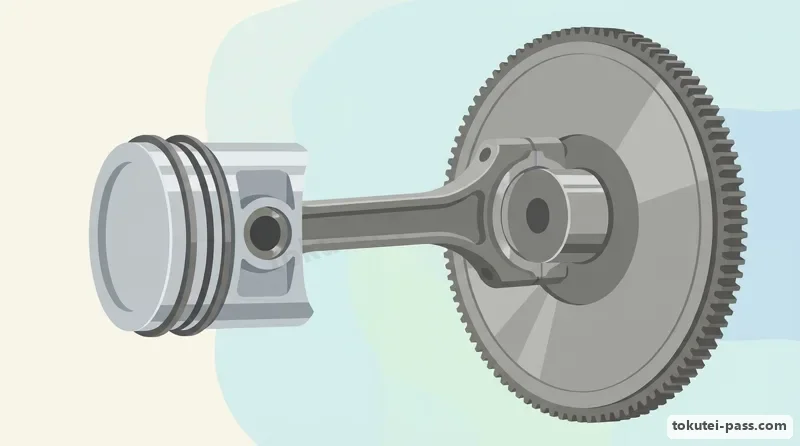
Key points
- コンロッド(connecting rod)とクランクシャフトは、ピストンの往復運動を回転運動に変換する
The connecting rod and crankshaft convert the reciprocating motion of the piston into rotational motion - コンプレッション・リングは燃焼ガスの漏れ防止(気密保持)とピストンの放熱を行い、オイル・リングは余分なオイルをかき落とす
Compression rings maintain gas tightness and dissipate piston heat, while oil rings scrape off excess oil to form an appropriate oil film - フライホイールは回転慣性によってクランクシャフトの回転変動(回転ムラ)を抑え、外周のリング・ギヤにスタータのピニオンが噛み合う
The flywheel uses rotational inertia to reduce engine speed fluctuations, and its outer ring gear meshes with the starter pinion
| Word | Meaning |
|---|---|
| シリンダ・ヘッド(cylinder head) | Cylinder head |
| ピストン・リング(piston ring) | Piston ring |
| コンロッド(connecting rod) | Connecting rod |
| フライホイール(flywheel) | Flywheel |
動弁機構とバルブ・クリアランス(バルブすき間)
Valve Mechanism and Valve Clearance
動弁機構は、クランクシャフトの回転をタイミング・チェーンやタイミング・ベルトでカムシャフトに伝え、インテーク・バルブとエキゾースト・バルブを適切なタイミングで開閉させる装置です。カムシャフトの歯数(プーリ径)はクランクシャフトの2倍になっており、クランクシャフトの1/2の速度で回転します。
The valve mechanism transmits crankshaft rotation to the camshaft via a timing chain or timing belt to open and close the intake and exhaust valves at the proper timing. Because the camshaft sprocket or pulley has twice the teeth of the crankshaft sprocket, the camshaft rotates at 1/2 the speed of the crankshaft.
カムシャフトをシリンダ・ヘッドの上に配置した方式をOHC(オーバー・ヘッド・カムシャフト)といい、吸気用と排気用の2本のカムシャフトを持つ方式をDOHC(ダブル・オーバー・ヘッド・カムシャフト)といいます。バルブはカムによって押し開かれ、バルブ・スプリングの張力によって閉じられます。
Placing the camshaft above the cylinder head is called OHC (Overhead Camshaft), and using two separate camshafts for intake and exhaust valves is called DOHC (Double Overhead Camshaft). Valves are pushed open by the cam lobes and closed by the tension of the valve springs.
排気行程の終わりから吸入行程の始めにかけての上死点付近では、インテーク・バルブとエキゾースト・バルブの両方が同時に開いている期間があり、これを「バルブ・オーバーラップ(valve overlap)」と呼びます。排気ガスの慣性を利用して新気の吸入効率を高める効果があります。
Near Top Dead Center between the end of the exhaust stroke and the beginning of the intake stroke, there is a period when both the intake and exhaust valves are open simultaneously, called valve overlap. This utilizes exhaust gas inertia to improve fresh air intake efficiency.
また、エンジンが温まるとバルブが熱膨張して長くなるため、冷間時にも確実にバルブが閉じるよう、バルブ・ステム端とロッカ・アーム(またはリフタ)の間に「バルブ・クリアランス(バルブすき間)」を設けます。すき間が過大だとタペット音(打音)が発生し、過小だと温間時にバルブが完全に閉じず圧縮漏れを起こします。
Because valves lengthen due to thermal expansion when the engine warms up, a small gap called valve clearance is provided between the valve stem end and the rocker arm (or lifter) so that the valves still close completely when hot. Excessive clearance causes tappet noise, while insufficient clearance prevents complete valve closure when warm, causing compression leakage.
Key points
- バルブはカムシャフトのカムで押し開かれ、バルブ・スプリングの力で閉じられる
Valves are pushed open by the camshaft cams and closed by the force of the valve springs - バルブ・オーバーラップとは、排気行程末期から吸入行程初期の上死点付近で吸気弁と排気弁が同時に開いている期間である
Valve overlap is the period near TDC between the end of the exhaust stroke and the start of the intake stroke when both intake and exhaust valves are open simultaneously - バルブ・クリアランス(バルブすき間)はバルブの熱膨張による突き上げ(閉鎖不良)を防ぐために設けられ、一般に高温になる排気弁側の方が吸気弁側より広く設定される
Valve clearance prevents incomplete valve closure caused by thermal expansion; the hotter exhaust valve side is generally given a larger clearance than the intake side
| Word | Meaning |
|---|---|
| 動弁機構 | Valve mechanism (valve train) |
| バルブ・スプリング(valve spring) | Valve spring |
| バルブ・オーバーラップ(valve overlap) | Valve overlap |
| バルブ・クリアランス(valve clearance) | Valve clearance |
異常燃焼(ノッキング・プレイグニッション・ジーゼル・ノック)
Abnormal Combustion (Knocking, Pre-ignition, and Diesel Knock)
ガソリン・エンジンの正常燃焼では、スパーク・プラグで点火された火炎が燃焼室全体へ順次広がります。しかし、点火時期が早すぎたり圧縮圧力・温度が高すぎたりすると、火炎が届く前に末端の未燃焼ガスが自然発火して激しい圧力振動と金属打音(カリカリ音)を生じます。これを「ノッキング(knocking:デトネーション)」といいます。
In normal gasoline engine combustion, the flame ignited by the spark plug propagates progressively across the combustion chamber. However, if ignition timing is too advanced or compression pressure and temperature are too high, the unburned end-gas spontaneous ignites before the flame front arrives, causing severe pressure oscillations and a metallic pinging noise called knocking (detonation).
また、燃焼室内に堆積したカーボンや過熱したスパーク・プラグの電極などが熱源となり、スパーク・プラグが火花を飛ばす前に混合気に着火してしまう現象を「プレイグニッション(pre-ignition:早期着火)」といいます。
Furthermore, when carbon deposits or an overheated spark plug electrode act as a heat source and ignite the air-fuel mixture before the spark plug fires, the phenomenon is called pre-ignition.
ガソリンのアンチノック性(ノッキングの起きにくさ)を示す数値を「オクタン価」といい、数値が大きいほどノッキングが起きにくくなります。
The anti-knock quality of gasoline is expressed by the octane number; a higher octane number makes knocking less likely to occur.
一方、ジーゼル・エンジンでは噴射された軽油がすぐには燃えず、蒸発して周囲の空気と混ざり着火するまでにわずかな時間(「着火遅れ期間」)がかかります。この着火遅れ期間が長すぎると、その間に溜まった多量の燃料が一気に爆発的に燃焼し、激しい打音と振動を生じます。これが「ジーゼル・ノック」です。
In a diesel engine, injected diesel fuel does not burn immediately; it takes a brief ignition delay period to vaporize and mix with hot air before self-igniting. If this ignition delay period is too long, a large amount of fuel accumulated during the delay burns explosively all at once, producing severe metallic noise and vibration called diesel knock.
ジーゼル・ノックは、ガソリン・エンジンのノッキングとは逆に、エンジンが冷えているとき(始動直後や低負荷時)や圧縮圧力が低いときに起こりやすくなります。軽油の自己着火のしやすさを示す数値を「セタン価」といい、セタン価が高いほど着火遅れが短くなりジーゼル・ノックが起きにくくなります。
Contrary to gasoline knocking, diesel knock occurs more easily when the engine is cold (immediately after starting or at light load) or when compression pressure is low. The ease of self-ignition of diesel fuel is indicated by the cetane number; a higher cetane number shortens ignition delay and suppresses diesel knock.
Key points
- ガソリンのノッキング(デトネーション)は末端の未燃焼ガスの自然発火であり、オクタン価が高いガソリンほどノッキングが起きにくい
Gasoline knocking (detonation) is spontaneous ignition of the unburned end-gas, and gasoline with a higher octane number is more resistant to knocking - プレイグニッション(早期着火)は過熱したプラグ電極や赤熱したカーボンを熱源として電気火花より前に着火する現象である
Pre-ignition occurs when overheated plug electrodes or glowing carbon deposits ignite the mixture before the electric spark fires - ジーゼル・ノックは着火遅れ期間中に噴射された多量の燃料が一気に燃焼して起こるため、冷間時に起こりやすく、軽油のセタン価が高いほど起きにくい
Diesel knock is caused by explosive combustion of fuel accumulated during the ignition delay period; it occurs easily when cold and is reduced by higher-cetane diesel fuel
| Word | Meaning |
|---|---|
| ノッキング(knocking) | Knocking (detonation) |
| プレイグニッション(pre-ignition) | Pre-ignition |
| オクタン価 | Octane number |
| ジーゼル・ノック(diesel knock) | Diesel knock |
| セタン価 | Cetane number |
潤滑装置と冷却装置の構造・機能
Lubrication System and Cooling System Structure and Function
潤滑装置は、オイル・パンのエンジン・オイルをオイル・ストレーナから吸い上げ、オイル・ポンプ(トロコイド式やギヤ式)で圧送し、オイル・フィルタでろ過してから各運動部へ送ります。
The lubrication system draws engine oil from the oil pan through an oil strainer, pumps it under pressure with an oil pump (trochoid or gear type), filters it through an oil filter, and supplies it to moving parts.
オイル・ポンプには油圧が異常に高くなるのを防ぐプレッシャ・リリーフ・バルブが設けられ、フィルタにはエレメント目詰まり時にオイルを直接エンジンへ流して焼き付きを防ぐバイパス・バルブが内蔵されています。
The oil pump has a pressure relief valve to prevent excessive oil pressure, and the oil filter incorporates a bypass valve that opens if the filter element becomes clogged, sending unfiltered oil directly to the engine to prevent seizure.
冷却装置は、シリンダ周りのウォータ・ジャケットを流れる冷却水(LLC)をウォータ・ポンプで循環させ、ラジエータ(radiator)で放熱します。
The cooling system circulates coolant (LLC) through the water jackets around the cylinders using a water pump and dissipates heat through the radiator.
ラジエータとエンジンの間にはサーモスタット(thermostat:ワックス・ペレット式)があり、冷間時はバルブを閉じて冷却水をラジエータへ流さず暖機を早め、水温が上がると開いてラジエータへ流します。
A wax-pellet thermostat is installed between the engine and radiator: when the engine is cold, it stays closed to block flow to the radiator and speed up warm-up; when coolant temperature rises, it opens to let coolant flow to the radiator.
ラジエータ・キャップ(radiator cap)には2つの弁があります。プレッシャ・バルブ(加圧弁)は冷却水系統内を大気圧より高く加圧することで冷却水の沸点を100℃以上(約110〜120℃)に高め、沸騰を防ぎます。
The radiator cap contains two valves. The pressure valve pressurizes the cooling system above atmospheric pressure, raising the boiling point of the coolant above 100°C (to about 110 to 120°C) to prevent boiling.
もう一つのバキューム・バルブ(負圧弁)は、エンジン停止後に冷却水温度が下がってラジエータ内が負圧になったときに開き、リザーバ・タンクから冷却水を戻してラジエータやホースがへこむ(つぶれる)のを防ぎます。
The vacuum valve opens when the coolant cools down after engine shutdown and creates negative pressure inside the radiator, drawing coolant back from the reservoir tank to prevent the radiator and hoses from collapsing.
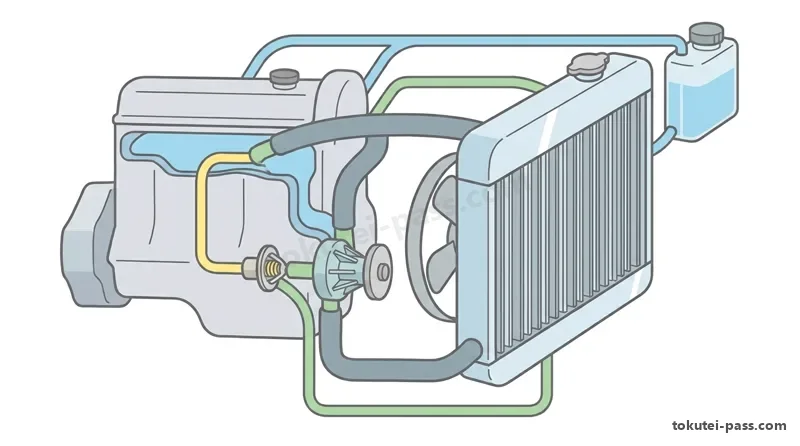
Key points
- オイル・フィルタのバイパス・バルブは、フィルタ(エレメント)が目詰まりしたときに開き、ろ過しないままオイルをエンジン各部へ送って焼き付きを防ぐ
The oil filter bypass valve opens when the filter element is clogged, allowing oil to flow directly to engine parts to prevent engine seizure - サーモスタットは冷間時に閉じて暖機を促進し、温間時に開いてラジエータへ冷却水を流す(閉じたままだとオーバーヒート、開いたままだとオーバークールになる)
The thermostat closes when cold to accelerate warm-up and opens when warm to route coolant to the radiator (stuck closed causes overheating; stuck open causes overcooling) - ラジエータ・キャップのプレッシャ・バルブは冷却系統を加圧して沸点を100℃以上に上げ、バキューム・バルブは冷却後の負圧によるホースやタンクの変形を防ぐ
The radiator cap pressure valve pressurizes the system to raise the boiling point above 100°C, while the vacuum valve prevents hose collapse under negative pressure after cooling
| Word | Meaning |
|---|---|
| オイル・フィルタ(oil filter) | Oil filter |
| プレッシャ・リリーフ・バルブ(pressure relief valve) | Pressure relief valve |
| サーモスタット(thermostat) | Thermostat |
| ラジエータ・キャップ(radiator cap) | Radiator cap |
燃料装置(ガソリン・ジーゼル)と吸排気・過給器
Fuel Systems (Gasoline and Diesel) and Intake, Exhaust, and Supercharging
電子制御式ガソリン燃料噴射装置(EFI)では、フューエル・タンク内のフューエル・ポンプで汲み上げたガソリンをフューエル・フィルタでろ過し、プレッシャ・レギュレータで燃料圧力を一定に保ちます。
In an electronically controlled gasoline fuel injection (EFI) system, fuel pumped from the fuel tank is filtered and held at a constant pressure differential by a pressure regulator. The ECU then controls fuel injection quantity by varying the opening duration (pulse width) of the electromagnetic injectors.
そしてECU(コンピュータ)からの信号でインジェクタ(injector:電磁噴射弁)の開弁時間を変えることで燃料噴射量を制御します。
In a diesel common-rail fuel injection system, a supply pump pressurizes diesel fuel to ultra-high pressure and stores it in a common rail (accumulator), from which electronically controlled injectors spray it as a fine mist.
ジーゼル・エンジンのコモンレール式燃料噴射装置では、サプライ・ポンプで超高圧に加圧した軽油をコモンレール(蓄圧室)に蓄え、電子制御インジェクタから微細な霧状にして噴射します。また、ジーゼルの燃料フィルタには水分離器(セジメンタ)が備えられており、冷間始動を助けるため燃焼室にグロー・プラグ(予熱栓)が設けられています。
Diesel fuel filters also include a water separator (sedimenter), and glow plugs are installed in the combustion chambers to preheat the air and assist cold starting.
吸気装置のエアクリーナは吸入空気中のゴミやホコリを取り除き、排気装置のマフラー(消音器)は高温・高圧の排気ガスの圧力と温度を段階的に下げて排気音を小さくします。
In the intake and exhaust systems, the air cleaner removes dust from intake air, while the muffler steps down the temperature and pressure of high-pressure exhaust gas to reduce exhaust noise.
過給器の代表であるターボチャージャ(turbocharger)は、排気ガスのエネルギーでタービン・ホイールを高速回転させ、同軸のコンプレッサ・ホイールで吸入空気を圧縮してシリンダに押し込みます。圧縮されて高温になった吸気はインタークーラ(intercooler)で冷却し、空気密度を高めて充填効率を向上させます。
A turbocharger uses exhaust gas energy to spin a turbine wheel at high speed, driving a coaxial compressor wheel that compresses intake air into the cylinders. The compressed air, which becomes hot, is cooled by an intercooler to increase air density and improve charging efficiency.
Key points
- ガソリンEFIのインジェクタは、燃料圧力を一定にした状態でニードル・バルブの開弁時間(通電時間)を変化させて噴射量を調整する
Gasoline EFI injectors regulate fuel injection quantity by varying the valve opening duration (energizing time) while maintaining constant fuel pressure - ジーゼル・エンジンのグロー・プラグ(予熱栓)は、冷間始動時に燃焼室内を温めて軽油の自己着火を助ける装置である
Diesel engine glow plugs heat the combustion chamber during cold starting to assist self-ignition of the diesel fuel - ターボチャージャは排気ガスのエネルギーでタービンを回して吸気を圧縮し、インタークーラは圧縮されて温度が上がった吸入空気を冷却する
A turbocharger uses exhaust gas energy to drive a turbine and compress intake air, while an intercooler cools the compressed, heated intake air
| Word | Meaning |
|---|---|
| インジェクタ(injector) | Injector |
| コモンレール(common rail) | Common rail |
| グロー・プラグ(glow plug) | Glow plug |
| ターボチャージャ(turbocharger) | Turbocharger |
| インタークーラ(intercooler) | Intercooler |
排出ガス浄化装置(三元触媒・EGR・PCV・DPF)
Exhaust Emission Control Systems (Three-Way Catalyst, EGR, PCV, DPF)
自動車の排出ガスに含まれる主な有害成分は、一酸化炭素(CO)、炭化水素(HC)、窒素酸化物(NOx)、およびジーゼル車の粒子状物質(PM:黒煙など)です。ガソリン車の三元触媒(three-way catalyst)は、COとHCを酸化して二酸化炭素(CO2)と水(H2O)にし、NOxを還元して窒素(N2)にします。
The main harmful pollutants in automotive exhaust gas are carbon monoxide (CO), hydrocarbons (HC), nitrogen oxides (NOx), and particulate matter (PM, such as soot in diesel vehicles). A three-way catalyst on a gasoline vehicle simultaneously oxidizes CO and HC into CO2 and H2O and reduces NOx into N2.
三元触媒が3つの有害成分を同時に最も効率よく浄化できるのは、空気とガソリンの重量比が「理論空燃比(約14.7:1)」付近のときに限られます。そのため、排気管のO2センサ(酸素センサ)や空燃比センサで排気中の酸素濃度を検出し、インジェクタの噴射量をフィードバック制御しています。
A three-way catalyst can purify all three pollutants simultaneously at peak efficiency only when the air-fuel mass ratio is maintained near the stoichiometric (theoretical) air-fuel ratio of about 14.7 : 1. Therefore, an O2 sensor or air-fuel ratio sensor in the exhaust pipe detects oxygen concentration so the ECU can perform feedback control of injection quantity.
また、EGR(排気ガス再循環装置)は排気ガスの一部を吸気側へ戻すことで最高燃焼温度を下げ、高温で発生しやすいNOx(窒素酸化物)の生成を抑えます。ジーゼル車のDPF(ジーゼル微粒子捕集フィルタ)は排気中のPM(すす)をフィルタで捕集し、高温で燃焼除去(再生)します。
An EGR (Exhaust Gas Recirculation) system routes a portion of inert exhaust gas back into the intake system to lower peak combustion temperature, thereby suppressing NOx formation. On diesel vehicles, a DPF (Diesel Particulate Filter) traps PM (soot) and burns it off at high temperature (regeneration).
さらに、ピストンとシリンダ壁のすき間からクランクケースに漏れ出た未燃焼ガス(ブローバイ・ガス:HCを多く含む)は、PCVバルブを通じて吸気系へ戻して再燃焼させます。燃料タンクから蒸発したガソリン蒸気(エバポ・ガス)は、チャコール・キャニスタの活性炭に吸着させ、走行中に吸気管へ送って燃焼させます。
Unburned blow-by gas (rich in HC) leaking past the piston rings into the crankcase is routed back into the intake manifold via a PCV valve to be burned. Evaporative fuel vapor (HC) from the fuel tank is adsorbed by activated carbon in a charcoal canister and purged into the intake manifold during driving.
Key points
- 三元触媒は理論空燃比(約14.7:1)付近でCO・HC(酸化)とNOx(還元)の3成分を同時に最も高い効率で浄化する
A three-way catalyst purifies CO, HC (oxidation) and NOx (reduction) simultaneously with highest efficiency near the theoretical air-fuel ratio (about 14.7 : 1) - EGR(排気ガス再循環装置)は排気ガスの一部を吸気系に戻して燃焼温度を下げ、NOxの発生を低減する
EGR (Exhaust Gas Recirculation) recirculates part of the exhaust gas into the intake to lower combustion temperature and reduce NOx emissions - ブローバイ・ガス還元装置(PCV)はクランクケース内の未燃ガスを吸気系へ戻し、チャコール・キャニスタは燃料タンクの蒸発ガス(HC)を活性炭に吸着させて吸気系へ送る
The PCV system returns crankcase blow-by gas to the intake, while the charcoal canister adsorbs fuel tank evaporative gas (HC) on activated carbon for combustion
| Word | Meaning |
|---|---|
| 三元触媒 | Three-way catalyst |
| 理論空燃比 | Theoretical (stoichiometric) air-fuel ratio (14.7 : 1) |
| ブローバイ・ガス(blow-by gas) | Blow-by gas |
| チャコール・キャニスタ(charcoal canister) | Charcoal canister |
試験によく出るポイントと覚え方
Frequently Tested Points and Memory Tips
学科試験の正誤問題では、クランクシャフトとカムシャフトの回転比が入れ替えられて出題されます。「4サイクル1回(4行程)=クランク2回転(720°)=カム1回転(360°)」をセットで暗記し、「クランク1回転でカム2回転」という引っ掛けを即座に誤りと判断できるようにしましょう。
In True/False written exam questions, the rotation ratio between the crankshaft and camshaft is often reversed. Memorize as a set: 1 four-stroke cycle (4 strokes) = 2 crankshaft revolutions (720°) = 1 camshaft revolution (360°), so you can immediately spot a trap stating 1 crankshaft turn equals 2 camshaft turns as False.
ガソリンとジーゼルの比較では、「ガソリン=混合気吸入・スパーク・プラグ火花点火・オクタン価・圧縮比が低い(9〜11)」に対し、「ジーゼル=空気のみ吸入・軽油高圧噴射で自己着火・セタン価・圧縮比が高い(15〜22)・冷間時にジーゼル・ノックが起こりやすい」という対比が頻出です。
When comparing gasoline and diesel engines: Gasoline = air-fuel mixture intake, spark plug ignition, octane number, lower compression ratio (9 to 11); Diesel = air-only intake, high-pressure fuel injection self-ignition, cetane number, higher compression ratio (15 to 22), prone to diesel knock when cold.
冷却装置と潤滑装置では、各バルブの役割を正確に区別してください。サーモスタットは「冷間時=閉じる(暖機促進)、温間時=開く」です。ラジエータ・キャップは「プレッシャ・バルブ=加圧して沸点を100℃以上に上げる」「バキューム・バルブ=冷えたときの負圧でホースがつぶれるのを防ぐ」です。
In cooling and lubrication systems, distinguish each valve clearly: Thermostat = closed when cold (for rapid warm-up), open when warm. Radiator cap = pressure valve raises boiling point above 100°C; vacuum valve prevents hose collapse under negative pressure when cooled.
排出ガス対策では、「三元触媒=理論空燃比(14.7:1)でCO・HC・NOxを同時浄化」「EGR=排気を吸気に戻して燃焼温度を下げNOx低減」「PCV=クランクケースのブローバイ・ガス」「チャコール・キャニスタ=燃料タンクの蒸発ガス」の4組を混同しないように整理しておきましょう。
For emission control systems, keep the four pairs distinct: Three-way catalyst = theoretical air-fuel ratio 14.7 for CO, HC, and NOx; EGR = lowers combustion temperature to reduce NOx; PCV = crankcase blow-by gas; Charcoal canister = fuel tank evaporative gas.
Key points
- 4サイクルはクランクシャフト2回転(720°)でカムシャフト1回転(360°)であり、逆にした引っ掛け問題に注意する
4-stroke cycle: 2 crankshaft revolutions (720°) per 1 camshaft revolution (360°); watch out for reversed-ratio trap questions - ガソリン=火花点火・オクタン価・圧縮比9〜11 / ジーゼル=空気のみ吸入・自己着火・セタン価・圧縮比15〜22・冷間時ノック
Gasoline = spark ignition, octane number, compression ratio 9 to 11 / Diesel = air-only intake, self-ignition, cetane number, compression ratio 15 to 22, cold knock - サーモスタットは冷間時に閉じて暖機を早める / ラジエータ・キャップの加圧弁は沸点を100℃以上に高める
Thermostat closes when cold to speed up warm-up / Radiator cap pressure valve raises the coolant boiling point above 100°C - オイル・フィルタのバイパス・バルブはエレメント目詰まり時にオイルを直接流してエンジンの焼き付きを防ぐ
The oil filter bypass valve opens when the element is clogged to supply oil directly and prevent engine seizure - 三元触媒=理論空燃比14.7 / EGR=燃焼温度低下でNOx低減 / PCV=ブローバイ・ガス / キャニスタ=燃料蒸発ガス
Three-way catalyst = ratio 14.7 / EGR = lowers combustion temp to cut NOx / PCV = blow-by gas / Canister = fuel evaporative gas
| Word | Meaning |
|---|---|
| 暖機 | Engine warm-up |
| 沸点 | Boiling point |
| バイパス・バルブ(bypass valve) | Bypass valve |
Gasoline & Diesel Engines: Structure & Function
Practice this chapter in the appOfficial references
- 一般社団法人 日本自動車整備振興会連合会(JASPA)「自動車整備分野特定技能評価試験 学習用テキスト(三級自動車整備士講習用テキスト準拠)」 — https://www.jaspa.or.jp/
- 国土交通省 物流・自動車局「自動車整備分野特定技能1号評価試験 試験実施要領」 — https://www.mlit.go.jp/jidosha/jidosha_fr10_000041.html