
Power Generation, Transmission & Distribution, Substations, and High-Voltage Receiving Equipment
発電・送配電・変電設備と高圧受電設備機器
Class 1 Electrician 第一種電気工事士 (written exam) · 第一種電気工事士(学科試験) · Written by Tokutei Pass based on the official study texts; not copied verbatim.
汽力発電・ディーゼル発電とコージェネレーション
Steam Thermal Power, Diesel Power Generation, and Cogeneration
火力発電(汽力発電)の自然循環式ボイラでは、水と蒸気が「給水ポンプ → 節炭器 → 蒸気ドラム → 蒸発管(水冷壁管)→ 過熱器 → 蒸気タービン」の順に流れます。節炭器は燃焼排ガスの余熱で給水を予熱し、熱効率を高める装置です。
In a natural circulation boiler (自然循環式ボイラ) of a thermal power plant (汽力発電), water and steam flow in the order: Feedwater pump (給水ポンプ) → Economizer (節炭器) → Steam drum (蒸気ドラム) → Generating tubes / Waterwall tubes (蒸発管 / 水冷壁管) → Superheater (過熱器) → Steam turbine (蒸気タービン). The economizer (節炭器) preheats feedwater using residual heat from combustion exhaust gas to improve thermal efficiency.
高圧タービンで仕事をした蒸気を再びボイラへ戻して再熱器で加熱し、中低圧タービンへ送る方式を再熱サイクルといいます。またタービンを出た蒸気を冷却水で冷やして水に戻すのが復水器であり、内部を高真空に保つことでタービン出力を増加させます。
Returning steam that has performed work in the high-pressure turbine back to the boiler to be reheated in a reheater (再熱器) before sending it to the intermediate/low-pressure turbine is called a reheat cycle (再熱サイクル). Also, the condenser (復水器) cools steam exhausted from the turbine with cooling water to return it to water, maintaining a high vacuum inside to increase turbine output.
ビルや工場の非常用予備発電装置に広く使われるディーゼル機関は、ピストンで高温高圧に圧縮した空気中に軽油や重油を噴射して自然着火させる内燃機関です。そのためガソリン機関のような点火プラグは不要であり、熱効率が高く始動が迅速です。
A diesel engine (ディーゼル機関), widely used in emergency standby generator sets in buildings and factories, is an internal combustion engine that injects light oil (軽油) or heavy oil (重油) into air compressed to high temperature and pressure by a piston, causing spontaneous ignition (自然着火). Therefore, it needs no spark plugs (点火プラグ) like a gasoline engine, achieving high thermal efficiency and rapid starting.
4サイクル(4ストローク)ディーゼル機関は「吸入 → 圧縮 → 燃焼(膨張)→ 排気」の 4行程(クランク軸 2回転)で 1回の仕事を行います。回転の脈動(速度変動)を抑えて滑らかに回すため、軸には重い「はずみ車(フライホイール)」が取り付けられます。
A 4-cycle (4-stroke) diesel engine performs work once every 4 strokes (2 crankshaft revolutions) in the order: Intake (吸入) → Compression (圧縮) → Combustion / Expansion (燃焼・膨張) → Exhaust (排気). To suppress rotational pulsation (speed fluctuation) and ensure smooth rotation, a heavy flywheel (はずみ車 / フライホイール) is mounted on the shaft.
コージェネレーションシステム(熱電併給)は、ガスエンジンやガスタービン等で発電すると同時に、排出される排熱を給湯や冷暖房の蒸気・温水として回収利用する方式で、総合熱効率を 70〜80% 程度まで高めることができます。
A cogeneration system (コージェネレーションシステム / 熱電併給 — combined heat and power) generates electricity using a gas engine or gas turbine while simultaneously recovering exhaust heat as steam or hot water for hot water supply and air conditioning, boosting total thermal efficiency to around 70 to 80%.
Key points
- 自然循環式ボイラの水・蒸気経路:給水ポンプ → 節炭器(排ガスで給水予熱)→ 蒸発管 → 過熱器 → タービン → 復水器
Water/steam path in a natural circulation boiler: Feedwater pump → Economizer (preheats water with exhaust gas) → Generating tubes → Superheater → Turbine → Condenser - ディーゼル機関は圧縮空気へ燃料噴射して自然着火させる(点火プラグ不要)。回転脈動防止には「はずみ車」を使用
A diesel engine injects fuel into compressed air for spontaneous ignition (no spark plugs needed). A flywheel (はずみ車) is used to prevent rotational pulsation - 4サイクル機関の行程順は「吸入 → 圧縮 → 燃焼(膨張)→ 排気」
Stroke order of a 4-cycle engine: Intake (吸入) → Compression (圧縮) → Combustion / Expansion (燃焼・膨張) → Exhaust (排気) - コージェネレーション(熱電併給)は発電と排熱利用を併用し、総合エネルギー効率を 70〜80% に向上させる
Cogeneration combines power generation and exhaust heat utilization, improving overall energy efficiency to 70–80%
| Word | Meaning |
|---|---|
| 節炭器・過熱器・復水器 | 節炭器・過熱器・復水器: Economizer, Superheater, Condenser |
| 再熱サイクル | 再熱サイクル: Reheat cycle |
| ディーゼル発電機 | ディーゼル発電機: Diesel generator |
| はずみ車(フライホイール) | はずみ車 (フライホイール): Flywheel |
| コージェネレーション | コージェネレーション: Cogeneration (Combined Heat and Power - CHP) |
水力発電・揚水発電と再生可能エネルギー
Hydroelectric Power, Pumped-Storage Power, and Renewable Energy
水力発電所の導水経路は「取水口 → 沈砂池 → 導水路 → サージタンク(調圧水槽)→ 水圧管路 → 水車 → 吸出管 → 放水口」の順です。サージタンクは急激な負荷変動時に水圧管路で発生する水撃作用(ウォーターハンマ)を吸収・緩和する設備です。
The water conduit path of a hydroelectric power plant is: Intake (取水口) → Settling basin (沈砂池) → Headrace (導水路) → Surge tank (サージタンク / 調圧水槽) → Penstock (水圧管路) → Hydraulic turbine (水車) → Draft tube (吸出管) → Tailrace (放水口). The surge tank is installed to absorb and mitigate water hammer (水撃作用 / ウォーターハンマ) occurring in the penstock during sudden load changes.
水車の種類では、高落差・少水量向きの衝動水車が「ペルトン水車」、中落差向きの反動水車が「フランシス水車」、低落差・大水量向きの反動水車が「プロペラ水車(可動羽根はカプラン水車)」です。クロスフロー水車は小水力発電用であり風車ではありません。
Among hydraulic turbines, an impulse turbine suited for high head and small flow is the Pelton turbine (ペルトン水車); a reaction turbine for medium head is the Francis turbine (フランシス水車); and a reaction turbine for low head and large flow is the Propeller turbine (プロペラ水車; with adjustable blades, the Kaplan turbine カプラン水車). A cross-flow turbine (クロスフロー水車) is for small hydro power, not a wind turbine.
有効落差 H(m)、流量 Q(m³/s)、総合効率 η のとき、水力発電出力 P(kW)は P = 9.8 × Q × H × η で求まります。一方、揚水発電で全揚程 H(m)、揚水量 Q(m³/s)をくみ上げる電動機入力 P(kW)は P = (9.8 × Q × H) ÷ η となります。
When the effective head is H (m), flow rate is Q (m³/s), and combined efficiency of the turbine and generator is η, the hydroelectric generator output P (kW) is found by P = 9.8 × Q × H × η. Conversely, in pumped-storage hydro (揚水発電), the motor input P (kW) required to pump a flow rate Q (m³/s) up a total head H (m) is divided by efficiency: P = (9.8 × Q × H) ÷ η.
太陽光発電を電力系統へ連系する順序は「太陽電池モジュール → 接続箱(逆流防止ダイオード内蔵)→ パワーコンディショナ(インバータ・系統連系保護装置内蔵)→ 変圧器・系統」です。パワーコンディショナは直流を交流へ変換し、単独運転を防止します。
The connection order for grid-tied solar photovoltaics (太陽光発電) is: Solar cell module (太陽電池モジュール) → Junction box (接続箱, with built-in blocking diodes) → Power conditioner (パワーコンディショナ, with built-in inverter and grid-interconnection protection) → Transformer / Grid. The power conditioner converts DC to AC and prevents islanding operation (単独運転).
風力発電用の風車には水平軸形の「プロペラ形」や垂直軸形の「ダリウス形・ジャイロミル形・サボニウス形」があります。地熱発電は地下の天然蒸気で蒸気タービンを回して発電するため、天候に左右されずベースロード電源として安定稼働できます。
Wind turbines for wind power generation include horizontal-axis Propeller types (プロペラ形) and vertical-axis Darrieus (ダリウス形), Gyromill (ジャイロミル形), and Savonius (サボニウス形) types. Geothermal power generation (地熱発電) uses underground natural steam to drive a steam turbine, enabling stable operation as a baseload power source unaffected by weather.
Key points
- サージタンク(調圧水槽)は水圧管路の上流に設け、急閉鎖時の水撃作用(ウォーターハンマ)を緩和する
A surge tank (調圧水槽) is installed upstream of the penstock to mitigate water hammer (ウォーターハンマ) during sudden valve closure - 水力発電出力 P = 9.8 × Q × H × η(kW)、揚水時の電動機入力 P = 9.8 × Q × H ÷ η(kW)
Hydroelectric generator output P = 9.8 × Q × H × η (kW); Pumped-storage motor input P = 9.8 × Q × H ÷ η (kW) - 太陽光発電の経路:太陽電池モジュール → 接続箱 → パワーコンディショナ(DC→AC 変換)→ 系統
Solar PV path: Solar cell module → Junction box (接続箱) → Power conditioner (DC → AC conversion) → Grid - プロペラ形・ダリウス形・ジャイロミル形は「風車」、ペルトン・フランシス・カプラン・クロスフローは「水車」
Propeller, Darrieus, and Gyromill are wind turbines; Pelton, Francis, Kaplan, and Cross-flow are hydraulic (water) turbines
| Word | Meaning |
|---|---|
| サージタンク(調圧水槽) | サージタンク (調圧水槽): Surge tank |
| 水撃作用(ウォーターハンマ) | 水撃作用 (ウォーターハンマ): Water hammer |
| ペルトン・フランシス・カプラン水車 | ペルトン・フランシス・カプラン水車: Pelton, Francis, and Kaplan hydraulic turbines |
| 揚水発電 | 揚水発電 (ようすいはつでん): Pumped-storage hydroelectricity |
| パワーコンディショナ | パワーコンディショナ: Power Conditioning System (PCS / Solar inverter) |
架空送電線路の現象と地中電力ケーブル
Overhead Transmission Line Phenomena and Underground Power Cables
架空送電線の鉄塔最上部に張られる「架空地線」は、送電線への直撃雷を遮蔽して防止するための裸線です。またがいし連の両端に取り付ける角状の「アークホーン(招弧角)」は、雷サージ等による閃絡(フラッシオーバ)時のアーク熱からがいし連の破損を保護します。
An overhead ground wire (架空地線) strung at the very top of transmission towers is a bare conductor used to shield transmission lines from direct lightning strikes (直撃雷). Also, horn-shaped arcing horns (アークホーン / 招弧角) attached to both ends of an insulator string protect the insulators from damage caused by arc heat during a lightning flashover (閃絡).
送電線の機械的振動では、微風によって電線が上下に細かく振動する現象を防ぐために「ダンパ(トーショナルダンパ等)」を取り付けます。また多導体送電線で素導体同士が衝突するのを防ぐ間隔保持具を「スペーサ」と呼びます。
Regarding mechanical vibrations of transmission lines, dampers (ダンパ, such as torsional dampers) are attached to prevent aeolian vibration, where gentle wind causes fine vertical oscillation of conductors. Furthermore, distance-keeping fittings that prevent sub-conductors from colliding on bundled-conductor transmission lines (多導体送電線) are called spacers (スペーサ).
冬期に電線に付着した氷雪が落下した反動で電線が大きく跳ね上がり、上下の電線が接触・短絡する現象を「スリートジャンプ」といいます。対策として、上下の電線に水平方向のずれ(オフセット)を設けることや、相間スペーサの取付が行われます。
In winter, when snow and ice adhering to a conductor drop off, the recoil causes the conductor to jump violently upward, resulting in contact and short-circuiting between upper and lower conductors; this phenomenon is called sleet jump (スリートジャンプ). Countermeasures include providing horizontal offset (オフセット) between upper and lower conductors and installing phase-to-phase spacers (相間スペーサ).
夜間や休日などの軽負荷時に、長距離送電線や地中ケーブルの対地静電容量によって進み充電電流が流れ、受電端電圧が送電端電圧よりも高くなる現象を「フェランチ効果」と呼びます。これを抑制するため変電所では分路リアクトル(遅れ無効電力を消費)を投入します。
During light-load periods such as late night or holidays, leading charging current flows due to the line-to-ground capacitance of long-distance transmission lines or underground cables, causing the receiving-end voltage to become higher than the sending-end voltage; this is called the Ferranti effect (フェランチ効果). To suppress it, shunt reactors (分路リアクトル, which consume lagging reactive power) are switched in at substations.
地中送電に使われる CV ケーブル(架橋ポリエチレン絶縁ビニルシースケーブル)では、導体の抵抗損に加えて、絶縁体に流れる充電電流による「誘電体損(ε・tanδ に比例)」と、金属シースに誘導される電流による「シース損」が発生します。
In CV cables (cross-linked polyethylene insulated vinyl-sheathed cables) used for underground transmission, in addition to conductor resistance loss (抵抗損), dielectric loss (誘電体損, proportional to ε·tanδ) due to charging current in the insulation and sheath loss (シース損) due to induced current in the metallic sheath occur.
Key points
- 架空地線=直撃雷の防止、アークホーン=閃絡時のアーク熱からがいし連を保護、ダンパ=微風振動の防止
Overhead ground wire = prevents direct lightning strikes; Arcing horn = protects insulator strings from flashover arc heat; Damper = prevents gentle-wind vibration - スリートジャンプ=氷雪脱落時の電線跳上がり短絡(対策:水平オフセット・相間スペーサ)
Sleet jump = conductor jumping and short-circuiting when ice/snow drops off (countermeasures: horizontal offset, phase-to-phase spacers) - フェランチ効果=軽負荷時に対地静電容量(進み電流)により「受電端電圧 > 送電端電圧」となる現象
Ferranti effect = phenomenon where Receiving-end voltage > Sending-end voltage under light load due to ground capacitance (leading current) - 電力ケーブルの損失=導体の抵抗損 + 絶縁体の誘電体損 + 金属被覆のシース損
Power cable losses = Conductor resistance loss + Insulation dielectric loss (誘電体損) + Metallic sheath loss (シース損)
| Word | Meaning |
|---|---|
| 架空地線・アークホーン | 架空地線・アークホーン: Overhead ground wire and Arcing horn |
| ダンパ・スペーサ | ダンパ・スペーサ: Damper and Spacer |
| スリートジャンプ | スリートジャンプ: Sleet jump |
| フェランチ効果 | フェランチ効果 (こうか): Ferranti effect |
| 誘電体損・シース損 | 誘電体損・シース損: Dielectric loss and Sheath loss |
変電設備・変圧器並行運転と電力貯蔵
Substation Equipment, Transformer Parallel Operation, and Energy Storage
中性点接地方式では、1線地絡電流と通信誘導障害が最小なのが「消弧リアクトル接地方式」や「非接地方式(6.6kV 配電線)」であり、逆に地絡電流は最大だが健全相電圧上昇が最小なのが超高圧系統の「直接接地方式」です。
Among neutral grounding methods in power systems, the methods with the smallest single-line-to-ground fault current and least inductive interference to communication lines are peterson-coil (arc-suppression reactor) grounding (消弧リアクトル接地方式) and ungrounded systems (非接地方式, used in 6.6kV distribution lines); conversely, direct grounding (直接接地方式) in extra-high-voltage grids has the largest ground fault current but the lowest voltage rise on healthy phases.
都市部の変電所で広く使われるガス絶縁開閉装置(GIS)は、遮断器・断路器・母線等を金属容器内に収め、絶縁体力と消弧能力に優れた無色・無臭・不燃性の「六フッ化硫黄(SF₆)ガス」を充填して大幅な小形化・密閉化を実現した設備です。
Gas-insulated switchgear (GIS — ガス絶縁開閉装置), widely used in urban substations, encloses circuit breakers, disconnecting switches, and busbars inside grounded metal vessels filled with colorless, odorless, non-flammable sulfur hexafluoride (SF₆ — 六フッ化硫黄) gas, which has superior dielectric strength and arc-quenching capability, achieving dramatic miniaturization.
変電所で負荷変動に応じて無停電(負荷をかけたまま)で変圧器の巻数比(タップ)を切り替えて二次電圧を一定に保つ装置を「負荷時タップ切換変圧器(LRT)」といいます。なお受電室のモールド変圧器などのタップは必ず停電状態(無電圧)で切り替えます。
A transformer at a substation that changes its turns ratio (taps) without interrupting power (under load) in response to load fluctuations to keep secondary voltage constant is called a load ratio control transformer (負荷時タップ切換変圧器 — LRT). Note that taps on cast-resin transformers in customer receiving rooms must always be switched under de-energized (no-voltage) conditions.
2台の変圧器の並行運転条件は、①極性の一致、②一次・二次定格電圧と変圧比の一致、③百分率インピーダンス降下(%Z)と抵抗・リアクタンス比の一致、④三相では角変位と相回転の一致です。「効率や容量の一致」は不要です。
The four required conditions for parallel operation of two transformers are: (1) matching polarity (極性); (2) equal primary and secondary rated voltages and transformation ratio (変圧比); (3) equal percentage impedance (%Z) and resistance-to-reactance ratio; and (4) for three-phase units, matching angular displacement (角変位) and phase sequence (相回転). Equal rated efficiency or equal capacity is not required.
電力貯蔵用の二次電池(充放電可能)には、ナトリウム・硫黄電池(NAS電池)、レドックスフロー電池、リチウムイオン電池、ニッケル水素電池があります。試験では一次電池(充電不可)である「アルカリマンガン乾電池」を誤りの選択肢として混ぜる問題が頻出です。
Secondary batteries (二次電池, rechargeable) for electric energy storage include sodium-sulfur (NAS) batteries, redox flow batteries (レドックスフロー電池), lithium-ion batteries, and nickel-metal hydride batteries. Exam questions frequently include alkaline-manganese dry cells (アルカリマンガン乾電池 — which are non-rechargeable primary cells 一次電池) as the wrong choice.
Key points
- 6.6kV 高圧配電系統は「非接地方式」、1線地絡電流と誘導障害が最小なのは「消弧リアクトル接地方式」
6.6kV distribution systems use the ungrounded method (非接地方式); single-line ground fault current and inductive interference are smallest in arc-suppression reactor grounding - ガス絶縁開閉装置(GIS)には絶縁・消弧能力の高い不燃性の「SF₆(六フッ化硫黄)ガス」を使用
Gas-insulated switchgear (GIS) uses non-flammable SF₆ (sulfur hexafluoride) gas, which has high insulating and arc-quenching performance - 変圧器並行運転の条件:極性一致・変圧比一致・%Z一致・角変位と相回転一致(「効率が等しい」は不要)
Transformer parallel operation conditions: matching polarity, transformation ratio, %Z, angular displacement, and phase sequence (matching efficiency is not required) - 電力貯蔵用二次電池=NAS電池・レドックスフロー電池・リチウムイオン電池(アルカリマンガン乾電池は一次電池で不可)
Energy storage secondary batteries = NAS, Redox flow, Lithium-ion batteries (alkaline-manganese dry cell is a primary battery and cannot be used)
| Word | Meaning |
|---|---|
| 中性点接地方式 | 中性点接地方式 (ちゅうせいてんせっちほうしき): Neutral grounding method |
| ガス絶縁開閉装置(GIS) | ガス絶縁開閉装置 (GIS): Gas-Insulated Switchgear (using SF₆ gas) |
| 負荷時タップ切換変圧器(LRT) | 負荷時タップ切換変圧器 (LRT): Load Ratio Control Transformer (on-load tap changer) |
| 並行運転条件 | 並行運転条件 (へいこううんてんじょうけん): Conditions for parallel operation |
| レドックスフロー電池・NAS電池 | レドックスフロー電池・NAS電池: Redox flow battery and Sodium-Sulfur (NAS) battery |
6.6kV 高圧受電設備の主要機器①(PAS・VCT・DS・LA・VCB・LBS)
Main Equipment in 6.6kV High-Voltage Receiving Substations 1 (PAS, VCT, DS, LA, VCB, LBS)
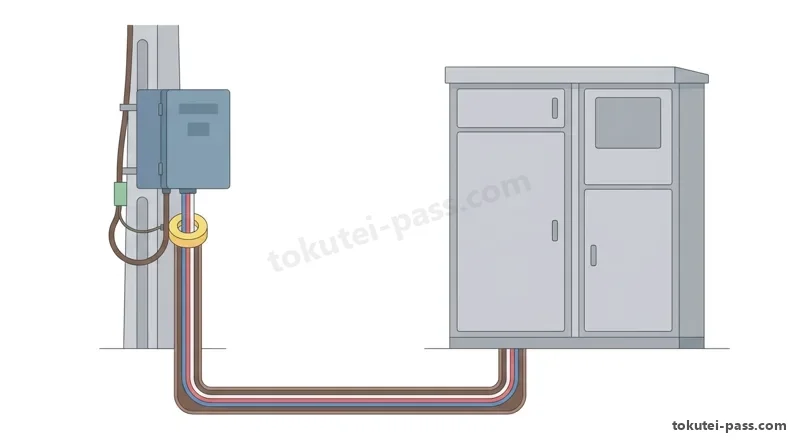
責任分界点の引込柱に設ける「高圧交流負荷開閉器(PAS)」や地中用の「UGS」は、ZCT と地絡継電装置(GR・DGR)を内蔵(GR付 PAS)し、地絡事故時に自動開放して波及事故を防ぎます。短絡電流は直接遮断できず、SOG 動作で無電圧開放します。
A pole-mounted high-voltage AC load break switch (PAS) or underground load break switch (UGS) installed at the service demarcation point incorporates a zero-phase current transformer (ZCT) and ground fault relay (GR / DGR) (GR-equipped PAS), automatically opening during an internal ground fault to prevent utility-wide fault propagation (波及事故). Because it cannot interrupt short-circuit current directly, during a short circuit it performs SOG operation to open under no-voltage after the utility substation breaker trips.
電力量計(Wh)に高圧の電圧・電流を低圧・小電流に変換して送る計器用変成器が「VCT(または MOF)」で、内部に VT 2台(V結線)と CT 2台が収められています。電力会社所有の取引計量用機器であり、ケースには A種接地、二次側には D種接地(3.5mm² 以上)を施します。
A combined instrument transformer that steps down high voltage and current to low voltage and small current for the watt-hour meter (Wh) is the VCT (or MOF), housing two VTs (V-connected) and two CTs inside. Owned by the electric utility for billing metering, its case receives Class A grounding and its secondary side receives Class D grounding (3.5mm² or larger).
断路器(DS)は消弧装置を持たないため「負荷電流は開閉できず、無負荷時(遮断器を開いた後)のみ開閉可能」です。ただし変圧器の励磁電流や短いケーブルの充電電流は開閉できます。避雷器(LA)は雷サージを大地へ逃がす機器で、A種接地(14mm² 以上)を施します。
A disconnecting switch (DS — 断路器) has no arc-extinguishing device, so it cannot switch load current and can only be opened or closed under no-load (after opening the circuit breaker). However, it can switch transformer exciting current or the charging current of a short cable. A lightning arrester (LA — 避雷器) discharges lightning surges to earth, requires Class A grounding (14mm² or larger), and never has a fuse upstream.
受電設備容量 300kVA 超の主遮断装置(CB形)に使われる「真空遮断器(VCB)」は、高真空容器内でアークを消弧して地絡・短絡電流を高速遮断します。必ず変流器(CT)および過電流継電器(OCR)と組み合わせて使用します。
A vacuum circuit breaker (VCB — 真空遮断器), used as the main interrupting device (CB-type) for receiving capacities over 300kVA, extinguishes arcs inside a high-vacuum interrupter to rapidly interrupt ground-fault and short-circuit currents. It must always be used in combination with current transformers (CT) and overcurrent relays (OCR).
設備容量 300kVA 以下の主遮断装置(PF・S形)や変圧器一次側には「高圧限流ヒューズ(PF)付 LBS」を使います。LBS は負荷電流を開閉し、短絡電流は PF が溶断遮断します。また 50kVA 以下の変圧器や進相コンデンサには高圧カットアウト(PC)も使われます。
For main interrupting devices of 300kVA or less (PF·S-type) or on the primary side of transformers, a load break switch with high-voltage current-limiting power fuses (PF-equipped LBS) is used. The LBS switches load current, while the PF melts to interrupt short-circuit current. For transformers of 50kVA or less and power capacitors, high-voltage primary cutouts (PC) are also used.
Key points
- GR付 PAS・UGS は地絡電流と負荷電流を遮断できるが、短絡電流は遮断できない(SOG 機能で無電圧開放)
GR-equipped PAS and UGS can interrupt ground-fault current and load current, but cannot interrupt short-circuit current (they open under no-voltage via SOG function) - 断路器(DS)は負荷電流を開閉できない(必ず VCB や LBS を切った後に開く)。変圧器励磁電流は開閉可能
A disconnecting switch (DS) cannot switch load current (always open it after opening the VCB or LBS). It can switch transformer exciting current - 主遮断装置:300kVA 以下は「LBS + PF(PF・S形)」が可能、300kVA 超は「VCB + CT + OCR(CB形)」が必要
Main interrupting device: LBS + PF (PF·S-type) is allowed for 300kVA or less; VCB + CT + OCR (CB-type) is required for over 300kVA - 高調波発生源はインバータ・整流器・UPS 等の半導体変換機器であり、進相コンデンサ(SC)は発生源ではない(流入被害側)
Harmonic sources (高調波発生源) are semiconductor converters such as inverters, rectifiers, and UPS units; power capacitors (SC) are not a source (they suffer harmonic inflow)
| Word | Meaning |
|---|---|
| 高圧交流負荷開閉器(PAS・LBS) | 高圧交流負荷開閉器 (PAS・LBS): High-voltage AC load break switch (PAS / LBS) |
| 計器用変成器(VCT / MOF) | 計器用変成器 (VCT / MOF): Combined instrument transformer (Metering Outfit) |
| 断路器(DS)・避雷器(LA) | 断路器 (DS)・避雷器 (LA): Disconnecting switch (DS) and Lightning arrester (LA) |
| 真空遮断器(VCB) | 真空遮断器 (VCB): Vacuum circuit breaker (VCB) |
| 高圧カットアウト(PC) | 高圧カットアウト (PC): High-voltage primary cutout (PC) |
6.6kV 高圧受電設備の機器②と工事用材料・工具鑑別
6.6kV Receiving Equipment 2 and Material / Tool Identification
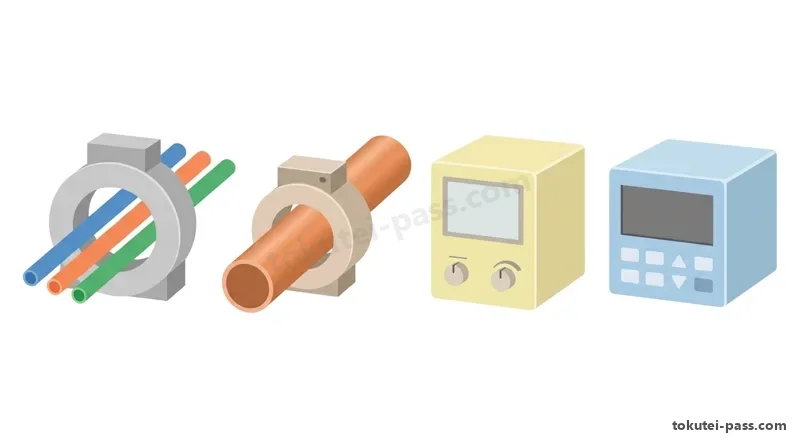
変流器(CT)は大電流を 5A に、計器用変圧器(VT)は 6,600V を 110V に変成します。零相変流器(ZCT)は三相 3本を一括貫通させて地絡電流を検出し、ケーブル遮蔽銅テープ接地線が ZCT を貫通する場合は下から上へ折り返して再度通します。
A current transformer (CT) steps down large currents to 5A, and a voltage transformer (VT) steps down 6,600V to 110V. A zero-phase current transformer (ZCT) passes all three phase conductors through together to detect ground-fault current; if the cable shield copper tape grounding wire passes through the ZCT, it must be looped back from bottom to top through the ZCT again to cancel induced current.
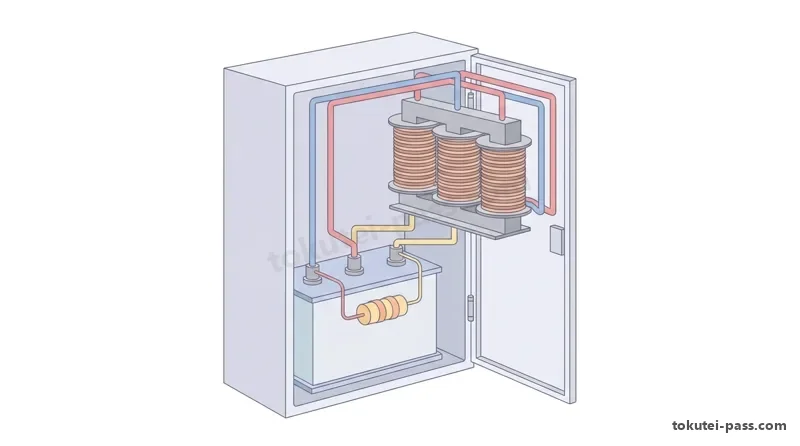
力率改善用の高圧進相コンデンサ(SC)には、直列に「直列リアクトル(SR、容量の 6%)」を接続します。SR の目的は「投入時の突入電流抑制」と「第5調波等の高調波流入防止(波形改善)」です。また開放後 5秒以内に 50V 以下へ放電させる放電コイルを内蔵します。
A high-voltage power capacitor (SC — 高圧進相コンデンサ) for power factor correction must have a series reactor (SR — 直列リアクトル, about 6% of capacitor capacity) connected in series. The two purposes of the SR are suppressing inrush current when switching on the capacitor and preventing overheating/burnout caused by inflow of 5th-harmonic currents (waveform improvement). A built-in discharge coil discharges residual voltage to 50V or less within 5 seconds after opening.
高圧受電盤(キュービクル)を屋内に施設する場合、火災予防等のため建築物の壁面等から原則「0.2m 以上(点検面は 0.6m 以上)」離して設置します。また接地極には銅板や銅覆鋼棒を用い、腐食しやすい「アルミニウム板」は接地極に使用できません。
When installing a high-voltage receiving cubicle (キュービクル) indoors, for fire prevention it must in principle be separated from building walls by at least 0.2m (at least 0.6m on inspection sides). Also, copper plates or copper-clad steel rods are used for grounding electrodes; aluminum plates (アルミニウム板) corrode easily and must never be used.
材料鑑別では、電柱の支線工事に使う「支線ロッド・支線バンド・玉がいし・シンブル・亜鉛めっき鋼より線」と、架空線引留め用の「引留クランプ(支線材料ではない)」の区別が頻出です。手術室用の 3極「医用コンセント」や天井埋込用「インサート」も覚えましょう。
In material identification, exams frequently test distinguishing guy-wire hardware for utility poles (支線工事: guy rod, guy band, strain ball insulator 玉がいし, thimble, galvanized steel strand) from a strain clamp (引留クランプ — used for dead-ending overhead conductors, not guy wires). Also remember the 3-pole hospital-grade outlet (医用コンセント) for operating rooms and concrete ceiling inserts (インサート).
工具鑑別では、規定トルクでボルトを締める「トルクレンチ」、鋼製キャビネットに油圧で丸穴をあける「ノックアウトパンチャ」、電線のたるみを調整する「張線器(シメラー)」、厚鋼電線管を曲げる「油圧式パイプベンダ」、ドラムを浮かせて回転させる「ケーブルジャッキ」を見分けてください。
In tool identification, distinguish: a torque wrench (トルクレンチ) for tightening bolts to specified torque, a hydraulic knockout puncher (ノックアウトパンチャ) for punching round holes in steel enclosures, a wire puller (張線器 / シメラー) for adjusting conductor sag, a hydraulic pipe bender (油圧式パイプベンダ) for bending thick steel conduits, and cable jacks (ケーブルジャッキ) for lifting and rotating cable drums.
Key points
- CT 二次側定格=5A(運転中二次側開放厳禁)、VT 二次側定格=110V、ZCT=地絡電流(零相電流)の検出
CT secondary rating = 5A (never open-circuit secondary while energized), VT secondary rating = 110V, ZCT = detects ground-fault (zero-phase) current - 直列リアクトル(SR)は進相コンデンサ(SC)と直列に入れ、高調波流入防止(波形改善)と突入電流抑制を行う
A series reactor (SR) is connected in series with a power capacitor (SC) to prevent harmonic inflow (waveform improvement) and suppress inrush current - 接地極に「アルミニウム板」は腐食するため使用不可。支線工事に「引留クランプ」は使わない(架空電線用)
An aluminum plate (アルミニウム板) cannot be used as a grounding electrode due to corrosion. A strain clamp (引留クランプ) is not used for pole guy-wire work - キュービクルと建築物壁面との離隔距離は 0.2m 以上(点検面は 0.6m 以上)
Clearance between a cubicle and building walls must be at least 0.2m (at least 0.6m on the inspection side)
| Word | Meaning |
|---|---|
| 変流器(CT)・計器用変圧器(VT) | 変流器 (CT)・計器用変圧器 (VT): Current transformer (5A) and Voltage transformer (110V) |
| 零相変流器(ZCT) | 零相変流器 (ZCT): Zero-phase current transformer |
| 進相コンデンサ(SC)・直列リアクトル(SR) | 進相コンデンサ (SC)・直列リアクトル (SR): Power capacitor and Series reactor |
| 引留クランプ・玉がいし | 引留クランプ・玉がいし: Strain clamp and Guy strain insulator |
| ノックアウトパンチャ・張線器 | ノックアウトパンチャ・張線器: Knockout puncher and Wire puller |
試験によく出るポイントと覚え方
Key Exam Points and Memory Tricks
発電分野の計算は水力発電の「発電出力 P = 9.8 × Q × H × η(効率を掛ける)」と、揚水発電の「電動機入力 P = 9.8 × Q × H ÷ η(効率で割る)」の 2つだけです。掛けるか割るかだけを慎重に確認しましょう。
Power generation calculations require only two formulas: hydroelectric generator output P = 9.8 × Q × H × η (multiply by efficiency) and pumped-storage motor input P = 9.8 × Q × H ÷ η (divide by efficiency). Carefully check whether the question asks for generation (multiply) or pumping (divide).
送変電の用語は「水撃作用緩和=サージタンク」「氷雪跳上がり=スリートジャンプ」「軽負荷時受電端電圧上昇=フェランチ効果」「微風振動防止=ダンパ」「GIS のガス=SF₆」を 1対1 で暗記してください。
Memorize transmission and substation terms one-to-one: Water hammer mitigation = Surge tank; Ice/snow drop conductor jump = Sleet jump; Light-load receiving voltage rise = Ferranti effect; Gentle-wind vibration prevention = Damper; GIS insulating gas = SF₆.
定番の誤り選択肢は、並行運転条件の「定格効率一致」、二次電池の「アルカリマンガン乾電池(一次電池)」、高調波発生源の「進相コンデンサ」、接地極の「アルミニウム板」、支線材料の「引留クランプ」です。
Classic wrong answer choices are fixed: Transformer parallel operation condition → Equal rated efficiency; Energy-storage secondary battery → Alkaline-manganese dry cell (primary battery); Harmonic source → Power capacitor (進相コンデンサ); Grounding electrode → Aluminum plate; Guy-wire material → Strain clamp (引留クランプ).
高圧受電機器では、「PAS・LBS は短絡電流を切れない(VCB と PF は切れる)」「DS は負荷電流を切れない」「300kVA 超の主遮断装置は CB形(VCB+CT+OCR)」「SR は突入電流と第5調波抑制」が頻出ポイントです。
For high-voltage receiving equipment, frequent exam points are: PAS and LBS cannot interrupt short-circuit current (VCB and PF can); DS cannot switch load current; substations over 300kVA require a CB-type main breaker (VCB + CT + OCR); and SR suppresses inrush current and 5th harmonics.
Key points
- 水力発電出力=9.8QHη(掛ける)、揚水入力=9.8QH ÷ η(割る)
Hydro generation output = 9.8QHη (multiply); Pumped-storage input = 9.8QH ÷ η (divide) - スリートジャンプ(氷雪跳上がり)、フェランチ効果(軽負荷電圧上昇)、サージタンク(水撃緩和)、GIS(SF₆ガス)
Sleet jump (ice drop jump), Ferranti effect (light-load voltage rise), Surge tank (water hammer mitigation), GIS (SF₆ gas) - 定番の誤り選択肢:並行運転の「効率一致」、二次電池の「アルカリマンガン電池」、高調波源の「進相コンデンサ」、接地極の「アルミ板」
Classic wrong choices: Equal efficiency (parallel operation), Alkaline-manganese cell (secondary battery), Power capacitor (harmonic source), Aluminum plate (ground electrode) - PAS・LBS は短絡電流遮断不可、DS は負荷電流開閉不可、300kVA を境に「PF・S形(以下)」と「CB形(超)」が分かれる
PAS and LBS cannot interrupt short circuits; DS cannot switch load current; 300kVA divides PF·S-type (≤ 300kVA) and CB-type (> 300kVA)
| Word | Meaning |
|---|---|
| SOG動作(PAS・UGS) | SOG動作 (PAS・UGS): Storage Overcurrent Ground-fault operation |
| PF・S形とCB形(300kVA基準) | PF・S形とCB形 (300kVA基準): Fuse-Switch type vs Circuit-Breaker type main protection |
| 高調波と直列リアクトル | 高調波と直列リアクトル: Harmonics and Series reactor (SR) |
Generation, Transmission, Substations & HV Receiving Equipment
Practice this chapter in the appOfficial references
- 一般財団法人 電気技術者試験センター — 第一種電気工事士 試験問題と解答 — https://www.shiken.or.jp/situation/past_exam.html
- 経済産業省 — 電気設備に関する技術基準を定める省令・高圧受電設備規程 — https://www.meti.go.jp/policy/safety_security/industrial_safety/sangyo/electric/