
Safety Management of Private Electrical Installations and Electrical Laws
自家用電気工作物の保安と電気関係法令
Class 1 Electrician 第一種電気工事士 (written exam) · 第一種電気工事士(学科試験) · Written by Tokutei Pass based on the official study texts; not copied verbatim.
電気工事士法①:第一種電気工事士の作業範囲と特殊電気工事
Electricians Act 1: Scope of Work for First-Class Electricians and Special Electrical Work
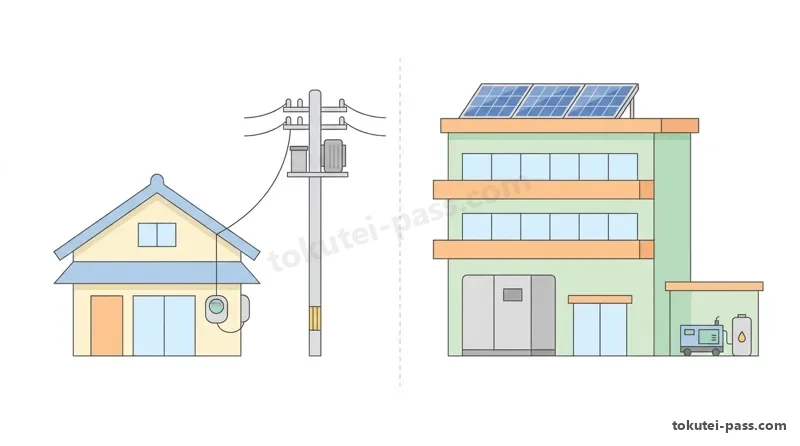
電気工事士法において、「第一種電気工事士」が従事できる範囲は、「一般用電気工作物等(600V 以下受電の住宅・店舗等)」および「最大電力 500kW 未満の自家用電気工作物(特殊電気工事を除く)」の工事です。
Under the Electricians Act (電気工事士法), the scope of electrical work that a First-Class Electrician (第一種電気工事士) license holder may perform covers general electrical installations (一般用電気工作物等 — residences and small shops receiving low voltage at 600V or less) and private electrical installations (自家用電気工作物) with a maximum power of under 500kW (excluding special electrical work).
一方、「最大電力 500kW 以上の自家用電気工作物」や「発電所・変電所・送電線路などの電気事業用電気工作物」の工事は、電気工事士法の規制対象外となるため、電気工事士免状がなくても作業できます。
Conversely, electrical work on private electrical installations with a maximum power of 500kW or more, or electric utility installations (電気事業用電気工作物) such as power plants, substations, and transmission lines, falls outside the scope of the Electricians Act (under the safety supervision of a Chief Electrical Engineer 電気主任技術者), so work may be performed without an electrician's license.
最大電力 500kW 未満の自家用電気工作物であっても、「ネオン工事(ネオン用分電盤・ネオン変圧器・ネオン管等の工事)」と「非常用予備発電装置工事」の 2つは「特殊電気工事」に指定されています。
Even within private electrical installations under 500kW, two categories are designated as special electrical work (特殊電気工事): neon work (ネオン工事 — work on neon distribution boards, neon transformers, and neon tubes) and emergency standby generator work (非常用予備発電装置工事).
この特殊電気工事は、第一種電気工事士免状だけでは作業できず、「特種電気工事資格者」の認定証が必要です。試験では「第一種電気工事士が非常用予備発電装置工事を行った」という誤りの選択肢が最頻出です。
This special electrical work cannot be performed with only a First-Class Electrician license; it requires a Special Electrical Work Qualifier (特種電気工事資格者) certificate for the respective field. On the exam, the most frequent wrong choice states that a First-Class Electrician performed emergency standby generator work.
また最大電力 500kW 未満の自家用のうち、「600V 以下で使用する低圧部分の工事(電線路と特殊電気工事を除く)」を「簡易電気工事」といい、「認定電気工事従事者」の認定証があれば作業できます。
Additionally, within private installations under 500kW, work on low-voltage sections operating at 600V or less (excluding outdoor power lines and special electrical work) is called simple electrical work (簡易電気工事), which may be performed by someone holding a Certified Electrical Work Worker (認定電気工事従事者) certificate.
Key points
- 第一種電気工事士の作業範囲:一般用電気工作物等 + 最大電力 500kW 未満の自家用電気工作物(特殊電気工事を除く)
Scope of work for a First-Class Electrician: General electrical installations + Private electrical installations with maximum power under 500kW (excluding special electrical work) - 最大電力 500kW 以上の自家用電気工作物や発電所・変電所の工事には、電気工事士免状は不要
No electrician license is required for private electrical installations of 500kW or more, or for power stations and utility substations - 特殊電気工事(ネオン工事・非常用予備発電装置工事)は「特種電気工事資格者」のみ作業可(第一種免状だけでは不可)
Special electrical work (neon work and emergency standby generator work) can only be performed by a Special Electrical Work Qualifier (特種電気工事資格者); a First-Class license alone is not enough - 簡易電気工事(500kW 未満の自家用のうち電線路を除く 600V 以下の低圧部分)は「認定電気工事従事者」でも作業可
Simple electrical work (low-voltage sections ≤ 600V excluding power lines in private installations < 500kW) can also be performed by a Certified Electrical Work Worker (認定電気工事従事者)
| Word | Meaning |
|---|---|
| 自家用電気工作物(500kW未満) | 自家用電気工作物 (500kW未満): Private electrical installation (maximum power under 500kW) |
| 特殊電気工事(ネオン・非常用予備発電) | 特殊電気工事 (ネオン・非常用予備発電): Special electrical work (Neon and Emergency generator) |
| 特種電気工事資格者 | 特種電気工事資格者: Special Electrical Work Qualifier |
| 簡易電気工事・認定電気工事従事者 | 簡易電気工事・認定電気工事従事者: Simple electrical work and Certified Electrical Work Worker |
電気工事士法②:免状交付の実務経験3年・定期講習と軽微な工事
Electricians Act 2: 3 Years Practical Experience for License, Periodic Training, and Minor Work
第一種電気工事士試験に合格しても、直ちに免状は交付されません。都道府県知事から免状交付を受けるには、合格の前後を問わず「3年以上の電気工事の実務経験」が必要です(合格後すぐに「認定電気工事従事者」となり実務を積むことも可能です)。
Passing the First-Class Electrician exam does not immediately grant a license (免状). To receive the license from the prefectural governor, at least 3 years of practical experience in electrical work is required, whether gained before or after passing the exam (immediately after passing, one can apply to become a Certified Electrical Work Worker 認定電気工事従事者 to accumulate practical experience).
この 3年間の実務経験からは、「①軽微な工事」「②特殊電気工事(ネオン・非常用予備発電装置)」「③電圧 5万V 以上の架空電線路工事」「④保安通信設備工事」の 4つが除外されます。「非常用予備発電装置の工事経験」を含めるひっかけが頻出です。
Excluded from this 3-year practical experience requirement are four types of work: (1) Minor work (軽微な工事); (2) Special electrical work (neon and emergency standby generators); (3) Overhead power line work at 50,000V or higher; and (4) Safety communication equipment work. Exam questions frequently try to trap you by counting emergency standby generator work experience toward the 3 years.
第一種電気工事士は、自家用電気工作物の保安知識・技能を維持するため、免状交付日(または前回受講日)から「5年以内ごとに 1回」、経済産業大臣指定の「定期講習」を受講する義務があります(第二種には定期講習義務はありません)。
To maintain up-to-date safety knowledge and skills for private electrical installations, a First-Class Electrician is obligated to attend periodic training (定期講習) conducted by an organization designated by the Minister of Economy, Trade and Industry at least once every 5 years from the date the license was issued (or the date of the previous training). Second-Class Electricians have no periodic training obligation.
また氏名に変更が生じたときは都道府県知事へ「免状の書換え申請」を行い、汚損・紛失時は「再交付申請」を行います(住所変更のみでは書換え不要)。作業中は必ず免状を携帯します。
When a name change occurs, an application for license rewriting (免状の書換え申請) must be submitted to the prefectural governor, and if the license is damaged or lost, an application for reissuance (再交付申請) must be made (an address change alone does not require rewriting). The license must always be carried while working.
誰でもできる「軽微な工事」には、600V 以下の差込・ねじ込接続器へのコード接続、ヒューズ取替え、インターホン等 36V 以下の二次側配線、電力量計や接地極の取付があります。電気工事士が現場監督すれば無資格でできる「軽微な作業」には管・ダクト・ラック取付等があります。
Minor work (軽微な工事) that anyone can do without a license includes connecting cords to plug-in or screw-in connectors at 600V or less, replacing fuses, secondary wiring (36V or less) for bells and intercoms, and installing watt-hour meters or grounding electrodes. Minor tasks (軽微な作業) that unlicensed persons can perform under on-site supervision by an electrician include mounting conduits, ducts, and racks.
Key points
- 第一種免状の交付には「実務経験 3年以上」が必要(合格後は実務経験なしでも直ちに「認定電気工事従事者」になれる)
Issuance of a First-Class license requires at least 3 years of practical experience (after passing the exam, one can immediately become a Certified Electrical Work Worker without prior experience) - 実務経験に含まれない 4つの工事:軽微な工事・特殊電気工事・5万V以上架空電線路・保安通信設備工事
Four works excluded from practical experience: Minor work, Special electrical work, Overhead lines ≥ 50,000V, and Safety communication equipment work - 第一種電気工事士は免状交付日(または前回受講日)から「5年以内ごとに」定期講習を受講する義務がある
A First-Class Electrician must take periodic training (定期講習) once within every 5 years from the license issue date (or previous training date) - 免状の書換え申請は「氏名変更時」に必要であり、「住所変更時」には書換え申請不要
An application to rewrite the license (書換え申請) is required for a name change, but is not required for an address change
| Word | Meaning |
|---|---|
| 実務経験(3年以上) | 実務経験 (3年以上): Practical work experience (3 years or more) |
| 定期講習(5年以内ごと) | 定期講習 (5年以内ごと): Periodic training (once within every 5 years for First-Class) |
| 軽微な工事・軽微な作業 | 軽微な工事・軽微な作業: Minor work (unlicensed) and Minor tasks (supervised) |
| 免状の書換え・再交付 | 免状の書換え・再交付: Rewriting and Reissuance of an electrician license |
電気事業法(小出力発電設備・事故報告)と電気用品安全法
Electricity Business Act (Small-Output Generation, Accident Reports) and Electrical Appliance Safety Act
電気事業法の「小出力発電設備(低圧受電)」の出力上限は、「太陽電池:10kW 未満」「水力:20kW 未満」「内燃力(ディーゼル等)・燃料電池:10kW 未満」(合計 50kW 未満)です。太陽電池 10kW 以上 50kW 未満と風力 20kW 未満は「小規模事業用電気工作物」になりました。
Under the Electricity Business Act (電気事業法), since the March 2023 amendment the output limits for small-output power generation facilities (小出力発電設備, connected to low-voltage installations) are: solar PV under 10kW; hydro under 20kW; internal combustion (diesel, etc.) and fuel cells under 10kW; with the total on the same premises under 50kW. Solar PV of 10kW to under 50kW and wind under 20kW are now Small-scale Electrical Facilities for Business Use (小規模事業用電気工作物).
高圧(6,600V 等)で受電する工場・ビルや、50kW 以上の太陽電池発電所等は「自家用電気工作物」となります。設置者には「保安規程」の届出義務と、「電気主任技術者」の選任(または外部委託)届出義務があります。
Factories and buildings receiving high voltage (such as 6,600V) or solar power plants of 50kW or more are classified as private electrical installations (自家用電気工作物). The owner is obligated to establish and file Safety Regulations (保安規程) and to appoint (or outsource) and file a Chief Electrical Engineer (電気主任技術者).
自家用電気工作物で「感電死傷事故・電気火災事故・主要電気工作物破損事故・波及事故(供給支障事故)」が発生した場合、設置者は知ったときから「24時間以内に速報」し、発生日から「30日以内に詳報」を産業保安監督部長等へ提出します。
If an electric shock fatality/injury, electrical fire, damage to major electrical equipment, or fault propagation disrupting utility supply (波及事故) occurs at a private electrical installation, the owner must submit a preliminary report (速報) within 24 hours of learning of the accident, and a detailed report (詳報) within 30 days of the accident occurrence to the Director of the Regional Industrial Safety and Inspection Department.
電気用品安全法では、危険が生じるおそれが大きい「特定電気用品」にひし形の「<PS>E(◇PSE)マーク」、それ以外の電気用品に丸形の「(PS)E(〇PSE)マーク」を表示します。マークのない電気用品は販売も工事使用も禁止です。
Under the Electrical Appliance and Material Safety Act (電気用品安全法), Specified Electrical Appliances (特定電気用品) with a higher hazard risk bear a diamond-shaped <PS>E (◇PSE) mark, while other electrical appliances bear a circular (PS)E (〇PSE) mark. Appliances without a PSE mark are prohibited from sale or use in electrical construction.
特定電気用品(◇PSE)の例は「遮断器(100A 以下)」「コンセント・タイムスイッチ」「IV 線(100mm² 以下)」「VVF などのケーブル(22mm² 以下)」です。「金属管・CD管・PF管・換気扇・LED ランプ・電磁開閉器・22mm² 超のケーブル」は 〇PSE です。
Examples of Specified Electrical Appliances (◇PSE) include circuit breakers (100A or less), switches, outlets, time switches, insulated wires such as IV (100mm² or less), and VVF/VVR cables (22mm² or less). Conversely, conduits (metal, CD and PF), ventilation fans, LED lamps, electromagnetic switches, and cables over 22mm² (such as 38mm²) carry the circular 〇PSE mark.
Key points
- 小出力発電設備の出力上限:太陽電池 10kW未満・水力 20kW未満・内燃力(ディーゼル)10kW未満(合計 50kW未満)。太陽電池 10〜50kW と風力 20kW未満は小規模事業用電気工作物
Small-output generation limits: solar PV < 10kW, hydro < 20kW, internal combustion (diesel) < 10kW (total on premises < 50kW). Solar 10–50kW and wind < 20kW are Small-scale Electrical Facilities for Business Use - 自家用電気工作物の設置者は「保安規程の届出」と「電気主任技術者の選任」が必要。電気事故報告は「速報 24時間以内・詳報 30日以内」
Owners of private electrical installations must file Safety Regulations and appoint a Chief Electrical Engineer. Electrical accident reports: preliminary within 24 hours, detailed within 30 days - 特定電気用品(◇PSE):遮断器(100A以下)・タイムスイッチ・コンセント・100mm² 以下の IV 線・22mm² 以下の VVF ケーブル
Specified Electrical Appliances (◇PSE): circuit breakers (≤ 100A), time switches, outlets, IV wires ≤ 100mm², VVF cables ≤ 22mm² - 特定電気用品以外(〇PSE):38mm² 等の太いケーブル・金属管・CD管/PF管・電磁開閉器・カバー付ナイフスイッチ・LED ランプ・換気扇
Non-Specified Electrical Appliances (〇PSE): thick cables over 22mm² (e.g., 38mm²), metal conduits, CD / PF conduits, electromagnetic switches, covered knife switches, LED lamps, ventilation fans
| Word | Meaning |
|---|---|
| 小出力発電設備(太陽10kW・水力20kW・内燃10kW未満) | 小出力発電設備 (太陽10kW・水力20kW・内燃10kW未満): Small-output power generation equipment |
| 保安規程・電気主任技術者 | 保安規程・電気主任技術者: Safety Regulations and Chief Electrical Engineer |
| 電気関係報告規則(24時間・30日) | 電気関係報告規則 (24時間・30日): Electricity-Related Reporting Rules (24 hours / 30 days) |
| 特定電気用品(◇PSE) | 特定電気用品 (◇PSE): Specified Electrical Appliances (diamond PSE mark) |
電気工事業法(主任電気工事士と備え付け計測器)
Electrical Construction Business Act (Chief Electrician and Required Measuring Instruments)
「電気工事業法」では、扱う電気工作物と建設業許可の有無により業者を 4つに区分します。一般用(および自家用)の工事を行う者は「登録電気工事業者(5年更新)」、建設業許可を持って行う者は「みなし登録電気工事業者」となります。
The Electrical Construction Business Act (電気工事業法) classifies contractors into four categories based on the installations handled and whether they hold a construction business permit. Those performing general (and private) electrical work are Registered Electrical Contractors (登録電気工事業者, renewed every 5 years); those with a construction business permit are Deemed Registered Electrical Contractors (みなし登録電気工事業者).
一方、「自家用電気工作物(500kW 未満)の工事のみ」を行う業者は、開始 10日前までに届け出る「通知電気工事業者」(建設業許可業者は「みなし通知電気工事業者」)となります。一般用の工事を行わないため、「主任電気工事士」の設置義務がありません。
Conversely, contractors performing work only on private electrical installations (under 500kW) file a notification at least 10 days before starting business as Notified Electrical Contractors (通知電気工事業者; or Deemed Notified Electrical Contractors if holding a construction permit). Because they do not work on general electrical installations, they are not required to appoint a Chief Electrician (主任電気工事士).
一般用の工事を行う「登録・みなし登録電気工事業者」は、営業所ごとに「主任電気工事士」を置きます。なれるのは「①第一種電気工事士」または「②第二種免状交付後 3年以上の実務経験者」のみであり、「電気主任技術者」や「認定電気工事従事者」はなれません。
Registered and Deemed Registered Electrical Contractors who perform work on general electrical installations must appoint a Chief Electrician (主任電気工事士) at each business office. Only two qualifications can serve as Chief Electrician: (1) a First-Class Electrician, or (2) a Second-Class Electrician with at least 3 years of practical experience after receiving the license. Neither a Chief Electrical Engineer (電気主任技術者) nor a Certified Electrical Work Worker can serve as Chief Electrician.
営業所に備え付けなければならない測定器具は、一般用電気工作物のみを扱う営業所では「①絶縁抵抗計・②接地抵抗計・③抵抗および交流電圧を測定できる回路計(テスタ)」の 3品目です。
The measuring instruments that must be kept at a business office handling only general electrical installations are three items: (1) an insulation resistance tester (Megger); (2) an earth resistance tester; and (3) a circuit tester (multimeter) capable of measuring resistance and AC voltage.
一方、自家用電気工事も行う営業所では、上記 3品目に「④低圧検電器・⑤高圧検電器・⑥継電器試験装置・⑦絶縁耐力試験装置」を加えた計「7品目」を備え付けます(⑥と⑦は借入れ等も可)。「回転計・照度計・騒音計・力率計・クランプ計」は不要です。
In contrast, a business office that also performs work on private electrical installations must keep a total of seven items by adding four more to the three above: (4) a low-voltage voltage detector; (5) a high-voltage voltage detector; (6) a protective relay test set (継電器試験装置); and (7) a dielectric strength test set (絶縁耐力試験装置) (items 6 and 7 may be borrowed when needed). Tachometers, lux meters, sound level meters, power factor meters, and clamp meters are not required.
Key points
- 主任電気工事士になれる資格:「第一種電気工事士」または「第二種免状交付後 3年以上の実務経験者」(電気主任技術者は不可!)
Qualifications for Chief Electrician (主任電気工事士): First-Class Electrician, or Second-Class Electrician with ≥ 3 years experience after license issuance (Chief Electrical Engineer 電気主任技術者 is not eligible!) - 自家用電気工作物の工事のみを行う「通知・みなし通知電気工事業者」には、主任電気工事士の選任義務はない
Notified / Deemed Notified Electrical Contractors handling only private electrical installations are not required to appoint a Chief Electrician - 自家用電気工事を行う営業所の備付計測器 7つ:絶縁抵抗計・接地抵抗計・回路計・低圧検電器・高圧検電器・継電器試験装置・絶縁耐力試験装置
7 required instruments for offices performing private electrical work: Insulation tester, Earth tester, Circuit tester, LV detector, HV detector, Relay test set, Dielectric strength test set - 備え付け義務がない計測器(誤り選択肢):回転計・照度計・騒音計・力率計・電力量計
Instruments not required (wrong choices): Tachometer (回転計), Illuminance meter (照度計), Sound level meter, Power factor meter, Watt-hour meter
| Word | Meaning |
|---|---|
| 登録電気工事業者・通知電気工事業者 | 登録電気工事業者・通知電気工事業者: Registered vs Notified Electrical Contractor |
| 主任電気工事士 | 主任電気工事士 (しゅにんでんきこうじし): Chief Electrician (at a contractor's office) |
| 継電器試験装置・絶縁耐力試験装置 | 継電器試験装置・絶縁耐力試験装置: Protective relay test set and Dielectric strength test set |
| 低圧検電器・高圧検電器 | 低圧検電器・高圧検電器: Low-voltage and High-voltage voltage detectors |
電気設備技術基準(電圧区分・低圧絶縁抵抗)と試験制度
Technical Standards for Electrical Equipment (Voltage Classes, LV Insulation Resistance) and Exam System
技術基準省令における電圧区分は、①「低圧」が直流 750V 以下・交流 600V 以下、②「高圧」が直流 750V 超・交流 600V 超でともに 7,000V 以下、③「特別高圧」が 7,000V を超えるものです。
Voltage classifications under the Ministerial Ordinance Establishing Technical Standards for Electrical Equipment are: (1) Low Voltage (低圧): DC 750V or less and AC 600V or less; (2) High Voltage (高圧): over DC 750V / over AC 600V up to 7,000V or less; and (3) Extra-High Voltage (特別高圧): over 7,000V for both DC and AC.
低圧電路の絶縁抵抗値は 3段階です。①「対地電圧 150V 以下(単相100V、単相3線式 100/200V 等)」は「0.1MΩ 以上」、②「300V 以下で対地電圧 150V 超(三相 200V 等)」は「0.2MΩ 以上」、③「使用電圧 300V 超(三相 400V 等)」は「0.4MΩ 以上」です。
Minimum insulation resistance values for low-voltage circuits are set in three tiers: (1) Voltage to ground 150V or less (single-phase 100V, single-phase 3-wire 100/200V, etc.) requires 0.1MΩ or more; (2) Working voltage 300V or less with voltage to ground over 150V (3-phase 200V, etc.) requires 0.2MΩ or more; and (3) Working voltage over 300V (3-phase 400V, etc.) requires 0.4MΩ or more.
絶縁抵抗の基準値は「0.1MΩ・0.2MΩ・0.4MΩ」の 3つだけであり、「0.3MΩ」という基準値は存在しない点を確実に覚えておきましょう。また低圧電路の絶縁性能を漏れ電流で判定する場合は、使用電圧に関わらずすべて「1mA 以下」です。
Make sure to remember that the standard insulation resistance values are only 0.1MΩ, 0.2MΩ, and 0.4MΩ; a standard value of 0.3MΩ does not exist. Also, when judging low-voltage circuit insulation by leakage current, the limit is 1mA or less regardless of working voltage.
高圧・特別高圧の機器は、取扱者以外が容易に触れるおそれがないよう施設します。また高圧電路と低圧電路を結合する変圧器には、混触防止のため低圧側中性点(または 1端子)に必ず「B種接地工事」を施します。
High-voltage and extra-high-voltage equipment must be installed so that unauthorized persons cannot easily touch them. Furthermore, a transformer coupling a high-voltage circuit and a low-voltage circuit must always be given Class B grounding (B種接地工事) on its low-voltage neutral point (or one terminal) to prevent danger from high-to-low-voltage contact.
第一種学科試験では筆記方式に加えて CBT 方式が導入されています。通常の問題にはふりがなは付きませんが、外国人受験者等が事前に「援助措置申請(ふりがな付試験)」を行い承認された場合は、ふりがな付問題で受験できます。
In addition to paper-based testing, CBT (Computer-Based Testing) has been introduced for the First-Class Electrician written exam. Standard exam questions do not include furigana readings on kanji, but foreign candidates who submit a Support Measure Application (援助措置申請 — exam with furigana) beforehand and receive approval can take the exam with furigana.
Key points
- 電圧区分:低圧=直流 750V以下・交流 600V以下、高圧=7,000V以下、特別高圧=7,000V超
Voltage classes: Low Voltage = DC ≤ 750V, AC ≤ 600V; High Voltage = ≤ 7,000V; Extra-High Voltage = > 7,000V - 低圧電路の絶縁抵抗:対地 150V以下=0.1MΩ以上、300V以下(対地150V超)=0.2MΩ以上、300V超=0.4MΩ以上(「0.3MΩ」はない!)
Low-voltage insulation resistance: ≤ 150V to ground = ≥ 0.1MΩ; ≤ 300V (> 150V to ground) = ≥ 0.2MΩ; > 300V = ≥ 0.4MΩ (there is no 0.3MΩ!) - 高圧と低圧を結合する変圧器の低圧側には、高低圧混触防止のため必ず「B種接地工事」を施す
The low-voltage side of a transformer coupling high voltage and low voltage must always receive Class B grounding to prevent HV/LV contact - 外国人受験者がふりがな付問題を希望する場合は、申込前に試験センターへ「援助措置申請」を行う
Foreign examinees wishing to take the exam with furigana readings must submit a Support Measure Application (援助措置申請) to the exam center before applying
| Word | Meaning |
|---|---|
| 低圧・高圧・特別高圧 | 低圧・高圧・特別高圧: Low voltage (DC≤750V/AC≤600V), High voltage (≤7,000V), Extra-high voltage (>7,000V) |
| 絶縁抵抗値(0.1MΩ・0.2MΩ・0.4MΩ) | 絶縁抵抗値 (0.1MΩ・0.2MΩ・0.4MΩ): Minimum LV insulation resistance values |
| 高低圧混触防止(B種接地) | 高低圧混触防止 (B種接地): High/low-voltage contact prevention (Class B grounding) |
| CBT方式・援助措置申請 | CBT方式・援助措置申請: Computer-Based Testing (CBT) and Support Measure Application |
試験によく出るポイントと覚え方
Key Exam Points and Memory Tricks
法令の期間は一括で覚えましょう。①第一種免状交付の実務経験=「3年以上」、②第二種が主任電気工事士になる実務経験=「免状後 3年以上」、③第一種定期講習=「5年以内ごと」、④登録業者更新=「5年」、⑤事故報告=「速報 24時間・詳報 30日以内」です。
Memorize all legal time periods together: (1) Practical experience for First-Class license = 3 years or more; (2) Practical experience for Second-Class to become Chief Electrician = 3 years or more after license; (3) First-Class periodic training = once within every 5 years; (4) Registered contractor renewal = 5 years; (5) Electrical accident report = preliminary within 24 hours, detailed within 30 days.
資格のひっかけは、①「非常用予備発電装置・ネオン工事は特種電気工事資格者が必要(第一種免状のみでは不可・実務経験 3年にも算入不可)」、②「500kW 以上の自家用工事は免状不要」、③「電気主任技術者は主任電気工事士になれない(通知業者は選任不要)」です。
The three big qualification traps are: (1) Emergency standby generator and neon work require a Special Electrical Work Qualifier (a First-Class license alone is insufficient, and the work does not count toward the 3-year experience); (2) Private installations of 500kW or more do not require an electrician license; (3) A Chief Electrical Engineer (電気主任技術者) cannot become a Chief Electrician (主任電気工事士), and notified contractors do not need a Chief Electrician.
備付計測器 7つは「絶縁抵抗計・接地抵抗計・回路計(一般用 3つ)+ 低圧検電器・高圧検電器・継電器試験装置・絶縁耐力試験装置」です。「回転計・照度計・力率計」は不要です。
The 7 required measuring instruments are: Insulation tester, Earth tester, Circuit tester (the 3 for general work) + LV detector, HV detector, Relay test set, and Dielectric strength test set. Tachometers (回転計), lux meters (照度計), and power factor meters (力率計) are not required.
小出力発電設備の数字は「太陽 10kW・水力 20kW・内燃(ディーゼル)10kW 未満」です(令和5年の改正で太陽 50kW・風力 20kW から変更)。低圧絶縁抵抗は「150V 以下=0.1MΩ、300V 以下=0.2MΩ、300V 超=0.4MΩ(0.3MΩ は存在しない)」と暗記しましょう。
Numbers for small-output generation: solar < 10kW, hydro < 20kW, internal combustion (diesel) < 10kW (the 2023 amendment changed them from solar 50kW and wind 20kW). Low-voltage insulation resistance: ≤ 150V = 0.1MΩ, ≤ 300V = 0.2MΩ, > 300V = 0.4MΩ (0.3MΩ does not exist).
Key points
- 年数整理:第一種免状実務経験=3年、第一種定期講習=5年以内ごと、事故報告=速報24時間・詳報30日
Time periods: First-Class license experience = 3 years; First-Class periodic training = within every 5 years; Accident reports = 24 hours preliminary, 30 days detailed - ネオン・非常用予備発電工事=特種電気工事資格者が必要(実務経験3年にも含めない)。500kW 以上=免状不要
Neon & Emergency generator work = requires Special Electrical Work Qualifier (excluded from 3-year experience). ≥ 500kW = no electrician license required - 主任電気工事士に「電気主任技術者」はなれない。備付計測器 7品目に「回転計・照度計・力率計」は不要
A Chief Electrical Engineer cannot serve as Chief Electrician. The 7 required instruments do not include tachometers, lux meters, or power factor meters - 小出力発電=太陽10kW・水力20kW・内燃10kW未満。低圧絶縁抵抗=0.1MΩ・0.2MΩ・0.4MΩ(0.3MΩは偽物)
Small-output generation = solar 10kW, hydro 20kW, diesel 10kW. LV insulation resistance = 0.1MΩ, 0.2MΩ, 0.4MΩ (0.3MΩ is fake)
| Word | Meaning |
|---|---|
| 実務経験3年・定期講習5年 | 実務経験3年・定期講習5年: 3 years practical experience and 5-year periodic training |
| 備え付け測定器具(7品目) | 備え付け測定器具 (7品目): 7 required measuring instruments for private electrical work offices |
| 特定電気用品(◇PSE・絶縁電線100mm²以下・ケーブル22mm²以下・遮断器100A以下) | 特定電気用品 (◇PSE・絶縁電線100mm²以下・ケーブル22mm²以下・遮断器100A以下): Specified Electrical Appliances (insulated wires ≤ 100mm², cables ≤ 22mm², breakers ≤ 100A) |
Electrical Safety Laws
Practice this chapter in the appOfficial references
- 経済産業省 — 電気工事士法・電気工事業の業務の適正化に関する法律・電気事業法 — https://www.meti.go.jp/policy/safety_security/industrial_safety/sangyo/electric/
- 一般財団法人 電気技術者試験センター — 第一種電気工事士免状の交付および定期講習 — https://www.shiken.or.jp/