 Tokutei Pass
Production Control
生産管理
Food Manufacturing (SSW 2) · 飲食料品製造業(2号) · Written by Tokutei Pass based on the official study texts; not copied verbatim.
生産形態・生産計画とIE(標準時間)・JIT
Production Types, Production Planning, IE (Standard Time), and JIT
生産形態には、需要予測に基づき計画生産する「見込生産」と注文後に作る「受注生産」、品種と量による「少品種多量生産」と「多品種少量生産」があります。生産計画は大日程(長期)→中日程(月次)→小日程計画(週次・日次)の順に具体化します。
Production types include 'Make-to-Stock' based on demand forecasts and 'Make-to-Order' produced after receiving orders, as well as 'Low-mix high-volume' and 'High-mix low-volume' production. Production plans are detailed sequentially from Master (long-term) → Medium-term (monthly) → Short-term (weekly/daily) schedules.
IEは「方法研究」と「作業測定」でムダをなくします。作業1単位の「標準時間(ST)」は「正味時間+余裕時間」、標準生産量は「稼働時間÷ST」、必要人員は「総必要工数(人時)÷1人当たり労働時間」で求めます。
Industrial Engineering (IE) eliminates waste through 'Method Study' and 'Work Measurement.' 'Standard Time (ST)' per unit = 'Net Time + Allowance Time'; Standard Output = Working Time ÷ ST; and Required Workers = Total Required Man-hours ÷ Working Hours per Person.
ジャスト・イン・タイム(JIT)は「必要なものを、必要なときに、必要な量だけ」生産・供給して在庫のムダを減らす方式であり、標準作業の3要素は「タクトタイム・作業順序・標準手持ち」です。
Just-In-Time (JIT) produces and supplies 'what is needed, when it is needed, in the amount needed' to reduce inventory waste, and the 3 elements of standard work are 'Takt Time, Work Sequence, and Standard Work-in-Process (WIP).'
Key points
- 見込生産と受注生産、少品種多量生産と多品種少量生産、および大・中・小日程計画の特徴を理解する。
Understand Make-to-Stock vs. Make-to-Order, Low-mix high-volume vs. High-mix low-volume, and Master/Medium/Short-term schedules. - 標準時間(正味時間+余裕時間)から標準生産量や必要人員を計算する。
Calculate standard output and required personnel from Standard Time (Net Time + Allowance Time). - JIT(必要なものを必要なときに必要な量だけ)と標準作業の3要素(タクトタイム・作業順序・標準手持ち)を押さえる。
Grasp JIT (what is needed, when needed, in the amount needed) and the 3 elements of standard work (Takt time, work sequence, standard WIP).
| Word | Meaning |
|---|---|
| 見込生産・受注生産 | make-to-stock production, make-to-order production |
| 少品種多量生産・多品種少量生産 | low-mix high-volume, high-mix low-volume production |
| 標準時間(正味時間+余裕時間) | standard time (net time + allowance time) |
| ジャスト・イン・タイム(JIT) | Just-In-Time (JIT) |
| タクトタイム・標準手持ち | takt time, standard work-in-process (WIP) |
生産性・原単位・ボトルネック工程と段取り改善
Productivity, Unit Consumption, Bottleneck Processes, and Changeover Improvement
生産性は「産出量(OUTPUT)÷投入量(INPUT)」、人時生産性は「生産量÷延べ労働時間(人数×時間の工数)」で求めます。逆に製品1単位当たりの投入量(INPUT÷OUTPUT)を「原単位」といい、小さいほど効率的です。
Productivity is 'OUTPUT ÷ INPUT,' and labor productivity (man-hour productivity) is 'Output ÷ Total Man-hours (Workers × Hours).' Conversely, the input required per unit of output (INPUT ÷ OUTPUT) is 'Unit Consumption (Gentan-i),' where a smaller value means higher efficiency.
生産効率(能率)は「実績生産量÷標準生産量×100(%)」で計算します。直列ラインでは最もサイクルタイムが長く能力が低い「ボトルネック工程」がライン全体の生産量を決定します(例:最長工程が45秒/個なら1時間3,600秒で最大80個)。
Production efficiency = Actual Output ÷ Standard Output × 100 (%). In a serial line, the 'Bottleneck Process' with the longest cycle time and lowest capacity determines the entire line's output (e.g., if the slowest step takes 45 sec/unit, maximum output in 1 hour of 3,600 sec is 80 units).
各工程の作業時間を均等化する「ラインバランシング」や進捗管理図で遅れを防ぎます。品種切替時は、ライン停止中にしかできない「内段取り」を稼働中に準備する「外段取り」へ移して停止時間を短縮し、ポカヨケでミスを防ぎます。
Prevent delays using 'Line Balancing' to equalize cycle times across steps and progress control charts. During product changeovers, convert 'Internal Setup' (done only while stopped) into 'External Setup' (prepared while running) to shorten downtime, and use Poka-yoke to prevent errors.
Key points
- 生産性(OUTPUT÷INPUT、大きいほど良い)と原単位(INPUT÷OUTPUT、小さいほど良い)、人時生産性を計算する。
Calculate Productivity (OUTPUT ÷ INPUT, higher is better), Unit Consumption (INPUT ÷ OUTPUT, lower is better), and Man-hour Productivity. - 直列ライン全体の生産能力は最も時間がかかる「ボトルネック工程」に制約されるため、ラインバランシングで改善する。
Because a serial line's capacity is constrained by its slowest 'Bottleneck Process,' improve it through Line Balancing. - 内段取りの外段取り化によって品種切替の停止時間を短縮し、ポカヨケで作業ミスを防止する。
Shorten changeover downtime by converting internal setup to external setup, and prevent operational mistakes with Poka-yoke.
| Word | Meaning |
|---|---|
| 生産性・人時生産性・工数 | productivity, man-hour productivity, man-hours |
| 原単位 | unit consumption (input per unit of output) |
| ボトルネック工程・ラインバランシング | bottleneck process, line balancing |
| 内段取り・外段取り | internal setup (offline), external setup (online) |
| ポカヨケ(ミス防止) | Poka-yoke (mistake-proofing) |
歩留まり・時間稼働率と設備保全
Yield, Time Operating Rate, and Equipment Maintenance
「歩留まり(良品重量÷投入原料重量×100)」は原料が製品になった割合です(炊飯は約220%)。2工程の総合歩留まりは各歩留まりの積(90%×80%=72%)、必要原料量は「目標量÷歩留まり」で求め、異常高値は加水過多等を疑います。
'Yield (Good output weight ÷ Input raw material weight × 100)' is the ratio of raw material turned into product (based on full bags if sold by bag; cooked rice yield is ~220% due to water absorption). Combined yield across 2 steps is the product of each yield (90% × 80% = 72%), and required raw material = Target Output ÷ Yield (400 kg ÷ 0.8 = 500 kg); an abnormally high yield suggests excess water or mixing errors.
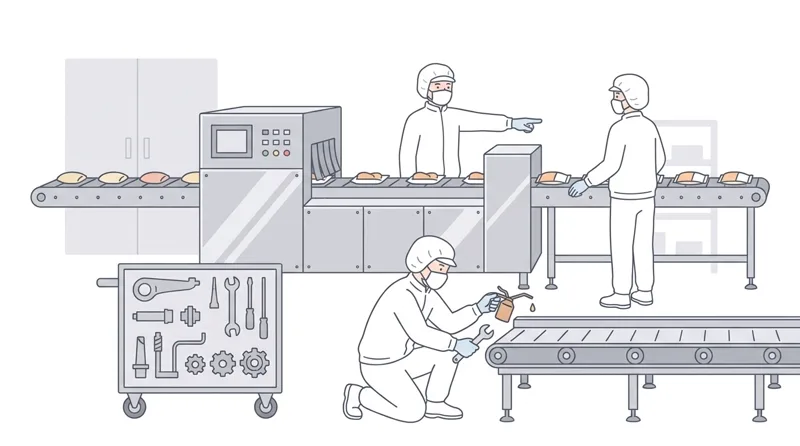
設備の「時間稼働率」は「実稼働時間÷負荷時間(休憩や計画準備時間を除いた予定稼働時間)×100」で求めます。設備七大ロス(チョコ停・空転ロスなど)を減らすため、予防保全(PM)と日常の自主保全(清掃・給油・増し締め・五感点検)を行います。
Equipment 'Time Operating Rate' = Actual Operating Time ÷ Loading Time (planned operating time excluding breaks and planned prep/cleaning) × 100. To reduce the 7 Major Equipment Losses (such as minor stops/idling), practice Preventive Maintenance (PM) and daily Autonomous Maintenance (cleaning, lubrication, retightening bolts, 5-sense checks).
Key points
- 歩留まり計算(総合歩留まり=各工程歩留まりの積、必要原料=目標量÷歩留まり)と異常高値時の原因確認を行う。
Calculate yield (combined yield = product of step yields; required material = target ÷ yield) and check causes when yield is abnormally high. - 時間稼働率(実稼働時間÷負荷時間×100)を理解し、予防保全と自主保全(清掃・給油・増し締め)でチョコ停等を防ぐ。
Understand Time Operating Rate (Actual Operating Time ÷ Loading Time × 100) and prevent minor stops via Preventive and Autonomous Maintenance (cleaning, oiling, retightening).
| Word | Meaning |
|---|---|
| 歩留まり・総合歩留まり | yield, overall combined yield |
| 時間稼働率・負荷時間 | time operating rate, loading time |
| チョコ停・予防保全・自主保全 | minor stops, preventive maintenance, autonomous maintenance |
在庫管理(発注方式)と製造原価・省エネ
Inventory Control (Ordering Systems), Manufacturing Cost, and Energy Saving
在庫発注には、在庫が発注点まで減ったら一定量を発注する「定量発注方式」と、決まった期間ごとに必要量を発注する「定期発注方式」があり、保管時は先入れ先出しを徹底します。
Inventory ordering uses the 'Fixed-Quantity Ordering System' (ordering a fixed quantity when stock drops to the reorder point) or the 'Periodic Ordering System' (ordering the required amount at fixed intervals), strictly enforcing First-In, First-Out (FIFO) during storage.
製造原価は「材料費+労務費+製造経費」の3要素で構成されます。稼働時間の短縮や歩留まりの向上は、コスト削減だけでなく省エネルギー(CO2削減)や食品ロス削減に直結します。
Manufacturing cost consists of three elements: 'Material Cost + Labor Cost + Manufacturing Overhead.' Shortening operating hours and improving yield directly contribute not only to cost reduction but also to energy conservation (CO2 reduction) and food loss reduction.
Key points
- 定量発注方式(発注点方式)と定期発注方式の特徴を理解し、先入れ先出しで在庫を管理する。
Understand Fixed-Quantity Ordering (reorder point method) vs. Periodic Ordering, and manage inventory using FIFO. - 製造原価の3要素(材料費・労務費・製造経費)を押さえ、歩留まり向上で原価低減と省エネを実現する。
Grasp the 3 elements of manufacturing cost (material, labor, and overhead costs), improving yield to lower costs and save energy.
| Word | Meaning |
|---|---|
| 定量発注方式・発注点 | fixed-quantity ordering system, reorder point |
| 定期発注方式・先入れ先出し | periodic ordering system, first-in first-out (FIFO) |
| 製造原価(材料費・労務費・製造経費) | manufacturing cost (material, labor, and overhead costs) |
Production Management
Practice this chapter in the appOfficial references
- 厚生労働省・OTAFF 飲食料品製造業特定技能2号技能測定試験 学習用テキスト — https://otaff.or.jp/tokutei/insyoku-2/materials/