Industrial Packaging 2 (Packaging Design, Strength/Cushioning/Moisture Calculations, Defect Analysis, Handling Safety, and QC Management)
工業包装(包装設計・強度緩衝防湿計算・不具合分析・荷役安全・品質工程管理)
Industrial Manufacturing (SSW 2) · 製造分野(2号) · Written by Tokutei Pass based on the official study texts; not copied verbatim.
1. 特定技能2号における工業包装の役割と包装仕様設計
1. Role of Industrial Packaging in Specified Skilled Worker (ii) and Specification Design
製造分野特定技能2号では、現場作業者を指導・監督し、工程管理・品質管理・安全管理を担う熟練技能者としての判断力が求められます。評価試験と並行して「技能検定 工業包装 1級または2級」の合格が重要な要件となります。
In Specified Skilled Worker (ii) for Industrial Product Manufacturing, candidates must demonstrate the judgment of a skilled supervisor capable of instructing shop-floor workers and managing processes, quality, and safety. Alongside the evaluation exam, passing Grade 1 or Grade 2 of the National Trade Skill Test in Industrial Packaging is a key requirement.
2号技能者は、出荷製品の「純質量(N/W)・外寸・重心位置・許容加速度(G値)・防錆防湿要否」と輸送環境(海上コンテナ・クレーン荷役等)を総合分析し、最適な包装仕様書を設計・選定します。
A Level 2 specialist comprehensively analyzes the product's net mass (N/W), external dimensions, center of gravity, allowable peak acceleration (G-value), and rust/moisture sensitivity together with the transport environment (marine container, port crane handling, etc.) to design and select the optimal packaging specification.
JIS規格に基づく外装容器選定では、「内容品質量1,500 kg以下かつ内のり長さ4.0 m以下」の双方を満たす場合にJIS Z 1402(普通木箱)を適用し、いずれか一方でも超える重量機械・長尺貨物にはJIS Z 1403(枠組箱)を選定します。
When selecting outer containers under JIS standards, JIS Z 1402 (nailed wooden box) applies only when BOTH "content mass ≤ 1,500 kg AND internal length ≤ 4.0 m" are satisfied; if either threshold is exceeded, JIS Z 1403 (framed wooden box) must be selected.
また環境配慮設計(3R:リデュース・リユース・リサイクル)の推進にあたっては、製品保護性能(許容加速度・安全率)と検疫法規を厳守したうえで、通い箱(リターナブル容器)の導入や単一素材化による包装適正化を図ります。
When promoting eco-friendly 3R design (Reduce, Reuse, Recycle), supervisors strictly maintain required product protection performance (allowable G-value and safety factors) and quarantine compliance while introducing returnable containers and single-material designs for packaging optimization.
Key points
- 特定技能2号では作業者指導と工程・品質・安全管理を担い、技能検定(工業包装1級・2級)水準の設計判断を行う
Specified Skilled Worker (ii) supervisors instruct operators and manage processes, quality, and safety with Grade 1 / Grade 2 Skill Test engineering judgment - 質量1,500 kg以下かつ内のり長さ4.0 m以下は「普通木箱(JIS Z 1402)」、いずれかを超える場合は「枠組箱(JIS Z 1403)」を選定する
Select a nailed wooden box (JIS Z 1402) only when mass ≤ 1,500 kg AND internal length ≤ 4.0 m; select a framed wooden box (JIS Z 1403) if either limit is exceeded - 包装適正化と3R推進では、製品保護性能と安全率を満たしたうえで通い箱導入や単一素材化を進める
Promote 3R and packaging optimization (returnable containers and mono-material design) only while fully satisfying product protection and safety factors
| Word | Meaning |
|---|---|
| 包装仕様設計と容器選定判断 | Packaging specification design and Container selection judgment |
| 普通木箱(JIS Z 1402)と枠組箱(JIS Z 1403) | Nailed wooden box (JIS Z 1402) vs. Framed wooden box (JIS Z 1403) |
| 許容加速度(G値)と安全率 | Allowable acceleration (G-value) and Safety factor |
| 包装適正化・3R(通い箱・単一素材化) | Packaging optimization & 3R (Returnable containers, Mono-material design) |
2. 枠組箱(JIS Z 1403)の腰下・側枠・天井補強設計と防水通気構造
2. Framed Wooden Box (JIS Z 1403) Base, Side Frame, Ceiling Reinforcement, and Waterproof/Ventilation Structure
枠組箱(JIS Z 1403)の「腰下」は、床面に接する縦方向の「滑材」、その両端を結ぶ「ヘッダー」、滑材の上に直交配置して機械荷重を直接支持する「負荷床材」で構成され、フォークリフト荷役部には爪による底面損傷を防ぐ補強材・すり材を設けます。
The "base" (腰下) of a framed wooden box (JIS Z 1403) consists of longitudinal floor-contacting "skids" (滑材), end "headers" (ヘッダー) joining the skids, and transverse "load-bearing floor members" (負荷床材) placed atop the skids to support the machine; forklift handling zones are reinforced with rubbing strips and floorboards to prevent tine damage.
側面パネルは「上かまち・下かまち・側支柱・すじかい」によるトラス構造とし、横荷重による平行四辺形状の傾き(ラッキング変形)を防ぐため、すじかい角度は水平面に対し「標準45°(35°〜55°)」に配置します。
Side panels form a truss structure of top/bottom frame members, vertical side struts, and diagonal braces. To prevent parallelogram skewing (racking deformation) under lateral forces, diagonal braces (すじかい) are installed at a "standard angle of 45° (within 35° to 55°)" to the horizontal.
上積み荷重が大きい大型枠組箱では、天井の「はり(梁)」を支える「はり受け」の下に、側支柱の内側へ添えて打ち付ける「そえ柱(長さは側支柱の2/3以上)」を設けます。また組立て打ちの釘長さは打ち抜く板厚の2.5〜3倍を標準とします。
In large framed crates subject to heavy top-stacking loads, "auxiliary posts" (そえ柱) at least 2/3 the length of the vertical side struts are nailed inside the side struts beneath the "joist bearers" (はり受け) supporting the ceiling joists. Standard assembly nail length is 2.5 to 3 times the penetrated board thickness.
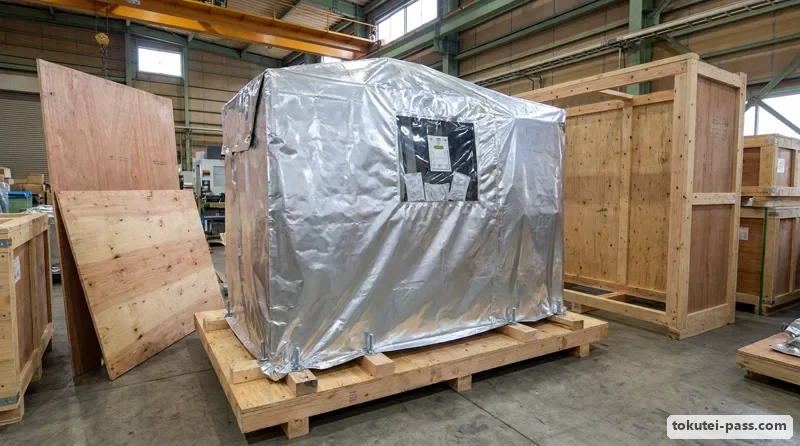
バリヤ袋を用いない密閉木箱では、内部結露と雨水浸入の両方を防ぐため、側面上部に防虫網付きの「換気口(ガラリ)」を設け、機械上部には防水紙を屋根状にかぶせる「シェッド張り(傘掛け防水)」を施し、底板には「水抜き穴」をあけます。
In close-boarded crates without a sealed barrier bag, preventing both internal condensation and rainwater ingress requires installing screened upper "ventilation louvers" (換気口 / ガラリ), draping roof-like "shed waterproofing" (シェッド張り) over the machine, and drilling "drain holes" (水抜き穴) in the bottom board.
Key points
- 枠組箱の腰下は「滑材→負荷床材」の順に組み、ラッキング変形防止のため「標準45°(35°〜55°)」のすじかいを設ける
Stack the framed box base from the floor up as Skids → Load-bearing floor members, and install diagonal braces at a standard 45° (35°–55°) to prevent racking deformation - 天井のはりを支える「そえ柱」は側支柱長さの2/3以上とし、組立て打ちの釘長さは板厚の2.5〜3倍とする
Make auxiliary posts (そえ柱) supporting joist bearers at least 2/3 of the side strut length, and use assembly nails 2.5–3 times the board thickness - 密閉木箱の防水通気設計は「側面上部の防虫網付き換気口 + 機械上部のシェッド張り + 底板の水抜き穴」の3点セットで行う
Combine three elements for close-boarded crate waterproofing/ventilation: Screened upper vents + Shed waterproofing over the machine + Bottom drain holes
| Word | Meaning |
|---|---|
| 腰下設計(滑材・ヘッダー・負荷床材) | Base design (Skids, Headers, Load-bearing floor members) |
| ラッキング変形防止とすじかい(標準45°) | Racking deformation prevention and Diagonal braces (standard 45°) |
| はり受けとそえ柱(側支柱長さの2/3以上) | Joist bearers and Auxiliary posts (≥ 2/3 of side strut length) |
| 換気口(ガラリ)・シェッド張り・水抜き穴 | Ventilation louvers, Shed waterproofing, and Bottom drain holes |
3. 質量・容積(M3)・接地圧・木材含水率・偏重心の実務計算
3. Practical Calculations for Mass, Volume (M3), Floor Bearing Pressure, Wood Moisture, and Center of Gravity
ユニットロード全体の総質量は「(1箱の純質量N/W + 風袋質量Tare)× 箱数 + パレット自重」で算出します。また海上運賃算定用の貨物容積(M3:CBM)は、木箱の最大外寸(長さm × 幅m × 高さm)に箱数を乗じて求めます。
Total unit-load gross mass is calculated as "(Net Weight N/W per box + Tare Weight per box) × Number of boxes + Pallet self-weight". Cargo volume (M3 / CBM) for ocean freight is obtained by multiplying the maximum external dimensions (Length m × Width m × Height m) by the number of crates.
滑材底面が床面に及ぼす平均接地圧力(面圧 p)は、「総質量 W ÷ 滑材の合計接地断面積 A(幅 × 接地長さ × 本数)」で計算します。木材の含水率 u(%)は全乾質量 W0 を基準とし、「u = {(乾燥前質量 W1 − W0) ÷ W0} × 100」で算出します。
Average floor contact pressure (bearing stress p) beneath the skids is calculated as "Gross mass W ÷ Total skid contact area A (Width × Contact length × Number of skids)". Wood moisture content u (%) on an oven-dry basis (W0) is defined as "u = {(Initial mass W1 − W0) ÷ W0} × 100".
滑材上の距離 x1 に質量 W1、距離 x2 に質量 W2 の機械部が載る偏重心貨物では、モーメントのつり合いより合成重心位置は「xG = (W1・x1 + W2・x2) ÷ (W1 + W2)」となります。重心位置マークは必ずこの実重心 xG に表示します。
For eccentric cargo where a machine unit of mass W1 is placed at distance x1 and a unit of mass W2 at distance x2 along the skids, moment equilibrium gives the combined center of gravity as "xG = (W1·x1 + W2·x2) ÷ (W1 + W2)". Center-of-gravity symbols must be marked at this actual position xG.
Key points
- ユニットロード総質量 = (N/W + 箱風袋) × 箱数 + パレット質量 / 貨物容積 M3 = 外寸長さ(m)×幅(m)×高さ(m)×箱数
Unit load gross mass = (N/W + box tare) × box count + pallet mass / Cargo volume M3 = External L (m) × W (m) × H (m) × crate count - 滑材平均接地圧 p = W ÷ (滑材幅×長さ×本数) / 木材含水率 u(%) = {(乾燥前W1 − 全乾W0) ÷ W0} × 100
Average skid bearing pressure p = W ÷ (skid width × length × count) / Wood moisture content u (%) = {(W1 − oven-dry W0) ÷ W0} × 100 - 偏重心貨物の合成重心位置は「xG = (W1・x1 + W2・x2) ÷ (W1 + W2)」で計算し、実重心位置にマークを表示する
Calculate combined center of gravity for eccentric cargo using xG = (W1·x1 + W2·x2) ÷ (W1 + W2) and stencil the mark at the actual xG
| Word | Meaning |
|---|---|
| ユニットロード総質量と貨物容積(M3・CBM) | Unit load gross mass and Cargo volume (M3 / CBM) |
| 滑材平均接地圧力(面圧 p = W ÷ A) | Average skid floor bearing pressure (p = W ÷ A) |
| 木材含水率定義式(全乾質量 W0 基準) | Wood moisture content formula (oven-dry mass W0 basis) |
| 合成重心位置計算(モーメントのつり合い) | Combined center-of-gravity calculation (moment equilibrium) |
4. 緩衝包装設計(JIS Z 0119)・振動共振回避・防湿乾燥剤計算
4. Cushioning Design (JIS Z 0119), Vibration Resonance Avoidance, and Desiccant Calculation
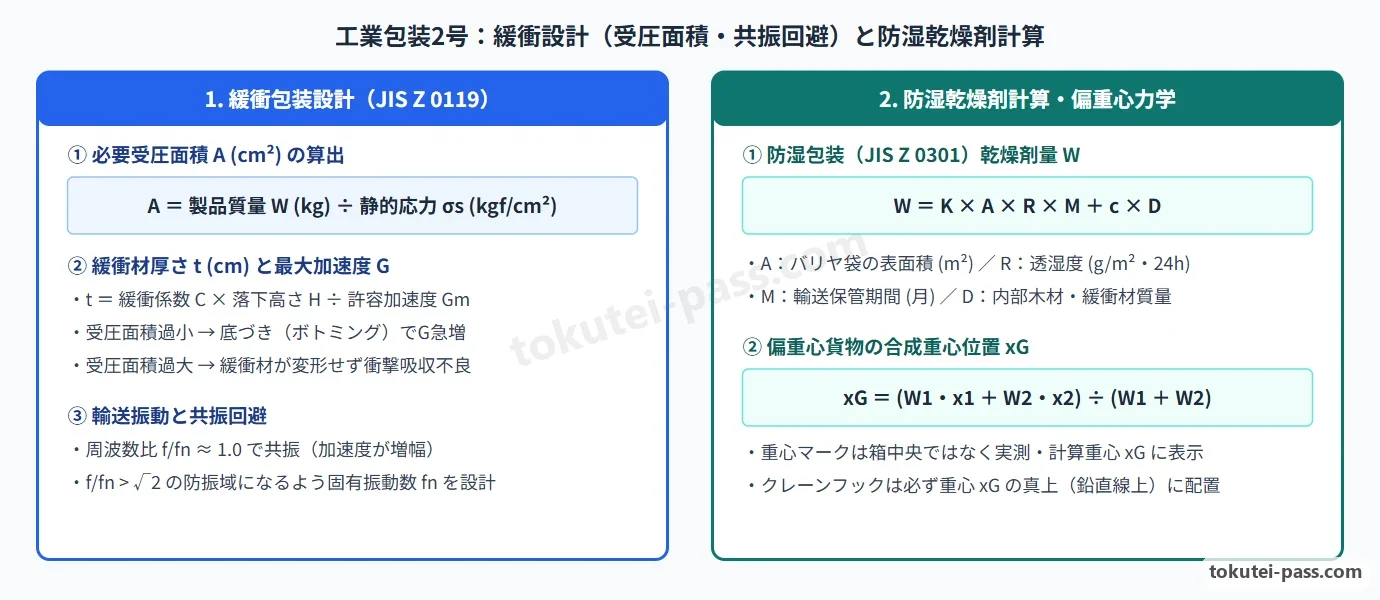
緩衝包装設計(JIS Z 0119)において、製品質量 W(kg)を支える緩衝材の合計必要受圧面積 A(cm²)は、緩衝材の設計静的応力を σs(kgf/cm²)とするとき「A = W ÷ σs」で求められます。底面4隅のパッドで均等支持する場合、1個あたりの面積は「a = A ÷ 4」となります。
In cushioning design (JIS Z 0119), the total required bearing area A (cm²) supporting a product of mass W (kg) at a design static stress σs (kgf/cm²) is "A = W ÷ σs". When supported equally on 4 bottom corner pads, the area per pad is "a = A ÷ 4".
緩衝材の必要最小厚さ t(cm)は、緩衝係数 C、想定落下高さ H(cm)、製品の許容加速度 Gm(G)から「t = C × H ÷ Gm」で算出します。受圧面積が狭すぎると「底づき」を起こし、逆に軽量品で受圧面積が広すぎると緩衝材が変形せず高い加速度 G が製品に伝わります。
The minimum required cushion thickness t (cm) is calculated from the cushion factor C, drop height H (cm), and allowable acceleration Gm (G) as "t = C × H ÷ Gm". Too small a bearing area causes "bottoming out", whereas too large an area under a light item prevents cushion deflection—both transmitting excessive shock G.
輸送振動では、トラック荷台等の振動周波数 f と包装系の固有振動数 fn の比が「f / fn ≈ 1.0」になると共振して加速度が増幅(伝達率 T > 1)します。共振破損を防ぐには、緩衝材のばね定数・厚さを調整して fn を下げ、「f / fn > √2」の防振域(T < 1)で設計します。
During transport vibration, if the ratio of forcing frequency f (e.g., truck bed vibration) to package natural frequency fn is near "f / fn ≈ 1.0", resonance amplifies acceleration (transmissibility T > 1). To prevent resonance damage, adjust cushion stiffness and thickness to lower fn into the isolation zone "f / fn > √2" (where T < 1).
防湿包装(JIS Z 0301)の乾燥剤所要量 W(g)は、バリヤ袋表面積 A(m²)、透湿度 R、期間 M(月)、気候係数 K、内部木材等の吸湿補正量 D_term から「W = K × A × R × M + D_term」で算出します。
In moisture-proof packaging (JIS Z 0301), required desiccant mass W (g) is calculated from barrier bag area A (m²), water vapor transmission rate R, duration M (months), climate factor K, and internal wood/dunnage allowance D_term using "W = K × A × R × M + D_term".
Key points
- 緩衝材の必要受圧面積は「A = W ÷ σs」、必要最小厚さは「t = C × H ÷ Gm」で計算する(4隅配置なら1個面積 a = A ÷ 4)
Calculate required cushion area as A = W ÷ σs (a = A ÷ 4 for 4 corner pads) and minimum cushion thickness as t = C × H ÷ Gm - 受圧面積が小さすぎると「底づき」、大きすぎると「未変形」となり、いずれも製品の破損加速度 G を増大させる
Too small a pad area causes bottoming out, while too large an area prevents deflection; both spike the peak acceleration G transmitted to the product - 輸送振動は「f / fn > √2(防振域)」となるよう固有振動数 fn を設計し、防湿乾燥剤量は「W = K・A・R・M + 補正量」で求める
Design natural frequency fn so that f / fn > √2 (vibration isolation zone), and calculate desiccant mass via W = K·A·R·M + dunnage allowance
| Word | Meaning |
|---|---|
| 必要受圧面積(A = W ÷ σs)と緩衝材厚さ(t = C・H ÷ Gm) | Required bearing area (A = W ÷ σs) and Cushion thickness (t = C·H ÷ Gm) |
| 底づき(面積過小)と未変形(面積過大) | Bottoming out (insufficient area) vs. Non-deflection (excessive area) |
| 振動伝達率曲線・共振域(f/fn≈1)と防振域(f/fn>√2) | Vibration transmissibility curve, Resonance zone (f/fn ≈ 1), and Isolation zone (f/fn > √2) |
| 乾燥剤所要量計算式(JIS Z 0301) | Required desiccant calculation formula (JIS Z 0301) |
5. 段ボール積付け強度計算とコンテナバンニング・ラッシング管理
5. Corrugated Box Stacking Strength Calculation and Container Vanning / Lashing Management
段ボール箱をパレットに n 段積みする場合、最下段の箱が支える静的荷重は「上に載る (n − 1) 箱分の質量」です。温湿度劣化や長期保管のクリープを考慮した安全率を S(例:S = 5.0)とするとき、必要箱圧縮強さは「P = 1箱質量 × (n − 1) × S」となります。
When corrugated boxes are stacked n tiers high on a pallet, the static load on the bottom-tier box equals the mass of the "(n − 1) boxes above it". Multiplying by a safety factor S (e.g., S = 5.0) for humidity and long-term creep gives the required box compressive strength: "P = Box mass × (n − 1) × S".
T11形パレット上の積付けでは、箱の4隅が上下に一致する「ブロック積み(棒積み)」は圧縮強さの保持率が最も高い一方で荷崩れしやすく、交互に組む「レンガ積み(インターロック積み)」は安定して荷崩れしにくい反面、角がずれるため圧縮強さが20〜30%低下します。
On a T11 flat pallet, "Block/Column stacking" (ブロック積み) aligns all four vertical box corners for maximum compressive strength retention but shifts easily, whereas "Brick/Interlock stacking" (レンガ積み) resists load shifting but loses 20–30% of compressive strength due to misaligned corners.
重量部品の長期積載では、耐湿ライナと複両面段ボール(ABフルート等)の垂直段設計を採用し、PPバンド結束時は張力過大による角破断・胴膨れを防ぐため「コーナー当て板」と箱内の「仕切り・胴枠パット」を併用します。
For long-term stacking of heavy parts, specify moisture-resistant liners and double-wall board (e.g., AB-flute) with vertical flutes; during PP strapping, regulate tension and use "corner protectors" (当て板) and internal "partitions/liner pads" to prevent edge tearing and sidewall bulging (胴膨れ).
海上コンテナへの積込み(バンニング)では、重量貨物を下段かつコンテナ中央寄りに配置して偏荷重を防ぎ、隙間を角材(ショアリング・ダンネージ)とラッシングベルトで床面リングへ確実に固縛します。熱帯航路ではコンテナレイン対策として乾燥パレット・トップカバー・コンテナ乾燥剤を併用します。
In marine container loading (vanning), place heavy crates on the lower tier near the longitudinal/lateral center, brace gaps with timber shoring/dunnage, and lash cargo to floor rings. On tropical routes, prevent "container rain" damage by combining dry or plastic pallets, waterproof top covers, and container desiccants.
Key points
- n段積み最下段の段ボール箱に必要な圧縮強さは「P = 1箱質量 × (n − 1) × 安全率 S」で算出する
Calculate required compressive strength for the bottom box in an n-tier stack as P = Box mass × (n − 1) × Safety factor S - 「ブロック積み」は圧縮強さ保持率が最高だが荷崩れしやすく、「レンガ積み」は荷崩れに強いが圧縮強さが20〜30%低下する
Block stacking retains maximum compression strength but shifts easily; Brick/interlock stacking improves stability but reduces compression strength by 20–30% - コンテナバンニングでは重量箱を下段中央寄りに配してショアリング・ラッシングを行い、コンテナレイン対策として乾燥パレットとトップカバーを用いる
During container vanning, place heavy crates low and near the center with shoring/lashing, and use dry pallets plus top covers against container rain
| Word | Meaning |
|---|---|
| 必要箱圧縮強さ(P = W × (n−1) × 安全率 S) | Required box compressive strength (P = W × (n−1) × Safety factor S) |
| ブロック積み(棒積み)とレンガ積み(インターロック積み) | Block/Column stacking vs. Brick/Interlock stacking |
| バンニング・ラッシング・ショアリング | Container vanning, Lashing, and Shoring |
| コンテナレイン(結露)対策とトップカバー | Container rain (condensation) countermeasures and Top covers |
6. 梱包不具合の原因分析とトラブルシューティング
6. Root-Cause Analysis of Packaging Defects and Troubleshooting
【さび・防湿不良】VCI紙包装にもかかわらず指紋状のさびが発生した場合は、洗浄後の「素手接触(汗の塩分)」が原因であり、保護手袋着用を徹底します。
【Rust & Moisture Defects】Fingerprint-shaped rust inside VCI packaging is caused by workers touching cleaned metal parts with "bare hands" (sweat salt); enforce wearing protective gloves.
また脱気したアルミ防湿バリヤ袋の破袋(ピンホール)は機械の鋭利角部への発泡シート養生で防ぎ、シール部の「しわ(リークパス)」は袋口を平らに引き伸ばして適正温度・圧力で再溶着します。
Pinhole punctures in evacuated aluminum moisture-barrier bags are prevented by padding sharp machine edges with foam sheets beforehand (養生); heat-seal "wrinkles (capillary leak paths)" are prevented by pulling the bag mouth taut and flat during sealing at proper temperature and pressure.
【木箱内移動・カバー損傷】長距離海上輸送中にアンカーボルトが緩んで機械が横滑りする事故は、木材の乾燥収縮と船体動揺が原因であり、乾燥材の使用・ダブルナット(緩み止め)・根止め材の密着配置で防止します。
【Internal Shifting & Cover Damage】Loosened anchor bolts and lateral machine shifting during long ocean voyages result from wood drying shrinkage and vessel motion; prevent this by using seasoned lumber, double nuts (anti-loosening), and tight base blocking cleats (根止め材).
また、浮き上がり防止の「押さえ材」によって機械上面の薄板カバーが凹んだり塗装が剥離したりする不具合に対しては、押さえ材を薄板ではなく「強度のある剛性フレーム部」に当て、接触面にフェルトやゴム板等の「当て材」を必ず挟みます。
To prevent top "hold-down braces" (押さえ材) from denting thin sheet-metal covers or peeling paint, position hold-down braces against "rigid structural frame members" and always interpose protective pads (当て材 such as felt or rubber sheets).
Key points
- 指紋状さび=洗浄後の素手接触禁止 / バリヤ袋ピンホール=鋭利角部の事前養生 / シールしわ(リークパス)=袋口を平らに引き伸ばして熱溶着
Fingerprint rust = prohibit bare-hand contact / Barrier-bag pinholes = pre-pad sharp corners / Heat-seal wrinkles (leak paths) = pull bag mouth flat and reseal - アンカーボルトの緩み・機械横滑り=適正含水率の乾燥木材使用 + ダブルナット・ばね座金 + 根止め材の併用
Bolt loosening & lateral shifting = use seasoned lumber + double nuts/spring washers + tight-fitting base blocking cleats (根止め材) - 押さえ材によるカバー凹み・塗膜剥離=薄板カバーを避けて「剛性フレーム部」に当て、フェルト等の「当て材」を介在させる
Cover dents & paint peeling from hold-down braces = bear on rigid structural frame sections and interpose felt/rubber protective pads (当て材)
| Word | Meaning |
|---|---|
| 指紋状さびと素手接触禁止 | Fingerprint rust and Prohibition of bare-hand contact |
| ピンホール養生とヒートシールのリークパス(しわ) | Pinhole padding (養生) and Heat-seal leak paths (wrinkles) |
| ダブルナット緩み止めと根止め材 | Double-nut locking and Base blocking cleats |
| 剛性フレーム部への押さえ材配置と当て材 | Hold-down brace placement on rigid frames and Protective pads |
7. クレーン玉掛け力学・つり天秤・フォークリフト許容荷重管理
7. Crane Slinging Mechanics, Spreader Beams, and Forklift Allowable Load Management
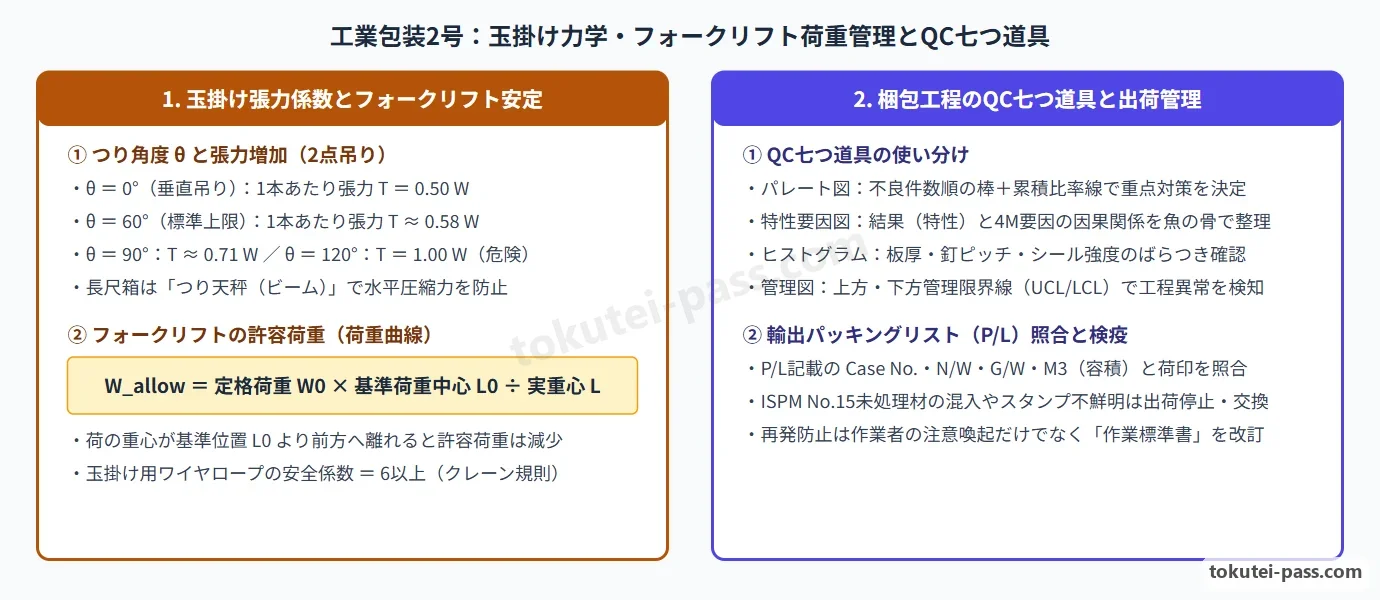
クレーンで質量 W の貨物を2本のワイヤで対称玉掛けするとき、つり角度 θ が広がるほど1本の張力「T = W ÷ {2・cos(θ/2)}」は急増します。θ=0°で 0.50 W、θ=60°で約0.58 W ですが、θ=120°では「T = 1.00 W(全質量)」となり危険です。
When lifting a cargo of mass W symmetrically with two crane wire ropes, the tension per rope "T = W ÷ {2·cos(θ/2)}" rises sharply as the slinging angle θ widens. Tension is 0.50 W at θ = 0° and ~0.58 W at the standard limit θ = 60°, but reaches "T = 1.00 W (full cargo weight on each rope)" at θ = 120°.
そのため直接2点吊りのつり角度は「60°以内」とし、玉掛け用ワイヤロープの安全係数は「6以上」を確保します。長尺枠組箱では斜めワイヤの水平分力による箱上部の圧潰を防ぐため、「つり天秤(スプレッダビーム)」を用いてワイヤを垂直に下ろします。
Therefore, keep direct 2-point slinging angles "within 60°" and ensure a wire rope safety factor of "6 or more". For long framed wooden crates, use a "spreader beam / lifting beam" (つり天秤) so slings hang vertically and do not crush the top frame inward.
また偏重心貨物をクレーンで吊る際は、実測重心位置の真上(鉛直線上)にフックを誘導し、地面から数十cm浮かせる「地切り」で一旦停止して水平バランスと玉掛け状態を確認します。
When hoisting eccentric cargo, guide the crane hook directly onto the vertical line above the actual center of gravity, pause at "ground clearance" (地切り: a few dozen cm off the floor), and verify horizontal balance and sling seating.
フォークリフトでは、基準荷重中心 L0 での定格荷重を W0 とするとき、重心距離 L の長尺箱に対する許容荷重は「W = W0 × L0 ÷ L」に減少します。積載坂道走行は「登坂=前進、降坂=後進」とし、マストを後傾させて爪を低く保ちます。
For a forklift with rated capacity W0 at standard load center L0, the maximum allowable load for a long crate with center-of-gravity distance L decreases to "W = W0 × L0 ÷ L". When driving a loaded forklift on slopes, travel "forward uphill and in reverse downhill" with the mast tilted back and forks kept low.
Key points
- 玉掛けつり角度は「60°以内(ワイヤ安全係数6以上)」とし、θ=120°では1本の張力が貨物全質量 W(T=W)に達する
Keep slinging angles within 60° (wire rope safety factor ≥ 6); at θ = 120°, tension in each single rope equals the full cargo mass (T = W) - 長尺木箱の側圧潰れ防止には「つり天秤」を使用し、偏重心箱は実重心真上にフックを誘導して「地切り」で水平確認する
Use a spreader beam (つり天秤) to prevent top crushing on long crates, and position the hook directly above the actual center of gravity with a ground-clearance check (地切り) - フォークリフトの許容荷重は「W = W0 × L0 ÷ L」で計算し、積載坂道走行は「登坂前進・降坂後進・マスト後傾」を徹底する
Calculate forklift allowable load as W = W0 × L0 ÷ L; on slopes with a load, drive forward uphill and in reverse downhill with the mast tilted back
| Word | Meaning |
|---|---|
| つり角度 θ とワイヤ張力(θ=120°で T=W) | Slinging angle θ and Wire rope tension (T = W at θ = 120°) |
| つり天秤(スプレッダビーム)と地切り確認 | Spreader beam (つり天秤) and Ground-clearance check (地切り) |
| フォークリフト基準荷重中心(W = W0 × L0 ÷ L) | Forklift standard load center (W = W0 × L0 ÷ L) |
| 積載坂道走行(登坂前進・降坂後進) | Loaded slope travel (Forward uphill, Reverse downhill) |
8. 木材加工機・エアネイラ・有機溶剤の安全衛生監督とKYT
8. Occupational Safety Supervision for Woodworking Machines, Nailers, Organic Solvents, and KYT
丸のこ盤による木材切断作業では、のこ歯後部で木材が跳ね返る「キックバック(反発)」を防ぐため「反発予防装置(割刃)」と「接触予防装置(安全カバー)」を適正位置に装着し、巻き込まれ防止のため「軍手着用を厳禁」とします。
In circular saw (丸のこ盤) lumber cutting, prevent "kickback" (wood pinched by the rear saw teeth and thrown back at the operator) by properly installing the "riving knife / anti-kickback splitter" (割刃) and "blade safety guard", and strictly prohibit wearing knitted cotton gloves (軍手).
エアネイラ(空気圧式釘打機)の監督では、コンタクトアーム(安全装置)の無効化や引き金を引いたままの移動を禁止し、釘詰まり除去・点検・休憩時には必ず「エアホース(カプラー)を外して残圧を抜く」手順を徹底します。
When supervising pneumatic nailers (エアネイラ), prohibit disabling the contact arm safety or walking with a finger on the trigger, and enforce "disconnecting the air hose coupler to bleed residual pressure" before clearing jams, inspecting, or taking breaks.
防錆前処理で有機溶剤を使う屋内洗浄作業場では、蒸気が空気より重く滞留するため「局所排気装置(またはプッシュプル型換気装置)」を稼働させ、「有機ガス用防毒マスク」と「不浸透性保護手袋」を着用させます。
In indoor degreasing workshops using organic solvents for rust pre-treatment, vapors are heavier than air; operate "local exhaust ventilation (or push-pull ventilation)" and require workers to wear "organic-vapor respirators" and "impermeable protective gloves".
職場の危険予知訓練(KYT 4ラウンド法)は「①現状把握 → ②本質追究 → ③対策樹立 → ④目標設定(指差呼称)」の順に進め、ハインリッヒの法則(1:29:300)に基づき300件のヒヤリハット段階で危険要因を排除します。
Conduct workplace Hazard Prediction Training (KYT 4-Round Method) in the sequence "① Grasp Current Status → ② Pursue Essence → ③ Establish Countermeasures → ④ Set Action Target (pointing-and-calling)", eliminating hazards at the 300 near-miss (Hiyari-Hatto) stage under Heinrich's Law (1 : 29 : 300).
Key points
- 丸のこ盤は「割刃(反発予防装置)+ 安全カバー + 軍手禁止」を徹底し、エアネイラは点検・詰まり除去時に必ず「エアホースを外す」
On circular saws, enforce Riving knife (割刃) + Blade guard + No cotton gloves; on pneumatic nailers, always disconnect the air hose before clearing jams or inspecting - 有機溶剤洗浄作業では「局所排気装置の稼働 + 有機ガス用防毒マスク + 不浸透性保護手袋」を義務づける
For organic solvent degreasing, mandate operating local exhaust ventilation + wearing organic-vapor respirators + wearing impermeable gloves - KYT 4ラウンド法は「①現状把握 → ②本質追究 → ③対策樹立 → ④目標設定」の順に進め、ヒヤリハット段階で対策する
Follow the KYT 4-Round sequence (① Status → ② Essence → ③ Countermeasures → ④ Action target) and eliminate hazards at the near-miss stage
| Word | Meaning |
|---|---|
| 割刃(反発予防装置)とキックバック防止 | Riving knife (anti-kickback splitter / 割刃) and Kickback prevention |
| エアホース離脱と残圧排出 | Air hose disconnection and Residual pressure release |
| 局所排気装置と有機ガス用防毒マスク | Local exhaust ventilation and Organic-vapor respirator |
| KYT 4ラウンド法とハインリッヒの法則(1:29:300) | KYT 4-Round Method and Heinrich's Law (1 : 29 : 300) |
9. 梱包工程のQC七つ道具・ポカヨケ・出荷前検査・輸出検疫管理
9. Seven QC Tools in Packaging, Poka-yoke, Pre-Shipment Inspection, and Export Quarantine Control
梱包工程の品質改善ではQC七つ道具を活用します。「パレート図」は不良項目を件数順の棒グラフと累積比率折れ線で示して重点対策項目を決める図、「特性要因図(魚の骨図)」は結果(さび等)に対する4M(作業者・材料・方法・設備)の因果関係を整理する図です。
Packaging quality improvement utilizes the Seven QC Tools: a "Pareto chart" combines descending defect bars and a cumulative percentage line to select priority improvement items, while a "Cause-and-effect (fishbone) diagram" organizes 4M factors (Man, Material, Method, Machine) behind a defect characteristic.
測定値のばらつき分布は「ヒストグラム」で把握し、工程推移は「管理図(Xbar-R管理図等)」で監視します。打点が管理限界線(UCL/LCL)を超えたときは「異常原因」の発生と判断して直ちに調査・調整し、PDCAのActでは「作業標準書」を改訂して標準化します。
Measurement dispersion is visualized with a "Histogram", while process stability over time is monitored with "Control charts (Xbar-R)". A point outside the Upper/Lower Control Limits (UCL/LCL) signals an "assignable (abnormal) cause" requiring immediate investigation, and in the Act phase of PDCA the "Standard Operating Procedure (作業標準書)" is revised.
同梱付属品の入れ忘れ(欠品)防止には、トレイへの定数配膳(キット化)・バーコード照合などの「ポカヨケ」を導入します。大型密閉枠組箱では、外板を閉じる前に内部のアンカー締結・根止め・乾燥剤・バリヤ袋シール状態を写真記録し、完成後はパッキングリスト(P/L)と現物荷印(常に G/W > N/W)を照合します。
To prevent missing accessories (omission defects), implement "Poka-yoke" mechanisms such as pre-kitting trays, barcode scanning, and checkweighing. For large close-boarded crates, photograph internal anchor bolts, blocking, desiccant, and barrier-bag seals before closing the sheathing, then verify stenciled marks against the Packing List (always G/W > N/W).
輸出用木箱のISPM No.15管理では、補修用の根止め材やダンネージに未処理無垢材が1本でも混入すると検疫違反(輸入拒否・廃棄)となるため、必ずHT処理済材(中心温度56℃以上・30分以上)または合板等の検疫免除材を使用します。
In ISPM No.15 export wood management, including even a single piece of untreated solid lumber for internal blocking or repair constitutes a quarantine violation (import rejection or destruction); always use certified HT-treated wood (core ≥ 56°C for ≥ 30 min) or exempt materials such as plywood.
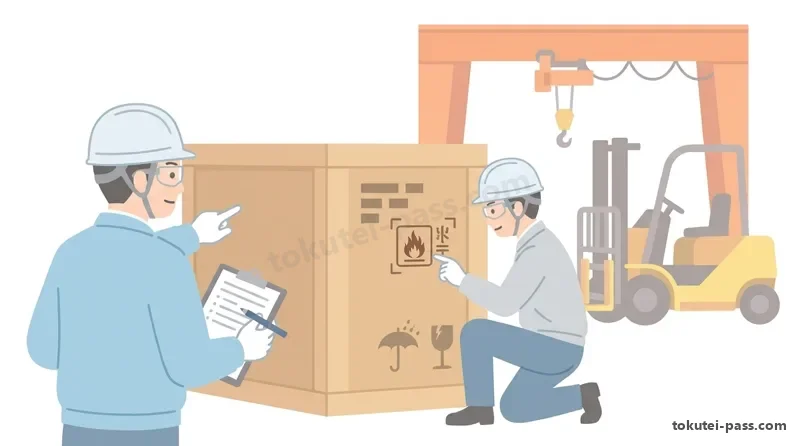
Key points
- パレート図=累積比率による重点対策決定 / 特性要因図=4M要因整理 / ヒストグラム=ばらつき分布 / 管理図UCL・LCL外=異常原因調査
Pareto chart = cumulative % for priority items / Fishbone diagram = 4M root-cause analysis / Histogram = dispersion / Control chart beyond UCL-LCL = abnormal cause investigation - PDCAのActでは「作業標準書の改訂」を行い、欠品防止にはキット化・バーコード照合・重量検量の「ポカヨケ」を導入する
Standardize improvements in the PDCA Act stage by revising the Standard Operating Procedure; prevent omissions using Poka-yoke (kitting, barcode scanning, checkweighing) - 密閉前に内部固定・シール状態の写真記録を残し、P/L照合(G/W>N/W)とISPM No.15補修材管理(未処理無垢材混入厳禁)を徹底する
Photograph internal securing/seals before closing crates, verify Packing List marks (G/W > N/W), and never use untreated solid wood for ISPM No.15 repairs
| Word | Meaning |
|---|---|
| パレート図・特性要因図・ヒストグラム・管理図 | Pareto chart, Cause-and-effect diagram, Histogram, and Control chart |
| PDCAサイクルと作業標準書の改訂 | PDCA cycle and Revision of Standard Operating Procedure |
| ポカヨケ(キット化・バーコード照合)と密閉前中間検査 | Poka-yoke (Kitting, Barcode check) and Pre-closure inspection |
| パッキングリスト照合とISPM No.15補修材管理 | Packing List verification and ISPM No.15 repair lumber control |
10. 2号試験対策の重要計算式・管理判断まとめ
10. Summary of Essential Formulas & Supervisory Judgments for the Level 2 Exam
【必須計算式①】合成重心位置:xG = (W1・x1 + W2・x2) ÷ (W1 + W2) / 緩衝受圧面積:A = W ÷ σs(4隅なら a = A ÷ 4) / 緩衝材厚さ:t = C × H ÷ Gm / 防湿乾燥剤量:W = K・A・R・M + 補正量。
【Essential Formulas ①】Combined center of gravity: xG = (W1·x1 + W2·x2) ÷ (W1 + W2) / Cushion bearing area: A = W ÷ σs (a = A ÷ 4 for 4 pads) / Cushion thickness: t = C × H ÷ Gm / Desiccant mass: W = K·A·R·M + dunnage allowance.
【必須計算式②】段ボールn段積み必要圧縮強さ:P = 1箱質量 × (n − 1) × 安全率 S / 木材含水率:u = {(W1 − W0) ÷ W0} × 100(%) / フォークリフト許容荷重:W = W0 × L0 ÷ L / 2点吊り120°時の1本張力:T = W。
【Essential Formulas ②】Bottom corrugated box required strength in n tiers: P = Box mass × (n − 1) × Safety factor S / Wood moisture content: u = {(W1 − W0) ÷ W0} × 100 (%) / Forklift allowable load: W = W0 × L0 ÷ L / Sling tension per rope at 120° 2-point lift: T = W.
【監督判断の鉄則】① 共振回避は固有振動数 fn を下げて「f / fn > √2」の防振域へ。② 長尺木箱のクレーン荷役は「つり天秤」で垂直吊り。③ 再発防止は注意喚起だけで終わらせず「作業標準書の改訂」と「ポカヨケ」で標準化する。
【Supervisory Rules】① Avoid resonance by lowering natural frequency fn into the isolation zone "f / fn > √2". ② Use a "spreader beam (つり天秤)" to keep slings vertical on long crates. ③ Prevent recurrence permanently by "revising the Standard Operating Procedure" and implementing "Poka-yoke".
Key points
- 計算公式:重心 xG=Σ(Wi・xi)/ΣWi / 受圧面積 A=W/σs / 緩衝厚さ t=C・H/Gm / 最下段箱強度 P=W・(n−1)・S
Formulas: Center of gravity xG = Σ(Wi·xi)/ΣWi / Cushion area A = W/σs / Cushion thickness t = C·H/Gm / Bottom box strength P = W·(n−1)·S - 荷役力学:つり角度60°以内(120°では張力T=W)・ワイヤ安全係数6以上・長尺箱はつり天秤 / リフト許容荷重 W=W0・L0/L
Handling mechanics: Sling angle ≤ 60° (at 120° tension T = W), wire rope safety factor ≥ 6, spreader beam for long crates / Forklift capacity W = W0·L0/L - 品質安全管理:パレート図累積比率・4M特性要因図・管理図UCL/LCL・KYT 4ラウンド法・ISPM No.15補修材の未処理材混入厳禁
QC & Safety: Pareto cumulative %, 4M fishbone diagram, UCL/LCL control limits, KYT 4-Round Method, and zero untreated solid repair wood under ISPM No.15
| Word | Meaning |
|---|---|
| 緩衝受圧面積(A=W/σs)と共振回避(f/fn>√2) | Cushion bearing area (A = W/σs) and Resonance avoidance (f/fn > √2) |
| 合成重心 xG とフォークリフト許容荷重(W0・L0/L) | Combined center of gravity xG and Forklift allowable load (W0·L0/L) |
| つり角度120°張力(T=W)とつり天秤 | 120° sling tension (T = W) and Spreader beam |
| パレート図・特性要因図・作業標準書改訂 | Pareto chart, Fishbone diagram, and SOP revision |
Advanced industrial packaging (crate design, calculations, lifting, QC)
Practice this chapter in the appOfficial references
- 製造分野特定技能2号評価試験(経済産業省・JAIM) — https://www.jaim-skill.or.jp/exam/about-ssw2/
- 技能検定 工業包装 1級・2級 試験問題・試験基準(中央職業能力開発協会 JAVADA) — https://www.javada.or.jp/jigyou/gino/giken/