Industrial Packaging (工業包装)
工業包装(木箱・枠組箱・段ボール・防錆防湿・緩衝包装・安全作業)
Industrial Manufacturing - Machinery and Electronics · 製造分野 · Written by Tokutei Pass based on the official study texts; not copied verbatim.
1. 特定技能1号における位置づけと工業包装の基礎
1. Role in Specified Skilled Worker (i) and Fundamentals of Industrial Packaging
製造分野特定技能1号に「工業包装」という単独の試験区分はなく、受験者は「機械金属加工区分」「電気電子機器組立て区分」「家具製造区分」のいずれかで受験します。本章は3区分の包装知識と技能検定(随時3級・2級)・2号移行を補完する専門トラックです。
In the Specified Skilled Worker (i) Industrial Product Manufacturing field, there is no standalone exam division called "Industrial Packaging"; candidates take the exam under one of three divisions: "Machine and Metal Processing", "Electrical and Electronic Equipment Assembling", or "Furniture Manufacturing". This chapter serves as a specialized supplementary track covering the packaging and logistics quality topics tested in those three divisions while preparing workers for the National Trade Skill Test in Industrial Packaging (Grades 3 & 2) and transition to Specified Skilled Worker (ii).
JIS Z 0108において「工業包装」とは、製品や部品の輸送・保管にあたり、品質の保護と荷役・物流の効率を第一の目的とする包装と定義されます。店頭で消費者の購買意欲を高める美しいデザインを優先する「商業包装」とは目的が大きく異なります。
Under JIS Z 0108, "industrial packaging" (工業包装) is defined as packaging whose primary purposes are protecting the quality of products and parts and improving cargo handling and logistics efficiency during transport and storage. This differs fundamentally from "commercial packaging" (商業包装), which prioritizes attractive visual design to stimulate consumer purchasing desire at retail stores.
包装構造は内側から順に、物品個々を包む「個装」、水分や衝撃を防ぐ「内装」、木箱や段ボール箱に入れて荷印を付ける「外装」の3段階に区分されます。金属部品では、洗浄・乾燥・防錆の「前処理」を行ってから「個装 → 内装 → 外装」の順に進めます。
Packaging structure is classified from the inside out into three levels: "Unit packaging" (個装) wrapping individual items; "Inner packaging" (内装) protecting against moisture, rust, and shock; and "Outer packaging" (外装) placing items into the outermost container (such as a wooden box or corrugated box) and applying shipping marks. For metal parts, work begins with "pre-treatment" (前処理: cleaning, drying, and rust prevention) followed in order by "Unit → Inner → Outer packaging".
質量表示では、製品のみの質量を「純質量(N/W)」、木箱など包装材料の質量を「風袋質量(Tare)」、両者の合計を「総質量(G/W=N/W+風袋質量)」といいます。また複数の貨物をパレットに積み、フォークリフトで一括荷役できるようにすることを「パレタイズ(ユニットロード化)」といいます。
In cargo mass markings, the mass of the product alone is "Net Weight" (純質量: N/W), the mass of packaging materials such as wooden boxes and cushioning is "Tare Weight" (風袋質量), and the combined total mass of the cargo is "Gross Weight" (総質量: G/W = N/W + Tare Weight). Consolidating multiple packages onto a pallet for mechanical handling as a single unit by forklift is called "palletizing" (パレタイズ) or "unit load formation" (ユニットロード化).
物流品質は「納期品質・商品品質・配送品質」の3つに分類され、100万件あたりの不良発生件数を表す「PPM」を指標として管理されます。作業者は常に包装仕様書の寸法や材料指定を厳守しなければなりません。
Logistics quality is classified into three pillars—"delivery date quality, product quality, and shipping/delivery quality"—and is managed using "PPM" (defects per 1 million cases). Workers must strictly follow all dimensions and material rules specified in the packaging specification sheet (包装仕様書).
Key points
- 特定技能1号では「機械金属加工・電気電子機器組立て・家具製造」の3区分のいずれかで受験する
In Specified Skilled Worker (i), candidates take the exam under Machine & Metal Processing, Electrical & Electronic Equipment Assembling, or Furniture Manufacturing - JIS Z 0108の「工業包装」は輸送・保管時の品質保護と荷役効率を目的とし、「前処理→個装→内装→外装」の順に進める
Industrial packaging (JIS Z 0108) protects product quality and cargo-handling efficiency, proceeding in order: Pre-treatment → Unit → Inner → Outer packaging - 総質量(G/W)=純質量(N/W)+風袋質量(Tare)であり、物流品質は100万件あたりの不良件数「PPM」で管理する
Gross Weight (G/W) = Net Weight (N/W) + Tare Weight; logistics quality is managed using PPM (defects per 1 million cases)
| Word | Meaning |
|---|---|
| 工業包装と商業包装 | Industrial packaging vs. Commercial packaging |
| 前処理・個装・内装・外装 | Pre-treatment / Unit / Inner / Outer packaging |
| 純質量(N/W)・総質量(G/W)・風袋質量 | Net Weight (N/W) / Gross Weight (G/W) / Tare Weight |
| パレタイズ(ユニットロード化) | Palletizing (Unit load formation) |
| 物流品質(PPM管理) | Logistics quality (PPM management) |
2. 木材・合板の性質と植物検疫基準(ISPM No.15)
2. Properties of Lumber & Plywood and Phytosanitary Standards (ISPM No.15)
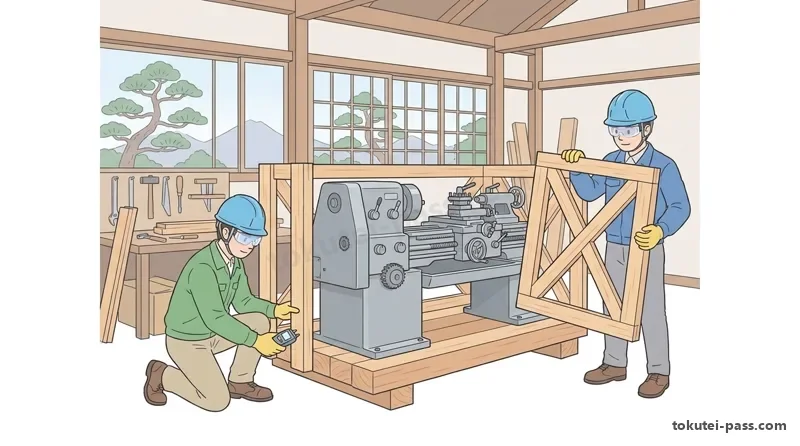
工業包装の木箱にはスギ・マツ・エゾマツなどの針葉樹材やラワン材が多く用いられます。木材は含水率が高いと乾燥収縮によって割れや反りが生じ、釘の保持力が低下し、内部の機械にさびを発生させるため、十分に乾燥させた木材(含水率15〜20%程度、JIS基準で20〜25%以下)を使用します。
Softwoods (such as cedar, pine, and spruce) and lauan lumber are widely used for industrial wooden boxes. Lumber with high moisture content shrinks as it dries, causing splitting and warping, losing nail-holding power, and promoting rust on enclosed machinery; therefore, properly seasoned lumber (moisture content around 15–20%, and 20–25% or less under JIS standards) must be used.
木材が乾燥するときの収縮率には異方性があり、年輪の接線方向(板目方向)が最も大きく、次いで半径方向(柾目方向)であり、繊維方向(長さ方向)が最も小さくなります。また、木材の欠点である「死に節(抜け節)」は周囲の組織と結合しておらず抜け落ちやすいため、「生き節」に比べて曲げ強さを大きく低下させます。
Wood shrinkage during drying is anisotropic: it is largest in the direction tangential to the annual rings (接線方向 / flat grain: 板目), followed by the radial direction (半径方向 / edge grain: 柾目), and smallest in the longitudinal fiber direction (繊維方向). Regarding wood defects, "dead knots" (死に節 / loose knots: 抜け節) are not intergrown with surrounding fibers and easily fall out, reducing bending strength far more severely than "live knots" (生き節).
合板(ベニヤ合板)は、薄い単板(ベニヤ)を繊維方向が互いに直交するように奇数枚(3枚・5枚など)張り合わせたもので、反りやひび割れが少なく方向による強度差が小さいのが特徴です。また補強用の角材は、断面積が同じであれば薄い板状よりも正方形に近い断面の方が多方向の曲げ荷重に対して折れにくくなります。
Plywood (合板) is made by gluing an odd number (3, 5, 7, etc.) of thin wood veneers (単板) together with their fiber directions perpendicular (90°) to each other, resulting in minimal warping or splitting and uniform strength across directions. For reinforcing lumber of equal cross-sectional area, a cross-section close to a square resists multi-directional bending loads much better than a thin flat board.
輸出用木箱等の無垢木材には、国際植物検疫措置基準(ISPM No.15)に基づく消毒処理とスタンプ押印が義務づけられています。熱処理(記号:HT)では「木材中心部温度56℃以上で30分間以上」の加熱を行います。一方、高温高圧で製造された合板やパーティクルボードのみの箱は検疫免除となります。
Solid wood used in export wooden boxes and pallets must undergo phytosanitary treatment and be stamped with an IPPC mark under the International Standards for Phytosanitary Measures (ISPM No.15) to prevent the spread of forest pests. Standard Heat Treatment (symbol: HT) requires heating the wood so that the "wood core temperature reaches 56°C or higher for at least 30 minutes". Packaging made solely of engineered wood processed under high heat and pressure—such as plywood, particle board, or OSB—is exempt.
Key points
- 木箱用木材は乾燥収縮・割れ・釘保持力低下・内部発錆を防ぐため、含水率15〜20%程度(JIS基準20〜25%以下)に乾燥させて使う
Lumber for wooden boxes must be seasoned to about 15–20% moisture content (JIS ≤ 20–25%) to prevent shrinkage splitting, nail loosening, and internal rust - 木材の収縮率は「接線方向(板目)>半径方向(柾目)>繊維方向」の順に大きく、「死に節」は曲げ強さを大きく低下させる
Wood shrinkage follows Tangential (flat grain) > Radial (edge grain) > Longitudinal fiber direction; dead knots severely reduce bending strength - 輸出用無垢木材のISPM No.15熱処理(HT)は「木材中心部温度56℃以上で30分間以上」であり、合板のみの外装は検疫免除となる
ISPM No.15 heat treatment (HT) for export solid wood requires a core temperature of ≥ 56°C for ≥ 30 minutes; all-plywood packaging is exempt
| Word | Meaning |
|---|---|
| 木材の含水率と乾燥収縮 | Wood moisture content and Drying shrinkage |
| 生き節と死に節(抜け節) | Live knots vs. Dead knots (loose knots) |
| 合板(単板の奇数枚直交張り) | Plywood (odd number of cross-laminated veneers) |
| 国際植物検疫措置基準(ISPM No.15) | International phytosanitary standard (ISPM No.15) |
| 熱処理(HT:中心部温度56℃以上・30分間以上) | Heat treatment (HT: core temperature ≥ 56°C for ≥ 30 min) |
3. 普通木箱(JIS Z 1402)と枠組箱(JIS Z 1403)の構造
3. Structure of Nailed Wooden Boxes (JIS Z 1402) and Framed Wooden Boxes (JIS Z 1403)
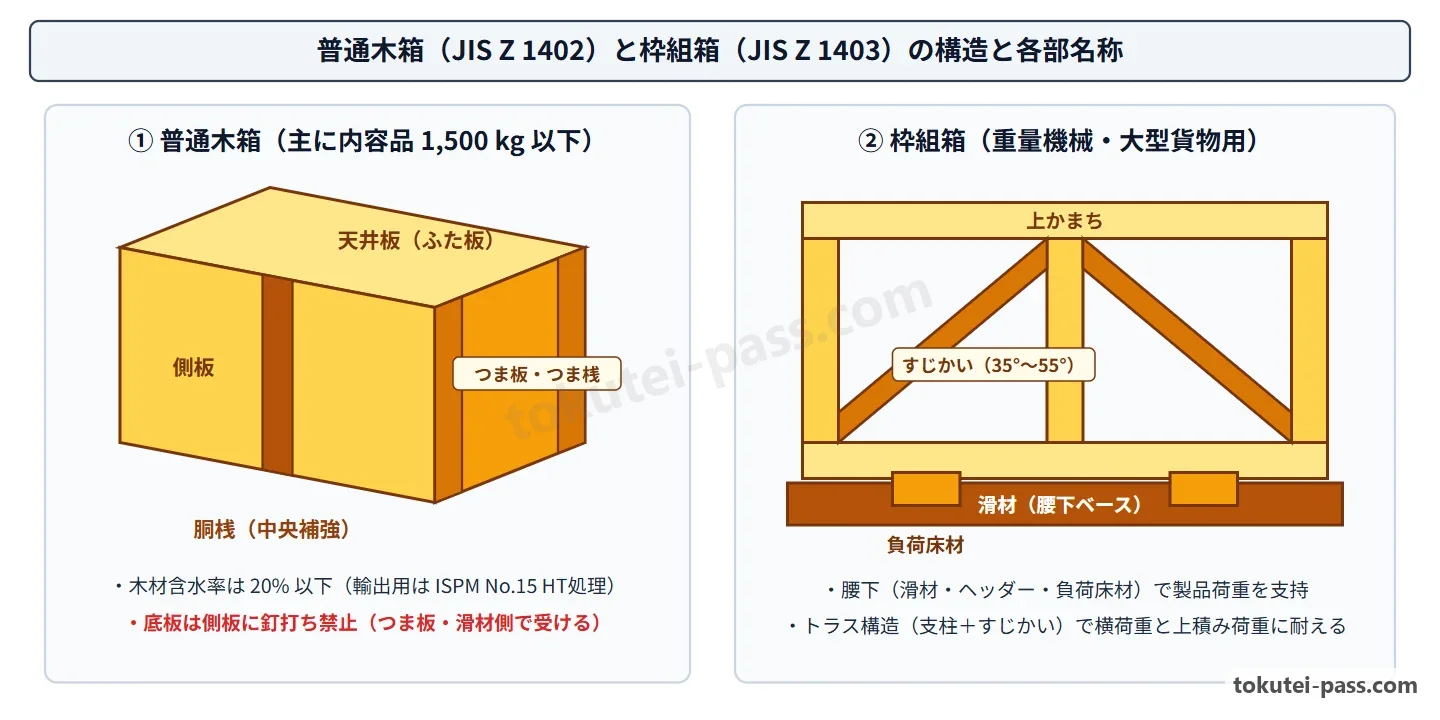
「普通木箱(JIS Z 1402)」は、内容品の質量が1,500 kg以下、内のり長さが4 m以下の貨物に用いる木箱です。板を隙間なく張る「密閉木箱」と隙間をあける「すかし木箱」があり、端面は「つま板・つま桟」、側面は「側板・胴桟」、上下は「天井板・底板」で構成されます。
A "nailed wooden box" (普通木箱: JIS Z 1402) is used mainly for cargo with a content mass of 1,500 kg or less and an internal length of 4 m or less. It includes "close-boarded boxes" (密閉木箱) with boards fitted tightly together and "slatted/crated boxes" (すかし木箱) with gaps between boards. The shorter ends consist of "end boards" (つま板) and "end cleats" (つま桟); the longer sides consist of "side boards" (側板) and "side cleats" (胴桟); the bottom is the "bottom board" (底板); and the top is the "top board" (天井板).
「枠組箱(JIS Z 1403)」は、頑丈な「腰下」の上にトラス構造の「側面・つま面・天井」を組む木箱で、重量機械や大型貨物に用います。腰下の最下部で床に接して縦に走る角材が「滑材」、その両端をつなぐ横材が「ヘッダー」、滑材の上に渡して製品荷重を直接支える部材が「負荷床材」です。
A "framed wooden box" (枠組箱: JIS Z 1403) assembles truss-framed "side panels", "end panels", and a "top panel" onto a heavy-duty "base" (腰下), and is used for heavy machinery and large cargo. In the base, the bottom-most longitudinal timbers contacting the floor are "skids" (滑材), the end cross-members joining the skids are "headers" (ヘッダー), and the crosswise timbers resting on top of the skids to directly support the product weight are "load-bearing floor members" (負荷床材).
枠組箱の側面パネルは、上下の横枠である「上かまち」「下かまち」、垂直の柱である「側支柱」、および横方向の力による変形を防ぐ斜め材「すじかい」で構成されます。すじかいの角度は、下かまちの水平面に対して「45°を標準(35°〜55°の範囲)」とします。
The side panel framework of a framed wooden box consists of horizontal "top frame members" (上かまち) and "bottom frame members" (下かまち), vertical "side struts" (側支柱), and diagonal "braces" (すじかい) that prevent lateral racking deformation. Diagonal braces are installed at a "standard angle of 45° (within 35° to 55°)" relative to the horizontal plane of the bottom frame member.
また、天井の荷重を支える「はり受け」を保持するため、側支柱の内側に添えて打ち付ける「そえ柱」の長さは、側支柱の長さの3分の2(2/3)以上とします。
In addition, "auxiliary posts / scabs" (そえ柱) nailed to the inside of the vertical side struts to support the ceiling "joist bearers" (はり受け) must have a length at least two-thirds (2/3) of the length of the side struts (側支柱).
Key points
- 「普通木箱(JIS Z 1402)」は内容品質量1,500 kg以下・内のり長さ4 m以下に用い、つま板・側板・底板・天井板で構成される
Nailed wooden boxes (JIS Z 1402) apply to cargo ≤ 1,500 kg and internal length ≤ 4 m, consisting of end boards, side boards, bottom boards, and top boards - 「枠組箱(JIS Z 1403)」の腰下は下から「滑材→負荷床材」の順に組み、滑材両端を「ヘッダー」で連結する
A framed wooden box base (JIS Z 1403) is stacked from the floor up as Skids (滑材) → Load-bearing floor members (負荷床材), with skid ends joined by headers - 枠組箱側面の「すじかい」は水平面に対し標準45°(35°〜55°)とし、はり受けを支える「そえ柱」は側支柱長さの2/3以上とする
Side diagonal braces (すじかい) are set at a standard 45° (35°–55°), and auxiliary posts (そえ柱) supporting joist bearers must be ≥ 2/3 of the side strut length
| Word | Meaning |
|---|---|
| 普通木箱(1,500 kg以下・内のり長さ4 m以下) | Nailed wooden box (≤ 1,500 kg, internal length ≤ 4 m) |
| つま板・つま桟・側板・胴桟 | End board / End cleat / Side board / Side cleat |
| 枠組箱の腰下(滑材・ヘッダー・負荷床材) | Framed box base (Skids / Headers / Load-bearing floor members) |
| 上かまち・下かまち・側支柱・すじかい(標準45°) | Top/Bottom frame members / Side struts / Diagonal braces (45°) |
| はり受けとそえ柱(側支柱長さの2/3以上) | Joist bearer and Auxiliary post (≥ 2/3 of side strut length) |
4. 釘打ち・ボルト締結のルールと木箱製作実技
4. Rules for Nailing, Bolting, and Wooden Box Fabrication Practice
木箱の板材と桟材(または合板と枠材)を重ねて釘を貫通させる「平打ち」では、作業台の上に木製敷板(または鉄板)を敷いて打ち、裏面に貫通して出た釘の先端を木材の繊維方向に沿って曲げて打ち込みます(打ち曲げ)。これにより高い保持力が得られ、釘先によるけがや製品損傷を防ぎます。
In "flat nailing / clinch nailing" (平打ち) where nails penetrate through overlapping plywood/sheathing and cleats, a wooden backing plate (木製敷板) is placed on the workbench during nailing, and the protruding nail tips on the back are bent (打ち曲げ: clinched) parallel to the "wood fiber direction" (繊維方向) and driven flush. This maximizes holding power and prevents protruding nail points from injuring workers or damaging cargo.
一方、板材を枠材や桟材の木口・側面に打ち付けて箱に組み立てる「組立て打ち」では、使用する釘の長さは打ち抜く板材の厚さの約2.5〜3倍を標準とします。木材の端(木口付近)に複数の釘を打つときは、木割れを防ぐため、木口から適度な距離をあけ、同じ木目線上を避けて「千鳥状(ジグザグ)」に配置します。
In "assembly nailing" (組立て打ち) where boards are nailed into the edges or ends of frame members/cleats to assemble a box, the standard nail length is 2.5 to 3 times the thickness of the board being penetrated. When driving multiple nails near the end of a board (木口), to prevent wood splitting (木割れ), leave proper distance from the board end and arrange nails in a "staggered pattern" (千鳥状: zig-zag) rather than along the same wood grain line.
普通木箱を組み立てる際、つり上げ時の底抜け事故を防ぐため、底板の下から側板の下端に向かって釘を打ってはなりません。側板を底板の側面まで下ろし、横方向から底板またはつま桟へ釘を打って荷重をせん断力で受ける構造にします。
When assembling a nailed wooden box, to prevent the bottom from dropping out (底抜け) when lifted, never drive nails upward from the bottom board into the bottom edge of the side board. Instead, extend the side board down past the edge of the bottom board and nail horizontally into the bottom board or end cleats so the nails carry shear load.
また、枠組箱の腰下で滑材とヘッダーや負荷床材をボルト締結する際は、ボルトの頭やナットが滑材の底面から下へ突出しないよう、滑材底面に「座ぐり(めくら穴加工)」を施してボルト頭を沈めます。
When bolting skids (滑材) to headers or load-bearing floor members in the base of a framed wooden box, machine recessed "counterbore holes" (座ぐり) into the bottom surface of the skids so that bolt heads or nuts sit recessed and never protrude below the underside of the skids.
Key points
- 貫通させた釘先を曲げる「平打ち」では、裏面に出た釘先を木材の「繊維方向」に沿って打ち曲げて埋め込む
In flat/clinch nailing (平打ち), protruding nail tips on the back face must be bent parallel to the wood fiber direction (繊維方向) and driven flush - 「組立て打ち」の釘長さは打ち抜く板厚の2.5〜3倍とし、木口付近では木割れ防止のため「千鳥状」に打つ
Assembly nails (組立て打ち) should be 2.5–3 times the penetrated board thickness and driven in a staggered pattern (千鳥状) near board ends to prevent splitting - 底抜け防止のため底板から側板への上向き釘打ちは厳禁であり、滑材底面のボルト頭は「座ぐり」で沈める
Never nail upward from the bottom board into the side board to prevent bottom drop-out; recess bolt heads on skid undersides using counterbore holes (座ぐり)
| Word | Meaning |
|---|---|
| 平打ちと釘先の打ち曲げ(繊維方向) | Flat nailing and Clinching nail tips (along fiber direction) |
| 組立て打ちの釘長さ(板厚の2.5〜3倍) | Assembly nailing length (2.5–3 times board thickness) |
| 木割れ防止の千鳥打ち(千鳥状配置) | Staggered nailing pattern to prevent wood splitting |
| 底抜け防止(底板から側板への釘打ち禁止) | Bottom drop-out prevention (no upward nailing from bottom board) |
| 滑材底面の座ぐり加工 | Counterboring on the bottom surface of skids |
5. 段ボール包装・パレット・フィルム包装
5. Corrugated Fiberboard Packaging, Pallets, and Film Wrapping
段ボールシート(JIS Z 1516)は、波形に成形した「中しん」と平らな板紙である「ライナ」を張り合わせた構造です。1枚の中しんと1枚のライナからなる「片面段ボール」(緩衝巻き用)、1枚の中しんと2枚のライナからなる「両面段ボール」、2層の中しんと3枚のライナからなる重量物用の「複両面段ボール」があります。
A corrugated fiberboard sheet (段ボールシート: JIS Z 1516) consists of wave-shaped fluted paper called "corrugating medium" (中しん) bonded to flat paperboard sheets called "liners" (ライナ). Major types include "single-faced corrugated board" (片面段ボール: 1 medium + 1 liner, used for cushioning wrap), "single-wall / double-faced board" (両面段ボール: 1 medium + 2 liners), and heavy-duty "double-wall board" (複両面段ボール: 2 mediums + 3 liners).
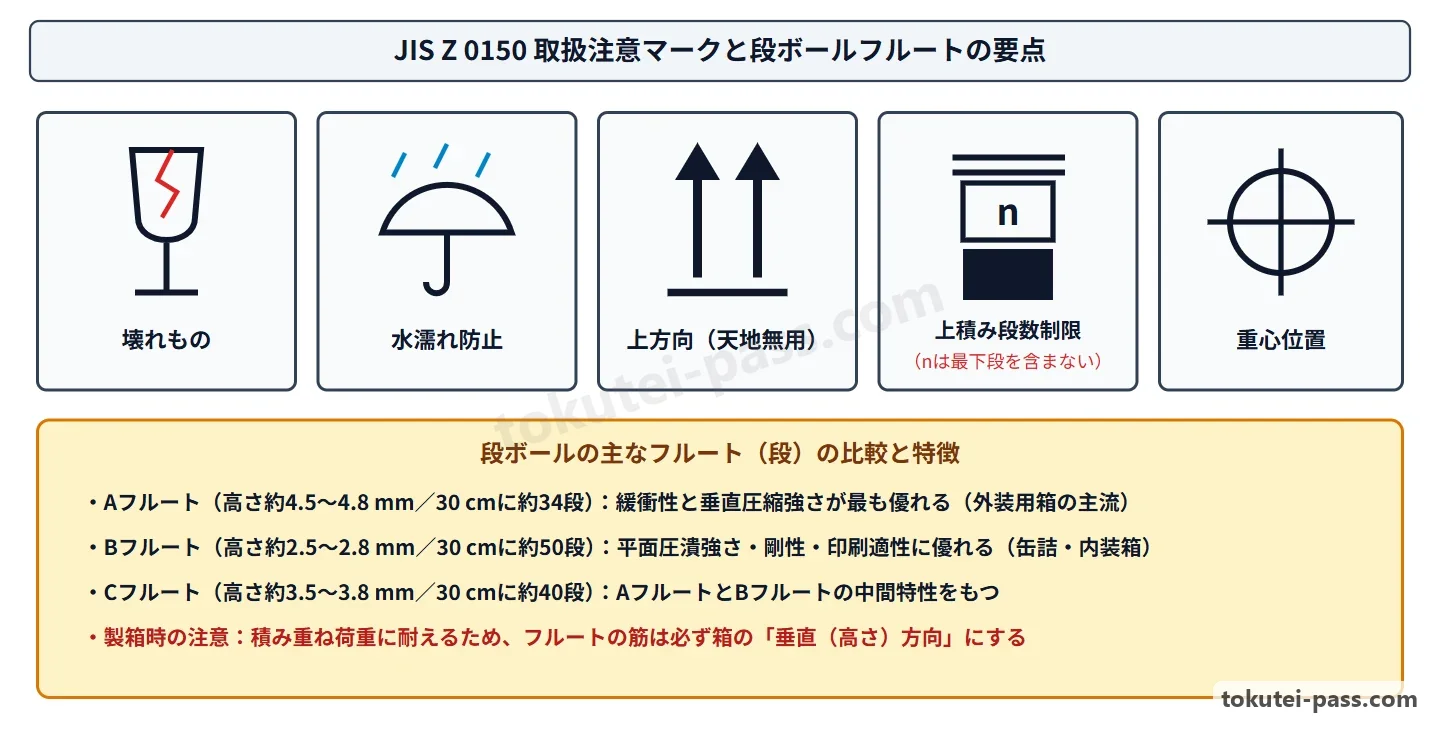
フルート(段)では、段高約4.5〜4.8 mm(30 cmに約34段)の「Aフルート」が緩衝性と垂直圧縮強さに優れ、段高約2.5〜2.8 mm(約50段)の「Bフルート」は平面圧縮に強い特徴があります。0201形箱ではフルートを必ず「垂直方向」にし、高湿度では圧縮強さが低下します。
Among flute (段) profiles, "A-flute" (flute height ~4.5–4.8 mm, ~34 flutes per 30 cm) excels in cushioning performance and vertical compressive strength, whereas "B-flute" (flute height ~2.5–2.8 mm, ~50 flutes per 30 cm) has superior flat crush resistance. In outer corrugated boxes (0201 type), flutes must always run in the "vertical direction" (垂直方向) to withstand stacking loads (上積み荷重). Because paper absorbs moisture, high relative humidity causes a sharp drop in box compressive strength.
0201形段ボール箱を組み立てるときは、先に短い「内フラップ」を折り、次に長い「外フラップ」を閉じて粘着テープで封かんし、テープの両端は側面へ50〜70 mm程度折り返して貼ります。また、PPバンドや帯鉄を掛ける際は、角がつぶれて裂けないよう適切な張力で締め、必要に応じて「当て板(コーナープロテクタ)」を使用します。
When assembling a 0201-type corrugated box, fold the shorter "inner flaps" (内フラップ) first, then close the longer "outer flaps" (外フラップ) and seal the seam with adhesive tape extending about 50–70 mm down the end panels. When applying PP bands or steel strapping, tension properly and use "corner protectors" (当て板) so box edges do not crush or tear.
JIS規格(JIS Z 0161)の一貫輸送用平パレット(T11形)の標準平面寸法は「1,100 mm × 1,100 mm」です。箱はパレットの縁からはみ出さないように積み、伸縮性のある「ストレッチフィルム」で巻くか、加熱収縮する「シュリンクフィルム」で密着固定して荷崩れを防ぎます。
Japan's standard flat pallet for through-transit under JIS Z 0161 is the "T11-type pallet" with plan dimensions of "1,100 mm × 1,100 mm". When palletizing boxes, stack them flush within the pallet edges without overhang, and unitize the load with elastic "stretch film" or heat-contracting "shrink film" to prevent load collapse (荷崩れ).
Key points
- 段ボールは「ライナ」と波形の「中しん」からなり、Aフルートは緩衝性・垂直圧縮強さに優れ、Bフルートは平面圧縮に強い
Corrugated fiberboard consists of liners and fluted medium; A-flute excels in cushioning and vertical compression, while B-flute resists flat crush - 0201形段ボール箱のフルートは「垂直方向」とし、組み立ては「内フラップ→外フラップ」の順に折り、高湿度下では強度が低下する
Flutes in 0201 boxes must run vertically (垂直方向), folding inner flaps first then outer flaps; high humidity sharply reduces box compressive strength - JIS一貫輸送用平パレット(T11形)の標準寸法は「1,100 mm × 1,100 mm」であり、はみ出し積みを避けてフィルムで固定する
Standard JIS T11 flat pallets measure 1,100 mm × 1,100 mm; stack boxes without overhang and unitize with stretch film or heat-shrink film
| Word | Meaning |
|---|---|
| ライナと中しん(両面・複両面段ボール) | Liner and Corrugating medium (Single-wall / Double-wall board) |
| AフルートとBフルート・垂直方向 | A-flute vs. B-flute / Vertical flute orientation |
| 内フラップ・外フラップと封かん | Inner flaps / Outer flaps and Box sealing |
| T11形平パレット(1,100 mm × 1,100 mm) | T11-type standard flat pallet (1,100 mm × 1,100 mm) |
| ストレッチフィルムとシュリンクフィルム | Stretch film and Shrink film |
6. 防錆包装(JIS Z 0303)と防湿包装(JIS Z 0301)
6. Rust-Preventive Packaging (JIS Z 0303) and Moisture-Proof Packaging (JIS Z 0301)
鉄鋼部品の表面に水分(湿気)と酸素が同時に作用すると酸化反応によりさび(腐食)が発生します。特に海上輸送用の密閉型ドライコンテナは昼夜の激しい温湿度変化で結露が発生しやすいため、厳重な防錆・防湿対策が不可欠です。
When moisture (humidity) and oxygen act simultaneously on steel parts, oxidation causes rust (corrosion). Closed dry marine containers experience severe day-night temperature swings during ocean transport that cause heavy condensation (container sweat), making thorough rust-preventive and moisture-proof packaging essential.
防錆包装では部品を洗浄・完全乾燥させてから防錆処理を行います。素手で触れると汗の塩分等でさびが生じるため必ず手袋を着用します。気化性さび止め紙(VCI紙)は、常温で気化した防錆成分が金属表面に吸着被膜を作るよう、薬品塗布面を製品側に向けて近づけ、外気を遮断して密封します。
In rust-preventive packaging, metal parts are first cleaned of machining chips and oil, thoroughly dried, and treated with rust preventives. Workers must wear gloves and never touch cleaned parts with bare hands, as salt and moisture in human sweat cause fingerprint rust. When using volatile corrosion inhibitor paper (VCI paper: 気化性さび止め紙), face the chemical-coated side toward the metal surface at close range and seal the package to block outside air so the VCI vapor forms a protective film over all details.
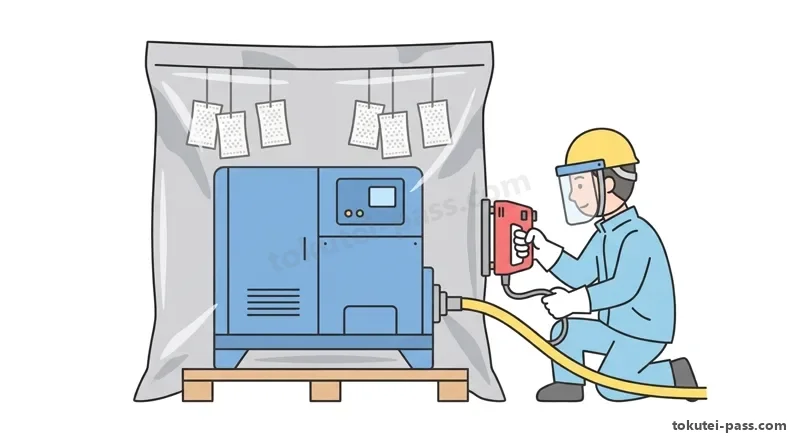
防湿包装では、水蒸気透過度が極めて低い「アルミ箔ラミネート防湿バリヤ袋」などの内部に製品と「乾燥剤(シリカゲル)」を封入し、袋の口にしわや隙間ができないよう「ヒートシール(熱溶着)」で完全に密封します。
In moisture-proof packaging, the product and "desiccant" (乾燥剤: silica gel) are enclosed inside an "aluminum-foil laminated moisture-proof barrier bag" (アルミ防湿バリヤ袋) with an extremely low water vapor transmission rate, and the bag opening is hermetically sealed by "heat sealing" (ヒートシール) without any wrinkles or gaps.
シリカゲルは外気に触れると直ちに湿気を吸うため、保管容器はすぐに密閉し手早く封かんします。青色のインジケータ付きシリカゲル(青ゲル)が吸湿して「ピンク色(淡赤色)」に変色していた場合は、除湿能力が低下しているため新しい乾燥剤と交換して再密封します。
Because silica gel absorbs moisture immediately upon exposure to outside air, reseal its storage container right away and seal the barrier bag quickly. If blue indicator silica gel (青ゲル) has absorbed moisture and turned "pink (light red)", its dehumidifying capacity is exhausted and it must be replaced with fresh desiccant before resealing.
Key points
- 防錆包装では洗浄・完全乾燥後の金属部品への「素手接触」を厳禁とし、VCI紙は薬品塗布面を製品側に向けて密封する
In rust-preventive packaging, never touch cleaned metal parts with bare hands; face the chemical-coated side of VCI paper toward the product and seal - 防湿包装では水蒸気透過度の低い「アルミ箔ラミネート防湿バリヤ袋」に乾燥剤(シリカゲル)を封入してヒートシールする
In moisture-proof packaging, enclose the item and silica gel desiccant inside an aluminum-foil laminated barrier bag and hermetically heat-seal it - 青色インジケータ付きシリカゲルが「ピンク色(淡赤色)」に変色していたら吸湿済みのため、新品の乾燥剤と交換する
When blue indicator silica gel turns pink (light red), its moisture-absorbing capacity is exhausted and it must be replaced with fresh desiccant
| Word | Meaning |
|---|---|
| 洗浄・乾燥と素手接触禁止 | Cleaning, drying, and Prohibition of bare-hand contact |
| 気化性さび止め剤(VCI)・気化性さび止め紙 | Volatile Corrosion Inhibitor (VCI) / VCI paper |
| アルミ防湿バリヤ袋(水蒸気透過度) | Aluminum moisture-proof barrier bag (low WVTR) |
| ヒートシール(熱溶着) | Heat sealing (thermal welding) |
| シリカゲル乾燥剤(青色→吸湿後ピンク色) | Silica gel desiccant (Blue when dry → Pink when saturated) |
7. 緩衝包装・製品固定・防水施工
7. Cushioning Packaging, Product Blocking/Bracing, and Waterproofing
緩衝包装は、輸送や荷役中の落下衝撃や振動を緩衝材の変形によって吸収し、製品に伝わる加速度(G)を製品の許容値以下に抑えるために行います。設計手法には、製品全面を包む「全面緩衝包装」、角や縁にパッドを当てる「部分緩衝包装(コーナーパッドなど)」、ばねやベルトで宙吊りにする「サスペンション包装」があります。
Cushioning packaging absorbs drop shocks and transport vibrations through deformation of cushioning materials to keep peak acceleration (G) transmitted to the product at or below its allowable fragility limit. The three primary methods are "Full-surface cushioning" (全面緩衝包装: covering all faces), "Partial cushioning" (部分緩衝包装: corner/edge pads), and "Suspension packaging" (サスペンション包装: suspending the item with springs or straps).
気泡緩衝シート(エアキャップ)や発泡ポリエチレン(EPE)は柔軟性と復元力に優れます。一方、発泡ポリスチレン(EPS)は硬質で、大きな繰り返し衝撃で気泡がつぶれると元の厚さに100%は回復しません。また受圧面積が狭すぎると緩衝材が完全につぶれる「底づき」を起こすため適正面積を確保します。
Air bubble sheets (bubble wrap) and expanded polyethylene (EPE) foam offer high flexibility and elastic recovery against repeated shocks. By contrast, expanded polystyrene (EPS / Styrofoam) is a rigid foam whose cells crush plastically under heavy or repeated drop impacts and do not recover 100% of their original thickness. Furthermore, making the load-bearing area too small causes "bottoming out" (底づき: complete compression of the cushion), transmitting high shock directly to the product.
木箱内部での製品固定では、重量機械は腰下にアンカーボルトで隙間なく確実に締結し緩み止めを施します。さらに横滑りを防ぐ「根止め材」や浮き上がりを防ぐ「押さえ材」を配置します。押さえ材は薄い板金カバーではなく強度のあるフレーム部に当て、塗装面との間にフェルトやゴム板等の「当て材」を挟んで傷つきを防ぎます。
To secure machinery inside a wooden box, heavy machines are firmly bolted to the base with anti-loosening hardware, supplemented by "base blocking cleats" (根止め材) against lateral sliding and "hold-down braces" (押さえ材) against vertical lifting. Hold-down braces must press against rigid structural frame sections (never thin sheet-metal covers) with protective pads (当て材 such as felt or rubber sheets) interposed to prevent paint scratches.
外装木箱の内部防水では、天井面や側面からの雨水・結露水の滴下を防ぐため、製品の上部から側面へ防水紙やシートを屋根(傘)のようにかぶせる「シェッド張り(傘掛け防水法)」を行います。底面を防水紙で密閉すると内部に水が溜まるため、底面は通気・水抜きができるようにします。
For internal waterproofing of outer wooden boxes, waterproof paper or plastic sheeting is draped like a roof/umbrella over the top and upper sides of the machine to shed rainwater and condensation drips—a method called the "Shed method" (シェッド張り / 傘掛け防水法). The bottom board is never sealed watertight so any water can drain out.
Key points
- 緩衝材では発泡ポリエチレン(EPE)は復元力に優れ、硬質の発泡ポリスチレン(EPS)は大衝撃で気泡がつぶれると元に戻らない
Expanded polyethylene (EPE) has high elastic recovery, whereas rigid expanded polystyrene (EPS) crushes permanently under heavy repeated impacts - 木箱内固定ではアンカーボルト・根止め材・押さえ材を用い、押さえ材は当て材を介して強度のあるフレーム部に当てる
Secure machinery inside wooden boxes using anchor bolts, base blocking cleats, and hold-down braces pressing against rigid frames via protective pads - 外装木箱内部で製品上部に屋根状(傘状)に防水紙やシートをかぶせる防水法を「シェッド張り」といい、底面は密閉しない
Draping waterproof sheeting like a roof over machinery inside a crate is called the Shed method (シェッド張り), leaving the bottom open for drainage
| Word | Meaning |
|---|---|
| 全面緩衝・部分緩衝・サスペンション包装 | Full-surface / Partial / Suspension cushioning |
| 発泡ポリエチレン(EPE)と発泡ポリスチレン(EPS) | Expanded polyethylene (EPE) vs. Expanded polystyrene (EPS) |
| 受圧面積と底づき(ボトミング) | Load-bearing area and Bottoming out |
| 根止め材・押さえ材・当て材 | Base blocking cleats / Hold-down braces / Protective pads |
| シェッド張り(傘掛け防水法) | Shed lining method (umbrella/canopy waterproofing) |
8. 貨物取扱注意マーク(JIS Z 0150)とシッピングマーク
8. Cargo Handling Attention Marks (JIS Z 0150) and Shipping Marks
包装貨物の外装には、言葉が通じない海外の荷役現場でも取扱方法が直感的に分かるよう、JIS Z 0150(ISO 780対応)の図記号「取扱注意マーク(ケアマーク・指示マーク)」を表示します。
Graphical symbols specified in JIS Z 0150 (aligned with ISO 780), called "cargo handling attention marks / care marks" (取扱注意マーク), are stenciled on outer packages so cargo handlers worldwide can intuitively understand proper handling regardless of language.
2本の上向き矢印は「天地無用」、傘は「水ぬれ防止」、グラスは「壊れもの注意」、十字と円は「重心位置」、鎖は「つり位置」、フックに斜線は「手鉤使用禁止」です。偏重心の機械は実際の重心位置に表示し、手鉤禁止マークの貨物には木箱でも手鉤を使ってはなりません。
Key symbols include: two upward arrows for "This way up" (天地無用); an umbrella for "Keep dry" (水ぬれ防止); a wine glass for "Fragile, handle with care" (壊れもの注意); a crosshair circle for "Center of gravity" (重心位置); a chain for "Sling here" (つり位置); and a crossed-out hook for "Use no hooks" (手鉤使用禁止). For asymmetrical machinery, mark the actual center of gravity rather than the geometric center of the box; never use hand hooks on any package bearing the "Use no hooks" mark.
輸出貨物の側面に刷り込む「シッピングマーク(荷印)」には、荷受人略号(メインマーク)、仕向地(ポートマーク)、ケースナンバー(例:C/NO. 3/10=全10箱中3箱目)、総質量(G/W)、純質量(N/W)、寸法、原産国を正確に記載します。
Export "shipping marks" (荷印) stenciled on the side of crates include the consignee abbreviation (Main mark), destination port (Port mark / 仕向地), Case Number (e.g., C/NO. 3/10 = Box 3 of 10), Gross Weight (G/W), Net Weight (N/W), crate dimensions (L×W×H), and Country of Origin (e.g., MADE IN JAPAN).
Key points
- JIS Z 0150の取扱注意マーク:上向き2矢印=天地無用、傘=水ぬれ防止、グラス=壊れもの注意、フック斜線=手鉤使用禁止
JIS Z 0150 marks: Two upward arrows = This way up; Umbrella = Keep dry; Wine glass = Fragile; Crossed-out hook = Use no hooks - 十字と円は「重心位置」(偏重心貨物は実際の重心位置に表示)、鎖マークはクレーンワイヤーを掛ける「つり位置」を示す
Crosshair circle = Center of gravity (marked at actual center of gravity); Chain symbol = Sling here (where crane wire ropes are placed) - 輸出用シッピングマークにはメインマーク、仕向地、ケースナンバー(C/NO. 3/10=10箱中3箱目)、G/W・N/W、寸法、原産国を記す
Export shipping marks include Main mark, Port mark, Case No. (C/NO. 3/10 = Box 3 of 10), G/W, N/W, Dimensions, and Country of Origin
| Word | Meaning |
|---|---|
| 取扱注意マーク(JIS Z 0150) | Cargo handling attention marks (JIS Z 0150) |
| 天地無用・水ぬれ防止・壊れもの注意 | This way up / Keep dry / Fragile |
| 重心位置・つり位置・手鉤使用禁止 | Center of gravity / Sling here / Use no hooks |
| シッピングマーク(メインマーク・仕向地・ケースナンバー) | Shipping mark (Main mark, Port mark, Case number) |
9. 工具の取扱い・安全衛生・包装貨物試験
9. Tool Handling, Occupational Safety, and Package Testing
木材切断用の丸のこ盤やボール盤などの回転刃物機械を使用する際は、繊維が巻き込まれるのを防ぐため「軍手の着用は厳禁」であり、刃の接触予防装置(安全カバー)や反発予防装置(割刃)を絶対に取り外してはなりません。また、曲尺やコンベックスルールなどの測定工具は精度が命であり、落としたり金槌代わりに使ったりしてはなりません。
When operating rotating cutting machinery such as circular saws (丸のこ盤) or drill presses (ボール盤), "wearing knitted cotton gloves (軍手) is strictly prohibited" to prevent entanglement, and the blade safety guard (接触予防装置) and riving knife / anti-kickback splitter (割刃 / 反発予防装置) must never be removed. Precision measuring tools such as carpenter's squares (曲尺) and convex tape rules must never be dropped, stepped on, or used as hammers.
エアネイラ使用時は保護めがねを着用し、打つ時以外は引き金に指を掛けず、コンタクトアーム(安全装置)を無効化してはなりません。添え手を十分離し、釘補充や詰まり除去時は必ずエアホースを外します。帯鉄切断時は端を押さえて専用カッタで切り、抜いた古釘や切れ端は踏み抜き防止のため直ちに回収します。
When using a pneumatic nailer (エアネイラ), wear safety glasses, keep your finger off the trigger until nailing, never tie back the contact arm safety device, keep your supporting hand well away from the nailing point in case a nail deflects off a knot, and always disconnect the air hose before loading nails or clearing jams. Wear safety glasses and gloves when cutting tensioned steel strapping (帯鉄) while holding down the band, and immediately collect pulled nails and strap offcuts to prevent foot puncture injuries (踏み抜き).
重量物を人力で持ち上げる際は、荷物に体を近づけ膝を曲げて腰を落とし、脚の力で立ち上がります。最大荷重1トン以上のフォークリフト運転やつり上げ荷重1トン以上の玉掛け作業には技能講習資格が必要であり、玉掛け時は「つり位置マーク」にワイヤロープを掛け、「地切り」で安全を確認します。
When lifting heavy loads manually, stand close to the load, bend your knees, lower your hips, and lift with your leg muscles to prevent lower back pain. Operating a forklift (maximum load ≥ 1 t) or crane slinging (玉掛け: lifting capacity ≥ 1 t) requires an official Skill Training qualification; during slinging, hook wire ropes at the "Sling here marks" and lift slightly off the ground first (地切り) to check balance.
完成した包装貨物は、寸法・釘打ち・バンド張力・荷印の誤記などを最終検査します。また包装設計の評価にはJIS Z 0200・JIS Z 0202の振動試験や落下試験が用いられ、落下姿勢には底面が平行に落ちる「面落下」、辺から落ちる「稜落下」、頂点から落ちる「角落下」の3種類があります。
Completed packages undergo final inspection for dimensions, nailing/bolting, strap tension, and marking accuracy. Packaging designs are evaluated under JIS Z 0200 / JIS Z 0202 using vibration tests and drop tests in three orientations: "Flat drop" (面落下: landing flat on a face), "Edge drop" (稜落下: landing on an edge line), and "Corner drop" (角落下: landing on a single corner vertex).
Key points
- 丸のこ盤・ボール盤等の回転刃物機械では巻き込まれ防止のため「軍手着用厳禁」であり、安全カバーや割刃を外してはならない
Never wear knitted cotton gloves (軍手) when operating rotating machinery like circular saws or drill presses, and never remove blade guards or riving knives - エアネイラはコンタクトアームを無効化せず、釘補充や釘詰まり除去時には必ず「エアホースを外して」空気圧を遮断する
Never disable a pneumatic nailer's contact arm safety, and always disconnect the air hose before loading nails or clearing jammed nails - 1トン以上のフォークリフト・玉掛けは技能講習資格が必要であり、落下試験(JIS Z 0202)には面落下・稜落下・角落下の3姿勢がある
Forklift operation and crane slinging ≥ 1 t require Skill Training certificates; drop tests (JIS Z 0202) cover flat drop, edge drop, and corner drop
| Word | Meaning |
|---|---|
| 回転刃物の軍手禁止・安全カバーと割刃 | No cotton gloves on rotating saws / Blade guard & Riving knife |
| エアネイラの安全作業(コンタクトアーム・エアホース離脱) | Pneumatic nailer safety (Contact arm & Disconnect air hose) |
| フォークリフト・玉掛け技能講習と地切り確認 | Forklift & Crane slinging qualification (≥ 1 t) and Ground-clearance check |
| 落下試験(面落下・稜落下・角落下) | Drop test orientations (Flat drop / Edge drop / Corner drop) |
10. 試験対策の急所(重要数値・比較まとめ)
10. Exam Preparation Essentials (Key Numbers & Common Traps)
【重要数値】① 普通木箱(JIS Z 1402):内容品1,500 kg以下、内のり長さ4 m以下。② 枠組箱(JIS Z 1403):すじかい角度45°(35°〜55°)、そえ柱長さは側支柱の2/3以上、腰下は下から「滑材→負荷床材」。③ 組立て釘長さ:板厚の2.5〜3倍(平打ちは繊維方向に打ち曲げ)。
【Essential JIS Numbers】 ① Nailed wooden box (JIS Z 1402): content mass ≤ 1,500 kg, internal length ≤ 4 m. ② Framed wooden box (JIS Z 1403): diagonal brace (すじかい) angle = standard 45° (35°–55°); auxiliary post (そえ柱) length ≥ 2/3 of side strut; base order from floor up = "Skids (滑材) → Load-bearing floor members (負荷床材)". ③ Assembly nail length: 2.5–3× board thickness (flat nailing 平打ち clinches protruding nail tips along the wood grain).
【検疫・パレット・段ボール】① ISPM No.15熱処理(HT):木材中心部温度56℃以上で30分間以上(合板等は免除)。② T11形平パレット:1,100 mm×1,100 mm。③ 段ボール:Aフルートは緩衝性・垂直圧縮強さ大、フルートは垂直方向、0201形は「内フラップ→外フラップ」の順に折る。
【Quarantine, Pallets & Corrugated Board】 ① ISPM No.15 heat treatment (HT): wood core temperature ≥ 56°C for ≥ 30 min (plywood is exempt). ② Standard T11 flat pallet: 1,100 mm × 1,100 mm. ③ Corrugated board: A-flute has superior cushioning and vertical compression; flutes in 0201 boxes must run vertically (垂直); fold "inner flaps first → outer flaps second".
【防錆防湿・防水・安全】① 防錆:素手接触厳禁、VCI紙は塗布面を製品側へ。② 防湿:青色シリカゲルがピンク色に変色したら吸湿のため新品交換。③ 防水:屋根型にかぶせる防水は「シェッド張り」。④ 安全:丸のこ盤は軍手禁止、エアネイラ詰まり確認時はエアホースを外す。
【Rust/Moisture, Waterproofing & Safety】 ① Rust prevention: Never touch cleaned metal with bare hands; face VCI paper's coated side toward the product. ② Moisture protection: blue silica gel turning pink means it is saturated and must be replaced. ③ Roof-like internal waterproofing over machinery is called the "Shed method" (シェッド張り). ④ Safety: Never wear cotton gloves (軍手) on circular saws; disconnect the air hose before clearing a pneumatic nailer jam.
Key points
- 木箱数値:普通木箱=1,500 kg以下・内のり4 m以下/枠組箱すじかい=標準45°(35°〜55°)・そえ柱=側支柱の2/3以上/組立て釘長さ=板厚の2.5〜3倍
Wooden box figures: Nailed box ≤ 1,500 kg & ≤ 4 m / Framed box diagonal brace = 45° (35°–55°), auxiliary post ≥ 2/3 of side strut / Assembly nail = 2.5–3× board thickness - 検疫・段ボール・パレット:ISPM No.15熱処理(HT)=中心温度56℃以上・30分以上/T11形パレット=1,100×1,100 mm/0201形箱=フルート垂直・内フラップが先
Quarantine, Corrugated & Pallet: ISPM No.15 HT = core ≥ 56°C for ≥ 30 min / T11 pallet = 1,100×1,100 mm / 0201 box = vertical flutes, fold inner flaps first - 防錆防湿・安全:素手接触禁止・VCI塗布面は製品側/シリカゲル青→ピンク変色で交換/シェッド張り=屋根型防水/丸のこ軍手禁止・ネイラはホース外し
Rust/Moisture & Safety: No bare hands, VCI coated side toward item / Replace blue silica gel when pink / Shed lining = roof-like waterproofing / No cotton gloves on saws, disconnect nailer air hose
| Word | Meaning |
|---|---|
| 普通木箱(1,500 kg・4 m)と枠組箱(すじかい45°) | Nailed box (1,500 kg / 4 m) & Framed box (45° diagonal brace) |
| ISPM No.15(HT:56℃・30分)とT11形(1,100×1,100 mm) | ISPM No.15 (HT: 56°C / 30 min) & T11 pallet (1,100×1,100 mm) |
| 青ゲル(乾燥)→ ピンク色(吸湿後交換) | Blue silica gel (dry) → Pink (saturated, replace immediately) |
Industrial packaging (wooden crates, cartons, rust and moisture proofing, cushioning, marks)
Practice this chapter in the appOfficial references
- 製造分野特定技能1号評価試験(経済産業省・JAIM) — https://www.jaim-skill.or.jp/exam/about-ssw1/
- 技能検定 工業包装 試験問題・試験基準(中央職業能力開発協会 JAVADA) — https://www.javada.or.jp/jigyou/gino/giken/