
Human Relations and Communication (Part A - Subject Group 3)
人間関係とコミュニケーション(Aパート・科目群③)
National Exam for Certified Care Workers 介護福祉士 · 介護福祉士国家試験(筆記) · Written by Tokutei Pass based on the official study texts; not copied verbatim.
人間関係の形成と自己覚知・ジョハリの窓
Building Human Relationships, Self-Awareness, and the Johari Window
介護福祉職が利用者と信頼関係(ラポール)を築くためには、まず他者への先入観や偏見、目立つ特徴に評価が引きずられる「ハロー効果」などに気づくことが大切です。
For care welfare professionals to build a relationship of trust (rapport) with users, it is first important to recognize preconceptions, prejudices, and the 'halo effect'—where an overall evaluation of a person is biased by one prominent trait.
自分自身の性格・価値観・感情のクセ・偏見などを客観的に見つめ直して理解することを「自己覚知」といい、専門職として利用者をありのままに受け止めるための出発点となります。
Objectively reflecting on and understanding one's own personality, values, emotional habits, and biases is called 'self-awareness (jikokakuchi),' which serves as the starting point for accepting users as they are.
心理学者のジョセフ・ルフトとハリー・インガムが提唱した「ジョハリの窓」は、自己理解と対人関係を4つの領域で説明するモデルです。
The 'Johari Window,' proposed by psychologists Joseph Luft and Harry Ingham, explains self-understanding and interpersonal relationships through four quadrants.
自分も他人も知っている「開放の窓」、自分は気づかず他人が知っている「盲点の窓」、自分だけ知っていて他人が知らない「秘密の窓」、双方とも知らない「未知の窓」の4領域があります。
These four areas are the 'Open area' (known to self and others), 'Blind area' (unknown to self but known to others), 'Hidden area' (known only to self), and 'Unknown area' (unknown to both).
自分の考えや気持ちを適切に伝える「自己開示」によって秘密の窓を狭め、他者からの助言(フィードバック)を受け入れて盲点の窓を減らすことで、「開放の窓」が広がり自己覚知が深まります。
By appropriately sharing one's thoughts and feelings ('self-disclosure') to narrow the Hidden area and accepting advice ('feedback') from others to reduce the Blind area, the 'Open area' expands and self-awareness deepens.
Key points
- 自分自身の価値観や感情の傾向・偏見を客観的に理解することを「自己覚知」という
Objectively understanding one's own values, emotional tendencies, and biases is called 'self-awareness (jikokakuchi)' - 「ジョハリの窓」は開放の窓・盲点の窓・秘密の窓・未知の窓の4領域で構成される
The 'Johari Window' consists of four quadrants: Open, Blind, Hidden, and Unknown - 適切な自己開示と他者からのフィードバックによって「開放の窓」を広げると円滑な関係が築ける
Expanding the 'Open window' through appropriate self-disclosure and feedback from others builds smooth relationships
| Word | Meaning |
|---|---|
| 自己覚知 | self-awareness (jikokakuchi) |
| ジョハリの窓(開放・盲点・秘密・未知) | Johari Window (Open, Blind, Hidden, Unknown) |
| ハロー効果と先入観 | halo effect and preconceptions |
| ラポール(信頼関係) | rapport (relationship of trust) |
欲求不満・防衛機制とストレスコーピング
Frustration, Defense Mechanisms, and Stress Coping
欲求が障害に阻まれて満たされない状態を「欲求不満(フラストレーション)」といい、2つ以上の相反する欲求の間で迷う状態を「葛藤(コンフリクト)」といいます。
A state in which desires are blocked by obstacles and left unfulfilled is called 'frustration,' while a state of wavering between two or more conflicting desires is called 'conflict.'
強い不安や欲求不満から心の安定(自我)を無意識に守ろうとする心理的な働きを「防衛機制」といいます。代表的なものに、もっともらしい理由をつける「合理化」や、本心と逆の態度をとる「反動形成」があります。
Unconscious psychological processes that protect mental stability (the ego) from intense anxiety or frustration are called 'defense mechanisms.' Typical examples include 'rationalization' (making up plausible excuses) and 'reaction formation' (acting opposite to one's true feelings).
また、嫌な記憶を無意識に閉じ込める「抑圧」、幼い頃の行動に戻る「退行」、自分の嫌いな感情を相手が持っているとみなす「投影」、社会的に価値ある活動へ転化する「昇華」などもよく問われます。
Other frequently tested mechanisms include 'repression' (unconsciously locking away painful memories), 'regression' (returning to childish behavior), 'projection' (attributing one's own unacceptable feelings to others), and 'sublimation' (channeling impulses into socially valuable activities).
ストレスへの意図的な対処法である「ストレスコーピング(ラザルス)」には、ストレッサー自体を解決・軽減する「問題焦点型コーピング」と、誰かに話したり気分転換したりして感情を和らげる「情動焦点型コーピング」があります。
Intentional strategies for dealing with stress, known as 'stress coping (Lazarus),' are divided into 'problem-focused coping' (directly solving or reducing the stressor itself) and 'emotion-focused coping' (talking to someone or refreshing oneself to ease emotional distress).
たとえば業務量が多すぎるときに上司と相談して業務分担を見直すのは「問題焦点型」、休日に音楽を聴いたり同僚に悩みを聴いてもらったりして気持ちを整理するのは「情動焦点型」にあたります。
For example, consulting a supervisor to review workload distribution when overburdened is 'problem-focused coping,' whereas listening to music on a day off or sharing worries with a colleague to sort out feelings is 'emotion-focused coping.'
Key points
- 防衛機制は無意識に自我を守る働きであり、合理化・反動形成・抑圧・退行・投影・昇華などがある
Defense mechanisms unconsciously protect the ego and include rationalization, reaction formation, repression, regression, projection, and sublimation - 問題そのものに働きかけて解決を図る対処法を「問題焦点型コーピング」という
Coping that directly addresses and resolves the problem itself is called 'problem-focused coping' - 感情の表出やリフレッシュにより辛い気持ちを和らげる対処法を「情動焦点型コーピング」という
Coping that eases painful feelings through emotional expression or relaxation is called 'emotion-focused coping'
| Word | Meaning |
|---|---|
| 防衛機制(合理化・反動形成・退行・投影・昇華) | defense mechanisms (rationalization, reaction formation, regression, projection, sublimation) |
| フラストレーション(欲求不満)と葛藤 | frustration and conflict |
| 問題焦点型コーピング | problem-focused coping |
| 情動焦点型コーピング | emotion-focused coping |
援助関係形成の原則(バイステックの7原則)
Principles of Forming Helping Relationships (Biestek's Seven Principles)
アメリカの社会福祉学者バイステックは、援助専門職がクライエント(利用者)と良好な援助関係を築くための基本姿勢を「バイステックの7原則」としてまとめました。
American social work scholar Felix Biestek summarized the fundamental professional attitudes for building a sound helping relationship with clients (users) into 'Biestek's Seven Principles.'
第1の「個別化」は利用者を唯一無二の個人としてとらえること、第2の「意図的な感情表出」は怒りや悲しみなどの負の感情も含めて自由に表現できるよう促すことです。
The first principle, 'Individualization,' is viewing each user as a unique person; the second, 'Purposeful expression of feelings,' is encouraging users to freely express their feelings, including negative emotions like anger or sadness.
第3の「統制された情緒的関与」は援助者自身が感情に巻き込まれず自覚的に共感すること、第4の「受容」は利用者のありのままを受け止めること、第5の「非審判的態度」は善悪の評価や批判をしないことです。
The third, 'Controlled emotional involvement,' means the helper empathizes consciously without being swept away by emotions; the fourth, 'Acceptance,' is receiving the user as they are; the fifth, 'Nonjudgmental attitude,' is refraining from moral evaluation or criticism.
そして第6の「自己決定」は利用者自身が選び決定する権利を支えること、第7の「秘密保持」は職務上知り得た秘密を厳格に守ることであり、これら7つは介護福祉実践でも共通の原則です。
The sixth, 'Client self-determination,' supports the user's right to choose and decide for themselves, and the seventh, 'Confidentiality,' strictly protects secrets learned in professional practice. All seven are core principles in care welfare.
特に試験では、利用者の言動を道徳的に叱責したり「それは間違っています」と一方的に断定したりせず、なぜそう感じたのかを受け止める「受容」と「非審判的態度」の応用が頻出です。
In the national exam, questions frequently test the application of 'Acceptance' and 'Nonjudgmental attitude'—receiving why the user felt a certain way rather than morally scolding them or flatly declaring 'You are wrong.'
Key points
- バイステックの7原則は「個別化・意図的な感情表出・統制された情緒的関与・受容・非審判的態度・自己決定・秘密保持」である
Biestek's Seven Principles are Individualization, Purposeful expression of feelings, Controlled emotional involvement, Acceptance, Nonjudgmental attitude, Self-determination, and Confidentiality - 「非審判的態度」とは、利用者の言動や考えを一方的に良い・悪いと裁いたり非難したりしない姿勢である
A 'nonjudgmental attitude' means not unilaterally judging a user's words, actions, or thoughts as good or bad - 「統制された情緒的関与」では、専門職が自らの感情をコントロールしながら共感的に応答する
In 'controlled emotional involvement,' the professional regulates their own emotions while responding empathetically
| Word | Meaning |
|---|---|
| バイステックの7原則 | Biestek's Seven Principles |
| 意図的な感情表出 | purposeful expression of feelings |
| 統制された情緒的関与 | controlled emotional involvement |
| 非審判的態度と受容 | nonjudgmental attitude and acceptance |
言語的・非言語的コミュニケーションと対人距離
Verbal and Nonverbal Communication and Interpersonal Distance
コミュニケーションは、言葉や文字・手話などを用いる「言語的コミュニケーション」と、表情・視線・姿勢・うなずき・身振り・声のトーンや速さ・触れ合い(タッチング)などによる「非言語的コミュニケーション」に分けられます。
Communication is divided into 'verbal communication' (using spoken words, writing, or sign language) and 'nonverbal communication' (through facial expressions, eye contact, posture, nodding, gestures, tone and speed of voice, and touching).
感情や態度を伝えるうえでは非言語的要素が非常に大きな役割を果たします。言葉では「いつでも言ってくださいね」と言いながら、腕組みをして険しい表情や忙しそうな態度をとると、相手は強い不安や混乱を抱きます(二重拘束:ダブルバインド)。
Nonverbal elements play an enormous role in conveying feelings and attitudes. Saying 'Please call me anytime' in words while crossing one's arms with a stern look or acting busy creates strong anxiety and confusion in the listener ('double bind').
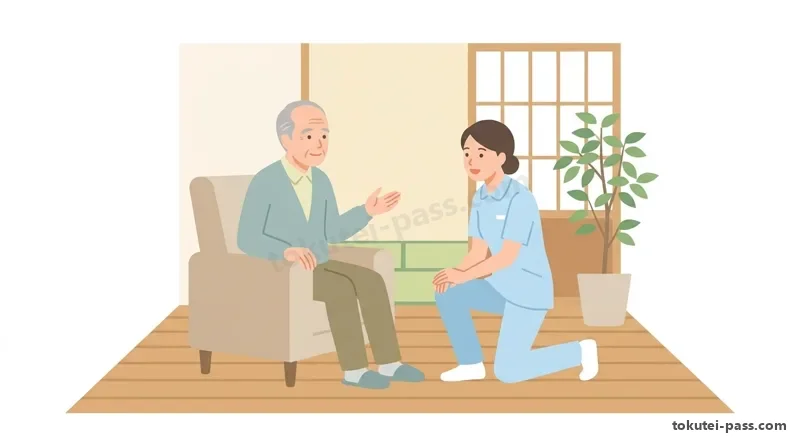
初めて出会う利用者や緊張している利用者と接するときは、個人の縄張り意識である「パーソナルスペース(対人距離)」に配慮し、急に近づきすぎない適度な距離を保ちます。
When interacting with a user for the first time or someone who is tense, be mindful of 'personal space (interpersonal distance)' and maintain a comfortable distance without approaching too abruptly.
また、車いすやベッド上の利用者に対して立ったまま見下ろして話すのではなく、腰を落として「目線の高さを合わせる」とともに、穏やかな笑顔とうなずきで安心感を伝えます。
Furthermore, rather than standing and looking down when speaking to a user in a wheelchair or bed, lower your posture to 'match eye level' and convey reassurance with a gentle smile and nodding.
椅子に座って話す際も、真っ正面からにらみ合う配置より、テーブルの角を挟んで90度(直角)や斜めに座る「直角法・斜め対面」の方が緊張が和らぎ、自然に視線を外せるため話しやすくなります。
When sitting on chairs to talk, sitting at a 90-degree angle across the corner of a table ('right-angle / diagonal seating') eases tension and allows natural eye movement better than sitting directly face-to-face.
Key points
- 表情・視線・うなずき・姿勢・声の調子・対人距離などは「非言語的コミュニケーション」にあたる
Facial expressions, eye contact, nodding, posture, vocal tone, and interpersonal distance belong to 'nonverbal communication' - 言葉と態度(非言語サイン)が矛盾するメッセージを「ダブルバインド(二重拘束)」といい、相手を混乱させる
A contradictory message where words and nonverbal attitude conflict is called a 'double bind' and confuses the recipient - 利用者と接するときはパーソナルスペースに配慮し、目線の高さを合わせて穏やかな表情で聴く
Respect personal space, match the user's eye level, and listen with a calm, gentle expression
| Word | Meaning |
|---|---|
| 言語的コミュニケーションと非言語的コミュニケーション | verbal communication and nonverbal communication |
| ダブルバインド(二重拘束) | double bind |
| パーソナルスペース(対人距離) | personal space (interpersonal distance) |
| タッチングと直角法(座る位置) | touching and right-angle seating arrangement |
チームマネジメント・リーダーシップ(PM理論)とフォロワーシップ
Team Management, Leadership (PM Theory), and Followership
良質な介護サービスを提供するためには、組織の目的と指揮命令系統(誰が誰に指示・報告するか)を明確にし、「報告・連絡・相談(ホウレンソウ)」を徹底するチームマネジメントが欠かせません。
To provide high-quality care services, team management must clarify organizational goals and the chain of command (who instructs and reports to whom) and thoroughly practice 'Reporting, Contacting, and Consulting (Ho-Ren-So).'
社会心理学者の三隅二不二が提唱した「PM理論」では、リーダーシップを目標達成や課題解決を進める「P機能(Performance)」と、職場の人間関係やまとまりを保つ「M機能(Maintenance)」の2軸でとらえます。
'PM Theory,' proposed by social psychologist Juji Misumi, views leadership along two axes: the 'P function (Performance)' for achieving goals and solving tasks, and the 'M function (Maintenance)' for maintaining workplace relationships and team cohesion.
P機能とM機能の両方が高い「PM型」が最も理想的なリーダーとされます。また、メンバーの熟練度や状況に応じて指示的行動と支持的行動を使い分ける「SL理論(状況対応型リーダーシップ)」も活用されます。
The 'PM type,' where both P and M functions are high, is considered the most ideal leadership style. 'SL Theory (Situational Leadership),' which adapts directive and supportive behaviors according to staff maturity and situations, is also widely used.
さらにチームケアではリーダーだけでなく、メンバー一人ひとりが組織の目標を理解し、主体的に意見や改善案を出してリーダーを支える「フォロワーシップ」が極めて重要です。
Moreover, effective team care requires not only leadership but also 'followership'—where each team member understands organizational goals and proactively offers opinions and improvement ideas to support the leader.
業務上の指示を受ける際は、原則として直属の上司(リーダー)から受け、結果もその上司へ報告する「命令一元化の原則」を守ることで、現場の混乱や事故を防ぎます。
When receiving work instructions, observing the 'principle of unity of command'—receiving instructions from one's direct supervisor and reporting results back to that same supervisor—prevents confusion and accidents on the floor.
Key points
- 三隅二不二の「PM理論」では、目標達成機能(P)と集団維持機能(M)の双方が高いPM型が理想的とされる
In Misumi's 'PM Theory,' the ideal leader is the 'PM type,' excelling in both goal achievement (P) and group maintenance (M) - 組織では指揮命令系統を明確にし、迅速・正確な「報告・連絡・相談」を行う
Organizations must clarify the chain of command and practice prompt, accurate 'Reporting, Contacting, and Consulting' - メンバーが主体的に判断・提案してリーダーやチームを支える働きを「フォロワーシップ」という
Proactive judgment and proposals by team members to support the leader and team are called 'followership'
| Word | Meaning |
|---|---|
| PM理論(目標達成機能Pと集団維持機能M) | PM Theory (Performance function P and Maintenance function M) |
| 指揮命令系統と命令一元化 | chain of command and unity of command |
| リーダーシップとフォロワーシップ | leadership and followership |
| 報告・連絡・相談(ホウレンソウ) | Reporting, Contacting, and Consulting (Ho-Ren-So) |
人材育成(OJT・Off-JT・SDS)とキャリアパス
Human Resource Development (OJT, Off-JT, SDS) and Career Paths
介護現場の人材育成は、日常の業務を通じて上司や先輩職員が計画的・継続的に実務指導を行う「OJT(On-the-Job Training:職場内訓練)」が中心となります。
Human resource development in care settings centers on 'OJT (On-the-Job Training),' in which supervisors or senior staff provide planned, continuous practical instruction through daily work.
OJTは「教える→やってみせる→やらせてみる→確認・評価する」の段階で進め、新人職員の習熟度に合わせて即時に個別指導ができる利点があります。
OJT proceeds through the steps of 'explain → demonstrate → let them try → check and evaluate,' offering the advantage of immediate individualized instruction tailored to a new staff member's proficiency.
一方、職場を離れて外部の研修会や講習で体系的・専門的な知識を学ぶ方法を「Off-JT(職場外訓練)」、職員が自発的に読書や勉強会などで学ぶことを「SDS(自己啓発)」といいます。
By contrast, learning systematic and specialized knowledge at external seminars away from the workplace is called 'Off-JT (Off-the-Job Training),' and voluntary learning by staff through reading or study groups is called 'SDS (Self-Development System).'
また、初任者から中堅・リーダー・管理職へと至る職位や必要な能力・資格・賃金体系の道筋を明示する「キャリアパス制度」を整えることで、職員の定着と資質向上を図ります。
Establishing a 'career path system' that clearly outlines job ranks from entry-level to mid-career, leader, and manager—along with required competencies, qualifications, and wage structures—promotes staff retention and skill development.
OJTを行う際には、単に「見て覚えて」と放置するのではなく、指導目標やチェックリストを定めた「個別育成計画」を作成し、職場全体で新任職員を支える体制づくりが求められます。
When conducting OJT, rather than leaving new hires to 'just watch and learn,' facilities should create an 'individualized training plan' with clear goals and checklists so the entire workplace supports new staff.
Key points
- 日常業務を通じて上司や先輩が計画的に指導する方法を「OJT(職場内訓練)」という
Planned practical instruction by supervisors or seniors through daily work is called 'OJT (On-the-Job Training)' - 職場を離れて集合研修などで体系的知識を学ぶ方法を「Off-JT(職場外訓練)」という
Learning systematic knowledge through group training away from the workplace is called 'Off-JT (Off-the-Job Training)' - 職員が自発的に能力開発を行う「SDS(自己啓発)」や昇進・処遇の道筋を示す「キャリアパス」が重要である
Voluntary 'SDS (self-development)' and a clear 'career path' showing advancement and compensation are vital
| Word | Meaning |
|---|---|
| OJT(職場内訓練) | OJT (On-the-Job Training) |
| Off-JT(職場外訓練) | Off-JT (Off-the-Job Training) |
| SDS(自己啓発) | SDS (Self-Development System) |
| キャリアパス制度 | career path system |
スーパービジョン・コーチング・コンサルテーション・メンター制度
Supervision, Coaching, Consultation, and the Mentor System
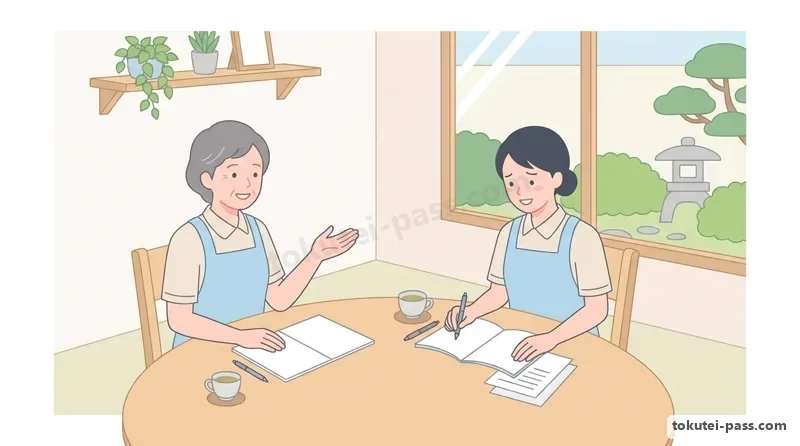
「スーパービジョン」とは、熟練した指導者(スーパーバイザー)が援助者(スーパーバイジー)に対し、専門職としての成長とケアの質向上をめざして継続的に行う教育・支援のプロセスです。
'Supervision' is a continuous educational and supportive process in which an experienced supervisor guides a practitioner (supervisee) toward professional growth and improved care quality.
カドゥシンによれば、スーパービジョンには業務基準や方針を守らせる「管理的機能」、知識や技術を高める「教育的機能」、悩みや不安を支える「支持的機能」の3つの機能があります。
According to Kadushin, supervision has three functions: the 'administrative (managerial) function' (ensuring compliance with standards and policies), the 'educational function' (enhancing knowledge and skills), and the 'supportive function' (supporting emotional concerns and anxiety).
「コーチング」は、一方的に答えを教え込むのではなく、対話や質問を通じて相手自身の気づきや自発的な行動を引き出す育成技法です。
'Coaching' is a development technique that draws out the other person's own awareness and voluntary action through dialogue and questions rather than one-sidedly teaching answers.
また、異なる専門領域の専門家(医師や理学療法士など)に助言を求めることを「コンサルテーション」といい、直属の上司とは別の先輩職員が若手職員の相談相手となる仕組みを「メンター制度」といいます。
Seeking advice from experts in different specialized fields (such as physicians or physical therapists) on an equal footing is called 'consultation,' while pairing younger staff with a senior advisor outside their direct chain of command is called a 'mentor system.'
さらに、同じ立場や同じ職種の仲間同士が対等な関係で事例や悩みを話し合い、互いに学び合う「ピア・スーパービジョン」も現場の力量向上に有効です。
Additionally, 'peer supervision'—in which colleagues in the same position or profession discuss cases and concerns as equals to learn from one another—is also effective for improving workplace capability.
Key points
- スーパービジョンの3機能は「管理的機能・教育的機能・支持的機能」である
The three functions of supervision are the administrative function, educational function, and supportive function - 対話や質問によって相手の気づきと自発的行動を引き出す手法を「コーチング」という
Drawing out a person's awareness and voluntary action through dialogue and questions is called 'coaching' - 他分野の専門家から対等な立場で専門的助言を得ることを「コンサルテーション」という
Obtaining specialized advice on an equal footing from experts in other fields is called 'consultation'
| Word | Meaning |
|---|---|
| スーパービジョン(管理的・教育的・支持的機能) | supervision (administrative, educational, and supportive functions) |
| スーパーバイザーとスーパーバイジー | supervisor and supervisee |
| コーチングとメンター制度 | coaching and mentor system |
| コンサルテーション(他職種専門家への相談) | consultation (consulting experts in other professions) |
コンプライアンス・苦情対応とメンタルヘルスケア(バーンアウト予防)
Compliance, Complaint Handling, and Mental Health Care (Burnout Prevention)
介護事業所における「コンプライアンス(法令遵守)」とは、関係法令や職場規則を守るだけでなく、高い職業倫理と社会的規範に従って誠実に業務を行うことを意味します。
'Compliance' in a care facility means not only obeying laws and workplace rules, but also conducting duties sincerely in accordance with high professional ethics and social norms.
利用者や家族からの「苦情」はサービスの質を改善する貴重な機会です。まず謝罪と共感をもって丁寧に事実を聴き取り、個人で抱え込まず苦情解決責任者や上司へ報告して組織的に対応します。
'Complaints' from users or families are valuable opportunities to improve service quality. Staff should first listen carefully to the facts with apology and empathy, and report immediately to the complaint resolution manager or supervisor for an organizational response rather than keeping it to themselves.
厚生労働省の指針では、職場のメンタルヘルスケアとして①労働者自身の「セルフケア」、②管理監督者による「ラインによるケア」、③「事業場内産業保健スタッフ等によるケア」、④「事業場外資源によるケア」の「4つのケア」を示しています。
Ministry of Health, Labour and Welfare guidelines specify 'Four Types of Care' for workplace mental health: (1) 'Self-care' by workers, (2) 'Line care' by supervisors, (3) 'Care by in-house industrial health staff,' and (4) 'Care by external resources.'
また、献身的に働いていた対人援助職が極度の疲労から意欲を失う「バーンアウト(燃え尽き症候群:マスラック)」の3症状は、「情緒的消耗感」「脱人格化」「個人的達成感の低下」であり、早期の相談と休息・業務分担で予防します。
Additionally, the three symptoms of 'burnout (Maslach)'—where dedicated human service workers lose motivation due to extreme exhaustion—are 'emotional exhaustion,' 'depersonalization,' and 'reduced personal accomplishment,' which are prevented through early consultation, rest, and workload sharing.
なお、苦情申立人は事業所内の相談窓口や第三者委員だけでなく、都道府県の「運営適正化委員会」や「国民健康保険団体連合会(国保連)」へ直接申し立てることも制度上保障されています。
Furthermore, complainants are legally guaranteed the right to file complaints not only with the facility's consultation desk or third-party committee members, but also directly with prefectural 'Operational Appropriateness Committees' or 'National Health Insurance Federations (Kokuho-ren).'
Key points
- 苦情はサービス改善の機会として真摯に傾聴し、速やかに上司や苦情解決責任者へ報告して組織的に対応する
Listen sincerely to complaints as opportunities for service improvement and report promptly to supervisors for an organizational response - 職場のメンタルヘルスケアには「セルフケア・ラインによるケア・事業場内産業保健スタッフ等・事業場外資源」の4つのケアがある
Workplace mental health comprises 'Four Types of Care': self-care, line care, in-house occupational health staff, and external resources - バーンアウト(燃え尽き症候群)の3徴候は「情緒的消耗感・脱人格化・個人的達成感の低下」である
The three symptoms of burnout are 'emotional exhaustion, depersonalization, and reduced personal accomplishment'
| Word | Meaning |
|---|---|
| コンプライアンス(法令遵守)と苦情解決制度 | compliance and complaint resolution system |
| メンタルヘルスの4つのケア(セルフケア・ラインケア等) | Four Types of Mental Health Care (self-care, line care, etc.) |
| バーンアウト(燃え尽き症候群) | burnout syndrome |
| 情緒的消耗感と脱人格化 | emotional exhaustion and depersonalization |
Human Relations & Communication
Practice this chapter in the appOfficial references
- 公益財団法人社会福祉振興・試験センター「介護福祉士国家試験 試験科目別出題基準(人間関係とコミュニケーション)」 — https://www.sssc.or.jp/kaigo/kijun/index.html
- 厚生労働省「労働者の心の健康の保持増進のための指針(メンタルヘルス指針)」 — https://www.mhlw.go.jp/stf/seisakunitsuite/bunya/0000055195.html