
Mechanisms of Mind and Body
こころとからだのしくみ
National Exam for Certified Care Workers 介護福祉士 · 介護福祉士国家試験(筆記) · Written by Tokutei Pass based on the official study texts; not copied verbatim.
こころのしくみ:記憶・欲求・睡眠のメカニズム
Mechanisms of the Mind: Memory, Needs, and Sleep
人間の記憶は、情報を取り込む「記銘(符号化)」、それを脳内に保つ「保持(貯蔵)」、必要なときに取り出す「想起(検索)」という3つの過程で成立しています。
Human memory operates through three processes: Encoding (taking in information), Retention (storing it in the brain), and Retrieval (recalling it when needed).
長期記憶のうち、個人の体験や出来事に関する「エピソード記憶」は加齢や認知症で低下しやすい一方、言葉の知識である「意味記憶」や体で覚えた「手続き記憶」は保たれやすい特徴があります。
Within long-term memory, Episodic Memory regarding personal experiences and events tends to decline with aging and dementia, whereas Semantic Memory (knowledge of words) and Procedural Memory (skills learned by the body) are relatively well preserved.
アメリカの心理学者マズローは人間の欲求を5段階のピラミッドで説明し、下位から「生理的欲求」「安全の欲求」「所属と愛の欲求」「承認(自尊)の欲求」「自己実現の欲求」に分類しました。
American psychologist Maslow explained human needs as a five-tier pyramid, classified from lowest to highest as Physiological Needs, Safety Needs, Belongingness and Love Needs, Esteem Needs, and Self-Actualization Needs.
下位の4つは不足するとそれを埋めようとする「欠乏欲求」であり、最上位の自己実現の欲求は自分の能力や可能性を発展させようとする「成長欲求」と呼ばれます。
The lower four tiers are called Deficiency Needs (arising from deprivation), while the highest tier—Self-Actualization—is called a Growth Need aimed at developing one's abilities and potential.
また睡眠は、脳が休まり深い眠りとなる「ノンレム睡眠」と、身体は休んでいるが眼球が急速に動き夢を見やすい「レム睡眠」が約90分周期で繰り返され、高齢者では深いノンレム睡眠が減少し中途覚醒が増えます。
Sleep alternates in approximately 90-minute cycles between Non-REM sleep (when the brain rests deeply) and REM sleep (when the body rests but rapid eye movements occur and dreaming is common); in older adults, deep Non-REM sleep decreases and nocturnal awakenings increase.
Key points
- 記憶の3過程は記銘・保持・想起であり、エピソード記憶は加齢で低下しやすい
The 3 processes of memory are Encoding, Retention, and Retrieval; episodic memory easily declines with age - マズローの欲求階層説は生理的・安全・所属と愛・承認・自己実現の5段階
Maslow's hierarchy of needs has 5 levels: Physiological, Safety, Belonging & Love, Esteem, and Self-Actualization - ノンレム睡眠とレム睡眠は約90分周期で交代し、高齢者は深い睡眠が減る
Non-REM and REM sleep alternate in ~90-minute cycles; deep sleep decreases in older adults
| Word | Meaning |
|---|---|
| エピソード記憶 | Episodic memory |
| 手続き記憶 | Procedural memory |
| マズローの欲求階層説 | Maslow's hierarchy of needs |
| ノンレム睡眠 | Non-REM sleep |
神経系・感覚器・運動器の構造と廃用症候群
Structure of the Nervous, Sensory, and Musculoskeletal Systems and Disuse Syndrome
中枢神経である脳は、思考や言語を担う大脳、平衡感覚や運動調節を司る小脳、そして呼吸・循環・嚥下の中枢がある延髄を含む脳幹から構成されています。
The brain, part of the central nervous system, comprises the Cerebrum (governing thought and language), the Cerebellum (controlling balance and motor coordination), and the Brainstem, which includes the Medulla Oblongata (housing the centers for respiration, circulation, and swallowing).
なお、体温調節中枢や摂食・飲水中枢、自律神経の最高中枢は間脳の「視床下部」にあるため、延髄の機能と混同しないよう区別して覚えることが重要です。
Note that the thermoregulatory center, feeding/drinking centers, and the highest center of the autonomic nervous system are located in the Hypothalamus of the diencephalon, which must be carefully distinguished from the Medulla Oblongata.
自律神経は、活動時や緊張時に優位となり心拍数上昇・気管支拡張・消化管運動抑制を起こす「交感神経」と、休息時に優位となり心拍数低下・消化管運動促進を起こす「副交感神経」が拮抗的に働きます。
The autonomic nervous system functions antagonistically through the Sympathetic Nervous System (dominant during activity or tension, increasing heart rate, dilating bronchi, and inhibiting digestion) and the Parasympathetic Nervous System (dominant during rest, lowering heart rate and promoting digestion).
運動器である骨は破骨細胞による骨吸収と骨芽細胞による骨形成を繰り返しており、女性ホルモン(エストロゲン)の減少やビタミンD不足により骨粗鬆症が生じやすくなります。
Bones in the musculoskeletal system continuously undergo bone resorption by osteoclasts and bone formation by osteoblasts; decreased female hormones (estrogen) or vitamin D deficiency increases susceptibility to osteoporosis.
過度の安静や活動低下が続くと、筋萎縮・関節拘縮・骨萎縮・起立性低血圧・誤嚥性肺炎・褥瘡などの「廃用症候群(生活不活発病)」が全身に生じるため、早期離床が不可欠です。
Prolonged bed rest or inactivity causes systemic Disuse Syndrome—including muscle atrophy, joint contracture, bone atrophy, orthostatic hypotension, aspiration pneumonia, and pressure ulcers—making early mobilization essential.
Key points
- 呼吸・循環・嚥下中枢は延髄、体温調節中枢は間脳の視床下部
Respiration, circulation, and swallowing centers are in the Medulla Oblongata; thermoregulation is in the Hypothalamus - 交感神経は活動時(心拍上昇・消化抑制)、副交感神経は休息時に優位
Sympathetic nerves dominate during activity (higher heart rate, inhibited digestion); parasympathetic nerves dominate at rest - 長期臥床による廃用症候群(筋萎縮・関節拘縮・起立性低血圧等)の予防が重要
Preventing Disuse Syndrome (muscle atrophy, joint contracture, orthostatic hypotension, etc.) from prolonged bed rest is vital
| Word | Meaning |
|---|---|
| 延髄 | Medulla oblongata |
| 視床下部 | Hypothalamus |
| 自律神経 | Autonomic nervous system |
| 廃用症候群 | Disuse syndrome |
循環器系・呼吸器系とバイタルサインの観察
Circulatory and Respiratory Systems and Observation of Vital Signs
心臓から送り出される血液循環には、左心室から大動脈を経て全身を回り右心房に戻る「体循環」と、右心室から肺動脈(静脈血が流れる)を経て肺でガス交換し左心房に戻る「肺循環」があります。
Blood circulation pumped from the heart consists of Systemic Circulation (left ventricle -> aorta -> whole body -> right atrium) and Pulmonary Circulation (right ventricle -> pulmonary artery carrying venous blood -> gas exchange in the lungs -> left atrium).
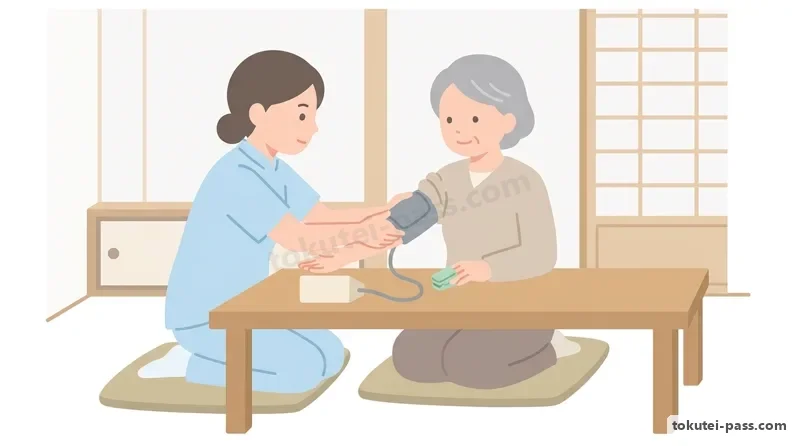
生命徴候であるバイタルサインの基本は「体温」「脈拍」「呼吸」「血圧」の4つであり、これに意識レベルや経皮的動脈血酸素飽和度(SpO2)を加えて全身状態を評価します。
The four basic Vital Signs are Body Temperature, Pulse, Respiration, and Blood Pressure, evaluated alongside consciousness level and percutaneous arterial oxygen saturation (SpO2) to assess systemic status.
高齢者は動脈硬化により収縮期血圧(最高血圧)が上昇しやすく、収縮期血圧と拡張期血圧の差である「脈圧」が大きくなる特徴があるほか、食事後や起立時に急激な血圧低下を起こしやすくなります。
In older adults, arterial stiffness tends to elevate systolic blood pressure, widening the Pulse Pressure (the difference between systolic and diastolic blood pressure), and makes them prone to sudden blood pressure drops after meals or upon standing.
また高齢者は感染症にかかっても典型的な高熱が出にくいことがあり、普段の平熱を把握したうえで、食欲低下や活気のなさといった微細な変化を早期に察知することが求められます。
Older adults may also not exhibit typical high fevers during infections, requiring care workers to know each user's baseline temperature and detect subtle signs such as decreased appetite or lethargy early.
血液中の酸素が不足し還元ヘモグロビンが増加すると、口唇や爪床が青紫色になる「チアノーゼ」が出現するため、呼吸状態と合わせて観察し速やかに医療職へ報告します。
When blood oxygen levels drop and deoxygenated hemoglobin increases, Cyanosis (a bluish-purple discoloration of the lips and nail beds) appears, which must be observed alongside breathing status and reported promptly to medical staff.
Key points
- 体循環は左心室→大動脈→全身→右心房、肺動脈には静脈血が流れる
Systemic circulation: Left ventricle -> Aorta -> Body -> Right atrium; the pulmonary artery carries venous blood - バイタルサインは体温・脈拍・呼吸・血圧が基本で、普段の数値との比較が重要
Basic vital signs are Temperature, Pulse, Respiration, and Blood Pressure; comparison with baseline values is crucial - 口唇や爪が青紫色になるチアノーゼは低酸素状態を示す重要なサイン
Cyanosis (bluish-purple lips and nails) is an important sign indicating hypoxia
| Word | Meaning |
|---|---|
| 体循環 | Systemic circulation |
| 肺循環 | Pulmonary circulation |
| バイタルサイン | Vital signs |
| チアノーゼ | Cyanosis |
消化器系と摂食・嚥下の5期モデル
Digestive System and the 5-Stage Model of Eating and Swallowing
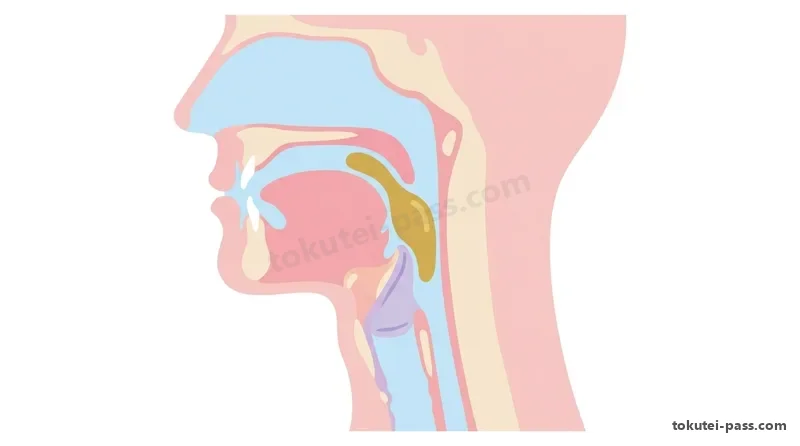
食物を認識して口に取り込み胃へ送り込むまでの過程(摂食・嚥下)は、「先行期(認知期)」「準備期(咀嚼期)」「口腔期」「咽頭期」「食道期」の5期に分けられます。
The process of recognizing food, taking it into the mouth, and propelling it into the stomach (eating and swallowing) is divided into five stages: the Anticipatory Stage, Preparatory Stage, Oral Stage, Pharyngeal Stage, and Esophageal Stage.
「先行期」は食物の形や匂い・温度を視覚や嗅覚で認識して口まで運ぶ段階であり、「準備期」は食物を歯で噛み砕き(咀嚼)、唾液と混ぜ合わせて飲み込みやすい「食塊」を形成する段階です。
The Anticipatory Stage involves recognizing the shape, smell, and temperature of food visually and olfactorily and bringing it to the mouth; the Preparatory Stage involves chewing food (mastication) and mixing it with saliva to form an easy-to-swallow bolus.
「口腔期」は舌を使って食塊を口腔から咽頭へ送り込む随意運動の段階であり、続く「咽頭期」では軟口蓋が挙上して鼻腔を塞ぎ、喉頭蓋が気管の入口を閉鎖して嚥下反射により食塊が食道へ送られます。
The Oral Stage is the voluntary movement of using the tongue to propel the bolus from the oral cavity into the pharynx; in the subsequent Pharyngeal Stage, the soft palate elevates to close the nasal cavity, the epiglottis closes the tracheal entrance, and the swallowing reflex sends the bolus into the esophagus.
最後の「食道期」では、食道の蠕動運動によって食塊が胃へと運ばれ、噴門(食道と胃の境目)によって胃内容物の逆流が防がれています。
In the final Esophageal Stage, peristalsis of the esophagus carries the bolus to the stomach, while the cardia (the junction between the esophagus and stomach) prevents reflux of gastric contents.
嚥下反射や咳反射(むせ)が低下すると、食物や唾液が気管に入る「誤嚥」が起こりやすくなり、特にむせのない「不顕性誤嚥」は夜間睡眠中などに生じて誤嚥性肺炎の原因となります。
When the swallowing reflex or cough reflex declines, food or saliva easily enters the trachea (Aspiration); Silent Aspiration—which occurs without coughing, often during nighttime sleep—is a major cause of aspiration pneumonia.
Key points
- 摂食嚥下の5期は先行期・準備期(食塊形成)・口腔期・咽頭期・食道期
The 5 stages of swallowing are Anticipatory, Preparatory (bolus formation), Oral, Pharyngeal, and Esophageal - 咽頭期には喉頭蓋が気管入口を閉鎖し、一時的に呼吸が止まって嚥下反射が起こる
In the Pharyngeal Stage, the epiglottis closes the tracheal entrance, breathing pauses briefly, and the swallowing reflex occurs - むせのない不顕性誤嚥は誤嚥性肺炎の重大なリスクとなる
Silent aspiration without coughing is a serious risk factor for aspiration pneumonia
| Word | Meaning |
|---|---|
| 先行期 | Anticipatory stage (cognitive stage of eating) |
| 食塊形成 | Bolus formation |
| 喉頭蓋 | Epiglottis |
| 不顕性誤嚥 | Silent aspiration |
泌尿器系・排泄のしくみと尿失禁・便秘の分類
Urinary System, Excretion Mechanisms, and Classification of Incontinence and Constipation
腎臓でつくられた尿は尿管を通って膀胱に蓄えられ、約150〜300mL溜まると仙髄および大脳へ信号が伝わって尿意を感じ、排尿反射により尿道から体外へ排出されます。
Urine produced in the kidneys travels through the ureters to be stored in the bladder; when about 150–300 mL accumulates, signals to the sacral cord and cerebrum create the urge to urinate, and the micturition reflex expels urine through the urethra.
尿失禁には、咳やくしゃみで漏れる「腹圧性尿失禁(骨盤底筋群の緩みが原因)」、急に強い尿意が起きて我慢できない「切迫性尿失禁」、前立腺肥大等で尿が出にくくなり溢れ出る「溢流性尿失禁」があります。
Urinary incontinence includes Stress Incontinence (leaking when coughing or sneezing due to weakened pelvic floor muscles), Urge Incontinence (a sudden, strong urge to urinate that cannot be held), and Overflow Incontinence (difficulty passing urine due to prostatic hyperplasia, etc., causing urine to dribble out).
さらに、排尿機能は正常であるにもかかわらず歩行障害や認知症によりトイレに間に合わない「機能性尿失禁」や、脊髄損傷等で尿意なく不随意に漏れる「反射性尿失禁」があり、原因に応じたケアが必要です。
Further types include Functional Incontinence (normal urinary function, but inability to reach the toilet in time due to mobility impairment or dementia) and Reflex Incontinence (involuntary leaking without feeling the urge due to spinal cord injury, etc.), each requiring tailored care.
一方、器質的疾患のない機能性便秘は、大腸の蠕動運動低下で生じ高齢者に最も多い「弛緩性便秘」、ストレス等で腸が過緊張し兎糞状便となる「けいれん性便秘」、便意の我慢等で排便反射が鈍る「直腸性便秘」の3つに分類されます。
Meanwhile, functional constipation without organic disease is classified into three types: Atonic Constipation (caused by decreased colonic peristalsis, most common in older adults), Spastic Constipation (excessive bowel tension from stress causing rabbit-pellet stools), and Rectal Constipation (blunted defecation reflex from suppressing the urge).
便の性状評価には7段階の「ブリストル便性状スケール」が用いられ、タイプ1(コロコロ便)〜タイプ2が硬便、タイプ3〜5(特にタイプ4のバナナ状便)が正常便、タイプ6〜7(水様便)が下痢便と判定されます。
The 7-level Bristol Stool Form Scale is used to evaluate stool consistency: Types 1 (hard lumps) to 2 indicate hard stool, Types 3 to 5 (especially Type 4 banana-shaped stool) indicate normal stool, and Types 6 to 7 (watery) indicate diarrhea.
Key points
- 尿失禁は腹圧性・切迫性・溢流性・機能性・反射性の5タイプを区別
Distinguish the 5 types of urinary incontinence: Stress, Urge, Overflow, Functional, and Reflex - 高齢者には大腸蠕動運動低下による「弛緩性便秘」や排便反射低下の「直腸性便秘」が多い
Older adults frequently experience Atonic Constipation (reduced peristalsis) and Rectal Constipation (blunted defecation reflex) - ブリストル便性状スケールではタイプ1が最も硬いコロコロ便、タイプ4が普通のバナナ状便、タイプ7が水様便
On the Bristol Stool Scale, Type 1 is the hardest pellet stool, Type 4 is normal banana-shaped stool, and Type 7 is watery stool
| Word | Meaning |
|---|---|
| 腹圧性尿失禁 | Stress urinary incontinence |
| 機能性尿失禁 | Functional urinary incontinence |
| 弛緩性便秘 | Atonic constipation |
| ブリストル便性状スケール | Bristol Stool Form Scale |
皮膚の構造と褥瘡の好発部位・予防
Skin Structure and Common Sites and Prevention of Pressure Ulcers
皮膚は外側から「表皮」「真皮」「皮下組織」の3層で構成され、健康な皮膚表面は皮脂膜によって弱酸性(pH4.5〜6.0程度)に保たれ、細菌の侵入を防ぐバリア機能を果たしています。
The skin consists of three layers from the outside in: the Epidermis, Dermis, and Subcutaneous Tissue; healthy skin surface is maintained at a weakly acidic pH (around 4.5–6.0) by the sebum film, serving as a barrier against bacterial invasion.
加齢に伴い皮脂や汗の分泌・角質層の水分量が減少すると、皮膚が乾燥してかゆみ(老人性皮膚掻痒症)や表皮剥離(スキン・ティア)が起こりやすくなるため、保湿剤の塗布や愛護的なケアが大切です。
As sebum, sweat secretion, and stratum corneum moisture decrease with aging, the skin dries out and becomes prone to itching (senile pruritus) and epidermal stripping (skin tears), making moisturizers and gentle care essential.
「褥瘡(床ずれ)」は、骨突出部に持続的な圧迫やズレ力(剪断力)・摩擦が加わることで血流障害が起こり、皮膚や皮下組織が壊死する状態を指します。
A Pressure Ulcer (bedsores) is a condition in which sustained pressure, shear force, or friction over bony prominences impairs blood flow, leading to necrosis of the skin and subcutaneous tissue.
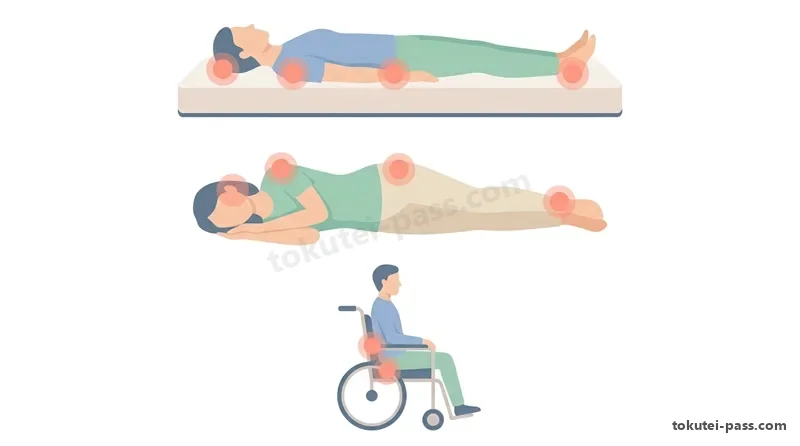
褥瘡の好発部位は体位によって異なり、仰臥位では「仙骨部・踵骨部・後頭部・肩甲骨部」、側臥位では「大転子部・腸骨稜部・耳介部」、座位では「坐骨結節部・尾骨部」が代表的です。
Common sites for pressure ulcers vary by posture: the sacrum, heels, occiput, and scapulae in the supine position; the greater trochanter, iliac crest, and ear auricle in the lateral position; and the ischial tuberosity and coccyx in the sitting position.
褥瘡発生予測には6項目(知覚認知・湿潤・活動性・可動性・栄養状態・摩擦とズレ)の「ブレーデンスケール」が用いられ、予防には体圧分散寝具の活用・定期的な体位変換・スキンケア・栄養管理を行います。
The 6-item Braden Scale (sensory perception, moisture, activity, mobility, nutrition, friction and shear) is used to predict pressure ulcer risk, and prevention involves pressure-redistributing mattresses, regular repositioning, skin care, and nutritional management.
Key points
- 皮膚は表皮・真皮・皮下組織の3層で、表面は弱酸性に保たれている
The skin has 3 layers (Epidermis, Dermis, Subcutaneous Tissue) and its surface is kept weakly acidic - 褥瘡好発部位:仰臥位は仙骨部・踵骨部、側臥位は大転子部、座位は坐骨結節部
Common pressure ulcer sites: Sacrum/heels when supine, Greater trochanter when lateral, Ischial tuberosity when sitting - リスク評価にはブレーデンスケール、予防には体圧分散・ズレの解消・保湿と栄養改善
Risk assessment uses the Braden Scale; prevention uses pressure redistribution, shear reduction, moisturizing, and nutrition
| Word | Meaning |
|---|---|
| 表皮剥離 | Epidermal stripping (skin tear) |
| 褥瘡 | Pressure ulcer (bedsore) |
| 仙骨部 | Sacral region |
| ブレーデンスケール | Braden Scale |
終末期の心理過程とACP(人生会議)・グリーフケア
Psychological Process at the End of Life, ACP, and Grief Care
精神科医のキューブラー・ロスは、死が近づいた人の心理過程として「第1段階:否認と孤立」「第2段階:怒り」「第3段階:取引」「第4段階:抑うつ」「第5段階:受容」の5段階を提唱しました。
Psychiatrist Elisabeth Kübler-Ross proposed five psychological stages experienced by people approaching death: Stage 1: Denial and Isolation, Stage 2: Anger, Stage 3: Bargaining, Stage 4: Depression, and Stage 5: Acceptance.
これらの段階は必ずしも順序通りに進むわけではなく、前の段階に戻ったり揺れ動いたりするため、介護福祉職はどの段階の感情も否定せず受容的に寄り添う姿勢が大切です。
These stages do not necessarily progress in order and individuals may move back and forth or waver between them; therefore, care workers must accompany users empathetically without denying emotions at any stage.
また終末期の苦痛は、身体的苦痛・精神的苦痛・社会的苦痛・スピリチュアルペイン(霊的苦痛:生きる意味の喪失等)の4つが絡み合った「トータルペイン(全人的苦痛)」として捉えられます。
End-of-life suffering is understood as Total Pain, an intertwining of four dimensions: Physical Pain, Psychological Pain, Social Pain, and Spiritual Pain (such as loss of meaning in life).
将来の医療やケアについて、本人を主体に家族や医療・介護従事者があらかじめ繰り返し話し合うプロセスを「アドバンス・ケア・プランニング(ACP:人生会議)」と呼び、本人の意思変化に合わせて何度でも見直します。
The process in which the individual, family, and medical/care professionals repeatedly discuss future medical care and support in advance is called Advance Care Planning (ACP), and it can be reviewed as many times as the person's wishes change.
さらに、大切な人を亡くした家族や遺族が抱える深い悲嘆(グリーフ)に対し、感情表出を支え立ち直りを支援する「グリーフケア」も介護福祉職の重要な役割です。
Furthermore, Grief Care—supporting emotional expression and recovery for bereaved families experiencing deep grief after losing a loved one—is an important role of certified care workers.
Key points
- キューブラー・ロスの5段階は「否認→怒り→取引→抑うつ→受容」
Kübler-Ross's 5 stages are Denial -> Anger -> Bargaining -> Depression -> Acceptance - トータルペイン(全人的苦痛)は身体的・精神的・社会的・スピリチュアルペインの4側面
Total Pain encompasses 4 aspects: Physical, Psychological, Social, and Spiritual Pain - ACP(人生会議)は本人主体で家族・専門職と繰り返し話し合うプロセス
ACP (Advance Care Planning) is an ongoing discussion process centered on the individual with family and professionals
| Word | Meaning |
|---|---|
| キューブラー・ロス | Elisabeth Kübler-Ross |
| トータルペイン(全人的苦痛) | Total Pain (holistic suffering) |
| ACP(人生会議) | Advance Care Planning (ACP) |
| グリーフケア | Grief care |
臨終期の身体変化と死の三徴候・エンゼルケア
Physical Changes Near Death, the Three Signs of Death, and Angel Care
死が間近に迫った臨終期には、手足の冷感やチアノーゼ、血圧低下、尿量の減少(乏尿・無尿)、喉でゴロゴロと音がする死前喘鳴などがみられるようになります。
In the terminal phase as death approaches, physical signs include coolness and cyanosis of the extremities, falling blood pressure, decreased urine output (oliguria or anuria), and death rattle (gurgling sounds in the throat).
呼吸パターンも変化し、浅い呼吸から次第に深い呼吸となり無呼吸を経て繰り返す「チェーン・ストークス呼吸」や、あごをしゃくるような「下顎呼吸」が出現し、やがて呼吸停止に至ります。
Breathing patterns also change, showing Cheyne-Stokes Respiration (repeating cycles of shallow breathing gradually deepening followed by apnea) or Mandibular Breathing (gasping with the lower jaw), eventually leading to respiratory arrest.
医師が死亡診断を行う際の「死の三徴候」は、「自発呼吸の停止」「心拍動(心臓)の停止」「瞳孔散大と対光反射の消失」の3つであり、死亡確認は医師(または歯科医師)のみが行えます。
The Three Signs of Death used by a physician to pronounce death are Cessation of Spontaneous Breathing, Cessation of Heartbeat, and Dilation of Pupils with Loss of Light Reflex; pronouncement of death can only be performed by a physician (or dentist).
死後の身体には、体温が周囲の温度まで下がる「死体冷」、血液が重力で下側に溜まり紫赤色の斑点ができる「死斑」、顎の関節などから全身へと筋肉が硬くなる「死後硬直」が生じます。
Postmortem physical changes include Algor Mortis (cooling of the body to ambient temperature), Livor Mortis (purplish-red spots where blood pools downward by gravity), and Rigor Mortis (stiffening of muscles starting from the jaw joint and spreading throughout the body).
医師による死亡確認後、介護福祉職は看護師等や家族と一緒に清拭・着替え・整容などの「死後のケア(エンゼルケア)」を丁寧に行い、故人の尊厳を守るとともに家族の悲嘆に寄り添います。
After the physician confirms death, care workers carefully perform postmortem care (Angel Care)—such as bed bathing, dressing, and grooming—together with nurses and family members to uphold the deceased's dignity and support the grieving family.
Key points
- 臨終期には死前喘鳴・チェーンストークス呼吸・下顎呼吸・尿量減少がみられる
Near death, death rattle, Cheyne-Stokes respiration, mandibular breathing, and decreased urine output are observed - 死の三徴候は「自発呼吸停止」「心拍動停止」「瞳孔散大と対光反射消失」
The Three Signs of Death are cessation of spontaneous breathing, cessation of heartbeat, and pupil dilation with loss of light reflex - 死亡診断は医師が行い、その後に家族や看護職と共にエンゼルケアを行う
Death is pronounced by a physician, followed by Angel Care performed together with family and nursing staff
| Word | Meaning |
|---|---|
| チェーン・ストークス呼吸 | Cheyne-Stokes respiration |
| 下顎呼吸 | Mandibular breathing (jaw gasping) |
| 死の三徴候 | Three signs of death |
| エンゼルケア | Angel care (postmortem care) |
Mind & Body Mechanisms
Practice this chapter in the appOfficial references
- 公益財団法人社会福祉振興・試験センター「介護福祉士国家試験 試験科目別出題基準」 — https://www.sssc.or.jp/kaigo/kijun/index.html
- 厚生労働省「介護保険制度の概要・障害福祉サービスについて」 — https://www.mhlw.go.jp/stf/seisakunitsuite/bunya/hukushi_kaigo/index.html