
Daily Living Support Techniques (Seikatsu Shien Gijutsu)
生活支援技術
National Exam for Certified Care Workers 介護福祉士 · 介護福祉士国家試験(筆記) · Written by Tokutei Pass based on the official study texts; not copied verbatim.
生活支援の原則・室内環境整備とレクリエーション
Principles of Daily Living Support, Indoor Environment, and Recreation
生活支援技術の基本は、利用者の心身機能だけでなく生活歴や価値観を含めた「全体像」を把握し、残存機能(できる力)を活かして自立生活とQOLを支えることにあります。
The foundation of Daily Living Support Techniques lies in grasping the user's 'holistic picture'—including physical/mental functions, life history, and values—and utilizing residual functions to support independent living and QOL.
快適な室内環境として、室温は夏期25〜28℃・冬期18〜22℃、湿度は40〜60%を目安に調整し、エアコンの風が利用者の身体に直接当たらないよう風向きに配慮します。
For a comfortable indoor environment, adjust room temperature to 25–28°C in summer and 18–22°C in winter with 40–60% humidity, ensuring air conditioner airflow does not blow directly onto the user's body.
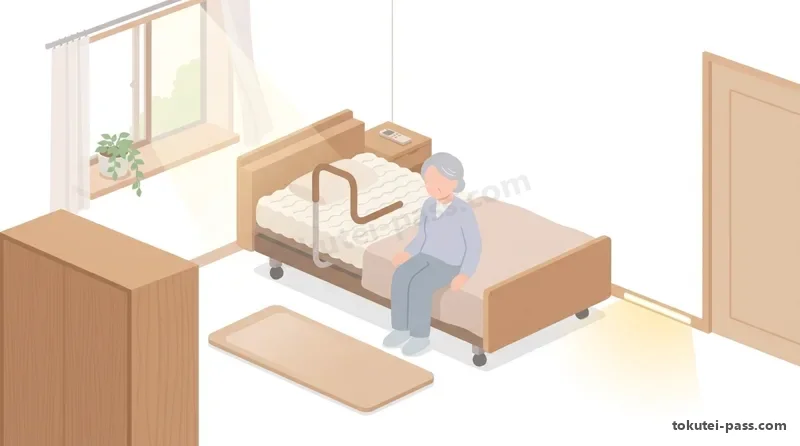
換気を行う際は、対角線上にある2か所の窓を開けると空気の流れができ効率的に入れ替わります。照明は加齢による視力低下に配慮しつつ、直接光源が目に入る眩しさ(グレア)を防ぐ間接照明などを活用します。
For ventilation, opening two windows located diagonally across from each other creates an efficient airflow. Lighting should account for age-related vision decline while using indirect lighting to prevent direct glare.
集団活動やレクリエーションでは、開始時に初対面や緊張をほぐす「アイスブレーキング(手遊びや簡単な挨拶ゲームなど)」を取り入れ、参加を強制せず自己決定を尊重します。
In group activities and recreation, incorporate 'ice-breaking' (simple hand games or greeting activities) at the start to ease tension, while respecting self-determination rather than forcing participation.
Key points
- 室内環境:対角線上の2か所を開ける換気と、グレア(眩しさ)を防ぐ照明配慮
Indoor environment: Diagonal two-window ventilation and lighting arrangements that prevent glare - レクリエーション開始時に緊張をほぐす「アイスブレーキング」の活用と参加の自己決定尊重
Use 'ice-breaking' to ease tension at the start of recreation and respect self-determination in participation
| Word | Meaning |
|---|---|
| 全体像の把握と残存機能の活用 | Grasping the holistic picture and utilizing residual functions |
| グレア(眩しさ)の防止 | Preventing glare |
| 対角線換気と温湿度管理 | Diagonal ventilation and temperature/humidity control |
| アイスブレーキング | Ice-breaking activities |
住環境整備と疾患・障害特性に応じた住宅改修
Home Environment Modification Tailored to Diseases and Disabilities
転倒防止や自立支援のための住環境整備では、床の段差解消(スロープや敷居撤去)、滑りにくい床材への変更、少ない力で開閉でき車いすでも通りやすい「引き戸」への変更が有効です。
Effective home modifications for fall prevention and independence include eliminating floor steps (ramps or threshold removal), changing to non-slip flooring, and replacing hinged doors with 'sliding doors' (Hikido) that open with minimal force.
手すりには、歩行や移動を支える「水平手すり(床から75〜80cm程度、大転子の高さ)」と、立ち上がりや座り込み・跨ぎ動作を支える「縦手すり(垂直手すり)」があり、用途に合わせて設置します。
Handrails include 'horizontal handrails' (installed at about 75–80 cm high, around the greater trochanter level, to support walking) and 'vertical handrails' (supporting standing up, sitting down, and stepping over thresholds).
パーキンソン病で「すくみ足(第1歩が出にくい)」がある利用者には、視覚的刺激によって足が出やすくなる「矛盾性運動」を利用し、廊下などの床に一定間隔で横線の目印テープを貼る工夫が効果的です。
For users with Parkinson's disease experiencing 'freezing of gait' (difficulty taking the first step), placing horizontal marker tapes at regular intervals on the floor utilizes 'paradoxical kinesia' via visual cues to facilitate stepping.
また「関節リウマチ」で手指の関節変形や痛みがある利用者には、握らずに前腕を乗せて支えられる「平手すり(ボード状手すり)」や、手首をひねらずに操作できる「レバー式ドアノブ・レバー式水栓」を選定します。
For users with 'rheumatoid arthritis' who have finger joint deformity or pain, select 'flat handrails' (platform handrails supported by resting the forearm without gripping) and lever-type door handles or faucets operable without twisting the wrist.
Key points
- 水平手すりは歩行補助(大転子の高さ)、縦手すりは立ち座り・跨ぎ動作の補助に用いる
Horizontal handrails assist walking (greater trochanter height); vertical handrails assist standing/sitting and stepping motions - パーキンソン病のすくみ足には床の目印テープ、関節リウマチには平手すり・レバー式水栓が有効
Floor marker tapes help freezing of gait in Parkinson's disease; flat handrails and lever faucets help rheumatoid arthritis
| Word | Meaning |
|---|---|
| 水平手すり(大転子の高さ)と縦手すり | Horizontal handrails (greater trochanter height) and Vertical handrails |
| 引き戸と段差解消 | Sliding doors (Hikido) and step elimination |
| すくみ足への床の目印テープ(視覚的刺激) | Floor marker tapes for freezing of gait (visual cues) |
| 関節リウマチと平手すり・レバー式ノブ | Rheumatoid arthritis with flat handrails and lever handles |
ボディメカニクス・ノーリフティングケアとベッド上の体位変換
Body Mechanics, No-Lifting Care, and Bed Repositioning
介護福祉職の腰痛予防と安全な介助のため、「ボディメカニクスの原則」を活用します。足を前後左右に開いて「支持基底面を広く」とり、膝を曲げて「重心を低く」し、利用者に「重心を近づけ」ます。
To prevent lower-back pain and ensure safe assistance, apply 'Body Mechanics principles': spread feet front-to-back and side-to-side for a 'wide base of support,' bend knees to 'lower the center of gravity,' and 'move your center of gravity close' to the user.
さらに、利用者の腕や膝を組んで「身体を小さくまとめ」、持ち上げるのではなくベッド面を「水平に滑らせる(引く)」ようにし、腰をひねらず「足先を移動方向に向け」、てこの原理と大筋群を使います。
Fold the user's arms and bend their knees to 'make their body compact,' 'slide horizontally' across the bed rather than lifting vertically, point your toes toward the direction of movement without twisting the waist, and use leverage and large muscle groups.
また人力だけで抱え上げない「ノーリフティングケア」として、摩擦を減らす「スライディングシート」や座面移動を助ける「スライディングボード」、床走行式リフトを積極的に活用します。
Under 'No-Lifting Care' (avoiding manual lifting alone), actively use friction-reducing 'sliding sheets,' seated transfer 'sliding boards,' and mobile floor lifts.
ギャッチベッドで「背上げ(ファーラー位)」を行う際は、身体が足元側へずり落ちるのを防ぐため、まず「膝(脚部)を先に上げてから背を上げ」、背上げ後は一旦背中をベッドから離す「背部の圧抜き」を行います。
When raising the backrest (Fowler's position) on a Gatch bed, 'raise the knee section first before raising the backrest' to prevent the body from sliding down toward the foot of the bed, and perform 'back pressure relief' (Haibu no Atsunuki) afterward.
Key points
- ボディメカニクス:支持基底面を広く・重心を低く近く・身体を小さくまとめ・腰をひねらず水平移動
Body Mechanics: Wide base of support, low and close center of gravity, compact posture, horizontal sliding without twisting the waist - ギャッチベッドの背上げは「膝上げ→背上げ」の順に行い、最後に必ず「背部の圧抜き」を行う
Gatch bed backrest elevation follows 'Knee elevation first → Backrest elevation,' followed by 'back pressure relief'
| Word | Meaning |
|---|---|
| 支持基底面と重心 | Base of support and Center of gravity |
| ボディメカニクスの8原則 | 8 Principles of Body Mechanics |
| ノーリフティングケア(スライディングボード・シート) | No-Lifting Care (Sliding boards and Sliding sheets) |
| ギャッチベッドの膝上げ先行と背部の圧抜き | Knee-first elevation and Back pressure relief on Gatch beds |
片麻痺のある人の起居・移乗と車いす・杖歩行・視覚障害者誘導
Transfers in Hemiplegia, Wheelchair Operation, Cane Walking, and Guiding Visually Impaired Users
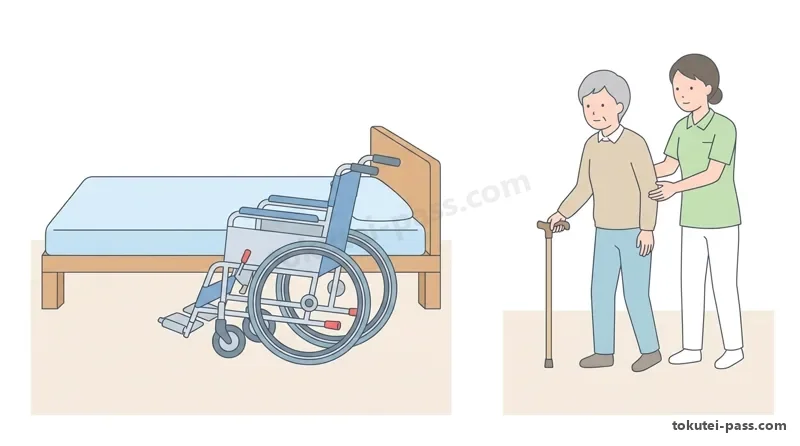
片麻痺のある人が仰臥位から起き上がる際は「健側(麻痺のない側)を下にした側臥位」になり、健側の肘と手でベッドを押して端座位になります。ベッドから車いすへの移乗では、車いすを利用者の「健側に20〜30度の角度」で置きます。
When a person with hemiplegia sits up from supine, they first roll onto their 'sound (unaffected) side' and push up with the sound elbow and hand into a seated position. For bed-to-wheelchair transfers, place the wheelchair on the 'sound side at a 20–30 degree angle.'
立ち上がり介助では、利用者の「健側の足を少し後ろに引き」、介護福祉職は「患側(麻痺側)の膝折れ」を防ぎながら、お辞儀をするように重心を前へ移動させて立ち上がってもらいます。
When assisting standing up, draw the user's 'sound foot slightly back,' support the 'affected knee to prevent buckling,' and guide the user to lean forward like bowing to shift their center of gravity forward.
車いす移動では、上り坂は前向き、急な「下り坂は後ろ向き」で進み、段差を上がる際はティッピングレバーを踏んで前輪(キャスター)を浮かせます。段差を下りる際も後ろ向きで後輪から静かに下ろします。
In wheelchair mobility, move forward uphill, but 'move backward down steep slopes'; when ascending a step, step on the tipping lever to lift the front casters; when descending a step, go backward and lower the rear wheels first.
片麻痺の三動作歩行(平地)は「①杖 → ②患側足 → ③健側足」の順に進み、階段を「上るときは『杖 → 健側足 → 患側足』」、階段を「下るときは『杖 → 患側足 → 健側足』」の順となります。
Three-point cane walking on flat ground follows: '(1) Cane → (2) Affected leg → (3) Sound leg.' When 'climbing stairs,' the order is 'Cane → Sound leg → Affected leg'; when 'descending stairs,' it is 'Cane → Affected leg → Sound leg.'
視覚障害者の歩行誘導では、介護福祉職は白杖を持っていない側の「半歩前」に立ち、利用者に介護福祉職の肘の少し上を軽く握ってもらって誘導します。
When guiding a person with visual impairment, the care worker stands 'half a step ahead' on the side opposite the white cane, allowing the user to lightly hold just above the worker's elbow.
Key points
- 車いすは「健側」に配置し、急な下り坂や段差を下りる際は「後ろ向き」で操作する
Place the wheelchair on the 'sound side'; move 'backward' when descending steep slopes or steps in a wheelchair - 杖歩行:平地と下り階段は「杖→患側→健側」、上り階段は「杖→健側→患側」、視覚障害誘導は「半歩前」
Cane walking: Flat ground and descending stairs follow 'Cane → Affected → Sound'; ascending stairs follows 'Cane → Sound → Affected'; guide visually impaired users from 'half a step ahead'
| Word | Meaning |
|---|---|
| 健側からの移乗と患側の膝折れ防止 | Transfer from the sound side and preventing affected knee buckling |
| ティッピングレバーと下り坂の後ろ向き移動 | Tipping lever and backward descent on slopes |
| 三動作歩行(杖→患側→健側)と階段昇降 | Three-point cane gait (Cane → Affected → Sound) and stair navigation |
| 視覚障害者の半歩前誘導 | Half-step-ahead guidance for visually impaired persons |
身じたく・整容・口腔ケアと衣類着脱(脱健着患)
Grooming, Oral Care, and Dressing / Undressing (Dakken Chakkan)
洗顔・整髪・ひげ剃り・化粧などの「身じたく・整容」は、清潔保持だけでなく生活のハリや社会参加への意欲を高める重要な活動です。電気カミソリは毛の流れに逆らって皮膚を伸ばしながら動かします。
'Grooming' (washing the face, hair styling, shaving, makeup) not only maintains hygiene but boosts vitality and motivation for social participation. Move electric razors against the grain while stretching the skin.
爪切りは入浴後など爪が柔らかいときに行い、深爪や巻き爪を防ぐため真っすぐ切って角をやすりで整える「スクエアカット」とします。爪周囲に発赤・腫脹・化膿や重度の変形がある場合は介護職は切らず医療職へつなぎます。
Clip nails after bathing when soft, using a 'Square Cut' (cutting straight across and filing corners) to prevent ingrown nails. If redness, swelling, pus, or severe deformity is present around the nail, refer to medical staff without cutting.
口腔ケアでは誤嚥防止のため「顎を軽く引いた前傾姿勢」をとり、歯ブラシは鉛筆持ち(ペングリップ)で1〜2本ずつ小刻みに動かします。舌苔を取る舌ブラシは嘔吐反射を防ぐため「奥から手前へ」優しく動かします。
In oral care, maintain a 'slightly forward-leaning posture with the chin tucked' to prevent aspiration, holding the toothbrush in a pen grip to brush 1–2 teeth at a time. Move tongue brushes gently 'from back to front' to avoid the gag reflex.
総義歯(総入れ歯)は「下顎から外し、装着時は上顎から入れる」のが基本であり、外した義歯は乾燥による変形を防ぐため必ず「水(または義歯洗浄剤入りの水)の中」で保管します(熱湯消毒は厳禁)。
Full dentures are 'removed from the lower jaw first and inserted into the upper jaw first,' and removed dentures must be stored 'in water' (or denture cleanser solution) to prevent warping from drying (never use boiling water).
片麻痺のある人の衣類着脱は、関節への負担を減らすため「脱ぐときは健側から、着るときは患側(麻痺側)から」行う「脱健着患」が鉄則です。
When dressing or undressing a person with hemiplegia, the golden rule to protect joints is 'Dakken Chakkan'—'undress from the sound side first, and dress from the affected (paralyzed) side first.'
Key points
- 爪切りはスクエアカット、舌ブラシは「奥から手前へ」、義歯は乾燥防止のため「水中」で保管する
Use Square Cut for nails, brush the tongue 'from back to front,' and store dentures 'in water' to prevent warping - 衣類の着脱は「脱健着患(健側から脱ぎ、患側から着る)」を原則とする
Follow 'Dakken Chakkan' (undress sound side first, dress affected side first) for clothing assistance
| Word | Meaning |
|---|---|
| スクエアカット(爪切りの方法) | Square Cut (nail clipping method) |
| ペングリップと舌ブラシ(奥から手前へ) | Pen grip and tongue brushing (from back to front) |
| 総義歯の着脱と水中保管 | Full denture insertion/removal and storage in water |
| 脱健着患(衣類着脱の原則) | Dakken Chakkan (undress sound side, dress affected side) |
食事介助・誤嚥予防と疾患・障害別の栄養・水分補給
Meal Assistance, Aspiration Prevention, and Disease-Specific Nutrition / Hydration
安全な食事姿勢は、いすに深く腰掛けて「両足底を床にしっかり接地」させ、体幹をやや前傾にして「顎を軽く引く(頸部前屈)」姿勢です。顎が上がると気道が開き誤嚥しやすくなります。
A safe eating posture involves sitting deeply in a chair with 'both soles flat on the floor,' leaning the trunk slightly forward, and 'lightly tucking the chin' (cervical flexion). Tilting the chin up opens the airway and increases aspiration risk.
食事介助では利用者と同じ目線の高さに座り、最初にお茶や汁物で口腔内を湿らせ、1口量はティースプーン1杯程度を「健側(麻痺のない側)の舌の上」に入れ、完全に飲み込んだ(嚥下した)ことを確認してから次を運びます。
Sit at eye level with the user, moisten the mouth first with tea or soup, place about one teaspoonful onto the 'tongue on the sound side,' and confirm complete swallowing before offering the next bite.
嚥下機能が低下した人のおやつには、ぱさつくカステラや粘着性の高い餅・もなか・こんにゃくゼリーは避け、まとまりやすく滑らかな「プリンやムース、軟らかいゼリー」を選びます。
For snacks in dysphagia, avoid crumbly sponge cake or sticky mochi, monaka wafers, and konjac jelly; choose smooth, cohesive foods such as 'pudding, mousse, or soft jelly.'
疾患別では、「血液透析」の利用者は水分・塩分・カリウム(生野菜や果物に多く、野菜は「ゆでこぼし」で減らす)・リンを制限し、「胃食道逆流症」では脂肪分を控えて食後すぐに臥床しないよう上体を起こして過ごします。
By condition: users on 'hemodialysis' require restrictions on water, salt, potassium (abundant in raw vegetables/fruit; reduce by boiling vegetables and discarding the water), and phosphorus; users with 'gastroesophageal reflux disease' should avoid fatty foods and remain upright after meals.
「左半側空間無視」がある人には食器を右側に寄せたり声かけで左側への注意を促したりし、発汗や下痢・発熱時の脱水予防には電解質を含む「経口補水液」や白湯をこまめに補給します。
For users with 'left unilateral spatial neglect,' place dishes toward the right side or verbally cue attention to the left; during sweating, diarrhea, or fever, replenish fluids frequently with 'oral rehydration solution' (ORS) or warm water.
Key points
- 食事姿勢は「足底接地・やや前傾・顎を引く」、食物は「健側」へ入れ嚥下確認後に次を運ぶ
Eating posture: 'Soles flat on the floor, slight forward lean, chin tucked'; place food on the 'sound side' and confirm swallowing - 血液透析は水分・塩分・カリウム(野菜のゆでこぼし)・リン制限、逆流性食道炎は食後すぐ横にならない
Hemodialysis restricts water, salt, potassium (boil and discard water), and phosphorus; avoid lying down immediately after meals in reflux
| Word | Meaning |
|---|---|
| 食事姿勢(足底接地と頸部前屈) | Eating posture (soles flat on floor and chin tuck) |
| 健側への食物投入と嚥下確認 | Placing food on the sound side and confirming swallowing |
| 血液透析食(カリウム・リン・塩分・水分制限) | Hemodialysis diet (potassium, phosphorus, salt, and fluid restriction) |
| 左半側空間無視への配膳工夫と経口補水液 | Tray placement for left spatial neglect and Oral Rehydration Solution (ORS) |
入浴・部分浴と全身清拭・陰部洗浄の介護
Bathing, Partial Baths, Full-Body Bed Bath, and Perineal Wash
入浴には温熱作用(血行促進)・静水圧作用・浮力作用がありますが、急激な温度差による血圧変動(ヒートショック)や食直後の消化不良を防ぐため、脱衣室と浴室を事前に温め、食後1時間以内の入浴は避けます。
Bathing provides thermal, hydrostatic pressure, and buoyancy effects; to prevent blood pressure spikes from temperature differences (heat shock) and indigestion, pre-warm the changing room and bathroom and avoid bathing within 1 hour after meals.
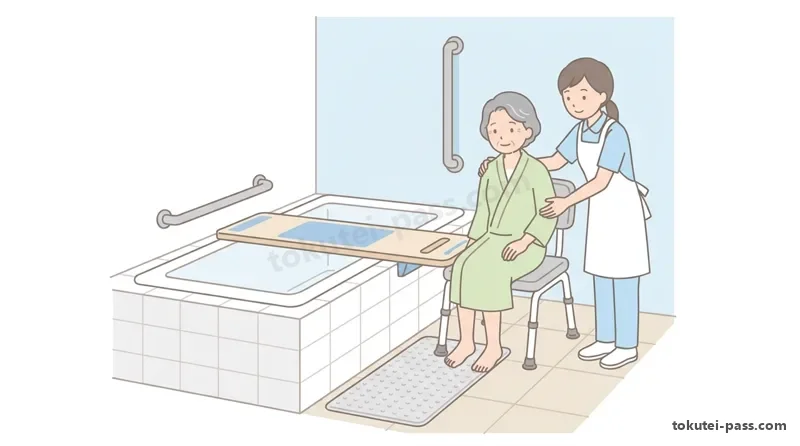
片麻痺のある人が浴槽をまたいで出入りする際は、安全に重心を支えるため、浴槽に「入るときも出るときも『健側(麻痺のない側)の足から』」動かすのが基本です(バスボード等も有効)。
When a person with hemiplegia steps over the bathtub rim, to support their center of gravity safely, the basic rule is to 'step in with the sound leg first AND step out with the sound leg first' (using a bath board is also effective).
入浴が難しい場合は、ストレッチャー型などの「特殊浴槽」、血行や睡眠を促す「足浴・手浴」、ケリーパッドを用いたベッド上洗髪、またはベッド上での「全身清拭」を行います。
When regular bathing is difficult, provide 'special mechanical baths' (stretcher baths), 'foot or hand baths' to promote circulation and sleep, bed hair washing using a Kelly pad, or a 'full-body bed bath' (Zenshin Seishiki).
全身清拭では50〜55℃の熱めの湯でタオルを絞り(肌に当てるときは約40℃)、露出を最小限にして「顔→上肢→胸・腹部→背部→下肢→陰部」の順に拭きます。
In a full-body bed bath, wring towels in hot water at 50–55°C (about 40°C when touching the skin), minimize exposure, and wipe in the order: 'Face → Upper limbs → Chest/Abdomen → Back → Lower limbs → Perineum.'
その際、目は「目頭から目尻へ」一方向に拭き、上肢・下肢は静脈還流を促すため「末梢(手足の先)から中枢(心臓側)へ」、腹部は大腸の走行(上行→横行→下行結腸)に沿って「おへそを中心に『の』の字(時計回り)」に拭きます。
Wipe the eyes in one direction 'from the inner corner to the outer corner,' wipe limbs 'from distal (extremities) to proximal (toward the heart)' to aid venous return, and wipe the abdomen 'clockwise in a circular motion around the navel' following the colon.
陰部洗浄では38〜39℃(人肌程度)の微温湯を用い、尿路感染症を防ぐため、必ず「恥骨側(前・尿道口側)から肛門側(後ろ)へ」向かって一方向に洗い拭きます。
For perineal washing, use warm water at 38–39°C and always wash and pat dry in one direction 'from front (pubic/urethral side) to back (anal side)' to prevent urinary tract infections.
Key points
- 片麻痺の浴槽出入りは「入るときも出るときも健側足から」、食直後の入浴は避ける
Hemiplegia bathtub entry/exit: 'Step in with the sound leg first and step out with the sound leg first'; avoid bathing right after meals - 全身清拭:目は「目頭→目尻」、腹部は「時計回り(のの字)」、四肢は「末梢→中枢」、陰部は「前→後ろ」
Full-body bed bath: Eyes 'inner to outer corner,' abdomen 'clockwise,' limbs 'distal to proximal,' perineum 'front to back'
| Word | Meaning |
|---|---|
| 入浴の3作用(温熱・静水圧・浮力)とヒートショック予防 | 3 physiological effects of bathing and Heat shock prevention |
| 片麻痺の浴槽出入り(健側足から入り健側足から出る) | Bathtub entry and exit in hemiplegia (sound leg first both ways) |
| 全身清拭の方向(目頭から目尻・腹部時計回り・末梢から中枢) | Full-body bed bath directions (inner-to-outer eye, clockwise abdomen, distal-to-proximal limbs) |
| 陰部洗浄(38〜39℃・前から後ろへ) | Perineal wash (38–39°C, front to back) |
排泄の介護・坐薬とグリセリン浣腸・ストーマケア
Excretion Care, Suppositories, Glycerin Enemas, and Stoma Care
排泄の介護では羞恥心への配慮とプライバシー保護を最優先し、朝食後に起こる「胃・結腸反射」を活かしてトイレやポータブルトイレで前傾姿勢(腹圧がかかりやすい姿勢)をとる自然排便を促します。
In excretion care, prioritize privacy and sensitivity to embarrassment; utilize the 'gastrocolic reflex' occurring after breakfast and encourage natural defecation in a forward-leaning posture on the toilet or portable toilet.
おむつ交換では、おむつを重ね使いすると隙間ができて漏れや蒸れ・褥瘡の原因になるため、体型と尿量に合ったサイズ・吸収量のパッドを選び、鼠径部のギャザーをしっかり立てて装着します。
During diaper changes, layering multiple pads creates gaps that cause leakage, dampness, and pressure ulcers; choose pads matching body size and urine volume, and raise the leg gathers snugly along the groin.
介護福祉職が実施できる「坐薬(肛門に挿入する薬)」の介助では、下剤以外の坐薬は事前に排便を済ませ、左側臥位になってもらい、坐薬の「太い方(尖っている先端)から」口呼吸(息を吐くタイミング)に合わせて挿入します。
When assisting with 'suppositories' (non-laxative suppositories require prior defecation), position the user in the 'left lateral position' and insert from the 'thick (pointed) tip first' while the user exhales through the mouth.
市販のディスポーザブル(使い捨て)「グリセリン浣腸器」の介助では、薬液を「39〜40℃」に温め、直腸から下行結腸へ流れやすい「左側臥位」をとり、立位での挿入は直腸穿孔の危険があるため絶対に行いません。
When assisting with a disposable 'glycerin enema,' warm the solution to '39–40°C' and position the user in the 'left lateral position'; never insert in a standing position due to the risk of rectal perforation.
人工肛門(消化管ストーマ)は腹筋や括約筋がないため便意を我慢できず、パウチ(ストーマ袋)に便が1/3〜半分程度たまったら破棄します。装具交換時は皮膚保護剤を皮膚を押さえながらゆっくり剥がします。
Because an intestinal 'stoma' (colostomy/ileostomy) lacks sphincter muscles, bowel movements cannot be controlled; empty the pouch when stool fills 'one-third to one-half' of the bag, and peel the skin barrier slowly while pressing down the skin.
Key points
- 朝食後の「胃・結腸反射」と前傾姿勢による自然排便の促進、おむつの重ね使いは避ける
Promote natural defecation using the post-breakfast 'gastrocolic reflex' and forward-leaning posture; avoid double-layering diapers - グリセリン浣腸は「39〜40℃・左側臥位(立位厳禁)」、ストーマパウチは1/3〜半分で処理する
Glycerin enema: '39–40°C in left lateral position (standing strictly prohibited)'; empty stoma pouches at 1/3 to 1/2 full
| Word | Meaning |
|---|---|
| 胃・結腸反射と排便時の前傾姿勢 | Gastrocolic reflex and forward-leaning defecation posture |
| 坐薬挿入(太い先端側から) | Suppository insertion (pointed/thick end first) |
| グリセリン浣腸(39〜40℃・左側臥位) | Glycerin enema (39–40°C, left lateral position) |
| ストーマ(人工肛門・人工膀胱)とパウチ交換 | Stoma (colostomy / urostomy) and pouch management |
家事援助(調理「さしすせそ」・食品衛生・洗濯・消費生活保護)
Housework Support (Cooking 'Sa-Shi-Su-Se-So,' Food Safety, Laundry, Consumer Protection)
調理支援における調味料の基本順序「さしすせそ」は、「さ=砂糖、し=塩、す=酢、せ=しょうゆ(せうゆ)、そ=みそ」であり、分子が大きく浸透しにくい砂糖を塩より先に入れ、風味が飛びやすいしょうゆやみそは最後に入れます。
In cooking support, the basic seasoning order 'Sa-Shi-Su-Se-So' stands for 'Sa = Sugar, Shi = Salt, Su = Vinegar, Se = Soy sauce, So = Miso'; add sugar before salt because its larger molecules penetrate more slowly, and add soy sauce and miso last to preserve aroma.
食品表示の「消費期限」は劣化が速い食品(弁当・生肉など)の「安全に食べられる期限」であり、「賞味期限」は保存性の高い食品(缶詰など)の「おいしく食べられる期限」です。
On food labels, 'Use-by Date' (Shouhi Kigen) indicates the 'safety limit' for perishable foods, whereas 'Best-before Date' (Shoumi Kigen) indicates the 'quality/taste limit' for shelf-stable foods.
食中毒予防の3原則は「つけない・増やさない・やっつける」であり、ノロウイルス汚染の可能性がある二枚貝等は中心温度「85〜90℃で90秒以上」加熱します。
The 3 principles of food poisoning prevention are 'Do not attach, Do not multiply, Destroy'; bivalves or foods at risk of Norovirus must be heated to a core temperature of '85–90°C for 90 seconds or longer.'
衣類管理では、洗濯表示(桶・漂白の三角・乾燥・アイロン・クリーニング記号)を確認します。ドライクリーニング後のビニール袋は湿気や溶剤残りを防ぐため外して保管し、防虫剤のガスは空気より重いため「衣類の一番上」に置きます。
In clothing care, check laundry symbols, remove plastic covers after dry cleaning to prevent moisture buildup and residual solvents, and place 'mothballs (insect repellents) on top of clothing' because their gas is heavier than air.
一人暮らしや認知症のある高齢者の金銭管理・買物支援では、不審な訪問販売や大量の健康食品・布団の契約書に気づいた際、クーリング・オフ制度や消費者ホットライン(局番なしの「188」)・地域包括支援センターへ速やかにつなぎます。
In shopping and money management support for older adults living alone or with dementia, if suspicious door-to-door sales or excessive contracts are found, connect promptly with the cooling-off system, the Consumer Hotline ('188'), or the Community General Support Center.
Key points
- 調味料「さしすせそ(砂糖→塩→酢→しょうゆ→みそ)」と、ノロウイルスの加熱(85〜90℃で90秒以上)
Seasoning order 'Sa-Shi-Su-Se-So (Sugar → Salt → Vinegar → Soy sauce → Miso)' and Norovirus heating (85–90°C for ≥90 seconds) - 防虫剤は空気より重いため「衣類の上」に置き、消費者被害は消費者ホットライン「188」等へ連携する
Place mothballs 'on top of clothing' (gas is heavier than air), and report consumer fraud to Consumer Hotline '188'
| Word | Meaning |
|---|---|
| 調味料の「さしすせそ」 | Sa-Shi-Su-Se-So seasoning order |
| 消費期限(安全の期限)と賞味期限(おいしさの期限) | Use-by Date (safety limit) and Best-before Date (taste limit) |
| 防虫剤の配置(衣類の一番上) | Placement of mothballs (on top of clothes) |
| 消費者ホットライン(188)とクーリング・オフ | Consumer Hotline (188) and Cooling-off system |
安眠支援・終末期の介護と福祉用具の活用
Sleep Support, End-of-Life Care, and Utilization of Assistive Devices
良質な睡眠を促すため、朝は日光を浴びて体内時計をリセットし、日中は適度に活動し、就寝1〜2時間前のぬるめの入浴や足浴で深部体温が下がるリズムを作ります。ベッドメイキングではシワを作らないようシーツをピンと張り、コーナーは三角または四角に折り込みます。
To promote quality sleep, get morning sunlight to reset the biological clock, stay moderately active during the day, and take a warm bath or foot bath 1–2 hours before bed. In bed-making, pull sheets taut without wrinkles to prevent pressure ulcers.
終末期(ターミナル期)の看取りケアでは、食事や水分摂取量の減少、下顎呼吸や無呼吸を繰り返す「チェーン・ストークス呼吸」などの身体的変化を家族へ丁寧に説明して不安を和らげます。
In end-of-life (terminal) care, gently explain natural physical changes—such as decreased food/fluid intake, mandibular breathing, and 'Cheyne-Stokes respiration' (alternating deep breathing and apnea)—to alleviate family anxiety.
死亡確認は医師(または一定条件下の看護師)が行い、その後に尊厳を保ち生前の穏やかな姿に整える「エンゼルケア(死後の処置)」や遺族の悲嘆に寄り添う「グリーフケア」、チームでケアを振り返る「デスカンファレンス」を行います。
After a physician confirms death, perform 'Angel Care' (post-mortem care preserving dignity and a peaceful appearance), 'Grief Care' (supporting bereaved family members), and a 'Death Conference' (team reflection to improve future care).
福祉用具では、握力が低下した人や関節リウマチの人が前腕と手の2点で支える「ロフストランド・クラッチ」、安定性の高い「多点杖」、交互に前へ出す「交互式歩行器」など身体機能に合わせて選定します。
For mobility aids, select 'Lofstrand crutches' (supported at two points by forearm cuff and grip) for users with weak grip strength or rheumatoid arthritis, 'multi-point canes' for high stability, or 'reciprocal walkers' matched to physical function.
このほか、靴下を履くための「ソックスエイド(ストッキングエイド)」、ボタンをかける「ボタンエイド」、携帯用会話補助装置や点字器などの自助具・日常生活用具を活用し、使用後も適合状況をモニタリングします。
Additionally, utilize self-help devices (Jijogu) and daily living aids such as 'sock aids,' 'button hooks,' portable conversation aids, and Braille slates, while continuously monitoring their fit after introduction.
Key points
- 終末期のチェーン・ストークス呼吸の理解と、エンゼルケア・グリーフケア・デスカンファレンスの意義
Understand Cheyne-Stokes respiration in terminal stages and the purposes of Angel Care, Grief Care, and Death Conferences - ロフストランド・クラッチ(前腕支持)、多点杖、バスボード、ソックスエイドなど福祉用具・自助具の選定
Select appropriate assistive devices: Lofstrand crutches (forearm support), multi-point canes, bath boards, and sock aids
| Word | Meaning |
|---|---|
| チェーン・ストークス呼吸と下顎呼吸 | Cheyne-Stokes respiration and Mandibular breathing |
| エンゼルケア・グリーフケア・デスカンファレンス | Angel Care, Grief Care, and Death Conference |
| ロフストランド・クラッチと多点杖・歩行器 | Lofstrand crutches, Multi-point canes, and Walkers |
| 自助具(ソックスエイド・ボタンエイド) | Self-help devices (Sock aid, Button hook) |
Daily Living Support Skills
Practice this chapter in the appOfficial references
- 公益財団法人社会福祉振興・試験センター「介護福祉士国家試験 試験科目別出題基準(生活支援技術)」 — https://www.sssc.or.jp/kaigo/kijun/index.html
- 厚生労働省「介護福祉士養成課程 カリキュラム(生活支援技術)」 — https://www.mhlw.go.jp/stf/seisakunitsuite/bunya/hukushi_kaigo/seikatsuhogo/kaigo-fukushishi/index.html