
Occupational Safety, Health & Environmental Management Fundamentals
安全衛生・環境管理基礎
Production Management Planning Grade 3 生産管理プランニング (BC検定) · ビジネス・キャリア検定 生産管理プランニング3級 · Written by Tokutei Pass based on the official study texts; not copied verbatim.
1. 労働安全衛生法の目的・「労働者」の定義と安全衛生管理体制
1. Purpose of the Industrial Safety and Health Act, Definition of "Worker," and Management Organization
「労働安全衛生法」は、労働基準法と相まって、危害防止基準の確立・責任体制の明確化・自主的活動の促進により、職場における労働者の安全と健康を確保するとともに「快適な職場環境の形成」を促進することを目的としています。
The "Industrial Safety and Health Act," in conjunction with the Labor Standards Act, aims to secure the safety and health of workers in the workplace and promote the "formation of a comfortable working environment" by establishing hazard-prevention standards, clarifying responsibility structures, and encouraging voluntary safety activities.
同法における「労働者」とは労働基準法と同義(事業に使用され賃金を支払われる者)であり、正社員だけでなく「短期のパートタイマーやアルバイト・契約社員」もすべて含まれます(※「短期アルバイトは労働者に含まれない」は頻出の誤り選択肢です)。
The term "Worker" under this Act has the same meaning as in the Labor Standards Act (any person employed at an enterprise who receives wages) and includes not only regular full-time employees but also "short-term part-timers, temporary/arubaito workers, and contract employees" (Note: the statement "short-term part-time workers are excluded from 'workers'" is a frequent FALSE exam trap).
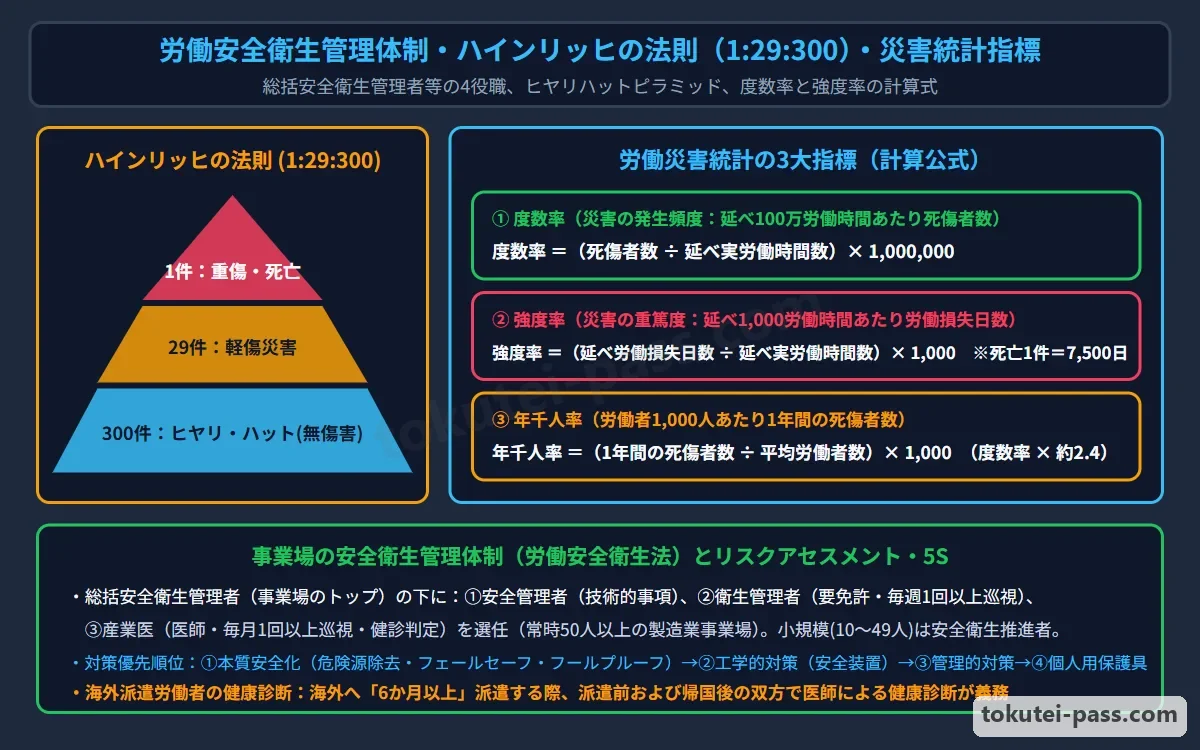
常時「50人以上」の労働者を使用する製造業の事業場では、「安全管理者」「衛生管理者」「産業医」を選任し、「安全衛生委員会(毎月1回以上開催)」を設置します(10〜49人は「安全衛生推進者」、300人以上は工場長等を「総括安全衛生管理者」に選任します)。
A manufacturing workplace regularly employing "50 or more workers" must appoint a "Safety Officer," a "Health Officer," and an "Industrial Physician," and establish a "Safety and Health Committee (meeting at least once a month)" (10–49 workers require a "Safety and Health Promoter"; 300 or more workers require appointing the plant manager as "General Safety and Health Manager").
職場巡視の義務頻度は、安全管理者が随時、「衛生管理者」が「少なくとも毎週1回」、「産業医」が「少なくとも毎月1回(一定条件と事業者同意で2か月に1回)」です。
Mandatory workplace patrol frequencies are: Safety Officer as needed; "Health Officer" "at least once every week"; and "Industrial Physician" "at least once every month (or once every two months if specified conditions are met and the employer consents)."
Key points
- 労働安全衛生法の目的=労働者の安全と健康の確保+「快適な職場環境の形成」の促進(※「労働者」には短期パート・アルバイトも含まれる!)。
Purpose of the Industrial Safety and Health Act = securing worker safety and health + promoting the "formation of a comfortable working environment" (Note: "Worker" includes short-term part-timers and arubaito!). - 製造業で常時50人以上の事業場=「安全管理者・衛生管理者・産業医」の選任と「安全衛生委員会(月1回以上)」の設置が義務。
Manufacturing workplaces with 50 or more regular workers = mandatory appointment of "Safety Officer, Health Officer, and Industrial Physician" and establishment of a "Safety and Health Committee (meets ≥ once/month)." - 職場巡視の義務頻度:衛生管理者=「少なくとも毎週1回」/産業医=「少なくとも毎月1回」。
Mandatory workplace patrol frequency: Health Officer = "at least once a week" / Industrial Physician = "at least once a month."
| Word | Meaning |
|---|---|
| 労働安全衛生法(快適な職場環境の形成) | Industrial Safety and Health Act (formation of a comfortable working environment) |
| 労働者の定義(パート・アルバイトも含む) | definition of Worker (includes part-timers and arubaito) |
| 安全管理者・衛生管理者・産業医(50人以上) | Safety Officer, Health Officer, and Industrial Physician (50 or more workers) |
| 職場巡視(衛生管理者=週1回、産業医=月1回) | workplace patrol (Health Officer = weekly; Industrial Physician = monthly) |
2. ハインリッヒの法則(1:29:300)と労働災害統計指標(度数率・強度率・年千人率)
2. Heinrich's Law (1 : 29 : 300) and Occupational Accident Statistics (Frequency Rate, Severity Rate, Annual Rate per 1,000)
1件の重大災害(死亡・重傷)の背後には、29件の軽傷災害と、300件の無傷事故(ヒヤリ・ハット)が存在するという経験則を「ハインリッヒの法則(1:29:300の法則)」といい、重大災害をなくすには300件のヒヤリ・ハットや不安全行動・不安全状態の段階で摘み取ることが重要です。
The empirical rule stating that behind 1 major accident (fatality or serious injury) lie 29 minor injury accidents and 300 no-injury near-miss incidents (Hiyari-Hatto) is called "Heinrich's Law (the 1 : 29 : 300 Law)"; eliminating major accidents requires addressing the 300 near-misses as well as unsafe acts and unsafe conditions.
労働災害の発生状況を評価する統計指標の1つ目「度数率」は、100万延べ実労働時間あたりの死傷者数で、災害発生の「頻度」を表します。公式は「度数率=(死傷者数÷延べ実労働時間数)×1,000,000」です(不休災害は含めず、休業1日以上が対象)。
First among occupational accident statistical indicators, the "Frequency Rate (Dosuuritsu)" represents the number of casualties per 1,000,000 total actual working hours, expressing accident "frequency." Its formula is "Frequency Rate = (Number of Casualties ÷ Total Actual Working Hours) × 1,000,000" (for casualties requiring 1 or more days of absence, excluding no-lost-time injuries).
2つ目の「強度率」は、1,000延べ実労働時間あたりの労働損失日数で、災害の「重篤度(重さ)」を表します。公式は「強度率=(延べ労働損失日数÷延べ実労働時間数)×1,000」です(死亡や永久全労働不能は「7,500日」、一時労働不能は「休業日数×(300÷365)」で換算)。
Second, the "Severity Rate (Kyoudoritsu)" represents lost workdays per 1,000 total actual working hours, expressing accident "severity." Its formula is "Severity Rate = (Total Lost Workdays ÷ Total Actual Working Hours) × 1,000" (fatality or permanent total disability = "7,500 days"; temporary disability = "Days of Absence × (300 ÷ 365)").
3つ目の「年千人率」は、労働者1,000人あたり1年間に発生する死傷者数を示し、「年千人率=(1年間の死傷者数÷1年間の平均労働者数)×1,000」で計算します。
Third, the "Annual Incidence Rate per 1,000 Workers (Nen-sennin-ritsu)" indicates annual casualties per 1,000 workers, calculated as "Annual Rate per 1,000 = (Annual Casualties ÷ Average Number of Workers during the Year) × 1,000."
Key points
- ハインリッヒの法則=「1件の重大災害:29件の軽傷災害:300件のヒヤリ・ハット(無傷事故)」。
Heinrich's Law = "1 major injury : 29 minor injuries : 300 no-injury near-misses (Hiyari-Hatto)." - 度数率(頻度)=(死傷者数÷延べ実労働時間)×1,000,000/強度率(重さ)=(延べ労働損失日数÷延べ実労働時間)×1,000(死亡=7,500日)。
Frequency Rate (frequency) = (Casualties ÷ Total Actual Working Hours) × 1,000,000 / Severity Rate (seriousness) = (Total Lost Workdays ÷ Total Actual Working Hours) × 1,000 (death = 7,500 days). - 年千人率=(年間死傷者数÷年間平均労働者数)×1,000。
Annual Rate per 1,000 Workers = (Annual Casualties ÷ Average Annual Workers) × 1,000. - 【例】平均労働者数400人・年間延べ実労働時間800,000時間で死傷者2人 → 度数率=2÷800,000×1,000,000=2.5、年千人率=2÷400×1,000=5.0
Example: Average 400 workers, 800,000 total actual working hours/year, 2 casualties → Frequency rate = 2 ÷ 800,000 × 1,000,000 = 2.5; Annual rate per 1,000 workers = 2 ÷ 400 × 1,000 = 5.0 - 【例】延べ実労働時間800,000時間で延べ労働損失日数400日(うち休業365日の換算損失日数=365×300÷365=300日) → 強度率=400÷800,000×1,000=0.5
Example: 800,000 total actual working hours and 400 total lost workdays (including 365 absence days converted as 365 × 300 ÷ 365 = 300 lost days) → Severity rate = 400 ÷ 800,000 × 1,000 = 0.5
| Word | Meaning |
|---|---|
| ハインリッヒの法則(1:29:300とヒヤリ・ハット) | Heinrich's Law (1 : 29 : 300 and near-misses / Hiyari-Hatto) |
| 度数率(100万時間あたりの死傷者数:頻度) | Frequency Rate (casualties per 1,000,000 working hours: frequency) |
| 強度率(1,000時間あたりの労働損失日数:重さ) | Severity Rate (lost workdays per 1,000 working hours: severity) |
| 年千人率(労働者1,000人あたりの年間死傷者数) | Annual Rate per 1,000 Workers (annual casualties per 1,000 workers) |
3. 本質安全化(フェールセーフ・フールプルーフ)と機械設備の計画届・特定機械等・特定自主検査
3. Inherent Safety (Fail-Safe / Fool-Proof), Plan Notification, Specified Machinery, and Specified Autonomous Inspection
機械設備の「本質安全化(安全設計)」の2大原則が「フェールセーフ」と「フールプルーフ」です。「フェールセーフ」は機械が故障・停電しても必ず安全側(停止側)に働く設計であり、「フールプルーフ」は人間が誤操作しても危険が生じない仕組み(インターロックや両手操作式安全装置など)です。
The two major principles of "Inherent Machine Safety" are "Fail-Safe" and "Fool-Proof." "Fail-Safe" ensures that even if a machine fails or loses power, it always defaults to the safe (stopped) state; "Fool-Proof" ensures that even if a human misoperates a control, no hazard arises (such as interlocks or two-hand press safety controls).
プランニング3級では、危険な機械設備の行政手続きが出題されます。まず「動力プレス機械」や「局所排気装置」などを設置・移転・変更しようとする事業者は、その計画を「工事開始の30日前まで」に「労働基準監督署長」へ届け出なければなりません。
The Grade 3 Planning exam tests administrative filings for hazardous machinery. First, an employer planning to install, relocate, or alter a "Power Press Machine" or "Local Exhaust Ventilation System" must file the plan with the "Chief of the Labor Standards Inspection Office (Roudou Kijun Kantokusho-chou)" "at least 30 days prior to the start of construction."
また特に危険度が高い「特定機械等(ボイラー、第一種圧力容器、つり上げ荷重3t以上のクレーン・移動式クレーン、デリック、エレベーター、ゴンドラ)」を製造する際にはあらかじめ「都道府県労働局長の製造許可」が必要であり、設置した際には「労働基準監督署長の落成検査」を受けて「検査証」の交付を受けなければ使用できません。
For particularly hazardous "Specified Machinery, etc. (Boilers, Class-1 Pressure Vessels, Cranes and Mobile Cranes with a lifting capacity of 3 tons or more, Derricks, Elevators, Gondolas)," manufacturing requires prior "Manufacturing Permission from the Prefectural Labor Bureau Director," and installation requires passing a "Completion Inspection (Rakusei Kensa) by the Chief of the Labor Standards Inspection Office" and receiving an "Inspection Certificate."
さらに動力プレスやフォークリフトについては、「1年以内ごとに1回」有資格者(または登録検査業者)による「特定自主検査」を実施し、「検査標章」を貼付して記録を3年間保存する義務があります。
Furthermore, for power presses and forklifts, employers must conduct a "Specified Autonomous Inspection" "at least once every year" by a qualified inspector (or registered inspection agency), affix an "Inspection Sticker," and retain records for 3 years.
Key points
- フェールセーフ=故障時に安全側(停止側)へ働く設計/フールプルーフ=人間が誤操作しても危険にならない設計(インターロック・両手操作スイッチ等)。
Fail-Safe = design defaulting to the safe (stopped) side upon failure / Fool-Proof = design preventing danger even upon human misoperation (interlocks, two-hand switches, etc.). - 動力プレスや局所排気装置の設置計画届=「工事開始の30日前まで」に「労働基準監督署長」へ届出。
Installation plan notification for power presses or local exhaust ventilation = file with the "Chief of the Labor Standards Inspection Office" "at least 30 days before construction starts." - 特定機械等(ボイラー・3t以上クレーン等)=「都道府県労働局長の製造許可」および設置時の「労働基準監督署長の落成検査(検査証交付)」が義務。
Specified Machinery (Boilers, Cranes ≥ 3t, etc.) = requires "Manufacturing Permission from the Prefectural Labor Bureau Director" and "Completion Inspection (Inspection Certificate issuance) by the Chief of the Labor Standards Inspection Office" upon installation.
| Word | Meaning |
|---|---|
| フェールセーフとフールプルーフ(インターロック) | Fail-Safe and Fool-Proof (Interlock) |
| 計画届(工事開始の30日前までに労働基準監督署長へ届出) | Plan Notification (filed with Labor Standards Inspection Office Chief ≥ 30 days before construction) |
| 特定機械等(製造許可と落成検査・検査証) | Specified Machinery (Manufacturing Permission, Completion Inspection, Inspection Certificate) |
| 特定自主検査(1年以内ごとに1回・検査標章) | Specified Autonomous Inspection (once a year and Inspection Sticker) |
4. リスクアセスメントの優先順位と安全衛生教育・就業制限業務
4. Risk Assessment Priority Hierarchy, Safety Education, and Restricted Work
職場の潜在的な危険性や有害性を特定し、リスク(災害の重篤度×発生可能性)を見積もって優先度に応じ低減措置をとる手法が「リスクアセスメント」です。
"Risk Assessment" is the systematic process of identifying potential workplace hazards or harmful factors, estimating their risk (Severity × Probability), and implementing risk-reduction measures in order of priority.
リスク低減措置の優先順位は、法令遵守を大前提として、①「危険な作業の廃止・代替などの本質安全設計」、②「安全ガード・インターロック・局所排気装置などの工学的対策」、③「マニュアル整備や立入禁止などの管理的対策」、そして最後の補完手段が④「個人用保護具の着用」です。
With legal compliance as an absolute prerequisite, the priority order for risk reduction is: ① "Inherent Safety Design (eliminating or substituting hazardous work/substances)," ② "Engineering Controls (safety guards, interlocks, local exhaust ventilation)," ③ "Administrative Controls (manuals, warning signs, restricted entry)," and finally ④ "Using Personal Protective Equipment (PPE)."
また事業者は、雇入れ時や作業内容変更時に「安全衛生教育」を行うほか、アーク溶接や低圧電気取扱・産業用ロボット教示などの危険有害業務に就かせる際には「特別教育」を行わなければなりません。
Employers must provide "Safety and Health Education" upon hiring or changing job duties, and must conduct "Special Education" before assigning workers to designated hazardous tasks such as arc welding, low-voltage electrical work, or industrial robot teaching.
さらに危険度が高い「就業制限業務(最大荷重1t以上のフォークリフト運転、つり上げ荷重1t以上の玉掛け、5t以上のクレーン運転[免許]、ガス溶接など)」では、都道府県労働局長の「免許」や登録教習機関の「技能講習」を修了した有資格者でなければ業務に就かせてはなりません(また危険有害作業では「作業主任者」を選任します)。
For higher-hazard "Restricted Work" (forklifts with max load ≥ 1 ton, slinging/Tamagake ≥ 1 ton, crane operation ≥ 5 tons (License), gas welding, etc.), only qualified personnel holding a "License" from the Prefectural Labor Bureau Director or having completed a "Skill Training Course" may be assigned (and an "Operations Chief" must be appointed for hazardous work).
Key points
- リスクアセスメントの低減優先順位:①本質安全化(危険源の排除・代替)→②工学的対策(防護柵・安全装置)→③管理的対策(手順・教育)→④保護具の使用(最後の手段)。
Risk Assessment reduction priority: ① Inherent safety (elimination/substitution) → ② Engineering controls (guards, safety devices) → ③ Administrative controls (procedures, training) → ④ Personal Protective Equipment (last resort). - 安全衛生教育=雇入れ時・作業内容変更時の教育、および一定の危険有害業務に就く際の「特別教育」。
Safety & Health Education = education upon hiring or job change, plus "Special Education" when assigning specific hazardous tasks. - 就業制限業務(免許・技能講習が必須)=最大荷重1t以上のフォークリフト、つり上げ荷重1t以上の玉掛け、5t以上のクレーン運転、ガス溶接など。
Restricted Work (requires License or Skill Training Course) = Forklifts ≥ 1 ton, Slinging (Tamagake) ≥ 1 ton, Crane operation ≥ 5 tons, Gas welding, etc.
| Word | Meaning |
|---|---|
| リスクアセスメントとリスク低減措置の優先順位 | Risk Assessment and priority hierarchy of risk-reduction measures |
| 雇入れ時教育と特別教育 | education upon hiring and Special Education |
| 就業制限業務(免許・技能講習) | Restricted Work (License and Skill Training Course) |
| 作業主任者の選任 | appointment of an Operations Chief (Sagyou Shuninsha) |
5. 労働衛生の3管理・作業環境測定(第1〜第3管理区分)と健康診断(海外派遣者健診)
5. Three Managements of Occupational Health, Working Environment Measurement (Classes 1–3), and Health Exams (Overseas Dispatch)
職業性疾病を防ぐ「労働衛生の3管理」とは、①「作業環境管理(有害物発散源の密閉化・局所排気装置の設置・照明や温湿度の適正化など環境そのものの改善)」、②「作業管理(有害作業時間の短縮・作業姿勢・保護具着用など作業方法の管理)」、③「健康管理(健康診断や事後措置)」です。
The "Three Managements of Occupational Health" are: ① "Working Environment Management (enclosing hazard sources, installing local exhaust ventilation, optimizing lighting/temperature/humidity)," ② "Work Management (shortening hazardous exposure time, ergonomic posture, proper PPE use)," and ③ "Health Management (medical examinations and follow-up care)."
粉じん・有機溶剤・特定化学物質・騒音などの有害作業場では、定期的(多くは6か月以内ごとに1回)に「作業環境測定」を行い、3つの「管理区分」で評価します。「第1管理区分」は適切(維持)、「第2管理区分」は改善余地あり、「第3管理区分」は不適切で直ちに設備改善と保護具使用が義務づけられます。
In hazardous workplaces handling dust, organic solvents, specified chemicals, or noise, employers must periodically (typically once every 6 months) conduct "Working Environment Measurement" and evaluate results into three "Control Classes": "Class 1" is appropriate (maintain); "Class 2" requires improvement efforts; and "Class 3" is inappropriate—requiring immediate equipment inspection/improvement and mandatory respiratory PPE.
また「一般健康診断」には、雇入れ時および1年以内ごとに1回の「定期健康診断」、深夜業等の「特定業務従事者健診(配置替え時および6か月以内ごとに1回)」があります。さらに有機溶剤・鉛・じん肺などの有害業務では「特殊健康診断(原則6か月以内ごとに1回)」を実施します。
"General Health Examinations" include exams upon hiring, periodic annual exams (once every year), and exams for night-shift/specified workers (upon reassignment and "once every 6 months"). Hazardous work involving organic solvents, lead, or dust requires "Special Health Examinations (generally once every 6 months)."
加えてプランニング3級では、「海外に6か月以上派遣する労働者の健康診断」が頻出です。事業者は、労働者を本邦外(海外)に「6か月以上」派遣しようとするとき(派遣前)、および6か月以上の海外勤務から帰国させ国内業務に就かせるとき(帰国後)に、医師による健康診断を行わなければなりません。
Furthermore, the Grade 3 Planning exam frequently tests "Health Examinations for Workers Dispatched Overseas for 6 Months or More." Employers must provide a physician's medical examination both "before dispatching" a worker overseas for 6 months or more AND "after returning" to domestic duties from an overseas assignment of 6 months or more.
Key points
- 労働衛生の3管理:①作業環境管理(局所排気装置・密閉化)+②作業管理(作業時間・姿勢・保護具)+③健康管理(健康診断)。
Three Managements of Occupational Health: ① Working Environment Management (local exhaust ventilation, enclosure) + ② Work Management (hours, posture, PPE) + ③ Health Management (health exams). - 作業環境測定:第1管理区分(良好)、第2管理区分(改善努力)、第3管理区分(不適切→直ちに設備改善と保護具着用が義務)。
Working Environment Measurement: Control Class 1 (good), Control Class 2 (strive to improve), Control Class 3 (inappropriate → immediate equipment improvement and PPE mandatory). - 海外派遣労働者の健康診断=海外に「6か月以上」派遣する際、「派遣前」および「帰国後」の両方で実施する義務がある。
Overseas Dispatch Health Exam = mandatory both "before dispatch" and "upon return" when dispatching a worker overseas for "6 months or more."
| Word | Meaning |
|---|---|
| 労働衛生の3管理(作業環境管理・作業管理・健康管理) | Three Managements of Occupational Health (Working Environment, Work, Health) |
| 作業環境測定(第1・第2・第3管理区分) | Working Environment Measurement (Control Classes 1, 2, and 3) |
| 一般健康診断・特殊健康診断(6か月以内ごとに1回) | General Health Examination and Special Health Examination (once every 6 months) |
| 海外派遣労働者の健康診断(6か月以上:派遣前・帰国後) | Health Examination for Overseas Dispatched Workers (≥ 6 months: pre-dispatch and post-return) |
6. 産業公害の歴史(足尾銅山・四大公害病)と環境基本法の3理念・典型7公害
6. History of Industrial Pollution (Ashio Copper Mine, Four Big Pollution Diseases) & Basic Environment Act Principles / Typical 7 Pollutions
日本の産業公害の歴史は、明治〜大正期の鉱工業発展に伴う「足尾銅山鉱毒事件(栃木県渡良瀬川流域)」「別子銅山煙害事件(愛媛県)」「大阪アルカリ事件」などに始まり、戦後の高度経済成長期(1950〜60年代)には深刻な「四大公害病」が発生しました。
Japan's history of industrial pollution began in the Meiji–Taisho eras with mining and industrial growth—such as the "Ashio Copper Mine Mineral Pollution Incident (Watarase River basin, Tochigi)," the "Besshi Copper Mine Smoke Pollution Incident (Ehime)," and the "Osaka Alkali Incident"—followed during the post-war rapid economic growth era (1950s–1960s) by the severe "Four Big Pollution Diseases."
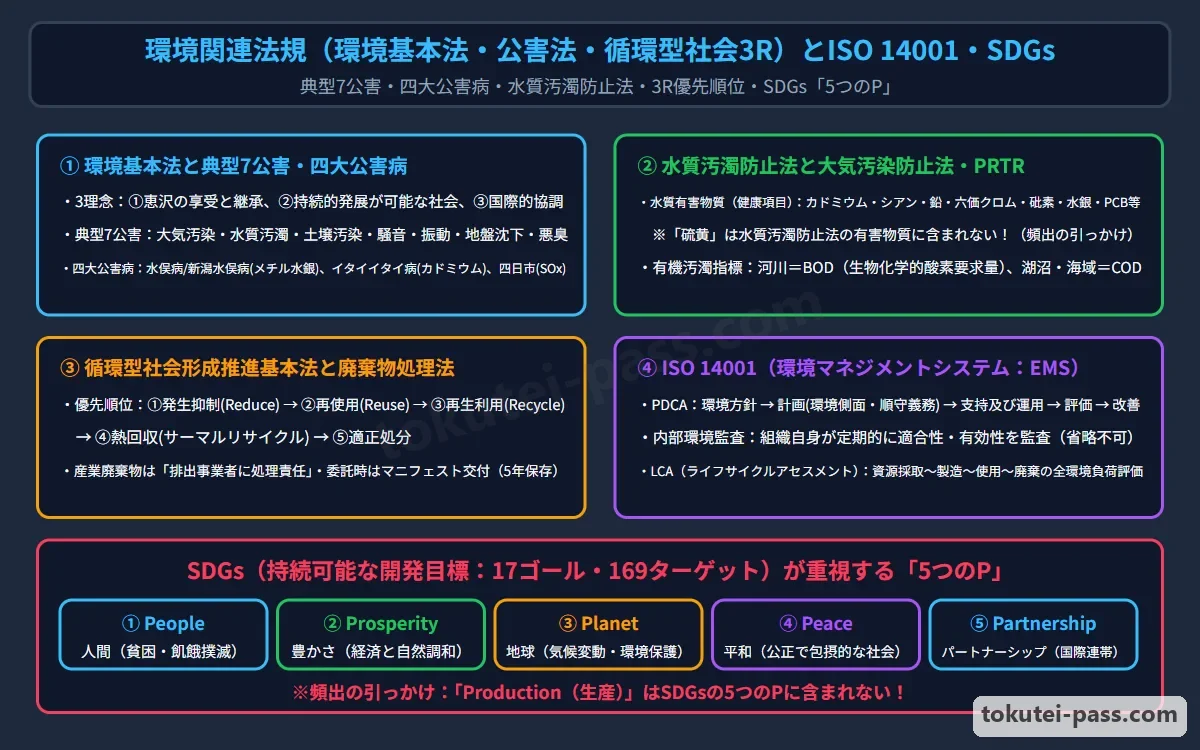
四大公害病の「地域と原因物質」は、①「水俣病(熊本県水俣湾)」と②「新潟水俣病(阿賀野川流域)」が工場排水の「メチル水銀(有機水銀)化合物」、③「イタイイタイ病(富山県神通川流域)」が鉱山排水の「カドミウム」、④「四日市ぜんそく(三重県)」が「硫黄酸化物(SOx:亜硫酸ガス等)」です。
The "regions and causative substances" of the Four Big Pollution Diseases are: ① "Minamata Disease (Kumamoto)" and ② "Niigata Minamata Disease (Agano River, Niigata)" caused by "Methylmercury compounds" in factory effluent; ③ "Itai-itai Disease (Jinzu River, Toyama)" caused by "Cadmium" in mine wastewater; and ④ "Yokkaichi Asthma (Mie)" caused by "Sulfur Oxides (SOx)" from petrochemical complexes.
1993年に制定された「環境基本法」は、「3つの基本理念」として①環境の恵沢の享受と継承(将来世代への継承)、②環境への負荷の少ない持続的発展が可能な社会の構築、③国際的協調による地球環境保全の積極的推進を掲げています(※「快適な職場環境の形成」は労働安全衛生法であり環境基本法ではないという引っかけが頻出です!)。
Enacted in 1993, the "Basic Environment Act" sets forth "Three Basic Principles": ① Enjoyment and inheritance of environmental blessings for future generations, ② Building a sustainable society with reduced environmental load, and ③ Actively promoting global environmental conservation through international cooperation (Watch out for a frequent exam trap: "Formation of a comfortable working environment" belongs to the Industrial Safety and Health Act, NOT the Basic Environment Act!).
また環境基本法では、事業活動等によって人の健康や生活環境に被害が生じる「典型7公害」として、①大気汚染、②水質汚濁、③土壌汚染、④騒音、⑤振動、⑥地盤沈下、⑦悪臭の7つを定義しています。
The Basic Environment Act also defines the "Typical 7 Pollutions": ① Air Pollution, ② Water Pollution, ③ Soil Contamination, ④ Noise, ⑤ Vibration, ⑥ Ground Subsidence, and ⑦ Offensive Odors.
Key points
- 明治〜大正期の産業公害=足尾銅山鉱毒事件・別子銅山煙害事件/高度経済成長期=四大公害病(水俣・新潟=メチル水銀、イタイイタイ病=カドミウム、四日市=SOx)。
Meiji–Taisho industrial pollution = Ashio Copper Mine & Besshi Copper Mine incidents / Rapid growth era = Four Big Pollution Diseases (Minamata & Niigata = Methylmercury, Itai-itai = Cadmium, Yokkaichi = SOx). - 環境基本法の3理念=①環境の恵沢の享受と継承、②環境負荷の少ない持続的発展社会の構築、③国際的協調による地球環境保全(※「快適な職場環境の形成」は労働安全衛生法!)。
Three Basic Principles of the Basic Environment Act = ① Enjoyment & inheritance of environmental blessings, ② Sustainable society with low environmental load, ③ Global conservation via international cooperation (Note: "comfortable working environment" is the Industrial Safety and Health Act!). - 環境基本法の「典型7公害」=①大気汚染、②水質汚濁、③土壌汚染、④騒音、⑤振動、⑥地盤沈下、⑦悪臭。
"Typical 7 Pollutions" of the Basic Environment Act = ① Air pollution, ② Water pollution, ③ Soil contamination, ④ Noise, ⑤ Vibration, ⑥ Ground subsidence, ⑦ Offensive odors.
| Word | Meaning |
|---|---|
| 足尾銅山鉱毒事件と四大公害病 | Ashio Copper Mine incident and the Four Big Pollution Diseases |
| メチル水銀・カドミウム・硫黄酸化物(SOx) | Methylmercury, Cadmium, and Sulfur Oxides (SOx) |
| 環境基本法の3つの基本理念 | Three Basic Principles of the Basic Environment Act |
| 典型7公害 | Typical 7 Pollutions |
7. 公害防止法規(大気・水質汚濁防止法の有害物質と3年保存・産廃マニフェスト)
7. Pollution Control Laws (Air, Water Pollution Harmful Substances & 3-Year Record Retention, Waste Manifest)
「大気汚染防止法」は、ばい煙発生施設から出る「ばい煙(硫黄酸化物SOx・ばいじん・窒素酸化物NOx等)」、塗装・洗浄工程から出る「揮発性有機化合物(VOC)」、建物解体時等の「特定粉じん(石綿=アスベスト)」などを規制します。
The "Air Pollution Control Act" regulates "Soot and Smoke (SOx, dust, NOx)" from boilers/incinerators, "Volatile Organic Compounds (VOCs)" from painting/cleaning processes, and "Specified Particulates (Asbestos)" during building demolition.
「水質汚濁防止法」は、特定施設からの排水につき、カドミウム・シアン・有機リン・鉛・六価クロム・砒素・水銀・PCB・トリクロロエチレン等の「有害物質(健康項目)」を規制します(※「硫黄」は有害物質に含まれません)。また有機汚濁指標は「河川=BOD(生物化学的酸素要求量)」「湖沼・海域=COD(化学的酸素要求量)」です。
The "Water Pollution Prevention Act" regulates "Harmful Substances (human health items)" in effluent such as cadmium, cyanide, organic phosphorus, lead, hexavalent chromium, arsenic, mercury, PCBs, and trichloroethylene (Watch out for a classic exam trap: "Sulfur (Iou)" is NOT included among the Harmful Substances of the Water Pollution Prevention Act!). Organic water pollution indicators are "BOD" for "Rivers" and "COD" for "Lakes/Marshes and Sea Areas."
プランニング3級では水質汚濁防止法の手続きも問われます。特定施設を設置しようとする者は「都道府県知事(または政令市長)」に届け出なければならず(工事着手制限は届出受理から60日間)、排出水の汚染状態を測定してその結果を記録し「3年間保存」する義務があります(※「20年間保存」は誤り)。
The Grade 3 Planning exam also tests Water Pollution Prevention Act procedures: anyone installing a Specified Facility must file a notification with the "Prefectural Governor (or designated city mayor)" (subject to a 60-day construction restriction from receipt), and must measure effluent pollution levels, record the results, and "retain the records for 3 years" (Note: "20 years" is FALSE).
「廃棄物処理法」では、汚泥・廃油・廃プラ等の「産業廃棄物」は「排出事業者に処理責任」があり、委託時は「マニフェスト(管理票)」を交付し5年間保存します。また「循環型社会形成推進基本法」では、①発生抑制(リデュース)→②再使用(リユース)→③再生利用(リサイクル)→④熱回収→⑤適正処分の優先順位です。
Under the "Waste Management Act," "Industrial Waste" is the "responsibility of the waste-generating business," which must issue a "Manifest" when outsourcing disposal and retain copies for 5 years. Furthermore, the "Basic Act for Establishing a Sound Material-Cycle Society" sets the priority order: ① Reduce → ② Reuse → ③ Recycle (material recycling) → ④ Heat Recovery (thermal recycling) → ⑤ Proper Disposal.
Key points
- 水質汚濁防止法の有害物質=カドミウム・シアン・鉛・六価クロム・砒素・水銀・トリクロロエチレン等(※「硫黄」は含まれない!)。河川=BOD、湖沼・海域=COD。
Harmful Substances under the Water Pollution Prevention Act = cadmium, cyanide, lead, hexavalent chromium, arsenic, mercury, trichloroethylene, etc. ("Sulfur" is NOT included!). Rivers = BOD; Lakes & Sea = COD. - 水質汚濁防止法の特定施設設置は「都道府県知事」へ届出/排出水の水質測定結果の記録保存期間は「3年間」(※20年ではない)。
Specified Facility installation under the Water Pollution Prevention Act is notified to the "Prefectural Governor" / Water quality measurement records must be "retained for 3 years" (NOT 20 years). - 循環型社会の優先順位:①リデュース(発生抑制)→②リユース(再使用)→③リサイクル(再生利用)→④熱回収→⑤適正処分(産廃委託はマニフェストを交付)。
Sound Material-Cycle priority order: ① Reduce → ② Reuse → ③ Recycle → ④ Heat Recovery → ⑤ Proper Disposal (outsourced industrial waste requires a Manifest).
| Word | Meaning |
|---|---|
| 水質汚濁防止法の有害物質と水質測定記録(3年間保存) | Water Pollution Prevention Act Harmful Substances and measurement records (3-year retention) |
| BOD(河川)とCOD(湖沼・海域) | BOD (Rivers) and COD (Lakes/Marshes and Sea Areas) |
| 産業廃棄物とマニフェスト制度(5年間保存) | Industrial Waste and the Manifest System (5-year retention) |
| 3R(リデュース・リユース・リサイクル)と熱回収 | 3Rs (Reduce, Reuse, Recycle) and Heat Recovery (thermal recycling) |
8. ISO 14001(環境マネジメントシステム・内部環境監査)とSDGs(5つのP)
8. ISO 14001 (Environmental Management System & Internal Environmental Audit) and the SDGs (The 5 Ps)
組織が自主的・継続的に環境負荷の低減や汚染の予防に取り組むための「環境マネジメントシステム(EMS)」の国際規格が「ISO 14001」です。
The international standard for an "Environmental Management System (EMS)" enabling organizations to voluntarily and continually reduce environmental impact and prevent pollution is "ISO 14001."
ISO 14001では、経営トップの「環境方針」のもと、①計画(Plan:環境側面・順守義務・環境目標)→②支持及び運用(Do:運用管理・緊急事態への準備)→③パフォーマンス評価(Check:監視測定・内部監査・マネジメントレビュー)→④改善(Act:是正処置・継続的改善)のPDCAを回します。
Under an "Environmental Policy" established by top management, ISO 14001 rotates the PDCA cycle: ① Plan (environmental aspects, compliance obligations, environmental objectives) → ② Do (support/operation and emergency preparedness) → ③ Check (monitoring/measurement, internal environmental audit, management review) → ④ Act (nonconformity/corrective action and continual improvement).
特に「内部環境監査」は、EMSが規格の要求事項に適合し有効に実施・維持されているかを組織自身がチェックする仕組みであり、「あらかじめ定めた間隔で定期的に実施」しなければなりません(※「環境影響が小さい場合は内部監査を省略できる」という選択肢は誤りです)。
In particular, the "Internal Environmental Audit" checks whether the EMS conforms to standard requirements and is effectively implemented and maintained; it must be "conducted periodically at planned intervals" (Note: the exam option "internal audits can be omitted if environmental impact is small" is FALSE).
また国際目標「SDGs(持続可能な開発目標:17ゴール・169ターゲット)」が重視する「5つのP」とは、①人間(People)、②豊かさ(Prosperity)、③地球(Planet)、④平和(Peace)、⑤パートナーシップ(Partnership)の5つです(※「Production」は含まれません)。
Adopted at the 2015 UN Summit for 2030, the "SDGs (Sustainable Development Goals: 17 Goals and 169 Targets)" emphasize the "5 Ps": ① People, ② Prosperity, ③ Planet, ④ Peace, and ⑤ Partnership (Watch out for a frequent exam trap: "Production" is NOT one of the 5 Ps of the SDGs!).
Key points
- ISO 14001=環境マネジメントシステム(EMS)の国際規格であり、環境方針のもとPDCAサイクルを回して継続的改善を図る。
ISO 14001 = international standard for an Environmental Management System (EMS), driving continual improvement via the PDCA cycle under an Environmental Policy. - ISO 14001の「内部環境監査」はあらかじめ定めた間隔で定期的に実施する義務があり、環境影響の大小によって省略することはできない。
ISO 14001 "Internal Environmental Audits" must be conducted periodically at planned intervals and CANNOT be omitted regardless of the size of environmental impact. - SDGs(17のゴール・169のターゲット)の「5つのP」=People(人間)・Prosperity(豊かさ)・Planet(地球)・Peace(平和)・Partnership(パートナーシップ)(※Productionは誤り!)。
The "5 Ps" of the SDGs (17 Goals, 169 Targets) = People, Prosperity, Planet, Peace, and Partnership ("Production" is FALSE!).
| Word | Meaning |
|---|---|
| ISO 14001(環境マネジメントシステム:EMS) | ISO 14001 (Environmental Management System: EMS) |
| 内部環境監査とマネジメントレビュー | Internal Environmental Audit and Management Review |
| SDGs(持続可能な開発目標:17のゴール) | SDGs (Sustainable Development Goals: 17 Goals) |
| SDGsの5つのP(People・Prosperity・Planet・Peace・Partnership) | The 5 Ps of the SDGs (People, Prosperity, Planet, Peace, Partnership) |
試験によく出るポイントと覚え方
High-Frequency Exam Points and Memory Aids
安全衛生の計算では、「度数率(100万延べ労働時間あたりの死傷者数=頻度)」と「強度率(1,000延べ労働時間あたりの労働損失日数=重さ)」の桁数(100万と1,000)および「ハインリッヒの法則(1:29:300)」を確実に押さえましょう。
In safety statistics calculations, be sure to master the multipliers (1,000,000 vs. 1,000) for "Frequency Rate (casualties per 1,000,000 working hours = frequency)" and "Severity Rate (lost workdays per 1,000 working hours = seriousness)," along with "Heinrich's Law (1 : 29 : 300)."
労働安全衛生法の引っかけでは、①「短期パート・アルバイトも『労働者』に含まれる」、②「動力プレス等の設置計画届は工事開始の30日前までに労働基準監督署長へ届出」、③「特定機械等は都道府県労働局長の製造許可と労働基準監督署長の落成検査」、④「海外に6か月以上派遣する労働者は派遣前および帰国後に健康診断が必要」が頻出です。
For Industrial Safety and Health Act traps, remember: ① "Short-term part-timers and arubaito ARE included as 'Workers'," ② "Installation plan notifications for power presses, etc. must be filed with the Chief of the Labor Standards Inspection Office at least 30 days before construction starts," ③ "Specified Machinery requires a Manufacturing Permit from the Prefectural Labor Bureau Director and a Completion Inspection by the Labor Standards Inspection Office Chief," and ④ "Workers dispatched overseas for 6 months or more require health exams both before dispatch and upon return."
環境分野の引っかけでは、①「『快適な職場環境の形成』は労働安全衛生法であり環境基本法の基本理念ではない」、②「水質汚濁防止法の有害物質に『硫黄』は含まれず、水質測定結果の保存期間は3年間(20年は誤り)」、③「川=BOD、海・湖=COD」が狙われます。
For environmental law traps, remember: ① "'Formation of a comfortable working environment' is in the Industrial Safety and Health Act, NOT a basic principle of the Basic Environment Act," ② "'Sulfur' is NOT a Harmful Substance under the Water Pollution Prevention Act, and water measurement records must be kept for 3 years (20 years is false)," and ③ "Rivers = BOD vs. Lakes & Sea = COD."
さらに「四大公害病と明治〜大正期の足尾銅山・別子銅山」、「ISO 14001の内部環境監査は環境影響が小さくても省略できない」、「SDGsの5つのPにProduction(生産)は含まれない」という正誤ポイントを押さえれば完璧です。
Finally, lock in: "The Four Big Pollution Diseases plus the Meiji–Taisho Ashio and Besshi Copper Mine incidents," "ISO 14001 Internal Environmental Audits cannot be omitted even if environmental impact is small," and "'Production' is NOT included in the 5 Ps of the SDGs."
Key points
- 労働安全衛生法:短期アルバイトも労働者に含む/計画届=30日前に労基署長/海外6か月以上派遣=派遣前・帰国後の健診義務。
Industrial Safety & Health Act: Short-term part-timers are Workers / Plan notification = ≥ 30 days prior to Labor Standards Inspection Office Chief / Overseas dispatch ≥ 6 months = health exams before dispatch & after return. - 環境法規:「快適な職場環境の形成」は安衛法(環境基本法ではない)/水質汚濁防止法の有害物質に「硫黄」は含まれず、測定記録は「3年間保存」。
Environmental Laws: "Comfortable working environment" is the Safety & Health Act (not Basic Environment Act) / Water Pollution Harmful Substances do NOT include "Sulfur," and water records are kept "3 years." - ISO 14001の内部環境監査は省略不可/SDGsの5つのP=People・Prosperity・Planet・Peace・Partnership(※Productionは誤り)。
ISO 14001 Internal Audits cannot be omitted / 5 Ps of the SDGs = People, Prosperity, Planet, Peace, Partnership (Production is FALSE!).
| Word | Meaning |
|---|---|
| 度数率(100万時間)・強度率(1,000時間)とハインリッヒの法則 | Frequency Rate (1,000,000 hours), Severity Rate (1,000 hours), and Heinrich's Law |
| 計画届(30日前)・特定機械等・海外派遣者健診(6か月以上) | Plan Notification (30 days prior), Specified Machinery, and Overseas Dispatch Health Exam (≥ 6 months) |
| 環境基本法の3理念と水質汚濁防止法(3年間保存) | Basic Environment Act 3 Principles and Water Pollution Prevention Act (3-year retention) |
| ISO 14001の内部監査とSDGsの5つのP | ISO 14001 Internal Audit and the 5 Ps of the SDGs |
Safety, Health & Environment
Practice this chapter in the appOfficial references
- 中央職業能力開発協会(JAVADA) ビジネス・キャリア検定試験 3級 生産管理プランニング 試験範囲 — https://www.javada.or.jp/jigyou/gino/business/subject.html
- 中央職業能力開発協会 編『ビジネス・キャリア検定試験 標準テキスト【専門知識】生産管理プランニング 3級』 — https://www.javada.or.jp/jigyou/gino/business/text.html