
Production Systems and Production Types (Exam Overview, MTO vs MTS, Cellular vs Line Production)
生産システムと生産形態(試験概要・受注と見込・セルとライン)
Production Management Planning Grade 3 生産管理プランニング (BC検定) · ビジネス・キャリア検定 生産管理プランニング3級 · Written by Tokutei Pass based on the official study texts; not copied verbatim.
1. ビジネス・キャリア検定「生産管理プランニング3級」の概要とオペレーションとの違い
1. Overview of Business Career Test Grade 3 Production Management Planning and Differences from Operations
中央職業能力開発協会(JAVADA)が実施する「ビジネス・キャリア検定試験 生産管理プランニング3級」は、製造業の生産計画や設計・工程管理に関わる職務知識を評価する公的資格試験です。
The Business Career Test Grade 3 in Production Management Planning, administered by the Japan Vocational Ability Development Association (JAVADA), is an official qualification exam evaluating job knowledge related to production planning, design, and process control in manufacturing.
試験形式は4肢択一のマークシート方式で、出題数は「全40問(専門知識25問+共通知識15問)」、試験時間は「110分」、合格基準は「100点満点中60%以上(24問以上の正解)」です。
The exam uses a 4-option multiple-choice mark-sheet format with a total of 40 questions (25 specialized knowledge questions + 15 common knowledge questions), a time limit of 110 minutes, and a passing standard of 60% or higher out of 100 points (at least 24 correct answers).
本試験は製造分野(素形材・産業機械・電気電子情報関連製造業)の「特定技能2号」移行要件の対象試験であり、外国人受験者向けに漢字すべてにふりがなを付けた「ルビ付き試験問題(試験番号041B02)」も選択できます。
This exam qualifies as a requirement for transitioning to Specified Skilled Worker (i) to (ii) in manufacturing fields (basic materials, industrial machinery, and electrical/electronic/information industries), and foreign test-takers can select the Ruby-annotated question booklet (exam code 041B02) with furigana on all kanji.
なお「生産管理オペレーション3級」が製造現場での作業実施・設備保全・資材在庫運搬の実務を主対象とするのに対し、「生産管理プランニング3級」は上流の「製品企画・設計管理・VE・生産計画・MRP・ラインバランシング」に重点を置く点が大きな違いです。
While Grade 3 Production Management Operations focuses on shop-floor execution, equipment maintenance, and materials/inventory handling, Grade 3 Production Management Planning emphasizes upstream functions: product planning, design management, VE, production planning, MRP, and line balancing.
Key points
- 試験仕様=4肢択一・全40問(専門知識25問+共通知識15問)・試験時間110分・合格基準60%以上(24問以上正解)。
Exam specifications = 4-option multiple choice, 40 questions total (25 specialized + 15 common), 110 minutes duration, passing score 60% or higher (24+ correct answers). - 特定技能2号(製造3分野)の試験要件であり、全漢字にふりがなが振られた「ルビ付き問題(041B02)」を選択できる。
Qualifies for Specified Skilled Worker No. 2 (3 manufacturing fields) and offers a full-furigana ruby question booklet (code 041B02). - オペレーションが「現場の製造・保全・購買物流実務」を問うのに対し、プランニングは「製品企画・設計・VE・生産計画・工程編成」を問う。
Operations tests shop-floor manufacturing, maintenance, purchasing, and logistics practice, whereas Planning tests product planning, design, VE, production planning, and line organization. - 【例】全40問(100点満点・各2.5点)・合格基準60%・試験時間110分 → 合格最低正解数=40×0.60=24問(60点)、1問あたり平均解答時間=110÷40=2.75分
Example: Total 40 questions (100 points max, 2.5 points each), passing standard 60%, exam time 110 min → Minimum correct answers to pass = 40 × 0.60 = 24 questions (60 points), average time per question = 110 ÷ 40 = 2.75 min
| Word | Meaning |
|---|---|
| 生産管理プランニング3級(041B01・ルビ付き041B02) | Grade 3 Production Management Planning (041B01, Ruby version 041B02) |
| 専門知識(25問)と共通知識(15問) | Specialized Knowledge (25 questions) and Common Knowledge (15 questions) |
| 特定技能2号(製造業3分野) | Specified Skilled Worker No. 2 (3 Manufacturing Fields) |
2. 企業活動の流れと物流システム(調達・生産・販売・回収物流)・マテハン
2. Flow of Corporate Activities, Logistics Systems (Procurement, Production, Sales, Recovery), and Material Handling
製造業の企業活動は、市場ニーズを捉える「①製品企画」から始まり、「②製品設計」→「③生産準備・工程設計」→「④資材調達・製造(量産)」→「⑤販売・アフターサービス」という一連のプロセスで進められます。
Corporate activities in manufacturing begin with (1) Product planning to capture market needs, proceeding through (2) Product design → (3) Production preparation and process design → (4) Material procurement and manufacturing (mass production) → (5) Sales and after-sales service.
このモノの流れを支える「物流システム」は4つの領域に分かれます。サプライヤーから原材料や部品を買い入れて工場へ運ぶ「調達物流」、工場内の工程間で仕掛品を移動・保管する「生産物流(社内物流)」です。
The logistics system supporting this physical flow is divided into four domains: Procurement logistics (purchasing raw materials and parts from suppliers and transporting them to the plant) and Production logistics or internal logistics (moving and storing work-in-process between processes inside the plant).
さらに、完成品を物流センターや顧客へ届ける「販売物流」、および使用済み製品・空容器・パレット・返品などを回収してリサイクルや適正処理を行う「回収物流(静脈物流)」があります。
Furthermore, there are Sales logistics (delivering finished goods to distribution centers or customers) and Recovery logistics or venous logistics (collecting used products, empty containers, pallets, and returns for recycling or proper disposal).
また、工場や倉庫内における原材料・仕掛品・完成品の運搬・荷役・保管・仕分けなどの取扱い全般を「マテリアルハンドリング(マテハン)」と呼び、コンベヤやAGV(無人搬送車)の活用で省力化を図ります。
In addition, all handling operations such as transporting, loading/unloading, storing, and sorting raw materials, work-in-process, and finished goods inside factories and warehouses are called Material Handling (Matehan), utilizing conveyors and AGVs (Automated Guided Vehicles) to save labor.
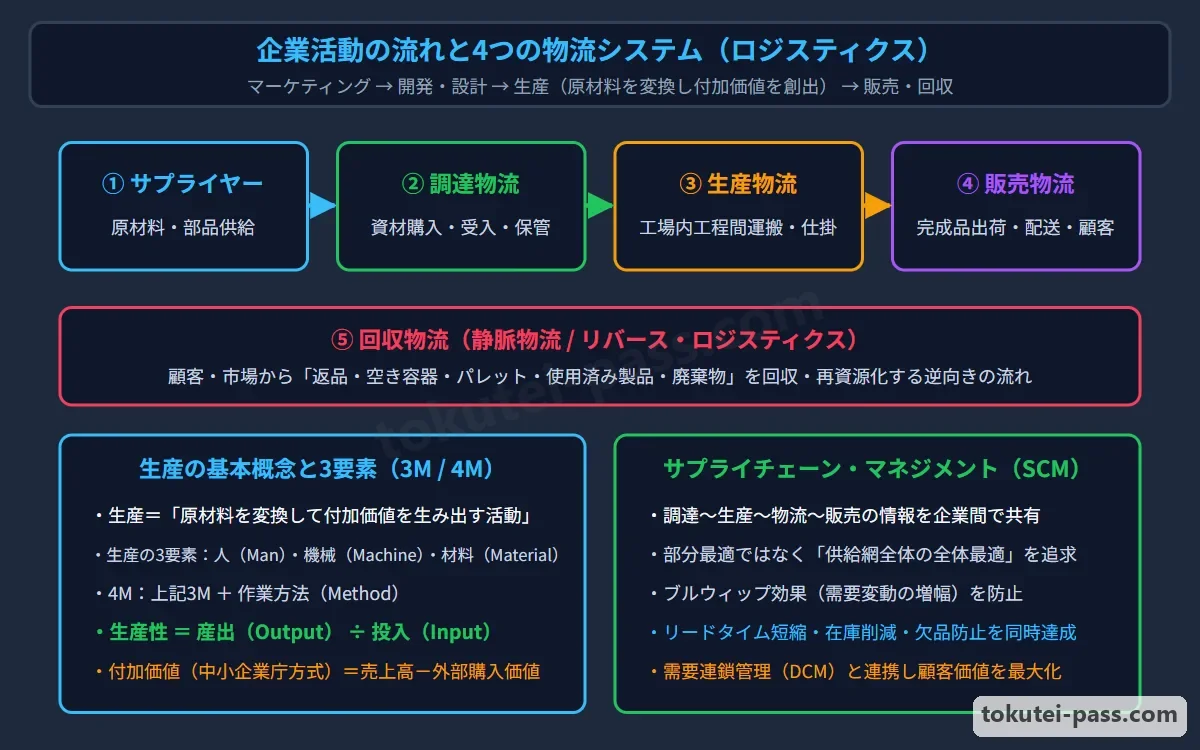
Key points
- 企業活動の基本順序:①製品企画→②設計→③生産準備(工程設計・設備手配)→④製造(量産)→⑤販売。
Basic sequence of corporate activities: (1) Product planning → (2) Design → (3) Production preparation (process design, equipment arrangement) → (4) Manufacturing (mass production) → (5) Sales. - 4つの物流領域:調達物流(部品納入)・生産物流(工場内移動)・販売物流(顧客出荷)・回収物流(静脈物流)。
Four logistics domains: Procurement logistics (parts delivery), Production logistics (in-plant movement), Sales logistics (customer shipment), Recovery logistics (reverse/venous logistics). - マテリアルハンドリング(マテハン)=生産拠点や倉庫内でのモノの移動・積卸し・保管・ピッキングに関わる取扱い技術。
Material Handling (Matehan) = Handling technology for moving, loading/unloading, storing, and picking items within production sites and warehouses.
| Word | Meaning |
|---|---|
| 製品企画・設計・生産準備・量産 | Product planning, Design, Production preparation, Mass production |
| 調達物流・生産物流・販売物流・回収物流 | Procurement logistics, Production logistics, Sales logistics, Recovery logistics |
| マテリアルハンドリング(マテハン) | Material Handling (Matehan) |
3. 生産管理の目的(QCDとPQCDSME)・6つの管理活動とPDCA/SDCA
3. Objectives of Production Management (QCD and PQCDSME), 6 Management Activities, and PDCA / SDCA
生産システムとは、人(Man)・機械設備(Machine)・材料(Material)の3Mと方法(Method)・情報(Information)を投入(インプット)し、変換加工して付加価値の高い製品(アウトプット)を産出する仕組みです。
A production system is a mechanism that takes inputs of the 3Ms—Man, Machine, and Material—along with Method and Information, transforms and processes them, and outputs high-value-added products.
生産管理の1次目的(3大目的)は、顧客が満足する「品質(Quality:Q)」の製品を、低い「原価(Cost:C)」で、約束した「納期(Delivery:D)」および数量どおりに供給する「QCDの最適化」にあります。
The primary objective (three major goals) of production management is QCD optimization: supplying products of Quality (Q) that satisfy customers, at low Cost (C), and according to the promised Delivery date (D) and quantity.
さらに現場では、QCDを支える2次目的として、生産性(Productivity:P)・安全性(Safety:S)・士気(Morale:M)・環境保全(Environment:E)を加えた「PQCDSME」を総合的に高めます。
Furthermore, on the shop floor, as secondary objectives supporting QCD, companies comprehensively enhance PQCDSME by adding Productivity (P), Safety (S), Morale (M), and Environment (E).
また工場の6大管理活動は「工程管理(納期と数量)」「作業管理(標準作業と時間)」「設備管理(保全)」「資材・購買管理」「品質管理」「原価管理」であり、標準を守る維持の「SDCA」と、目標を高める改善の「PDCA」の両輪で回します。
The six major factory management activities are Process control (delivery and quantity), Work management (standard operations and time), Equipment management (maintenance), Materials & purchasing management, Quality control, and Cost control—driven by both SDCA to maintain standards and PDCA to improve targets.
Key points
- 生産管理の1次目的=「品質(Q)・原価(C)・納期(D)」の最適達成(2次目的としてP・S・M・Eが加わる)。
Primary objective of production management = Optimal achievement of Quality (Q), Cost (C), and Delivery (D) (with P, S, M, and E added as secondary objectives). - 6つの管理活動:工程管理・作業管理・設備管理・資材購買管理・品質管理・原価管理。
Six management activities: Process control, Work management, Equipment management, Materials & purchasing management, Quality control, and Cost control. - 日常の標準維持は「SDCA(標準→実施→確認→処置)」、問題解決とレベルアップは「PDCA(計画→実施→確認→処置)」。
Daily standard maintenance uses SDCA (Standardize → Do → Check → Act); problem-solving and level-up improvement use PDCA (Plan → Do → Check → Act).
| Word | Meaning |
|---|---|
| QCD(品質・原価・納期)とPQCDSME | QCD (Quality, Cost, Delivery) and PQCDSME |
| 工程・作業・設備・資材購買・品質・原価管理 | Process, Work, Equipment, Materials/Purchasing, Quality, and Cost Management |
| 維持のSDCAサイクルと改善のPDCAサイクル | SDCA cycle for maintenance and PDCA cycle for improvement |
4. 受注生産と見込生産の特徴比較・BTO/ATO(デカップリングポイント)
4. Make-to-Order vs Make-to-Stock Comparison, and BTO / ATO (Decoupling Point)
注文を受ける時期と生産開始の関係により「見込生産」と「受注生産」に分かれます。「見込生産(MTS)」は、需要予測に基づいてあらかじめ完成品を生産して在庫を持ち、注文が来たら製品在庫から即座に出荷する方式です。
Depending on the timing between receiving customer orders and starting production, systems are classified into Make-to-Stock and Make-to-Order. Make-to-Stock (MTS) produces finished goods in advance based on demand forecasts, holds them in inventory, and ships immediately from finished goods stock when orders arrive.
見込生産は、顧客への納入リードタイムが極めて短く、計画的な大量生産で製造原価を低減できる反面、予測が外れると売れ残り(過剰在庫)や品切れ(機会損失)のリスクを負い、個別の仕様変更には対応できません。
Make-to-Stock offers extremely short delivery lead times to customers and reduces manufacturing cost through planned mass production; however, forecast errors create risks of unsold goods (excess inventory) or stockouts (lost sales opportunities), and it cannot accommodate custom specification changes.
一方、「受注生産(MTO)」は、顧客から正式な注文(仕様・数量・納期)を受けてから設計・資材手配・製造を行う方式です。完成品の売れ残り在庫リスクはなく個別仕様に応じられますが、納入リードタイムが長くなります。
Conversely, Make-to-Order (MTO) begins design, material procurement, and manufacturing only after receiving a formal customer order (specifications, quantity, delivery date). There is no risk of unsold finished goods inventory and custom specifications can be met, but delivery lead time becomes long.
両者の折衷方式が「BTO(Build to Order:受注組立生産/ATO)」です。標準化した共通部品やモジュール(半製品)までは見込生産で在庫しておき、受注後に最終組立だけを行うことで、短納期と多様な仕様対応を両立します。
A hybrid approach combining both is BTO (Build to Order / Assemble to Order: ATO). Standardized common parts and modules (semi-finished subassemblies) are produced to stock based on forecasts, and final assembly is performed after receiving an order—achieving both short delivery times and diverse customization.
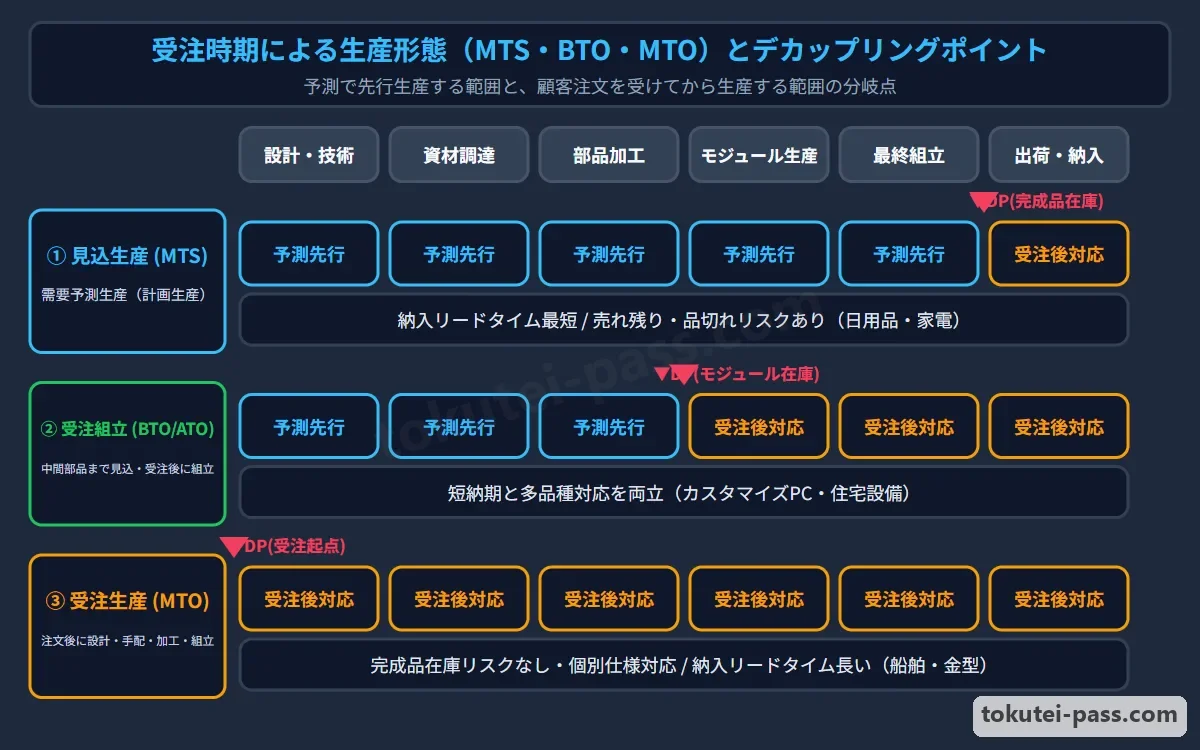
Key points
- 見込生産=需要予測で完成品在庫を持つ(納入リードタイムは短いが、需要予測外れによる過剰在庫リスクがある)。
Make-to-Stock (MTS) = Holds finished goods inventory based on demand forecasts (short delivery lead time, but carries excess inventory risk from forecast errors). - 受注生産=注文確定後に設計・製造を開始する(完成品在庫リスクはないが、納入リードタイムが長く負荷変動が大きい)。
Make-to-Order (MTO) = Starts design and manufacturing after order confirmation (no finished goods inventory risk, but long delivery lead time and large load fluctuations). - BTO(受注組立生産)=共通部品・ユニットを見込生産で在庫(デカップリングポイント)し、受注後に最終組立を行う。
BTO (Build-to-Order) = Holds common parts and units in inventory via forecast production (decoupling point) and performs final assembly after order receipt.
| Word | Meaning |
|---|---|
| 見込生産と受注生産 | Make-to-Stock (MTS) and Make-to-Order (MTO) |
| BTO(受注組立生産)・ATO | BTO (Build to Order) / ATO (Assemble to Order) |
| デカップリングポイント(予測と受注の分岐点) | Decoupling point (boundary between forecast-driven and order-driven stages) |
| 納入リードタイムと在庫リスク | Delivery lead time and inventory risk |
5. 品種と生産量による分類(少種多量・中種中量・多種少量生産)
5. Classification by Product Variety and Volume (Low-Mix High-Volume, Medium-Mix Medium-Volume, High-Mix Low-Volume)
生産形態を「品種の多さ(種類)」と「生産量の多さ」の組み合わせで見ると、①少種多量生産、②中種中量生産、③多種少量生産の3つに分類されます。
Viewed by the combination of product variety and production volume, production types are classified into three categories: (1) Low-mix high-volume production, (2) Medium-mix medium-volume production, and (3) High-mix low-volume production.
「少種多量生産」は、限定された少ない種類の標準品(飲料・日用品・基礎化学品・汎用ネジ等)を大量に造る形態です。専用設備による自動化ラインを組みやすく、作業の標準化と習熟により製品1個あたりの原価を大幅に下げられます。
Low-mix high-volume production manufactures large quantities of a limited variety of standard products (beverages, daily necessities, basic chemicals, standard screws, etc.). Automated lines with dedicated equipment are easy to set up, and operation standardization and learning effects greatly reduce unit cost.
「多種少量生産」は、顧客ごとの多様な仕様の製品(特注産業機械・金型・試作品等)を少ない数量ずつ造る形態です。汎用機械と熟練作業者(多能工)が中心となり、きめ細かい日程管理・進捗管理と段取り替え短縮が課題となります。
High-mix low-volume production manufactures small quantities of diverse custom-specified products per customer (custom industrial machinery, molds/dies, prototypes, etc.). General-purpose machines and skilled multi-functional workers take center stage, making detailed scheduling, progress control, and setup time reduction critical.
「中種中量生産」は両者の中間(工作機械・建設機械・家電製品等)であり、共通部品のモジュール化やグループテクノロジー(GT:類似部品のグループ化加工)によって、多品種でありながら量産効果を引き出す工夫を行います。
Medium-mix medium-volume production lies between the two (machine tools, construction machinery, home appliances, etc.) and uses modularization of common parts and Group Technology (GT: grouping similar parts for processing) to achieve mass-production efficiency despite high product variety.
Key points
- 少種多量生産=見込生産・専用ライン向きで、設備稼働率が高く単価低減に優れるが、需要変化への柔軟性は低い。
Low-mix high-volume = Suited for make-to-stock and dedicated lines; achieves high equipment utilization and low unit cost, but has low flexibility to demand changes. - 多種少量生産=受注生産・汎用設備向きで、仕様変更に柔軟に対応できるが、段取り替えや運搬・停滞が増えやすい。
High-mix low-volume = Suited for make-to-order and general-purpose equipment; flexible to specification changes, but prone to frequent setups, transport, and waiting. - 中種中量生産=部品の共通化(モジュール化)やグループテクノロジー(GT)により、多様性と生産効率を両立する。
Medium-mix medium-volume = Balances product diversity and production efficiency through parts commonality (modularization) and Group Technology (GT).
| Word | Meaning |
|---|---|
| 少種多量生産・中種中量生産・多種少量生産 | Low-mix high-volume, Medium-mix medium-volume, and High-mix low-volume production |
| 専用機械と汎用機械 | Dedicated machinery and General-purpose machinery |
| グループテクノロジー(GT:類似部品の集約) | Group Technology (GT: aggregating similar parts) |
6. 仕事の流し方による分類(個別生産・ロット生産・連続生産)
6. Classification by Work Flow Continuity (Job/Individual Production, Lot Production, Continuous Production)
時期的な仕事の流し方(連続性)によって、生産形態は「個別生産」「ロット生産」「連続生産」の3つに分かれます。「個別生産」は、船舶・大型橋梁・発電プラント・専用金型など、注文ごとに設計が異なる製品を1個(1基)ずつ製作する形態です。
By the temporal continuity of work flow, production is classified into Individual (job) production, Lot (batch) production, and Continuous production. Individual production manufactures products with different designs per order one unit at a time, such as ships, large bridges, power plants, and custom dies.
「ロット生産(断続生産)」は、複数の品種を同一の機械やラインで交互に生産するため、品種ごとにまとまった数量(ロット)を生産しては「段取り替え(金型や治具の交換)」を行い、次の品種へ切り替える方式です。
Lot production (intermittent production) alternates multiple product types on the same machines or lines; it produces a grouped quantity (lot) for one product type, performs a setup change (changing dies or jigs), and switches to the next product type.
ロット生産では、1回のロットサイズを大きくしすぎると段取り替え回数は減るものの仕掛品・完成品在庫が増大し、逆に小ロット化すると在庫やリードタイムは縮まりますが段取り替え頻度が増えるため、段取り時間短縮が鍵となります。
In lot production, making the lot size too large reduces setup frequency but swells work-in-process and finished goods inventories; conversely, small-lot production shortens inventory and lead time but increases setup frequency, making setup time reduction essential.
「連続生産」は、石油精製・製鉄・セメント・飲料・量産家電など、同一品種の製品を長期間にわたって絶え間なく連続的に流し続ける形態であり、工程間のバランス維持と設備の予防保全が最重点となります。
Continuous production continuously flows the same product type without interruption over long periods—such as oil refining, steelmaking, cement, beverages, and mass-produced appliances—where maintaining inter-process balance and preventive equipment maintenance are top priorities.
Key points
- 個別生産=注文ごとに異なる製品を1品ずつ製造(造船・大型プラント・特注金型等)。
Individual production = Manufactures unique products one item at a time per order (shipbuilding, large plants, custom molds/dies, etc.). - ロット生産=同じ設備で「段取り替え」を行いながら、品種ごとに一定のまとまった数量(ロット)単位で反復生産する。
Lot production = Repeats production in fixed batch quantities (lots) per product type while performing setup changes on the same equipment. - 連続生産=少種多量の同一製品を専用設備・ラインで長期間休みなく連続して生産する。
Continuous production = Continuously produces low-mix high-volume identical products without interruption over long periods on dedicated equipment/lines.
| Word | Meaning |
|---|---|
| 個別生産・ロット生産・連続生産 | Individual production, Lot production, Continuous production |
| ロットサイズと段取り替え | Lot size and Setup / Changeover |
| 小ロット化とシングル段取り | Small-lot production and Single-minute Exchange of Die (SMED) |
7. 作業現場の生産方式①(ジョブショップとフローショップ、単一・混合・切替ライン)
7. Shop-Floor Production Methods (1): Job Shop vs Flow Shop, Single-, Mixed-, and Changeover-Model Lines
機械設備の配置(レイアウト)と仕事の流れ方により、現場は「ジョブショップ型」と「フローショップ型」に分かれます。「ジョブショップ型(機能別配置・機種別配置)」は、旋盤職場・フライス盤職場・溶接職場のように同種の機械を1か所に集める方式で、多種少量の個別生産に適します。
By machine layout and work flow, shop floors are divided into Job-shop type and Flow-shop type. A Job-shop layout (functional layout / machine-type layout) groups identical machines together—such as a lathe shop, milling shop, or welding shop—suiting high-mix low-volume individual production.
「フローショップ型(製品別配置・工程別配置)」は、製品の加工・組立順序に従って機械や作業ステーションを一列に並べる方式(ライン生産)で、運搬距離や仕掛品が最小となり少種多量の連続生産に適します。
A Flow-shop layout (product layout / process-sequence layout) arranges machines and workstations in a line according to the product's processing and assembly sequence (line production), minimizing transport distance and work-in-process and suiting low-mix high-volume continuous production.
さらにライン生産は流す品種により3種類に分かれます。1つ目は1種類の製品のみを流し続ける「単一品種ライン(専用ライン)」、2つ目は段取り替えを行ってロット単位で別品種を順番に流す「切替ライン(ロットライン)」です。
Line production is further divided into three types by the variety flowing on the line: first, a Single-model line (dedicated line) that continuously runs only one product type; second, a Changeover line (lot line) that performs setup changes to run different product types sequentially in lots.
3つ目は、基本構造が似た複数のモデル(乗用車の異なるグレード等)を、段取り替えなしで1個ずつ混ぜて同じラインに流す「混合品種ライン(混流ライン)」であり、生産の平準化に大きな効果を発揮します。
Third is a Mixed-model line, which feeds multiple models sharing similar basic structures (such as different passenger car trims) mixed one by one onto the same line without setup changes, delivering powerful results in production leveling (Heijunka).
Key points
- ジョブショップ型(機能別・機種別配置)=同種の汎用機を集約し、多種少量・個別生産に柔軟に対応する。
Job-shop type (functional / machine-type layout) = Groups general-purpose machines of the same kind, flexibly handling high-mix low-volume individual production. - フローショップ型(製品別・工程順配置)=加工順に機械を並べるライン方式で、少種多量生産で運搬と仕掛を最小化する。
Flow-shop type (product / process-sequence layout) = Line method arranging machines in processing order, minimizing transport and WIP in low-mix high-volume production. - ラインの3形態:単一品種ライン(1品種専用)・切替ライン(段取り替えでロット生産)・混合品種ライン(段取り替えなしで複数品種を混流)。
Three line forms: Single-model line (dedicated to 1 item), Changeover line (lot production with setup changes), Mixed-model line (mixing multiple items without setup changes).
| Word | Meaning |
|---|---|
| ジョブショップ型(機能別配置)とフローショップ型(製品別配置) | Job-shop type (functional layout) and Flow-shop type (product layout) |
| 単一品種ライン・切替ライン・混合品種(混流)ライン | Single-model line, Changeover line, Mixed-model line |
| 生産の平準化 | Production leveling (Heijunka) |
8. 作業現場の生産方式②(ライン生産とセル生産の3方式:1人屋台・巡回・分割)
8. Shop-Floor Production Methods (2): Line Production vs 3 Cellular Production Methods (One-Person Stall, Chase/Circuit, Division)
組立現場では、ベルトコンベヤ等で単一工程を細かく分業する「ライン生産方式」に対し、1人または少人数の「多能工」がU字型等に配置した作業台(セル・屋台)で製品の組み立てから検査まで一貫して担う「セル生産方式」が広く活用されています。
In assembly shops, in contrast to Line production which finely divides single processes along a belt conveyor, Cellular production (cell production) is widely used: one or a small team of multi-skilled workers consistently handles assembly through inspection at a U-shaped workbench (cell or stall).
セル生産方式は、多品種少量生産や需要量の変動・設計変更に柔軟に対応でき、コンベヤによる編成ロス(手待ち)がなく、作業者の責任感や完成の達成感(モラール)が高まるメリットがあります。
Cellular production flexibly adapts to high-mix low-volume production, demand volume fluctuations, and design changes, eliminates conveyor line-balancing waiting losses, and boosts worker responsibility and sense of achievement (morale).
セル生産の作業分担には3つの方式があります。①「1人屋台方式」は、1人の多能工が1つのセル内ですべての工程を最初から最後まで1人で組み立てる方式です。
Work allocation in cellular production has three methods: (1) One-person stall method (Hitori-yatai), where a single multi-skilled worker assembles all processes from start to finish alone within one cell.
②「巡回方式(ウサギ追い方式)」は、複数の作業者がそれぞれ製品を持ってU字ラインの最初から最後まで順番に回りながら全工程を完成させる方式です。③「分割方式」は、1つのセル内を複数のゾーンに分け、複数の作業者が数工程ずつ分担してリレーする方式です。
(2) Circuit / Chase method (Rabbit-chasing method), where multiple workers each carry a product and walk sequentially from the start to the end of a U-shaped cell to complete all processes. (3) Division (Subdivided) method, where one cell is divided into zones and multiple workers share a few processes each in a relay.
Key points
- セル生産方式=1人または少人数の多能工が屋台(セル)で複数工程を一貫担当し、品種切替や数量変動に強い。
Cellular production = One or a few multi-skilled workers handle multiple processes end-to-end in a cell (stall), excelling in model changeovers and volume fluctuations. - セル生産の3形態:①1人屋台方式(1人で全工程完結)、②巡回方式(複数人が各自で全工程を巡回)、③分割方式(セル内を複数人で工程分担)。
Three cellular forms: (1) One-person stall method (1 worker completes all processes), (2) Circuit/chase method (multiple workers each circulate through all processes), (3) Division method (multiple workers divide processes within a cell). - ライン生産は少種多量で単能工でも習熟しやすいが、ボトルネック工程に全体の生産速度が制約される。
Line production suits low-mix high-volume and allows single-skilled workers to learn quickly, but overall line speed is constrained by the bottleneck process.
| Word | Meaning |
|---|---|
| ライン生産方式とセル生産方式(屋台生産) | Line production method and Cellular production method (Stall production) |
| 1人屋台方式・巡回方式・分割方式 | One-person stall method, Circuit (rabbit-chasing) method, Division method |
| 多能工とモラール(作業意欲)向上 | Multi-skilled worker and Morale improvement |
試験によく出るポイントと覚え方
Frequent Exam Points and How to Remember Them
第1章(問1〜問4)では、まず「企業活動と4つの物流(調達・生産・販売・回収物流)」および「1次目的(QCD)と2次目的(P・S・M・E)」の定義が問われます。工場内の運搬・荷役を指す「マテリアルハンドリング(マテハン)」も頻出です。
In Chapter 1 (Questions 1 to 4), questions first test definitions of corporate activities, the 4 logistics areas (procurement, production, sales, recovery), and primary objectives (QCD) vs secondary objectives (P, S, M, E). Material Handling (Matehan) referring to in-plant transport and loading also appears frequently.
問2では「見込生産」と「受注生産」の特徴を入れ替えるひっかけが毎回出題されます。「見込生産=納入リードタイムが短い・需要予測と完成品在庫が不可欠」「受注生産=完成品在庫リスクがない・納入リードタイムが長い」を対比して覚えましょう。
In Question 2, a trap swapping the characteristics of Make-to-Stock and Make-to-Order appears on almost every exam. Contrast and memorize: Make-to-Stock = short delivery lead time, requires demand forecasting and finished goods inventory; Make-to-Order = no finished goods inventory risk, long delivery lead time.
また「共通部品・ユニットまでは見込生産し、受注後に最終組立を行うBTO(受注組立生産)」は、短納期と多品種対応を両立する代表方式です。
Also, BTO (Build-to-Order)—producing common parts and modules to stock and performing final assembly after order receipt—is the representative method balancing short delivery times and multi-product variety.
問3〜問4では、「多種少量=個別生産=ジョブショップ(機能別配置)・セル生産」「少種多量=連続生産=フローショップ(製品別配置)・ライン生産」の対応、およびセル生産の「1人屋台・巡回・分割方式」の区別を確実に押さえてください。
In Questions 3 to 4, firmly master the correspondence: High-mix low-volume = Individual production = Job shop (functional layout) & Cellular production; Low-mix high-volume = Continuous production = Flow shop (product layout) & Line production; plus the distinction among the 3 cellular methods (one-person stall, circuit, division).
Key points
- 見込生産(予測生産・短納期・在庫リスクあり)vs 受注生産(注文後生産・長納期・製品在庫なし)vs BTO(部品見込+受注後組立)。
Make-to-Stock (forecast-based, short lead time, inventory risk) vs Make-to-Order (post-order production, long lead time, no product stock) vs BTO (parts to stock + post-order assembly). - 多種少量・個別生産=汎用機・ジョブショップ型(機能別配置)/少種多量・連続生産=専用機・フローショップ型(製品別配置)。
High-mix low-volume & individual = General-purpose machines, Job-shop (functional layout) / Low-mix high-volume & continuous = Dedicated machines, Flow-shop (product layout). - セル生産(多能工による1人屋台・巡回・分割方式)vs ライン生産(単一品種・切替・混合品種[混流]ライン)。
Cellular production (multi-skilled workers in one-person stall, circuit, or division method) vs Line production (single-model, changeover, or mixed-model line).
| Word | Meaning |
|---|---|
| 見込生産・受注生産・BTOの比較 | Comparison of Make-to-Stock, Make-to-Order, and BTO |
| ジョブショップ型とフローショップ型 | Job-shop type and Flow-shop type |
| セル生産の3方式と混流ライン | Three Cellular Production methods and Mixed-model line |
Production Systems & Types
Practice this chapter in the appOfficial references
- 中央職業能力開発協会(JAVADA) ビジネス・キャリア検定試験 3級 生産管理プランニング 試験範囲 — https://www.javada.or.jp/jigyou/gino/business/subject.html
- 中央職業能力開発協会 編『ビジネス・キャリア検定試験 標準テキスト【専門知識】生産管理プランニング 3級〔第4版〕』 — https://www.javada.or.jp/jigyou/gino/business/text.html